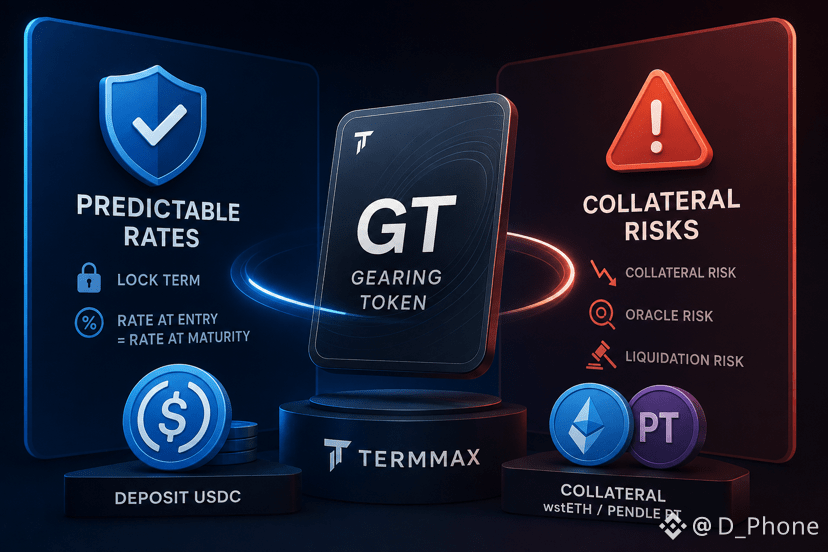
"Predictable" is the word TermMax leans on hardest, and it earns it in one specific place. Deposit USDC into one of TermMax's fixed pools, lock a term, and the rate at entry is the rate at maturity. No accrual math, no rate resets, no refreshing a dashboard at 2am to see what the market did. For a lender, that part of the pitch holds up completely.
Where it gets murkier is the borrowing side, specifically inside the Gearing Token. A GT is TermMax's NFT wrapper around a leveraged position: collateral locked, debt owed, interest fixed the moment it mints. Fixed interest is real. Fixed safety is a different claim, and the two get blurred whenever "removing uncertainty" gets used as a blanket phrase for the whole protocol.
A GT is still an over-collateralized loan underneath the wrapper. If the value of the locked collateral, wstETH or a Pendle PT token for instance, falls far enough against the debt, that position gets liquidated like any other DeFi loan. TermMax's own risk documentation says this outright: collateral liquidation risk, oracle risk tied to its Chainlink and RedStone feeds, a physical delivery mechanism built to soften shortfalls rather than erase them. I'd rather see a project write that down plainly than sell a landing page implying fixed rate means fixed outcome.
The accurate version of the pitch is narrower than the marketing version. TermMax removes interest rate volatility from a position. It does not remove collateral risk, oracle risk, or liquidation risk, and it never claimed to on the documentation side. Anyone opening a GT for leverage should read the risk page before the landing page.
That's still a real advance, not a knock against it. Rate certainty is a problem traditional finance solved a century ago through zero coupon bonds, and DeFi hadn't caught up until protocols like this one. TermMax just isn't selling what some readers assume it's selling, and the difference is worth being precise about
@TermMax #TermMax $VELVET $BTW $PORTAL
Where it gets murkier is the borrowing side, specifically inside the Gearing Token. A GT is TermMax's NFT wrapper around a leveraged position: collateral locked, debt owed, interest fixed the moment it mints. Fixed interest is real. Fixed safety is a different claim, and the two get blurred whenever "removing uncertainty" gets used as a blanket phrase for the whole protocol.
A GT is still an over-collateralized loan underneath the wrapper. If the value of the locked collateral, wstETH or a Pendle PT token for instance, falls far enough against the debt, that position gets liquidated like any other DeFi loan. TermMax's own risk documentation says this outright: collateral liquidation risk, oracle risk tied to its Chainlink and RedStone feeds, a physical delivery mechanism built to soften shortfalls rather than erase them. I'd rather see a project write that down plainly than sell a landing page implying fixed rate means fixed outcome.
The accurate version of the pitch is narrower than the marketing version. TermMax removes interest rate volatility from a position. It does not remove collateral risk, oracle risk, or liquidation risk, and it never claimed to on the documentation side. Anyone opening a GT for leverage should read the risk page before the landing page.
That's still a real advance, not a knock against it. Rate certainty is a problem traditional finance solved a century ago through zero coupon bonds, and DeFi hadn't caught up until protocols like this one. TermMax just isn't selling what some readers assume it's selling, and the difference is worth being precise about
@TermMax #TermMax $VELVET $BTW $PORTAL