I used to think “tokenization” was the endgame for stocks and bonds on-chain.
Then I looked closer at what Dusk is actually building, and the difference became clear.
Most RWA projects still rely on a wrapper.
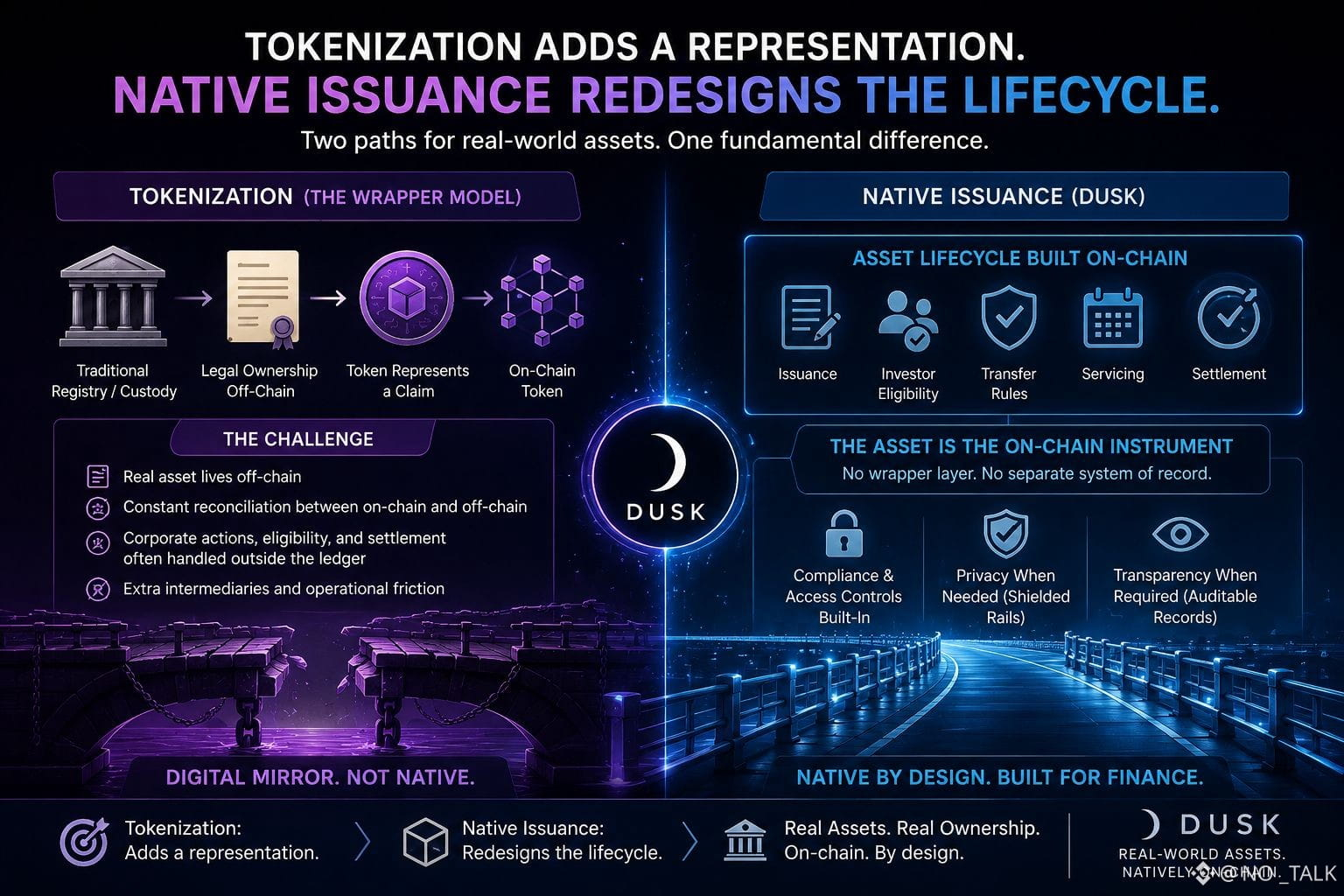
A real stock or bond lives in a traditional registry or custody system. Someone creates a token that represents a claim on that asset. The blockchain becomes a digital mirror, and you still need constant reconciliation between the on chain token and the off-chain record.
Dusk is aiming for something different: native issuance.
Tokenization adds a representation. Native issuance redesigns the lifecycle.
With native issuance, the asset and its lifecycle can be designed directly around the on-chain ledger from day one. Issuance, transfer rules, investor eligibility, servicing and settlement can sit closer to the asset itself instead of living in separate offline systems. The architecture can reduce the need to maintain a separate off-chain asset record and the reconciliation around it, depending on the legal structure.
That is what “removing the wrapper layer” means in practice for stocks and bonds. Compliance rules, access controls and settlement finality can be built into the workflow rather than bolted on afterwards. Privacy remains available when needed through Dusk’s shielded rails, while transparent records stay accessible for regulators or counterparties.
Of course the full vision still depends on regulation, licensed venues and real adoption. But the architectural choice is different from most RWA chains I have seen.
Curious how many other projects are actually aiming to redesign the lifecycle rather than just wrapping existing securities. @Dusk #dusk $DUSK
Then I looked closer at what Dusk is actually building, and the difference became clear.
Most RWA projects still rely on a wrapper.
A real stock or bond lives in a traditional registry or custody system. Someone creates a token that represents a claim on that asset. The blockchain becomes a digital mirror, and you still need constant reconciliation between the on chain token and the off-chain record.
Dusk is aiming for something different: native issuance.
Tokenization adds a representation. Native issuance redesigns the lifecycle.
With native issuance, the asset and its lifecycle can be designed directly around the on-chain ledger from day one. Issuance, transfer rules, investor eligibility, servicing and settlement can sit closer to the asset itself instead of living in separate offline systems. The architecture can reduce the need to maintain a separate off-chain asset record and the reconciliation around it, depending on the legal structure.
That is what “removing the wrapper layer” means in practice for stocks and bonds. Compliance rules, access controls and settlement finality can be built into the workflow rather than bolted on afterwards. Privacy remains available when needed through Dusk’s shielded rails, while transparent records stay accessible for regulators or counterparties.
Of course the full vision still depends on regulation, licensed venues and real adoption. But the architectural choice is different from most RWA chains I have seen.
Curious how many other projects are actually aiming to redesign the lifecycle rather than just wrapping existing securities. @Dusk #dusk $DUSK