I still think the hardest problem in putting financial markets onchain isn’t tokenization. It’s deciding what should actually be visible.
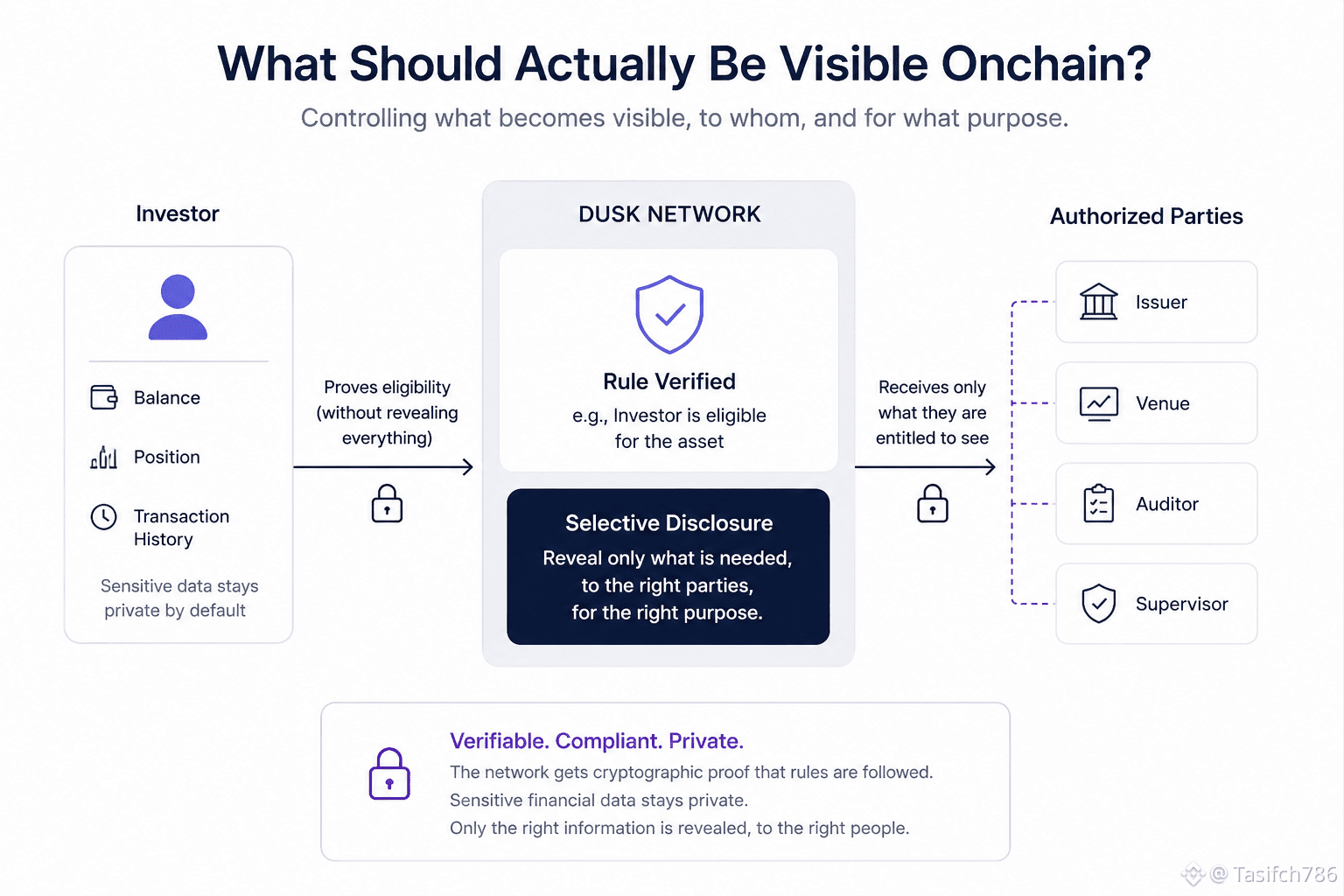
The more I looked into @Dusk , the more I noticed something interesting: its privacy approach seems less about making financial activity invisible and more about controlling what becomes visible, to whom, and for what purpose.
That sounds like a small distinction, but for regulated finance, it changes the problem completely.
Take a simple example. An institution may need to prove an investor is eligible for a regulated asset. The network needs evidence that the rule was satisfied. But why should every other participant also see that investor’s balance, position, or transaction history?
What I found particularly interesting in Dusk’s documentation is this idea of deciding what should remain confidential and what can be selectively disclosed when required.
That philosophy also shows up in the technology. DuskEVM provides a familiar Solidity/EVM environment, while Hedger supports confidential EVM workflows using homomorphic encryption and zero-knowledge proofs.
So privacy doesn’t have to mean hiding everything. It can become something an application uses when needed, while still keeping execution verifiable.
The tension I keep coming back to is this:
Regulated markets need transparency for oversight, but too much transparency can expose sensitive financial information.
Maybe the real challenge isn’t choosing between privacy and transparency.
It’s building a system that knows the difference.
Can a blockchain prove that the right rules were followed while revealing only what the right people are actually entitled to see?
$DUSK #dusk
The more I looked into @Dusk , the more I noticed something interesting: its privacy approach seems less about making financial activity invisible and more about controlling what becomes visible, to whom, and for what purpose.
That sounds like a small distinction, but for regulated finance, it changes the problem completely.
Take a simple example. An institution may need to prove an investor is eligible for a regulated asset. The network needs evidence that the rule was satisfied. But why should every other participant also see that investor’s balance, position, or transaction history?
What I found particularly interesting in Dusk’s documentation is this idea of deciding what should remain confidential and what can be selectively disclosed when required.
That philosophy also shows up in the technology. DuskEVM provides a familiar Solidity/EVM environment, while Hedger supports confidential EVM workflows using homomorphic encryption and zero-knowledge proofs.
So privacy doesn’t have to mean hiding everything. It can become something an application uses when needed, while still keeping execution verifiable.
The tension I keep coming back to is this:
Regulated markets need transparency for oversight, but too much transparency can expose sensitive financial information.
Maybe the real challenge isn’t choosing between privacy and transparency.
It’s building a system that knows the difference.
Can a blockchain prove that the right rules were followed while revealing only what the right people are actually entitled to see?
$DUSK #dusk