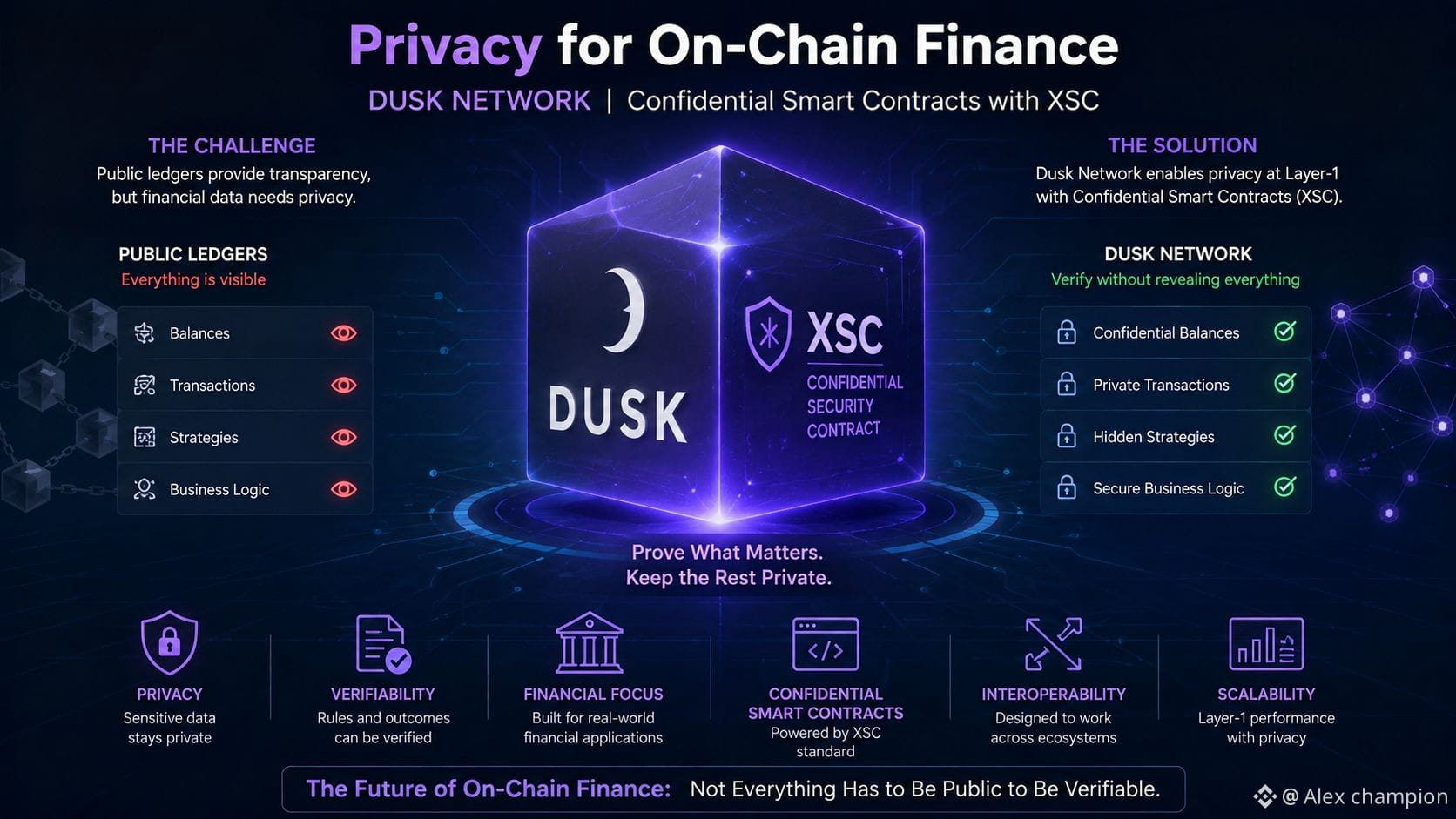
I keep noticing how crypto narratives change with every market cycle, from faster blockchains and cheaper transactions to AI, real-world assets, and more sophisticated financial products. Yet one problem keeps becoming more relevant as blockchain adoption grows: privacy. Public ledgers make verification easier, but financial activity often requires information that should not be visible to everyone. That is what made me look more closely at Dusk Network. What caught my attention is that Dusk approaches this issue at the Layer-1 level, focusing on financial applications and supporting confidential smart contracts through its Confidential Security Contract, or XSC, standard. I started thinking about the difference between simply hiding transactions and building applications where sensitive information can remain private while important rules can still be verified. That distinction could matter for businesses and financial users who want blockchain infrastructure without exposing every balance, transaction, or piece of business logic. At the same time, I wonder how Dusk will handle the difficult trade-offs around compliance, interoperability, scalability, and developer complexity. Privacy is useful, but it also has to work within systems that still need accountability and verification. What interests me is whether confidential smart contracts can move beyond being a specialized idea and become practical infrastructure for on-chain finance. If more financial activity eventually moves onto public networks, will transparency still mean revealing everything, or could the better model be proving what matters while keeping the rest private?
@Dusk #dusk $DUSK
@Dusk #dusk $DUSK