What if institutions didn’t have to choose between privacy and transparency on chain?
That question kept coming up while I was looking into Dusk. Most blockchains force a trade off either everything is public, or privacy comes at the cost of regulatory headaches. What caught my attention is that Dusk puts two different transaction models on the same chain and lets you switch between them without leaving the network.
Phoenix = Privacy
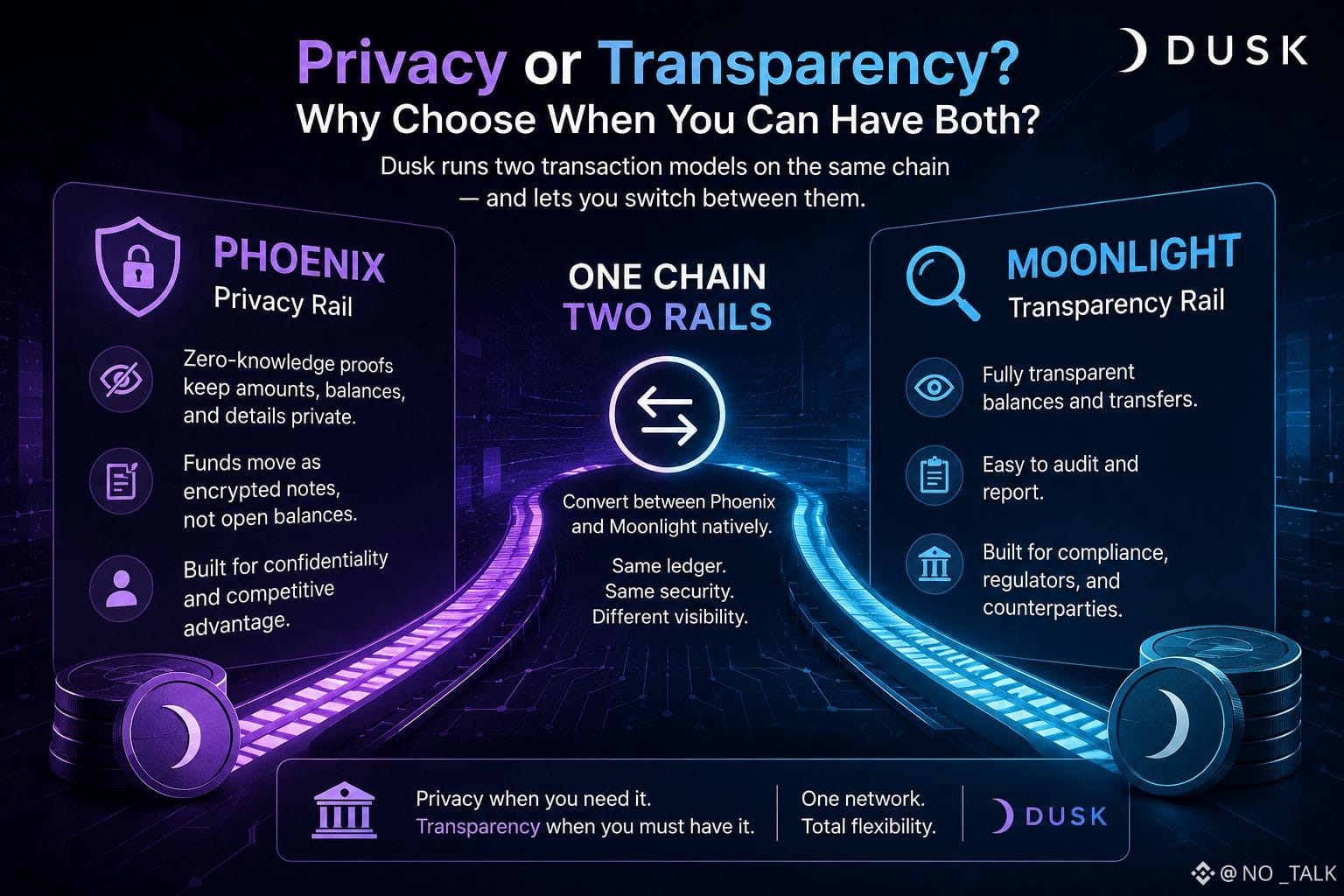
This is the privacy rail. It uses zero knowledge proofs so amounts, balances, and transaction details can stay hidden from public view. Funds move as encrypted notes rather than open account balances.(Source: DuskDS Transaction Models)
Moonlight = Transparency
This is the open rail. Balances and transfers are fully visible and easy to audit closer to a traditional account model. Useful when you need clear records for compliance or counterparties.
The practical part is that you can convert funds between the two models on the same ledger. Need privacy for a sensitive position? Use Phoenix. Need to show a transparent record to a regulator or auditor? Move the same value into Moonlight. No external bridges or separate privacy layers required.
Why this matters for institutions:
A fund or trading desk may want its positions private from competitors, yet still need clean, auditable records for regulators or settlement counterparties. Being able to choose the level of visibility depending on the situation removes a real operational friction.
The more I looked into Dusk, the more I realized the interesting part isn’t simply privacy. It’s the ability to dial visibility up or down while staying on the same chain.
That’s why Dusk’s approach stands out to me: privacy isn’t treated as the opposite of compliance. It becomes something you can use when needed, while transparency remains available when required.
Would you rather keep every on-chain move private by default, or have the flexibility to switch between the two depending on the context? @Dusk #dusk $DUSK
That question kept coming up while I was looking into Dusk. Most blockchains force a trade off either everything is public, or privacy comes at the cost of regulatory headaches. What caught my attention is that Dusk puts two different transaction models on the same chain and lets you switch between them without leaving the network.
Phoenix = Privacy
This is the privacy rail. It uses zero knowledge proofs so amounts, balances, and transaction details can stay hidden from public view. Funds move as encrypted notes rather than open account balances.(Source: DuskDS Transaction Models)
Moonlight = Transparency
This is the open rail. Balances and transfers are fully visible and easy to audit closer to a traditional account model. Useful when you need clear records for compliance or counterparties.
The practical part is that you can convert funds between the two models on the same ledger. Need privacy for a sensitive position? Use Phoenix. Need to show a transparent record to a regulator or auditor? Move the same value into Moonlight. No external bridges or separate privacy layers required.
Why this matters for institutions:
A fund or trading desk may want its positions private from competitors, yet still need clean, auditable records for regulators or settlement counterparties. Being able to choose the level of visibility depending on the situation removes a real operational friction.
The more I looked into Dusk, the more I realized the interesting part isn’t simply privacy. It’s the ability to dial visibility up or down while staying on the same chain.
That’s why Dusk’s approach stands out to me: privacy isn’t treated as the opposite of compliance. It becomes something you can use when needed, while transparency remains available when required.
Would you rather keep every on-chain move private by default, or have the flexibility to switch between the two depending on the context? @Dusk #dusk $DUSK