

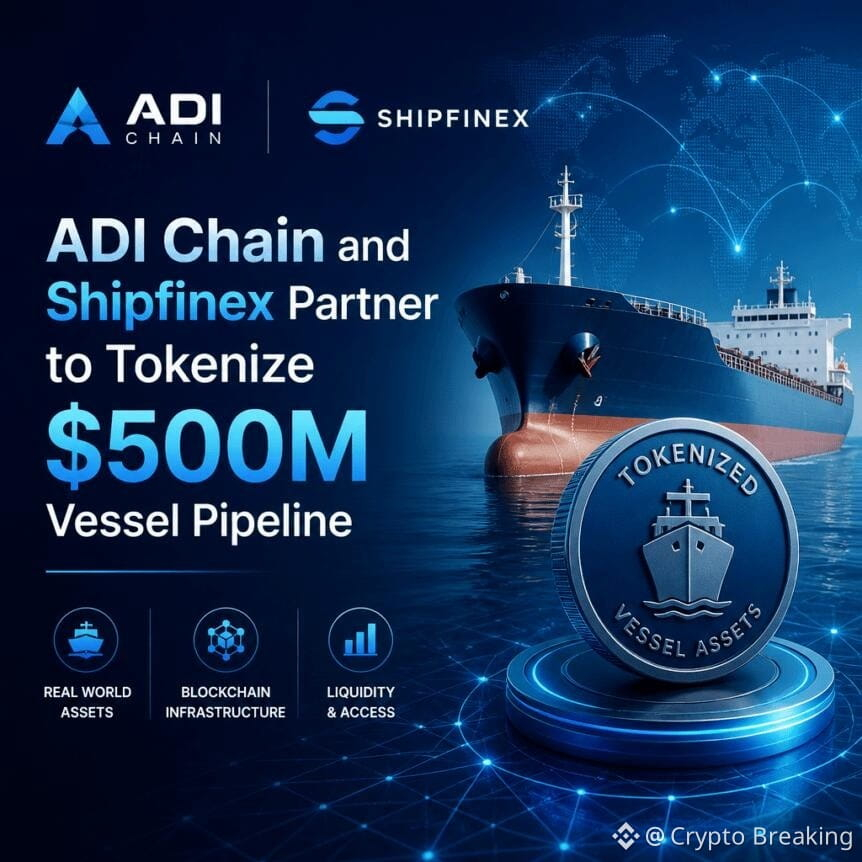
A Dubai-based maritime tokenization platform, Shipfinex, has teamed up with Abu Dhabi blockchain network ADI Chain to test how vessel-linked assets could be represented and financed on-chain. The partners say they are tokenizing a pipeline of roughly 35 vessels valued at about $500 million, aiming to create additional funding options for shipowners.
The concept centers on placing the vessels into separate special-purpose vehicles (SPVs). Tokens would then be issued to reflect economic exposure to each ship—potentially structured as vessel-backed credit, charter-related income, or other rights tied to the underlying assets. ADI Chain is expected to handle the distribution and settlement layer, with primary allocations and distributions planned to use stablecoins denominated in UAE dirham, US dollars, and other currencies.
Key takeaways
Shipfinex and ADI Chain are piloting tokenization of a vessel pipeline worth about $500 million across around 35 ships.
The structure uses separate SPVs per vessel, with tokens representing ship-specific economic interests such as credit or charter income.
ADI Chain will provide the stablecoin-oriented distribution and settlement infrastructure for the pilot.
The project is still in an operational readiness stage, with no Maritime Asset Tokens publicly issued yet and the regulated issuance route still being finalized.
The announcement aligns with broader growth forecasts for tokenized real-world assets (RWAs), including Standard Chartered’s estimate that the sector could reach $4 trillion by end-2028.
How the pilot is structured: SPVs and ship-linked tokens
Tokenizing shipping assets is notoriously complex, largely because the industry is fragmented and ship-level cash flows can vary widely depending on charter terms, routes, and financing arrangements. Shipfinex’s approach, as described in the announcement, attempts to translate that complexity into a modular on-chain wrapper: each vessel is moved into its own SPV, and tokens are intended to map to the economics of that specific vehicle.
That could matter for investors and lenders because it potentially enables more granular exposure than traditional fund structures—at least in theory—letting market participants choose how they want to participate in a given ship’s revenue stream or credit profile. The partners have also framed the tokens as potentially representing vessel-backed credit, charter-linked income, or other interests, suggesting room for multiple payoff designs depending on the underlying deal economics.
Stablecoin settlement: why ADI Chain’s role matters
ADI Chain, based in Abu Dhabi, is described as the partner providing distribution and settlement infrastructure. The planned use of currency-denominated stablecoins—specifically UAE dirham- and US dollar-linked assets, plus additional denominations—signals that the settlement model is being built to reduce friction in cross-currency payments, which is a common challenge in international shipping finance.
For market participants, stablecoin settlement can also influence how quickly transactions clear and how tokenized positions can be serviced operationally. Even so, the project’s success will likely depend on the operational details of issuance, custody, and investor onboarding, especially given the regulatory process the partners say remains unfinished.
Still in a pilot: issuance route not finalized
While the partnership outlines a significant vessel pipeline, it is important that the project is not yet live in terms of publicly issued tokens. The arrangement is described as being in a pilot and operational-readiness phase. The partners state that Maritime Asset Tokens have not been publicly issued and that the regulated issuance pathway is still being finalized.
This staging matters because tokenization efforts in RWAs can fail at different points: legal structuring, regulatory approvals, or the practical ability to support ongoing distributions and compliance. By highlighting that the regulated issuance route is still under development, Shipfinex and ADI Chain appear to be treating the first phase as a test of readiness rather than an immediate launch of investable tokens.
Investors watching similar initiatives may therefore want to track what changes next—particularly whether the pilot culminates in a formally approved issuance structure, and how ongoing payments tied to charter activity or credit terms are operationalized.
RWA tokenization momentum: from shipping to broader forecasts
The shipping pilot comes as tokenized RWAs continue to attract attention across traditional finance and crypto-native infrastructure. RWA.xyz data cited in the report indicates that assets tracked on its platform totaled about $38.1 billion as of Aug. 9. Within that figure, US Treasury debt accounts for roughly $16.2 billion and commodities about $4.9 billion.
Standard Chartered’s outlook also points to continued expansion. In a report released Monday, the bank forecast that tokenized RWAs could reach $4 trillion by the end of 2028, according to Geoff Kendrick, the global head of digital asset research at the bank. The scale of that projection suggests that the market is expected to grow beyond early niches—though it also underlines the difference between long-term forecasts and near-term, pilot-stage delivery.
In shipping specifically, the scale remains small relative to the total addressable market. The announcement cites Clarksons Research data valuing the world fleet and orderbook at about $2.1 trillion at the start of 2026. Compared with that estimate, the $500 million vessel pipeline represents a limited slice—meaning this pilot is likely best viewed as a proof-of-process and market test rather than a near-term transformation of shipping finance.
Still, even incremental moves can be significant in RWAs if they demonstrate repeatable mechanics: asset segregation, token-to-cashflow mapping, stablecoin-based settlement, and the ability to maintain compliance over time. That is precisely where pilots tend to earn or lose momentum.
For readers, the key next indicators to watch are whether Shipfinex and ADI Chain progress from operational readiness to a clearly defined regulated issuance route, and how they handle the practicalities of ongoing distributions tied to ship-level economics—especially once any tokens transition from closed testing to broader market participation.
This article was originally published as ADI Chain and Shipfinex Partner to Tokenize $500M Vessel Pipeline on Crypto Breaking News – your trusted source for crypto news, Bitcoin news, and blockchain updates.