

@Walrus 🦭/acc Trust is the invisible layer beneath every “store this file” click. With traditional cloud storage, the deal is straightforward: you hand your data to a provider and count on their people, policies, and contracts to keep it safe and available. When everything runs smoothly, it barely registers—and honestly, that kind of forgettable reliability is the goal. But boring has become harder to assume. Data sets keep growing, AI workflows pull from shared buckets at odd hours, and the blast radius of a storage incident now reaches roadmaps, compliance, and customer trust.
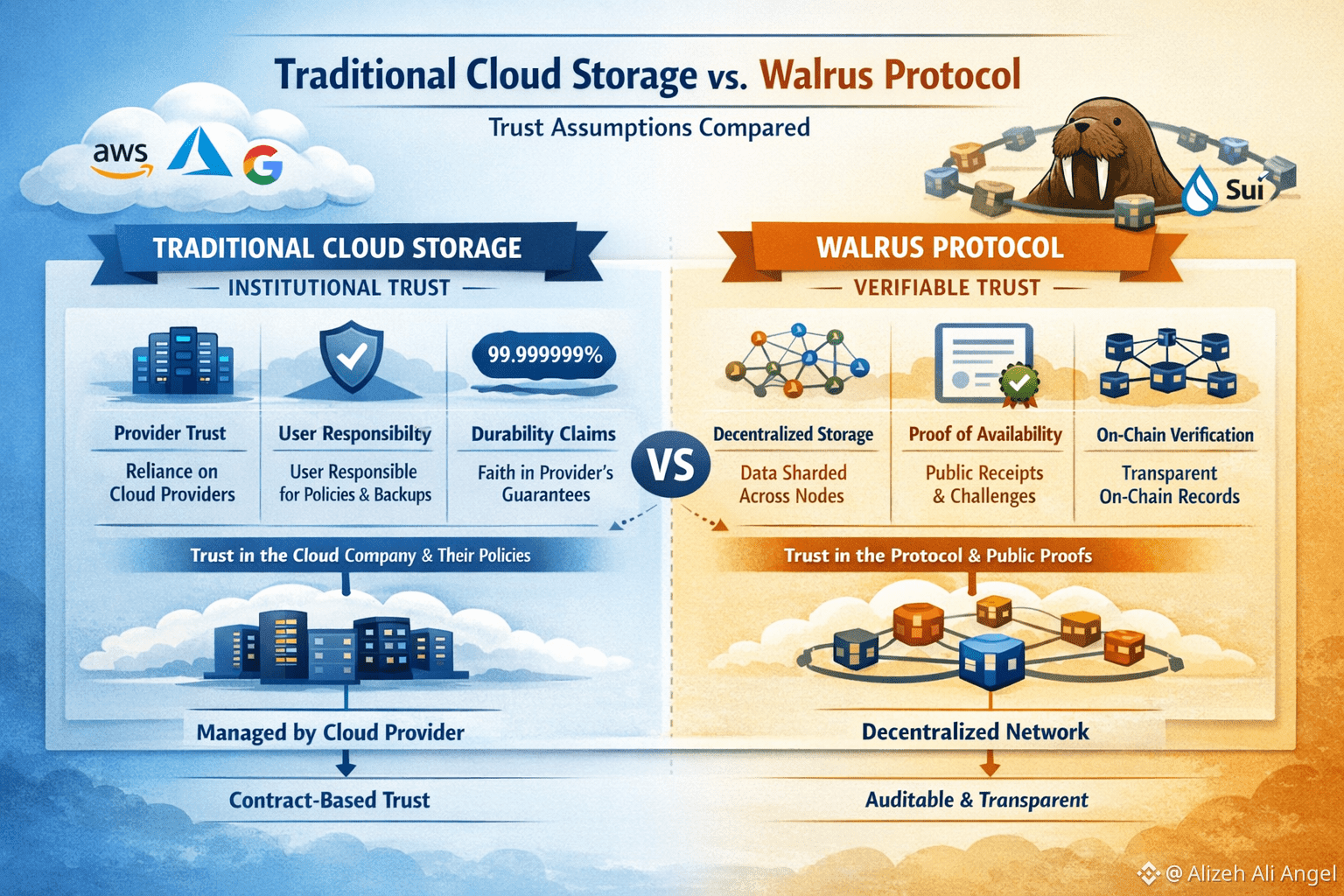
In the big clouds, the trust assumptions are mostly institutional. Amazon S3 is designed for 99.999999999% annual durability, and Google Cloud Storage describes the same “11 nines” durability target, achieved by splitting data into redundant pieces and placing them across availability zones. Microsoft’s Azure Storage documentation makes similar durability claims for certain redundancy options. Those figures reflect serious engineering, yet the leap of faith is still human: you trust the provider to implement it correctly and to explain failures when they happen.
Cloud providers also frame trust as a shared contract. AWS and Azure both describe a shared responsibility model: they secure the underlying cloud, while you remain responsible for identity, access rules, and how data is handled inside your account. Google’s durability guidance is blunt that human error—especially accidental deletion—can dominate real-world risk, and it points customers toward guardrails like checksums, versioning, and backups. That reality is why reliability conversations often turn into policy and backup conversations.
Walrus starts from a different instinct: reduce reliance on any single operator by turning storage into a protocol with public receipts. In Walrus, large files are treated as blobs, encoded into many pieces using Red Stuff, and distributed across a permissionless set of storage nodes. The Sui blockchain is used to publish certificates and coordinate timing so anyone can verify what the system claims happened. If cloud trust is institutional, Walrus tries to make trust more legible, by publishing receipts that outsiders can verify without a private relationship.
The centerpiece is Proof of Availability. Walrus describes an on-chain certificate that marks the start of storage service for a blob, created once enough storage nodes acknowledge they received and validated their assigned pieces. After that first receipt, the protocol leans on ongoing checks. The Walrus paper describes storage challenges designed to make it harder for nodes to earn rewards without actually keeping data, even when networks are asynchronous and delays could otherwise be exploited. In plain terms, the system is trying to turn “I promise I stored it” into “here’s evidence I’m still storing it.”
#Walrus doesn’t delete trust; it relocates it. You now depend on the protocol’s economics, the chain staying live enough to post and read certificates, and the correctness of the software that implements encoding, recovery, and challenges. You also have to be clear-eyed about what Proof of Availability is and isn’t. It speaks to whether data can be retrieved, not whether it stays private. If confidentiality matters, you still need encryption and careful key management above the protocol.
This contrast is trending because systems are increasingly multi-party by default. On-chain apps want shared data that doesn’t hinge on one company’s promise, and developers building rollups and modular chains treat data availability as a first-class dependency. Outside crypto, AI teams keep circling a similar question in plain language: can we prove where a dataset came from and reproduce results later, even after people and vendors change? The likely end state is a mix. For predictable operations and a vendor you can hold accountable, the cloud still matters. For shared data where neutrality matters, Walrus-style receipts and challenges can be compelling. The hard part is admitting what you assume—and choosing what you can actually check.

