Why is everyone talking about $BABY while so few people are actually testing the vault that gives the story real substance?
The problem is simple: most attention goes to price, staking rewards, and token narratives, while the Trustless Bitcoin Vault is where Babylon’s design becomes tangible. Instead of wrapping BTC, bridging it or handing it to a custodian, the vault keeps Bitcoin locked on its own chain under pre agreed spending conditions. That sounds smooth until you use it and realize trustless does not mean instant.
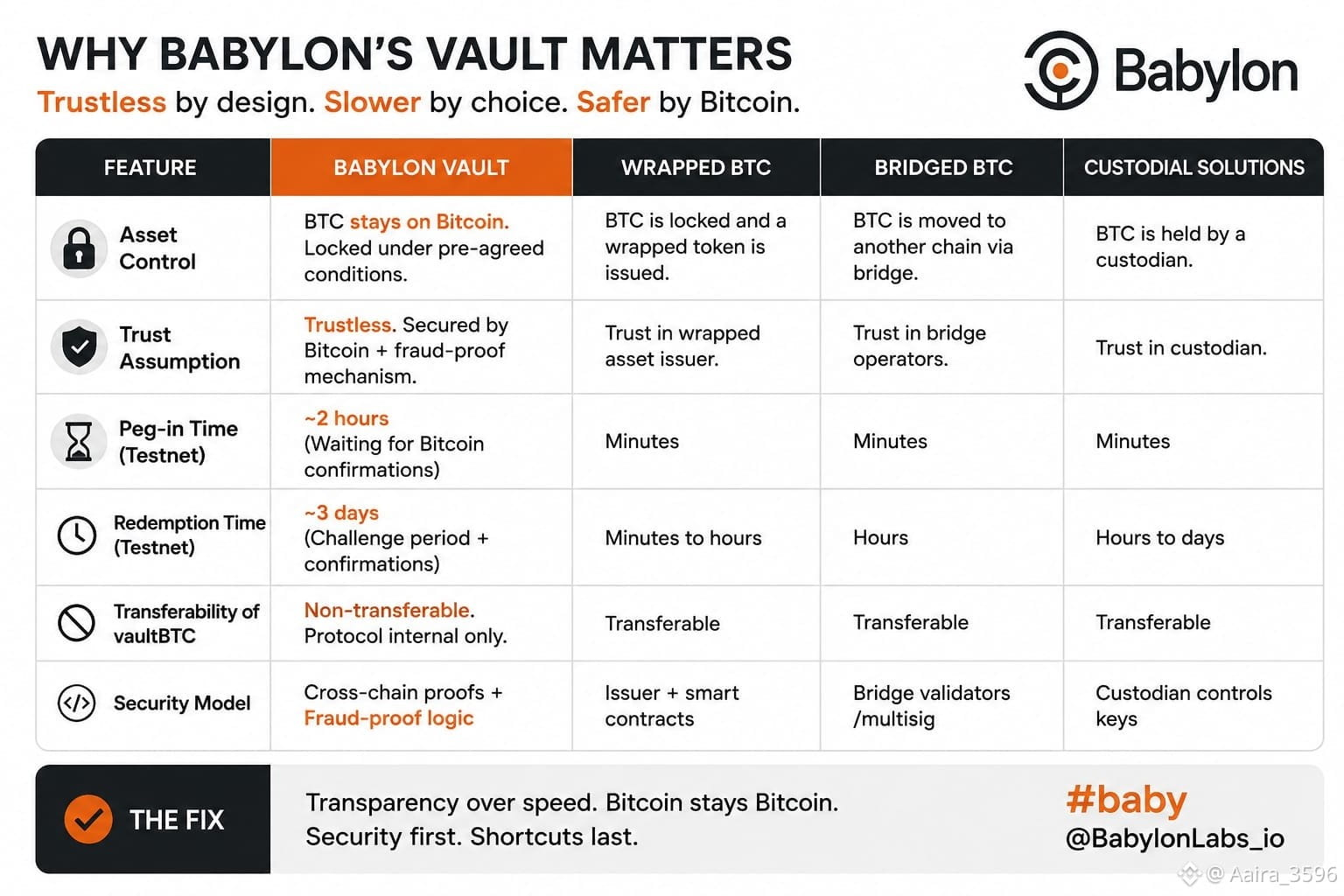
On the public testnet, the peg-in can take around two hours because the system waits for Bitcoin confirmations. Redemption is even slower, with a challenge period of roughly three days before funds complete the journey. At first, that delay feels frustrating. You lock BTC, expect to borrow quickly, and start wondering whether something has failed. In reality, the waiting is part of the security model, not a broken feature.
The fix is not to hide the delay or pretend native Bitcoin can move like a fast bridge. The fix is to make the process transparent: BTC stays on Bitcoin, vaultBTC remains internal and non-transferable, and the protocol uses cross-chain proofs plus fraud-proof logic rather than trusting a wrapped asset issuer.
Testing it changed my view. The vault feels less like tapping a payment app and more like placing something valuable inside a security box with strict withdrawal rules. Slower, yes—but deliberately slower.
So are people chasing $BABY because they understand the infrastructure, or because they have not tested the part that actually matters?
#baby @BabylonLabs_io
The problem is simple: most attention goes to price, staking rewards, and token narratives, while the Trustless Bitcoin Vault is where Babylon’s design becomes tangible. Instead of wrapping BTC, bridging it or handing it to a custodian, the vault keeps Bitcoin locked on its own chain under pre agreed spending conditions. That sounds smooth until you use it and realize trustless does not mean instant.
On the public testnet, the peg-in can take around two hours because the system waits for Bitcoin confirmations. Redemption is even slower, with a challenge period of roughly three days before funds complete the journey. At first, that delay feels frustrating. You lock BTC, expect to borrow quickly, and start wondering whether something has failed. In reality, the waiting is part of the security model, not a broken feature.
The fix is not to hide the delay or pretend native Bitcoin can move like a fast bridge. The fix is to make the process transparent: BTC stays on Bitcoin, vaultBTC remains internal and non-transferable, and the protocol uses cross-chain proofs plus fraud-proof logic rather than trusting a wrapped asset issuer.
Testing it changed my view. The vault feels less like tapping a payment app and more like placing something valuable inside a security box with strict withdrawal rules. Slower, yes—but deliberately slower.
So are people chasing $BABY because they understand the infrastructure, or because they have not tested the part that actually matters?
#baby @BabylonLabs_io