i once left my house key with someone because it seemed easier than carrying it myself. Nothing went wrong, but I knew access to my own home depended on another person. That is how most Bitcoin-backed DeFi still feels.
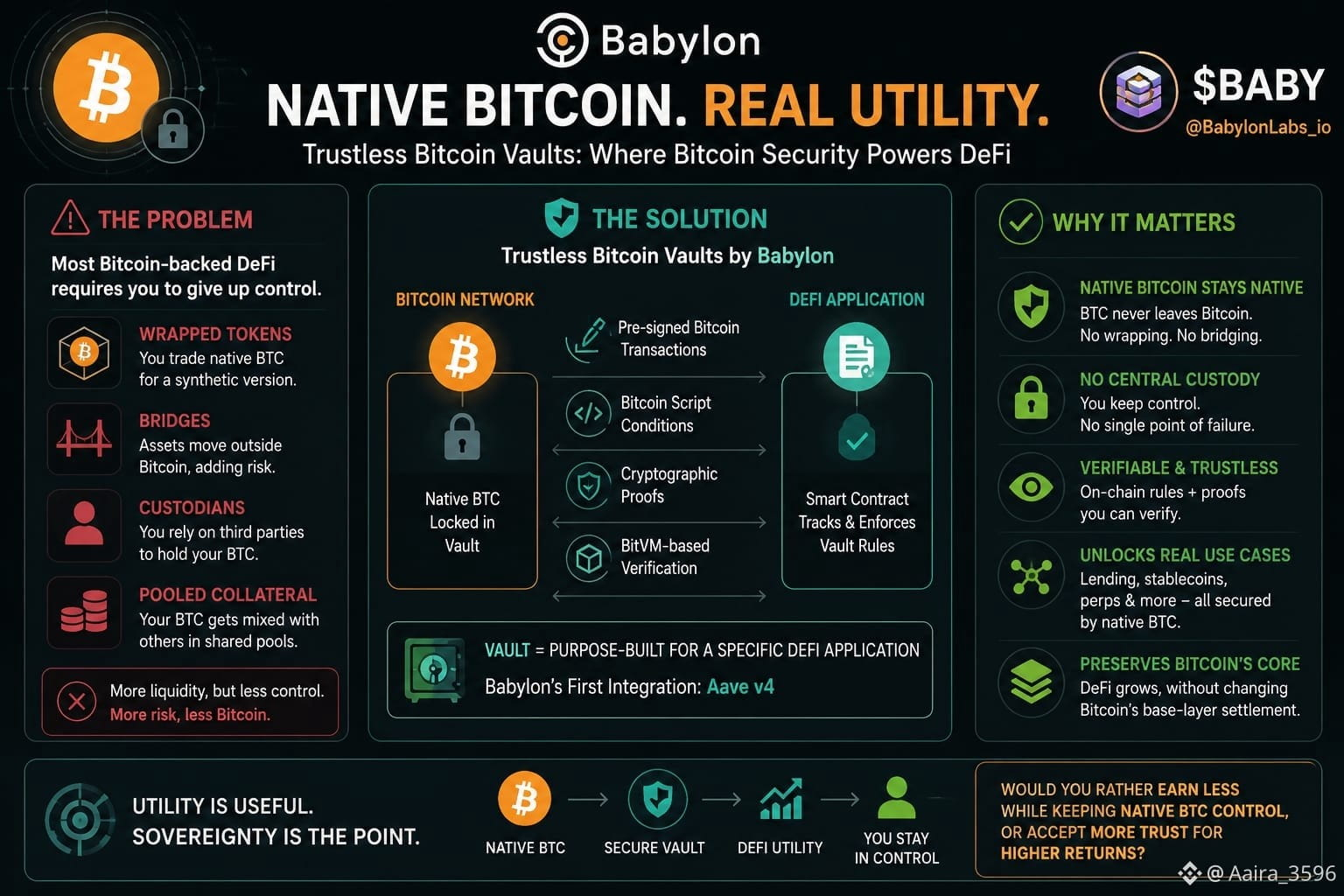
The real problem is not whether BTC can support borrowing. It is whether Bitcoin must stop behaving like Bitcoin before it becomes useful. Wrapped tokens, bridges, custodians, and pooled collateral introduce extra trust assumptions. You may gain liquidity, but you also give up direct control of the native asset and inherit risks outside Bitcoin.
Babylon’s Trustless Bitcoin Vaults take a different route. Native BTC remains locked on the Bitcoin network rather than being wrapped or bridged. Pre-signed Bitcoin transactions, Bitcoin Script conditions, cryptographic proofs, and BitVM-based verification allow a smart contract on another chain to coordinate what can happen to that collateral. The vault is created for a specific DeFi application, and Babylon’s first integration is designed around Aave v4.
Borrowing stablecoins is the first visible feature, but the deeper value is the collateral architecture. It gives DeFi a way to recognize and enforce claims against native BTC without placing the coins in a centralized custodian or moving them into a synthetic representation. That could support lending, stablecoin issuance, perpetuals, and other Bitcoin-backed markets while preserving Bitcoin’s base-layer settlement.
For me, that is why native Bitcoin matters more than the loan itself: utility is useful, but sovereignty is the point. $BABY may benefit if Babylon becomes core infrastructure for this model, though adoption and execution still matter.
Would you rather earn less while keeping native BTC control, or accept more trust for higher returns?
#baby @BabylonLabs_io
The real problem is not whether BTC can support borrowing. It is whether Bitcoin must stop behaving like Bitcoin before it becomes useful. Wrapped tokens, bridges, custodians, and pooled collateral introduce extra trust assumptions. You may gain liquidity, but you also give up direct control of the native asset and inherit risks outside Bitcoin.
Babylon’s Trustless Bitcoin Vaults take a different route. Native BTC remains locked on the Bitcoin network rather than being wrapped or bridged. Pre-signed Bitcoin transactions, Bitcoin Script conditions, cryptographic proofs, and BitVM-based verification allow a smart contract on another chain to coordinate what can happen to that collateral. The vault is created for a specific DeFi application, and Babylon’s first integration is designed around Aave v4.
Borrowing stablecoins is the first visible feature, but the deeper value is the collateral architecture. It gives DeFi a way to recognize and enforce claims against native BTC without placing the coins in a centralized custodian or moving them into a synthetic representation. That could support lending, stablecoin issuance, perpetuals, and other Bitcoin-backed markets while preserving Bitcoin’s base-layer settlement.
For me, that is why native Bitcoin matters more than the loan itself: utility is useful, but sovereignty is the point. $BABY may benefit if Babylon becomes core infrastructure for this model, though adoption and execution still matter.
Would you rather earn less while keeping native BTC control, or accept more trust for higher returns?
#baby @BabylonLabs_io