I once moved money between two banks to save a fee, then discovered the transfer would be locked for days. At first, the delay felt like bad design. Later, I understood it was there to stop mistakes and reduce fraud.
That is how Babylon’s biggest safety feature can look like a limitation.
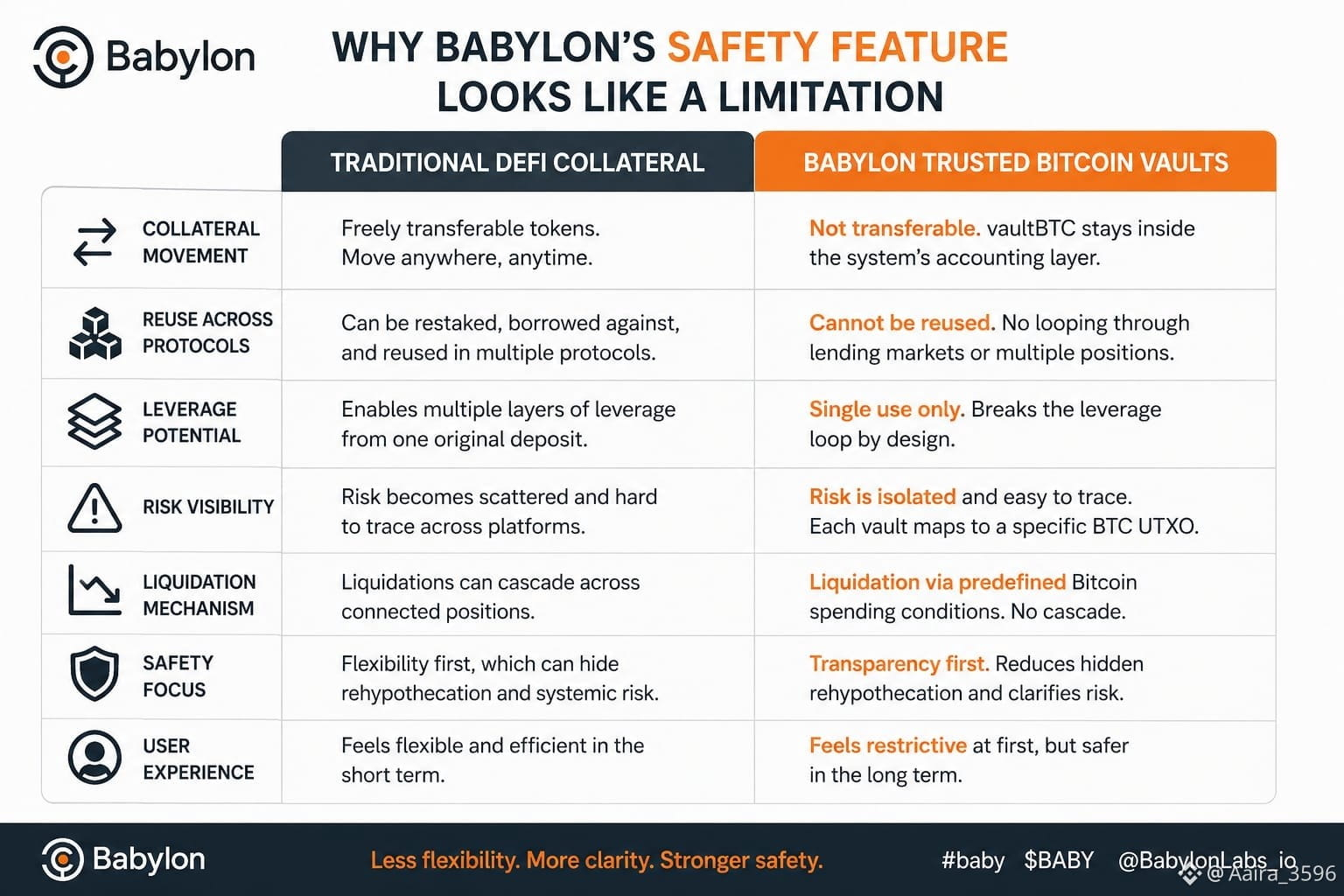
When BTC is locked inside a Babylon Trusted Bitcoin Vault, the resulting vaultBTC is not sent to your wallet as a freely transferable token. You cannot move it into another protocol, loop it through lending markets, or reuse the same collateral across several positions. The borrowed asset can move, but the collateral receipt stays inside the system’s accounting layer.
For yield hunters, that may feel restrictive. In many DeFi platforms, collateral receipts are designed to travel everywhere. Users can restake them, borrow against them again, and build multiple layers of leverage from one original deposit.
The problem is that this flexibility can hide where risk sits. When markets fall, several connected positions may unwind at once, and one liquidation can trigger another.
Babylon deliberately breaks that chain. Each vault maps to a specific Bitcoin UTXO, ownership stays easier to trace, and liquidation happens through predefined spending conditions instead of a wandering receipt token.
It does not remove software, governance, liquidity, or operator risk. But it reduces hidden rehypothecation and makes the collateral path much clearer.
Would you accept less flexibility if it meant knowing exactly where your BTC is and what can happen to it?
#baby $BABY @BabylonLabs_io
That is how Babylon’s biggest safety feature can look like a limitation.
When BTC is locked inside a Babylon Trusted Bitcoin Vault, the resulting vaultBTC is not sent to your wallet as a freely transferable token. You cannot move it into another protocol, loop it through lending markets, or reuse the same collateral across several positions. The borrowed asset can move, but the collateral receipt stays inside the system’s accounting layer.
For yield hunters, that may feel restrictive. In many DeFi platforms, collateral receipts are designed to travel everywhere. Users can restake them, borrow against them again, and build multiple layers of leverage from one original deposit.
The problem is that this flexibility can hide where risk sits. When markets fall, several connected positions may unwind at once, and one liquidation can trigger another.
Babylon deliberately breaks that chain. Each vault maps to a specific Bitcoin UTXO, ownership stays easier to trace, and liquidation happens through predefined spending conditions instead of a wandering receipt token.
It does not remove software, governance, liquidity, or operator risk. But it reduces hidden rehypothecation and makes the collateral path much clearer.
Would you accept less flexibility if it meant knowing exactly where your BTC is and what can happen to it?
#baby $BABY @BabylonLabs_io