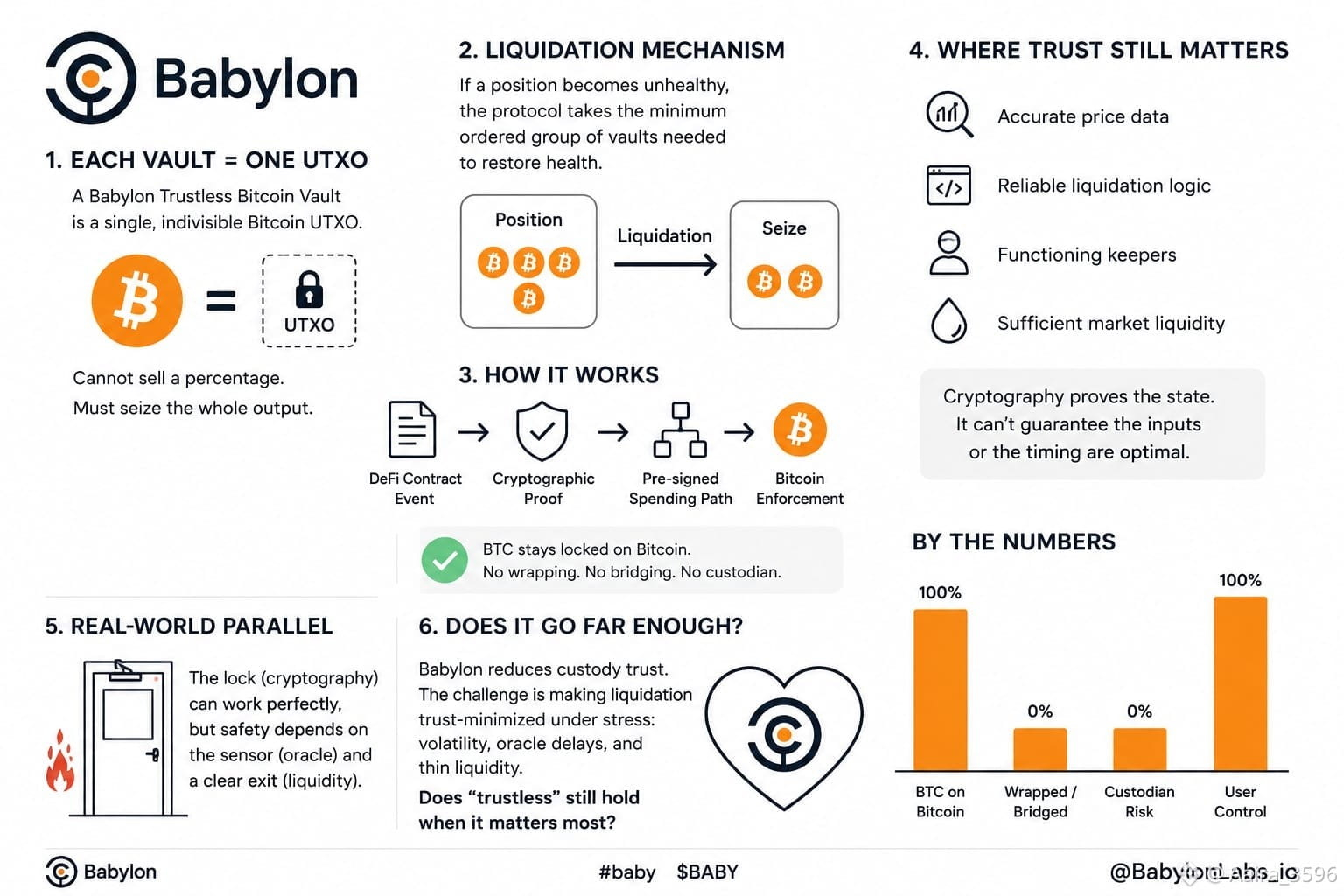
I keep coming back to one technical fact: each Babylon Trustless Bitcoin Vault is a single, indivisible Bitcoin UTXO. When liquidation begins, the protocol cannot sell a percentage of that vault. It must seize the whole output, or, when several vaults back one position, take the minimum ordered group needed to restore the loan’s health.
That mechanism still solves a serious problem. The BTC remains locked on Bitcoin rather than being wrapped, bridged, or handed to a custodian. Pre-signed spending paths define the possible outcomes, while cryptographic proofs translate the external DeFi contract’s state into conditions Bitcoin can enforce. In that sense, liquidation changes ownership according to rules agreed when the vault was created, instead of depending on a company promising to return the coins.
But this is where the word “trustless” becomes more complicated for me. The vault may remove custody risk, yet the lending application still depends on accurate price data, reliable liquidation logic, functioning keepers, and enough market liquidity to close unhealthy positions without creating a larger loss. Cryptography can prove that a contract reached a particular state; it cannot guarantee that the oracle price was economically fair or that liquidation happened at the best moment.
It reminds me of an automatic fire door. The locking mechanism can work exactly as designed, but safety still depends on the sensor detecting smoke correctly and the exit route remaining clear.
I think Babylon has meaningfully reduced the trust required to use native BTC in DeFi. The harder question is whether @BabylonLabs_io can make liquidation equally trust-minimized when volatility, oracle delays, and thin liquidity arrive together. Does “trustless” still hold at the moment users need it most?
#baby $BABY
That mechanism still solves a serious problem. The BTC remains locked on Bitcoin rather than being wrapped, bridged, or handed to a custodian. Pre-signed spending paths define the possible outcomes, while cryptographic proofs translate the external DeFi contract’s state into conditions Bitcoin can enforce. In that sense, liquidation changes ownership according to rules agreed when the vault was created, instead of depending on a company promising to return the coins.
But this is where the word “trustless” becomes more complicated for me. The vault may remove custody risk, yet the lending application still depends on accurate price data, reliable liquidation logic, functioning keepers, and enough market liquidity to close unhealthy positions without creating a larger loss. Cryptography can prove that a contract reached a particular state; it cannot guarantee that the oracle price was economically fair or that liquidation happened at the best moment.
It reminds me of an automatic fire door. The locking mechanism can work exactly as designed, but safety still depends on the sensor detecting smoke correctly and the exit route remaining clear.
I think Babylon has meaningfully reduced the trust required to use native BTC in DeFi. The harder question is whether @BabylonLabs_io can make liquidation equally trust-minimized when volatility, oracle delays, and thin liquidity arrive together. Does “trustless” still hold at the moment users need it most?
#baby $BABY