I keep returning to one question: is $BABY valuable because holders can vote, or because Babylon needs capital that can be punished when participants break the rules?
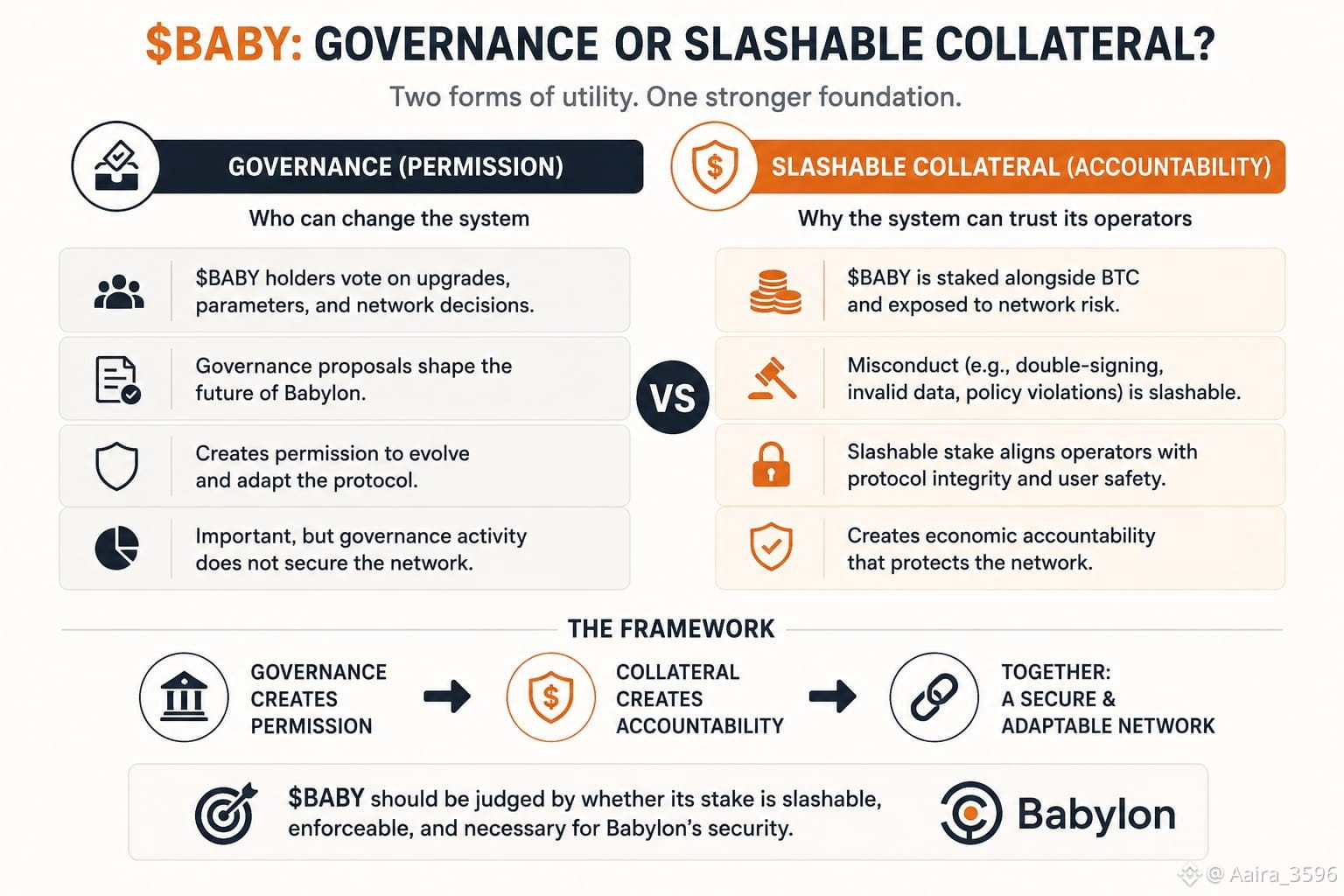
Governance is real. $BABY holders can vote on upgrades and parameters, while the token also pays gas and is staked alongside BTC. But governance explains who can change the system; slashing collateral explains why the system can trust its operators. Those are different forms of utility.
This matters in DeFi and onchain automation. A lending agent, liquidation bot, or cross-chain strategy can act immediately after detecting a state change. If the data is incomplete, an operator double-signs, or collateral conditions were never verified, automation can turn a small policy failure into irreversible settlement.
The stronger idea behind @BabylonLabs_io is verification before settlement. Pre-settlement policy checks can confirm staking conditions, validator status, exposure limits, and transaction rules before capital is released or finality is accepted. Onchain attestations and cryptographic proofs then create a verifiable record, while slashable stake gives misconduct an economic consequence.
My framework is simple: governance creates permission; collateral creates accountability. In my view, $BABY should not be judged mainly by proposal activity. Its deeper value depends on whether BABY stake is genuinely exposed to network risk, whether slashing is enforceable, and whether the token remains necessary as Babylon expands Bitcoin-backed security.
That is where my skepticism sits. A token can be called “governance” long before governance becomes economically meaningful. The harder test is whether BABY is indispensable to security rather than merely attached to it.
So, is $BABY ’s strongest utility the right to govern Babylon, or the obligation to stand behind its decisions with slashable capital? #baby
Governance is real. $BABY holders can vote on upgrades and parameters, while the token also pays gas and is staked alongside BTC. But governance explains who can change the system; slashing collateral explains why the system can trust its operators. Those are different forms of utility.
This matters in DeFi and onchain automation. A lending agent, liquidation bot, or cross-chain strategy can act immediately after detecting a state change. If the data is incomplete, an operator double-signs, or collateral conditions were never verified, automation can turn a small policy failure into irreversible settlement.
The stronger idea behind @BabylonLabs_io is verification before settlement. Pre-settlement policy checks can confirm staking conditions, validator status, exposure limits, and transaction rules before capital is released or finality is accepted. Onchain attestations and cryptographic proofs then create a verifiable record, while slashable stake gives misconduct an economic consequence.
My framework is simple: governance creates permission; collateral creates accountability. In my view, $BABY should not be judged mainly by proposal activity. Its deeper value depends on whether BABY stake is genuinely exposed to network risk, whether slashing is enforceable, and whether the token remains necessary as Babylon expands Bitcoin-backed security.
That is where my skepticism sits. A token can be called “governance” long before governance becomes economically meaningful. The harder test is whether BABY is indispensable to security rather than merely attached to it.
So, is $BABY ’s strongest utility the right to govern Babylon, or the obligation to stand behind its decisions with slashable capital? #baby