

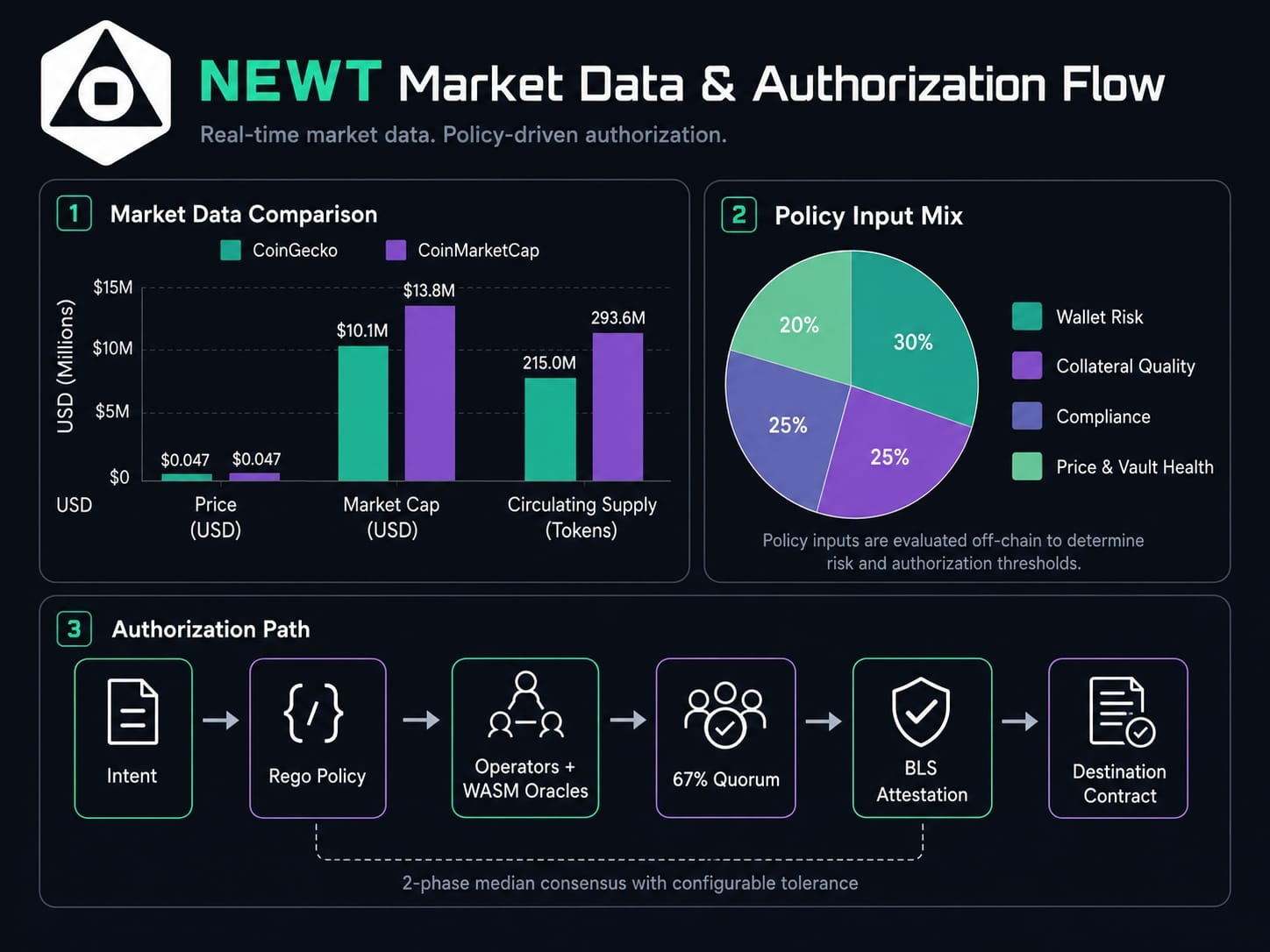
I caught myself checking Newton Protocol’s market data twice because the numbers didn’t line up. CoinGecko showed NEWT near $0.047, a market cap around $10.1 million, and roughly 215 million tokens circulating. CoinMarketCap showed the price but about $13.8 million in market value and 293.6 million tokens circulating. That gap isn’t Newton’s security failure, but it’s a reminder: even a clean calculation becomes unreliable when the input assumption is disputed. Automated finance can’t afford to ignore it.
That’s why I think Newton’s interesting security idea isn’t “stop every failure.” It’s assumption containment. Instead of pretending smart contracts can predict every attack, bad price, compromised wallet, or reckless agent, Newton asks developers to state what must be true before money moves. Think of it like a pilot’s checklist. The checklist doesn’t guarantee the engine will never fail. It prevents takeoff when known conditions already look wrong.
Newton’s Mainnet Beta, launched June 23 on Base and Ethereum, inserts that checklist before settlement. A transaction intent is matched with a Rego policy. Operators fetch data through WASM oracles, evaluate the same rules, sign the result, and aggregate their BLS signatures. The destination contract verifies the attestation before execution. Newton’s default requires 67 percent of operator stake for quorum, while its two-phase process uses median values and a configurable tolerance when time-sensitive data differs across operators. That’s security built around declared assumptions, not a rescue committee arriving after the vault is drained.
Why does this matter? Most DeFi defenses are reactive. Pause the contract. Trace the wallet. Vote on compensation. Publish the postmortem. Those tools matter, but settlement has finality and attackers understand the clock better than governance does. Newton moves the argument earlier: Is this wallet acceptable now? Is collateral quality above the threshold now? Does this agent’s proposed action fit its spending mandate now?
But here’s the thing. An explicit assumption can still be wrong.
If every operator reads a distorted source, consensus can faithfully certify nonsense. If a policy writer chooses a loose risk threshold, the system can correctly approve a bad trade. Newton’s docs acknowledge the dependency: policies are only as strong as their data, and incorrect evaluations are handled through challenge windows and slashing. I also don’t love that Ethereum mainnet policy usage currently requires coordination and allowlisting by the Newton team. That may be sensible during beta, but traders shouldn’t confuse controlled rollout with finished decentralization.
There’s another tension in the default settings. A 10 percent median-consensus tolerance may be harmless for some data, yet uncomfortably wide for thin collateral during a liquidation cascade. Operators outside tolerance cause consensus failure rather than being quietly discarded, which is good. Still, failure to reach a decision is itself an operational risk. If authorization becomes a required doorway, gateway downtime, oracle delay, or insufficient quorum can turn security into frozen capital. Sometimes blocking everything is safer. Sometimes it creates the next crisis.
This connects to the Retention Problem. NEWT still trades roughly 94 percent below its recorded all-time high, while a July 24 unlock is scheduled to release 17.84 million tokens. Price weakness alone doesn’t invalidate infrastructure, but it changes behavior. Incentive-driven users leave. Operators reassess economics. Developers stop integrating if authorization adds friction without measurable demand. Newton doesn’t need attention; it needs vault curators, institutions, and applications that keep paying for policy evaluation because the control becomes part of their workflow.
That’s the retention metric I’d watch, not follower growth. Are the same PolicyClients requesting attestations month after month? Are policies becoming more specific after near misses? Are challenged decisions rare because evaluations are accurate, or because nobody is watching? I want production task volume, repeat integrators, failed-evaluation rates, challenge outcomes, operator concentration, and authorization latency. Without those, the architecture is interesting but the trade remains narrative.
If you’re eyeing NEWT, open the Explorer and watch whether assumptions become recurring paid decisions rather than one-off demonstrations. I turn bullish when usage survives incentives, operator diversity improves, and failures produce better policies without freezing users. I turn bearish if allowlisting persists, data disagreements grow, or token activity outruns attestations. Newton doesn’t need to prove failure is avoidable. It needs to prove that admitting failure upfront creates a system people keep using.