It has been three days since South Korean memory giant SK Hynix made its U.S. listing debut. This article reviews the event through four key angles: the listing details and business strengths of SK Hynix, the support from surging AI capex for the memory sector, Goldman Sachs’ breakdown of the AI value chain, and SK Hynix’s strategic value with forward-looking insights.
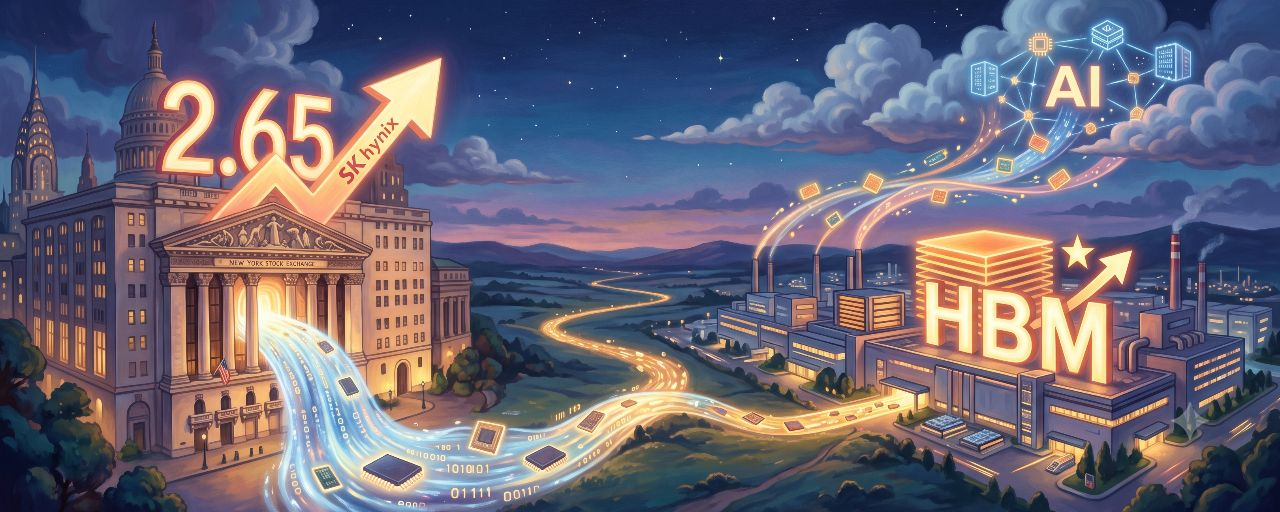
SK Hynix priced its ADRs at $149. Trading began under SKHYV and later switched to SKHY. The company raised a record $26.5 billion in the largest-ever U.S. IPO by a foreign company. Its ADRs surged about 13% on the first day, pushing market cap above $1.2 trillion. Proceeds are mainly for expanding wafer fabs in Korea and acquiring advanced EUV equipment to accelerate HBM capacity buildout. As a key supplier to NVIDIA and other high-end AI accelerators, its products already hold a critical position in global data center supply chains.
SK Hynix’s Core Strengths and Industry Position
SK Hynix has long specialized in DRAM and NAND, building deep expertise in HBM technology. Its HBM3E products are now in volume production, and the HBM4 roadmap is advancing smoothly. Since 2025, explosive demand for high-bandwidth memory in AI servers has driven strong order growth, with multiple cloud providers locking in future capacity early.
The global memory market is dominated by an oligopoly of SK Hynix, Samsung, and Micron. HBM shows even higher concentration. The stringent bandwidth and capacity requirements of AI training and inference have made HBM an essential component for data centers. SK Hynix maintains a leading edge through technological advantages and stable customer relationships.
AI Capex Surge Supporting the Memory Sector
In 2026, global AI infrastructure construction has entered a high-density phase. Major hyperscalers including Amazon, Microsoft, Alphabet, and Meta plan combined capital expenditures of approximately $725 billion, a sharp year-over-year increase. Most of this spending targets data centers, server clusters, and high-end chips, creating steady demand for memory products.
SK Hynix’s HBM is a major beneficiary of these expenditures. Cloud providers favor long-term agreements with upfront payments to secure supply, giving SK Hynix clear revenue visibility. AI investment is gradually expanding from initial compute power buildout to manufacturing optimization, energy management, and intelligent logistics. This broader shift is expected to continue driving demand for high-performance memory.
Goldman Sachs Report: AI Value Chain Closure and Sector Priorities
In its mid-2026 reports, Goldman Sachs systematically analyzed the structure and pricing dynamics of the full AI value chain. The core message is that AI competition has shifted from single links to complete closed-loop ecosystems. China accounts for roughly 16% of global AI revenue but receives significantly lower fund allocation, creating notable upside potential.
The report breaks the AI value chain into five prioritized tracks:
Power (Ranked #1 – Undervalued foundational bottleneck): AI training and inference consume massive electricity. Goldman forecasts China’s data center power demand to grow at a ~36% CAGR from 2025-2030. China’s advantages in supply scale, low-cost western green power, fast policy support, and construction speed stand out. Policies like East Data West Computing turn low electricity prices and land costs into real operational edges. Power equipment offers high rigidity and certainty.
Semiconductors (Storage super-cycle with domestic substitution): Focus on DRAM, NAND, and HBM. AI server demand for these products is growing exponentially. Chinese storage players are advancing rapidly in production scale, cost-performance, and supply security. Recent revenue and export data already reflect price increases and share gains. This track offers strong profit elasticity and faster earnings realization.
AI Infrastructure (Where capital expenditure actually lands): Covers servers, optical modules, liquid cooling, and data centers. China’s path is clear, with advantages in speed and cost-effectiveness. The report stresses that sustained spending comes from long-term inference and iteration rather than one-off training tasks.
AI Models: China pursues low-cost, high-efficiency routes and shows strength in code, math, and multimodal areas. Goldman ranks this lower due to commercialization pace and competitive variables, requiring solid upstream infrastructure support.
AI Applications (Lowest-risk monetization endpoint): China has the world’s largest single internet market. Massive real users and scenarios allow AI features to be directly embedded into existing products for monetization. Applications serve as the chain’s endpoint and driving force.
Goldman’s framework shifts capital allocation logic from betting on single links to betting on complete closed loops. Power and infrastructure provide certainty, semiconductors deliver elasticity, and models/applications offer longer-term excess returns. Overall, AI capex is expected to remain elevated, with greater weight placed on foundational bottleneck segments.
Post-Listing Institutional Participation
Following the debut, several institutions and product issuers joined or increased exposure:
Cornerstone Investors: Baillie Gifford Overseas, Coatue Management, and Situational Awareness Partners collectively showed interest in up to $7 billion of the ADRs.
Underwriters: Bank of America, Citigroup, Goldman Sachs, and J.P. Morgan led the offering.
ETFs and Derivatives: At least 10 fund managers, including Direxion and ProShares, filed to launch single-stock ETFs tracking SK Hynix. Leveraged and inverse products (SKHX and SKHZ) were also introduced shortly after listing.
The offering was oversubscribed more than 7 times, drawing broad interest from global long-only funds, tech-focused funds, sovereign wealth funds, and Asian-focused investors. This significantly expands U.S. institutional and retail access to SK Hynix.
SK Hynix’s Strategic Value and Risk Considerations
Within this AI value chain, SK Hynix sits at the core of semiconductor storage, especially HBM. Its technological leadership and long-term agreements align closely with the supply tightness and capex trends. The U.S. listing further opens international capital channels and strengthens its visibility in the global AI supply chain.
Geopolitical risks, macroeconomic fluctuations, and technological iteration remain factors to monitor.
Investment Outlook and Suggestions
In the short term, the U.S. listing improves SK Hynix’s global liquidity and visibility, with trading activity likely to stay elevated. Over the medium to long term, sustained AI capex and tight supply-demand dynamics provide solid support for its HBM business. Investors should track quarterly HBM shipments and capacity utilization.
For allocation, long-term investors may treat SK Hynix as a core AI theme holding. Those seeking diversification can supplement with related ETFs. Overall, decisions should align with personal risk tolerance and focus on the actual progress of AI infrastructure rollout.
SK Hynix’s U.S. listing marks a significant milestone for the company and reflects global capital markets’ emphasis on AI foundational technologies. Driven by both capital expenditure and technological progress, the memory sector demonstrates strong long-term resilience, with SK Hynix positioned at its center. Its future performance merits continued attention.
Disclaimer: This article is for informational purposes only and does not constitute investment advice. Markets are volatile; please conduct your own research.
