
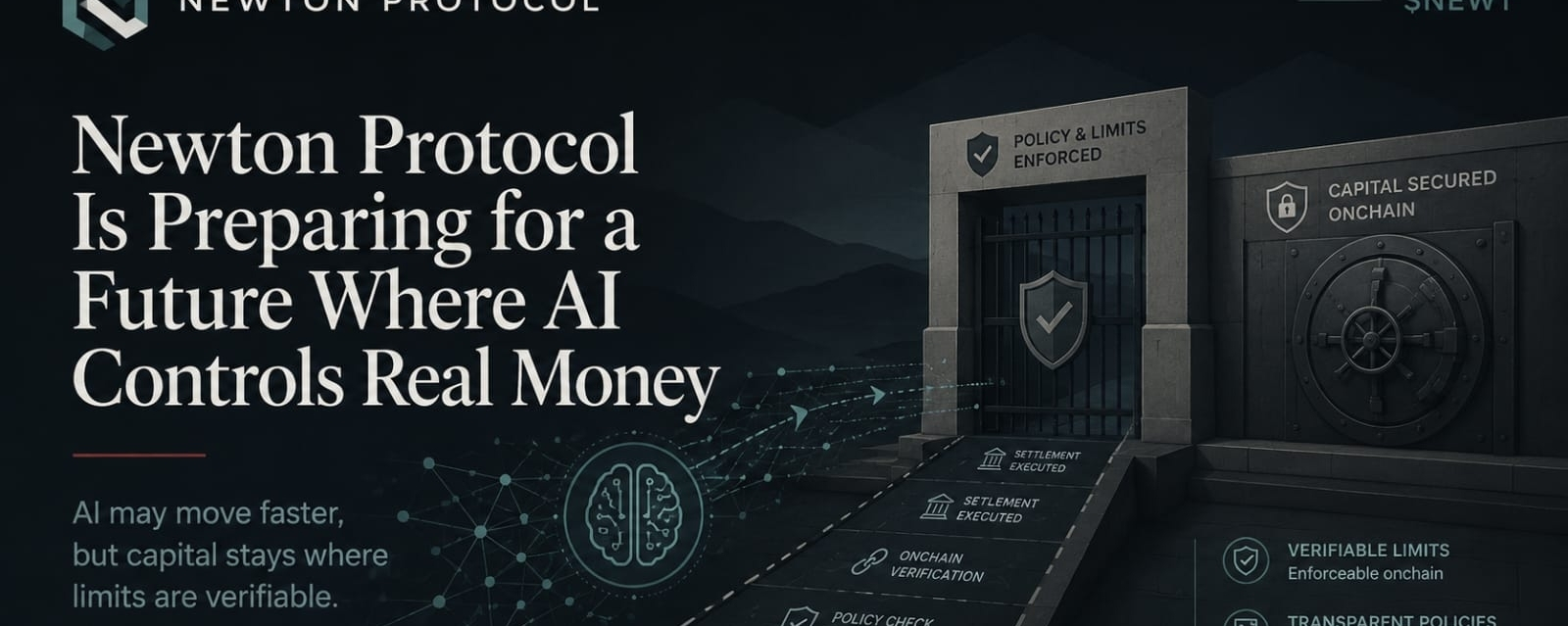

I remember watching a vault rebalance during a wasn’t the scary part. The strategy reacted faster than I could. What bothered me was simple: I couldn’t tell who defined the agent’s limits, whether those limits matched conditions, or what would stop the action from drifting outside them. That’s the risk Newton Protocol is trying to address, and why I’m not treating this as a token story.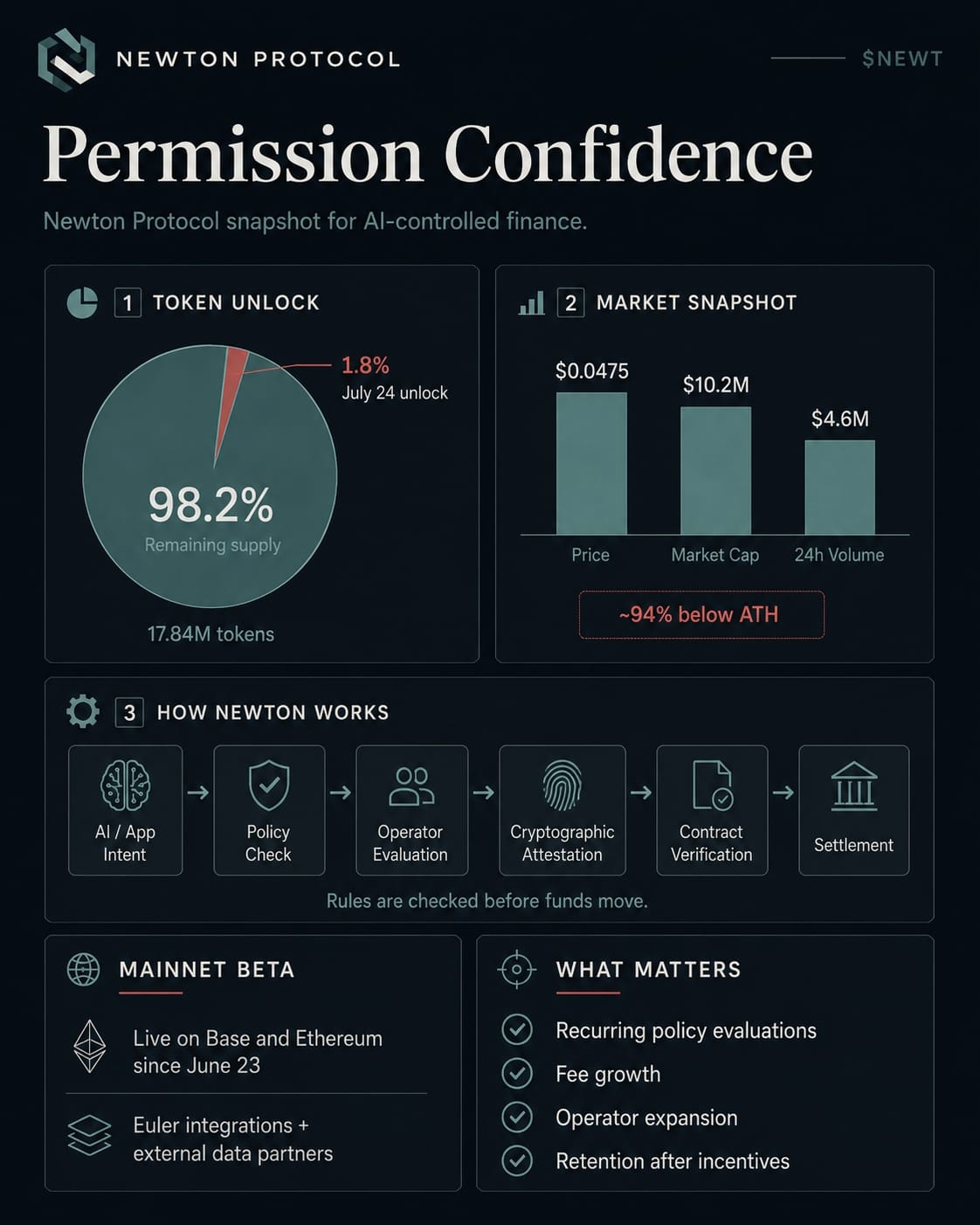
My framework is permission confidence. AI can improve decision speed, but capital stays only when users trust the boundaries around those decisions. Think of it like hiring a trader. Intelligence gets the seat. Verifiable limits keep capital there. Newton sits between a transaction and settlement, checks the action against a policy, then returns a cryptographic approval the destination contract can verify. Its mainnet beta went live on Base and Ethereum on June 23, with Euler implementations and data partners covering prices, sanctions, identity, vault health, quality, and wallet risk. omation proves execution better than authorization. We can inspect what an agent did after funds moved, but that’s not as proving it was allowed beforehand. Newton’s Rego policies can define exposure caps, approved markets, liquidity thresholds, identity conditions, or volatility rules. Operators evaluate the request, and the attestation becomes the gate. The contract settles after the policy says yes. n’t.
A policy can be enforced and still be wrong because its data is stale, its thresholds are designed, or conditions changed faster than the rule. Fail closed protects capital from unauthorized activity, but it can also block a legitimate rebalance during a depeg. More checks introduce complexity, dependencies, and latency. Newton’s design uses external data connectors, privacy tools, EigenLayer security, and zero knowledge proofs, expanding what policies can evaluate, but every component becomes another place traders should examine than trust. T recently traded near $0.0475, with roughly a $10.2 million market capitalization and $4.6 million in daily volume. That leaves it about 94% below its all-time high. A July 24 unlock is scheduled to release 17.84 million tokens, equal to 1.8% of total supply. If you’re eyeing this as a trade, those numbers matter more immediately than the AI narrative. Shipping infrastructure doesn’t automatically create token demand, and low-cap assets punish anyone who confuses product progress with market confirmation. ing: the Retention Problem may decide whether Newton becomes useful infrastructure or another impressive layer that struggles to hold participants. Developers may test policy checks because they’re new. Vault managers may integrate them for compliance. Stakers may remain for subsidized rewards. None of that proves durable retention. The real test is whether applications keep using Newton after incentives fade, whether policy evaluations generate recurring fees, and whether users deposit more capital because authorization receipts reduce perceived risk. seful contrast. Adoption is integration count. Retention is repeated paid authorization. I care more about the second. A dashboard full of partners can look convincing while transaction flow remains thin. The public explorer should eventually reveal whether policies are being evaluated across real applications, not just demonstrations. I also want the operator set to broaden beyond beta, because decentralization promised later differs from decentralization working under pressure today. m Newton chose. AI agents handling real money will need more than smart wallets and clever models. They’ll need enforceable limits, private data checks, and receipts showing why an action passed. Still, I’m skeptical that authorization alone guarantees value capture for NEWT. The token case depends on fees, staking security, operator demand, and sustained usage connecting cleanly enough that network growth reaches holders rather than stopping at the software layer.
So watch the boring evidence. Track recurring policy evaluations, active applications, fee growth, operator expansion, disputed attestations, and retention after incentives decline. Rising real usage with fewer trust assumptions would make me more bullish. Flat activity, dependence on foundation rewards, data failures, or integrations stuck in pilots would turn me bearish. Don’t buy the future because AI sounds inevitable. Demand proof that capital chooses to stay inside Newton’s rules.