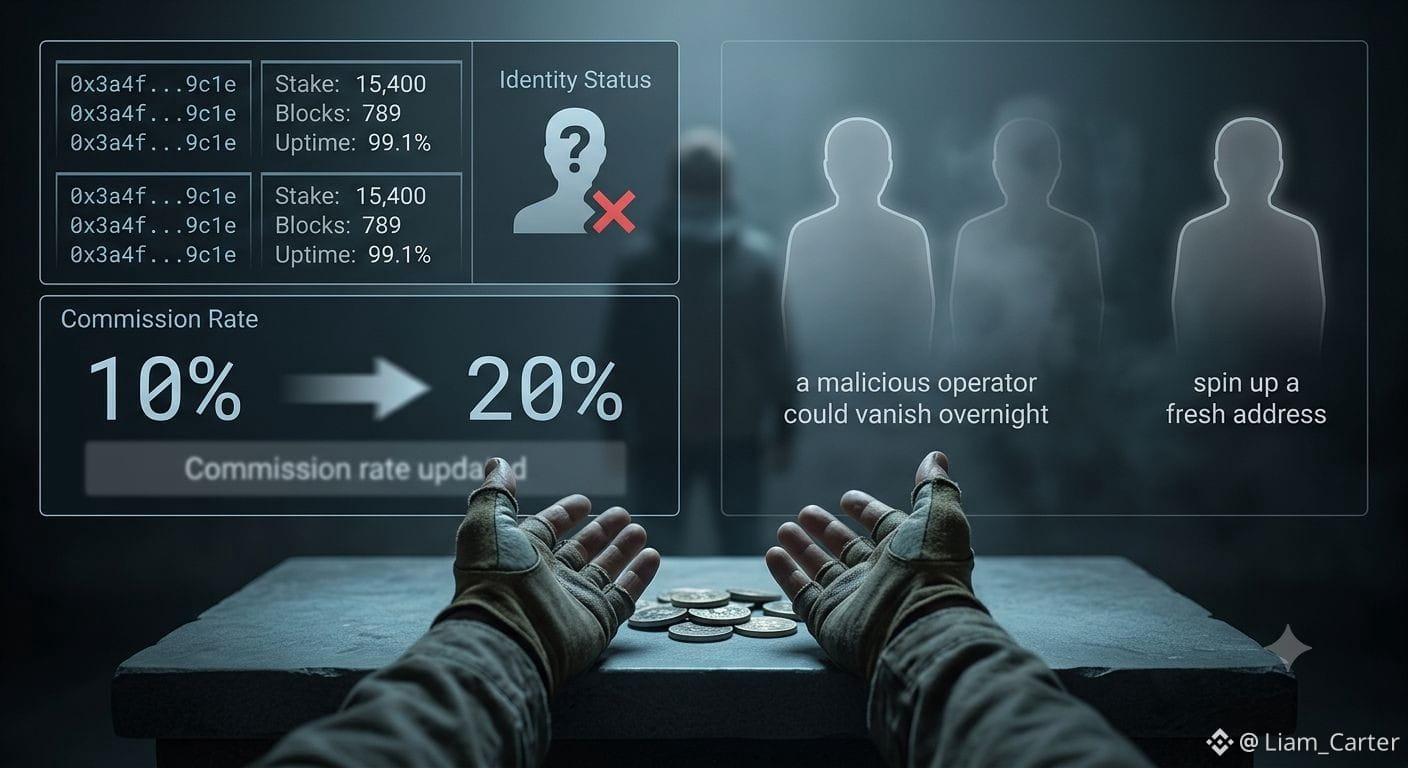
#newt $NEWT On one @NewtonProtocol verified node list, every operator is completely anonymous. What you see on-chain are mere hexadecimal addresses followed by staking amounts, block production tallies, and uptime percentages. There are no organization names, no team bios, no website links—nothing that reveals whether the entity behind the address is a company, an individual, or a ghost. I spent hours tracing interaction histories, trying to link these addresses to known wallets, transaction patterns, or timezone fingerprints. It led nowhere. Every address looked newly minted, carrying no cross-chain footprint and no trace of identity verification. A malicious operator could vanish overnight, spin up a fresh address, and keep running nodes without ever being linked to past behavior. Anonymity here is a perfect shield for bad actors.
That anonymity makes delegation feel like a blind bet. When you stake your tokens, you have no idea who really controls the validator. In traditional finance, you know a fund manager’s name, track record, and regulatory standing—if something goes wrong, there’s someone to hold accountable. Here you get nothing but an address. If a node secretly raises its commission or colludes with others to manipulate rewards, you have no face to confront.
Worse, these anonymous operators can change commission rates at any moment without prior notice. You might delegate at 10%, only to see it jump to 20% the next day. Your only option is to unbond and restake elsewhere, losing potential earnings during the waiting period. The operators know you bear that switching cost, so they exploit it. I saw a community complaint where a node’s commissionspiked from 12% to 22% with zero warning. An admin’s reply was simply, “Nodes have the right to independently adjust their commission rate.” That’s the rule—retail delegators just have to accept it. Without identity, reputation or accountability,what’s supposed to be a trust-based staking system feels instead like a high-stakes lottery where you don’t even know who’s running the wheel
That anonymity makes delegation feel like a blind bet. When you stake your tokens, you have no idea who really controls the validator. In traditional finance, you know a fund manager’s name, track record, and regulatory standing—if something goes wrong, there’s someone to hold accountable. Here you get nothing but an address. If a node secretly raises its commission or colludes with others to manipulate rewards, you have no face to confront.
Worse, these anonymous operators can change commission rates at any moment without prior notice. You might delegate at 10%, only to see it jump to 20% the next day. Your only option is to unbond and restake elsewhere, losing potential earnings during the waiting period. The operators know you bear that switching cost, so they exploit it. I saw a community complaint where a node’s commissionspiked from 12% to 22% with zero warning. An admin’s reply was simply, “Nodes have the right to independently adjust their commission rate.” That’s the rule—retail delegators just have to accept it. Without identity, reputation or accountability,what’s supposed to be a trust-based staking system feels instead like a high-stakes lottery where you don’t even know who’s running the wheel