

For a long time, I evaluated crypto projects by asking familiar questions. Is the technology faster? Is the token useful? Is there enough demand to justify the valuation? Those questions still matter, but recently I found myself asking something different: who decides whether an onchain transaction should happen in the first place?
That question led me to Newton Protocol.
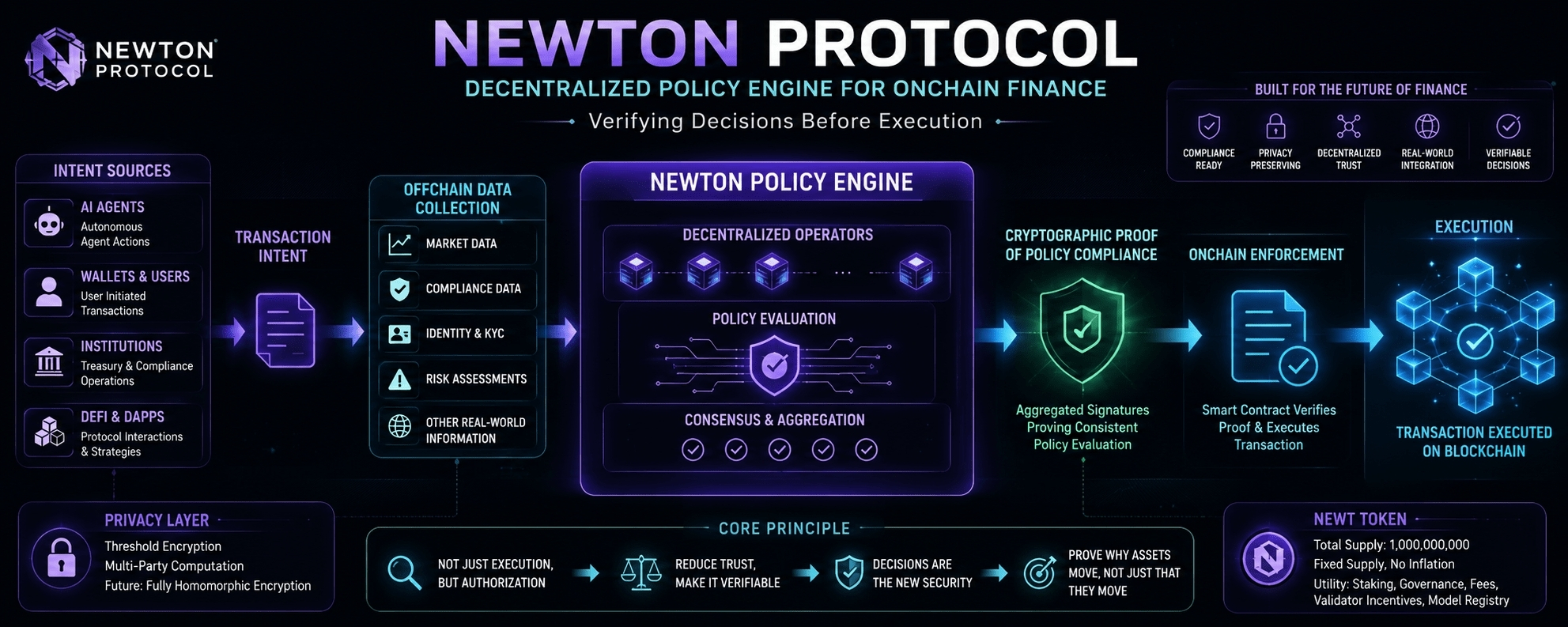
Newton does not present itself as another Layer 1 or DeFi application. Instead, it describes itself as a decentralized policy engine that sits between transaction intent and execution. Rather than focusing on moving assets faster, it focuses on deciding whether a transaction satisfies predefined rules before it is allowed to execute.At first, that sounded like a technical detail. The more I read, the more I realized it represents a different way of thinking about blockchain infrastructure.
Traditional smart contracts are deterministic, but they are also limited. They cannot naturally verify whether a wallet belongs to a sanctioned entity, whether an AI agent is acting within spending limits, or whether a transaction satisfies institutional compliance requirements. Most of these checks happen outside the blockchain through centralized services or application interfaces. Newton's argument is that these decisions should become verifiable parts of the protocol itself rather than assumptions hidden behind APIs.I find this idea compelling because the industry increasingly wants to automate financial decisions. AI agents, institutional treasury systems, tokenized real-world assets, and stablecoins all introduce situations where executing a transaction is no longer enough. The decision process itself becomes valuable.
However, this also made me ask a more difficult question.
Does blockchain actually need another execution layer, or does it need a trustworthy authorization layer?
Newton clearly believes the second answer is becoming more important.Its architecture combines decentralized operators, offchain information, cryptographic proofs, and onchain enforcement.
External data such as market prices, compliance information, identity credentials, or risk assessments are collected by multiple operators before policy evaluation occurs.
Those operators then reach consensus and generate aggregated cryptographic signatures proving that the required policy was evaluated consistently before execution.
That is an interesting design because it acknowledges something many crypto discussions avoid: blockchains rarely operate in complete isolation from the real world.
If regulation, identity, or financial risk matters, some information must originate outside the chain.The challenge therefore is not eliminating trust entirely.
It is reducing unnecessary trust while making external decisions verifiable.
Newton appears to build its entire protocol around this philosophy.
Privacy is another area that caught my attention. Institutional compliance often requires sensitive financial or identity information that should never become public blockchain data.
Newton addresses this using layered privacy techniques including threshold encryption, multi-party computation, and a future roadmap toward fully homomorphic encryption. The objective is to evaluate policies without unnecessarily exposing private information.
Whether these advanced cryptographic techniques become practical at large scale remains an engineering challenge, but I appreciate that the protocol recognizes privacy and compliance as interconnected rather than competing objectives.
The token itself also deserves examination.According to the available documentation, NEWT has a fixed supply of one billion tokens with no planned inflation after launch.
Initially it exists as an ERC-20 token before an eventual migration toward Newton's own rollup architecture. Utility is expected to include staking, governance, validator participation, protocol fees, and registration within the Newton Model Registry, where developers can publish AI models and potentially earn royalties.
Approximately 21.5% of the supply was planned to circulate at launch, while the remaining distribution follows allocations defined by the project.
Still, token utility should always be examined carefully.One question I kept asking myself was whether the protocol genuinely requires NEWT or whether the authorization network could theoretically function without it.
From the available documentation, the token appears tied to economic security, governance, validator incentives, and ecosystem participation rather than existing solely as a fundraising asset. That is encouraging, although the long-term effectiveness will ultimately depend on real protocol adoption rather than token design alone.$NEWT
Another observation is that Newton's security depends on more than cryptography.Its policy decisions rely on external information such as price feeds, compliance databases, and other real-world data providers. Cryptographic proofs can demonstrate that operators evaluated identical inputs correctly, but they cannot independently guarantee that the external inputs themselves were accurate.
In other words, the protocol can prove correct execution of a decision, but not necessarily the correctness of every external fact feeding that decision.
I do not view this as a weakness unique to Newton.
Instead, it highlights one of the deepest challenges facing programmable finance.
Whenever blockchain interacts with the real world, someone—or something—must provide external information.The real innovation lies in making those dependencies transparent rather than pretending they do not exist.
After spending time researching Newton Protocol, I came away with a perspective that feels different from most infrastructure projects I have studied.
Many protocols compete to execute transactions more efficiently.
Newton asks whether transactions should be executed at all until predefined rules have been verified.$NEWT
That subtle shift changes where trust lives inside blockchain systems.Whether this becomes foundational infrastructure will depend on adoption by developers, institutions, and applications that genuinely need programmable authorization rather than simple transaction execution. The concept is ambitious, and meaningful implementation will take time.
What I appreciate most is not the promise of faster finance, but the attempt to make decision-making itself verifiable.
The crypto industry has spent years optimizing settlement.
Perhaps the next stage is optimizing authorization.And if that happens, the most valuable infrastructure may not be the chain that moves assets the fastest, but the one that can prove why those assets were allowed to move in the first place
