
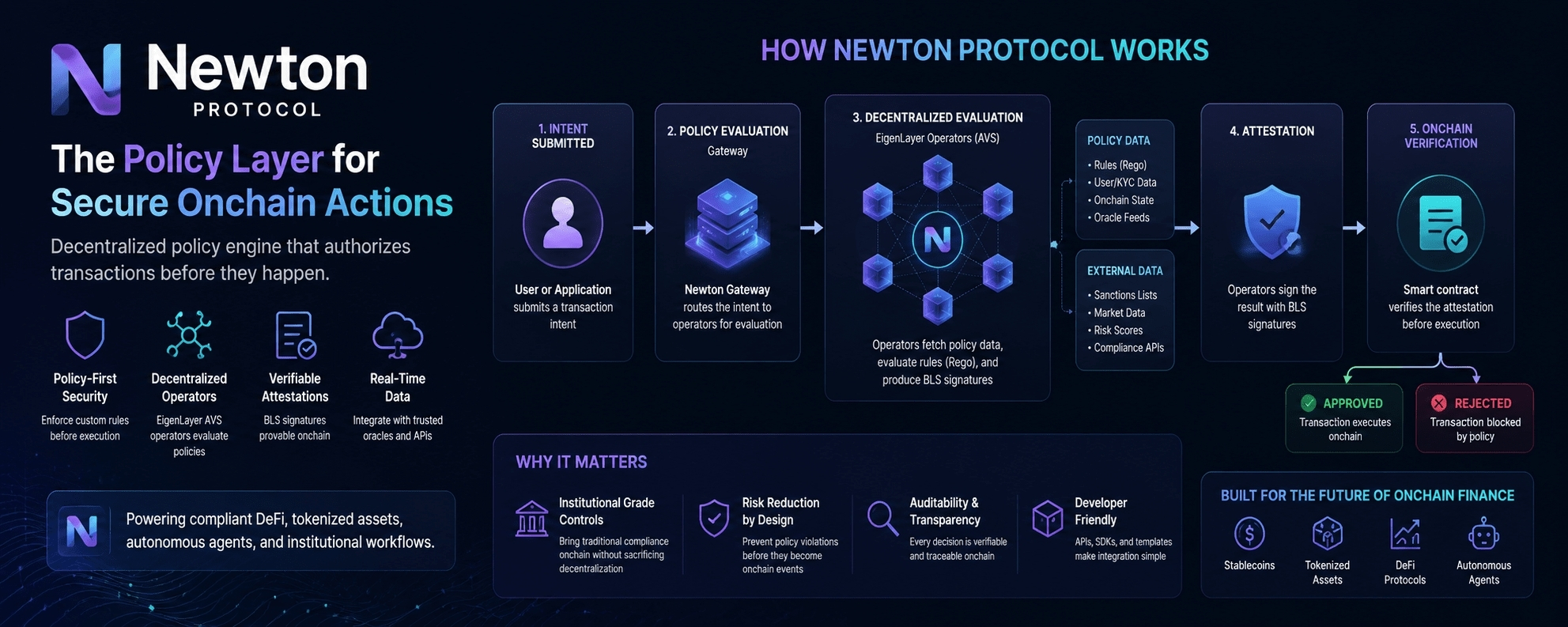

What keeps a system like this honest when nobody is watching? Newton Protocol is interesting because it is not trying to be another general-purpose chain story; it is trying to sit in front of onchain actions and decide whether they deserve to happen at all. That sounds small at first, but in real finance, the gate matters almost as much as the road behind it.
The reason this matters is bigger than crypto branding. Once stablecoins, tokenized assets, and automated agents start moving meaningful value, the issue is no longer just speed, it is control, accountability, and whether a machine can follow rules that humans actually care about.
Newton’s own materials frame the protocol around those kinds of workflows.
Many blockchain systems are strong at proving that something happened, but weak at proving that it should have happened. A contract can execute perfectly and still ignore a compliance boundary, a budget limit, or a company’s internal policy, because the chain itself does not naturally understand those layers.
That is the bottleneck in plain English: execution is easy to automate, but judgment is not. A useful system here needs to turn policy into something machines can check without turning every transaction into a manual review ticket.Newton Protocol appears to be aiming at that exact gap.
According to its documentation, it acts as a decentralized policy engine for onchain transaction authorization, with the policy check happening before the transaction is allowed to move forward.
One of the cleaner ideas in the design is its use of Rego-style policy logic.
In simple terms, that means rules can be written as readable conditions instead of buried inside custom contract code, which makes the logic easier to inspect and adapt, but also creates a new layer that teams must learn, test, and keep consistent.
That matters because readable policy is not the same thing as safe policy. The trade-off is that a flexible rule language can make governance easier for institutions, while also making mistakes easier to spread if a team copies a bad template or misunderstands how a rule behaves in edge cases.
The architecture also seems to rely on decentralized operators rather than a single gatekeeper.
The docs describe EigenLayer operators evaluating policy tasks and producing BLS signatures, which is useful because it spreads trust, but it also introduces dependence on operator uptime, network coordination, and consistent behavior.
The transaction flow itself is fairly intuitive once you strip away the jargon. An intent is submitted, the Gateway coordinates the policy evaluation, operators check the policy against the relevant data, and the result becomes an attestation that a contract can verify before execution.
That design helps because it keeps policy close to the point of action. But it also means the system is only as clean as the path between the user’s intent and the final attestation, and that path now depends on latency, service availability, and fresh data instead of just chain execution.
This is where reality usually gets less elegant. A rule that looks neat in a demo can become messy under pressure if an external feed is delayed, if an operator fails to respond, or if the policy engine behaves differently from what the team assumed in staging.
The quiet failure mode is the one that tends to hurt most. Not a dramatic exploit, but a small mismatch: a policy that blocks legitimate activity, misses a boundary case, or approves something that later turns out to have violated the organization’s own rulebook.If I were trying to trust this design, I would want more than architecture diagrams. I would want proof about how fast policy checks complete, how often operators stay online, how stale data is handled, and what the fallback behavior is when one part of the system fails.
The developer-facing side looks thoughtfully packaged. Newton’s site points to a dashboard, API keys, a TypeScript SDK, quickstarts, and contract integration paths, which lowers the barrier to entry, but it also means the quality of the docs and the SDK becomes part of the security story.That kind of packaging is helpful, but it is not free. The more a system abstracts away complexity, the more important it becomes that builders understand what is hidden underneath, because hidden complexity is often where mistakes become expensive.
Newton Protocol also seems to be aiming at a fairly specific operating zone. The documentation highlights EVM environments such as Ethereum, Base, and Arbitrum, while non-EVM support is described as future work, which suggests the current design is practical for one ecosystem but not universal.
That boundary is worth saying out loud because it defines what the system does not solve. It does not remove the need for legal judgment, it does not decide which external data source deserves trust forever, and it does not eliminate the hard work of turning company policy into precise machine rules.
A realistic example makes the consequences easier to see. Imagine a treasury wallet that can only interact with approved contracts, stay within daily limits, and pass sanctions-style checks before any transfer goes through; Newton could make that process more auditable, but a bad threshold or unavailable policy service would still create real operational friction.
The strongest case for the project is that it treats policy as infrastructure instead of paperwork. The strongest case against it is that infrastructure has to survive stress, and compliance rules are rarely stable enough to stay elegant once they meet live users, changing data, and internal politics.
The useful lesson here is broader than Newton itself.
A lot of the next wave of onchain systems may depend less on raw execution and more on the layer that decides whether execution is allowed, which means policy design, observability, and operational clarity will matter as much as contracts.
What still feels open is the real question: can Newton Protocol stay fast, transparent, and predictable when the rules change, the operators drift, and the data sources do not agree with each other?
$NEWT $EVAA $CLO @NewtonProtocol #Newt #newt #BinanceTurns9 #TreasuryCommerceVieForBitcoinReserveControl #JapanBondYieldHits30YearHigh