
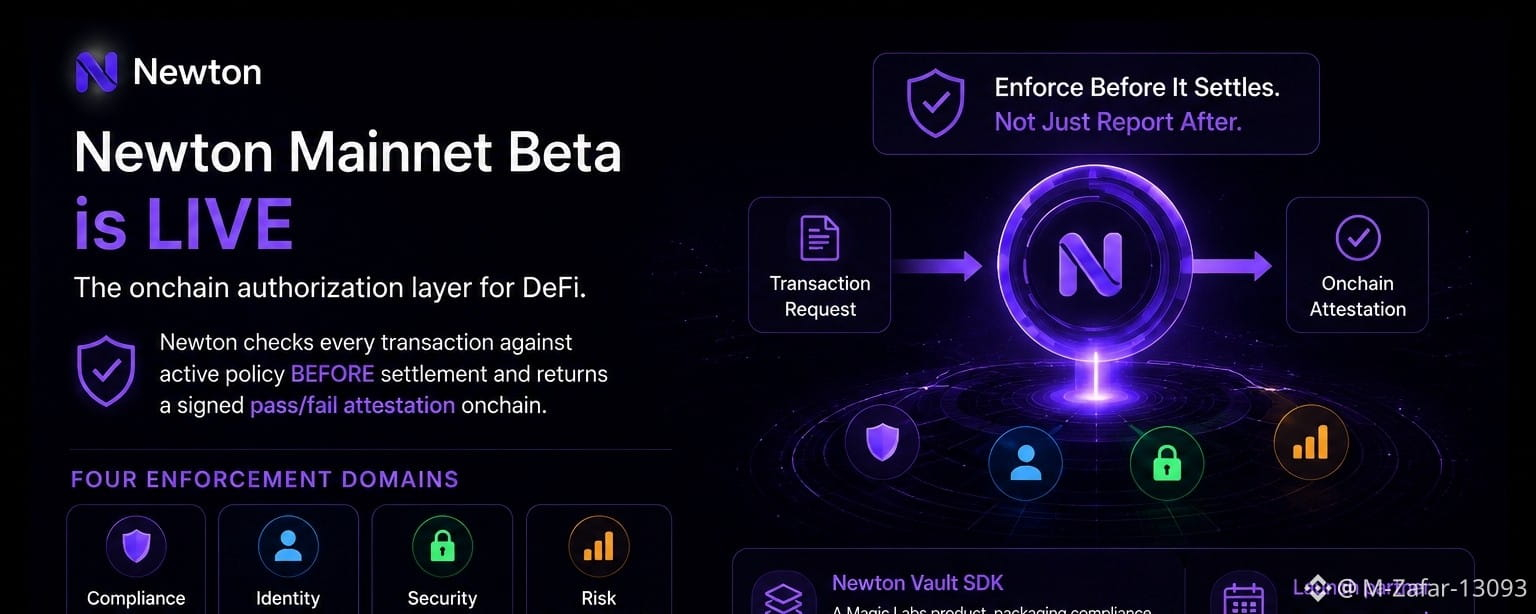

I've been reading about @NewtonProtocol and its Mainnet beta and one idea kept coming back to me that most DeFi protocols focus on what happens after a transaction, while Newton focuses on what should happen before it.This difference is more important than it sounds.
In traditional finance, payment networks don't simply move money. They first decide whether a transaction should be authorized. Newton brings a similar concept to the onchain economy by checking every transaction against predefined policies before settlement and then recording a signed onchain attestation.
What also caught my attention is that Newton isn't trying to solve only one problem. It combines multiple enforcement layers, including compliance, identity verification, security protection, and risk management into a single authorization framework. For institutions and curated DeFi vaults, this could reduce reliance on fragmented offchain processes and make policy enforcement transparent onchain.
I'm also curious to see how the upcoming Newton Vault SDK expands adoption. If developers can integrate policy enforcement more easily, it could encourage more secure vaults, RWAs, stablecoins and even AI-driven financial applications over time.
Of course, Mainnet Beta is only the beginning, and real adoption will depend on execution. But I think the idea of enforcing rules before funds move is an interesting direction for DeFi infrastructure.
What do you think will have the biggest impact on Newton's future,the authorization layer itself, the Vault SDK, or the long-term utility of $NEWT I'd love to hear different opinions.
