#opg $OPG
In my last post, we established that for AI agents managing assets, verifiability matters more than raw speed. The next logical challenge is economic: how do you scale an infrastructure where honesty must be mathematically proven?
In centralized systems, you only pay for compute cycles. Decentralized AI introduces a new variable: the cost of proof. If verification is too computationally expensive, the network stalls. If it is too weak, malicious nodes can corrupt outputs.
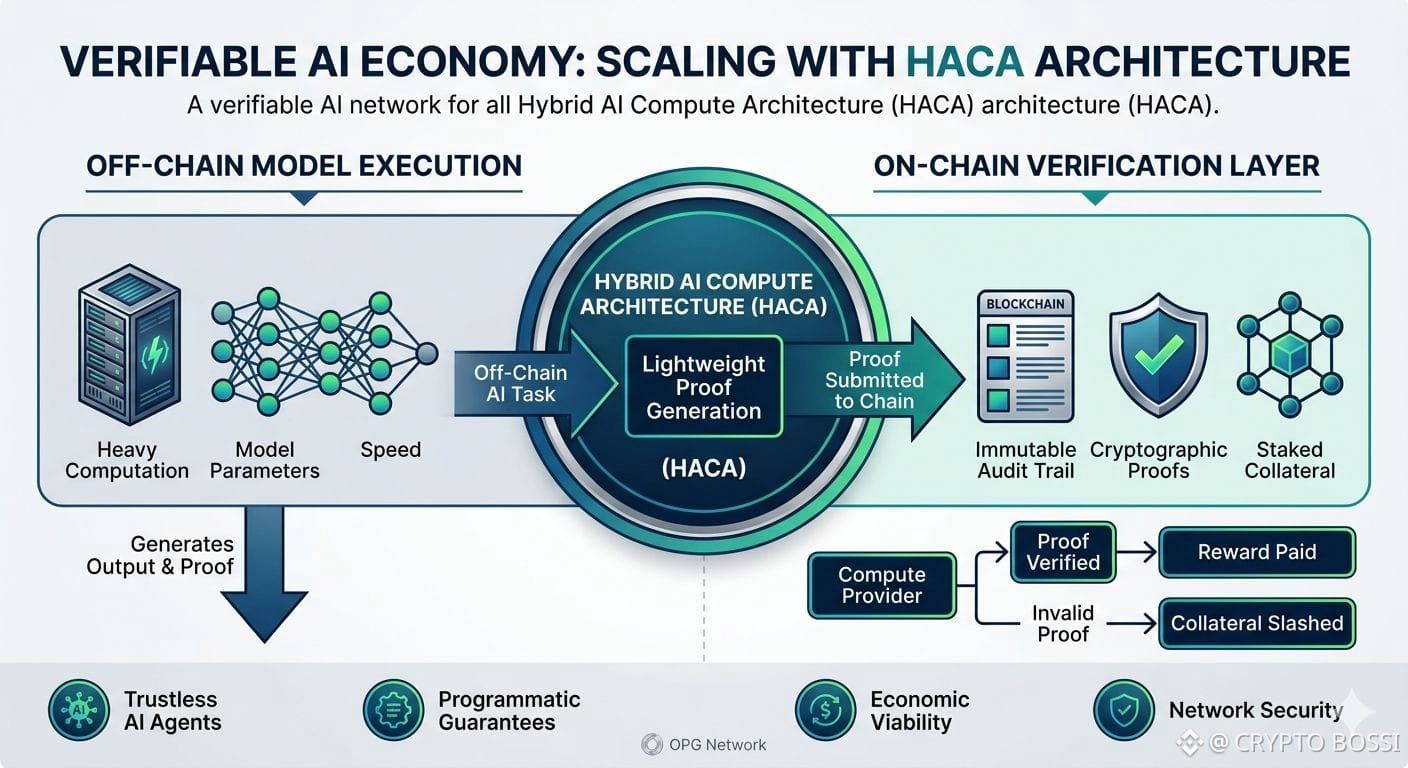
OpenGradient’s Hybrid AI Compute Architecture (HACA) addresses this by separating off-chain model execution from on-chain verification. This keeps resource-heavy processing efficient while securing the network through lightweight cryptographic proofs.
For a true machine-to-machine economy to function, autonomous agents cannot rely on trust or brand reputation. They require programmatic guarantees. By anchoring proofs to a decentralized consensus layer, compute providers can be held accountable via staked collateral, developers ensure their models are untampered, and users receive an immutable audit trail.
Ultimately, technical scalability must align with economic viability. The networks that succeed will be those that drive down the cost of cryptographic verification until provable honesty becomes a seamless, default standard for every AI transaction.
#OPG #OpenGradient #BinanceSquare #CryptoAI #Web3
$CAP
In my last post, we established that for AI agents managing assets, verifiability matters more than raw speed. The next logical challenge is economic: how do you scale an infrastructure where honesty must be mathematically proven?
In centralized systems, you only pay for compute cycles. Decentralized AI introduces a new variable: the cost of proof. If verification is too computationally expensive, the network stalls. If it is too weak, malicious nodes can corrupt outputs.
OpenGradient’s Hybrid AI Compute Architecture (HACA) addresses this by separating off-chain model execution from on-chain verification. This keeps resource-heavy processing efficient while securing the network through lightweight cryptographic proofs.
For a true machine-to-machine economy to function, autonomous agents cannot rely on trust or brand reputation. They require programmatic guarantees. By anchoring proofs to a decentralized consensus layer, compute providers can be held accountable via staked collateral, developers ensure their models are untampered, and users receive an immutable audit trail.
Ultimately, technical scalability must align with economic viability. The networks that succeed will be those that drive down the cost of cryptographic verification until provable honesty becomes a seamless, default standard for every AI transaction.
#OPG #OpenGradient #BinanceSquare #CryptoAI #Web3
$CAP