
Sometimes new technology sounds more complicated than it really is.
Blockchain is one of those words. Many people connect it only with Bitcoin, Ethereum, or crypto. But at its core, blockchain is simply a way to store information securely.
Let’s understand it in a very simple way.
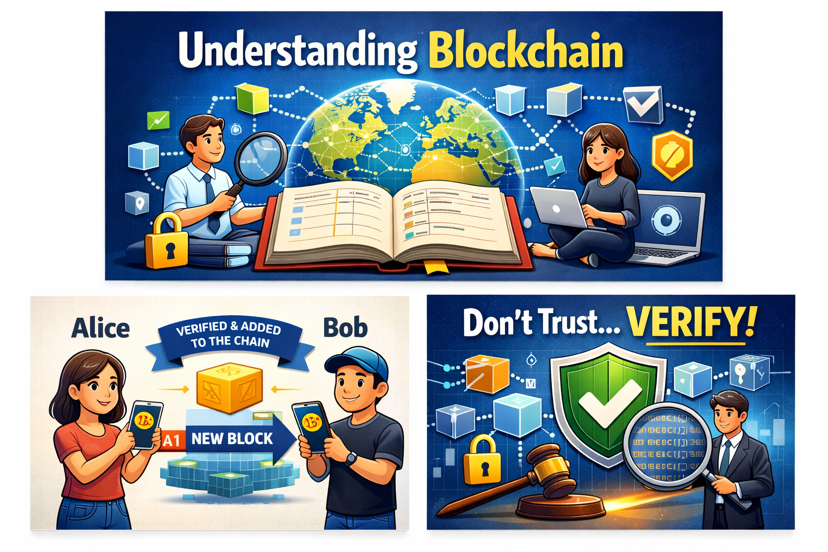
Imagine there is a big record book.
But instead of being kept by one bank, one company, or one government office, this record book is copied across many computers around the world.
Whenever something new is added to that book, many computers check it, agree that it is valid, and only then save it. Once it is recorded and accepted by the network, changing it later becomes extremely difficult.
That basic idea is what blockchain is all about.
What exactly is a blockchain?
A blockchain is a digital ledger.A ledger is just a record book used to track transactions or information.But blockchain is not like a normal database.It stores data in groups called blocks.Each block contains information such as:
transaction details
time of the transaction
a code that connects it to the previous block
These blocks are linked together one after another, like a chain.That is why it is called blockchain.Its special strength is this: once a block is added to the chain, changing it later is very hard. To change one block, you would also have to change all the blocks after it, which is extremely difficult and very expensive.
Why is blockchain important?
In simple terms, blockchain offers five major benefits:
1. Decentralization
It is not controlled by one person, company, or authority.
Many computers help run it together.
2. Transparency
On many public blockchains, anyone can view the transaction history.
That makes it harder to hide what happened.
3. Immutability
Once information is recorded, it cannot easily be changed.
4. Security
Blockchain uses cryptography and network rules to protect data.
5. Efficiency
In some cases, it can reduce the need for middlemen, which can make processes faster and cheaper.
What does decentralization mean?
This is one of the most important ideas in blockchain.Normally, a bank keeps its own records.
A company keeps its own data.A government office controls its own files.
But with blockchain, the data is not kept in just one place.It is shared across many computers in the network.
That means:
if one computer fails, the system still works
if one place is attacked, the whole network does not collapse
trust does not depend on a single authority
How does blockchain work?
Let’s understand it with a small example.
Imagine Alice wants to send Bitcoin to Bob.
Step 1: The transaction starts
Alice sends a request to transfer Bitcoin to Bob.
That request is shared with the network.
Step 2: The network checks it
Many computers in the network, called nodes, examine the transaction.
They check things like:
does Alice actually have the Bitcoin?
is her digital signature valid?
Step 3: A block is created
Once valid transactions are checked, they are grouped together into a block.
Step 4: The network agrees
Before that block is added, the network must agree that it is valid.
This agreement process is called consensus.
Step 5: The block is added to the chain
After agreement is reached, the block is added to the blockchain.
Now the transaction becomes part of the permanent record.
What is inside a block?
A block usually contains:
transaction data
a timestamp
its own unique code, called a hash
the hash of the previous block
Because each block includes the previous block’s hash, all blocks stay connected in order.
This is what creates the chain.
What is a hash?
A hash is like a digital fingerprint.
It is a unique code created from data using a special mathematical function.
What makes it useful is this:
even a tiny change in the input creates a completely different hash
it is very hard to go backward from the hash to the original data
it is extremely rare for two different pieces of data to create the same hash
This is one reason blockchain is secure.
If someone changes the data inside a block, the hash changes immediately, and the network can detect that something is wrong.
What are public and private keys?
Another important part of blockchain security is public-key cryptography.
Each user has two keys:
Private key
This is secret.
It is used to sign transactions.
If someone else gets it, your assets could be at risk.
Public key
This can be shared openly.
Others use it to verify that your transaction really came from you
In simple words:
private key = your secret signing power
public key = what others use to verify your signature
What is a consensus mechanism?
Since blockchain is run by many computers, a question comes up:
How do all these computers agree on what is true?
The answer is the consensus mechanism.
It is the rule system the network uses to decide:
which transactions are valid
which block can be added
what the current state of the blockchain is
The two most common types are:
1. Proof of Work (PoW)
This is the system used by Bitcoin.
In PoW, participants called miners compete to solve difficult mathematical problems.
The first one to solve the problem gets the right to add the next block and receive a reward.
Strength:
very battle-tested and secure
Weakness:
uses a lot of computing power
consumes a lot of energy
2. Proof of Stake (PoS)
This is used by many newer blockchains, including Ethereum today.
Instead of miners, there are validators.
They lock up some of their crypto as a stake, and the system selects validators to confirm transactions and add new blocks.
Strength:
uses much less energy
can be more efficient
Weakness:
if not designed well, power may concentrate among large holders
Are all blockchains the same?
No. There are different types of blockchain networks.
Public blockchain
Open to everyone.
Anyone can join, use it, and often inspect the data.
Examples: Bitcoin, Ethereum
Private blockchain
Restricted to certain users.
Usually run by one company or organization for internal purposes.
Consortium blockchain
Managed by a group of organizations together.
It is a middle ground between public and private systems.
What is blockchain used for?
Many people think blockchain is only for cryptocurrency, but it has many possible uses.
1. Cryptocurrencies
Bitcoin, Ethereum, and other digital assets rely on blockchain to record transactions.
2. Smart contracts
These are self-executing digital agreements that run automatically when conditions are met.
3. Tokenization
Real-world assets like real estate, art, or shares can be represented as digital tokens.
4. Digital identity
Blockchain can help create secure, tamper-resistant digital identity systems.
5. Voting
It can be used to build transparent voting systems that are harder to tamper with.
6. Supply chain tracking
It can help track goods from origin to destination with a clear and permanent record.
Why did blockchain become such a big idea?
Because it tried to solve an old problem in a new way:
Who do we trust?
Traditionally, we trust banks, governments, companies, or middlemen to keep accurate records.
Blockchain introduced a different idea:
Do not rely only on one authority. Rely on rules, cryptography, and a shared network.
That shift is what made blockchain so powerful and interesting.
Does blockchain have weaknesses?
Yes. It is not perfect.
Some challenges include:
not every blockchain is fully decentralized
some networks can be slow or expensive
some systems use a lot of energy
real-world adoption is still developing
regulation and integration remain difficult in many industries
So blockchain should not be seen as magic.
But it is an important new model for trust, security, and shared record-keeping
Simple conclusion
In the simplest possible words:Blockchain is a shared digital record book stored across many computers, where information is recorded securely, openly, and in a way that is very hard to change later.
It can:
make transactions more secure
reduce reliance on middlemen
improve trust in shared data
support many use cases beyond crypto
It started with Bitcoin, but its potential now reaches into finance, identity, supply chains, voting, and many other fields. As the technology continues to evolve, we may see even more practical uses in the future.$SIGN #blockchain #blockchain #Write2Earn