When the Cloud Dies
How Vanar Chain is building the infrastructure the internet should have always had — and why two AWS outages in one year made the case better than any whitepaper could
23 Minutes That Changed Everything
It was 9:47 AM on April 15, 2025. Traders logging into Binance saw a spinning wheel. KuCoin users got error screens. MEXC froze mid-order. For 23 minutes, three of the world's largest crypto exchanges — platforms that collectively handle hundreds of billions in daily trading volume — simply stopped working.
The cause had nothing to do with blockchain. No smart contract had failed. No node had gone rogue. The culprit was a single cloud provider: Amazon Web Services. One data center in one AWS region hiccupped, and the dominoes fell in slow motion across what the industry had confidently branded a "decentralized" financial system.
"One cloud hiccup broke half the trading world." — Jawad Ashraf, CEO of Vanar Chain, speaking at the Vanar Vision conference, Dubai, April 30, 2025
The irony was almost poetic. An industry built on the promise of trustless, permissionless, censorship-resistant infrastructure had quietly outsourced its most critical layer — data storage — to the same centralized giants it was supposedly replacing. And on April 15, that dependency became impossible to ignore.
But this story does not end in April.
Six months later, on October 20, 2025, AWS hit again. This time the outage was bigger. Coinbase went down. Robinhood went dark. Base, Coinbase's own Layer 2, became unreachable. Infura — the backbone connecting millions of MetaMask wallets to Polygon, Optimism, Arbitrum, Linea, and Scroll — collapsed. A second smaller outage followed just ten days after that. One region. One provider. Half the infrastructure of decentralized finance, offline.
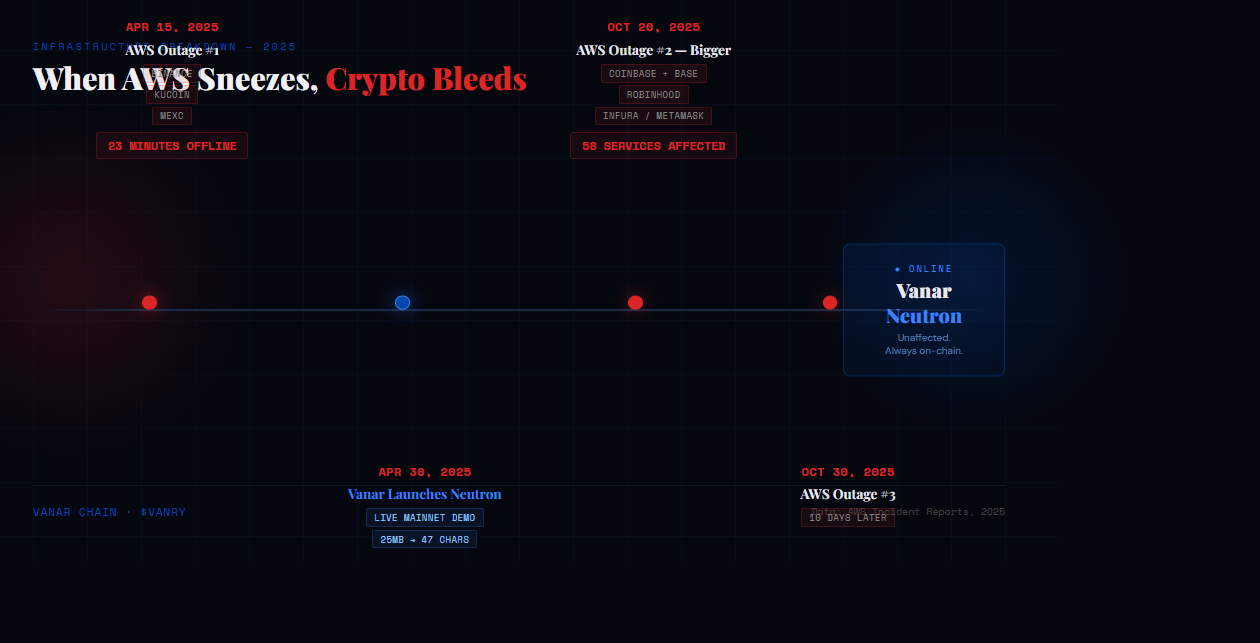
Somewhere in the middle of all this, Vanar Chain had already launched Neutron. And suddenly, what had seemed like a niche technical solution looked like the most important piece of infrastructure in the industry.
The Ownership Illusion Before we can understand what Vanar is building, we need to understand the problem it is solving. And that problem is more fundamental than most people realize.
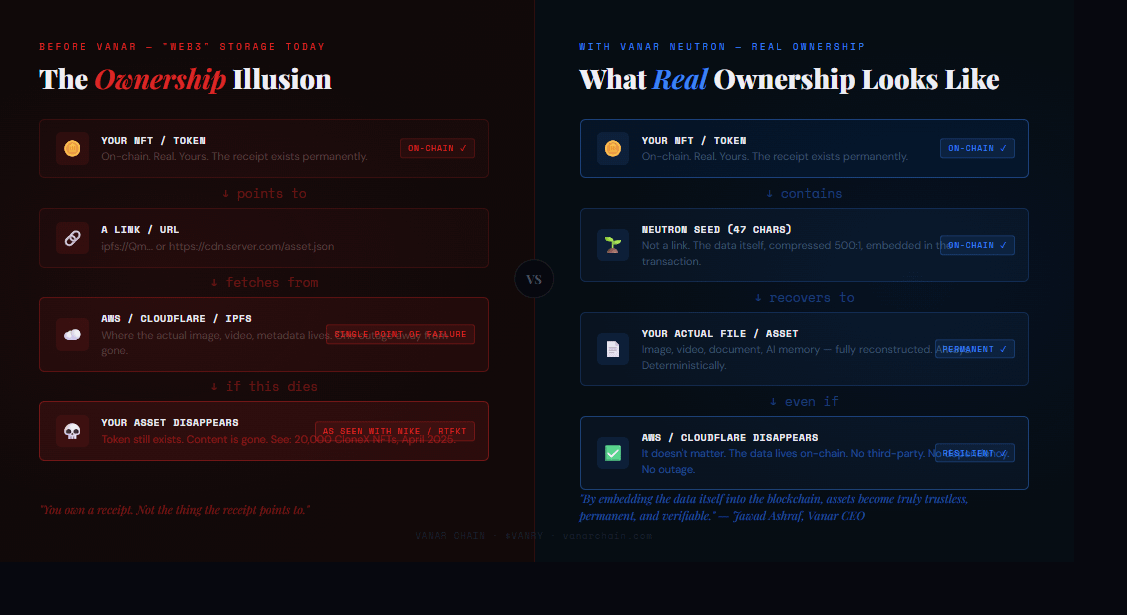
When you "own" an NFT, what do you actually own?
The smart contract records your wallet address as the token holder. That part is on-chain, verifiable, permanent. But the image, the metadata, the actual content of that NFT?
In almost every case, it lives on IPFS — a distributed but still external file system — or worse, on a centralized server. A link inside the token points to it. And a link is only as permanent as the thing it points to.
In April 2025, just days after the first AWS outage, this was demonstrated in spectacular fashion. Over 20,000 CloneX NFTs created by RTFKT Studios — Nike's Web3 brand, purchased for billions — temporarily vanished. The images disappeared. A Cloudflare configuration issue broke the links. The tokens still existed on-chain. The content they represented did not.
"What happened with Nike's NFTs and the AWS outage shows the risk: if the server fails, the asset effectively disappears." — Jawad Ashraf, CEO of Vanar Chain
This is what Jawad Ashraf calls the "ownership illusion."
You own a pointer. You own a receipt.
But the thing itself — the file, the data, the meaning — lives somewhere else. And that somewhere else is always one outage, one company decision, or one expired domain away from disappearing.
Traditional blockchains cannot solve this natively. Ethereum caps transaction payload near 65 kilobytes. Most chains are even more restrictive.
The architecture was never designed to store files — only to reference them. So developers have always had to park their assets somewhere external. IPFS. Arweave. AWS S3. Cloudflare. The very centralized infrastructure they were supposedly escaping.
Vanar's answer was to rebuild the assumption from scratch.
What if the chain itself could store the file? Not a link to the file. Not a hash of the file. The file itself, fully on-chain, queryable by any smart contract, recoverable without any external dependency?

Neutron: The Zip File That Lives Inside the Block
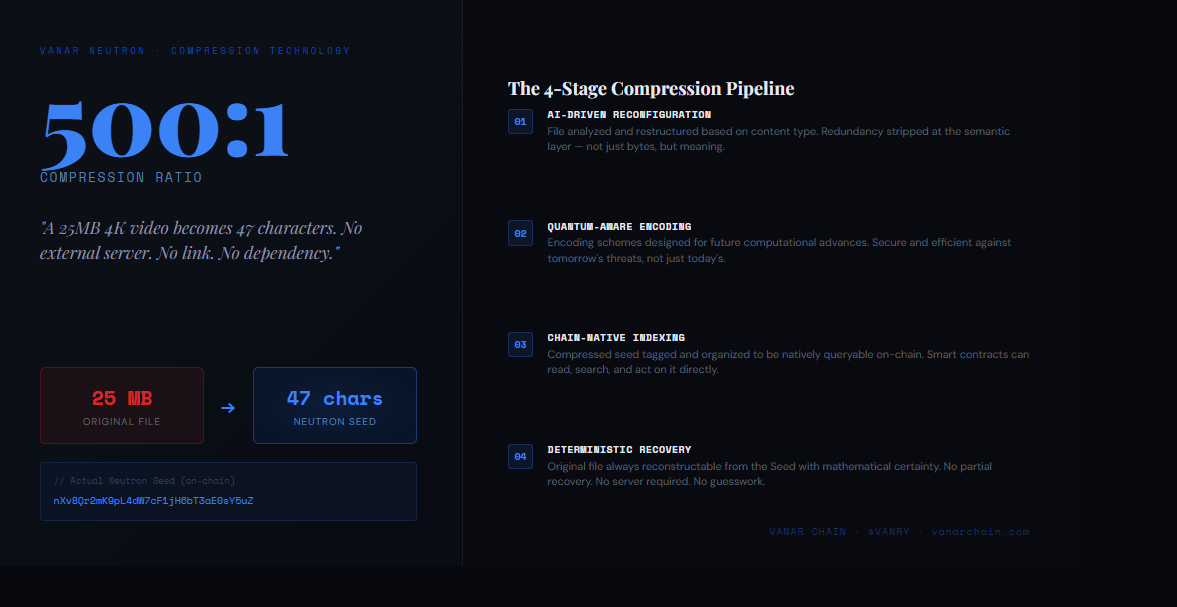
On April 30, 2025, at the Theatre of Digital Art in Dubai during Token2049, Vanar Chain made the case live. On a 360-degree projection wall, they compressed a 25-megabyte 4K video clip into a 47-character string — a "Neutron Seed" — embedded it inside a live mainnet transaction, and replayed the fully restored video in under thirty seconds. No external server. No IPFS gateway. No cloud bucket. Just the chain.
This is Neutron: an AI-powered compression stack that achieves ratios of up to 500:1. A 25-megabyte file becomes 50 kilobytes. A full document becomes a string short enough to fit in a tweet. And critically, that seed carries not just the compressed file but the semantic meaning inside it — queryable by any smart contract on the network.
How It Actually Works
Neutron's compression pipeline runs through four stages:
AI-Driven Reconfiguration: The file is analyzed and intelligently restructured based on its content type, stripping redundancy and optimizing for what matters.
Quantum-Aware Encoding: Applies encoding schemes designed to remain secure and efficient against future computational advances.
Chain-Native Indexing: The compressed seed is tagged and organized to be natively searchable on-chain.
Deterministic Recovery: Guarantees that the original file can always be reconstructed from the seed with mathematical certainty — no guesswork, no partial recovery, no dependency on the original server.
What makes Neutron genuinely novel is the semantic layer. When Jawad Ashraf told Cointelegraph it handles
"both physical file compression and semantic compression,"
he was describing something no other blockchain storage solution has attempted. It compresses not just the bytes of a file but the meaning encoded in those bytes. This means a smart contract can query a Neutron seed not just to retrieve a file, but to ask questions about its content — to understand what is inside without decompressing the entire thing.
The implications stretch across every sector:
DeFi: Verifiable file attachments can accompany transactions (proof of delivery, identity, or authorization) living on-chain.
Real-World Assets: The original deed, contract, or certificate can be embedded directly in the token.
Healthcare: Medical imaging can be stored with cryptographic proof of integrity, accessible without a third-party server.
Gaming: Entire game states can live on-chain, making games truly ownerless and unstoppable.
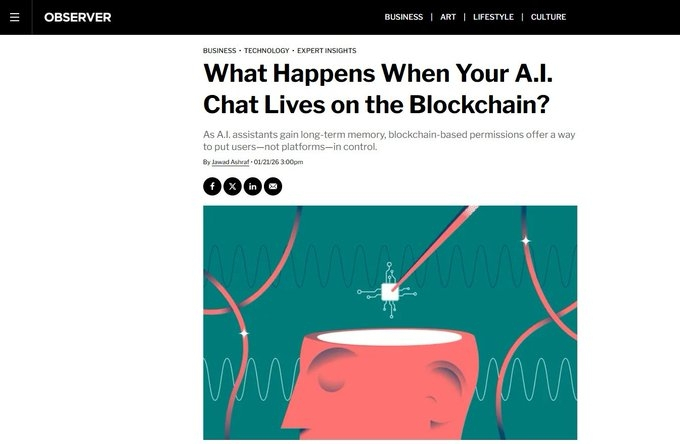
The AI Memory Crisis Every time you open a new conversation with an AI assistant, it has forgotten you. Your preferences, context, and previous work are gone. Every session starts from zero. This is a fundamental architectural limitation: AI systems do not have a persistent memory layer. Individual proprietary systems create lock-in; your memory lives on their servers, vulnerable to their policies and outages.

In August 2025, Vanar launched Neutron Personal. The pitch: what if your AI memory could live on-chain?
Private by default: Only you hold the decryption key.
Permanent: No server shutdown can erase what lives in a blockchain.
Interoperable: Any AI system can be given access to your on-chain memory Seeds without starting from scratch.
"Every conversation with AI starts from zero... Neutron Personal ends this madness." — Jawad Ashraf, CEO of Vanar
The product launched as a Chrome extension at vanarneutron.com, with Firefox, Edge, and Brave support following. It is the first on-chain AI memory layer, running on the same compression infrastructure as Neutron.
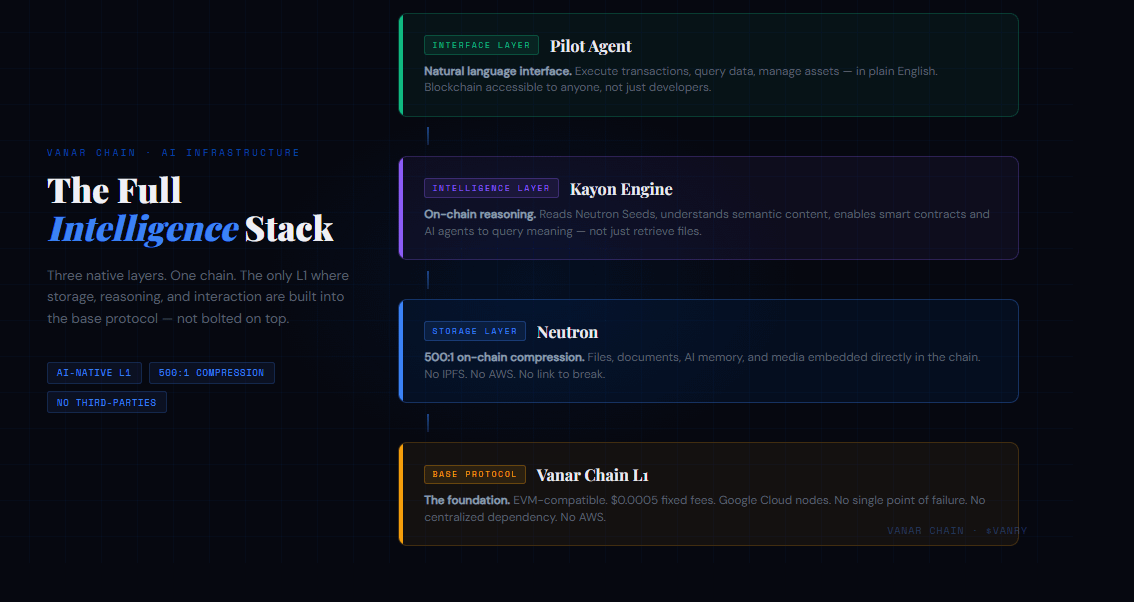
Kayon, Pilot Agent, and the Intelligence Stack Vanar's architecture assembles a complete AI intelligence stack:
Neutron: The storage/memory layer.
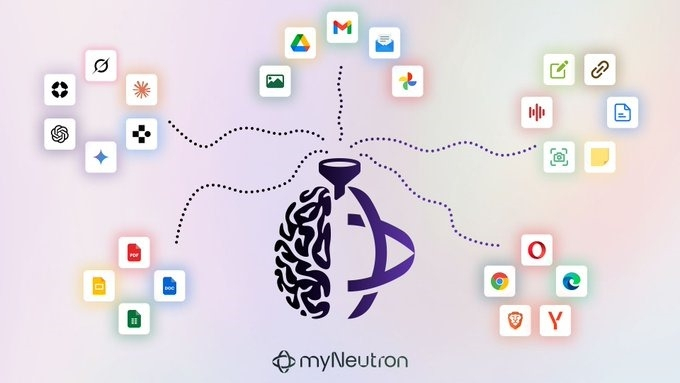
Kayon: The reasoning engine (the "brain") that reads Neutron Seeds and enables AI agents to interact with them. It connects to platforms like Gmail and Google Drive to turn personal info into structured on-chain knowledge.
Pilot Agent: Launched in October 2025, it provides a natural language interface, allowing users to execute transactions and query data through plain English.
These layers form what Vanar describes as the complete AI infrastructure stack for Web3. Unlike other "AI-native" chains where tools are built on top, Vanar integrates these layers into the base protocol.
The Ecosystem Behind the Technology
Worldpay: Processes trillions in volume; exploring Neutron seeds to make merchant disputes mathematically verifiable.
Google Cloud: Integrated through renewable-energy node infrastructure.
NVIDIA: Connected its CUDA-accelerated stack to enable high-performance seed generation.
Humanode: Integration of Biomapper C1 SDK (July 2025) adds biometric Sybil resistance for privacy-preserving user verification.
Gaming: World of Dypians has over 30,000 active players on Vanar.
The network processed over 12 million transactions in 2024 with more than 100 strategic partnerships. Fixed transaction fees are approximately $0.0005.
The VANRY Token and On-Chain Economics VANRY utility is structurally tied to the network:
Required for gas in every transaction, Neutron seed creation, Kayon query, and Pilot Agent interaction.
Powered by the subscription model for myNeutron.
Demand grows in parallel with network utility as users generate context, seeds, and sessions.
From Hosted Ownership to Real Ownership Vanar's answer to AWS outages and vanishing NFTs is a reconstruction of the assumption that data should live where consensus lives. When Jawad Ashraf demonstrated the video replay in Dubai, he was showing a model where the file, its meaning, and its proof of integrity live in the same place, controlled by no single party.
"It's a foundational shift from 'hosted ownership' to 'real ownership.'" — Jawad Ashraf
The question is no longer whether it works, but how long it will take the rest of the industry to catch up.