In Web3, everyone talks about speed. Faster transactions. Higher throughput. Lower latency. On paper, it sounds impressive. But if a network crashes during peak usage, all that speed is meaningless.
Real progress isn’t measured in transactions per second. It’s measured in trust, consistency, and the ability to perform when it matters most. And that’s exactly where Fogo is making a difference.
Most blockchains optimize for flashy performance metrics. They advertise how many transactions they can process per second or how quickly blocks are confirmed. But real-world systems — think banks, payment processors, and cloud providers — aren’t trusted because they’re flashy. They’re trusted because they’re reliable. They work when millions of people depend on them. They scale under pressure without failing.
Reliability isn’t exciting to talk about. It doesn’t make headlines. But it builds something far more valuable than hype: confidence. Builders trust the system. Users feel secure. Communities grow organically.
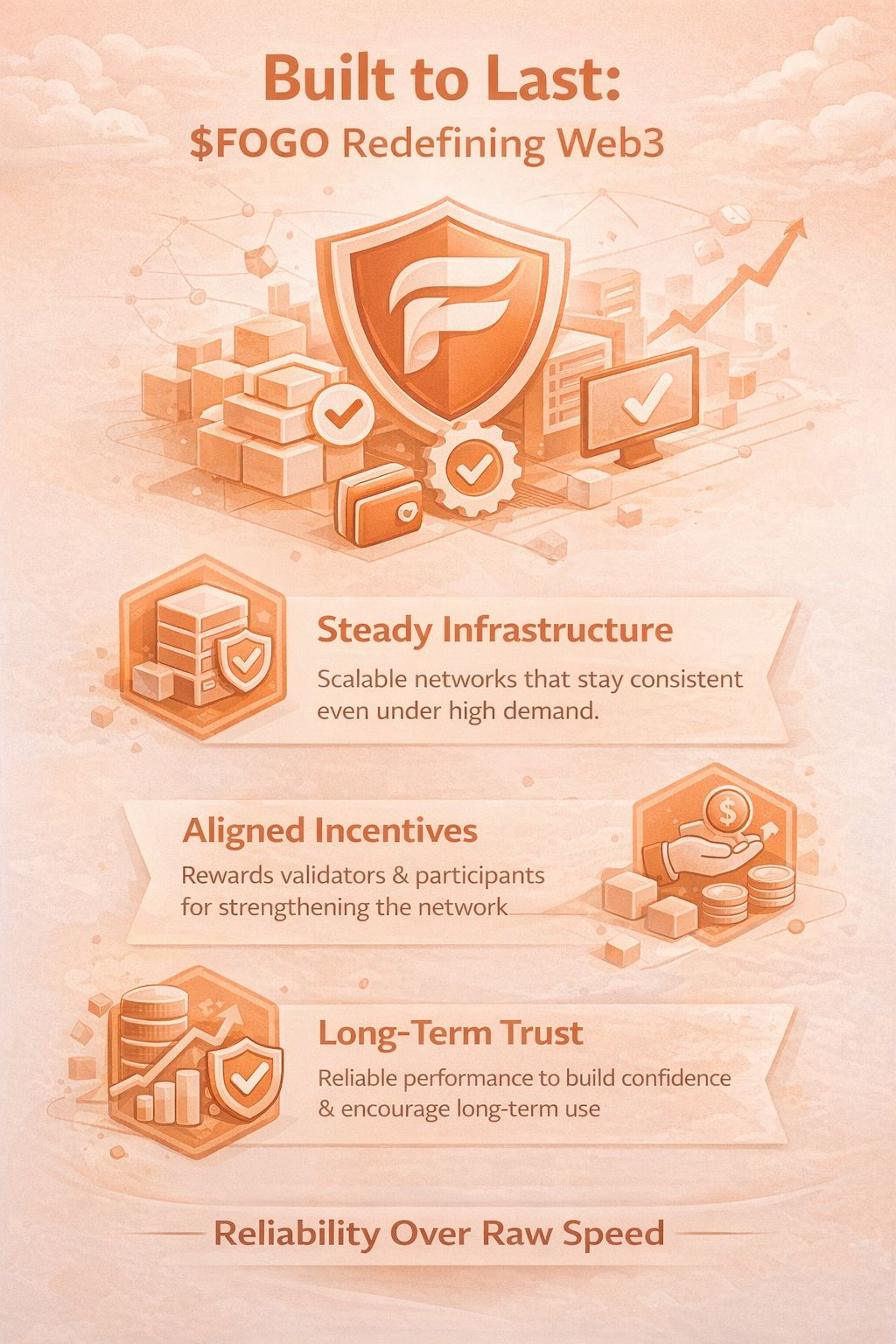
Fogo understands this. Instead of chasing the latest performance benchmarks, it focuses on creating steady, scalable infrastructure. One that doesn’t just work during quiet times, but thrives during high demand. When traffic surges, fees stay predictable. Transactions continue without failure. Developers can deploy applications knowing the system will hold up. That’s the kind of stability Web3 needs to mature.
Speed without reliability is like sprinting on ice — fast, risky, and likely to crash. Reliability, on the other hand, is endurance. It’s the ability to keep moving, consistently, even when the path gets challenging. That’s the mindset fogo brings to Web3 infrastructure.
Another critical piece is aligned incentives. A token shouldn’t just exist for speculation. Fogo integrates Fogo into the network’s operations, making it part of the system’s foundation. Validators are rewarded for securing the network. Participants are incentivized to engage responsibly. Long-term holders contribute to stability rather than chasing short-term gains. This alignment creates an ecosystem where growth is sustainable, not forced.
Think about how the internet evolved. Early systems promised speed and innovation, but only a few survived. The winners weren’t always the fastest—they were the most dependable. Developers built on platforms they could trust. Businesses adopted tools that worked consistently. Users returned to services they could rely on.
Web3 is following the same pattern. Temporary spikes in performance attract attention, but only reliable systems earn lasting adoption. If a blockchain wants to support gaming, AI, financial applications, or digital economies, it can’t rely on bursts of speed. It needs predictable performance. Infrastructure that holds under pressure. Networks that won’t fail when users depend on them the most.
$FOGO’s approach may not trend every week. It may not create viral headlines. But foundations rarely trend—they support everything else. By focusing on reliability, Fogo is setting the stage for long-term growth. Builders, developers, and users can plan for the future because the system can handle it.
Of course, no network is perfect. Every blockchain faces scaling challenges, governance decisions, and market cycles. But philosophy matters. Are you building for temporary attention or for enduring impact? Fogo chooses the latter. Its focus is on strengthening the core, preparing for the next wave of adoption, and ensuring the ecosystem can withstand stress while continuing to grow.
Over time, reliability compounds. Communities strengthen. Participation deepens. Developers commit for the long term. Users trust the network. That is how ecosystems mature, and that is how lasting value is created.
In crypto, speed grabs attention. But reliability earns loyalty. It builds real adoption. It creates ecosystems that survive when hype fades.
Fogo is more than just a token. It is part of a vision for a dependable Web3 future. A network that doesn’t just race ahead, but moves forward steadily, ensuring the foundation is strong enough to support everything built on top.
The lesson is simple: sprinting gets noticed. Endurance wins the race.
In the end, the question isn’t how fast a blockchain can move today. The question is whether it can still perform tomorrow, next year, and through the next market cycle.
Because real growth in Web3 doesn’t come from chasing speed. It comes from building something that lasts.$SAGA
#PEPEBrokeThroughDowntrendLine #TradeCryptosOnX #MarketRebound #fogo #LearnWithFatima @Fogo Official $FOGO $XAI