
Christiano_7
1.3k Posts

Christiano_7
Report
Block User
Open Trade
Frequent Trader
11.8 Months
302 Following
8.9K+ Followers
1.3K+ Liked
Posts
Portfolio
All
Quotes
Live
·
--
$TAC USDT posted an impressive +34.82% move.
Not every opportunity comes from the biggest names in crypto.
Sometimes the strongest percentage gains appear where few traders are looking.
Momentum remains the key factor to watch from here.
#TAC #TACUSDT #CryptoMarkets #Altcoins #Trading #PerpetualFutures #CryptoSignals #Blockchain
$TAC USDT posted an impressive +34.82% move.
Not every opportunity comes from the biggest names in crypto.
Sometimes the strongest percentage gains appear where few traders are looking.
Momentum remains the key factor to watch from here.
#TAC #TACUSDT #CryptoMarkets #Altcoins #Trading #PerpetualFutures #CryptoSignals #Blockchain
Not every opportunity comes from the biggest names in crypto.
Sometimes the strongest percentage gains appear where few traders are looking.
Momentum remains the key factor to watch from here.
#TAC #TACUSDT #CryptoMarkets #Altcoins #Trading #PerpetualFutures #CryptoSignals #Blockchain
92
·
--
$ESPORTS USDT continues to show strength with a +42.23% gain.
The gaming and esports narrative has been attracting attention again, and price action is starting to reflect growing interest.
Strong trends often start quietly before the crowd notices.
Keeping this one on the watchlist.
#ESPORTS #ESPORTSUSDT #GameFi #CryptonewswithJack #AltcoinSeason #CryptoTrader #Web3Gaming #CryptoX
$ESPORTS USDT continues to show strength with a +42.23% gain.
The gaming and esports narrative has been attracting attention again, and price action is starting to reflect growing interest.
Strong trends often start quietly before the crowd notices.
Keeping this one on the watchlist.
#ESPORTS #ESPORTSUSDT #GameFi #CryptonewswithJack #AltcoinSeason #CryptoTrader #Web3Gaming #CryptoX
The gaming and esports narrative has been attracting attention again, and price action is starting to reflect growing interest.
Strong trends often start quietly before the crowd notices.
Keeping this one on the watchlist.
#ESPORTS #ESPORTSUSDT #GameFi #CryptonewswithJack #AltcoinSeason #CryptoTrader #Web3Gaming #CryptoX
148
·
--
$AGT just delivered one of the strongest moves on the board.
While most traders were searching for momentum, AGTUSDT nearly doubled with a +99.31% surge.
Big moves like this remind us that crypto rewards patience, timing, and proper risk management.
The question now is simple:
Can AGT maintain this momentum, or is a cooldown coming next?
#AGT #AGTUSDT #CryptoTrading #Altcoins #CryptoMarket #Perpetuals #TradingView #CryptoCommunity
$AGT just delivered one of the strongest moves on the board.
While most traders were searching for momentum, AGTUSDT nearly doubled with a +99.31% surge.
Big moves like this remind us that crypto rewards patience, timing, and proper risk management.
The question now is simple:
Can AGT maintain this momentum, or is a cooldown coming next?
#AGT #AGTUSDT #CryptoTrading #Altcoins #CryptoMarket #Perpetuals #TradingView #CryptoCommunity
While most traders were searching for momentum, AGTUSDT nearly doubled with a +99.31% surge.
Big moves like this remind us that crypto rewards patience, timing, and proper risk management.
The question now is simple:
Can AGT maintain this momentum, or is a cooldown coming next?
#AGT #AGTUSDT #CryptoTrading #Altcoins #CryptoMarket #Perpetuals #TradingView #CryptoCommunity
2
416
·
--
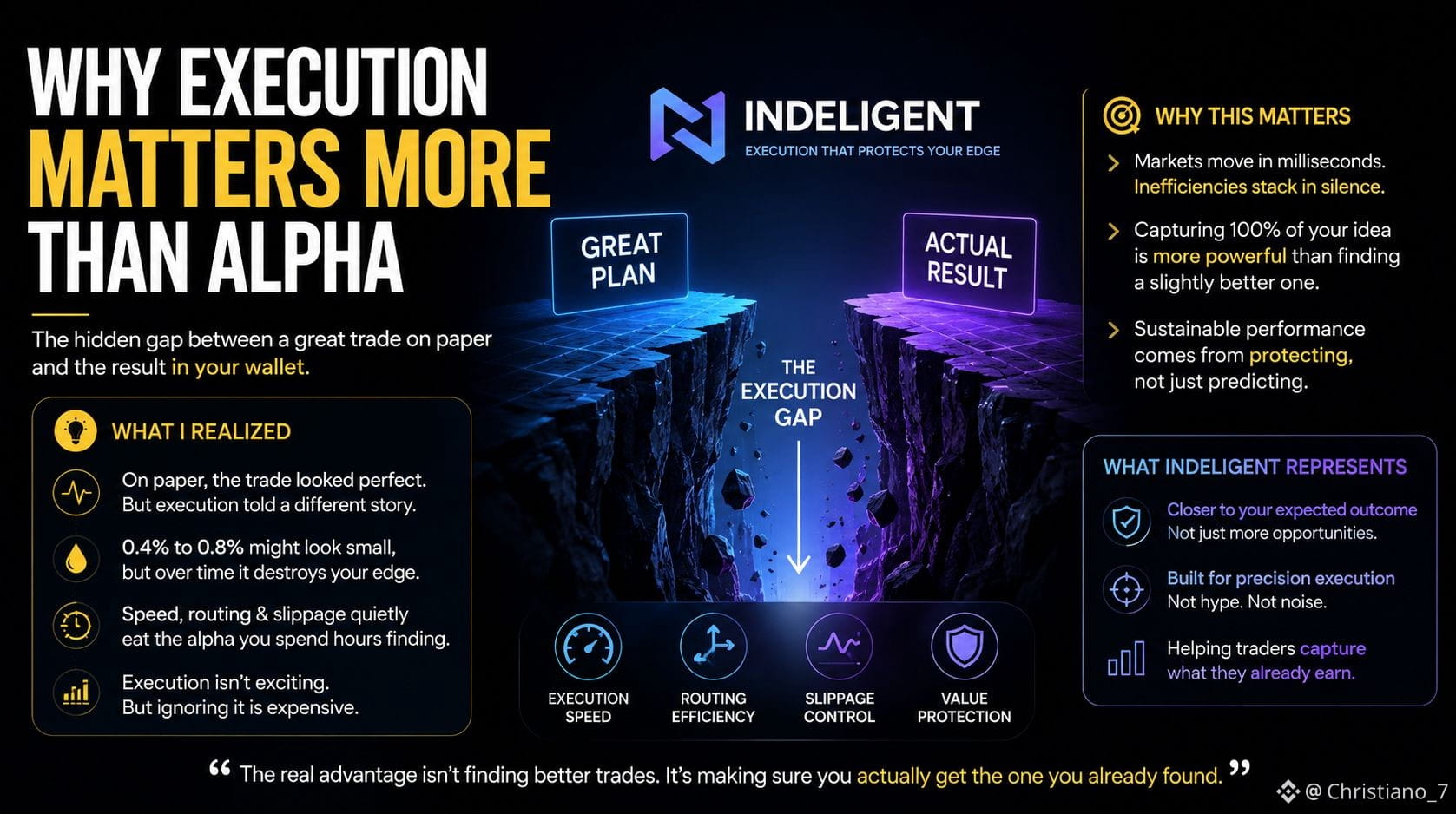
I used to think better trading meant finding smarter entries.
Lately, I’m not sure that’s the real game anymore.
After reviewing weeks of activity, something uncomfortable stood out: the market wasn’t taking most of my money. Friction was.
Small delays. Slightly worse fills. Routes that looked efficient until execution started. Nothing dramatic enough to notice in one trade, but enough to quietly compound.
That’s partly why Indeligent caught my attention.
Not because I automatically believe every claim. More because I keep asking myself a different question now:
Why are projects suddenly focusing so much on execution layers instead of only analytics?
Maybe the opportunity isn’t always in predicting better.
Maybe it’s in reducing how much value disappears between decision and action.
Still trying to figure out whether this shift is narrative-driven or an actual market need.
But the question feels more important than it did a few months ago.
#genius $GENIUS @GeniusOfficial
I used to think better trading meant finding smarter entries.
Lately, I’m not sure that’s the real game anymore.
After reviewing weeks of activity, something uncomfortable stood out: the market wasn’t taking most of my money. Friction was.
Small delays. Slightly worse fills. Routes that looked efficient until execution started. Nothing dramatic enough to notice in one trade, but enough to quietly compound.
That’s partly why Indeligent caught my attention.
Not because I automatically believe every claim. More because I keep asking myself a different question now:
Why are projects suddenly focusing so much on execution layers instead of only analytics?
Maybe the opportunity isn’t always in predicting better.
Maybe it’s in reducing how much value disappears between decision and action.
Still trying to figure out whether this shift is narrative-driven or an actual market need.
But the question feels more important than it did a few months ago.
#genius $GENIUS @GeniusOfficial
Lately, I’m not sure that’s the real game anymore.
After reviewing weeks of activity, something uncomfortable stood out: the market wasn’t taking most of my money. Friction was.
Small delays. Slightly worse fills. Routes that looked efficient until execution started. Nothing dramatic enough to notice in one trade, but enough to quietly compound.
That’s partly why Indeligent caught my attention.
Not because I automatically believe every claim. More because I keep asking myself a different question now:
Why are projects suddenly focusing so much on execution layers instead of only analytics?
Maybe the opportunity isn’t always in predicting better.
Maybe it’s in reducing how much value disappears between decision and action.
Still trying to figure out whether this shift is narrative-driven or an actual market need.
But the question feels more important than it did a few months ago.
#genius $GENIUS @GeniusOfficial
1
207
·
--
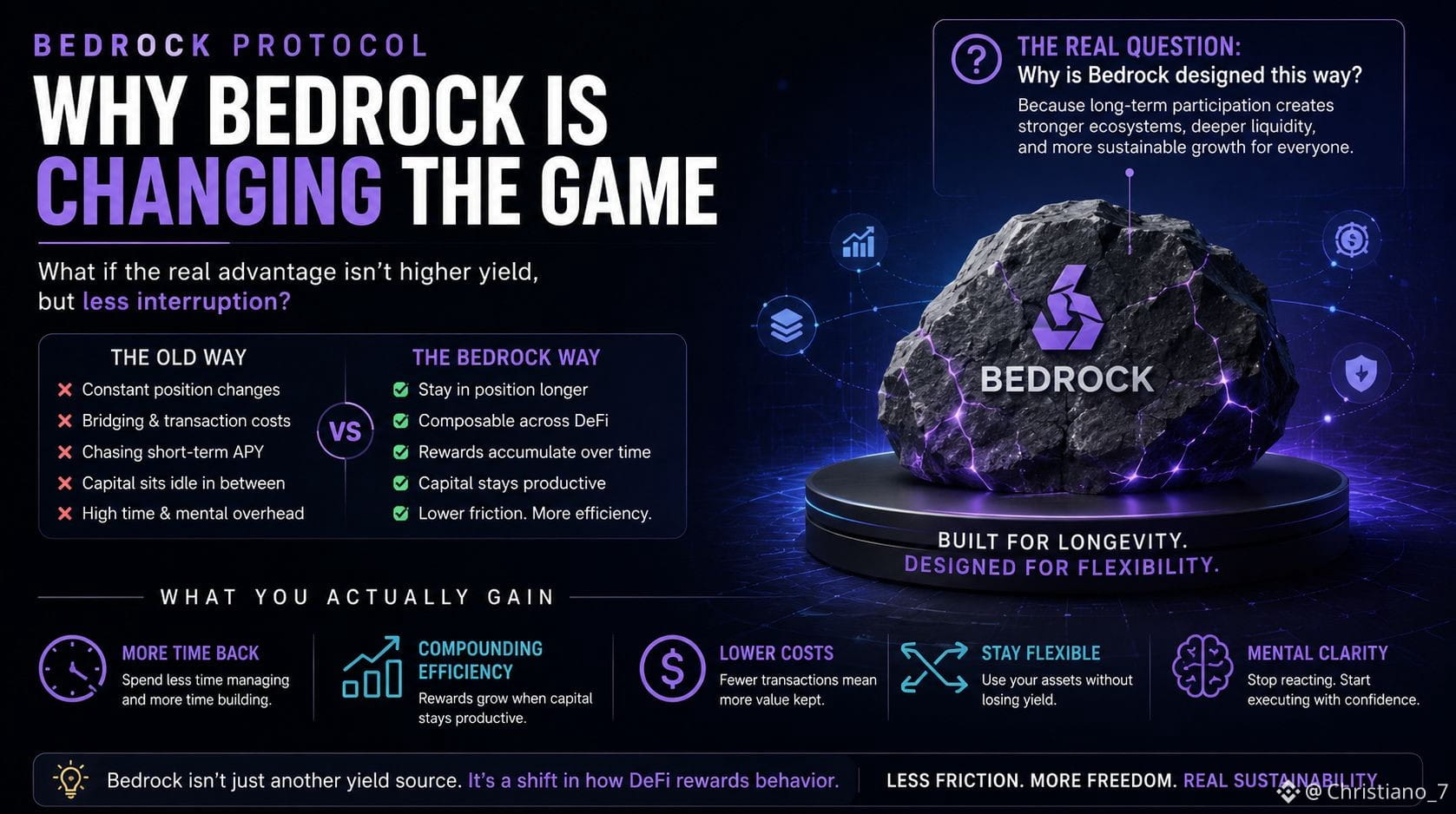
The part about Bedrock that keeps pulling me back isn’t the yield numbers themselves. It’s the question they quietly force me to ask:
Why are we still treating constant movement as a strategy?
Most DeFi users talk about maximizing returns, but spend half their time moving funds, checking incentives, bridging assets, and reacting to every new opportunity. At some point, optimization starts creating its own inefficiency.
What caught my attention with Bedrock is that it seems built around reducing decisions rather than creating more of them.
If capital stays useful while remaining flexible, the bigger advantage may not be APY at all. It may be attention.
Less repositioning. Less idle capital. Fewer moments where funds sit between strategies doing nothing.
Maybe the real signal here isn’t higher yield.
Maybe it’s protocols starting to compete on how little they ask users to interrupt themselves.
#bedrock $BR @Bedrock
The part about Bedrock that keeps pulling me back isn’t the yield numbers themselves. It’s the question they quietly force me to ask:
Why are we still treating constant movement as a strategy?
Most DeFi users talk about maximizing returns, but spend half their time moving funds, checking incentives, bridging assets, and reacting to every new opportunity. At some point, optimization starts creating its own inefficiency.
What caught my attention with Bedrock is that it seems built around reducing decisions rather than creating more of them.
If capital stays useful while remaining flexible, the bigger advantage may not be APY at all. It may be attention.
Less repositioning. Less idle capital. Fewer moments where funds sit between strategies doing nothing.
Maybe the real signal here isn’t higher yield.
Maybe it’s protocols starting to compete on how little they ask users to interrupt themselves.
#bedrock $BR @Bedrock
Why are we still treating constant movement as a strategy?
Most DeFi users talk about maximizing returns, but spend half their time moving funds, checking incentives, bridging assets, and reacting to every new opportunity. At some point, optimization starts creating its own inefficiency.
What caught my attention with Bedrock is that it seems built around reducing decisions rather than creating more of them.
If capital stays useful while remaining flexible, the bigger advantage may not be APY at all. It may be attention.
Less repositioning. Less idle capital. Fewer moments where funds sit between strategies doing nothing.
Maybe the real signal here isn’t higher yield.
Maybe it’s protocols starting to compete on how little they ask users to interrupt themselves.
#bedrock $BR @Bedrock
2
207
·
--
I keep noticing something weird about on-chain trading.
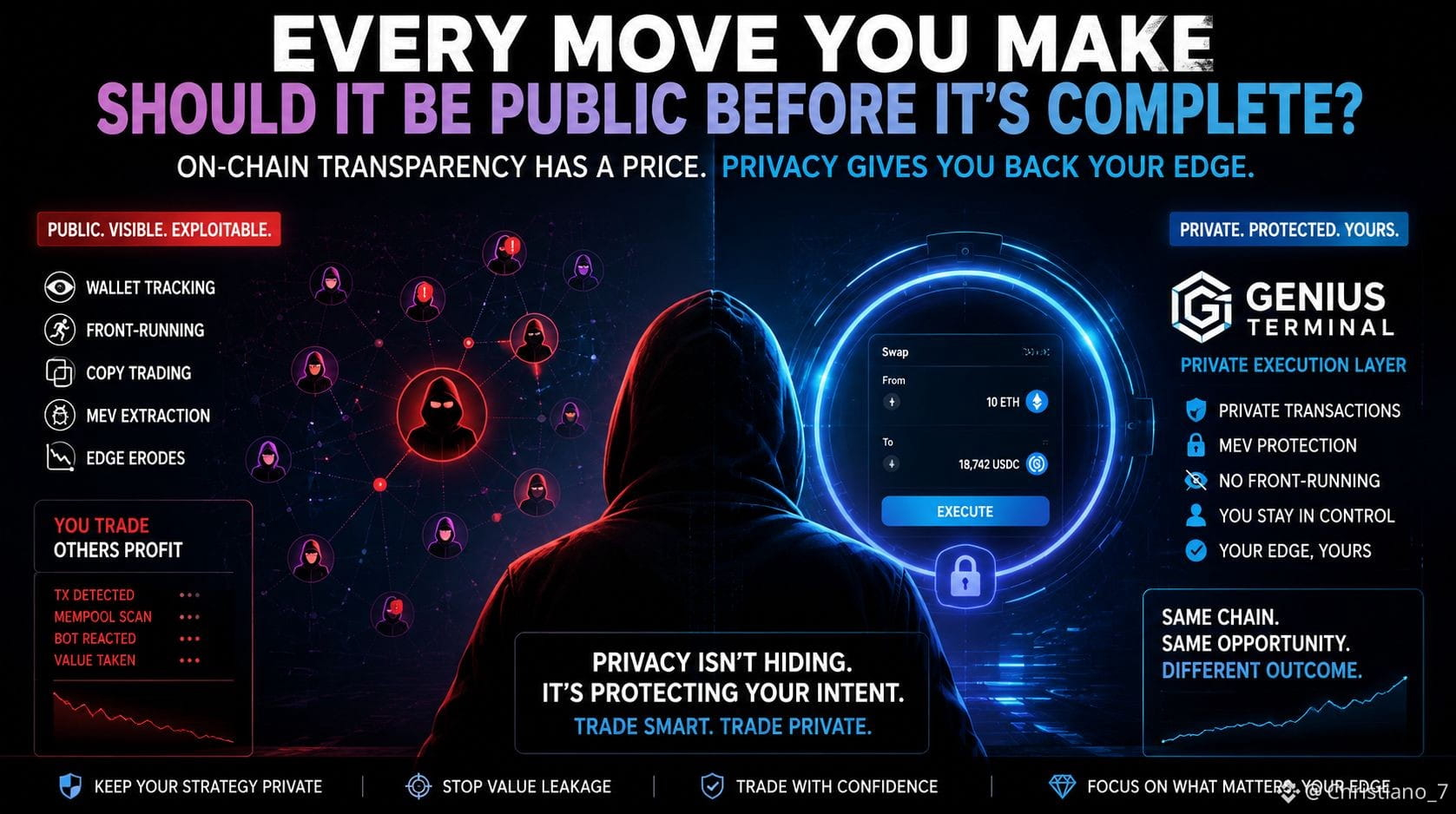
People spend hours researching entries, managing risk, building conviction — but very few ask what happens before the trade is finalized.
If transactions are visible early, and bots, trackers, or copy traders can react before execution, then is the competition really about better decisions anymore?
That’s the part I’m trying to understand.
Because when traders complain about bad execution, unexpected slippage, or losing edge over time, maybe the problem isn’t always strategy. Maybe some of the value disappears much earlier in the process.
This is why projects talking about private execution caught my attention recently.
Not because “privacy” sounds cool.
But because if more traders are moving on-chain, eventually people will ask a simple question:
Why should every move, every position, and every intention become public information before it’s even complete?
Maybe that’s the bigger conversation starting now.
#genius $GENIUS @GeniusOfficial
I keep noticing something weird about on-chain trading.
People spend hours researching entries, managing risk, building conviction — but very few ask what happens before the trade is finalized.
If transactions are visible early, and bots, trackers, or copy traders can react before execution, then is the competition really about better decisions anymore?
That’s the part I’m trying to understand.
Because when traders complain about bad execution, unexpected slippage, or losing edge over time, maybe the problem isn’t always strategy. Maybe some of the value disappears much earlier in the process.
This is why projects talking about private execution caught my attention recently.
Not because “privacy” sounds cool.
But because if more traders are moving on-chain, eventually people will ask a simple question:
Why should every move, every position, and every intention become public information before it’s even complete?
Maybe that’s the bigger conversation starting now.
#genius $GENIUS @GeniusOfficial
People spend hours researching entries, managing risk, building conviction — but very few ask what happens before the trade is finalized.
If transactions are visible early, and bots, trackers, or copy traders can react before execution, then is the competition really about better decisions anymore?
That’s the part I’m trying to understand.
Because when traders complain about bad execution, unexpected slippage, or losing edge over time, maybe the problem isn’t always strategy. Maybe some of the value disappears much earlier in the process.
This is why projects talking about private execution caught my attention recently.
Not because “privacy” sounds cool.
But because if more traders are moving on-chain, eventually people will ask a simple question:
Why should every move, every position, and every intention become public information before it’s even complete?
Maybe that’s the bigger conversation starting now.
#genius $GENIUS @GeniusOfficial
1
1
30
·
--
I stopped looking at Bedrock only through yields when I realized something simple: efficiency means very little if users cannot explain where the risk actually moved.
Most systems look strong when liquidity is flowing. The harder question is what happens when movement slows, incentives change, or stress finally shows up.
Bedrock talks about capital efficiency, routing, and productive assets. Fair enough. But I keep wondering about the layer underneath that story.
If assets move through multiple paths, where does complexity end and hidden exposure begin?
If losses appear somewhere in the stack, who feels them first?
And if users hold a liquid claim, how clearly can they understand what that claim really represents during bad conditions, not good ones?
Maybe this is exactly what Bedrock is trying to solve.
Or maybe it is showing something bigger happening across DeFi: systems becoming easier to use while becoming harder to inspect.
That gap is what I’m watching most closely.
#bedrock $BR @Bedrock
I stopped looking at Bedrock only through yields when I realized something simple: efficiency means very little if users cannot explain where the risk actually moved.
Most systems look strong when liquidity is flowing. The harder question is what happens when movement slows, incentives change, or stress finally shows up.
Bedrock talks about capital efficiency, routing, and productive assets. Fair enough. But I keep wondering about the layer underneath that story.
If assets move through multiple paths, where does complexity end and hidden exposure begin?
If losses appear somewhere in the stack, who feels them first?
And if users hold a liquid claim, how clearly can they understand what that claim really represents during bad conditions, not good ones?
Maybe this is exactly what Bedrock is trying to solve.
Or maybe it is showing something bigger happening across DeFi: systems becoming easier to use while becoming harder to inspect.
That gap is what I’m watching most closely.
#bedrock $BR @Bedrock
Most systems look strong when liquidity is flowing. The harder question is what happens when movement slows, incentives change, or stress finally shows up.
Bedrock talks about capital efficiency, routing, and productive assets. Fair enough. But I keep wondering about the layer underneath that story.
If assets move through multiple paths, where does complexity end and hidden exposure begin?
If losses appear somewhere in the stack, who feels them first?
And if users hold a liquid claim, how clearly can they understand what that claim really represents during bad conditions, not good ones?
Maybe this is exactly what Bedrock is trying to solve.
Or maybe it is showing something bigger happening across DeFi: systems becoming easier to use while becoming harder to inspect.
That gap is what I’m watching most closely.
#bedrock $BR @Bedrock

2
154
·
--
#genius $GENIUS @GeniusOfficial
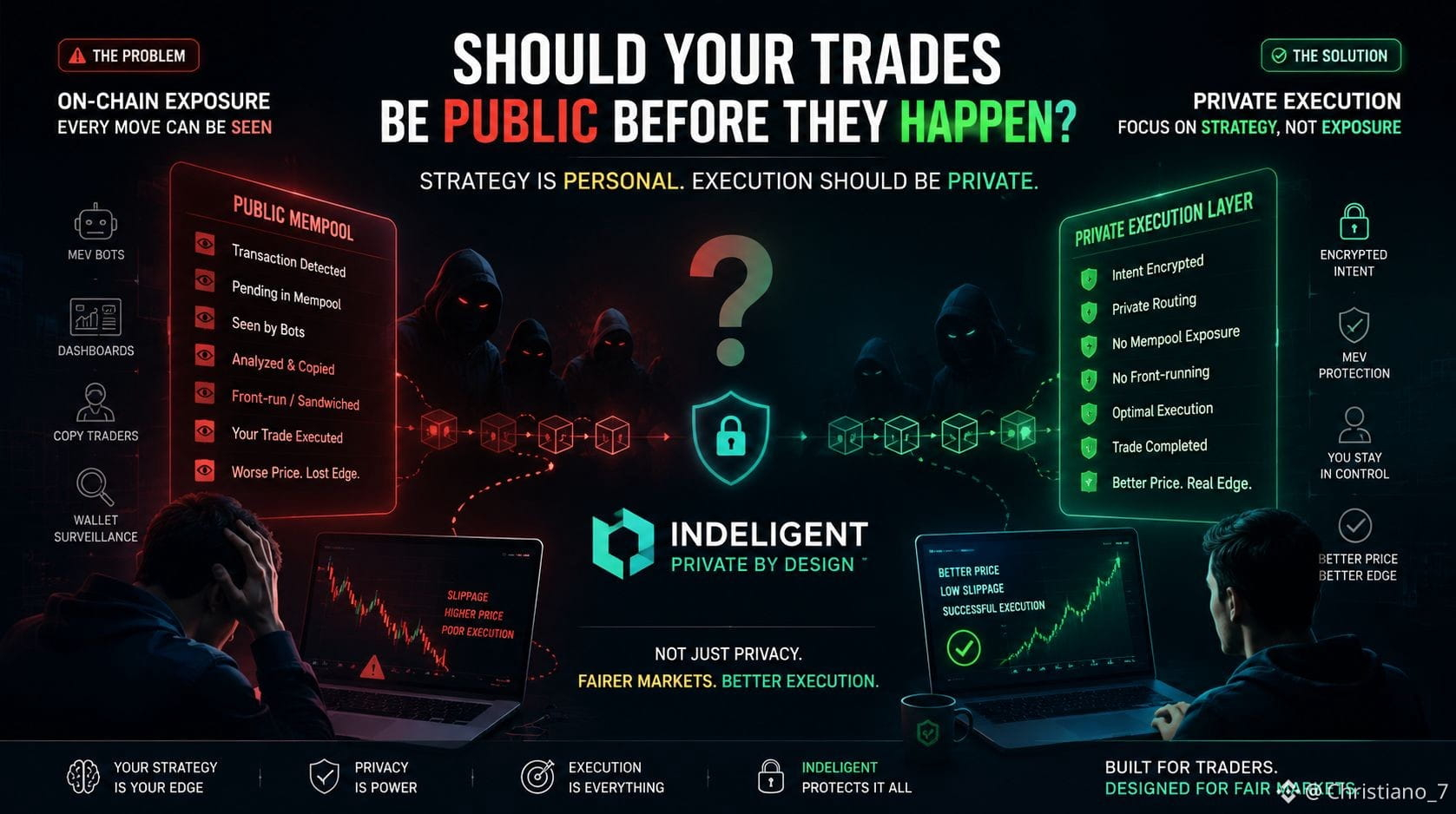
The longer I spend around on-chain traders, the more I notice something weird: people talk nonstop about finding alpha, but barely talk about protecting it.
Think about it. You spend hours researching, wait for the right setup, build conviction, and execute. But if your wallet activity, entries, and behavior are easy to watch, is the market really only competing on strategy anymore?
I’m not saying transparency is bad. Public systems create trust. But there’s a difference between transparent infrastructure and turning every action into public data before it’s even finished.
That’s partly why projects like Indeligent caught my attention. Not because “privacy” sounds cool, but because they seem to be asking a question more traders are quietly starting to ask:
Should execution quality depend only on skill, or also on how exposed you are?
Maybe the real issue isn’t visibility itself.
Maybe it’s how much unnecessary visibility we’ve accepted as normal.
#genius $GENIUS @GeniusOfficial
The longer I spend around on-chain traders, the more I notice something weird: people talk nonstop about finding alpha, but barely talk about protecting it.
Think about it. You spend hours researching, wait for the right setup, build conviction, and execute. But if your wallet activity, entries, and behavior are easy to watch, is the market really only competing on strategy anymore?
I’m not saying transparency is bad. Public systems create trust. But there’s a difference between transparent infrastructure and turning every action into public data before it’s even finished.
That’s partly why projects like Indeligent caught my attention. Not because “privacy” sounds cool, but because they seem to be asking a question more traders are quietly starting to ask:
Should execution quality depend only on skill, or also on how exposed you are?
Maybe the real issue isn’t visibility itself.
Maybe it’s how much unnecessary visibility we’ve accepted as normal.
The longer I spend around on-chain traders, the more I notice something weird: people talk nonstop about finding alpha, but barely talk about protecting it.
Think about it. You spend hours researching, wait for the right setup, build conviction, and execute. But if your wallet activity, entries, and behavior are easy to watch, is the market really only competing on strategy anymore?
I’m not saying transparency is bad. Public systems create trust. But there’s a difference between transparent infrastructure and turning every action into public data before it’s even finished.
That’s partly why projects like Indeligent caught my attention. Not because “privacy” sounds cool, but because they seem to be asking a question more traders are quietly starting to ask:
Should execution quality depend only on skill, or also on how exposed you are?
Maybe the real issue isn’t visibility itself.
Maybe it’s how much unnecessary visibility we’ve accepted as normal.
125
·
--
#bedrock $BR @Bedrock
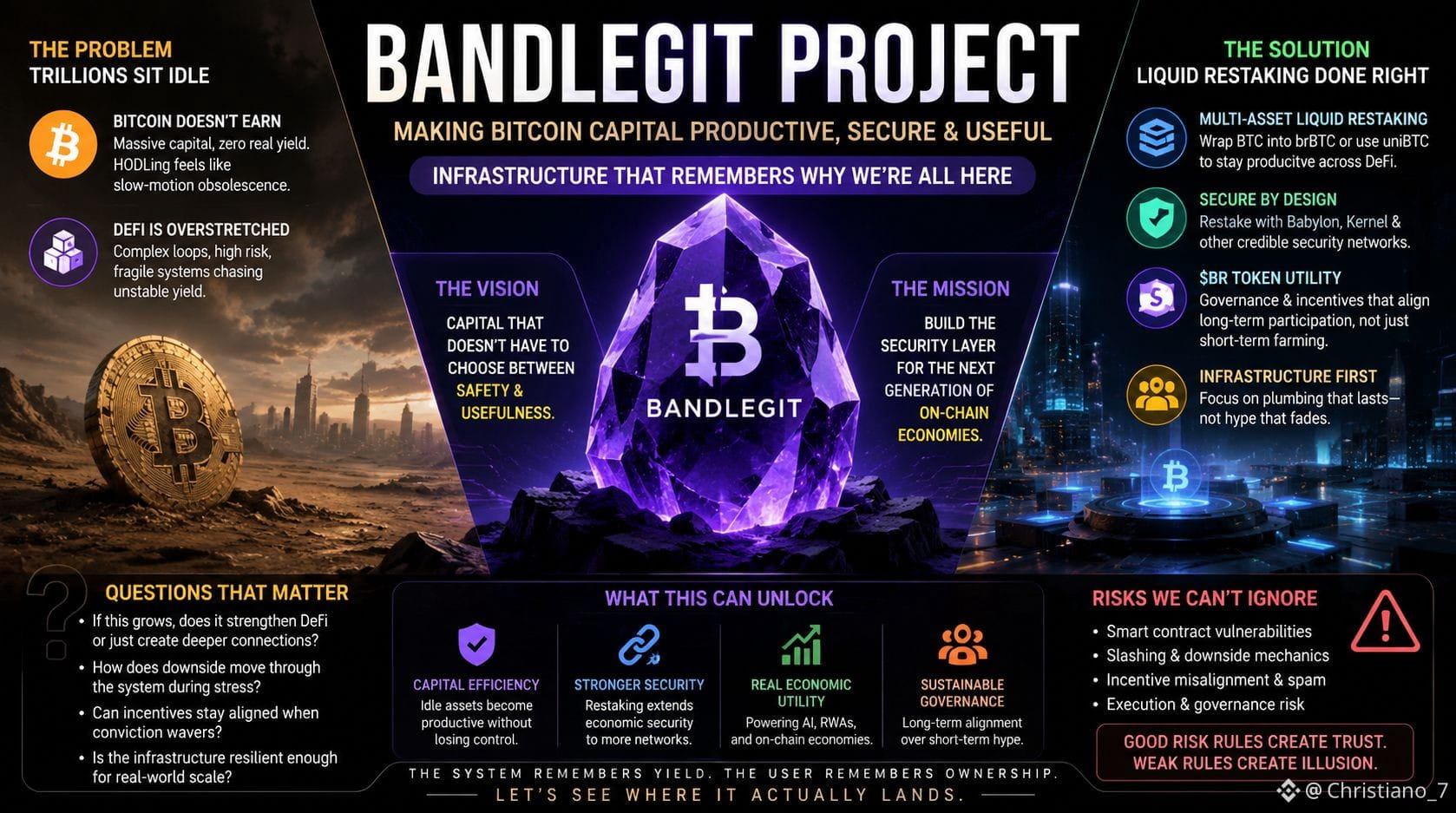
Everyone talks about making Bitcoin productive. Fewer people ask what happens when productivity starts adding layers nobody fully understands.
That’s what keeps pulling me back to Bedrock.
Not because “more yield” is a new story. It isn’t. The interesting part is the attempt to make idle capital useful without forcing holders to completely give up flexibility. That sounds simple until you realize every extra layer creates another place where risk can hide.
What I’m trying to understand is this: if Bedrock keeps pushing multi-asset restaking deeper into infrastructure, does it make DeFi stronger or just more connected in ways we haven’t stress-tested yet?
The part worth watching isn’t the rewards dashboard. It’s how downside moves through the system when conditions stop being friendly.
Good infrastructure usually looks boring before it looks important.
Maybe that’s the signal here.
#bedrock $BR @Bedrock
Everyone talks about making Bitcoin productive. Fewer people ask what happens when productivity starts adding layers nobody fully understands.
That’s what keeps pulling me back to Bedrock.
Not because “more yield” is a new story. It isn’t. The interesting part is the attempt to make idle capital useful without forcing holders to completely give up flexibility. That sounds simple until you realize every extra layer creates another place where risk can hide.
What I’m trying to understand is this: if Bedrock keeps pushing multi-asset restaking deeper into infrastructure, does it make DeFi stronger or just more connected in ways we haven’t stress-tested yet?
The part worth watching isn’t the rewards dashboard. It’s how downside moves through the system when conditions stop being friendly.
Good infrastructure usually looks boring before it looks important.
Maybe that’s the signal here.
Everyone talks about making Bitcoin productive. Fewer people ask what happens when productivity starts adding layers nobody fully understands.
That’s what keeps pulling me back to Bedrock.
Not because “more yield” is a new story. It isn’t. The interesting part is the attempt to make idle capital useful without forcing holders to completely give up flexibility. That sounds simple until you realize every extra layer creates another place where risk can hide.
What I’m trying to understand is this: if Bedrock keeps pushing multi-asset restaking deeper into infrastructure, does it make DeFi stronger or just more connected in ways we haven’t stress-tested yet?
The part worth watching isn’t the rewards dashboard. It’s how downside moves through the system when conditions stop being friendly.
Good infrastructure usually looks boring before it looks important.
Maybe that’s the signal here.
1
134
·
--
#genius $GENIUS @GeniusOfficial
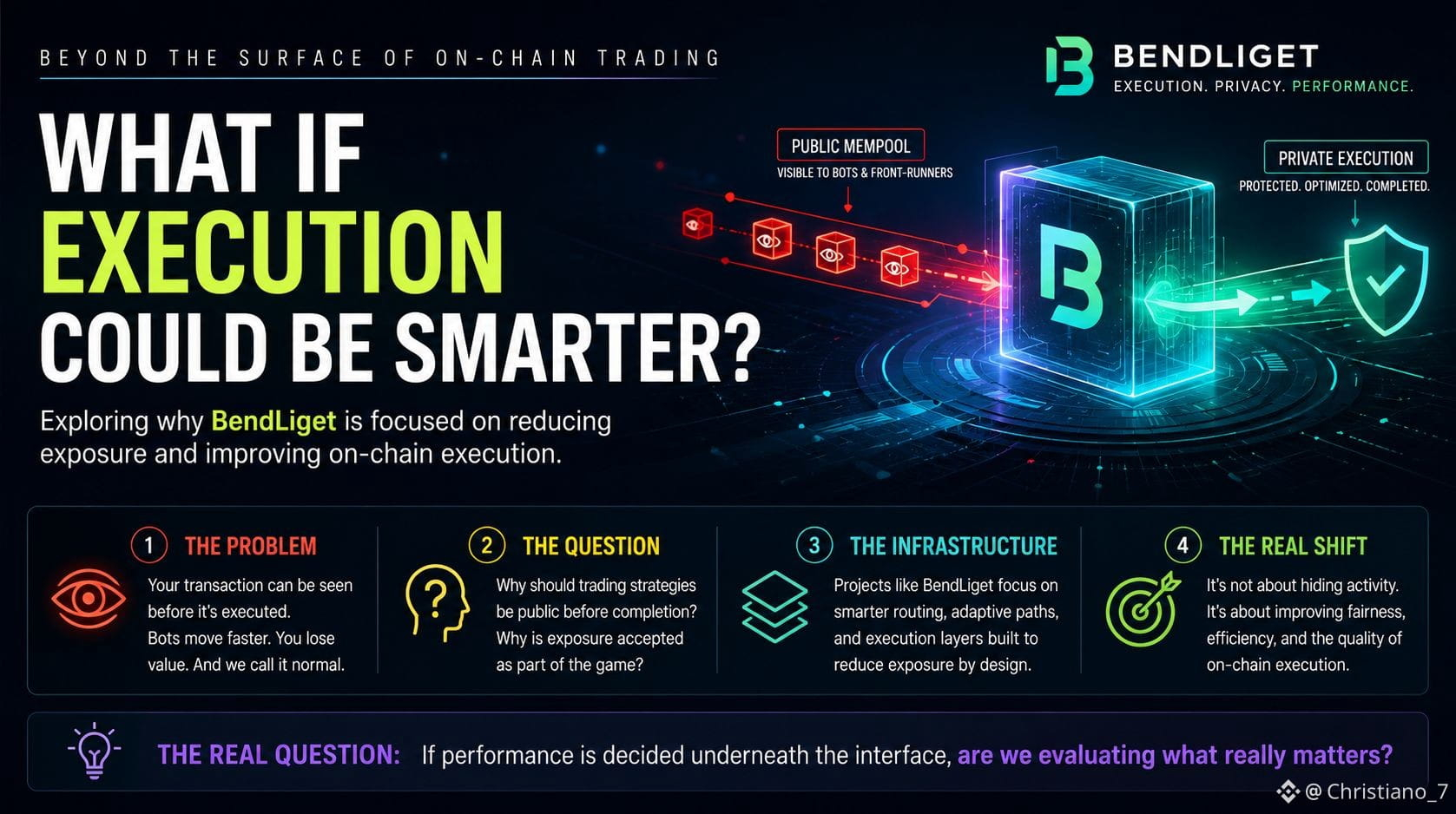
The more time I spend watching how on-chain trading actually behaves during busy market conditions, the less I think speed is the only problem.
Most people talk about better entries, lower fees, deeper liquidity. But what happens between clicking confirm and final execution rarely gets enough attention.
That’s why I started looking deeper into how projects like BendLiget approach execution infrastructure.
Not because “private” automatically means better.
What I’m trying to understand is this: if execution paths become smarter, routing becomes more adaptive, and exposure gets reduced before completion — does that change the quality of trading itself, or just hide the same problems behind better UX?
Sometimes infrastructure matters most when users barely notice it.
And maybe that’s the real question here.
If traders only see the interface, but performance is decided underneath it, are we evaluating products correctly — or only evaluating what’s visible?
#genius $GENIUS @GeniusOfficial
The more time I spend watching how on-chain trading actually behaves during busy market conditions, the less I think speed is the only problem.
Most people talk about better entries, lower fees, deeper liquidity. But what happens between clicking confirm and final execution rarely gets enough attention.
That’s why I started looking deeper into how projects like BendLiget approach execution infrastructure.
Not because “private” automatically means better.
What I’m trying to understand is this: if execution paths become smarter, routing becomes more adaptive, and exposure gets reduced before completion — does that change the quality of trading itself, or just hide the same problems behind better UX?
Sometimes infrastructure matters most when users barely notice it.
And maybe that’s the real question here.
If traders only see the interface, but performance is decided underneath it, are we evaluating products correctly — or only evaluating what’s visible?
The more time I spend watching how on-chain trading actually behaves during busy market conditions, the less I think speed is the only problem.
Most people talk about better entries, lower fees, deeper liquidity. But what happens between clicking confirm and final execution rarely gets enough attention.
That’s why I started looking deeper into how projects like BendLiget approach execution infrastructure.
Not because “private” automatically means better.
What I’m trying to understand is this: if execution paths become smarter, routing becomes more adaptive, and exposure gets reduced before completion — does that change the quality of trading itself, or just hide the same problems behind better UX?
Sometimes infrastructure matters most when users barely notice it.
And maybe that’s the real question here.
If traders only see the interface, but performance is decided underneath it, are we evaluating products correctly — or only evaluating what’s visible?
165
·
--
#genius $GENIUS @GeniusOfficial
Privacy in crypto still feels unfinished.
We talk about decentralization every day, yet most on-chain activity stays completely visible — wallets, trades, positions, and behavior patterns are often exposed for anyone watching.
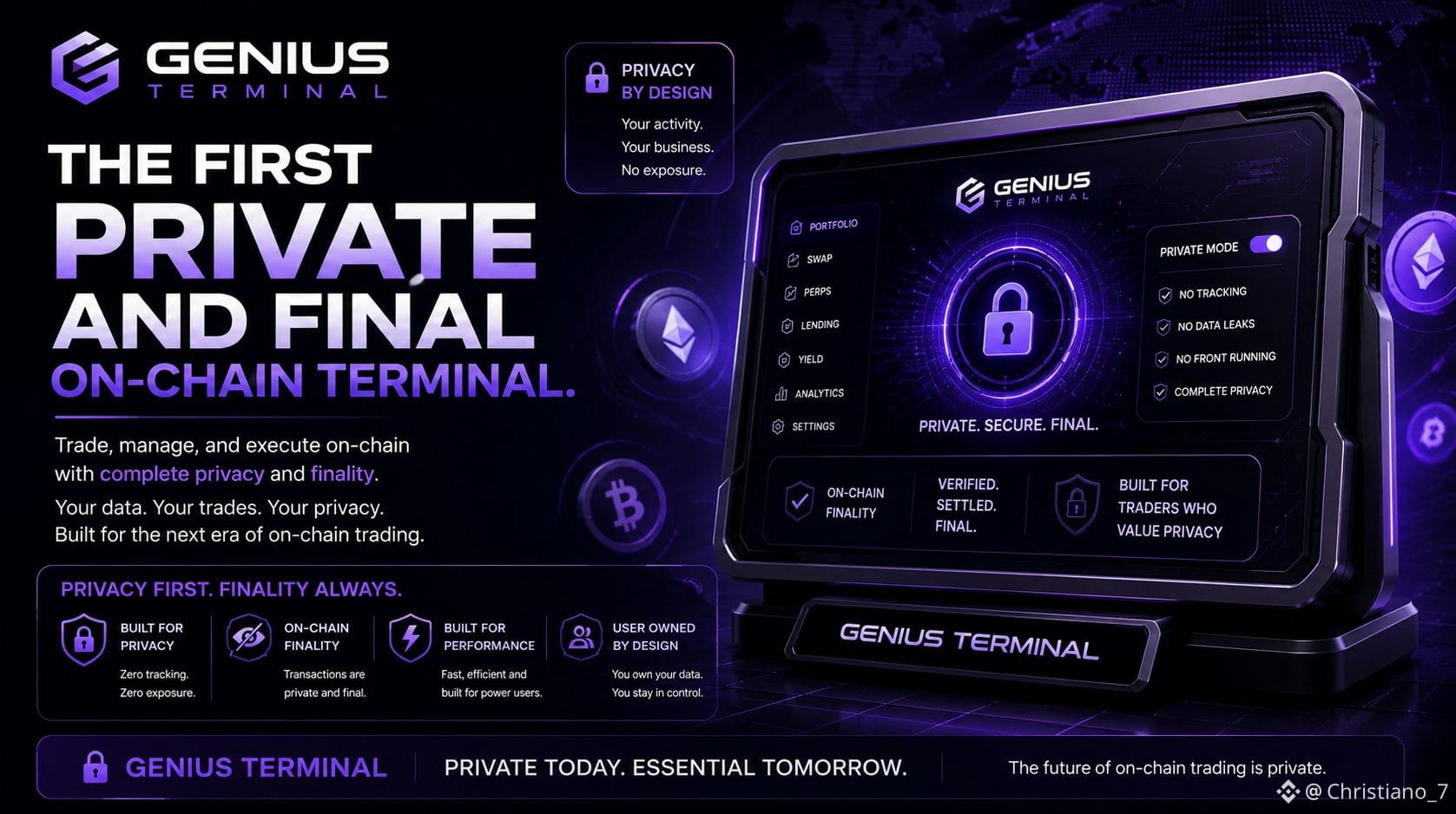
That’s why this statement stood out to me:
“Genius Terminal is the first private and final on-chain terminal.”
But it raises bigger questions.
Do traders actually need more tools — or do they need more privacy?
Should on-chain execution be transparent by default?
If privacy becomes standard infrastructure, how much does that change user behavior?
And in a world where data is value, who should really own your trading footprint?
The next generation of on-chain tools might not be about faster execution alone.
Maybe it’s about making privacy usable.
Because without privacy, is on-chain freedom really complete?
#genius $GENIUS @GeniusOfficial
Privacy in crypto still feels unfinished.
We talk about decentralization every day, yet most on-chain activity stays completely visible — wallets, trades, positions, and behavior patterns are often exposed for anyone watching.
That’s why this statement stood out to me:
“Genius Terminal is the first private and final on-chain terminal.”
But it raises bigger questions.
Do traders actually need more tools — or do they need more privacy?
Should on-chain execution be transparent by default?
If privacy becomes standard infrastructure, how much does that change user behavior?
And in a world where data is value, who should really own your trading footprint?
The next generation of on-chain tools might not be about faster execution alone.
Maybe it’s about making privacy usable.
Because without privacy, is on-chain freedom really complete?
Privacy in crypto still feels unfinished.
We talk about decentralization every day, yet most on-chain activity stays completely visible — wallets, trades, positions, and behavior patterns are often exposed for anyone watching.
That’s why this statement stood out to me:
“Genius Terminal is the first private and final on-chain terminal.”
But it raises bigger questions.
Do traders actually need more tools — or do they need more privacy?
Should on-chain execution be transparent by default?
If privacy becomes standard infrastructure, how much does that change user behavior?
And in a world where data is value, who should really own your trading footprint?
The next generation of on-chain tools might not be about faster execution alone.
Maybe it’s about making privacy usable.
Because without privacy, is on-chain freedom really complete?
150
·
--
#genius $GENIUS @GeniusOfficial
Most people say on-chain trading is about freedom. But if every wallet move, entry point, and behavior pattern is visible to everyone… how private is it really?
That’s what made me think about the idea behind Genius Terminal being called the first private and final on-chain terminal.
A few questions came to mind:
• Should traders really accept full transparency as the cost of being on-chain?
• If your wallet activity creates a public behavioral profile, who actually owns your data?
• Does privacy make on-chain trading safer, or does it create new risks?
• Why are we still using tools that expose positions and strategies by default?
• Is the future of on-chain trading more transparency… or selective privacy?
Maybe privacy isn’t just a feature anymore. Maybe it’s becoming infrastructure.
Curious how others see this — are we underestimating how much information we leak every day while trading?
#genius $GENIUS @GeniusOfficial
Most people say on-chain trading is about freedom. But if every wallet move, entry point, and behavior pattern is visible to everyone… how private is it really?
That’s what made me think about the idea behind Genius Terminal being called the first private and final on-chain terminal.
A few questions came to mind:
• Should traders really accept full transparency as the cost of being on-chain?
• If your wallet activity creates a public behavioral profile, who actually owns your data?
• Does privacy make on-chain trading safer, or does it create new risks?
• Why are we still using tools that expose positions and strategies by default?
• Is the future of on-chain trading more transparency… or selective privacy?
Maybe privacy isn’t just a feature anymore. Maybe it’s becoming infrastructure.
Curious how others see this — are we underestimating how much information we leak every day while trading?
Most people say on-chain trading is about freedom. But if every wallet move, entry point, and behavior pattern is visible to everyone… how private is it really?
That’s what made me think about the idea behind Genius Terminal being called the first private and final on-chain terminal.
A few questions came to mind:
• Should traders really accept full transparency as the cost of being on-chain?
• If your wallet activity creates a public behavioral profile, who actually owns your data?
• Does privacy make on-chain trading safer, or does it create new risks?
• Why are we still using tools that expose positions and strategies by default?
• Is the future of on-chain trading more transparency… or selective privacy?
Maybe privacy isn’t just a feature anymore. Maybe it’s becoming infrastructure.
Curious how others see this — are we underestimating how much information we leak every day while trading?

2
114
·
--
#genius $GENIUS @GeniusOfficial
Most traders say they moved on-chain for freedom. But if every wallet movement, every entry, every position, and every mistake is visible to everyone… how private is that freedom really?
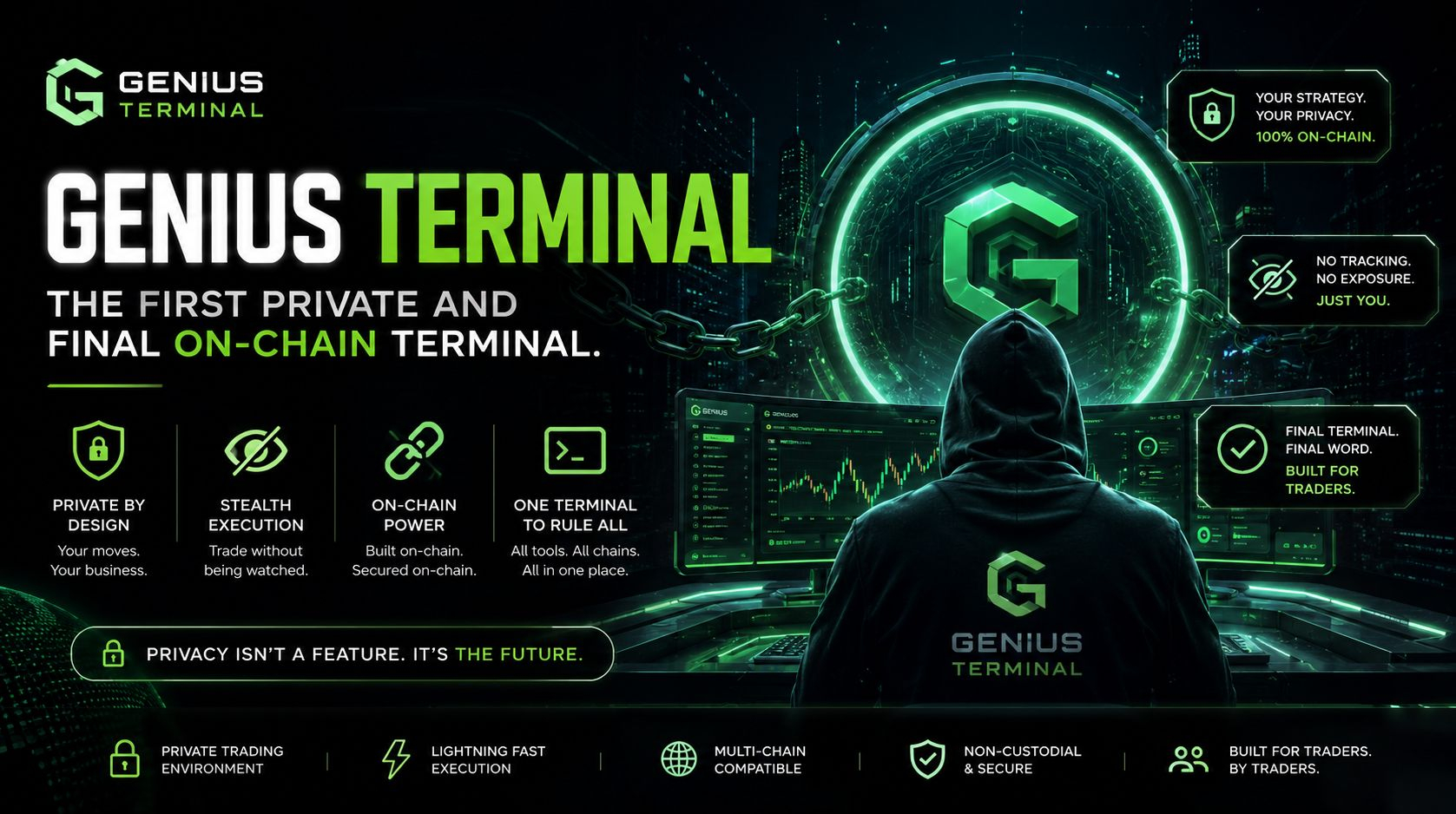
The idea behind Genius Terminal caught my attention because it pushes a different narrative:
“The first private and final on-chain terminal.”
And honestly, that raises bigger questions.
If transparency is good for networks, where should personal trading privacy begin?
Why are most traders still comfortable exposing their behavior patterns publicly?
Should on-chain tools focus only on speed and analytics, or should privacy become a core feature too?
What happens when your wallet history becomes your identity?
Maybe the next evolution of on-chain trading isn’t just faster execution.
Maybe it’s deciding who gets to watch in the first place.
#genius $GENIUS @GeniusOfficial
Most traders say they moved on-chain for freedom. But if every wallet movement, every entry, every position, and every mistake is visible to everyone… how private is that freedom really?
The idea behind Genius Terminal caught my attention because it pushes a different narrative:
“The first private and final on-chain terminal.”
And honestly, that raises bigger questions.
If transparency is good for networks, where should personal trading privacy begin?
Why are most traders still comfortable exposing their behavior patterns publicly?
Should on-chain tools focus only on speed and analytics, or should privacy become a core feature too?
What happens when your wallet history becomes your identity?
Maybe the next evolution of on-chain trading isn’t just faster execution.
Maybe it’s deciding who gets to watch in the first place.
Most traders say they moved on-chain for freedom. But if every wallet movement, every entry, every position, and every mistake is visible to everyone… how private is that freedom really?
The idea behind Genius Terminal caught my attention because it pushes a different narrative:
“The first private and final on-chain terminal.”
And honestly, that raises bigger questions.
If transparency is good for networks, where should personal trading privacy begin?
Why are most traders still comfortable exposing their behavior patterns publicly?
Should on-chain tools focus only on speed and analytics, or should privacy become a core feature too?
What happens when your wallet history becomes your identity?
Maybe the next evolution of on-chain trading isn’t just faster execution.
Maybe it’s deciding who gets to watch in the first place.
1
181
·
--
#genius $GENIUS @GeniusOfficial
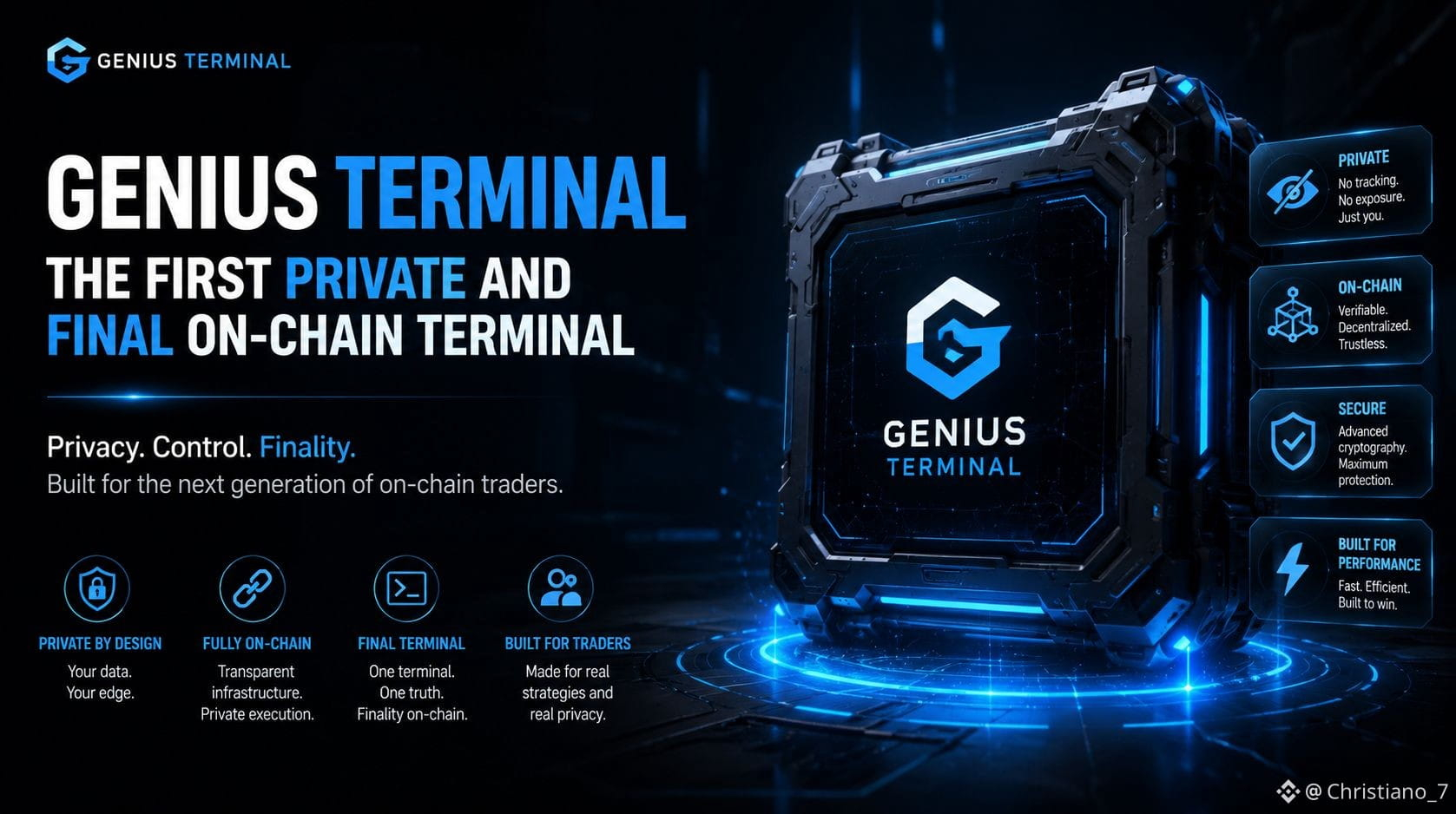
Genius Terminal calls itself the first private and final on-chain terminal — and that makes me think.
If crypto was built around ownership and control, why are most traders still exposing wallets, entries, positions, and behavior to anyone watching?
Are we actually trading on-chain… or just trading publicly with extra steps?
What happens when privacy becomes a feature traders expect instead of something optional?
And maybe the bigger question: if your strategy is valuable, should your on-chain footprint be visible to everyone?
Curious how people see this shift. Is private infrastructure the next step, or just another narrative?
#genius $GENIUS @GeniusOfficial
Genius Terminal calls itself the first private and final on-chain terminal — and that makes me think.
If crypto was built around ownership and control, why are most traders still exposing wallets, entries, positions, and behavior to anyone watching?
Are we actually trading on-chain… or just trading publicly with extra steps?
What happens when privacy becomes a feature traders expect instead of something optional?
And maybe the bigger question: if your strategy is valuable, should your on-chain footprint be visible to everyone?
Curious how people see this shift. Is private infrastructure the next step, or just another narrative?
Genius Terminal calls itself the first private and final on-chain terminal — and that makes me think.
If crypto was built around ownership and control, why are most traders still exposing wallets, entries, positions, and behavior to anyone watching?
Are we actually trading on-chain… or just trading publicly with extra steps?
What happens when privacy becomes a feature traders expect instead of something optional?
And maybe the bigger question: if your strategy is valuable, should your on-chain footprint be visible to everyone?
Curious how people see this shift. Is private infrastructure the next step, or just another narrative?
118
·
--
Bullish
#genius $GENIUS @GeniusOfficial
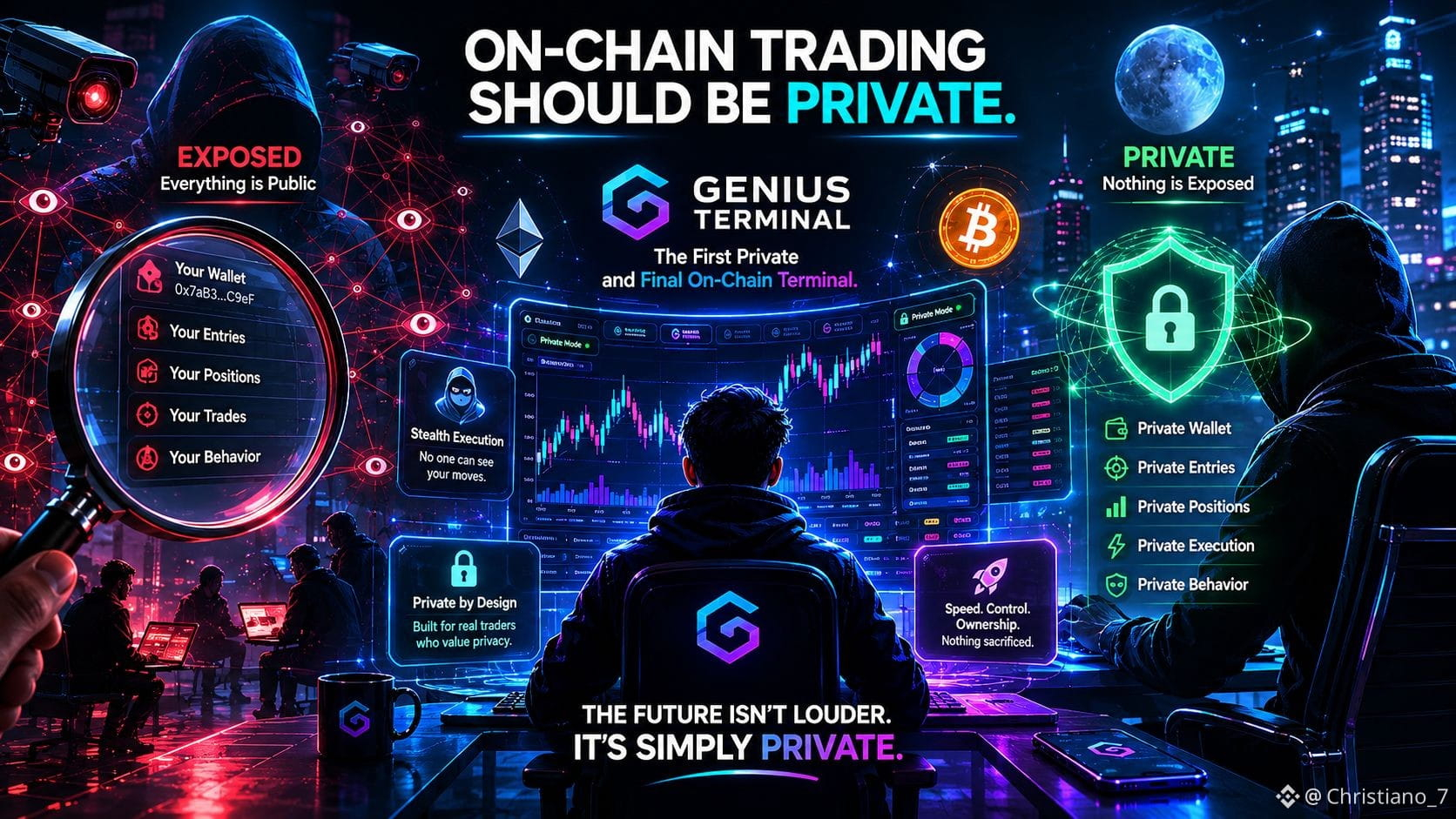
Most crypto traders still use tools that expose everything.
Your wallet.
Your entries.
Your positions.
Your behavior.
And honestly… that’s crazy when you really think about it.
We moved from centralized exchanges because people wanted control over their assets. But somehow, most on-chain activity still feels completely transparent to everyone watching.
That’s why the idea behind Genius Terminal caught my attention.
“The first private and final on-chain terminal.”
Not another dashboard pretending to be “advanced.”
Not another terminal farming attention with flashy features.
The real question is:
What happens when traders finally get privacy on-chain without sacrificing speed or control?
Because the current system feels broken.
Why should every move a trader makes become public data?
Why should wallets turn into open books?
Why are we acting like financial surveillance is normal in crypto?
Most people only realize this problem after getting copied, tracked, or hunted by bots.
And maybe that’s the bigger shift happening now.
People don’t just want better tools anymore.
They want invisible infrastructure.
Quiet execution.
Private positioning.
Real ownership.
Maybe the future of on-chain trading isn’t louder.
Maybe it’s simply private.
What do you think?
Does on-chain trading actually need privacy layers now?
Or do most traders still underestimate how exposed they already are?
#genius $GENIUS @GeniusOfficial
Most crypto traders still use tools that expose everything.
Your wallet.
Your entries.
Your positions.
Your behavior.
And honestly… that’s crazy when you really think about it.
We moved from centralized exchanges because people wanted control over their assets. But somehow, most on-chain activity still feels completely transparent to everyone watching.
That’s why the idea behind Genius Terminal caught my attention.
“The first private and final on-chain terminal.”
Not another dashboard pretending to be “advanced.”
Not another terminal farming attention with flashy features.
The real question is:
What happens when traders finally get privacy on-chain without sacrificing speed or control?
Because the current system feels broken.
Why should every move a trader makes become public data?
Why should wallets turn into open books?
Why are we acting like financial surveillance is normal in crypto?
Most people only realize this problem after getting copied, tracked, or hunted by bots.
And maybe that’s the bigger shift happening now.
People don’t just want better tools anymore.
They want invisible infrastructure.
Quiet execution.
Private positioning.
Real ownership.
Maybe the future of on-chain trading isn’t louder.
Maybe it’s simply private.
What do you think?
Does on-chain trading actually need privacy layers now?
Or do most traders still underestimate how exposed they already are?
Most crypto traders still use tools that expose everything.
Your wallet.
Your entries.
Your positions.
Your behavior.
And honestly… that’s crazy when you really think about it.
We moved from centralized exchanges because people wanted control over their assets. But somehow, most on-chain activity still feels completely transparent to everyone watching.
That’s why the idea behind Genius Terminal caught my attention.
“The first private and final on-chain terminal.”
Not another dashboard pretending to be “advanced.”
Not another terminal farming attention with flashy features.
The real question is:
What happens when traders finally get privacy on-chain without sacrificing speed or control?
Because the current system feels broken.
Why should every move a trader makes become public data?
Why should wallets turn into open books?
Why are we acting like financial surveillance is normal in crypto?
Most people only realize this problem after getting copied, tracked, or hunted by bots.
And maybe that’s the bigger shift happening now.
People don’t just want better tools anymore.
They want invisible infrastructure.
Quiet execution.
Private positioning.
Real ownership.
Maybe the future of on-chain trading isn’t louder.
Maybe it’s simply private.
What do you think?
Does on-chain trading actually need privacy layers now?
Or do most traders still underestimate how exposed they already are?
116
·
--
#genius $GENIUS @GeniusOfficial
Most people entered crypto because they wanted freedom.
No banks in the middle. No platform controlling your money. Just you and your wallet.
And honestly, DeFi did change the game.
Self-custody gave users real ownership for the first time.
But the deeper people go on-chain, the weirder one problem starts to feel:
Why is everything so visible?
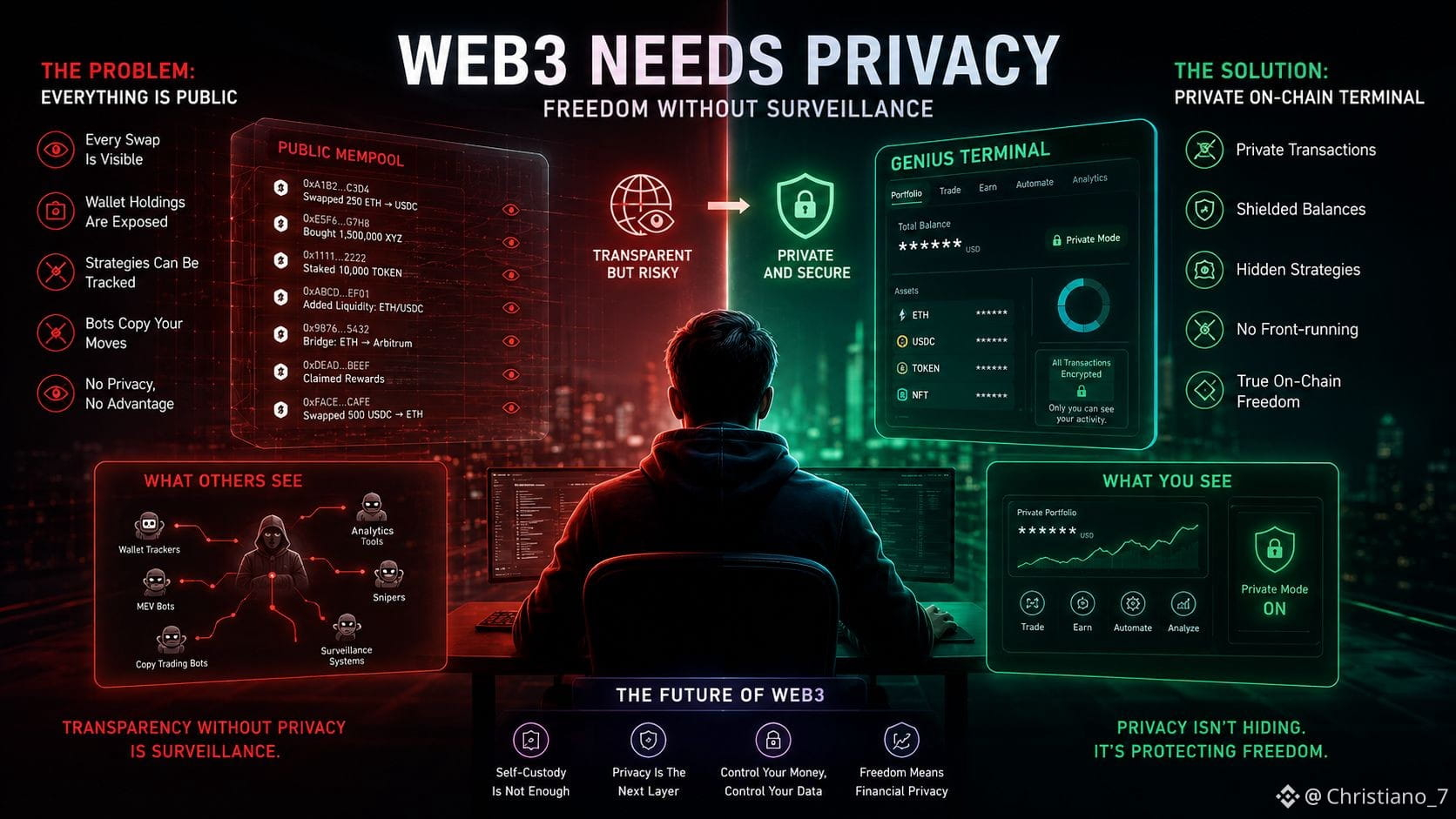
Every swap, every position, every farming strategy, every wallet rotation… all public.
Sometimes it feels like the moment a smart wallet buys something, trackers and bots appear seconds later.
Is that really the future we wanted for Web3?
We talk a lot about decentralization, but almost nobody talks enough about privacy.
And now users are doing way more than simple swaps.
People are staking across chains, automating strategies, managing multiple wallets, farming yields, trading from terminals all day long.
A terminal is no longer just a chart screen.
It’s basically the control center of a user’s entire on-chain life.
So the real question becomes:
Should every move inside that system be visible to everyone?
Because transparency sounds good in theory… until your activity becomes data for bots, trackers, and random strangers watching wallets all day.
That’s why I think privacy infrastructure will become one of the most important narratives in Web3.
And honestly, this is why projects like Genius are starting to make more sense to me.
Not just another trading platform — but a private on-chain terminal built for people who don’t want every action exposed publicly.
In the future, I don’t think users will only care about speed and low fees.
They’ll care about something simpler:
Can I operate on-chain comfortably without feeling watched all the time?
What do you think?
Is full transparency actually good for Web3 users?
Or did crypto accidentally normalize financial surveillance?
#genius $GENIUS @GeniusOfficial
Most people entered crypto because they wanted freedom.
No banks in the middle. No platform controlling your money. Just you and your wallet.
And honestly, DeFi did change the game.
Self-custody gave users real ownership for the first time.
But the deeper people go on-chain, the weirder one problem starts to feel:
Why is everything so visible?
Every swap, every position, every farming strategy, every wallet rotation… all public.
Sometimes it feels like the moment a smart wallet buys something, trackers and bots appear seconds later.
Is that really the future we wanted for Web3?
We talk a lot about decentralization, but almost nobody talks enough about privacy.
And now users are doing way more than simple swaps.
People are staking across chains, automating strategies, managing multiple wallets, farming yields, trading from terminals all day long.
A terminal is no longer just a chart screen.
It’s basically the control center of a user’s entire on-chain life.
So the real question becomes:
Should every move inside that system be visible to everyone?
Because transparency sounds good in theory… until your activity becomes data for bots, trackers, and random strangers watching wallets all day.
That’s why I think privacy infrastructure will become one of the most important narratives in Web3.
And honestly, this is why projects like Genius are starting to make more sense to me.
Not just another trading platform — but a private on-chain terminal built for people who don’t want every action exposed publicly.
In the future, I don’t think users will only care about speed and low fees.
They’ll care about something simpler:
Can I operate on-chain comfortably without feeling watched all the time?
What do you think?
Is full transparency actually good for Web3 users?
Or did crypto accidentally normalize financial surveillance?
Most people entered crypto because they wanted freedom.
No banks in the middle. No platform controlling your money. Just you and your wallet.
And honestly, DeFi did change the game.
Self-custody gave users real ownership for the first time.
But the deeper people go on-chain, the weirder one problem starts to feel:
Why is everything so visible?
Every swap, every position, every farming strategy, every wallet rotation… all public.
Sometimes it feels like the moment a smart wallet buys something, trackers and bots appear seconds later.
Is that really the future we wanted for Web3?
We talk a lot about decentralization, but almost nobody talks enough about privacy.
And now users are doing way more than simple swaps.
People are staking across chains, automating strategies, managing multiple wallets, farming yields, trading from terminals all day long.
A terminal is no longer just a chart screen.
It’s basically the control center of a user’s entire on-chain life.
So the real question becomes:
Should every move inside that system be visible to everyone?
Because transparency sounds good in theory… until your activity becomes data for bots, trackers, and random strangers watching wallets all day.
That’s why I think privacy infrastructure will become one of the most important narratives in Web3.
And honestly, this is why projects like Genius are starting to make more sense to me.
Not just another trading platform — but a private on-chain terminal built for people who don’t want every action exposed publicly.
In the future, I don’t think users will only care about speed and low fees.
They’ll care about something simpler:
Can I operate on-chain comfortably without feeling watched all the time?
What do you think?
Is full transparency actually good for Web3 users?
Or did crypto accidentally normalize financial surveillance?
136
·
--
#genius $GENIUS @GeniusOfficial Most people entered crypto because they wanted freedom.
No banks in the middle. No platform controlling your money. Just you and your wallet.
And honestly, DeFi did change the game.
Self-custody gave users real ownership for the first time.
But the deeper people go on-chain, the weirder one problem starts to feel:
Why is everything so visible?
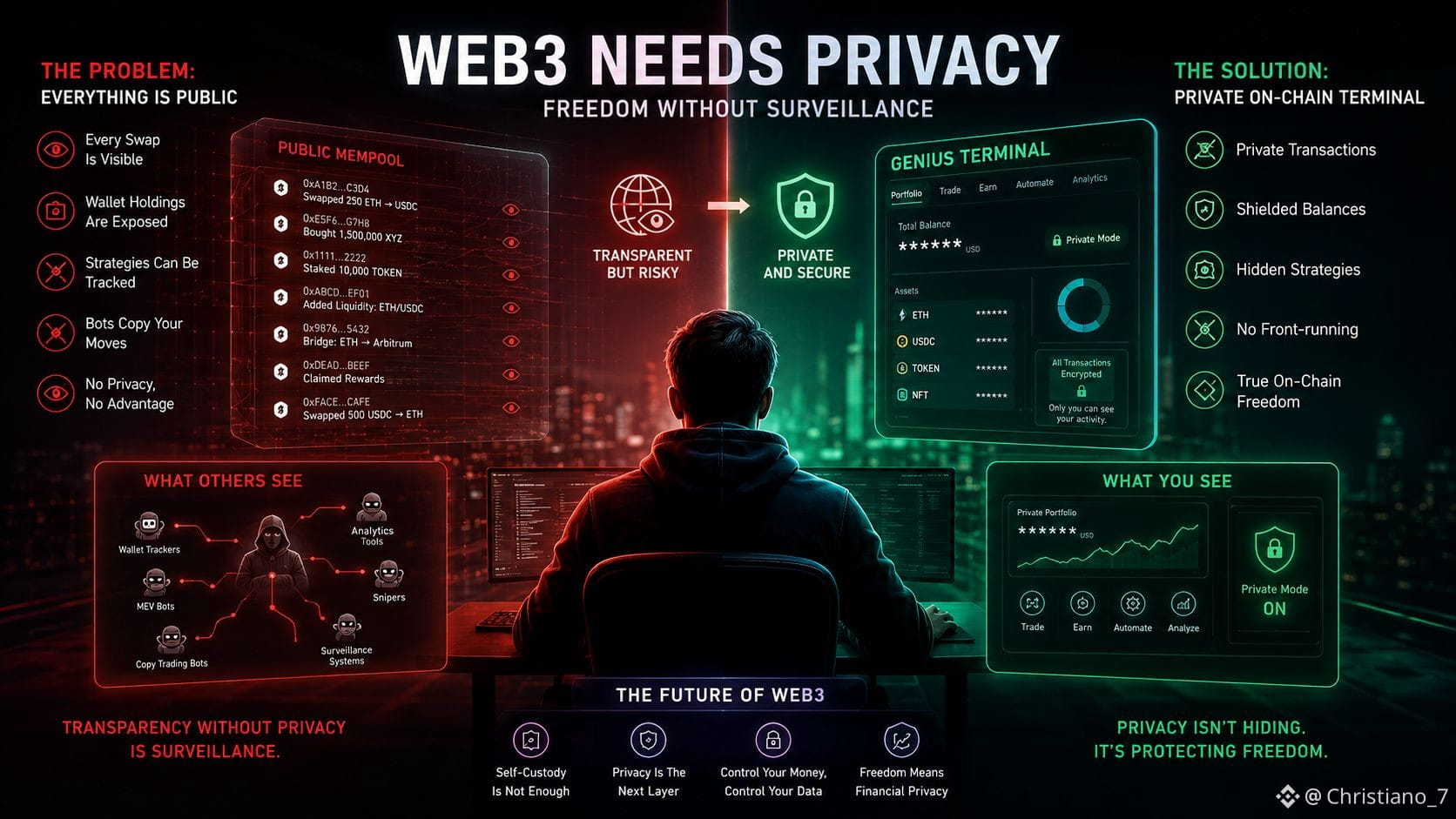
Every swap, every position, every farming strategy, every wallet rotation… all public.
Sometimes it feels like the moment a smart wallet buys something, trackers and bots appear seconds later.
Is that really the future we wanted for Web3?
We talk a lot about decentralization, but almost nobody talks enough about privacy.
And now users are doing way more than simple swaps.
People are staking across chains, automating strategies, managing multiple wallets, farming yields, trading from terminals all day long.
A terminal is no longer just a chart screen.
It’s basically the control center of a user’s entire on-chain life.
So the real question becomes:
Should every move inside that system be visible to everyone?
Because transparency sounds good in theory… until your activity becomes data for bots, trackers, and random strangers watching wallets all day.
That’s why I think privacy infrastructure will become one of the most important narratives in Web3.
And honestly, this is why projects like Genius are starting to make more sense to me.
Not just another trading platform — but a private on-chain terminal built for people who don’t want every action exposed publicly.
In the future, I don’t think users will only care about speed and low fees.
They’ll care about something simpler:
Can I operate on-chain comfortably without feeling watched all the time?
What do you think?
Is full transparency actually good for Web3 users?
Or did crypto accidentally normalize financial surveillance?
#genius $GENIUS @GeniusOfficial Most people entered crypto because they wanted freedom.
No banks in the middle. No platform controlling your money. Just you and your wallet.
And honestly, DeFi did change the game.
Self-custody gave users real ownership for the first time.
But the deeper people go on-chain, the weirder one problem starts to feel:
Why is everything so visible?
Every swap, every position, every farming strategy, every wallet rotation… all public.
Sometimes it feels like the moment a smart wallet buys something, trackers and bots appear seconds later.
Is that really the future we wanted for Web3?
We talk a lot about decentralization, but almost nobody talks enough about privacy.
And now users are doing way more than simple swaps.
People are staking across chains, automating strategies, managing multiple wallets, farming yields, trading from terminals all day long.
A terminal is no longer just a chart screen.
It’s basically the control center of a user’s entire on-chain life.
So the real question becomes:
Should every move inside that system be visible to everyone?
Because transparency sounds good in theory… until your activity becomes data for bots, trackers, and random strangers watching wallets all day.
That’s why I think privacy infrastructure will become one of the most important narratives in Web3.
And honestly, this is why projects like Genius are starting to make more sense to me.
Not just another trading platform — but a private on-chain terminal built for people who don’t want every action exposed publicly.
In the future, I don’t think users will only care about speed and low fees.
They’ll care about something simpler:
Can I operate on-chain comfortably without feeling watched all the time?
What do you think?
Is full transparency actually good for Web3 users?
Or did crypto accidentally normalize financial surveillance?
No banks in the middle. No platform controlling your money. Just you and your wallet.
And honestly, DeFi did change the game.
Self-custody gave users real ownership for the first time.
But the deeper people go on-chain, the weirder one problem starts to feel:
Why is everything so visible?
Every swap, every position, every farming strategy, every wallet rotation… all public.
Sometimes it feels like the moment a smart wallet buys something, trackers and bots appear seconds later.
Is that really the future we wanted for Web3?
We talk a lot about decentralization, but almost nobody talks enough about privacy.
And now users are doing way more than simple swaps.
People are staking across chains, automating strategies, managing multiple wallets, farming yields, trading from terminals all day long.
A terminal is no longer just a chart screen.
It’s basically the control center of a user’s entire on-chain life.
So the real question becomes:
Should every move inside that system be visible to everyone?
Because transparency sounds good in theory… until your activity becomes data for bots, trackers, and random strangers watching wallets all day.
That’s why I think privacy infrastructure will become one of the most important narratives in Web3.
And honestly, this is why projects like Genius are starting to make more sense to me.
Not just another trading platform — but a private on-chain terminal built for people who don’t want every action exposed publicly.
In the future, I don’t think users will only care about speed and low fees.
They’ll care about something simpler:
Can I operate on-chain comfortably without feeling watched all the time?
What do you think?
Is full transparency actually good for Web3 users?
Or did crypto accidentally normalize financial surveillance?
1
89
·
--
#genius $GENIUS @GeniusOfficial
Most people still treat crypto trading like it’s just about fast entries and fast exits.
But honestly, the real battle on-chain today feels completely different.
Everything is public now.
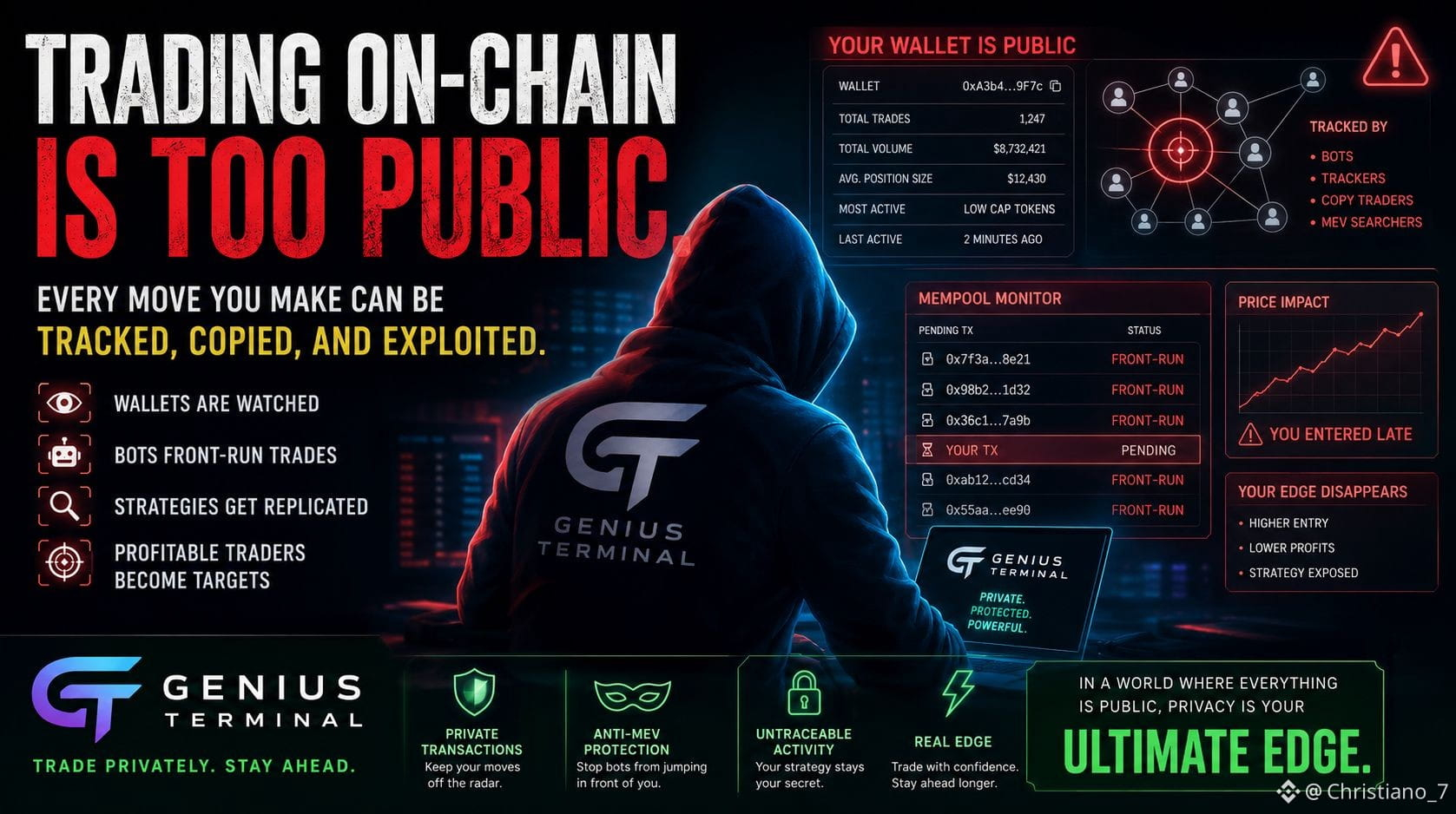
Your wallet activity, position size, entry timing, even the way you rotate capital between tokens — all of it leaves patterns behind. And once you become consistently profitable, people start watching. Bots start reacting. Wallet trackers start copying.
That’s the part many traders don’t talk about enough.
I’ve seen traders lose their edge not because their strategy was bad, but because their activity became too visible.
MEV bots sit in the mempool all day. Whale tracking accounts farm engagement from other traders’ wallets. Some people literally build strategies around following profitable wallets before moves happen.
At what point does “transparent finance” start hurting active traders instead of helping them?
This is why the idea behind Genius Terminal feels relevant right now.
Not because privacy sounds cool, but because modern on-chain trading is becoming harder to survive when every move can be studied in public.
Imagine finding a low-cap setup early.
You enter with conviction, submit the transaction… and suddenly bots slide in front of you before confirmation. Price moves before your order is even finalized. Your edge gets weaker before the trade even starts.
And somehow the space normalized this.
But should it really be normal?
Should profitable traders accept that their wallets become public hunting grounds?
Should every successful strategy eventually become free data for bots and copy traders?
And if every move is visible forever, how long can a real trading edge actually survive?
Feels like the next generation of trading terminals won’t just compete on speed anymore.
They’ll compete on how well they protect trader activity from being tracked, copied, and exploited on-chain.
#genius $GENIUS @GeniusOfficial
Most people still treat crypto trading like it’s just about fast entries and fast exits.
But honestly, the real battle on-chain today feels completely different.
Everything is public now.
Your wallet activity, position size, entry timing, even the way you rotate capital between tokens — all of it leaves patterns behind. And once you become consistently profitable, people start watching. Bots start reacting. Wallet trackers start copying.
That’s the part many traders don’t talk about enough.
I’ve seen traders lose their edge not because their strategy was bad, but because their activity became too visible.
MEV bots sit in the mempool all day. Whale tracking accounts farm engagement from other traders’ wallets. Some people literally build strategies around following profitable wallets before moves happen.
At what point does “transparent finance” start hurting active traders instead of helping them?
This is why the idea behind Genius Terminal feels relevant right now.
Not because privacy sounds cool, but because modern on-chain trading is becoming harder to survive when every move can be studied in public.
Imagine finding a low-cap setup early.
You enter with conviction, submit the transaction… and suddenly bots slide in front of you before confirmation. Price moves before your order is even finalized. Your edge gets weaker before the trade even starts.
And somehow the space normalized this.
But should it really be normal?
Should profitable traders accept that their wallets become public hunting grounds?
Should every successful strategy eventually become free data for bots and copy traders?
And if every move is visible forever, how long can a real trading edge actually survive?
Feels like the next generation of trading terminals won’t just compete on speed anymore.
They’ll compete on how well they protect trader activity from being tracked, copied, and exploited on-chain.
Most people still treat crypto trading like it’s just about fast entries and fast exits.
But honestly, the real battle on-chain today feels completely different.
Everything is public now.
Your wallet activity, position size, entry timing, even the way you rotate capital between tokens — all of it leaves patterns behind. And once you become consistently profitable, people start watching. Bots start reacting. Wallet trackers start copying.
That’s the part many traders don’t talk about enough.
I’ve seen traders lose their edge not because their strategy was bad, but because their activity became too visible.
MEV bots sit in the mempool all day. Whale tracking accounts farm engagement from other traders’ wallets. Some people literally build strategies around following profitable wallets before moves happen.
At what point does “transparent finance” start hurting active traders instead of helping them?
This is why the idea behind Genius Terminal feels relevant right now.
Not because privacy sounds cool, but because modern on-chain trading is becoming harder to survive when every move can be studied in public.
Imagine finding a low-cap setup early.
You enter with conviction, submit the transaction… and suddenly bots slide in front of you before confirmation. Price moves before your order is even finalized. Your edge gets weaker before the trade even starts.
And somehow the space normalized this.
But should it really be normal?
Should profitable traders accept that their wallets become public hunting grounds?
Should every successful strategy eventually become free data for bots and copy traders?
And if every move is visible forever, how long can a real trading edge actually survive?
Feels like the next generation of trading terminals won’t just compete on speed anymore.
They’ll compete on how well they protect trader activity from being tracked, copied, and exploited on-chain.
1
134
·
--
#genius $GENIUS @GeniusOfficial
Genius Terminal feels like the kind of product crypto users have been waiting for without even realizing it. Most on-chain terminals today are loud, crowded, and built around visibility. But what happens when serious users start valuing privacy more than attention?
If Genius Terminal is really building the first private and final on-chain terminal, then the bigger conversation is not just about trading. It’s about digital behavior.
Why are wallets becoming public diaries?
Why does every move on-chain feel permanently exposed?
And why are users still forced to choose between functionality and privacy in 2026?
The interesting part is that privacy on-chain is no longer a niche topic. It’s becoming infrastructure. The more people use crypto daily, the more they’ll ask harder questions:
Who owns transaction history?
Should every wallet interaction be traceable forever?
Can a terminal become intelligent without becoming invasive?
And what does a “final terminal” actually mean in a world where tools constantly fragment attention?
What I like here is the timing. Crypto is entering a phase where users want less noise and more control. Fewer tabs. Fewer leaks. Fewer distractions. Just execution.
If Genius Terminal understands that shift early, it could become more than a terminal. It could become the default operating layer for private on-chain activity.
The next era of crypto might not belong to the loudest platforms.
It might belong to the ones users can finally trust quietly.
#genius $GENIUS @GeniusOfficial
Genius Terminal feels like the kind of product crypto users have been waiting for without even realizing it. Most on-chain terminals today are loud, crowded, and built around visibility. But what happens when serious users start valuing privacy more than attention?
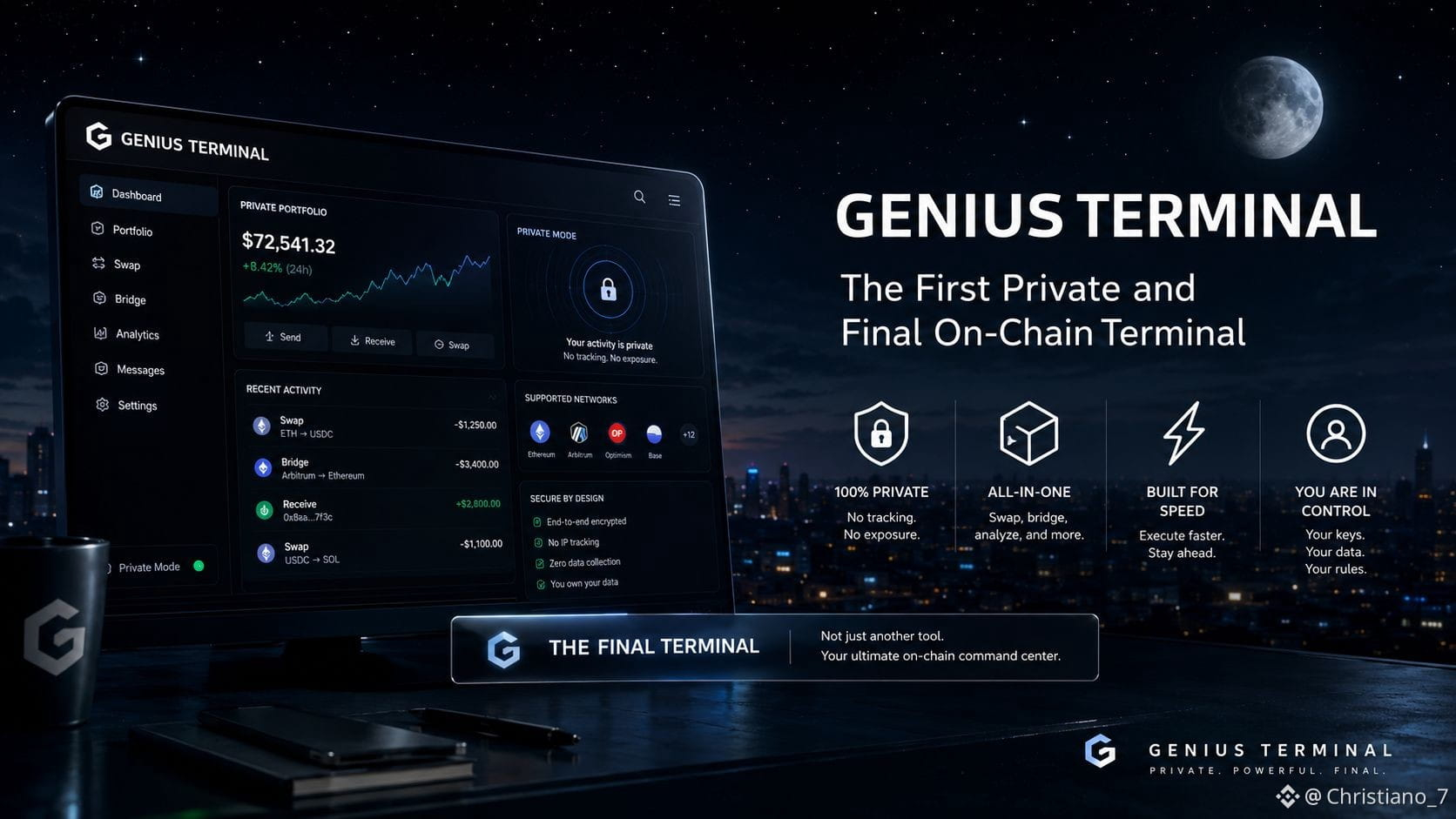
If Genius Terminal is really building the first private and final on-chain terminal, then the bigger conversation is not just about trading. It’s about digital behavior.
Why are wallets becoming public diaries?
Why does every move on-chain feel permanently exposed?
And why are users still forced to choose between functionality and privacy in 2026?
The interesting part is that privacy on-chain is no longer a niche topic. It’s becoming infrastructure. The more people use crypto daily, the more they’ll ask harder questions:
Who owns transaction history?
Should every wallet interaction be traceable forever?
Can a terminal become intelligent without becoming invasive?
And what does a “final terminal” actually mean in a world where tools constantly fragment attention?
What I like here is the timing. Crypto is entering a phase where users want less noise and more control. Fewer tabs. Fewer leaks. Fewer distractions. Just execution.
If Genius Terminal understands that shift early, it could become more than a terminal. It could become the default operating layer for private on-chain activity.
The next era of crypto might not belong to the loudest platforms.
It might belong to the ones users can finally trust quietly.
Genius Terminal feels like the kind of product crypto users have been waiting for without even realizing it. Most on-chain terminals today are loud, crowded, and built around visibility. But what happens when serious users start valuing privacy more than attention?
If Genius Terminal is really building the first private and final on-chain terminal, then the bigger conversation is not just about trading. It’s about digital behavior.
Why are wallets becoming public diaries?
Why does every move on-chain feel permanently exposed?
And why are users still forced to choose between functionality and privacy in 2026?
The interesting part is that privacy on-chain is no longer a niche topic. It’s becoming infrastructure. The more people use crypto daily, the more they’ll ask harder questions:
Who owns transaction history?
Should every wallet interaction be traceable forever?
Can a terminal become intelligent without becoming invasive?
And what does a “final terminal” actually mean in a world where tools constantly fragment attention?
What I like here is the timing. Crypto is entering a phase where users want less noise and more control. Fewer tabs. Fewer leaks. Fewer distractions. Just execution.
If Genius Terminal understands that shift early, it could become more than a terminal. It could become the default operating layer for private on-chain activity.
The next era of crypto might not belong to the loudest platforms.
It might belong to the ones users can finally trust quietly.
113
·
--
Bearish
#genius $GENIUS @GeniusOfficial
Genius Terminal is being called the first private and final on-chain terminal — but what does that really mean for everyday users?
If everything is moving on-chain, who protects your privacy? Can traders, builders, and communities finally interact without exposing every move? And is “final” just a big claim, or does it point to a serious shift in how crypto tools should work?
This project raises an important question: are we entering a phase where on-chain access is no longer just about speed and data, but about control, privacy, and trust?
That is the real conversation Genius Terminal starts.
#genius $GENIUS @GeniusOfficial
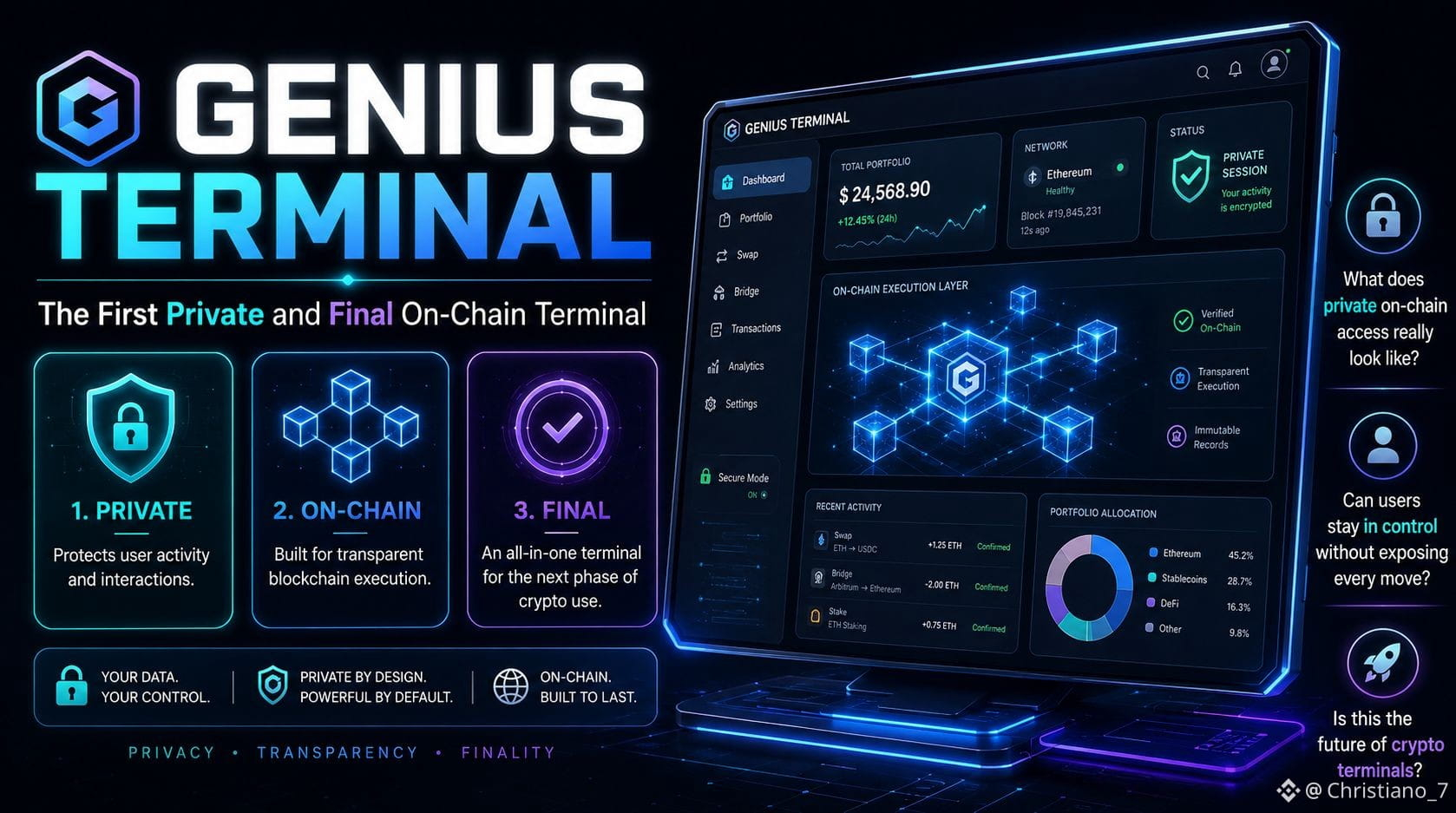
Genius Terminal is being called the first private and final on-chain terminal — but what does that really mean for everyday users?
If everything is moving on-chain, who protects your privacy? Can traders, builders, and communities finally interact without exposing every move? And is “final” just a big claim, or does it point to a serious shift in how crypto tools should work?
This project raises an important question: are we entering a phase where on-chain access is no longer just about speed and data, but about control, privacy, and trust?
That is the real conversation Genius Terminal starts.
Genius Terminal is being called the first private and final on-chain terminal — but what does that really mean for everyday users?
If everything is moving on-chain, who protects your privacy? Can traders, builders, and communities finally interact without exposing every move? And is “final” just a big claim, or does it point to a serious shift in how crypto tools should work?
This project raises an important question: are we entering a phase where on-chain access is no longer just about speed and data, but about control, privacy, and trust?
That is the real conversation Genius Terminal starts.
1
77
Log in to explore more content
Join global crypto users on Binance Square
⚡️ Get latest and useful information about crypto.
💬 Trusted by the world’s largest crypto exchange.
👍 Discover real insights from verified creators.
Email / Phone number
Trending Topics
USAugustPPIRisesLessThanExpected
16,624 views
422 Discussing
🚨 US AUG PPI: Rises LESS Than Expected! Bullish for Crypto? 🚀
PPI +0.4% MoM as expected, but CORE PPI only +0.2% vs +0.3% expected - cooling!
What it means:
• Wholesale inflation softer than feared
• Fed rate hike chance now 62% - but dovish signals coming
• Core PCE revisions expected downward - bullish
• BTC usually pumps on softer PPI
Fed meeting Sep 15-16 - Market now expects pause, not hike?
Is this the green light for Q4 rally?
#Bitcoin #PPI #Fed #CryptoNews #BTC#usaugustppiriseslessthanexpected
True News
·1 Likes
·1.2k views
SECApprovesNasdaqTexasCommodityTrustRule
12,452 views
379 Discussing
ECBRaisesRatesSecondTimeTo2.5%
8,858 views
269 Discussing