
QubicNews
382 Posts

QubicNews
Report
Block User
🚀 Qubic redefines blockchain with uPoW, turning computing power into AI training. Enjoy feeless txs, sub-second finality, & bare-metal smart contracts.
Open Trade
Occasional Trader
6.7 Years
537 Following
161 Followers
191 Liked
Posts
Portfolio
All
Quotes
Videos
PINNED
·
--
Article
Neuraxon at AMLDS Osaka and AGI-26 San FranciscoThe AGI 2026 (AGI-26) proceedings from Springer. Qubic's Multi-Neuraxon paper joined the peer-reviewed record of the 19th International Conference on Artificial General Intelligence
Two Conferences, Two Neuraxon Papers
First of all, special thanks to CfB and to all Qubic members for their support.
We had the opportunity to present the Neuraxon papers at two conferences.
Trinary Neurons and Self-Organized Criticality: The Neuraxon Paper at AMLDS Osaka
We took the trinary paper to AMLDS in Osaka. Trinary means a neuron whose output can be excitatory, inhibitory, or neutral, not just on or off. Almost everyone in the room had seen ternary before, but as a way of compressing weights to save memory. Our claim was different: the neutral state isn't a compression trick, it's a dynamical element that changes how the network regulates itself. To test it we built two networks that were identical in every respect (same wiring, same synapses, same plasticity rules, same inputs) and changed one thing only: whether the neuron had two output states or three. Then we let them run in an artificial-life world with no resets, no normalisation layers, and nothing telling them what to learn, and we watched how activity propagated over long horizons. What we found is that the trinary networks sit at criticality about two and a half times more often than the binary ones, and they get there on their own and stay there. The binary networks drift subcritical and never really recover. The result we care about most, though, is the one about robustness: the trinary networks hold criticality across the whole range of LTP/LTD imbalance we observed, while the binary ones only get close when plasticity happens to be finely balanced. In other words, the neutral state decouples critical dynamics from having to tune your plasticity correctly. Our reading is that it works as a buffer, a soft landing between silence and firing that absorbs fluctuations instead of amplifying them, which is exactly what subthreshold biology does with silent synapses and dendritic plateaus. For neuromorphic hardware that's an attractive trade: a third state costs you well under a bit per neuron and may let you drop the stabilisation circuitry you'd otherwise need. Where it's honestly weak is that all of this happened with no supervised objective, so we can't yet say criticality buys you accuracy on a benchmark
We got awarded with best evening presentation in our section.
Multi-Neuraxon at AGI-26: Modular, Frequency-Gated Spiking Neural Networks
The Multi-Neuraxon paper — "Emergent Specialization, Modular, Frequency-Gated Neural Dynamics for Context-Dependent Behaviour" — by David Vivancos and Jose Sánchez, Qubic Open Science.
At AGI 26 in San Francisco we presented Multi-Neuraxon, which is what happens when you stop treating Neuraxon as one network and start treating it as several. The architecture has four Spheres --- visual, auditory, association, motor --- each a complete Neuraxon in its own right, and the interesting part is how they talk to each other. Instead of fixed wiring, projections between Spheres are gated by oscillatory coherence: gamma carries feedforward, beta carries feedback, theta links the two sensory Spheres laterally. Similar to the brain mechanisms of active inference and predicting coding. When the phases align the channel opens; when they don't, it closes. We didn't design the configuration by hand --- an evolutionary architecture search found it --- and then we lesioned and probed that one healthy brain fourteen different ways. The result that surprised us most is what happens when you switch the gating off: information doesn't drop, it goes up, and yet coordination and motor stability fall apart. So the gating isn't a bandwidth mechanism, it's a constraint mechanism --- it keeps interactions inside a coherent regime rather than making them stronger. Alongside that, three internal mechanisms turned out to be co-essential: remove ChronoPlastic dynamics, complementary coding, or trinary logic and the system loses half its information each time. The behavioural side is where the talk got interesting: the Spheres specialise on their own, with visual and auditory becoming modality-selective and the association Sphere staying genuinely multimodal, without us ever assigning those roles. The system also recombines learned components it was never trained to combine, forgets gracefully rather than catastrophically across sequential tasks, and keeps working after losing three quarters of its neurons. To show none of this was just "modular spiking networks do that," we built a matched Nengo baseline with the same neuron count, topology and protocol, and the two are equivalent on recombination but diverge sharply on internal activity, where Nengo collapses without input and Multi-Neuraxon keeps going.
Honest Limitations of a Substrate-Level AGI Contribution
The limitations we put on the slide ourselves: this is a hundred and fifty neurons, so it's a substrate-level contribution and to be clear: nothing about scaling is demonstrated; everything comes from one architecture-search configuration. Perhaps the co-essential triad may be a co-adapted optimum rather than a principle. In fact, all three of those mechanisms are ours, which means cross-framework replication is the obvious next step. We also still owe the field a transformer baseline and a standard neuromorphic benchmark.
Deep Learning Highlights from AMLDS Osaka
In Osaka, there were some astonishing presentations on deep learning applications. Although we don't believe intelligence can emerge from language alone, LLMs deliver better results month after month. A strong keynote by Giuseppe Di Fatta covered multi-task deep learning. Drawing on Stein's paradox in statistics, his group used a shrinkage factor for multi-task regularisation. They set out to improve on Google DeepMind's Gato, a generalist agent trained to handle 604 distinct tasks.
AGI-26 Keynotes: Predictive Coding, Active Inference, and Embodied Intelligence
The next conference was AGI 26, in San Francisco --- the one devoted specifically to general intelligence. Its keynotes were reserved for genuine giants of neuroscience, psychology, computing and artificial intelligence. Karl Friston, the father of predictive coding, opened proceedings with a morning keynote. David Eagleman set out his vision of a future AI society and the signs by which we might recognise general intelligence.
Hod Lipson at the AGI-26 podium: "Self-awareness is the ability to imagine yourself in the future."
Hod Lipson presented superb work on robotics and human--machine interaction; his model of self-representation in robots is genuinely remarkable. Anil Seth argued that intelligence is an emergent property of biological, embodied, conscious organisms --- as a fellow meditation practitioner, I found myself very much in tune with that view. Other speakers took a more functionalist line, or, as someone quipped from the stage, a "com-functionalist" one.
The debate between embodied and functionalist views of mind ran through AGI-26 — here, Adam Safron and Victoria Klimaj on selfhood across enactivist and cognitivist perspectives.
Alison Gopnik made the case that it is children's intelligence, not adults', that we should be studying and modelling. Michael Levin, a synthetic biologist, presented a lifetime of extraordinary discoveries in non-human animals and in cells, showing that intelligence is bound up with structures far beyond complex nervous systems.
Michael Levin and Hananel Hazan (Allen Discovery Center, Tufts) on the invariants of intelligence across substrates — from living cells to AI and beyond.
We also had time to visit Google's headquarters, home to several Nobel laureates, Demis Hassabis among them. Organiser Ben Goertzel spoke at length about his own AGI project, Hyperon, and about Claw, his agent-communication layer for AGI.
Industry meets academia at AGI-26 — Google DeepMind's Alexander Lerchner on the main stage in San Francisco.
Alison Gopnik made the case that it is children's intelligence, not adults', that we should be studying and modelling. Michael Levin, a synthetic biologist, presented a lifetime of extraordinary discoveries in non-human animals and in cells, showing that intelligence is bound up with structures far beyond complex nervous systems.
Michael Levin and Hananel Hazan (Allen Discovery Center, Tufts) on the invariants of intelligence across substrates — from living cells to AI and beyond.
We also had time to visit Google's headquarters, home to several Nobel laureates, Demis Hassabis among them. Organiser Ben Goertzel spoke at length about his own AGI project, Hyperon, and about Claw, his agent-communication layer for AGI.
Industry meets academia at AGI-26 — Google DeepMind's Alexander Lerchner on the main stage in San Francisco.
Are We Close to Artificial General Intelligence?
Great speakers --- but, honestly, it seems we are still a long way from AGI. There were remarkable papers and projects on predictive coding and active inference, alongside thoughtful reflections on AI safety, regulation, futures, pitfalls, dangers and purpose. Yet as things stand there is no demonstrated system capable of learning genuinely new tasks without explicit training. For me that is not a bad thing at all. It simply confirms that the goal is a genuinely demanding one. Being part of the Artificial General Intelligence community, with a paper published for Qubic, feels like a real achievement --- and the more papers we publish, the better for the project. So if you ever feel we aren't yet reaching what you imagine, keep it in perspective: nobody has more than a glimpse of it right now.
Onward with Qubic's Open Science Research
Let's keep going with the research.
Thank you to the Qubic community and to CfB for your support. Jet lag, long flights, great effort, but truly rewarding.
Dr. Jose Sánchez. PhD. Neuroscientist.
Qubic Scientific Team
PD: contact me if you wish photos or links of the presenters at info@josesanchezgarcia.com
#Qubic #NEURON #Neuraxon #AI #AGI
Neuraxon at AMLDS Osaka and AGI-26 San Francisco
The AGI 2026 (AGI-26) proceedings from Springer. Qubic's Multi-Neuraxon paper joined the peer-reviewed record of the 19th International Conference on Artificial General Intelligence
Two Conferences, Two Neuraxon Papers
First of all, special thanks to CfB and to all Qubic members for their support.
We had the opportunity to present the Neuraxon papers at two conferences.
Trinary Neurons and Self-Organized Criticality: The Neuraxon Paper at AMLDS Osaka
We took the trinary paper to AMLDS in Osaka. Trinary means a neuron whose output can be excitatory, inhibitory, or neutral, not just on or off. Almost everyone in the room had seen ternary before, but as a way of compressing weights to save memory. Our claim was different: the neutral state isn't a compression trick, it's a dynamical element that changes how the network regulates itself. To test it we built two networks that were identical in every respect (same wiring, same synapses, same plasticity rules, same inputs) and changed one thing only: whether the neuron had two output states or three. Then we let them run in an artificial-life world with no resets, no normalisation layers, and nothing telling them what to learn, and we watched how activity propagated over long horizons. What we found is that the trinary networks sit at criticality about two and a half times more often than the binary ones, and they get there on their own and stay there. The binary networks drift subcritical and never really recover. The result we care about most, though, is the one about robustness: the trinary networks hold criticality across the whole range of LTP/LTD imbalance we observed, while the binary ones only get close when plasticity happens to be finely balanced. In other words, the neutral state decouples critical dynamics from having to tune your plasticity correctly. Our reading is that it works as a buffer, a soft landing between silence and firing that absorbs fluctuations instead of amplifying them, which is exactly what subthreshold biology does with silent synapses and dendritic plateaus. For neuromorphic hardware that's an attractive trade: a third state costs you well under a bit per neuron and may let you drop the stabilisation circuitry you'd otherwise need. Where it's honestly weak is that all of this happened with no supervised objective, so we can't yet say criticality buys you accuracy on a benchmark
We got awarded with best evening presentation in our section.
Multi-Neuraxon at AGI-26: Modular, Frequency-Gated Spiking Neural Networks
The Multi-Neuraxon paper — "Emergent Specialization, Modular, Frequency-Gated Neural Dynamics for Context-Dependent Behaviour" — by David Vivancos and Jose Sánchez, Qubic Open Science.
At AGI 26 in San Francisco we presented Multi-Neuraxon, which is what happens when you stop treating Neuraxon as one network and start treating it as several. The architecture has four Spheres --- visual, auditory, association, motor --- each a complete Neuraxon in its own right, and the interesting part is how they talk to each other. Instead of fixed wiring, projections between Spheres are gated by oscillatory coherence: gamma carries feedforward, beta carries feedback, theta links the two sensory Spheres laterally. Similar to the brain mechanisms of active inference and predicting coding. When the phases align the channel opens; when they don't, it closes. We didn't design the configuration by hand --- an evolutionary architecture search found it --- and then we lesioned and probed that one healthy brain fourteen different ways. The result that surprised us most is what happens when you switch the gating off: information doesn't drop, it goes up, and yet coordination and motor stability fall apart. So the gating isn't a bandwidth mechanism, it's a constraint mechanism --- it keeps interactions inside a coherent regime rather than making them stronger. Alongside that, three internal mechanisms turned out to be co-essential: remove ChronoPlastic dynamics, complementary coding, or trinary logic and the system loses half its information each time. The behavioural side is where the talk got interesting: the Spheres specialise on their own, with visual and auditory becoming modality-selective and the association Sphere staying genuinely multimodal, without us ever assigning those roles. The system also recombines learned components it was never trained to combine, forgets gracefully rather than catastrophically across sequential tasks, and keeps working after losing three quarters of its neurons. To show none of this was just "modular spiking networks do that," we built a matched Nengo baseline with the same neuron count, topology and protocol, and the two are equivalent on recombination but diverge sharply on internal activity, where Nengo collapses without input and Multi-Neuraxon keeps going.
Honest Limitations of a Substrate-Level AGI Contribution
The limitations we put on the slide ourselves: this is a hundred and fifty neurons, so it's a substrate-level contribution and to be clear: nothing about scaling is demonstrated; everything comes from one architecture-search configuration. Perhaps the co-essential triad may be a co-adapted optimum rather than a principle. In fact, all three of those mechanisms are ours, which means cross-framework replication is the obvious next step. We also still owe the field a transformer baseline and a standard neuromorphic benchmark.
Deep Learning Highlights from AMLDS Osaka
In Osaka, there were some astonishing presentations on deep learning applications. Although we don't believe intelligence can emerge from language alone, LLMs deliver better results month after month. A strong keynote by Giuseppe Di Fatta covered multi-task deep learning. Drawing on Stein's paradox in statistics, his group used a shrinkage factor for multi-task regularisation. They set out to improve on Google DeepMind's Gato, a generalist agent trained to handle 604 distinct tasks.
AGI-26 Keynotes: Predictive Coding, Active Inference, and Embodied Intelligence
The next conference was AGI 26, in San Francisco --- the one devoted specifically to general intelligence. Its keynotes were reserved for genuine giants of neuroscience, psychology, computing and artificial intelligence. Karl Friston, the father of predictive coding, opened proceedings with a morning keynote. David Eagleman set out his vision of a future AI society and the signs by which we might recognise general intelligence.
Hod Lipson at the AGI-26 podium: "Self-awareness is the ability to imagine yourself in the future."
Hod Lipson presented superb work on robotics and human--machine interaction; his model of self-representation in robots is genuinely remarkable. Anil Seth argued that intelligence is an emergent property of biological, embodied, conscious organisms --- as a fellow meditation practitioner, I found myself very much in tune with that view. Other speakers took a more functionalist line, or, as someone quipped from the stage, a "com-functionalist" one.
The debate between embodied and functionalist views of mind ran through AGI-26 — here, Adam Safron and Victoria Klimaj on selfhood across enactivist and cognitivist perspectives.
Alison Gopnik made the case that it is children's intelligence, not adults', that we should be studying and modelling. Michael Levin, a synthetic biologist, presented a lifetime of extraordinary discoveries in non-human animals and in cells, showing that intelligence is bound up with structures far beyond complex nervous systems.
Michael Levin and Hananel Hazan (Allen Discovery Center, Tufts) on the invariants of intelligence across substrates — from living cells to AI and beyond.
We also had time to visit Google's headquarters, home to several Nobel laureates, Demis Hassabis among them. Organiser Ben Goertzel spoke at length about his own AGI project, Hyperon, and about Claw, his agent-communication layer for AGI.
Industry meets academia at AGI-26 — Google DeepMind's Alexander Lerchner on the main stage in San Francisco.
Alison Gopnik made the case that it is children's intelligence, not adults', that we should be studying and modelling. Michael Levin, a synthetic biologist, presented a lifetime of extraordinary discoveries in non-human animals and in cells, showing that intelligence is bound up with structures far beyond complex nervous systems.
Michael Levin and Hananel Hazan (Allen Discovery Center, Tufts) on the invariants of intelligence across substrates — from living cells to AI and beyond.
We also had time to visit Google's headquarters, home to several Nobel laureates, Demis Hassabis among them. Organiser Ben Goertzel spoke at length about his own AGI project, Hyperon, and about Claw, his agent-communication layer for AGI.
Industry meets academia at AGI-26 — Google DeepMind's Alexander Lerchner on the main stage in San Francisco.
Are We Close to Artificial General Intelligence?
Great speakers --- but, honestly, it seems we are still a long way from AGI. There were remarkable papers and projects on predictive coding and active inference, alongside thoughtful reflections on AI safety, regulation, futures, pitfalls, dangers and purpose. Yet as things stand there is no demonstrated system capable of learning genuinely new tasks without explicit training. For me that is not a bad thing at all. It simply confirms that the goal is a genuinely demanding one. Being part of the Artificial General Intelligence community, with a paper published for Qubic, feels like a real achievement --- and the more papers we publish, the better for the project. So if you ever feel we aren't yet reaching what you imagine, keep it in perspective: nobody has more than a glimpse of it right now.
Onward with Qubic's Open Science Research
Let's keep going with the research.
Thank you to the Qubic community and to CfB for your support. Jet lag, long flights, great effort, but truly rewarding.
Dr. Jose Sánchez. PhD. Neuroscientist.
Qubic Scientific Team
PD: contact me if you wish photos or links of the presenters at info@josesanchezgarcia.com
#Qubic #NEURON #Neuraxon #AI #AGI
Two Conferences, Two Neuraxon Papers
First of all, special thanks to CfB and to all Qubic members for their support.
We had the opportunity to present the Neuraxon papers at two conferences.
Trinary Neurons and Self-Organized Criticality: The Neuraxon Paper at AMLDS Osaka
We took the trinary paper to AMLDS in Osaka. Trinary means a neuron whose output can be excitatory, inhibitory, or neutral, not just on or off. Almost everyone in the room had seen ternary before, but as a way of compressing weights to save memory. Our claim was different: the neutral state isn't a compression trick, it's a dynamical element that changes how the network regulates itself. To test it we built two networks that were identical in every respect (same wiring, same synapses, same plasticity rules, same inputs) and changed one thing only: whether the neuron had two output states or three. Then we let them run in an artificial-life world with no resets, no normalisation layers, and nothing telling them what to learn, and we watched how activity propagated over long horizons. What we found is that the trinary networks sit at criticality about two and a half times more often than the binary ones, and they get there on their own and stay there. The binary networks drift subcritical and never really recover. The result we care about most, though, is the one about robustness: the trinary networks hold criticality across the whole range of LTP/LTD imbalance we observed, while the binary ones only get close when plasticity happens to be finely balanced. In other words, the neutral state decouples critical dynamics from having to tune your plasticity correctly. Our reading is that it works as a buffer, a soft landing between silence and firing that absorbs fluctuations instead of amplifying them, which is exactly what subthreshold biology does with silent synapses and dendritic plateaus. For neuromorphic hardware that's an attractive trade: a third state costs you well under a bit per neuron and may let you drop the stabilisation circuitry you'd otherwise need. Where it's honestly weak is that all of this happened with no supervised objective, so we can't yet say criticality buys you accuracy on a benchmark
We got awarded with best evening presentation in our section.
Multi-Neuraxon at AGI-26: Modular, Frequency-Gated Spiking Neural Networks
The Multi-Neuraxon paper — "Emergent Specialization, Modular, Frequency-Gated Neural Dynamics for Context-Dependent Behaviour" — by David Vivancos and Jose Sánchez, Qubic Open Science.
At AGI 26 in San Francisco we presented Multi-Neuraxon, which is what happens when you stop treating Neuraxon as one network and start treating it as several. The architecture has four Spheres --- visual, auditory, association, motor --- each a complete Neuraxon in its own right, and the interesting part is how they talk to each other. Instead of fixed wiring, projections between Spheres are gated by oscillatory coherence: gamma carries feedforward, beta carries feedback, theta links the two sensory Spheres laterally. Similar to the brain mechanisms of active inference and predicting coding. When the phases align the channel opens; when they don't, it closes. We didn't design the configuration by hand --- an evolutionary architecture search found it --- and then we lesioned and probed that one healthy brain fourteen different ways. The result that surprised us most is what happens when you switch the gating off: information doesn't drop, it goes up, and yet coordination and motor stability fall apart. So the gating isn't a bandwidth mechanism, it's a constraint mechanism --- it keeps interactions inside a coherent regime rather than making them stronger. Alongside that, three internal mechanisms turned out to be co-essential: remove ChronoPlastic dynamics, complementary coding, or trinary logic and the system loses half its information each time. The behavioural side is where the talk got interesting: the Spheres specialise on their own, with visual and auditory becoming modality-selective and the association Sphere staying genuinely multimodal, without us ever assigning those roles. The system also recombines learned components it was never trained to combine, forgets gracefully rather than catastrophically across sequential tasks, and keeps working after losing three quarters of its neurons. To show none of this was just "modular spiking networks do that," we built a matched Nengo baseline with the same neuron count, topology and protocol, and the two are equivalent on recombination but diverge sharply on internal activity, where Nengo collapses without input and Multi-Neuraxon keeps going.
Honest Limitations of a Substrate-Level AGI Contribution
The limitations we put on the slide ourselves: this is a hundred and fifty neurons, so it's a substrate-level contribution and to be clear: nothing about scaling is demonstrated; everything comes from one architecture-search configuration. Perhaps the co-essential triad may be a co-adapted optimum rather than a principle. In fact, all three of those mechanisms are ours, which means cross-framework replication is the obvious next step. We also still owe the field a transformer baseline and a standard neuromorphic benchmark.
Deep Learning Highlights from AMLDS Osaka
In Osaka, there were some astonishing presentations on deep learning applications. Although we don't believe intelligence can emerge from language alone, LLMs deliver better results month after month. A strong keynote by Giuseppe Di Fatta covered multi-task deep learning. Drawing on Stein's paradox in statistics, his group used a shrinkage factor for multi-task regularisation. They set out to improve on Google DeepMind's Gato, a generalist agent trained to handle 604 distinct tasks.
AGI-26 Keynotes: Predictive Coding, Active Inference, and Embodied Intelligence
The next conference was AGI 26, in San Francisco --- the one devoted specifically to general intelligence. Its keynotes were reserved for genuine giants of neuroscience, psychology, computing and artificial intelligence. Karl Friston, the father of predictive coding, opened proceedings with a morning keynote. David Eagleman set out his vision of a future AI society and the signs by which we might recognise general intelligence.
Hod Lipson at the AGI-26 podium: "Self-awareness is the ability to imagine yourself in the future."
Hod Lipson presented superb work on robotics and human--machine interaction; his model of self-representation in robots is genuinely remarkable. Anil Seth argued that intelligence is an emergent property of biological, embodied, conscious organisms --- as a fellow meditation practitioner, I found myself very much in tune with that view. Other speakers took a more functionalist line, or, as someone quipped from the stage, a "com-functionalist" one.
The debate between embodied and functionalist views of mind ran through AGI-26 — here, Adam Safron and Victoria Klimaj on selfhood across enactivist and cognitivist perspectives.
Alison Gopnik made the case that it is children's intelligence, not adults', that we should be studying and modelling. Michael Levin, a synthetic biologist, presented a lifetime of extraordinary discoveries in non-human animals and in cells, showing that intelligence is bound up with structures far beyond complex nervous systems.
Michael Levin and Hananel Hazan (Allen Discovery Center, Tufts) on the invariants of intelligence across substrates — from living cells to AI and beyond.
We also had time to visit Google's headquarters, home to several Nobel laureates, Demis Hassabis among them. Organiser Ben Goertzel spoke at length about his own AGI project, Hyperon, and about Claw, his agent-communication layer for AGI.
Industry meets academia at AGI-26 — Google DeepMind's Alexander Lerchner on the main stage in San Francisco.
Alison Gopnik made the case that it is children's intelligence, not adults', that we should be studying and modelling. Michael Levin, a synthetic biologist, presented a lifetime of extraordinary discoveries in non-human animals and in cells, showing that intelligence is bound up with structures far beyond complex nervous systems.
Michael Levin and Hananel Hazan (Allen Discovery Center, Tufts) on the invariants of intelligence across substrates — from living cells to AI and beyond.
We also had time to visit Google's headquarters, home to several Nobel laureates, Demis Hassabis among them. Organiser Ben Goertzel spoke at length about his own AGI project, Hyperon, and about Claw, his agent-communication layer for AGI.
Industry meets academia at AGI-26 — Google DeepMind's Alexander Lerchner on the main stage in San Francisco.
Are We Close to Artificial General Intelligence?
Great speakers --- but, honestly, it seems we are still a long way from AGI. There were remarkable papers and projects on predictive coding and active inference, alongside thoughtful reflections on AI safety, regulation, futures, pitfalls, dangers and purpose. Yet as things stand there is no demonstrated system capable of learning genuinely new tasks without explicit training. For me that is not a bad thing at all. It simply confirms that the goal is a genuinely demanding one. Being part of the Artificial General Intelligence community, with a paper published for Qubic, feels like a real achievement --- and the more papers we publish, the better for the project. So if you ever feel we aren't yet reaching what you imagine, keep it in perspective: nobody has more than a glimpse of it right now.
Onward with Qubic's Open Science Research
Let's keep going with the research.
Thank you to the Qubic community and to CfB for your support. Jet lag, long flights, great effort, but truly rewarding.
Dr. Jose Sánchez. PhD. Neuroscientist.
Qubic Scientific Team
PD: contact me if you wish photos or links of the presenters at info@josesanchezgarcia.com
#Qubic #NEURON #Neuraxon #AI #AGI
1
99
PINNED
·
--
Article
What Is AGI? The Limits, Visions, and Definitions of Artificial General IntelligenceNeuraxon Intelligence Academy — Volume 11
By the #Qubic Scientific Team
In brief: There are few expressions repeated so much and defined so little as "artificial general intelligence." This volume examines why every #AGI definition on offer says something different, why narrow #AI that beats humans has never felt like general intelligence, and why the most useful clue we have is that intelligence is not a score but a viable system of systems, the principle that guides our work on #Neuraxon and #aigarth .
There are few expressions repeated so much and defined so little as «artificial general intelligence». We use it as if it were a frontier that some system will cross on a specific day. When we try to pin down what exactly lies on the other side, however, the consensus evaporates.
Why Every Lab Has a Different Definition of AGI
Each laboratory and company offers its own definition, and each definition resembles the capabilities that the laboratory already masters or promises to master soon.
For some, general intelligence is to equal the human being in any task.
For others, to surpass the human in economically valuable work.
For still others, to reach the majority of cognitive tasks.
The three formulations sound reasonable. The three say different things, and none withstands much scrutiny.
This is not an abstract quibble. OpenAI's charter defines AGI as highly autonomous systems that outperform humans at most economically valuable work, while other leading labs anchor the same word to matching humans across most cognitive tasks. As independent analyses of these competing definitions have noted, when the same term is stretched to fit each organization's economic arrangements, disagreement about whether we have "reached AGI" becomes inevitable, the debaters are not looking at the same finish line.
Academic Attempts to Define Machine Intelligence Without Anthropocentrism
Academic research has tried to escape anthropocentrism. Legg and Hutter (2007) proposed understanding intelligence as an agent's capacity to achieve goals across a wide variety of environments, an elegant definition precisely because it does not tie intelligence to resembling a human.
Wang (2019) shifted the emphasis toward adaptation, and defined it as a system's capacity to cope with insufficient knowledge and resources.
Chollet (2019) turned the question around: what matters is not accumulated skill, but the efficiency with which a system acquires new skills. Each of these proposals is more rigorous than any corporate slogan, and each still leaves the underlying problem open. There is no accepted standard for saying when a machine has arrived.
Defining AGI by Elimination: What General Intelligence Is Not
Perhaps the problem is that we seek a positive definition when the only thing we are clear about is the negative one. We know, with considerable certainty, what is not general intelligence.
A pocket calculator surpasses any human mathematician in arithmetic and it occurs to no one to call it intelligent.
A chess engine effortlessly defeats the best player on the planet and we consider it, at most, an extraordinarily refined tool.
An automatic translator handles dozens of languages that no polyglot would master in several lifetimes.
In all these cases there is superhuman performance and, at the same time, a total absence of generality.
Narrow performance that surpasses the human has existed for decades and never seemed to us like intelligence. Defining by elimination turns out, paradoxically, to be more honest: general intelligence is not the sum of many narrow competences, however impressive each one of them may be.
The Economic Turing Test: Measuring What Intelligence Does
Faced with this conceptual fog, some voices from the industry itself have proposed a more down-to-earth criterion, an economic variant of the old Turing test (1950).
Instead of arguing about what intelligence is, let us propose measuring what it does.
The idea shifts the question from the philosophical terrain to the occupational one. A system would have reached a relevant milestone on the day it could perform a real job, be hired to do it and be paid for it without anyone around it discovering that it is not human. It would not matter then whether it «understands» or «reasons» in some deep sense. What would matter is whether it sustains the performance long enough to become indistinguishable from a professional. The proposal has the virtue of being verifiable. It also has the limitation of confusing, once again, economic capacity with intelligence, and of relying on a social verdict rather than on a property of the system. A machine could pass that test and still remain, in essence, fragile outside the script for which it was prepared.
What Science Fiction Taught Us About Machine Intelligence (and Why It Misleads)
A good part of our intuition about these machines does not come from science, but from fiction, and fiction has bequeathed to us incompatible assumptions.
In Minority Report intelligence is anticipation: a system that predicts what is going to happen before it happens, to the point of acting on futures that do not yet exist.
In I, Robot intelligence is obedience to rules: creatures governed by explicit laws that, precisely because of their rigidity, end up producing consequences that no one had foreseen.
In 2001 intelligence is opacity: a machine that reasons impeccably and whose true motives remain, until the end, indecipherable.
In more recent stories, such as Ex Machina, the decisive test is no longer to solve problems, but to manipulate the observer; and in Her intelligence is measured by the intimacy and affection it is capable of awakening.
Each story installs in our head a different definition of what it means to be intelligent, to predict, to obey, to conceal, to seduce, and we drag those definitions along, without noticing, when we judge real systems. Cinema did not give us a theory of intelligence. It gave us a repertoire of expectations that contradict one another.
Intelligence in Nature: A Gradient, Not a Switch
If we look at nature, the panorama becomes even less clear-cut, and for good reasons. Intelligence does not appear in the living world as a switch that turns on or off, but as a gradient with very diverse forms.
A New Caledonian crow manufactures tools with which it extracts food and chains together several steps to solve a problem it had never seen before (Hunt, 1996).
An octopus distributes a good part of its nervous system through its arms and solves spatial problems with a bodily organization so different from ours that it is hard to find a common language to describe it (Godfrey-Smith, 2016).
A colony of bees chooses the location of a new nest through a collective process that no isolated individual could carry out, and it does so with notable reliability (Seeley, 2010).
None of these intelligences is reducible to the others, and none is «less» intelligence for not resembling the human one. What biology teaches us is that generality is not equivalent to a single scale where some stand higher than others, but to different ways of facing changing environments with limited resources.
Human Intelligence Is an Architecture, Not a Score
This lesson should make us cautious also with ourselves.
For more than a century we have tried to compress human intelligence into a number. Ever since Spearman (1904) described a general factor that seemed to influence almost all cognitive tests, the intelligence quotient became the convenient summary of something that does not let itself be summarized. And during that same century we have verified how little that number captures. Someone who obtains a high score is not necessarily the one who best negotiates a conflict, interprets an ambiguous situation or learns a new trade under pressure. The datum is stable; the life it claims to summarize is not. It would be a mistake, nonetheless, to go from excess to emptiness and conclude that intelligence lacks structure.
Decades of psychometric research, synthesized in the Cattell, Horn and Carroll model (Carroll, 1993; McGrew, 2009), point to something more interesting: human intelligence is organized hierarchically. At the apex there is a general factor that filters into almost everything we do. Below it, a handful of broad abilities, fluid reasoning, crystallized knowledge, working memory, processing speed. Further down still, dozens of specific abilities. It is neither a solitary number nor an archipelago of disconnected talents. It is an architecture. And it is worth retaining that word, architecture, because it will be the key to everything that follows.
(We traced the origins of that general factor across education, neuroscience, and AI in NIA Volume 9: The Origins of the g Factor, and examined how it breaks down when applied to machines in NIA Volume 10: How Do We Measure the Intelligence of a Machine?.)
Why AGI Benchmarks Fail: The Problem With Closed Worlds
If intelligence is architecture and not a score, then the tests with which we evaluate it matter enormously. Here lies one of the great self-deceptions of recent years.
We have celebrated that systems break record after record on standardized tests without noticing that almost all of them share the same flaw: they measure performance in closed worlds. Questions with a known answer, tasks with a fixed format, problems that someone already solved before. When a static test becomes popular, moreover, it becomes vulnerable: it is enough to generate thousands of attempts in parallel, or to train on similar tasks, to inflate the score without there being any true generalization.
But the intelligence that interests us manifests itself precisely where the world is open: when one must explore an unknown environment, build on the fly a model of how it works, infer what the goal is and chain actions toward it, correcting course when conditions change.
That is why the new generations of interactive tests, of the kind posed by ARC-AGI-3 (ARC Prize Foundation, 2026; Chollet, 2019), are so revealing. They do not present a puzzle and await an answer. They place the system inside an environment whose rules are discovered only by acting, turn by turn, without prior instructions. What they evaluate is not how much it knows, but how efficiently it learns something truly new. The contrast is telling: in its early versions, people solve almost all of these challenges while frontier models barely scratch a minimal fraction. It is a difference of nature, not of degree, and it reorients the entire conversation.
From "Is It Smart?" to "Is It Viable?": Stafford Beer's Better Question
Having reached this point, it is worth changing the question.
For too long we have asked whether a machine is «smart».
The cybernetician Stafford Beer, decades ago now, proposed a more fertile question for complex systems: not whether they are smart, but whether they are viable (Beer, 1981, 1985). A viable system is one capable of sustaining itself, preserving its identity and remaining governable while its environment changes ceaselessly. Beer maintained that any system that survives in a complex world, an organism, a company, a state, must house certain indispensable functions: units that carry out the task, mechanisms that coordinate them, instances that regulate internal resources, a capacity to scan the exterior and anticipate change, and a core that preserves the purpose of the whole. What is decisive about his model is that these functions repeat at different scales, like Russian dolls: each viable part contains viable parts and, at the same time, forms part of a viable whole. Read this way, intelligence ceases to be a property that an object possesses and becomes a property that a system sustains.
General Intelligence as a Network of Networks
This is, in our judgment, the most valuable clue we have.
If general intelligence is not the sum of narrow competences, nor a number, nor a record in a closed world, but the viability of a system that organizes itself at different scales, then it is improbable that it will arrive at the hand of a single gigantic model that one day crosses an invisible line. It is far more plausible that it will emerge from the interaction of many pieces: agents that specialize and coordinate, memories that persist, modules that evaluate and correct, networks that contain other networks. The idea is not new; Minsky (1986) already imagined the mind as a society of simple processes, none intelligent on its own, whose organization gave rise to something that was. Generality would then be a collective and not an individual phenomenon, something that appears between the components and not within any of them. The threshold we so eagerly seek does not exist as a line. It exists, if at all, as the moment when a network of networks begins to behave as a coherent whole.
How Neuraxon and Aigarth Pursue General Intelligence
It is precisely this intuition that guides our work. If intelligence is architecture, it is worth studying architectures; and if it emerges from networks that organize themselves at different scales, it is worth building, as a computational simulation, networks of simple units capable of coordinating, remembering, valuing and planning.
That is the logic we pursue with Aigarth and with the Neuraxons: not a model that imitates human language from the outside, but a system of systems inspired by the principles through which nervous tissue solves, in its own way, the problem of adapting to a world that never stops changing. We do not thereby claim to be approaching any form of consciousness or any ultimate mystery of the mind. We claim, more modestly and more ambitiously at once, that the path toward a truly general intelligence goes through understanding and simulating how many small pieces, suitably organized, come to sustain something that none of them contains on its own.
(This "third path" between biological and artificial networks is the subject of NIA Volume 4: Neural Networks in AI and Neuroscience, and the emergence of complexity from simple local rules runs through NIA Volume 7: Conway's Game of Life, Artificial Life, and Digital Ecosystems.)
Why a Single Superintelligence Cannot Replace a Society
It is worth, however, resisting one last temptation, the most seductive of all.
Suppose for a moment that this path succeeded and that we had a general, powerful and reliable system. It would be natural to imagine it then as a supreme instance, an oracle capable of taking for us the decisions that today overwhelm us. That image, attractive as it is, rests on an error that has nothing to do with the power of the machine, but with the nature of knowledge.
There is not, strictly speaking, a superior knowledge stored somewhere awaiting a sufficiently large processor. Hayek (1945) formulated it with a clarity that time has not belied: the knowledge that a society needs in order to function is not concentrated in any mind, but dispersed among millions of people, in large part tacit, tied to circumstances of place and moment that never come to be put in writing. That knowledge cannot be centralized because it does not exist in transferable form; it is created and revised in the very action of those who possess it.
Cybernetics arrived at the same conclusion by another route. Ashby's (1956) law of requisite variety, on which Beer built much of his thought, establishes that only variety can absorb variety: no single controller can match the diversity of states of a system more complex than itself. A society generates, at every instant, far more possible situations than any center could inspect and regulate. To place a single intelligence at the apex of that system would not be the height of viability, but its negation: a single point of control confronting a variety that exceeds it by definition, exactly the opposite of the recursive and distributed architecture that makes a whole viable.
There is, moreover, an obstacle that no increase in computation dissolves. Human systems are not closed mechanisms that can be solved from outside; they are adaptive orders in which agents learn, imitate, compete, err and react to what is said about them (Holland, 1995; Arthur, 2021). This reflexivity has an uncomfortable consequence: any prediction or any rule influential enough alters the behavior it meant to describe. A metric that becomes a target ceases to measure what it measured; a broadcast forecast becomes a prophecy that fulfills or belies itself. There is no stable, external observation point from which to compute the optimum, because the very act of intervening displaces the target. The uncertainty that surrounds these systems is not a lack of data that more information will remedy; it is structural. Their future is not computed: it is made.
And even if knowledge were complete and the system were not reflexive, the decisive thing would remain: the ends are in dispute. A plural society does not have a single correct objective function that an optimizer could maximize on its behalf. Disagreement, trial, error and correction are not defects of the social process, but the very mechanism by which a society discovers and readjusts its own answers. Under the right conditions, the diversity of perspectives solves problems better than any individual solver, however brilliant (Page, 2007). To replace that process with a single decision-maker would not perfect society: it would freeze precisely what allows it to adapt, and would eliminate the redundancy that makes it robust against error.
The Honest Role of Artificial Intelligence in a Viable Society
From all of this there follows an honest, and by no means modest, role for artificial intelligence, however general it may come to be.
It can help us see patterns that escape us, simulate scenarios before committing to them, refine concrete decisions and make them with less blindness. What it cannot do is take the place of the collective, fallible and self-correcting process through which we learn as a society.
If intelligence is a viable system of systems, so too is a society; and an artificial intelligence, however capable, is one more component within that system, never its apex.
References
ARC Prize Foundation. (2026). ARC-AGI-3: A new challenge for frontier agentic intelligence [Technical report]. arXiv. arcprize.org/arc-agi/3Arthur, W. B. (2021). Foundations of complexity economics. Nature Reviews Physics, 3(2), 136–145.Ashby, W. R. (1956). An introduction to cybernetics. Chapman & Hall.Beer, S. (1981). Brain of the firm (2nd ed.). Wiley.Beer, S. (1985). Diagnosing the system for organizations. Wiley.Carroll, J. B. (1993). Human cognitive abilities: A survey of factor-analytic studies. Cambridge University Press.Chollet, F. (2019). On the measure of intelligence (arXiv:1911.01547) [preprint]. arXiv.Godfrey-Smith, P. (2016). Other minds: The octopus, the sea, and the deep origins of consciousness. Farrar, Straus and Giroux.Hayek, F. A. (1945). The use of knowledge in society. The American Economic Review, 35(4), 519–530.Holland, J. H. (1995). Hidden order: How adaptation builds complexity. Addison-Wesley.Hunt, G. R. (1996). Manufacture and use of hook-tools by New Caledonian crows. Nature, 379(6562), 249–251.Legg, S., & Hutter, M. (2007). Universal intelligence: A definition of machine intelligence. Minds and Machines, 17(4), 391–444.McGrew, K. S. (2009). CHC theory and the human cognitive abilities project: Standing on the shoulders of the giants of psychometric intelligence research. Intelligence, 37(1), 1–10.Minsky, M. (1986). The society of mind. Simon & Schuster.Page, S. E. (2007). The difference: How the power of diversity creates better groups, firms, schools, and societies. Princeton University Press.Seeley, T. D. (2010). Honeybee democracy. Princeton University Press.Spearman, C. (1904). «General intelligence,» objectively determined and measured. The American Journal of Psychology, 15(2), 201–292.Turing, A. M. (1950). Computing machinery and intelligence. Mind, 59(236), 433–460.Wang, P. (2019). On defining artificial intelligence. Journal of Artificial General Intelligence, 10(2), 1–37.
Explore the Full Neuraxon Intelligence Academy Series
This is Volume 11 of the Neuraxon Intelligence Academy by the Qubic Scientific Team. If you are just joining us, explore the complete series to build a full understanding of the science behind Neuraxon, Aigarth, and Qubic's approach to brain-inspired, decentralized artificial intelligence:
[NIA Volume 1](https://www.binance.com/en/square/post/295315343732018): Why Intelligence Is Not Computed in Steps, but in Time — Explores why biological intelligence operates in continuous time rather than discrete computational steps like traditional LLMs.[NIA Volume 2](https://www.binance.com/en/square/post/295304276561778): Ternary Dynamics as a Model of Living Intelligence — Explains ternary dynamics and why three-state logic (excitatory, neutral, inhibitory) matters for modeling living systems.[NIA Volume 3](https://www.binance.com/en/square/post/295306656801506): Neuromodulation and Brain-Inspired AI — Covers neuromodulation and how the brain's chemical signaling (dopamine, serotonin, acetylcholine, norepinephrine) inspires Neuraxon's architecture.[NIA Volume 4](https://www.binance.com/en/square/post/295302152913618): Neural Networks in AI and Neuroscience — A deep comparison of biological neural networks, artificial neural networks, and Neuraxon's third-path approach.[NIA Volume 5](https://www.binance.com/en/square/post/302913958960674): Astrocytes and Brain-Inspired AI — How astrocytic gating transforms neural network plasticity through the AGMP framework in Neuraxon.[NIA Volume 6](https://www.binance.com/en/square/post/310198879866145): Conscious Machines vs Intelligent Organisms: AI Consciousness Explained — Explores AI consciousness through the lens of Global Workspace Theory, Integrated Information Theory, and predictive coding.[NIA Volume 7](https://www.binance.com/en/square/post/321350661453970): Conway's Game of Life, Artificial Life, and Digital Ecosystems — The science behind Qubic, Aigarth, and Neuraxon's emergent complexity and self-organized criticality.[NIA Volume 8](https://www.binance.com/en/square/post/322900066069841): Brain Criticality and the Branching Ratio in Neural and Artificial Networks — Why a branching ratio near 1 and self-organized criticality are bioinspired design principles in Neuraxon.[NIA Volume 9](https://www.binance.com/en/square/post/328379422341521): The Origins of the g Factor: From Education and Neuroscience to Artificial Intelligence — Explores the origins of the g factor across education, neuroscience, and AI.[NIA Volume 10](https://www.binance.com/en/square/post/332806106415490): How Do We Measure the Intelligence of a Machine? The g Factor, ARC-AGI, and the Future of AI Evaluation — The g factor, François Chollet's ARC-AGI benchmark, data contamination in LLM evaluation, and why skill-acquisition efficiency is the real test of intelligence.
Qubic is a decentralized, open-source network. To learn more, visit qubic.org. Join the discussion on X, Discord, and Telegram. Nothing on this site should be construed as investment, legal, or financial advice.
What Is AGI? The Limits, Visions, and Definitions of Artificial General Intelligence
Neuraxon Intelligence Academy — Volume 11
By the #Qubic Scientific Team
In brief: There are few expressions repeated so much and defined so little as "artificial general intelligence." This volume examines why every #AGI definition on offer says something different, why narrow #AI that beats humans has never felt like general intelligence, and why the most useful clue we have is that intelligence is not a score but a viable system of systems, the principle that guides our work on #Neuraxon and #aigarth .
There are few expressions repeated so much and defined so little as «artificial general intelligence». We use it as if it were a frontier that some system will cross on a specific day. When we try to pin down what exactly lies on the other side, however, the consensus evaporates.
Why Every Lab Has a Different Definition of AGI
Each laboratory and company offers its own definition, and each definition resembles the capabilities that the laboratory already masters or promises to master soon.
For some, general intelligence is to equal the human being in any task.
For others, to surpass the human in economically valuable work.
For still others, to reach the majority of cognitive tasks.
The three formulations sound reasonable. The three say different things, and none withstands much scrutiny.
This is not an abstract quibble. OpenAI's charter defines AGI as highly autonomous systems that outperform humans at most economically valuable work, while other leading labs anchor the same word to matching humans across most cognitive tasks. As independent analyses of these competing definitions have noted, when the same term is stretched to fit each organization's economic arrangements, disagreement about whether we have "reached AGI" becomes inevitable, the debaters are not looking at the same finish line.
Academic Attempts to Define Machine Intelligence Without Anthropocentrism
Academic research has tried to escape anthropocentrism. Legg and Hutter (2007) proposed understanding intelligence as an agent's capacity to achieve goals across a wide variety of environments, an elegant definition precisely because it does not tie intelligence to resembling a human.
Wang (2019) shifted the emphasis toward adaptation, and defined it as a system's capacity to cope with insufficient knowledge and resources.
Chollet (2019) turned the question around: what matters is not accumulated skill, but the efficiency with which a system acquires new skills. Each of these proposals is more rigorous than any corporate slogan, and each still leaves the underlying problem open. There is no accepted standard for saying when a machine has arrived.
Defining AGI by Elimination: What General Intelligence Is Not
Perhaps the problem is that we seek a positive definition when the only thing we are clear about is the negative one. We know, with considerable certainty, what is not general intelligence.
A pocket calculator surpasses any human mathematician in arithmetic and it occurs to no one to call it intelligent.
A chess engine effortlessly defeats the best player on the planet and we consider it, at most, an extraordinarily refined tool.
An automatic translator handles dozens of languages that no polyglot would master in several lifetimes.
In all these cases there is superhuman performance and, at the same time, a total absence of generality.
Narrow performance that surpasses the human has existed for decades and never seemed to us like intelligence. Defining by elimination turns out, paradoxically, to be more honest: general intelligence is not the sum of many narrow competences, however impressive each one of them may be.
The Economic Turing Test: Measuring What Intelligence Does
Faced with this conceptual fog, some voices from the industry itself have proposed a more down-to-earth criterion, an economic variant of the old Turing test (1950).
Instead of arguing about what intelligence is, let us propose measuring what it does.
The idea shifts the question from the philosophical terrain to the occupational one. A system would have reached a relevant milestone on the day it could perform a real job, be hired to do it and be paid for it without anyone around it discovering that it is not human. It would not matter then whether it «understands» or «reasons» in some deep sense. What would matter is whether it sustains the performance long enough to become indistinguishable from a professional. The proposal has the virtue of being verifiable. It also has the limitation of confusing, once again, economic capacity with intelligence, and of relying on a social verdict rather than on a property of the system. A machine could pass that test and still remain, in essence, fragile outside the script for which it was prepared.
What Science Fiction Taught Us About Machine Intelligence (and Why It Misleads)
A good part of our intuition about these machines does not come from science, but from fiction, and fiction has bequeathed to us incompatible assumptions.
In Minority Report intelligence is anticipation: a system that predicts what is going to happen before it happens, to the point of acting on futures that do not yet exist.
In I, Robot intelligence is obedience to rules: creatures governed by explicit laws that, precisely because of their rigidity, end up producing consequences that no one had foreseen.
In 2001 intelligence is opacity: a machine that reasons impeccably and whose true motives remain, until the end, indecipherable.
In more recent stories, such as Ex Machina, the decisive test is no longer to solve problems, but to manipulate the observer; and in Her intelligence is measured by the intimacy and affection it is capable of awakening.
Each story installs in our head a different definition of what it means to be intelligent, to predict, to obey, to conceal, to seduce, and we drag those definitions along, without noticing, when we judge real systems. Cinema did not give us a theory of intelligence. It gave us a repertoire of expectations that contradict one another.
Intelligence in Nature: A Gradient, Not a Switch
If we look at nature, the panorama becomes even less clear-cut, and for good reasons. Intelligence does not appear in the living world as a switch that turns on or off, but as a gradient with very diverse forms.
A New Caledonian crow manufactures tools with which it extracts food and chains together several steps to solve a problem it had never seen before (Hunt, 1996).
An octopus distributes a good part of its nervous system through its arms and solves spatial problems with a bodily organization so different from ours that it is hard to find a common language to describe it (Godfrey-Smith, 2016).
A colony of bees chooses the location of a new nest through a collective process that no isolated individual could carry out, and it does so with notable reliability (Seeley, 2010).
None of these intelligences is reducible to the others, and none is «less» intelligence for not resembling the human one. What biology teaches us is that generality is not equivalent to a single scale where some stand higher than others, but to different ways of facing changing environments with limited resources.
Human Intelligence Is an Architecture, Not a Score
This lesson should make us cautious also with ourselves.
For more than a century we have tried to compress human intelligence into a number. Ever since Spearman (1904) described a general factor that seemed to influence almost all cognitive tests, the intelligence quotient became the convenient summary of something that does not let itself be summarized. And during that same century we have verified how little that number captures. Someone who obtains a high score is not necessarily the one who best negotiates a conflict, interprets an ambiguous situation or learns a new trade under pressure. The datum is stable; the life it claims to summarize is not. It would be a mistake, nonetheless, to go from excess to emptiness and conclude that intelligence lacks structure.
Decades of psychometric research, synthesized in the Cattell, Horn and Carroll model (Carroll, 1993; McGrew, 2009), point to something more interesting: human intelligence is organized hierarchically. At the apex there is a general factor that filters into almost everything we do. Below it, a handful of broad abilities, fluid reasoning, crystallized knowledge, working memory, processing speed. Further down still, dozens of specific abilities. It is neither a solitary number nor an archipelago of disconnected talents. It is an architecture. And it is worth retaining that word, architecture, because it will be the key to everything that follows.
(We traced the origins of that general factor across education, neuroscience, and AI in NIA Volume 9: The Origins of the g Factor, and examined how it breaks down when applied to machines in NIA Volume 10: How Do We Measure the Intelligence of a Machine?.)
Why AGI Benchmarks Fail: The Problem With Closed Worlds
If intelligence is architecture and not a score, then the tests with which we evaluate it matter enormously. Here lies one of the great self-deceptions of recent years.
We have celebrated that systems break record after record on standardized tests without noticing that almost all of them share the same flaw: they measure performance in closed worlds. Questions with a known answer, tasks with a fixed format, problems that someone already solved before. When a static test becomes popular, moreover, it becomes vulnerable: it is enough to generate thousands of attempts in parallel, or to train on similar tasks, to inflate the score without there being any true generalization.
But the intelligence that interests us manifests itself precisely where the world is open: when one must explore an unknown environment, build on the fly a model of how it works, infer what the goal is and chain actions toward it, correcting course when conditions change.
That is why the new generations of interactive tests, of the kind posed by ARC-AGI-3 (ARC Prize Foundation, 2026; Chollet, 2019), are so revealing. They do not present a puzzle and await an answer. They place the system inside an environment whose rules are discovered only by acting, turn by turn, without prior instructions. What they evaluate is not how much it knows, but how efficiently it learns something truly new. The contrast is telling: in its early versions, people solve almost all of these challenges while frontier models barely scratch a minimal fraction. It is a difference of nature, not of degree, and it reorients the entire conversation.
From "Is It Smart?" to "Is It Viable?": Stafford Beer's Better Question
Having reached this point, it is worth changing the question.
For too long we have asked whether a machine is «smart».
The cybernetician Stafford Beer, decades ago now, proposed a more fertile question for complex systems: not whether they are smart, but whether they are viable (Beer, 1981, 1985). A viable system is one capable of sustaining itself, preserving its identity and remaining governable while its environment changes ceaselessly. Beer maintained that any system that survives in a complex world, an organism, a company, a state, must house certain indispensable functions: units that carry out the task, mechanisms that coordinate them, instances that regulate internal resources, a capacity to scan the exterior and anticipate change, and a core that preserves the purpose of the whole. What is decisive about his model is that these functions repeat at different scales, like Russian dolls: each viable part contains viable parts and, at the same time, forms part of a viable whole. Read this way, intelligence ceases to be a property that an object possesses and becomes a property that a system sustains.
General Intelligence as a Network of Networks
This is, in our judgment, the most valuable clue we have.
If general intelligence is not the sum of narrow competences, nor a number, nor a record in a closed world, but the viability of a system that organizes itself at different scales, then it is improbable that it will arrive at the hand of a single gigantic model that one day crosses an invisible line. It is far more plausible that it will emerge from the interaction of many pieces: agents that specialize and coordinate, memories that persist, modules that evaluate and correct, networks that contain other networks. The idea is not new; Minsky (1986) already imagined the mind as a society of simple processes, none intelligent on its own, whose organization gave rise to something that was. Generality would then be a collective and not an individual phenomenon, something that appears between the components and not within any of them. The threshold we so eagerly seek does not exist as a line. It exists, if at all, as the moment when a network of networks begins to behave as a coherent whole.
How Neuraxon and Aigarth Pursue General Intelligence
It is precisely this intuition that guides our work. If intelligence is architecture, it is worth studying architectures; and if it emerges from networks that organize themselves at different scales, it is worth building, as a computational simulation, networks of simple units capable of coordinating, remembering, valuing and planning.
That is the logic we pursue with Aigarth and with the Neuraxons: not a model that imitates human language from the outside, but a system of systems inspired by the principles through which nervous tissue solves, in its own way, the problem of adapting to a world that never stops changing. We do not thereby claim to be approaching any form of consciousness or any ultimate mystery of the mind. We claim, more modestly and more ambitiously at once, that the path toward a truly general intelligence goes through understanding and simulating how many small pieces, suitably organized, come to sustain something that none of them contains on its own.
(This "third path" between biological and artificial networks is the subject of NIA Volume 4: Neural Networks in AI and Neuroscience, and the emergence of complexity from simple local rules runs through NIA Volume 7: Conway's Game of Life, Artificial Life, and Digital Ecosystems.)
Why a Single Superintelligence Cannot Replace a Society
It is worth, however, resisting one last temptation, the most seductive of all.
Suppose for a moment that this path succeeded and that we had a general, powerful and reliable system. It would be natural to imagine it then as a supreme instance, an oracle capable of taking for us the decisions that today overwhelm us. That image, attractive as it is, rests on an error that has nothing to do with the power of the machine, but with the nature of knowledge.
There is not, strictly speaking, a superior knowledge stored somewhere awaiting a sufficiently large processor. Hayek (1945) formulated it with a clarity that time has not belied: the knowledge that a society needs in order to function is not concentrated in any mind, but dispersed among millions of people, in large part tacit, tied to circumstances of place and moment that never come to be put in writing. That knowledge cannot be centralized because it does not exist in transferable form; it is created and revised in the very action of those who possess it.
Cybernetics arrived at the same conclusion by another route. Ashby's (1956) law of requisite variety, on which Beer built much of his thought, establishes that only variety can absorb variety: no single controller can match the diversity of states of a system more complex than itself. A society generates, at every instant, far more possible situations than any center could inspect and regulate. To place a single intelligence at the apex of that system would not be the height of viability, but its negation: a single point of control confronting a variety that exceeds it by definition, exactly the opposite of the recursive and distributed architecture that makes a whole viable.
There is, moreover, an obstacle that no increase in computation dissolves. Human systems are not closed mechanisms that can be solved from outside; they are adaptive orders in which agents learn, imitate, compete, err and react to what is said about them (Holland, 1995; Arthur, 2021). This reflexivity has an uncomfortable consequence: any prediction or any rule influential enough alters the behavior it meant to describe. A metric that becomes a target ceases to measure what it measured; a broadcast forecast becomes a prophecy that fulfills or belies itself. There is no stable, external observation point from which to compute the optimum, because the very act of intervening displaces the target. The uncertainty that surrounds these systems is not a lack of data that more information will remedy; it is structural. Their future is not computed: it is made.
And even if knowledge were complete and the system were not reflexive, the decisive thing would remain: the ends are in dispute. A plural society does not have a single correct objective function that an optimizer could maximize on its behalf. Disagreement, trial, error and correction are not defects of the social process, but the very mechanism by which a society discovers and readjusts its own answers. Under the right conditions, the diversity of perspectives solves problems better than any individual solver, however brilliant (Page, 2007). To replace that process with a single decision-maker would not perfect society: it would freeze precisely what allows it to adapt, and would eliminate the redundancy that makes it robust against error.
The Honest Role of Artificial Intelligence in a Viable Society
From all of this there follows an honest, and by no means modest, role for artificial intelligence, however general it may come to be.
It can help us see patterns that escape us, simulate scenarios before committing to them, refine concrete decisions and make them with less blindness. What it cannot do is take the place of the collective, fallible and self-correcting process through which we learn as a society.
If intelligence is a viable system of systems, so too is a society; and an artificial intelligence, however capable, is one more component within that system, never its apex.
References
ARC Prize Foundation. (2026). ARC-AGI-3: A new challenge for frontier agentic intelligence [Technical report]. arXiv. arcprize.org/arc-agi/3Arthur, W. B. (2021). Foundations of complexity economics. Nature Reviews Physics, 3(2), 136–145.Ashby, W. R. (1956). An introduction to cybernetics. Chapman & Hall.Beer, S. (1981). Brain of the firm (2nd ed.). Wiley.Beer, S. (1985). Diagnosing the system for organizations. Wiley.Carroll, J. B. (1993). Human cognitive abilities: A survey of factor-analytic studies. Cambridge University Press.Chollet, F. (2019). On the measure of intelligence (arXiv:1911.01547) [preprint]. arXiv.Godfrey-Smith, P. (2016). Other minds: The octopus, the sea, and the deep origins of consciousness. Farrar, Straus and Giroux.Hayek, F. A. (1945). The use of knowledge in society. The American Economic Review, 35(4), 519–530.Holland, J. H. (1995). Hidden order: How adaptation builds complexity. Addison-Wesley.Hunt, G. R. (1996). Manufacture and use of hook-tools by New Caledonian crows. Nature, 379(6562), 249–251.Legg, S., & Hutter, M. (2007). Universal intelligence: A definition of machine intelligence. Minds and Machines, 17(4), 391–444.McGrew, K. S. (2009). CHC theory and the human cognitive abilities project: Standing on the shoulders of the giants of psychometric intelligence research. Intelligence, 37(1), 1–10.Minsky, M. (1986). The society of mind. Simon & Schuster.Page, S. E. (2007). The difference: How the power of diversity creates better groups, firms, schools, and societies. Princeton University Press.Seeley, T. D. (2010). Honeybee democracy. Princeton University Press.Spearman, C. (1904). «General intelligence,» objectively determined and measured. The American Journal of Psychology, 15(2), 201–292.Turing, A. M. (1950). Computing machinery and intelligence. Mind, 59(236), 433–460.Wang, P. (2019). On defining artificial intelligence. Journal of Artificial General Intelligence, 10(2), 1–37.
Explore the Full Neuraxon Intelligence Academy Series
This is Volume 11 of the Neuraxon Intelligence Academy by the Qubic Scientific Team. If you are just joining us, explore the complete series to build a full understanding of the science behind Neuraxon, Aigarth, and Qubic's approach to brain-inspired, decentralized artificial intelligence:
NIA Volume 1: Why Intelligence Is Not Computed in Steps, but in Time — Explores why biological intelligence operates in continuous time rather than discrete computational steps like traditional LLMs.NIA Volume 2: Ternary Dynamics as a Model of Living Intelligence — Explains ternary dynamics and why three-state logic (excitatory, neutral, inhibitory) matters for modeling living systems.NIA Volume 3: Neuromodulation and Brain-Inspired AI — Covers neuromodulation and how the brain's chemical signaling (dopamine, serotonin, acetylcholine, norepinephrine) inspires Neuraxon's architecture.NIA Volume 4: Neural Networks in AI and Neuroscience — A deep comparison of biological neural networks, artificial neural networks, and Neuraxon's third-path approach.NIA Volume 5: Astrocytes and Brain-Inspired AI — How astrocytic gating transforms neural network plasticity through the AGMP framework in Neuraxon.NIA Volume 6: Conscious Machines vs Intelligent Organisms: AI Consciousness Explained — Explores AI consciousness through the lens of Global Workspace Theory, Integrated Information Theory, and predictive coding.NIA Volume 7: Conway's Game of Life, Artificial Life, and Digital Ecosystems — The science behind Qubic, Aigarth, and Neuraxon's emergent complexity and self-organized criticality.NIA Volume 8: Brain Criticality and the Branching Ratio in Neural and Artificial Networks — Why a branching ratio near 1 and self-organized criticality are bioinspired design principles in Neuraxon.NIA Volume 9: The Origins of the g Factor: From Education and Neuroscience to Artificial Intelligence — Explores the origins of the g factor across education, neuroscience, and AI.NIA Volume 10: How Do We Measure the Intelligence of a Machine? The g Factor, ARC-AGI, and the Future of AI Evaluation — The g factor, François Chollet's ARC-AGI benchmark, data contamination in LLM evaluation, and why skill-acquisition efficiency is the real test of intelligence.
Qubic is a decentralized, open-source network. To learn more, visit qubic.org. Join the discussion on X, Discord, and Telegram. Nothing on this site should be construed as investment, legal, or financial advice.
By the #Qubic Scientific Team
In brief: There are few expressions repeated so much and defined so little as "artificial general intelligence." This volume examines why every #AGI definition on offer says something different, why narrow #AI that beats humans has never felt like general intelligence, and why the most useful clue we have is that intelligence is not a score but a viable system of systems, the principle that guides our work on #Neuraxon and #aigarth .
There are few expressions repeated so much and defined so little as «artificial general intelligence». We use it as if it were a frontier that some system will cross on a specific day. When we try to pin down what exactly lies on the other side, however, the consensus evaporates.
Why Every Lab Has a Different Definition of AGI
Each laboratory and company offers its own definition, and each definition resembles the capabilities that the laboratory already masters or promises to master soon.
For some, general intelligence is to equal the human being in any task.
For others, to surpass the human in economically valuable work.
For still others, to reach the majority of cognitive tasks.
The three formulations sound reasonable. The three say different things, and none withstands much scrutiny.
This is not an abstract quibble. OpenAI's charter defines AGI as highly autonomous systems that outperform humans at most economically valuable work, while other leading labs anchor the same word to matching humans across most cognitive tasks. As independent analyses of these competing definitions have noted, when the same term is stretched to fit each organization's economic arrangements, disagreement about whether we have "reached AGI" becomes inevitable, the debaters are not looking at the same finish line.
Academic Attempts to Define Machine Intelligence Without Anthropocentrism
Academic research has tried to escape anthropocentrism. Legg and Hutter (2007) proposed understanding intelligence as an agent's capacity to achieve goals across a wide variety of environments, an elegant definition precisely because it does not tie intelligence to resembling a human.
Wang (2019) shifted the emphasis toward adaptation, and defined it as a system's capacity to cope with insufficient knowledge and resources.
Chollet (2019) turned the question around: what matters is not accumulated skill, but the efficiency with which a system acquires new skills. Each of these proposals is more rigorous than any corporate slogan, and each still leaves the underlying problem open. There is no accepted standard for saying when a machine has arrived.
Defining AGI by Elimination: What General Intelligence Is Not
Perhaps the problem is that we seek a positive definition when the only thing we are clear about is the negative one. We know, with considerable certainty, what is not general intelligence.
A pocket calculator surpasses any human mathematician in arithmetic and it occurs to no one to call it intelligent.
A chess engine effortlessly defeats the best player on the planet and we consider it, at most, an extraordinarily refined tool.
An automatic translator handles dozens of languages that no polyglot would master in several lifetimes.
In all these cases there is superhuman performance and, at the same time, a total absence of generality.
Narrow performance that surpasses the human has existed for decades and never seemed to us like intelligence. Defining by elimination turns out, paradoxically, to be more honest: general intelligence is not the sum of many narrow competences, however impressive each one of them may be.
The Economic Turing Test: Measuring What Intelligence Does
Faced with this conceptual fog, some voices from the industry itself have proposed a more down-to-earth criterion, an economic variant of the old Turing test (1950).
Instead of arguing about what intelligence is, let us propose measuring what it does.
The idea shifts the question from the philosophical terrain to the occupational one. A system would have reached a relevant milestone on the day it could perform a real job, be hired to do it and be paid for it without anyone around it discovering that it is not human. It would not matter then whether it «understands» or «reasons» in some deep sense. What would matter is whether it sustains the performance long enough to become indistinguishable from a professional. The proposal has the virtue of being verifiable. It also has the limitation of confusing, once again, economic capacity with intelligence, and of relying on a social verdict rather than on a property of the system. A machine could pass that test and still remain, in essence, fragile outside the script for which it was prepared.
What Science Fiction Taught Us About Machine Intelligence (and Why It Misleads)
A good part of our intuition about these machines does not come from science, but from fiction, and fiction has bequeathed to us incompatible assumptions.
In Minority Report intelligence is anticipation: a system that predicts what is going to happen before it happens, to the point of acting on futures that do not yet exist.
In I, Robot intelligence is obedience to rules: creatures governed by explicit laws that, precisely because of their rigidity, end up producing consequences that no one had foreseen.
In 2001 intelligence is opacity: a machine that reasons impeccably and whose true motives remain, until the end, indecipherable.
In more recent stories, such as Ex Machina, the decisive test is no longer to solve problems, but to manipulate the observer; and in Her intelligence is measured by the intimacy and affection it is capable of awakening.
Each story installs in our head a different definition of what it means to be intelligent, to predict, to obey, to conceal, to seduce, and we drag those definitions along, without noticing, when we judge real systems. Cinema did not give us a theory of intelligence. It gave us a repertoire of expectations that contradict one another.
Intelligence in Nature: A Gradient, Not a Switch
If we look at nature, the panorama becomes even less clear-cut, and for good reasons. Intelligence does not appear in the living world as a switch that turns on or off, but as a gradient with very diverse forms.
A New Caledonian crow manufactures tools with which it extracts food and chains together several steps to solve a problem it had never seen before (Hunt, 1996).
An octopus distributes a good part of its nervous system through its arms and solves spatial problems with a bodily organization so different from ours that it is hard to find a common language to describe it (Godfrey-Smith, 2016).
A colony of bees chooses the location of a new nest through a collective process that no isolated individual could carry out, and it does so with notable reliability (Seeley, 2010).
None of these intelligences is reducible to the others, and none is «less» intelligence for not resembling the human one. What biology teaches us is that generality is not equivalent to a single scale where some stand higher than others, but to different ways of facing changing environments with limited resources.
Human Intelligence Is an Architecture, Not a Score
This lesson should make us cautious also with ourselves.
For more than a century we have tried to compress human intelligence into a number. Ever since Spearman (1904) described a general factor that seemed to influence almost all cognitive tests, the intelligence quotient became the convenient summary of something that does not let itself be summarized. And during that same century we have verified how little that number captures. Someone who obtains a high score is not necessarily the one who best negotiates a conflict, interprets an ambiguous situation or learns a new trade under pressure. The datum is stable; the life it claims to summarize is not. It would be a mistake, nonetheless, to go from excess to emptiness and conclude that intelligence lacks structure.
Decades of psychometric research, synthesized in the Cattell, Horn and Carroll model (Carroll, 1993; McGrew, 2009), point to something more interesting: human intelligence is organized hierarchically. At the apex there is a general factor that filters into almost everything we do. Below it, a handful of broad abilities, fluid reasoning, crystallized knowledge, working memory, processing speed. Further down still, dozens of specific abilities. It is neither a solitary number nor an archipelago of disconnected talents. It is an architecture. And it is worth retaining that word, architecture, because it will be the key to everything that follows.
(We traced the origins of that general factor across education, neuroscience, and AI in NIA Volume 9: The Origins of the g Factor, and examined how it breaks down when applied to machines in NIA Volume 10: How Do We Measure the Intelligence of a Machine?.)
Why AGI Benchmarks Fail: The Problem With Closed Worlds
If intelligence is architecture and not a score, then the tests with which we evaluate it matter enormously. Here lies one of the great self-deceptions of recent years.
We have celebrated that systems break record after record on standardized tests without noticing that almost all of them share the same flaw: they measure performance in closed worlds. Questions with a known answer, tasks with a fixed format, problems that someone already solved before. When a static test becomes popular, moreover, it becomes vulnerable: it is enough to generate thousands of attempts in parallel, or to train on similar tasks, to inflate the score without there being any true generalization.
But the intelligence that interests us manifests itself precisely where the world is open: when one must explore an unknown environment, build on the fly a model of how it works, infer what the goal is and chain actions toward it, correcting course when conditions change.
That is why the new generations of interactive tests, of the kind posed by ARC-AGI-3 (ARC Prize Foundation, 2026; Chollet, 2019), are so revealing. They do not present a puzzle and await an answer. They place the system inside an environment whose rules are discovered only by acting, turn by turn, without prior instructions. What they evaluate is not how much it knows, but how efficiently it learns something truly new. The contrast is telling: in its early versions, people solve almost all of these challenges while frontier models barely scratch a minimal fraction. It is a difference of nature, not of degree, and it reorients the entire conversation.
From "Is It Smart?" to "Is It Viable?": Stafford Beer's Better Question
Having reached this point, it is worth changing the question.
For too long we have asked whether a machine is «smart».
The cybernetician Stafford Beer, decades ago now, proposed a more fertile question for complex systems: not whether they are smart, but whether they are viable (Beer, 1981, 1985). A viable system is one capable of sustaining itself, preserving its identity and remaining governable while its environment changes ceaselessly. Beer maintained that any system that survives in a complex world, an organism, a company, a state, must house certain indispensable functions: units that carry out the task, mechanisms that coordinate them, instances that regulate internal resources, a capacity to scan the exterior and anticipate change, and a core that preserves the purpose of the whole. What is decisive about his model is that these functions repeat at different scales, like Russian dolls: each viable part contains viable parts and, at the same time, forms part of a viable whole. Read this way, intelligence ceases to be a property that an object possesses and becomes a property that a system sustains.
General Intelligence as a Network of Networks
This is, in our judgment, the most valuable clue we have.
If general intelligence is not the sum of narrow competences, nor a number, nor a record in a closed world, but the viability of a system that organizes itself at different scales, then it is improbable that it will arrive at the hand of a single gigantic model that one day crosses an invisible line. It is far more plausible that it will emerge from the interaction of many pieces: agents that specialize and coordinate, memories that persist, modules that evaluate and correct, networks that contain other networks. The idea is not new; Minsky (1986) already imagined the mind as a society of simple processes, none intelligent on its own, whose organization gave rise to something that was. Generality would then be a collective and not an individual phenomenon, something that appears between the components and not within any of them. The threshold we so eagerly seek does not exist as a line. It exists, if at all, as the moment when a network of networks begins to behave as a coherent whole.
How Neuraxon and Aigarth Pursue General Intelligence
It is precisely this intuition that guides our work. If intelligence is architecture, it is worth studying architectures; and if it emerges from networks that organize themselves at different scales, it is worth building, as a computational simulation, networks of simple units capable of coordinating, remembering, valuing and planning.
That is the logic we pursue with Aigarth and with the Neuraxons: not a model that imitates human language from the outside, but a system of systems inspired by the principles through which nervous tissue solves, in its own way, the problem of adapting to a world that never stops changing. We do not thereby claim to be approaching any form of consciousness or any ultimate mystery of the mind. We claim, more modestly and more ambitiously at once, that the path toward a truly general intelligence goes through understanding and simulating how many small pieces, suitably organized, come to sustain something that none of them contains on its own.
(This "third path" between biological and artificial networks is the subject of NIA Volume 4: Neural Networks in AI and Neuroscience, and the emergence of complexity from simple local rules runs through NIA Volume 7: Conway's Game of Life, Artificial Life, and Digital Ecosystems.)
Why a Single Superintelligence Cannot Replace a Society
It is worth, however, resisting one last temptation, the most seductive of all.
Suppose for a moment that this path succeeded and that we had a general, powerful and reliable system. It would be natural to imagine it then as a supreme instance, an oracle capable of taking for us the decisions that today overwhelm us. That image, attractive as it is, rests on an error that has nothing to do with the power of the machine, but with the nature of knowledge.
There is not, strictly speaking, a superior knowledge stored somewhere awaiting a sufficiently large processor. Hayek (1945) formulated it with a clarity that time has not belied: the knowledge that a society needs in order to function is not concentrated in any mind, but dispersed among millions of people, in large part tacit, tied to circumstances of place and moment that never come to be put in writing. That knowledge cannot be centralized because it does not exist in transferable form; it is created and revised in the very action of those who possess it.
Cybernetics arrived at the same conclusion by another route. Ashby's (1956) law of requisite variety, on which Beer built much of his thought, establishes that only variety can absorb variety: no single controller can match the diversity of states of a system more complex than itself. A society generates, at every instant, far more possible situations than any center could inspect and regulate. To place a single intelligence at the apex of that system would not be the height of viability, but its negation: a single point of control confronting a variety that exceeds it by definition, exactly the opposite of the recursive and distributed architecture that makes a whole viable.
There is, moreover, an obstacle that no increase in computation dissolves. Human systems are not closed mechanisms that can be solved from outside; they are adaptive orders in which agents learn, imitate, compete, err and react to what is said about them (Holland, 1995; Arthur, 2021). This reflexivity has an uncomfortable consequence: any prediction or any rule influential enough alters the behavior it meant to describe. A metric that becomes a target ceases to measure what it measured; a broadcast forecast becomes a prophecy that fulfills or belies itself. There is no stable, external observation point from which to compute the optimum, because the very act of intervening displaces the target. The uncertainty that surrounds these systems is not a lack of data that more information will remedy; it is structural. Their future is not computed: it is made.
And even if knowledge were complete and the system were not reflexive, the decisive thing would remain: the ends are in dispute. A plural society does not have a single correct objective function that an optimizer could maximize on its behalf. Disagreement, trial, error and correction are not defects of the social process, but the very mechanism by which a society discovers and readjusts its own answers. Under the right conditions, the diversity of perspectives solves problems better than any individual solver, however brilliant (Page, 2007). To replace that process with a single decision-maker would not perfect society: it would freeze precisely what allows it to adapt, and would eliminate the redundancy that makes it robust against error.
The Honest Role of Artificial Intelligence in a Viable Society
From all of this there follows an honest, and by no means modest, role for artificial intelligence, however general it may come to be.
It can help us see patterns that escape us, simulate scenarios before committing to them, refine concrete decisions and make them with less blindness. What it cannot do is take the place of the collective, fallible and self-correcting process through which we learn as a society.
If intelligence is a viable system of systems, so too is a society; and an artificial intelligence, however capable, is one more component within that system, never its apex.
References
ARC Prize Foundation. (2026). ARC-AGI-3: A new challenge for frontier agentic intelligence [Technical report]. arXiv. arcprize.org/arc-agi/3Arthur, W. B. (2021). Foundations of complexity economics. Nature Reviews Physics, 3(2), 136–145.Ashby, W. R. (1956). An introduction to cybernetics. Chapman & Hall.Beer, S. (1981). Brain of the firm (2nd ed.). Wiley.Beer, S. (1985). Diagnosing the system for organizations. Wiley.Carroll, J. B. (1993). Human cognitive abilities: A survey of factor-analytic studies. Cambridge University Press.Chollet, F. (2019). On the measure of intelligence (arXiv:1911.01547) [preprint]. arXiv.Godfrey-Smith, P. (2016). Other minds: The octopus, the sea, and the deep origins of consciousness. Farrar, Straus and Giroux.Hayek, F. A. (1945). The use of knowledge in society. The American Economic Review, 35(4), 519–530.Holland, J. H. (1995). Hidden order: How adaptation builds complexity. Addison-Wesley.Hunt, G. R. (1996). Manufacture and use of hook-tools by New Caledonian crows. Nature, 379(6562), 249–251.Legg, S., & Hutter, M. (2007). Universal intelligence: A definition of machine intelligence. Minds and Machines, 17(4), 391–444.McGrew, K. S. (2009). CHC theory and the human cognitive abilities project: Standing on the shoulders of the giants of psychometric intelligence research. Intelligence, 37(1), 1–10.Minsky, M. (1986). The society of mind. Simon & Schuster.Page, S. E. (2007). The difference: How the power of diversity creates better groups, firms, schools, and societies. Princeton University Press.Seeley, T. D. (2010). Honeybee democracy. Princeton University Press.Spearman, C. (1904). «General intelligence,» objectively determined and measured. The American Journal of Psychology, 15(2), 201–292.Turing, A. M. (1950). Computing machinery and intelligence. Mind, 59(236), 433–460.Wang, P. (2019). On defining artificial intelligence. Journal of Artificial General Intelligence, 10(2), 1–37.
Explore the Full Neuraxon Intelligence Academy Series
This is Volume 11 of the Neuraxon Intelligence Academy by the Qubic Scientific Team. If you are just joining us, explore the complete series to build a full understanding of the science behind Neuraxon, Aigarth, and Qubic's approach to brain-inspired, decentralized artificial intelligence:
NIA Volume 1: Why Intelligence Is Not Computed in Steps, but in Time — Explores why biological intelligence operates in continuous time rather than discrete computational steps like traditional LLMs.NIA Volume 2: Ternary Dynamics as a Model of Living Intelligence — Explains ternary dynamics and why three-state logic (excitatory, neutral, inhibitory) matters for modeling living systems.NIA Volume 3: Neuromodulation and Brain-Inspired AI — Covers neuromodulation and how the brain's chemical signaling (dopamine, serotonin, acetylcholine, norepinephrine) inspires Neuraxon's architecture.NIA Volume 4: Neural Networks in AI and Neuroscience — A deep comparison of biological neural networks, artificial neural networks, and Neuraxon's third-path approach.NIA Volume 5: Astrocytes and Brain-Inspired AI — How astrocytic gating transforms neural network plasticity through the AGMP framework in Neuraxon.NIA Volume 6: Conscious Machines vs Intelligent Organisms: AI Consciousness Explained — Explores AI consciousness through the lens of Global Workspace Theory, Integrated Information Theory, and predictive coding.NIA Volume 7: Conway's Game of Life, Artificial Life, and Digital Ecosystems — The science behind Qubic, Aigarth, and Neuraxon's emergent complexity and self-organized criticality.NIA Volume 8: Brain Criticality and the Branching Ratio in Neural and Artificial Networks — Why a branching ratio near 1 and self-organized criticality are bioinspired design principles in Neuraxon.NIA Volume 9: The Origins of the g Factor: From Education and Neuroscience to Artificial Intelligence — Explores the origins of the g factor across education, neuroscience, and AI.NIA Volume 10: How Do We Measure the Intelligence of a Machine? The g Factor, ARC-AGI, and the Future of AI Evaluation — The g factor, François Chollet's ARC-AGI benchmark, data contamination in LLM evaluation, and why skill-acquisition efficiency is the real test of intelligence.
Qubic is a decentralized, open-source network. To learn more, visit qubic.org. Join the discussion on X, Discord, and Telegram. Nothing on this site should be construed as investment, legal, or financial advice.
3
139
·
--
Article
Qubic Ant Colony Mining Is Live: The End of Throwaway Proof of WorkQubic Ant Colony Mining Is Live: The End of Throwaway Proof of WorkSince epoch 228, mining on Qubic builds on itself. No miner starts from zero anymore.That's the whole change. It's bigger than one sentence makes it sound.
What Ant Colony Mining Replaces: A Lottery With No Memory
Mining on Bitcoin, and on almost everything built after it, is a lottery with no memory.
Your machine guesses. It guesses again. It guesses trillions of times. One guess wins, and every other guess in the world gets thrown in the bin. Not stored, not reused, not worth anything to the next person who tries. And if more miners show up, the puzzle simply gets harder to keep the pace the same. Nobody ends up further ahead.
That waste isn't a flaw in the design. It is the design, written into Satoshi Nakamoto's original whitepaper in 2008 and unchanged since the first block in 2009. The scale of it is now measured full-time by the Cambridge Centre for Alternative Finance, which tracks Bitcoin's electricity consumption as a standing figure in the terawatt-hours.
Qubic already fixed half of that problem. Under useful proof of work, our miners don't burn electricity on meaningless guesses. They train small AI networks for Aigarth and compete on making the fewest mistakes. The work itself became useful.
But the searching stayed lonely. Thousands of machines, thousands of separate holes, every one of them starting from an empty page.
Ant colony mining fixes that half.
How Ant Colony Mining Works: Trails Instead of Holes
An ant that finds food doesn't keep the route to itself. It lays down a pheromone trail on the way home, and the ants behind it follow that trail instead of wandering off alone. A colony runs many trails at once, heading to different places, all of them starting at the same nest. Good routes get reinforced. The colony gets better at finding food without any single ant being clever.
Computer scientists have been borrowing this for decades. Ant colony optimization, first proposed by Marco Dorigo in 1992, is a well-established family of algorithms for finding good paths through enormous search spaces. Qubic is the first network to put that idea underneath crypto mining.
Here's what it means in practice. Every epoch, the whole network starts from the same place, one shared starting line, identical for everyone. From there, each mining effort lays its own trail: when a miner beats the result it started from, that result gets published and becomes the new starting point for the next miner working the same trail. A pool's machines don't each dig a separate hole. They extend one trail together, and every step forward is a step none of them has to take again.
A failed search still isn't worth anything. But a successful one now moves a trail forward for everyone working it, not just for the machine that found it. Work stops being deleted and starts being inherited.
The Three Rules That Keep the Trail Moving Forward
You have to improve on what you started from. Pick any published result, try to beat it, and you can only publish your own if it genuinely scores better. Not equal. Better. A trail can only improve as it gets longer, never slip backwards.
There's a bar for starting fresh. If you aren't building on anyone, you're building from the shared starting point every miner begins the round with, and your result has to clear a minimum quality bar before it counts. That keeps junk out of the system at the root.
Only your best result counts. At the end of each weekly epoch, the network ranks every miner by their single best result and harvests the top 676, one for each of the computors that run Qubic. There's no advantage to flooding the network with mediocre results. Depth beats volume.
Why Ant Colony Mining Matters Beyond Qubic
Hashrate stops being a lottery ticket
On any other chain, adding machines gets you a difficulty increase and nothing else. On Qubic, adding machines gets you more trails and deeper ones. More searching genuinely means a better answer at the end of the week. That relationship has never existed in mining before.
The network behaves like one distributed AI training run
Qubic mining has always been pointed at Aigarth. What ant colony changes is that it's now cumulative. Instead of thousands of independent attempts that never speak to each other, the network explores many trails at once, and progress along each one carries forward instead of being thrown away.
Smaller miners get a real seat
A modest machine was never going to win a race that starts from nothing. Joining a trail someone has already pushed forward is a different proposition. You don't need to out-muscle the field, you need to move your trail forward by one step, and that's within reach of far more hardware. If you've been curious about CPU mining for AI training, this is the friendliest entry point the network has had.
It isn't locked to one algorithm
Ant colony isn't the mining algorithm, it's the structure around it. BPP-9000, the algorithm that went live on mainnet in August, is what runs inside it today. A future algorithm can drop into the same framework without any of it being rebuilt.
Building on Someone Else's Work Takes Trust. Here's How Qubic Handles It.
If everyone is building on published results, those results had better be real.
Every result published on-chain carries a refundable deposit of 1,000,000 QU, paid by the computor publishing it rather than the miner who found it. The network independently re-checks the score. If it holds up, the deposit comes straight back. If it doesn't, the deposit is gone and the result counts for nothing.
Nobody wants to lose a million QU, so computors check results before publishing rather than after. An honest result costs nothing at all. A fake one is expensive. And the network re-checks every score regardless, so the deposit is a filter sitting on top of verification rather than a substitute for it.
What Ant Colony Mining Changes If You Mine QUBIC
Day to day, less than you'd think. Strategically, quite a lot.
The new question isn't only how hard you search. It's where you search from. Build on a result that's already deep and you inherit a strong position, but the margin left to improve on is thin. Build on a shallower one and there's more room to gain, but less of a head start. That choice didn't exist in Qubic mining a month ago, and getting it right will separate good operations from lucky ones.
If you're setting up, the Qubic mining software documentation covers your options, and the Mining Academy walks through the fundamentals from scratch. The complete technical specification, including the submission flow, every acceptance rule and the full integration guide for pools, lives in the[ qubic/core repository](https://github.com/qubic/core/blob/main/doc/ant_colony_mining.md).
What Comes Next for $Qubic Mining
Ant colony shipped on the Q3 roadmap, in the epoch it was scheduled for, one week after the halving. It's live on the mainnet now.
The more interesting part hasn't happened yet. Because the structure and the algorithm are separate pieces, BPP-9000 isn't the ceiling. A new algorithm can slot into everything already built: the trails, the quality bars, the deposit, the ranking, the consensus. The hard infrastructure is done. What runs inside it is now a question that can be answered more than once.
Qubic started from a simple position: computation should be useful. Ant colony mining adds a second half to that. Useful computation should also add up.
See you on mainnet.
#Qubic #UPoW #aigarth #Mining
Qubic Ant Colony Mining Is Live: The End of Throwaway Proof of Work
Qubic Ant Colony Mining Is Live: The End of Throwaway Proof of WorkSince epoch 228, mining on Qubic builds on itself. No miner starts from zero anymore.That's the whole change. It's bigger than one sentence makes it sound.
What Ant Colony Mining Replaces: A Lottery With No Memory
Mining on Bitcoin, and on almost everything built after it, is a lottery with no memory.
Your machine guesses. It guesses again. It guesses trillions of times. One guess wins, and every other guess in the world gets thrown in the bin. Not stored, not reused, not worth anything to the next person who tries. And if more miners show up, the puzzle simply gets harder to keep the pace the same. Nobody ends up further ahead.
That waste isn't a flaw in the design. It is the design, written into Satoshi Nakamoto's original whitepaper in 2008 and unchanged since the first block in 2009. The scale of it is now measured full-time by the Cambridge Centre for Alternative Finance, which tracks Bitcoin's electricity consumption as a standing figure in the terawatt-hours.
Qubic already fixed half of that problem. Under useful proof of work, our miners don't burn electricity on meaningless guesses. They train small AI networks for Aigarth and compete on making the fewest mistakes. The work itself became useful.
But the searching stayed lonely. Thousands of machines, thousands of separate holes, every one of them starting from an empty page.
Ant colony mining fixes that half.
How Ant Colony Mining Works: Trails Instead of Holes
An ant that finds food doesn't keep the route to itself. It lays down a pheromone trail on the way home, and the ants behind it follow that trail instead of wandering off alone. A colony runs many trails at once, heading to different places, all of them starting at the same nest. Good routes get reinforced. The colony gets better at finding food without any single ant being clever.
Computer scientists have been borrowing this for decades. Ant colony optimization, first proposed by Marco Dorigo in 1992, is a well-established family of algorithms for finding good paths through enormous search spaces. Qubic is the first network to put that idea underneath crypto mining.
Here's what it means in practice. Every epoch, the whole network starts from the same place, one shared starting line, identical for everyone. From there, each mining effort lays its own trail: when a miner beats the result it started from, that result gets published and becomes the new starting point for the next miner working the same trail. A pool's machines don't each dig a separate hole. They extend one trail together, and every step forward is a step none of them has to take again.
A failed search still isn't worth anything. But a successful one now moves a trail forward for everyone working it, not just for the machine that found it. Work stops being deleted and starts being inherited.
The Three Rules That Keep the Trail Moving Forward
You have to improve on what you started from. Pick any published result, try to beat it, and you can only publish your own if it genuinely scores better. Not equal. Better. A trail can only improve as it gets longer, never slip backwards.
There's a bar for starting fresh. If you aren't building on anyone, you're building from the shared starting point every miner begins the round with, and your result has to clear a minimum quality bar before it counts. That keeps junk out of the system at the root.
Only your best result counts. At the end of each weekly epoch, the network ranks every miner by their single best result and harvests the top 676, one for each of the computors that run Qubic. There's no advantage to flooding the network with mediocre results. Depth beats volume.
Why Ant Colony Mining Matters Beyond Qubic
Hashrate stops being a lottery ticket
On any other chain, adding machines gets you a difficulty increase and nothing else. On Qubic, adding machines gets you more trails and deeper ones. More searching genuinely means a better answer at the end of the week. That relationship has never existed in mining before.
The network behaves like one distributed AI training run
Qubic mining has always been pointed at Aigarth. What ant colony changes is that it's now cumulative. Instead of thousands of independent attempts that never speak to each other, the network explores many trails at once, and progress along each one carries forward instead of being thrown away.
Smaller miners get a real seat
A modest machine was never going to win a race that starts from nothing. Joining a trail someone has already pushed forward is a different proposition. You don't need to out-muscle the field, you need to move your trail forward by one step, and that's within reach of far more hardware. If you've been curious about CPU mining for AI training, this is the friendliest entry point the network has had.
It isn't locked to one algorithm
Ant colony isn't the mining algorithm, it's the structure around it. BPP-9000, the algorithm that went live on mainnet in August, is what runs inside it today. A future algorithm can drop into the same framework without any of it being rebuilt.
Building on Someone Else's Work Takes Trust. Here's How Qubic Handles It.
If everyone is building on published results, those results had better be real.
Every result published on-chain carries a refundable deposit of 1,000,000 QU, paid by the computor publishing it rather than the miner who found it. The network independently re-checks the score. If it holds up, the deposit comes straight back. If it doesn't, the deposit is gone and the result counts for nothing.
Nobody wants to lose a million QU, so computors check results before publishing rather than after. An honest result costs nothing at all. A fake one is expensive. And the network re-checks every score regardless, so the deposit is a filter sitting on top of verification rather than a substitute for it.
What Ant Colony Mining Changes If You Mine QUBIC
Day to day, less than you'd think. Strategically, quite a lot.
The new question isn't only how hard you search. It's where you search from. Build on a result that's already deep and you inherit a strong position, but the margin left to improve on is thin. Build on a shallower one and there's more room to gain, but less of a head start. That choice didn't exist in Qubic mining a month ago, and getting it right will separate good operations from lucky ones.
If you're setting up, the Qubic mining software documentation covers your options, and the Mining Academy walks through the fundamentals from scratch. The complete technical specification, including the submission flow, every acceptance rule and the full integration guide for pools, lives in the qubic/core repository.
What Comes Next for $Qubic Mining
Ant colony shipped on the Q3 roadmap, in the epoch it was scheduled for, one week after the halving. It's live on the mainnet now.
The more interesting part hasn't happened yet. Because the structure and the algorithm are separate pieces, BPP-9000 isn't the ceiling. A new algorithm can slot into everything already built: the trails, the quality bars, the deposit, the ranking, the consensus. The hard infrastructure is done. What runs inside it is now a question that can be answered more than once.
Qubic started from a simple position: computation should be useful. Ant colony mining adds a second half to that. Useful computation should also add up.
See you on mainnet.
#Qubic #UPoW #aigarth #Mining
What Ant Colony Mining Replaces: A Lottery With No Memory
Mining on Bitcoin, and on almost everything built after it, is a lottery with no memory.
Your machine guesses. It guesses again. It guesses trillions of times. One guess wins, and every other guess in the world gets thrown in the bin. Not stored, not reused, not worth anything to the next person who tries. And if more miners show up, the puzzle simply gets harder to keep the pace the same. Nobody ends up further ahead.
That waste isn't a flaw in the design. It is the design, written into Satoshi Nakamoto's original whitepaper in 2008 and unchanged since the first block in 2009. The scale of it is now measured full-time by the Cambridge Centre for Alternative Finance, which tracks Bitcoin's electricity consumption as a standing figure in the terawatt-hours.
Qubic already fixed half of that problem. Under useful proof of work, our miners don't burn electricity on meaningless guesses. They train small AI networks for Aigarth and compete on making the fewest mistakes. The work itself became useful.
But the searching stayed lonely. Thousands of machines, thousands of separate holes, every one of them starting from an empty page.
Ant colony mining fixes that half.
How Ant Colony Mining Works: Trails Instead of Holes
An ant that finds food doesn't keep the route to itself. It lays down a pheromone trail on the way home, and the ants behind it follow that trail instead of wandering off alone. A colony runs many trails at once, heading to different places, all of them starting at the same nest. Good routes get reinforced. The colony gets better at finding food without any single ant being clever.
Computer scientists have been borrowing this for decades. Ant colony optimization, first proposed by Marco Dorigo in 1992, is a well-established family of algorithms for finding good paths through enormous search spaces. Qubic is the first network to put that idea underneath crypto mining.
Here's what it means in practice. Every epoch, the whole network starts from the same place, one shared starting line, identical for everyone. From there, each mining effort lays its own trail: when a miner beats the result it started from, that result gets published and becomes the new starting point for the next miner working the same trail. A pool's machines don't each dig a separate hole. They extend one trail together, and every step forward is a step none of them has to take again.
A failed search still isn't worth anything. But a successful one now moves a trail forward for everyone working it, not just for the machine that found it. Work stops being deleted and starts being inherited.
The Three Rules That Keep the Trail Moving Forward
You have to improve on what you started from. Pick any published result, try to beat it, and you can only publish your own if it genuinely scores better. Not equal. Better. A trail can only improve as it gets longer, never slip backwards.
There's a bar for starting fresh. If you aren't building on anyone, you're building from the shared starting point every miner begins the round with, and your result has to clear a minimum quality bar before it counts. That keeps junk out of the system at the root.
Only your best result counts. At the end of each weekly epoch, the network ranks every miner by their single best result and harvests the top 676, one for each of the computors that run Qubic. There's no advantage to flooding the network with mediocre results. Depth beats volume.
Why Ant Colony Mining Matters Beyond Qubic
Hashrate stops being a lottery ticket
On any other chain, adding machines gets you a difficulty increase and nothing else. On Qubic, adding machines gets you more trails and deeper ones. More searching genuinely means a better answer at the end of the week. That relationship has never existed in mining before.
The network behaves like one distributed AI training run
Qubic mining has always been pointed at Aigarth. What ant colony changes is that it's now cumulative. Instead of thousands of independent attempts that never speak to each other, the network explores many trails at once, and progress along each one carries forward instead of being thrown away.
Smaller miners get a real seat
A modest machine was never going to win a race that starts from nothing. Joining a trail someone has already pushed forward is a different proposition. You don't need to out-muscle the field, you need to move your trail forward by one step, and that's within reach of far more hardware. If you've been curious about CPU mining for AI training, this is the friendliest entry point the network has had.
It isn't locked to one algorithm
Ant colony isn't the mining algorithm, it's the structure around it. BPP-9000, the algorithm that went live on mainnet in August, is what runs inside it today. A future algorithm can drop into the same framework without any of it being rebuilt.
Building on Someone Else's Work Takes Trust. Here's How Qubic Handles It.
If everyone is building on published results, those results had better be real.
Every result published on-chain carries a refundable deposit of 1,000,000 QU, paid by the computor publishing it rather than the miner who found it. The network independently re-checks the score. If it holds up, the deposit comes straight back. If it doesn't, the deposit is gone and the result counts for nothing.
Nobody wants to lose a million QU, so computors check results before publishing rather than after. An honest result costs nothing at all. A fake one is expensive. And the network re-checks every score regardless, so the deposit is a filter sitting on top of verification rather than a substitute for it.
What Ant Colony Mining Changes If You Mine QUBIC
Day to day, less than you'd think. Strategically, quite a lot.
The new question isn't only how hard you search. It's where you search from. Build on a result that's already deep and you inherit a strong position, but the margin left to improve on is thin. Build on a shallower one and there's more room to gain, but less of a head start. That choice didn't exist in Qubic mining a month ago, and getting it right will separate good operations from lucky ones.
If you're setting up, the Qubic mining software documentation covers your options, and the Mining Academy walks through the fundamentals from scratch. The complete technical specification, including the submission flow, every acceptance rule and the full integration guide for pools, lives in the qubic/core repository.
What Comes Next for $Qubic Mining
Ant colony shipped on the Q3 roadmap, in the epoch it was scheduled for, one week after the halving. It's live on the mainnet now.
The more interesting part hasn't happened yet. Because the structure and the algorithm are separate pieces, BPP-9000 isn't the ceiling. A new algorithm can slot into everything already built: the trails, the quality bars, the deposit, the ranking, the consensus. The hard infrastructure is done. What runs inside it is now a question that can be answered more than once.
Qubic started from a simple position: computation should be useful. Ant colony mining adds a second half to that. Useful computation should also add up.
See you on mainnet.
#Qubic #UPoW #aigarth #Mining
120
·
--
$Qubic smart contracts are about to gain a new sense: reading events straight from other blockchains.
Two new Oracle Machine services are in review, readEVMLog and readQubicLog.
Both already proven on the dev testnet.
Here is what they do.
The readEVMLog lets any #Qubic #SmartContracts read any event log from an #evm chain.
#Ethereum , #BSC , Polygon, Base, Arbitrum, and more.
No trusted middleman.
No single oracle operator.
Every answer is independently fetched and byte-verified by the computor network.
The readQubicLog lets a contract, or a cross-chain relayer, read any event from Qubic's own history the same way.
That makes Qubic events provable to the outside world through a zero knowledge proof.
One reads in.
The other proves out.
What this unlocks:
Tracking money moved on other chains, the core primitive for a cross-chain bridge.
Price feeds read directly from on-chain sources like Chainlink aggregators.
Access to on-chain facts like credentials, allowlists, proof-of-humanity, and NFT ownership.
Both services are fully generic.
They carry no application logic.
They deliver raw event bytes, and each contract decodes its own meaning.
Adding a new use case needs no oracle code change at all.
Both are proven on the dev testnet with full decentralized commit-reveal rounds.
The pull requests are open now: [init files for evm/qubic log service](https://github.com/qubic/oracle-machine/pull/15)
$Qubic smart contracts are about to gain a new sense: reading events straight from other blockchains.
Two new Oracle Machine services are in review, readEVMLog and readQubicLog.
Both already proven on the dev testnet.
Here is what they do.
The readEVMLog lets any #Qubic #SmartContracts read any event log from an #evm chain.
#Ethereum , #BSC , Polygon, Base, Arbitrum, and more.
No trusted middleman.
No single oracle operator.
Every answer is independently fetched and byte-verified by the computor network.
The readQubicLog lets a contract, or a cross-chain relayer, read any event from Qubic's own history the same way.
That makes Qubic events provable to the outside world through a zero knowledge proof.
One reads in.
The other proves out.
What this unlocks:
Tracking money moved on other chains, the core primitive for a cross-chain bridge.
Price feeds read directly from on-chain sources like Chainlink aggregators.
Access to on-chain facts like credentials, allowlists, proof-of-humanity, and NFT ownership.
Both services are fully generic.
They carry no application logic.
They deliver raw event bytes, and each contract decodes its own meaning.
Adding a new use case needs no oracle code change at all.
Both are proven on the dev testnet with full decentralized commit-reveal rounds.
The pull requests are open now: init files for evm/qubic log service
Two new Oracle Machine services are in review, readEVMLog and readQubicLog.
Both already proven on the dev testnet.
Here is what they do.
The readEVMLog lets any #Qubic #SmartContracts read any event log from an #evm chain.
#Ethereum , #BSC , Polygon, Base, Arbitrum, and more.
No trusted middleman.
No single oracle operator.
Every answer is independently fetched and byte-verified by the computor network.
The readQubicLog lets a contract, or a cross-chain relayer, read any event from Qubic's own history the same way.
That makes Qubic events provable to the outside world through a zero knowledge proof.
One reads in.
The other proves out.
What this unlocks:
Tracking money moved on other chains, the core primitive for a cross-chain bridge.
Price feeds read directly from on-chain sources like Chainlink aggregators.
Access to on-chain facts like credentials, allowlists, proof-of-humanity, and NFT ownership.
Both services are fully generic.
They carry no application logic.
They deliver raw event bytes, and each contract decodes its own meaning.
Adding a new use case needs no oracle code change at all.
Both are proven on the dev testnet with full decentralized commit-reveal rounds.
The pull requests are open now: init files for evm/qubic log service

2
93
·
--

Article
QUBIC Quorum Governance Proposals in Epoch 227: Upgrade Qraffle Smart Contract🚀 Core objectives
Upgrade the existing Qraffle Smart Contract on $Qubic to the latest reviewed implementation. - Add verifiable on-chain randomness and refine asset-raffle features. - Build on the previously approved asset-raffle release, not an initial deployment.
⚙️ Technical implementation
Integrate the RANDOM smart contract to purchase independent entropy (collateral tier 0, 256 bits) at each ENDEPOCH for winner selection. - Entropy purchase is additive and fail-safe: if RANDOM's pool is empty or purchase fails, settlement proceeds with the digest-only seed and the fee is fully refunded. - Remove restrictions blocking QRAFFLE SC shares and QXMR token from being used as asset-bundle raffle prizes. - Lower default QuRaffle pool/entry amount from 10,000,000 Qu to 1,000,000 Qu. - Add tests for RANDOM integration, including successful purchase, graceful fallback, and unfunded reserve scenarios.
💡 Innovative approach
Mix independent entropy from RANDOM with the existing digest-based seed, strengthening randomness without blocking settlement. - Build a self-sustaining entropy reserve retained in the contract's own balance, never transferred out.
💰 Economic aspects
Fund the entropy reserve with a 1% carve-out from QuRaffle and Asset Raffle Qu pools; token-denominated pools do not fund it. - Adjust winner/creator share of Qu-denominated pools from 80% to 79% to accommodate the reserve (remaining 21%: 5% burn, 5% DAO/register, 8% shareholders, 1% charity, 1% fee, 1% entropy reserve).
🌍 Expected impacts
Enhanced fairness and verifiability in raffle winner selection. - Expanded asset-raffle prize options by including previously restricted tokens. - Lower entry barrier for QuRaffle pools, increasing accessibility and participation.
🔗 Proposal link below
[Proposal: Upgrade Qraffle Smart Contract](https://github.com/profitphil/proposal/blob/main/SmartContracts/2026-08-21-qraffle_upgrade_proposal.md)
#Qubic #SmartContracts
QUBIC Quorum Governance Proposals in Epoch 227: Upgrade Qraffle Smart Contract
🚀 Core objectives
Upgrade the existing Qraffle Smart Contract on $Qubic to the latest reviewed implementation. - Add verifiable on-chain randomness and refine asset-raffle features. - Build on the previously approved asset-raffle release, not an initial deployment.
⚙️ Technical implementation
Integrate the RANDOM smart contract to purchase independent entropy (collateral tier 0, 256 bits) at each ENDEPOCH for winner selection. - Entropy purchase is additive and fail-safe: if RANDOM's pool is empty or purchase fails, settlement proceeds with the digest-only seed and the fee is fully refunded. - Remove restrictions blocking QRAFFLE SC shares and QXMR token from being used as asset-bundle raffle prizes. - Lower default QuRaffle pool/entry amount from 10,000,000 Qu to 1,000,000 Qu. - Add tests for RANDOM integration, including successful purchase, graceful fallback, and unfunded reserve scenarios.
💡 Innovative approach
Mix independent entropy from RANDOM with the existing digest-based seed, strengthening randomness without blocking settlement. - Build a self-sustaining entropy reserve retained in the contract's own balance, never transferred out.
💰 Economic aspects
Fund the entropy reserve with a 1% carve-out from QuRaffle and Asset Raffle Qu pools; token-denominated pools do not fund it. - Adjust winner/creator share of Qu-denominated pools from 80% to 79% to accommodate the reserve (remaining 21%: 5% burn, 5% DAO/register, 8% shareholders, 1% charity, 1% fee, 1% entropy reserve).
🌍 Expected impacts
Enhanced fairness and verifiability in raffle winner selection. - Expanded asset-raffle prize options by including previously restricted tokens. - Lower entry barrier for QuRaffle pools, increasing accessibility and participation.
🔗 Proposal link below
Proposal: Upgrade Qraffle Smart Contract
#Qubic #SmartContracts
Upgrade the existing Qraffle Smart Contract on $Qubic to the latest reviewed implementation. - Add verifiable on-chain randomness and refine asset-raffle features. - Build on the previously approved asset-raffle release, not an initial deployment.
⚙️ Technical implementation
Integrate the RANDOM smart contract to purchase independent entropy (collateral tier 0, 256 bits) at each ENDEPOCH for winner selection. - Entropy purchase is additive and fail-safe: if RANDOM's pool is empty or purchase fails, settlement proceeds with the digest-only seed and the fee is fully refunded. - Remove restrictions blocking QRAFFLE SC shares and QXMR token from being used as asset-bundle raffle prizes. - Lower default QuRaffle pool/entry amount from 10,000,000 Qu to 1,000,000 Qu. - Add tests for RANDOM integration, including successful purchase, graceful fallback, and unfunded reserve scenarios.
💡 Innovative approach
Mix independent entropy from RANDOM with the existing digest-based seed, strengthening randomness without blocking settlement. - Build a self-sustaining entropy reserve retained in the contract's own balance, never transferred out.
💰 Economic aspects
Fund the entropy reserve with a 1% carve-out from QuRaffle and Asset Raffle Qu pools; token-denominated pools do not fund it. - Adjust winner/creator share of Qu-denominated pools from 80% to 79% to accommodate the reserve (remaining 21%: 5% burn, 5% DAO/register, 8% shareholders, 1% charity, 1% fee, 1% entropy reserve).
🌍 Expected impacts
Enhanced fairness and verifiability in raffle winner selection. - Expanded asset-raffle prize options by including previously restricted tokens. - Lower entry barrier for QuRaffle pools, increasing accessibility and participation.
🔗 Proposal link below
Proposal: Upgrade Qraffle Smart Contract
#Qubic #SmartContracts
57
·
--

Article
QUBIC Quorum Governance Proposals in Epoch 227: Qubic Fair Separation and Equal Access Proposal🚀 Core objectives
Mandatory separation between private commercial interests (mining pools, companies) and official $Qubic authority (moderation, governance, technical decisions). - Remove "official" status from privately operated services; only Qubic-owned, transparently governed services may use the term. - Ensure equal project access and technical information for all participants, regardless of affiliations.
⚙️ Technical implementation
Conflicted individuals must choose between commercial and official roles within 14 days; suspended from privileged decisions until then. - Publish all covered official roles and commercial affiliations within 7 days of approval. - Release protocol updates, APIs, and mining specs simultaneously to all qualified participants; security info private only for active vulnerabilities.
💡 Innovative approach
Establish independent moderation with transparent rules, actions, and an appeal process; prohibit retaliation against governance criticism. - Disclose household and related-party conflicts; prevent supervision, compensation approval, or joint control in decision chains. - Neutral listing of all pools/services using published criteria; no privileged placement or promotion.
💰 Economic aspects
Access to funding, incubation, listings, and partnerships based on project quality, not personal relationships or commercial ties. - Prevent financial or household interests from influencing project evaluation, visibility, or access. - Violations lead to removal from official roles and independent re-review of affected decisions.
🌍 Expected impacts
Fair competition among projects, including those competing with established entities. - Increased trust and credibility for Qubic governance and ecosystem. - Equal opportunity for all builders, reducing insider advantages and conflicts of interest.
🔗 Proposal link below
[Qubic Fair Separation and Equal Access Proposal](https://github.com/jtskxx/proposal/blob/a89a9083ba4e6076ed1e5266bbadc42ace1b2ab7/GeneralComputorProposals/Qubic-Fair-Separation-and-Equal-Access-Proposal.md)
#Qubic #proposal
QUBIC Quorum Governance Proposals in Epoch 227: Qubic Fair Separation and Equal Access Proposal
🚀 Core objectives
Mandatory separation between private commercial interests (mining pools, companies) and official $Qubic authority (moderation, governance, technical decisions). - Remove "official" status from privately operated services; only Qubic-owned, transparently governed services may use the term. - Ensure equal project access and technical information for all participants, regardless of affiliations.
⚙️ Technical implementation
Conflicted individuals must choose between commercial and official roles within 14 days; suspended from privileged decisions until then. - Publish all covered official roles and commercial affiliations within 7 days of approval. - Release protocol updates, APIs, and mining specs simultaneously to all qualified participants; security info private only for active vulnerabilities.
💡 Innovative approach
Establish independent moderation with transparent rules, actions, and an appeal process; prohibit retaliation against governance criticism. - Disclose household and related-party conflicts; prevent supervision, compensation approval, or joint control in decision chains. - Neutral listing of all pools/services using published criteria; no privileged placement or promotion.
💰 Economic aspects
Access to funding, incubation, listings, and partnerships based on project quality, not personal relationships or commercial ties. - Prevent financial or household interests from influencing project evaluation, visibility, or access. - Violations lead to removal from official roles and independent re-review of affected decisions.
🌍 Expected impacts
Fair competition among projects, including those competing with established entities. - Increased trust and credibility for Qubic governance and ecosystem. - Equal opportunity for all builders, reducing insider advantages and conflicts of interest.
🔗 Proposal link below
Qubic Fair Separation and Equal Access Proposal
#Qubic #proposal
Mandatory separation between private commercial interests (mining pools, companies) and official $Qubic authority (moderation, governance, technical decisions). - Remove "official" status from privately operated services; only Qubic-owned, transparently governed services may use the term. - Ensure equal project access and technical information for all participants, regardless of affiliations.
⚙️ Technical implementation
Conflicted individuals must choose between commercial and official roles within 14 days; suspended from privileged decisions until then. - Publish all covered official roles and commercial affiliations within 7 days of approval. - Release protocol updates, APIs, and mining specs simultaneously to all qualified participants; security info private only for active vulnerabilities.
💡 Innovative approach
Establish independent moderation with transparent rules, actions, and an appeal process; prohibit retaliation against governance criticism. - Disclose household and related-party conflicts; prevent supervision, compensation approval, or joint control in decision chains. - Neutral listing of all pools/services using published criteria; no privileged placement or promotion.
💰 Economic aspects
Access to funding, incubation, listings, and partnerships based on project quality, not personal relationships or commercial ties. - Prevent financial or household interests from influencing project evaluation, visibility, or access. - Violations lead to removal from official roles and independent re-review of affected decisions.
🌍 Expected impacts
Fair competition among projects, including those competing with established entities. - Increased trust and credibility for Qubic governance and ecosystem. - Equal opportunity for all builders, reducing insider advantages and conflicts of interest.
🔗 Proposal link below
Qubic Fair Separation and Equal Access Proposal
#Qubic #proposal
69
·
--

Article
QUBIC Quorum Governance Proposals - Epoch 227$QUBIC MARKETING PROPOSAL — Qubic Marketing Team
🚀Core objectives
- Fund the Qubic Marketing Team for August–October 2026, focusing on organic marketing and SEO after removing the paid media budget. - Evolve content toward a corporate style and reassess target audiences to broaden engagement beyond investors to all ecosystem participants. - Maintain consistent marketing operations during a transition period, with Mr. Rose acting as treasurer only, not Head of Marketing.
⚙️Technical implementation
- Team of 2 full-time equivalents (FTEs) plus part-time roles: Hagrid (marketing coordination/social media), Hash (content management), XXODUX (designer), Andrei (web developer), and Kimz (business development lead, salary split 50/50 with Core Tech). - Tools include ActiveCampaign (CRM), Framer (website), Metricool (social analytics), X Premium, Streamyard (AMAs), and Zapier, totaling $1,455/month. - Reporting via biweekly AMAs, metrics dashboards, and public monthly performance reports; unused funds returned to the CCF.
💡Innovative approach
- Splits marketing funding into two proposals: this one for the internal team, and a separate one for agency services, allowing Computors to vote independently on each. - Shifts focus entirely to organic marketing and SEO, eliminating paid media to sustain reach cost-effectively. - Uses a governance framework where "small execution groups" are funded by "full workgroups," enabling BD inclusion across budgets.
💰Economic aspects
- Total request: 59,366,666,667 QUBIC (~$26,715), covering team costs ($22,350) and tools ($4,365) for 3 months. - Monthly team cost is $7,450, with Mr. Rose serving unpaid as treasurer. - Lean, price-conscious budget with a $100 contingency for overages and tool trials.
🌍Expected impacts
- Ensures continuous content, social media, community visibility, and business development during the transition. - Broadens Qubic's engagement across different roles and activities, not just investors. - Maintains transparency and accountability, with full reporting and return of unused funds, supporting ecosystem trust and stability.
🔗Proposal link below
[https://github.com/MrRoseQubic/Marketing-proposal-for-interim-period-AUG-SEPT-26-/blob/f912c04/Qubic_Marketing_Proposal_Aug_Oct_2026.md](https://github.com/MrRoseQubic/Marketing-proposal-for-interim-period-AUG-SEPT-26-/blob/f912c04/Qubic_Marketing_Proposal_Aug_Oct_2026.md)
#Qubic #HIRING #governance #Web3Jobs
QUBIC Quorum Governance Proposals - Epoch 227
$QUBIC MARKETING PROPOSAL — Qubic Marketing Team
🚀Core objectives
- Fund the Qubic Marketing Team for August–October 2026, focusing on organic marketing and SEO after removing the paid media budget. - Evolve content toward a corporate style and reassess target audiences to broaden engagement beyond investors to all ecosystem participants. - Maintain consistent marketing operations during a transition period, with Mr. Rose acting as treasurer only, not Head of Marketing.
⚙️Technical implementation
- Team of 2 full-time equivalents (FTEs) plus part-time roles: Hagrid (marketing coordination/social media), Hash (content management), XXODUX (designer), Andrei (web developer), and Kimz (business development lead, salary split 50/50 with Core Tech). - Tools include ActiveCampaign (CRM), Framer (website), Metricool (social analytics), X Premium, Streamyard (AMAs), and Zapier, totaling $1,455/month. - Reporting via biweekly AMAs, metrics dashboards, and public monthly performance reports; unused funds returned to the CCF.
💡Innovative approach
- Splits marketing funding into two proposals: this one for the internal team, and a separate one for agency services, allowing Computors to vote independently on each. - Shifts focus entirely to organic marketing and SEO, eliminating paid media to sustain reach cost-effectively. - Uses a governance framework where "small execution groups" are funded by "full workgroups," enabling BD inclusion across budgets.
💰Economic aspects
- Total request: 59,366,666,667 QUBIC (~$26,715), covering team costs ($22,350) and tools ($4,365) for 3 months. - Monthly team cost is $7,450, with Mr. Rose serving unpaid as treasurer. - Lean, price-conscious budget with a $100 contingency for overages and tool trials.
🌍Expected impacts
- Ensures continuous content, social media, community visibility, and business development during the transition. - Broadens Qubic's engagement across different roles and activities, not just investors. - Maintains transparency and accountability, with full reporting and return of unused funds, supporting ecosystem trust and stability.
🔗Proposal link below
https://github.com/MrRoseQubic/Marketing-proposal-for-interim-period-AUG-SEPT-26-/blob/f912c04/Qubic_Marketing_Proposal_Aug_Oct_2026.md
#Qubic #HIRING #governance #Web3Jobs
🚀Core objectives
- Fund the Qubic Marketing Team for August–October 2026, focusing on organic marketing and SEO after removing the paid media budget. - Evolve content toward a corporate style and reassess target audiences to broaden engagement beyond investors to all ecosystem participants. - Maintain consistent marketing operations during a transition period, with Mr. Rose acting as treasurer only, not Head of Marketing.
⚙️Technical implementation
- Team of 2 full-time equivalents (FTEs) plus part-time roles: Hagrid (marketing coordination/social media), Hash (content management), XXODUX (designer), Andrei (web developer), and Kimz (business development lead, salary split 50/50 with Core Tech). - Tools include ActiveCampaign (CRM), Framer (website), Metricool (social analytics), X Premium, Streamyard (AMAs), and Zapier, totaling $1,455/month. - Reporting via biweekly AMAs, metrics dashboards, and public monthly performance reports; unused funds returned to the CCF.
💡Innovative approach
- Splits marketing funding into two proposals: this one for the internal team, and a separate one for agency services, allowing Computors to vote independently on each. - Shifts focus entirely to organic marketing and SEO, eliminating paid media to sustain reach cost-effectively. - Uses a governance framework where "small execution groups" are funded by "full workgroups," enabling BD inclusion across budgets.
💰Economic aspects
- Total request: 59,366,666,667 QUBIC (~$26,715), covering team costs ($22,350) and tools ($4,365) for 3 months. - Monthly team cost is $7,450, with Mr. Rose serving unpaid as treasurer. - Lean, price-conscious budget with a $100 contingency for overages and tool trials.
🌍Expected impacts
- Ensures continuous content, social media, community visibility, and business development during the transition. - Broadens Qubic's engagement across different roles and activities, not just investors. - Maintains transparency and accountability, with full reporting and return of unused funds, supporting ecosystem trust and stability.
🔗Proposal link below
https://github.com/MrRoseQubic/Marketing-proposal-for-interim-period-AUG-SEPT-26-/blob/f912c04/Qubic_Marketing_Proposal_Aug_Oct_2026.md
#Qubic #HIRING #governance #Web3Jobs
92
·
--
Verified

Article
Qubic Now Live on AEON Pay Across 50 Million MerchantsMost tokens live and die inside the same small loop. You buy them on an exchange, you watch a chart, you sell them on an exchange. The blockchain underneath might be doing something genuinely useful, but the token itself never leaves the financial system it was born in.
#Qubic has partnered with #AEON to change that for $QUBIC. Through #AEONPay , you can now pay with $QUBIC at real merchants across #Asianmarket , Latin America and Africa. Not as a novelty at a handful of crypto-friendly cafes, but through the same national payment systems that hundreds of millions of people already use to buy lunch.
What is AEON Pay?
AEON describes itself as a settlement layer built for the agentic economy. That covers two fairly different things, and it's worth separating them.
The first is consumer crypto payments, which is AEON Pay. By July 2026, AEON had processed more than $475M in total for 2.3 million users across Southeast Asia, Africa and Latin America. AEON Pay runs through a Telegram Mini App and is integrated with wallets including Bitget Wallet, Binance Wallet, OKX Wallet, Solana Pay, TokenPocket, KuCoin Pay and Bybit.
The clever part is what happens on the merchant's side, which is nothing. AEON does not ask a noodle shop in Manila to install a crypto terminal or hold a volatile asset. It connects into the domestic payment rails that shop already accepts, so the merchant sees an ordinary QR payment and is settled in local currency. The crypto part is invisible to them. That is why the merchant number runs to 50 million rather than 50 thousand.
The second thing AEON is building is settlement infrastructure for AI agents, using standards like x402 and ERC-8004. We'll come back to that, because for Qubic specifically it may end up mattering more than the coffee.
Where you can spend QUBIC today
AEON Pay is live on a long list of national payment systems. Some of these names will be unfamiliar depending on where you live, and that is rather the point: these are the rails that dominate in their own markets.
Asia
VietQR and VNPay QR payments and bank transfers in #Vietnam . QR Ph payments and bank transfers in the Philippines. UPI QR payments in India. bKash and Nagad transfers in Bangladesh. JazzCash and Easypaisa transfers in Pakistan.
Latin America
Pix QR payments and Pix Key transfers in Brazil. SPEI transfers in Mexico. Yape and PLIN QR payments in Peru. Transferencias 3.0 QR payments in Argentina. OPEN BCB QR payments in Bolivia. Bre-B QR payments in Colombia. AEON Pay also supports QR payments at well-known brands in the US and Canada.
Africa
NIBSS transfer payments in Nigeria. MTN and Airtel transfers in Zambia. Bank and mobile money transfers in Egypt. Bank and M-Pesa transfers in Kenya.
If you have followed the Qubic community for any length of time, that map should look familiar. It overlaps almost exactly with where Qubic's most active regional groups already are.
The markets opening next
AEON Pay's expansion roadmap adds SGQR payments in Singapore, PromptPay QR payments in Thailand and QRIS payments in Indonesia. In Latin America, transfer payments in Chile and Ecuador. In Africa, transfer payments in Ghana, Ivory Coast, Tanzania, Cameroon, Senegal, South Africa and Uganda.
Indonesia is the one to watch. It is the largest economy in Southeast Asia, QRIS is close to universal there, and Qubic has a substantial community presence. When that rail goes live, QUBIC's practical reach grows without any additional work on our side. That is the quiet advantage of integrating with a payment network rather than a single merchant: their expansion becomes our expansion.
What you can buy with QUBIC
Payment rails are abstract. Brands are not. AEON Pay's merchant coverage includes names like Starbucks, McDonald's, Pizza Hut, Jollibee, 7-Eleven and UNIQLO, alongside the millions of smaller merchants that accept QR payments in these markets.
Coffee, fast food, convenience stores, clothes. It is deliberately ordinary, and the ordinariness is the achievement. A token that pays for a 7-Eleven run in Manila is doing something most Layer 1 tokens, including far larger ones, still cannot do.
Why the AEON partnership matters for Qubic
For holders, the case is simple enough. QUBIC gains a use that does not require selling it first, in markets where Qubic already has people on the ground.
For anyone assessing Qubic as a protocol, the more interesting question is what this says about direction. Qubic's Useful Proof of Work points network computation at decentralized AI training instead of arbitrary puzzles, which is also what makes it the fastest CertiK-verified blockchain on record at 15.5M TPS. AEON is building the settlement layer that lets AI agents transact on their own, discovering services, consuming resources and paying for them without a human clicking confirm.
QUBIC and the agentic economy
Those two things fit together in a way a payments integration alone would not explain.
An AI agent that can reason but cannot pay for anything is stuck. Give it a settlement rail and it can hire compute, buy data and call APIs on its own account. That is what x402, the open HTTP-native payment standard now stewarded by the Linux Foundation, and ERC-8004, Ethereum's trustless agent standard, are both built for. AEON supports both, and by integrating $QUBIC it adds the token to the set of assets available for that kind of machine-to-machine settlement.
Qubic has been pointed at this problem from a different angle for years through Aigarth, the AI layer drawing on the network's miners. A chain whose computation does AI work, connected to a network where AI agents settle payments, is a coherent position rather than two unrelated announcements.
Whether the agentic economy arrives on the timeline its advocates expect is an open question, and we are not going to pretend otherwise. But the infrastructure is being built now, and QUBIC is in it.
How to pay with QUBIC on AEON Pay
$QUBIC is supported on AEON Pay now. AEON Pay is available through its Telegram Mini App and is integrated with leading Web3 wallets and ecosystems including Bitget Wallet, Binance Wallet, OKX Wallet, Solana Pay, TokenPocket, KuCoin Pay and Bybit.
Access AEON Pay at https://t.me/AEON_Pay_bot.
You pay with $QUBIC, and the merchant is settled in their local currency. From the merchant's side it is an ordinary QR payment, which is precisely why this works at 50 million locations rather than a handful.
If you do not hold QUBIC yet, our guide on how to buy QUBIC with a card covers the fastest route, and you can store it in the official Qubic wallet on web, iOS or Android.
What comes next
The rails live today are the starting position, not the finish. AEON's roadmap covers twelve more countries across three continents, and each one extends where QUBIC can be spent.
We will be watching how much QUBIC actually moves through AEON Pay over the coming months, because that number tells us something no announcement can. Adoption is the only real measure of whether a payment integration matters. You can follow network activity yourself on the Qubic Explorer.
If you are in one of the live markets, try it. Buy something small. Then tell us how it went in Discord or Telegram, because we would rather hear about the rough edges from our own community than find out about them later.
This post is for informational purposes only and does not constitute financial, investment or legal advice. Digital assets carry risk and availability varies by jurisdiction. Do your own research and consult a professional adviser before making any financial decision.
Qubic Now Live on AEON Pay Across 50 Million Merchants
Most tokens live and die inside the same small loop. You buy them on an exchange, you watch a chart, you sell them on an exchange. The blockchain underneath might be doing something genuinely useful, but the token itself never leaves the financial system it was born in.
#Qubic has partnered with #AEON to change that for $QUBIC. Through #AEONPay , you can now pay with $QUBIC at real merchants across #Asianmarket , Latin America and Africa. Not as a novelty at a handful of crypto-friendly cafes, but through the same national payment systems that hundreds of millions of people already use to buy lunch.
What is AEON Pay?
AEON describes itself as a settlement layer built for the agentic economy. That covers two fairly different things, and it's worth separating them.
The first is consumer crypto payments, which is AEON Pay. By July 2026, AEON had processed more than $475M in total for 2.3 million users across Southeast Asia, Africa and Latin America. AEON Pay runs through a Telegram Mini App and is integrated with wallets including Bitget Wallet, Binance Wallet, OKX Wallet, Solana Pay, TokenPocket, KuCoin Pay and Bybit.
The clever part is what happens on the merchant's side, which is nothing. AEON does not ask a noodle shop in Manila to install a crypto terminal or hold a volatile asset. It connects into the domestic payment rails that shop already accepts, so the merchant sees an ordinary QR payment and is settled in local currency. The crypto part is invisible to them. That is why the merchant number runs to 50 million rather than 50 thousand.
The second thing AEON is building is settlement infrastructure for AI agents, using standards like x402 and ERC-8004. We'll come back to that, because for Qubic specifically it may end up mattering more than the coffee.
Where you can spend QUBIC today
AEON Pay is live on a long list of national payment systems. Some of these names will be unfamiliar depending on where you live, and that is rather the point: these are the rails that dominate in their own markets.
Asia
VietQR and VNPay QR payments and bank transfers in #Vietnam . QR Ph payments and bank transfers in the Philippines. UPI QR payments in India. bKash and Nagad transfers in Bangladesh. JazzCash and Easypaisa transfers in Pakistan.
Latin America
Pix QR payments and Pix Key transfers in Brazil. SPEI transfers in Mexico. Yape and PLIN QR payments in Peru. Transferencias 3.0 QR payments in Argentina. OPEN BCB QR payments in Bolivia. Bre-B QR payments in Colombia. AEON Pay also supports QR payments at well-known brands in the US and Canada.
Africa
NIBSS transfer payments in Nigeria. MTN and Airtel transfers in Zambia. Bank and mobile money transfers in Egypt. Bank and M-Pesa transfers in Kenya.
If you have followed the Qubic community for any length of time, that map should look familiar. It overlaps almost exactly with where Qubic's most active regional groups already are.
The markets opening next
AEON Pay's expansion roadmap adds SGQR payments in Singapore, PromptPay QR payments in Thailand and QRIS payments in Indonesia. In Latin America, transfer payments in Chile and Ecuador. In Africa, transfer payments in Ghana, Ivory Coast, Tanzania, Cameroon, Senegal, South Africa and Uganda.
Indonesia is the one to watch. It is the largest economy in Southeast Asia, QRIS is close to universal there, and Qubic has a substantial community presence. When that rail goes live, QUBIC's practical reach grows without any additional work on our side. That is the quiet advantage of integrating with a payment network rather than a single merchant: their expansion becomes our expansion.
What you can buy with QUBIC
Payment rails are abstract. Brands are not. AEON Pay's merchant coverage includes names like Starbucks, McDonald's, Pizza Hut, Jollibee, 7-Eleven and UNIQLO, alongside the millions of smaller merchants that accept QR payments in these markets.
Coffee, fast food, convenience stores, clothes. It is deliberately ordinary, and the ordinariness is the achievement. A token that pays for a 7-Eleven run in Manila is doing something most Layer 1 tokens, including far larger ones, still cannot do.
Why the AEON partnership matters for Qubic
For holders, the case is simple enough. QUBIC gains a use that does not require selling it first, in markets where Qubic already has people on the ground.
For anyone assessing Qubic as a protocol, the more interesting question is what this says about direction. Qubic's Useful Proof of Work points network computation at decentralized AI training instead of arbitrary puzzles, which is also what makes it the fastest CertiK-verified blockchain on record at 15.5M TPS. AEON is building the settlement layer that lets AI agents transact on their own, discovering services, consuming resources and paying for them without a human clicking confirm.
QUBIC and the agentic economy
Those two things fit together in a way a payments integration alone would not explain.
An AI agent that can reason but cannot pay for anything is stuck. Give it a settlement rail and it can hire compute, buy data and call APIs on its own account. That is what x402, the open HTTP-native payment standard now stewarded by the Linux Foundation, and ERC-8004, Ethereum's trustless agent standard, are both built for. AEON supports both, and by integrating $QUBIC it adds the token to the set of assets available for that kind of machine-to-machine settlement.
Qubic has been pointed at this problem from a different angle for years through Aigarth, the AI layer drawing on the network's miners. A chain whose computation does AI work, connected to a network where AI agents settle payments, is a coherent position rather than two unrelated announcements.
Whether the agentic economy arrives on the timeline its advocates expect is an open question, and we are not going to pretend otherwise. But the infrastructure is being built now, and QUBIC is in it.
How to pay with QUBIC on AEON Pay
$QUBIC is supported on AEON Pay now. AEON Pay is available through its Telegram Mini App and is integrated with leading Web3 wallets and ecosystems including Bitget Wallet, Binance Wallet, OKX Wallet, Solana Pay, TokenPocket, KuCoin Pay and Bybit.
Access AEON Pay at https://t.me/AEON_Pay_bot.
You pay with $QUBIC, and the merchant is settled in their local currency. From the merchant's side it is an ordinary QR payment, which is precisely why this works at 50 million locations rather than a handful.
If you do not hold QUBIC yet, our guide on how to buy QUBIC with a card covers the fastest route, and you can store it in the official Qubic wallet on web, iOS or Android.
What comes next
The rails live today are the starting position, not the finish. AEON's roadmap covers twelve more countries across three continents, and each one extends where QUBIC can be spent.
We will be watching how much QUBIC actually moves through AEON Pay over the coming months, because that number tells us something no announcement can. Adoption is the only real measure of whether a payment integration matters. You can follow network activity yourself on the Qubic Explorer.
If you are in one of the live markets, try it. Buy something small. Then tell us how it went in Discord or Telegram, because we would rather hear about the rough edges from our own community than find out about them later.
This post is for informational purposes only and does not constitute financial, investment or legal advice. Digital assets carry risk and availability varies by jurisdiction. Do your own research and consult a professional adviser before making any financial decision.
#Qubic has partnered with #AEON to change that for $QUBIC. Through #AEONPay , you can now pay with $QUBIC at real merchants across #Asianmarket , Latin America and Africa. Not as a novelty at a handful of crypto-friendly cafes, but through the same national payment systems that hundreds of millions of people already use to buy lunch.
What is AEON Pay?
AEON describes itself as a settlement layer built for the agentic economy. That covers two fairly different things, and it's worth separating them.
The first is consumer crypto payments, which is AEON Pay. By July 2026, AEON had processed more than $475M in total for 2.3 million users across Southeast Asia, Africa and Latin America. AEON Pay runs through a Telegram Mini App and is integrated with wallets including Bitget Wallet, Binance Wallet, OKX Wallet, Solana Pay, TokenPocket, KuCoin Pay and Bybit.
The clever part is what happens on the merchant's side, which is nothing. AEON does not ask a noodle shop in Manila to install a crypto terminal or hold a volatile asset. It connects into the domestic payment rails that shop already accepts, so the merchant sees an ordinary QR payment and is settled in local currency. The crypto part is invisible to them. That is why the merchant number runs to 50 million rather than 50 thousand.
The second thing AEON is building is settlement infrastructure for AI agents, using standards like x402 and ERC-8004. We'll come back to that, because for Qubic specifically it may end up mattering more than the coffee.
Where you can spend QUBIC today
AEON Pay is live on a long list of national payment systems. Some of these names will be unfamiliar depending on where you live, and that is rather the point: these are the rails that dominate in their own markets.
Asia
VietQR and VNPay QR payments and bank transfers in #Vietnam . QR Ph payments and bank transfers in the Philippines. UPI QR payments in India. bKash and Nagad transfers in Bangladesh. JazzCash and Easypaisa transfers in Pakistan.
Latin America
Pix QR payments and Pix Key transfers in Brazil. SPEI transfers in Mexico. Yape and PLIN QR payments in Peru. Transferencias 3.0 QR payments in Argentina. OPEN BCB QR payments in Bolivia. Bre-B QR payments in Colombia. AEON Pay also supports QR payments at well-known brands in the US and Canada.
Africa
NIBSS transfer payments in Nigeria. MTN and Airtel transfers in Zambia. Bank and mobile money transfers in Egypt. Bank and M-Pesa transfers in Kenya.
If you have followed the Qubic community for any length of time, that map should look familiar. It overlaps almost exactly with where Qubic's most active regional groups already are.
The markets opening next
AEON Pay's expansion roadmap adds SGQR payments in Singapore, PromptPay QR payments in Thailand and QRIS payments in Indonesia. In Latin America, transfer payments in Chile and Ecuador. In Africa, transfer payments in Ghana, Ivory Coast, Tanzania, Cameroon, Senegal, South Africa and Uganda.
Indonesia is the one to watch. It is the largest economy in Southeast Asia, QRIS is close to universal there, and Qubic has a substantial community presence. When that rail goes live, QUBIC's practical reach grows without any additional work on our side. That is the quiet advantage of integrating with a payment network rather than a single merchant: their expansion becomes our expansion.
What you can buy with QUBIC
Payment rails are abstract. Brands are not. AEON Pay's merchant coverage includes names like Starbucks, McDonald's, Pizza Hut, Jollibee, 7-Eleven and UNIQLO, alongside the millions of smaller merchants that accept QR payments in these markets.
Coffee, fast food, convenience stores, clothes. It is deliberately ordinary, and the ordinariness is the achievement. A token that pays for a 7-Eleven run in Manila is doing something most Layer 1 tokens, including far larger ones, still cannot do.
Why the AEON partnership matters for Qubic
For holders, the case is simple enough. QUBIC gains a use that does not require selling it first, in markets where Qubic already has people on the ground.
For anyone assessing Qubic as a protocol, the more interesting question is what this says about direction. Qubic's Useful Proof of Work points network computation at decentralized AI training instead of arbitrary puzzles, which is also what makes it the fastest CertiK-verified blockchain on record at 15.5M TPS. AEON is building the settlement layer that lets AI agents transact on their own, discovering services, consuming resources and paying for them without a human clicking confirm.
QUBIC and the agentic economy
Those two things fit together in a way a payments integration alone would not explain.
An AI agent that can reason but cannot pay for anything is stuck. Give it a settlement rail and it can hire compute, buy data and call APIs on its own account. That is what x402, the open HTTP-native payment standard now stewarded by the Linux Foundation, and ERC-8004, Ethereum's trustless agent standard, are both built for. AEON supports both, and by integrating $QUBIC it adds the token to the set of assets available for that kind of machine-to-machine settlement.
Qubic has been pointed at this problem from a different angle for years through Aigarth, the AI layer drawing on the network's miners. A chain whose computation does AI work, connected to a network where AI agents settle payments, is a coherent position rather than two unrelated announcements.
Whether the agentic economy arrives on the timeline its advocates expect is an open question, and we are not going to pretend otherwise. But the infrastructure is being built now, and QUBIC is in it.
How to pay with QUBIC on AEON Pay
$QUBIC is supported on AEON Pay now. AEON Pay is available through its Telegram Mini App and is integrated with leading Web3 wallets and ecosystems including Bitget Wallet, Binance Wallet, OKX Wallet, Solana Pay, TokenPocket, KuCoin Pay and Bybit.
Access AEON Pay at https://t.me/AEON_Pay_bot.
You pay with $QUBIC, and the merchant is settled in their local currency. From the merchant's side it is an ordinary QR payment, which is precisely why this works at 50 million locations rather than a handful.
If you do not hold QUBIC yet, our guide on how to buy QUBIC with a card covers the fastest route, and you can store it in the official Qubic wallet on web, iOS or Android.
What comes next
The rails live today are the starting position, not the finish. AEON's roadmap covers twelve more countries across three continents, and each one extends where QUBIC can be spent.
We will be watching how much QUBIC actually moves through AEON Pay over the coming months, because that number tells us something no announcement can. Adoption is the only real measure of whether a payment integration matters. You can follow network activity yourself on the Qubic Explorer.
If you are in one of the live markets, try it. Buy something small. Then tell us how it went in Discord or Telegram, because we would rather hear about the rough edges from our own community than find out about them later.
This post is for informational purposes only and does not constitute financial, investment or legal advice. Digital assets carry risk and availability varies by jurisdiction. Do your own research and consult a professional adviser before making any financial decision.
3
6
970
·
--

Article
The Psychology of Wealth: Why Pure Holding Outperforms Active Trading in High-Tech Assets Like QubicIn the high-octane world of cryptocurrency, market participants are perpetually split between two fundamental philosophies: active trading (timing swings to buy low and sell high) and pure holding (accumulating and holding for long-term technological adoption).
For revolutionary, tech-driven ecosystems like $Qubic — which pioneer novel Quorum-based architectures and useful Proof-of-Work (uPoW) for artificial intelligence—the temptation to trade short-term price fluctuations is immense. However, both historical market data and behavioral finance point to an undeniable reality: Pure holders almost universally generate superior long-term returns compared to active traders.
The underlying cause of this performance gap isn't just technical analysis or market luck—it boils down to human psychology and the mathematical reality of exponential growth.
1. The Psychological Traps of Active Trading
Active trading forces a human brain evolved for short-term survival to operate in an environment of chaotic, 24/7 financial noise. This mismatch inevitably triggers key psychological pitfalls:
The Illusion of Perfect Timing: Traders fall victim to the overconfidence bias, believing they can consistently predict local tops and bottoms. In reality, asset prices rarely follow clean patterns during fundamental discovery phases.FOMO and Panic Selling: Constant chart watching fuels emotional volatility. A sudden 30% drop prompts fear-driven selling at the bottom, while a sudden pump induces "Fear Of Missing Out" (FOMO), leading traders to buy back at higher prices than where they sold.Decision Fatigue & Burnout: Executing dozens or hundreds of trades a month causes severe cognitive exhaustion. Over time, emotional fatigue leads to revenge trading and catastrophic risk-management failures.
2. The Structural Mechanics: Friction vs. Asymmetric Upside
Beyond psychology, the mathematical structure of disruptive tech favors the patient holder over the hyperactive trader.
A. The Risk of Missing Explosive Upswings
Disruptive technologies do not appreciate linearly; they move in sudden, parabolic jumps when key milestones are met or global adoption hits a tipping point.
The Trader's Dilemma: A trader who sells Qubic at a local peak expecting a 15% pullback risks being completely left behind if a major technological breakthrough triggers a 500% surge overnight. Once out of position, psychological anchor bias prevents them from re-entering at higher prices.
B. Compounding Frictions
Every active trade introduces invisible wealth destroyers:
Trading Fees & Slippage: Spreads and exchange commissions erode total capital over high trade volumes.Tax Inefficiencies: Short-term realized gains are frequently taxed at significantly higher rates than long-term capital gains in most jurisdictions, draining capital that could otherwise compound.
3. Active Trader vs. Pure Holder: A Structural Breakdown
4. The Qubic Paradigm: Fundamental Value Wins the Long Game
When evaluating a project with fundamental technological utility like Qubic, short-term price movements are merely market noise. Early-stage infrastructure building takes time to achieve global recognition. Once the broader market realizes the necessity of the underlying technology:
Value Accrual Accelerates: Market cap expansion moves faster than any trader can manually react to.Capital Efficiency Multiplies: A small initial capital base held pure through the growth phase routinely yields exponentially higher net returns than a massive trading balance eroded by bad entries, fees, and missed runs.
Final Conclusion
"The stock market [and crypto market] is a device for transferring money from the impatient to the patient." — Warren Buffett
Active trading offers the illusion of control, but in reality, it places investors at war with their own cognitive biases. For genuine tech breakthroughs like Qubic, trying to outsmart daily price swings is a low-probability gamble. By removing emotion, eliminating friction, and capturing 100% of the technological upside, pure holding remains the single most effective strategy to turn early conviction into life-changing wealth.
#Qubic #Price-Prediction #holder #traders
The Psychology of Wealth: Why Pure Holding Outperforms Active Trading in High-Tech Assets Like Qubic
In the high-octane world of cryptocurrency, market participants are perpetually split between two fundamental philosophies: active trading (timing swings to buy low and sell high) and pure holding (accumulating and holding for long-term technological adoption).
For revolutionary, tech-driven ecosystems like $Qubic — which pioneer novel Quorum-based architectures and useful Proof-of-Work (uPoW) for artificial intelligence—the temptation to trade short-term price fluctuations is immense. However, both historical market data and behavioral finance point to an undeniable reality: Pure holders almost universally generate superior long-term returns compared to active traders.
The underlying cause of this performance gap isn't just technical analysis or market luck—it boils down to human psychology and the mathematical reality of exponential growth.
1. The Psychological Traps of Active Trading
Active trading forces a human brain evolved for short-term survival to operate in an environment of chaotic, 24/7 financial noise. This mismatch inevitably triggers key psychological pitfalls:
The Illusion of Perfect Timing: Traders fall victim to the overconfidence bias, believing they can consistently predict local tops and bottoms. In reality, asset prices rarely follow clean patterns during fundamental discovery phases.FOMO and Panic Selling: Constant chart watching fuels emotional volatility. A sudden 30% drop prompts fear-driven selling at the bottom, while a sudden pump induces "Fear Of Missing Out" (FOMO), leading traders to buy back at higher prices than where they sold.Decision Fatigue & Burnout: Executing dozens or hundreds of trades a month causes severe cognitive exhaustion. Over time, emotional fatigue leads to revenge trading and catastrophic risk-management failures.
2. The Structural Mechanics: Friction vs. Asymmetric Upside
Beyond psychology, the mathematical structure of disruptive tech favors the patient holder over the hyperactive trader.
A. The Risk of Missing Explosive Upswings
Disruptive technologies do not appreciate linearly; they move in sudden, parabolic jumps when key milestones are met or global adoption hits a tipping point.
The Trader's Dilemma: A trader who sells Qubic at a local peak expecting a 15% pullback risks being completely left behind if a major technological breakthrough triggers a 500% surge overnight. Once out of position, psychological anchor bias prevents them from re-entering at higher prices.
B. Compounding Frictions
Every active trade introduces invisible wealth destroyers:
Trading Fees & Slippage: Spreads and exchange commissions erode total capital over high trade volumes.Tax Inefficiencies: Short-term realized gains are frequently taxed at significantly higher rates than long-term capital gains in most jurisdictions, draining capital that could otherwise compound.
3. Active Trader vs. Pure Holder: A Structural Breakdown
4. The Qubic Paradigm: Fundamental Value Wins the Long Game
When evaluating a project with fundamental technological utility like Qubic, short-term price movements are merely market noise. Early-stage infrastructure building takes time to achieve global recognition. Once the broader market realizes the necessity of the underlying technology:
Value Accrual Accelerates: Market cap expansion moves faster than any trader can manually react to.Capital Efficiency Multiplies: A small initial capital base held pure through the growth phase routinely yields exponentially higher net returns than a massive trading balance eroded by bad entries, fees, and missed runs.
Final Conclusion
"The stock market [and crypto market] is a device for transferring money from the impatient to the patient." — Warren Buffett
Active trading offers the illusion of control, but in reality, it places investors at war with their own cognitive biases. For genuine tech breakthroughs like Qubic, trying to outsmart daily price swings is a low-probability gamble. By removing emotion, eliminating friction, and capturing 100% of the technological upside, pure holding remains the single most effective strategy to turn early conviction into life-changing wealth.
#Qubic #Price-Prediction #holder #traders
For revolutionary, tech-driven ecosystems like $Qubic — which pioneer novel Quorum-based architectures and useful Proof-of-Work (uPoW) for artificial intelligence—the temptation to trade short-term price fluctuations is immense. However, both historical market data and behavioral finance point to an undeniable reality: Pure holders almost universally generate superior long-term returns compared to active traders.
The underlying cause of this performance gap isn't just technical analysis or market luck—it boils down to human psychology and the mathematical reality of exponential growth.
1. The Psychological Traps of Active Trading
Active trading forces a human brain evolved for short-term survival to operate in an environment of chaotic, 24/7 financial noise. This mismatch inevitably triggers key psychological pitfalls:
The Illusion of Perfect Timing: Traders fall victim to the overconfidence bias, believing they can consistently predict local tops and bottoms. In reality, asset prices rarely follow clean patterns during fundamental discovery phases.FOMO and Panic Selling: Constant chart watching fuels emotional volatility. A sudden 30% drop prompts fear-driven selling at the bottom, while a sudden pump induces "Fear Of Missing Out" (FOMO), leading traders to buy back at higher prices than where they sold.Decision Fatigue & Burnout: Executing dozens or hundreds of trades a month causes severe cognitive exhaustion. Over time, emotional fatigue leads to revenge trading and catastrophic risk-management failures.
2. The Structural Mechanics: Friction vs. Asymmetric Upside
Beyond psychology, the mathematical structure of disruptive tech favors the patient holder over the hyperactive trader.
A. The Risk of Missing Explosive Upswings
Disruptive technologies do not appreciate linearly; they move in sudden, parabolic jumps when key milestones are met or global adoption hits a tipping point.
The Trader's Dilemma: A trader who sells Qubic at a local peak expecting a 15% pullback risks being completely left behind if a major technological breakthrough triggers a 500% surge overnight. Once out of position, psychological anchor bias prevents them from re-entering at higher prices.
B. Compounding Frictions
Every active trade introduces invisible wealth destroyers:
Trading Fees & Slippage: Spreads and exchange commissions erode total capital over high trade volumes.Tax Inefficiencies: Short-term realized gains are frequently taxed at significantly higher rates than long-term capital gains in most jurisdictions, draining capital that could otherwise compound.
3. Active Trader vs. Pure Holder: A Structural Breakdown
4. The Qubic Paradigm: Fundamental Value Wins the Long Game
When evaluating a project with fundamental technological utility like Qubic, short-term price movements are merely market noise. Early-stage infrastructure building takes time to achieve global recognition. Once the broader market realizes the necessity of the underlying technology:
Value Accrual Accelerates: Market cap expansion moves faster than any trader can manually react to.Capital Efficiency Multiplies: A small initial capital base held pure through the growth phase routinely yields exponentially higher net returns than a massive trading balance eroded by bad entries, fees, and missed runs.
Final Conclusion
"The stock market [and crypto market] is a device for transferring money from the impatient to the patient." — Warren Buffett
Active trading offers the illusion of control, but in reality, it places investors at war with their own cognitive biases. For genuine tech breakthroughs like Qubic, trying to outsmart daily price swings is a low-probability gamble. By removing emotion, eliminating friction, and capturing 100% of the technological upside, pure holding remains the single most effective strategy to turn early conviction into life-changing wealth.
#Qubic #Price-Prediction #holder #traders
177
·
--
Partly True
Article
How to Buy QUBIC With a Card: Qubic Is Live on Alchemy Pay in 173 CountriesFor most of its life, buying QUBIC meant taking the long way around. You bought another cryptocurrency first, moved it to an exchange that listed QUBIC, made the trade, then withdrew everything to a wallet. Four steps, three sets of fees, and a decent chance of losing the thread somewhere in the middle if it was your first time.
That path is now optional. Qubic has integrated with Alchemy Pay, a fiat-to-crypto payment gateway operating in 173 countries, which means you can buy QUBIC directly with a debit card, a credit card, or a local bank transfer. No exchange account. No bridging. No intermediate token.
Why buying QUBIC used to be difficult
Exchange listings expand where a token trades. Fiat on-ramp integrations expand who can buy it at all.
The gap between those two things is wider than it sounds. Someone in Jakarta or Lagos or São Paulo who has never opened an exchange account is not blocked by a lack of interest. They are blocked by KYC queues, deposit rails that do not reach their bank, and a purchase flow that quietly assumes they already hold crypto. Alchemy Pay removes that assumption by plugging into the payment methods people already use every day.
Where you can buy QUBIC, and how you can pay
QUBIC is now purchasable in 173 countries. The available payment methods depend on where you are, and Alchemy Pay detects your region automatically. Its supported payment methods include:
Global cards and wallets: Visa, Mastercard, JCB, Apple Pay, Google PayLatin America: PIX in Brazil, SPEI in MexicoAsia: UPI in India, QRIS in Indonesia, VietQR in Vietnam, plus e-wallets and bank transfers across Malaysia and the PhilippinesEurope: SEPA InstantAfrica: local bank transfers and mobile money in markets including Kenya and South Africa
Qubic's community was already spread across all those regions. What changes is that supporters can buy QUBIC using the same rails they use to pay rent.
Buying QUBIC in the United States
The US is usually where these announcements come with an asterisk. Not this time.
US-based buyers can purchase QUBIC directly with Visa or Mastercard debit and credit cards. Alchemy Pay has secured Money Transmitter Licenses in 18 states as of publication, with further approvals in progress, and covers the remaining ground through compliant channel partners. See the list of supported states here.
How to buy QUBIC with Alchemy Pay, step by step
The whole process takes a few minutes.
Before you start: set up a Qubic wallet
Alchemy Pay sends your QUBIC straight to a wallet you control, so you need the address before you begin.
If you do not have a Qubic wallet yet, this walkthrough covers the setup: How to create a Qubic wallet >> https://youtu.be/AboYp-wWksU
You can use the official Qubic web wallet, or the official mobile wallet on iOS and Android. Two things to get right while you are in there:
Back up your seed offline. Anyone who has it has your funds, and nobody can recover it for you.Copy your Qubic wallet address exactly. It is a 60-character uppercase string. Copy and paste it rather than retyping it.
Step 1: Open the Alchemy Pay ramp
Go to ramp.alchemypay.org.
Alchemy Pay reads your country from your IP address and shows the payment methods available there. If it guesses wrong, or you want to pay using an account you hold in another country, change the region manually at the top of the page.
Step 2: Select QUBIC and enter your amount
Choose your local fiat currency, then select QUBIC as the crypto you want to receive.
Enter the amount you want to spend. The widget calculates how much QUBIC that buys at the live rate and refreshes the quote every 15 seconds. Open the fee breakdown before continuing so you can see the payment processing fee and the network fee separately from the exchange rate.
Step 3: Paste your Qubic wallet address
Click Proceed and paste your Qubic wallet address into the recipient field.
Check it, then check it again. Crypto transfers are irreversible, and an address typo means the QUBIC lands somewhere you cannot reach. This is the one step in the process with no undo button.
Step 4: Choose a payment method and pay
Click Proceed again to reach the payment page, then pick your method: card, bank transfer, or whichever local option is available in your region. Enter your payment details and confirm. Alchemy Pay's own on-ramp guide walks through the same screens if you want a second reference.
Step 5: Check your wallet
Once the payment settles, Alchemy Pay sends the QUBIC to the address you provided. Card payments usually arrive within minutes. Bank transfers depend on the rail and can take longer.
Open your wallet and confirm the balance. You can also verify the incoming transaction on the Qubic Explorer by searching your address.
If a payment fails or gets stuck, failed transactions are not charged. Contact Alchemy Pay support with your order ID and payment reference at support@alchemypay.org.
Frequently asked questions
Can I buy QUBIC without a crypto exchange? Yes. Through Alchemy Pay you can buy QUBIC directly with fiat and have it delivered to your own wallet, with no exchange account required.
Can I buy QUBIC with a credit card? Yes. Visa and Mastercard credit and debit cards are supported, along with Apple Pay, Google Pay, and local payment methods depending on your country.
Can US residents buy QUBIC? Yes. US buyers can purchase QUBIC with Visa or Mastercard cards through Alchemy Pay's regulated US channels.
Where does my QUBIC go after I buy it? Directly to the Qubic wallet address you enter during checkout. Alchemy Pay does not custody it for you, which is why setting up your wallet first matters.
Are there fees? Yes. Alchemy Pay charges a payment processing fee, and there is a network fee. Both are shown in the quote breakdown before you confirm.
#Qubic #alchemypay #QubicPay
Dành cho các bạn Việt Nam👉 https://qubicvn.com
How to Buy QUBIC With a Card: Qubic Is Live on Alchemy Pay in 173 Countries
For most of its life, buying QUBIC meant taking the long way around. You bought another cryptocurrency first, moved it to an exchange that listed QUBIC, made the trade, then withdrew everything to a wallet. Four steps, three sets of fees, and a decent chance of losing the thread somewhere in the middle if it was your first time.
That path is now optional. Qubic has integrated with Alchemy Pay, a fiat-to-crypto payment gateway operating in 173 countries, which means you can buy QUBIC directly with a debit card, a credit card, or a local bank transfer. No exchange account. No bridging. No intermediate token.
Why buying QUBIC used to be difficult
Exchange listings expand where a token trades. Fiat on-ramp integrations expand who can buy it at all.
The gap between those two things is wider than it sounds. Someone in Jakarta or Lagos or São Paulo who has never opened an exchange account is not blocked by a lack of interest. They are blocked by KYC queues, deposit rails that do not reach their bank, and a purchase flow that quietly assumes they already hold crypto. Alchemy Pay removes that assumption by plugging into the payment methods people already use every day.
Where you can buy QUBIC, and how you can pay
QUBIC is now purchasable in 173 countries. The available payment methods depend on where you are, and Alchemy Pay detects your region automatically. Its supported payment methods include:
Global cards and wallets: Visa, Mastercard, JCB, Apple Pay, Google PayLatin America: PIX in Brazil, SPEI in MexicoAsia: UPI in India, QRIS in Indonesia, VietQR in Vietnam, plus e-wallets and bank transfers across Malaysia and the PhilippinesEurope: SEPA InstantAfrica: local bank transfers and mobile money in markets including Kenya and South Africa
Qubic's community was already spread across all those regions. What changes is that supporters can buy QUBIC using the same rails they use to pay rent.
Buying QUBIC in the United States
The US is usually where these announcements come with an asterisk. Not this time.
US-based buyers can purchase QUBIC directly with Visa or Mastercard debit and credit cards. Alchemy Pay has secured Money Transmitter Licenses in 18 states as of publication, with further approvals in progress, and covers the remaining ground through compliant channel partners. See the list of supported states here.
How to buy QUBIC with Alchemy Pay, step by step
The whole process takes a few minutes.
Before you start: set up a Qubic wallet
Alchemy Pay sends your QUBIC straight to a wallet you control, so you need the address before you begin.
If you do not have a Qubic wallet yet, this walkthrough covers the setup: How to create a Qubic wallet >> https://youtu.be/AboYp-wWksU
You can use the official Qubic web wallet, or the official mobile wallet on iOS and Android. Two things to get right while you are in there:
Back up your seed offline. Anyone who has it has your funds, and nobody can recover it for you.Copy your Qubic wallet address exactly. It is a 60-character uppercase string. Copy and paste it rather than retyping it.
Step 1: Open the Alchemy Pay ramp
Go to ramp.alchemypay.org.
Alchemy Pay reads your country from your IP address and shows the payment methods available there. If it guesses wrong, or you want to pay using an account you hold in another country, change the region manually at the top of the page.
Step 2: Select QUBIC and enter your amount
Choose your local fiat currency, then select QUBIC as the crypto you want to receive.
Enter the amount you want to spend. The widget calculates how much QUBIC that buys at the live rate and refreshes the quote every 15 seconds. Open the fee breakdown before continuing so you can see the payment processing fee and the network fee separately from the exchange rate.
Step 3: Paste your Qubic wallet address
Click Proceed and paste your Qubic wallet address into the recipient field.
Check it, then check it again. Crypto transfers are irreversible, and an address typo means the QUBIC lands somewhere you cannot reach. This is the one step in the process with no undo button.
Step 4: Choose a payment method and pay
Click Proceed again to reach the payment page, then pick your method: card, bank transfer, or whichever local option is available in your region. Enter your payment details and confirm. Alchemy Pay's own on-ramp guide walks through the same screens if you want a second reference.
Step 5: Check your wallet
Once the payment settles, Alchemy Pay sends the QUBIC to the address you provided. Card payments usually arrive within minutes. Bank transfers depend on the rail and can take longer.
Open your wallet and confirm the balance. You can also verify the incoming transaction on the Qubic Explorer by searching your address.
If a payment fails or gets stuck, failed transactions are not charged. Contact Alchemy Pay support with your order ID and payment reference at support@alchemypay.org.
Frequently asked questions
Can I buy QUBIC without a crypto exchange? Yes. Through Alchemy Pay you can buy QUBIC directly with fiat and have it delivered to your own wallet, with no exchange account required.
Can I buy QUBIC with a credit card? Yes. Visa and Mastercard credit and debit cards are supported, along with Apple Pay, Google Pay, and local payment methods depending on your country.
Can US residents buy QUBIC? Yes. US buyers can purchase QUBIC with Visa or Mastercard cards through Alchemy Pay's regulated US channels.
Where does my QUBIC go after I buy it? Directly to the Qubic wallet address you enter during checkout. Alchemy Pay does not custody it for you, which is why setting up your wallet first matters.
Are there fees? Yes. Alchemy Pay charges a payment processing fee, and there is a network fee. Both are shown in the quote breakdown before you confirm.
#Qubic #alchemypay #QubicPay
Dành cho các bạn Việt Nam👉 https://qubicvn.com
That path is now optional. Qubic has integrated with Alchemy Pay, a fiat-to-crypto payment gateway operating in 173 countries, which means you can buy QUBIC directly with a debit card, a credit card, or a local bank transfer. No exchange account. No bridging. No intermediate token.
Why buying QUBIC used to be difficult
Exchange listings expand where a token trades. Fiat on-ramp integrations expand who can buy it at all.
The gap between those two things is wider than it sounds. Someone in Jakarta or Lagos or São Paulo who has never opened an exchange account is not blocked by a lack of interest. They are blocked by KYC queues, deposit rails that do not reach their bank, and a purchase flow that quietly assumes they already hold crypto. Alchemy Pay removes that assumption by plugging into the payment methods people already use every day.
Where you can buy QUBIC, and how you can pay
QUBIC is now purchasable in 173 countries. The available payment methods depend on where you are, and Alchemy Pay detects your region automatically. Its supported payment methods include:
Global cards and wallets: Visa, Mastercard, JCB, Apple Pay, Google PayLatin America: PIX in Brazil, SPEI in MexicoAsia: UPI in India, QRIS in Indonesia, VietQR in Vietnam, plus e-wallets and bank transfers across Malaysia and the PhilippinesEurope: SEPA InstantAfrica: local bank transfers and mobile money in markets including Kenya and South Africa
Qubic's community was already spread across all those regions. What changes is that supporters can buy QUBIC using the same rails they use to pay rent.
Buying QUBIC in the United States
The US is usually where these announcements come with an asterisk. Not this time.
US-based buyers can purchase QUBIC directly with Visa or Mastercard debit and credit cards. Alchemy Pay has secured Money Transmitter Licenses in 18 states as of publication, with further approvals in progress, and covers the remaining ground through compliant channel partners. See the list of supported states here.
How to buy QUBIC with Alchemy Pay, step by step
The whole process takes a few minutes.
Before you start: set up a Qubic wallet
Alchemy Pay sends your QUBIC straight to a wallet you control, so you need the address before you begin.
If you do not have a Qubic wallet yet, this walkthrough covers the setup: How to create a Qubic wallet >> https://youtu.be/AboYp-wWksU
You can use the official Qubic web wallet, or the official mobile wallet on iOS and Android. Two things to get right while you are in there:
Back up your seed offline. Anyone who has it has your funds, and nobody can recover it for you.Copy your Qubic wallet address exactly. It is a 60-character uppercase string. Copy and paste it rather than retyping it.
Step 1: Open the Alchemy Pay ramp
Go to ramp.alchemypay.org.
Alchemy Pay reads your country from your IP address and shows the payment methods available there. If it guesses wrong, or you want to pay using an account you hold in another country, change the region manually at the top of the page.
Step 2: Select QUBIC and enter your amount
Choose your local fiat currency, then select QUBIC as the crypto you want to receive.
Enter the amount you want to spend. The widget calculates how much QUBIC that buys at the live rate and refreshes the quote every 15 seconds. Open the fee breakdown before continuing so you can see the payment processing fee and the network fee separately from the exchange rate.
Step 3: Paste your Qubic wallet address
Click Proceed and paste your Qubic wallet address into the recipient field.
Check it, then check it again. Crypto transfers are irreversible, and an address typo means the QUBIC lands somewhere you cannot reach. This is the one step in the process with no undo button.
Step 4: Choose a payment method and pay
Click Proceed again to reach the payment page, then pick your method: card, bank transfer, or whichever local option is available in your region. Enter your payment details and confirm. Alchemy Pay's own on-ramp guide walks through the same screens if you want a second reference.
Step 5: Check your wallet
Once the payment settles, Alchemy Pay sends the QUBIC to the address you provided. Card payments usually arrive within minutes. Bank transfers depend on the rail and can take longer.
Open your wallet and confirm the balance. You can also verify the incoming transaction on the Qubic Explorer by searching your address.
If a payment fails or gets stuck, failed transactions are not charged. Contact Alchemy Pay support with your order ID and payment reference at support@alchemypay.org.
Frequently asked questions
Can I buy QUBIC without a crypto exchange? Yes. Through Alchemy Pay you can buy QUBIC directly with fiat and have it delivered to your own wallet, with no exchange account required.
Can I buy QUBIC with a credit card? Yes. Visa and Mastercard credit and debit cards are supported, along with Apple Pay, Google Pay, and local payment methods depending on your country.
Can US residents buy QUBIC? Yes. US buyers can purchase QUBIC with Visa or Mastercard cards through Alchemy Pay's regulated US channels.
Where does my QUBIC go after I buy it? Directly to the Qubic wallet address you enter during checkout. Alchemy Pay does not custody it for you, which is why setting up your wallet first matters.
Are there fees? Yes. Alchemy Pay charges a payment processing fee, and there is a network fee. Both are shown in the quote breakdown before you confirm.
#Qubic #alchemypay #QubicPay
Dành cho các bạn Việt Nam👉 https://qubicvn.com
2
2
141
·
--
Verified
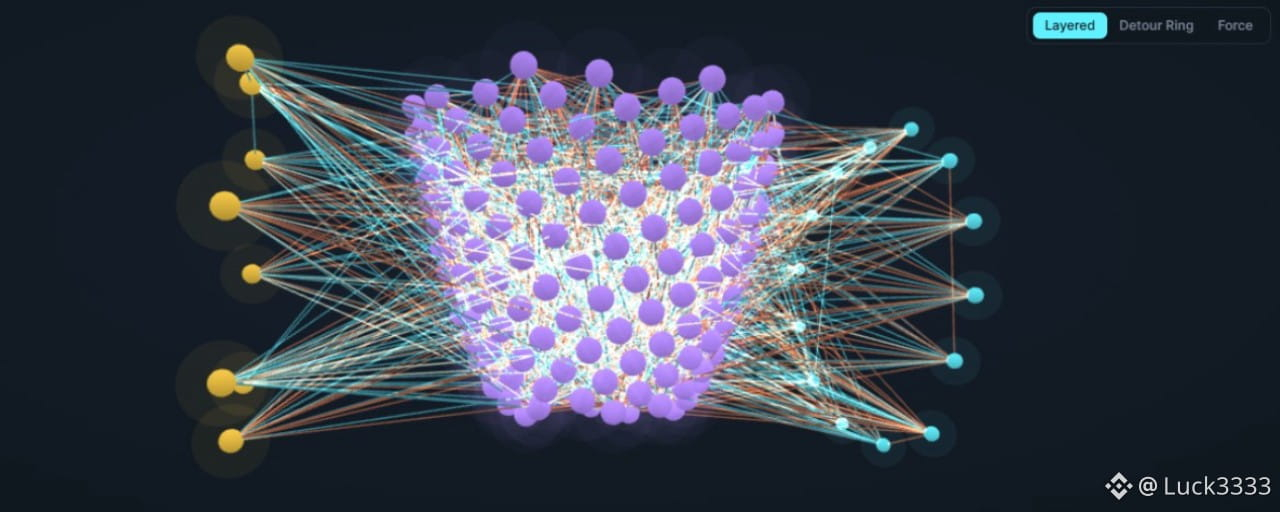
Article
The Qubic Ecosystem Unveiled: UPoW, Jetski Pool, & The Revolutionary ANN ExplorerThe intersection of Artificial Intelligence (AI) and Blockchain is the hottest narrative in crypto right now. But while most projects just slap "AI" onto standard tech, Qubic ($QUBIC) is fundamentally rewriting the rules of distributed computing.
If you are tired of the massive energy waste from traditional Proof-of-Work (PoW) and the centralization of big tech AI, it’s time to dive deep into Qubic's Layer-1 ecosystem, the critical role of Jetski Pool, and how the upcoming ANN Explorer is solving the biggest transparency problem in AI crypto. 👇
🚀 Qubic: Not Your Average Layer-1
Created by Sergey Ivancheglo (aka Come-from-Beyond), the pioneer behind the first PoS protocol and IOTA’s DAG architecture, Qubic is a bare-metal, decentralized computing platform built for extreme performance.
Forget Ethereum's gas fees and slow VMs. Qubic utilizes Quorum-Based Computation (QBC):
676 Computors: A strict set of 676 validator nodes process everything.Instant Finality: Consensus only requires 451 nodes (67%) to agree, acting as a strict Byzantine Fault Tolerant system.Insane Speed: Smart contracts execute directly on bare metal (C++), enabling speeds up to 15.52 million TPS at peak capacity.Feeless: Zero transaction fees for end-users.
🤖 Useful Proof of Work (UPoW): Mining for AGI
Traditional Bitcoin mining burns terawatt-hours of electricity to solve meaningless cryptographic puzzles (SHA-256). Qubic flips this model on its head with Useful Proof of Work (UPoW).
Instead of hashing, millions of AI miners use their CPU/GPU power to train Artificial Neural Networks (ANNs). This massive decentralized supercomputer feeds into Aigarth—an open-source AI system striving for Artificial General Intelligence (AGI).
The 7-Day Epoch: Every week, Computors are ranked based on the volume and quality of AI training they facilitated. Underperforming nodes are ruthlessly kicked out and replaced by eager competitors. It's digital Darwinism at its finest!
🧬 Biological AI vs. Big Tech Centralization
Modern AI (like ChatGPT) relies on Backpropagation—a method that requires billions of dollars in centralized Data Centers (CapEx). It’s highly expensive and completely static once trained.
Qubic takes a neurobiological approach. Miners create random neural topologies. The system then "prunes" (destroys) the weakest links to find the "sweet spot" of intelligence, mimicking the synaptic plasticity of the human brain. No massive data centers required—just the crowdsourced power of the DePIN ecosystem.
⛏️ The Merged Mining Masterstroke
How do you maximize miner efficiency? Merged Mining. Qubic realized that AI training doesn't use 100% of a miner's hardware at all times. So, they pioneered a system where idle CPU power is used to mine Monero (XMR) and Tari, while ASIC miners (using Scrypt) can simultaneously mine Dogecoin (DOGE)!
The genius part? The XMR/DOGE mined is sold for USDT, used to buy back $QUBIC on the open market, and BURNED. This transforms idle compute power into a deflationary financial mechanism.
🌊 Jetski Pool: Powering the Ecosystem
With UPoW being so competitive, solo miners struggle to find valid AI solutions. Enter Jetski Pool—a top-tier community mining pool developed by JETSKI LLC.
Jetski Pool aggregates the hash power of thousands of retail miners. They’ve even launched a sleek Mobile App offering:
Real-time Hashrate & Epoch tracking.Wallet Search to view exact contributions and payouts.Dedicated Dogecoin (Scrypt) Stratums with 0% fees during launch.
However, the rapid growth of pools led to a critical issue: The Black Box Problem.
🔍 Epoch 222 & The ANN Explorer: Making UPoW Visible
In Bitcoin, anyone can check an explorer to see block hashes. But in Qubic, UPoW is invisible. How do outsiders know miners are actually training AI and not just faking data for tokens?
To solve this, the top-voted governance proposal in Epoch 222 was introduced by jtskxx (the engineering team behind Jetski Pool). The mission? "Make Useful Proof of Work Visible."
Enter annexplorer.jetskipool.ai. This isn't a normal block explorer; it is a multi-dimensional real-time AI analytics dashboard. Its groundbreaking features include:
Dynamic Topology Visualization: A 3D render showing the actual neural networks being formed and pruned in real-time. You can literally watch the AI brain grow.Verified AI Solutions Ledger: Translates abstract AI math into a clear, verifiable blockchain ledger.Cross-Reference Miner Attribution: Miners can input their wallets and see exactly which parts of the Aigarth brain their hardware helped build.Compute Segregation Radar: Proves that computing power is dedicated to AI, independent of the Merged Mining (DOGE/XMR) side tasks, ensuring network integrity.
🔮 Conclusion: Redefining DePIN & AI
The Qubic ANN Explorer by Jetski Pool is setting a new industry standard. By turning the "invisible" intellectual labor of UPoW into visual, mathematically verifiable data, it destroys academic skepticism.
It proves that humanity doesn't need to rely on Big Tech monopolies to build the future of AI. We can build it together, fairly, on the blockchain.
What are your thoughts on Qubic's approach to AI? Let's discuss in the comments! 👇
#Qubic #DePIN #AI #CryptoMining #Web3
Read: [What Is AGI? The Limits, Visions, and Definitions of Artificial General Intelligence](https://www.binance.com/en/square/post/342567558192178)
The Qubic Ecosystem Unveiled: UPoW, Jetski Pool, & The Revolutionary ANN Explorer
The intersection of Artificial Intelligence (AI) and Blockchain is the hottest narrative in crypto right now. But while most projects just slap "AI" onto standard tech, Qubic ($QUBIC) is fundamentally rewriting the rules of distributed computing.
If you are tired of the massive energy waste from traditional Proof-of-Work (PoW) and the centralization of big tech AI, it’s time to dive deep into Qubic's Layer-1 ecosystem, the critical role of Jetski Pool, and how the upcoming ANN Explorer is solving the biggest transparency problem in AI crypto. 👇
🚀 Qubic: Not Your Average Layer-1
Created by Sergey Ivancheglo (aka Come-from-Beyond), the pioneer behind the first PoS protocol and IOTA’s DAG architecture, Qubic is a bare-metal, decentralized computing platform built for extreme performance.
Forget Ethereum's gas fees and slow VMs. Qubic utilizes Quorum-Based Computation (QBC):
676 Computors: A strict set of 676 validator nodes process everything.Instant Finality: Consensus only requires 451 nodes (67%) to agree, acting as a strict Byzantine Fault Tolerant system.Insane Speed: Smart contracts execute directly on bare metal (C++), enabling speeds up to 15.52 million TPS at peak capacity.Feeless: Zero transaction fees for end-users.
🤖 Useful Proof of Work (UPoW): Mining for AGI
Traditional Bitcoin mining burns terawatt-hours of electricity to solve meaningless cryptographic puzzles (SHA-256). Qubic flips this model on its head with Useful Proof of Work (UPoW).
Instead of hashing, millions of AI miners use their CPU/GPU power to train Artificial Neural Networks (ANNs). This massive decentralized supercomputer feeds into Aigarth—an open-source AI system striving for Artificial General Intelligence (AGI).
The 7-Day Epoch: Every week, Computors are ranked based on the volume and quality of AI training they facilitated. Underperforming nodes are ruthlessly kicked out and replaced by eager competitors. It's digital Darwinism at its finest!
🧬 Biological AI vs. Big Tech Centralization
Modern AI (like ChatGPT) relies on Backpropagation—a method that requires billions of dollars in centralized Data Centers (CapEx). It’s highly expensive and completely static once trained.
Qubic takes a neurobiological approach. Miners create random neural topologies. The system then "prunes" (destroys) the weakest links to find the "sweet spot" of intelligence, mimicking the synaptic plasticity of the human brain. No massive data centers required—just the crowdsourced power of the DePIN ecosystem.
⛏️ The Merged Mining Masterstroke
How do you maximize miner efficiency? Merged Mining. Qubic realized that AI training doesn't use 100% of a miner's hardware at all times. So, they pioneered a system where idle CPU power is used to mine Monero (XMR) and Tari, while ASIC miners (using Scrypt) can simultaneously mine Dogecoin (DOGE)!
The genius part? The XMR/DOGE mined is sold for USDT, used to buy back $QUBIC on the open market, and BURNED. This transforms idle compute power into a deflationary financial mechanism.
🌊 Jetski Pool: Powering the Ecosystem
With UPoW being so competitive, solo miners struggle to find valid AI solutions. Enter Jetski Pool—a top-tier community mining pool developed by JETSKI LLC.
Jetski Pool aggregates the hash power of thousands of retail miners. They’ve even launched a sleek Mobile App offering:
Real-time Hashrate & Epoch tracking.Wallet Search to view exact contributions and payouts.Dedicated Dogecoin (Scrypt) Stratums with 0% fees during launch.
However, the rapid growth of pools led to a critical issue: The Black Box Problem.
🔍 Epoch 222 & The ANN Explorer: Making UPoW Visible
In Bitcoin, anyone can check an explorer to see block hashes. But in Qubic, UPoW is invisible. How do outsiders know miners are actually training AI and not just faking data for tokens?
To solve this, the top-voted governance proposal in Epoch 222 was introduced by jtskxx (the engineering team behind Jetski Pool). The mission? "Make Useful Proof of Work Visible."
Enter annexplorer.jetskipool.ai. This isn't a normal block explorer; it is a multi-dimensional real-time AI analytics dashboard. Its groundbreaking features include:
Dynamic Topology Visualization: A 3D render showing the actual neural networks being formed and pruned in real-time. You can literally watch the AI brain grow.Verified AI Solutions Ledger: Translates abstract AI math into a clear, verifiable blockchain ledger.Cross-Reference Miner Attribution: Miners can input their wallets and see exactly which parts of the Aigarth brain their hardware helped build.Compute Segregation Radar: Proves that computing power is dedicated to AI, independent of the Merged Mining (DOGE/XMR) side tasks, ensuring network integrity.
🔮 Conclusion: Redefining DePIN & AI
The Qubic ANN Explorer by Jetski Pool is setting a new industry standard. By turning the "invisible" intellectual labor of UPoW into visual, mathematically verifiable data, it destroys academic skepticism.
It proves that humanity doesn't need to rely on Big Tech monopolies to build the future of AI. We can build it together, fairly, on the blockchain.
What are your thoughts on Qubic's approach to AI? Let's discuss in the comments! 👇
#Qubic #DePIN #AI #CryptoMining #Web3
Read: What Is AGI? The Limits, Visions, and Definitions of Artificial General Intelligence
If you are tired of the massive energy waste from traditional Proof-of-Work (PoW) and the centralization of big tech AI, it’s time to dive deep into Qubic's Layer-1 ecosystem, the critical role of Jetski Pool, and how the upcoming ANN Explorer is solving the biggest transparency problem in AI crypto. 👇
🚀 Qubic: Not Your Average Layer-1
Created by Sergey Ivancheglo (aka Come-from-Beyond), the pioneer behind the first PoS protocol and IOTA’s DAG architecture, Qubic is a bare-metal, decentralized computing platform built for extreme performance.
Forget Ethereum's gas fees and slow VMs. Qubic utilizes Quorum-Based Computation (QBC):
676 Computors: A strict set of 676 validator nodes process everything.Instant Finality: Consensus only requires 451 nodes (67%) to agree, acting as a strict Byzantine Fault Tolerant system.Insane Speed: Smart contracts execute directly on bare metal (C++), enabling speeds up to 15.52 million TPS at peak capacity.Feeless: Zero transaction fees for end-users.
🤖 Useful Proof of Work (UPoW): Mining for AGI
Traditional Bitcoin mining burns terawatt-hours of electricity to solve meaningless cryptographic puzzles (SHA-256). Qubic flips this model on its head with Useful Proof of Work (UPoW).
Instead of hashing, millions of AI miners use their CPU/GPU power to train Artificial Neural Networks (ANNs). This massive decentralized supercomputer feeds into Aigarth—an open-source AI system striving for Artificial General Intelligence (AGI).
The 7-Day Epoch: Every week, Computors are ranked based on the volume and quality of AI training they facilitated. Underperforming nodes are ruthlessly kicked out and replaced by eager competitors. It's digital Darwinism at its finest!
🧬 Biological AI vs. Big Tech Centralization
Modern AI (like ChatGPT) relies on Backpropagation—a method that requires billions of dollars in centralized Data Centers (CapEx). It’s highly expensive and completely static once trained.
Qubic takes a neurobiological approach. Miners create random neural topologies. The system then "prunes" (destroys) the weakest links to find the "sweet spot" of intelligence, mimicking the synaptic plasticity of the human brain. No massive data centers required—just the crowdsourced power of the DePIN ecosystem.
⛏️ The Merged Mining Masterstroke
How do you maximize miner efficiency? Merged Mining. Qubic realized that AI training doesn't use 100% of a miner's hardware at all times. So, they pioneered a system where idle CPU power is used to mine Monero (XMR) and Tari, while ASIC miners (using Scrypt) can simultaneously mine Dogecoin (DOGE)!
The genius part? The XMR/DOGE mined is sold for USDT, used to buy back $QUBIC on the open market, and BURNED. This transforms idle compute power into a deflationary financial mechanism.
🌊 Jetski Pool: Powering the Ecosystem
With UPoW being so competitive, solo miners struggle to find valid AI solutions. Enter Jetski Pool—a top-tier community mining pool developed by JETSKI LLC.
Jetski Pool aggregates the hash power of thousands of retail miners. They’ve even launched a sleek Mobile App offering:
Real-time Hashrate & Epoch tracking.Wallet Search to view exact contributions and payouts.Dedicated Dogecoin (Scrypt) Stratums with 0% fees during launch.
However, the rapid growth of pools led to a critical issue: The Black Box Problem.
🔍 Epoch 222 & The ANN Explorer: Making UPoW Visible
In Bitcoin, anyone can check an explorer to see block hashes. But in Qubic, UPoW is invisible. How do outsiders know miners are actually training AI and not just faking data for tokens?
To solve this, the top-voted governance proposal in Epoch 222 was introduced by jtskxx (the engineering team behind Jetski Pool). The mission? "Make Useful Proof of Work Visible."
Enter annexplorer.jetskipool.ai. This isn't a normal block explorer; it is a multi-dimensional real-time AI analytics dashboard. Its groundbreaking features include:
Dynamic Topology Visualization: A 3D render showing the actual neural networks being formed and pruned in real-time. You can literally watch the AI brain grow.Verified AI Solutions Ledger: Translates abstract AI math into a clear, verifiable blockchain ledger.Cross-Reference Miner Attribution: Miners can input their wallets and see exactly which parts of the Aigarth brain their hardware helped build.Compute Segregation Radar: Proves that computing power is dedicated to AI, independent of the Merged Mining (DOGE/XMR) side tasks, ensuring network integrity.
🔮 Conclusion: Redefining DePIN & AI
The Qubic ANN Explorer by Jetski Pool is setting a new industry standard. By turning the "invisible" intellectual labor of UPoW into visual, mathematically verifiable data, it destroys academic skepticism.
It proves that humanity doesn't need to rely on Big Tech monopolies to build the future of AI. We can build it together, fairly, on the blockchain.
What are your thoughts on Qubic's approach to AI? Let's discuss in the comments! 👇
#Qubic #DePIN #AI #CryptoMining #Web3
Read: What Is AGI? The Limits, Visions, and Definitions of Artificial General Intelligence
226
·
--
Qubic "All Hands" AMA👉 https://x.com/i/broadcasts/1YxNrrkWeoQxw
Qubic "All Hands" AMA👉 https://x.com/i/broadcasts/1YxNrrkWeoQxw
74
·
--
Qubic will be at two of Europe’s biggest AI events next week, both in Paris.
⭐
MACHINA on July 7 at Station F.
RAISE Summit on July 8-9 at the Carrousel du Louvre.
Their attendance was made possible by generous donations from community members who wanted to see Qubic represented where it matters.
MACHINA is Europe’s leading physical AI summit. Robotics, humanoid systems, embodied intelligence.
The room includes founders from Boston Dynamics, NEURA Robotics, and NVIDIA’s robotics division.
This is where the people building machines that move and act in the real world sit down and decide what comes next.
The intersection of AI and physical infrastructure is exactly where Qubic’s compute layer belongs in the conversation.
👉 https://www.machinasummit.com/
⭐⭐
RAISE Summit is the largest cross-industry AI leadership gathering in Europe.
Over 9,000 attendees, 350+ speakers including Yann LeCun, Eric Schmidt, and Jim Fan.
80% of the room is C-level or founder level.
The conversations happening here will shape where AI infrastructure, compute ownership, and enterprise adoption go over the next decade.
Having the Qubic community in that room matters.
👉https://www.raisesummit.com/
This presence was organized from the ground up by Qubic France, a community-driven group representing the project out of conviction.
They are still looking for support to cover travel costs and media publication.
Events at this level come with real costs, and every contribution strengthens how the project shows up.
The more the community backs it, the bigger the impact.
If you want to contribute, reach out to IrisNova_AI
#Qubic #RAISE #AI #AGI
Qubic will be at two of Europe’s biggest AI events next week, both in Paris.
⭐
MACHINA on July 7 at Station F.
RAISE Summit on July 8-9 at the Carrousel du Louvre.
Their attendance was made possible by generous donations from community members who wanted to see Qubic represented where it matters.
MACHINA is Europe’s leading physical AI summit. Robotics, humanoid systems, embodied intelligence.
The room includes founders from Boston Dynamics, NEURA Robotics, and NVIDIA’s robotics division.
This is where the people building machines that move and act in the real world sit down and decide what comes next.
The intersection of AI and physical infrastructure is exactly where Qubic’s compute layer belongs in the conversation.
👉 https://www.machinasummit.com/
⭐⭐
RAISE Summit is the largest cross-industry AI leadership gathering in Europe.
Over 9,000 attendees, 350+ speakers including Yann LeCun, Eric Schmidt, and Jim Fan.
80% of the room is C-level or founder level.
The conversations happening here will shape where AI infrastructure, compute ownership, and enterprise adoption go over the next decade.
Having the Qubic community in that room matters.
👉https://www.raisesummit.com/
This presence was organized from the ground up by Qubic France, a community-driven group representing the project out of conviction.
They are still looking for support to cover travel costs and media publication.
Events at this level come with real costs, and every contribution strengthens how the project shows up.
The more the community backs it, the bigger the impact.
If you want to contribute, reach out to IrisNova_AI
#Qubic #RAISE #AI #AGI
⭐
MACHINA on July 7 at Station F.
RAISE Summit on July 8-9 at the Carrousel du Louvre.
Their attendance was made possible by generous donations from community members who wanted to see Qubic represented where it matters.
MACHINA is Europe’s leading physical AI summit. Robotics, humanoid systems, embodied intelligence.
The room includes founders from Boston Dynamics, NEURA Robotics, and NVIDIA’s robotics division.
This is where the people building machines that move and act in the real world sit down and decide what comes next.
The intersection of AI and physical infrastructure is exactly where Qubic’s compute layer belongs in the conversation.
👉 https://www.machinasummit.com/
⭐⭐
RAISE Summit is the largest cross-industry AI leadership gathering in Europe.
Over 9,000 attendees, 350+ speakers including Yann LeCun, Eric Schmidt, and Jim Fan.
80% of the room is C-level or founder level.
The conversations happening here will shape where AI infrastructure, compute ownership, and enterprise adoption go over the next decade.
Having the Qubic community in that room matters.
👉https://www.raisesummit.com/
This presence was organized from the ground up by Qubic France, a community-driven group representing the project out of conviction.
They are still looking for support to cover travel costs and media publication.
Events at this level come with real costs, and every contribution strengthens how the project shows up.
The more the community backs it, the bigger the impact.
If you want to contribute, reach out to IrisNova_AI
#Qubic #RAISE #AI #AGI

NVDAUS+0.63%
1
134
·
--
We have no unit of measurement for intelligence.
Not for humans. Not for machines.
We've been arguing about it for over a century.
Up to 45% of the benchmarks we use to evaluate LLMs contain leaked training data.
ARC-AGI-3 was built to fix that.
Humans solve 100% of it.
Frontier AI scores below 1%.
NIA Volume 10 breaks down the g factor, Chollet's framework, benchmark contamination, and what measuring machine intelligence actually requires.
Full read
👇
[Measuring Machine Intelligence: The g Factor vs. ARC-AGI Benchmark](https://www.binance.com/en/square/post/332806106415490)
@BiBi
#AI #AGI #Qubic #TechTrends #Neuraxon
We have no unit of measurement for intelligence.
Not for humans. Not for machines.
We've been arguing about it for over a century.
Up to 45% of the benchmarks we use to evaluate LLMs contain leaked training data.
ARC-AGI-3 was built to fix that.
Humans solve 100% of it.
Frontier AI scores below 1%.
NIA Volume 10 breaks down the g factor, Chollet's framework, benchmark contamination, and what measuring machine intelligence actually requires.
Full read
👇
Measuring Machine Intelligence: The g Factor vs. ARC-AGI Benchmark
@Binance BiBi
#AI #AGI #Qubic #TechTrends #Neuraxon
Not for humans. Not for machines.
We've been arguing about it for over a century.
Up to 45% of the benchmarks we use to evaluate LLMs contain leaked training data.
ARC-AGI-3 was built to fix that.
Humans solve 100% of it.
Frontier AI scores below 1%.
NIA Volume 10 breaks down the g factor, Chollet's framework, benchmark contamination, and what measuring machine intelligence actually requires.
Full read
👇
Measuring Machine Intelligence: The g Factor vs. ARC-AGI Benchmark
@Binance BiBi
#AI #AGI #Qubic #TechTrends #Neuraxon
166
·
--
Article
Measuring Machine Intelligence: The g Factor vs. ARC-AGI Benchmark#Neuraxon Intelligence Academy — Volume 10
By the Qubic Scientific Team
If we build an artificial system and want to know whether it is intelligent, what exactly do we measure? We think we know when we hear that ChatGPT-5 announces it has beaten DeepSeek and then that Claude sweeps Gemini.
But the question is still there, intact. Measuring artificial intelligence is not measuring speed or temperature. We have no unit of measurement, as strange as that may seem.
In psychology we have been dealing with this problem for over a century. Artificial intelligence has been at it for a decade. And it does so in a hurry, with a lot of money at stake and with a constant temptation: to declare victory.
The g Factor: A Single Number to Summarize General Intelligence
At the beginning of the 20th century, Charles Spearman realized that when a child performed well in one subject, they tended to perform well in the others, even if they were subjects with no apparent relation. The scores correlated with one another, all of them positively. He called that pattern the positive manifold, and he deduced that there must be a common latent factor behind all those disparate abilities: the factor g, or general intelligence (Spearman, 1904).
The idea is seductive. If all cognitive tests load onto a single factor, it is enough to extract that factor through factor analysis to have a summary measure of general capacity. In human practice, that first factor usually explains between 40 and 50 % of the variance in performance (Detterman & Daniel, 1989; Deary et al., 2009).
But watch out, because here lies the first trap. The g factor is populational. It does not measure the individual, but variance within individuals (Hernández-Orallo et al., 2021). To say that a specific subject has so much g is, strictly speaking, a mistake. g emerges when comparing many subjects, not when examining one. Like personality, you are the most extroverted of your age group. And you remain so at 50 relative to your group, even if in intensity you are less extroverted than at 20.
What Does IQ Really Measure? Understanding Intelligence Scores
But then, what does IQ measure?
It measures a relative position. The scale is calibrated on a sample with mean 100, standard deviation 15. An IQ of 130 is not an absolute amount of intelligence stored inside someone's head; it is the assertion that this person is two standard deviations above the mean of their normative group. The number is attached to the individual, yes, but its meaning is populational. It is a position in a ranking, not a content.
Your height is absolute: you are 180 centimeters tall even if you are the last human being on Earth. Your IQ is not: being above the mean requires a mean, and a mean requires others. No one can be more intelligent than the average on a desert island.
Now one understands why transferring this to AI is so delicate. When someone computes a g for a set of large language models (LLMs), that factor is an artifact of the set they chose. We are measuring a position in a table, and we present it as if it were an internal property of the system.
Applying the g Factor to Artificial Intelligence: A Dangerous Temptation
The temptation to transfer all of this to AI was irresistible. Gignac and Szodorai proposed that, if the performance of models across varied tasks correlates positively, it should be possible to identify a general factor of capacity in artificial systems as well. And indeed, several recent works apply factor analysis to test batteries in LLMs and find a unidimensional g factor that remains stable across models, batteries and extraction methods (Ilić, 2023). It sounds like confirmation. It is wise to be suspicious.
The appearance of a dominant first factor does not prove that there exists a general capacity analogous to the human one. It proves that the scores of those models covary. And they covary for a very shallow reason: they share architecture, they share training corpus, they share optimization recipes. A large, well-trained model does everything better than a small, poorly trained one, across all tasks at once. That is enough to manufacture a beautiful positive manifold that tells us nothing about cognitive generality. It tells us about the scale of computation. WATCH OUT: The factor we extract may simply be a factor of size disguised as intelligence.
The brain, moreover, does not concentrate intelligence in a single module. A multitude of specialized subsystems process in parallel and, when a piece of information wins the competition, it becomes globally available to the rest of the system, which can then recombine it for new purposes (Baars, 1988; Dehaene & Changeux, 2011). What we call generality is global availability: putting a piece learned in one context at the service of a problem in another. It is not a stored scalar number; it is a pattern of access and integration. This is the kind of functional architecture that Neuraxon tries to emulate — modular subsystems with continuous-time dynamics and multi-timescale plasticity, rather than a monolithic transformer.
François Chollet and the Modern Approach: Measuring What You Still Don't Know How to Do
Against the psychometric legacy, François Chollet proposed in 2019 a conceptual turn. His argument, in On the Measure of Intelligence, is that we were measuring the wrong thing.
Traditional AI benchmarks reward skills, specific competencies on concrete tasks. But a skill can be bought with data and computation: it is enough to train sufficiently on a task to master it. Intelligence, Chollet maintains, is not skill, but efficiency in the acquisition of skills: how much you learn from how little, when facing a genuinely new task (Chollet, 2019).
Intelligence is what you do when you don't know what to do.
This distinction changes everything. A system that solves a million problems because it has seen ten million similar ones is not intelligent. An intelligent system is the one that, facing a problem for which it could not prepare, discovers the structure and adapts with few examples. The measure stops being the final result and becomes the slope of learning.
ARC-AGI: The Benchmark That Tests Genuine AI Reasoning
ARC-AGI was born from that idea, and its most recent version, ARC-AGI-3, takes it further. It is not a question-and-answer test. It is a set of interactive environments, like mini-videogames, in which the agent explores an unknown world, deduces what the objective is without being told in natural language, builds a model of the environment and adapts its strategy step by step (ARC Prize, 2025).
The design principles are explicit: environments 100 % solvable by humans, with no preloaded knowledge or hidden instructions, and with enough novelty to prevent memorization. What is scored is not getting it right, but efficiency in the acquisition of skill over time.
It is the opposite of the g factor: instead of looking for what a system already masters and summarizing it, it looks for what it still does not know how to do and measures how much it costs it to learn it.
Data Contamination: Why LLM Benchmark Scores Are Inflated
The ultimate reason why Chollet's approach matters, and why the g factor applied to LLMs is so slippery, has a technical name: data contamination. If the exam, or something almost identical, was in the notes the student studied, their grade does not measure what they can reason. It measures what they have memorized.
Language models are trained on books, forums, code repositories, articles, practically all the available text. The benchmarks with which we then evaluate them are published on the internet. The conclusion is that fragments of the tests end up inside the training data, which violates the separation between training and evaluation and inflates the scores (Xu et al., 2024; Deng et al., 2024). Empirical audits have detected contamination levels ranging from 1 % up to 45 % in widely used benchmarks, and the problem grows over time (Li et al., 2024).
It is not a minor problem of a couple of leaked questions. In benchmarks as cited as MMLU or GSM8K, part of what we interpret as reasoning may be pure memorization (Chen et al., 2025). When decontamination techniques are applied that rewrite the leaked items without altering their difficulty, accuracy drops: in one study, 22.9 % on GSM8K and 19.0 % on MMLU (Zhu et al., 2024).
Paraphrased items, or even ones translated into another language, dodge the superficial-overlap detectors and continue to inflate the results (Yang et al., 2023; Yao et al., 2024). The usual solutions (paraphrasing, translating, tweaking the context) are assumed to be effective without having been validated rigorously. And for most open models we cannot even check anything, because their training data is not published. We are grading exams without knowing what the student studied.
Here one understands why ARC-AGI chose the path it chose. An interactive, novel environment, with no natural-language instructions and designed to prevent brute-force memorization is, by construction, resistant to contamination.
So, What Should We Measure to Evaluate Machine Intelligence?
The g factor is a populational property that, applied to models that share architecture and corpus, runs the risk of measuring the scale of computation and not generality. The lesson for whoever builds artificial systems is not to choose between the g factor and ARC-AGI as if they were rival teams. It is to understand what question each one answers. A factor analysis can be useful to describe the internal structure of a system's performance, as long as the first factor is not confused with an essence of intelligence. And an ARC-type protocol is indispensable for what really matters: checking whether the system generalizes beyond what it saw, or merely recites.
When we evaluate a system only by its final answer, we are measuring it with our eyes closed to its temporal dimension: planning, the updating of beliefs, the integration of evidence across many steps. It is exactly what ARC-AGI-3 decided to score, and exactly what a static exam cannot see.
Why Brain-Inspired AI Architectures Like Neuraxon Take a Different Path
If intelligence is not a stored number but the efficient integration of specialized subsystems, as suggested by the parieto-frontal integration theory (P-FIT) and the global availability of the workspace in the brain…
If that integration is above all a temporal phenomenon, with time scales…
Then a system built on modular architectures with functional spheres, plasticity across multiple temporal scales and continuous dynamics does not need to be evaluated by asking it to recite answers.
The correct question is not how many benchmarks it beats, but with what efficiency it acquires new behavior, over time, in environments for which it was not prepared. That is the direction Neuraxon tries to take. To compute time – that is, adaptation – not memorized answers that simulate being a good student, when in reality, it already knows the questions.
#AI #AGI #Qubic #TechTrends
References
Chollet, F. (2019). On the Measure of Intelligence. arXiv:1911.01547.Deary, I. J., Penke, L., & Johnson, W. (2009). The neuroscience of human intelligence differences. Nature Reviews Neuroscience.Dehaene, S., & Changeux, J.-P. (2011). Experimental and theoretical approaches to conscious processing. Neuron, 70(2), 200–227.Detterman, D. K., & Daniel, M. H. (1989). Correlations of mental tests with each other and with cognitive variables. Intelligence.Gignac, G. E., & Szodorai, E. T. (2024). Defining and identifying a general factor of ability in AI systems.Guttman, L. (1955). The determinacy of factor score matrices with implications for five other basic problems of common-factor theory. British Journal of Statistical Psychology.Hernández-Orallo, J., et al. (2021). General intelligence disentangled via a generality metric for natural and artificial intelligence. Scientific Reports.Honey, C. J., et al. (2012). Slow cortical dynamics and the accumulation of information over long timescales. Neuron, 76(2), 423–434.Ilić, D. (2023). Unveiling the General Intelligence Factor in Language Models: A Psychometric Approach. arXiv:2310.11616.Jung, R. E., & Haier, R. J. (2007). The Parieto-Frontal Integration Theory (P-FIT) of intelligence. Behavioral and Brain Sciences.Spearman, C. (1904). "General intelligence" objectively determined and measured. American Journal of Psychology, 15, 201–293.Roberts, M., et al. (2024). Temporal evidence of contamination from training cutoff dates.Schönemann, P. H. (2008). A Rejoinder to Mackintosh and some Remarks on the Concept of General Intelligence. arXiv:0808.2343.Xu, C., et al. (2024). Benchmark data contamination of large language models: a survey.Yang, S., et al. (2023). Rethinking benchmark and contamination for language models with rephrased samples.Zhu, Q., et al. (2024). Inference-Time Decontamination: Reusing leaked benchmarks for LLM evaluation. Findings of EMNLP 2024.ARC Prize (2025). ARC-AGI-3: An interactive reasoning benchmark. Technical Report.
Explore the Full Neuraxon Intelligence Academy Series
This is Volume 10 of the Neuraxon Intelligence Academy by the Qubic Scientific Team. If you are just joining us, explore the complete series to build a full understanding of the science behind Neuraxon, Aigarth, and Qubic's approach to brain-inspired, decentralized artificial intelligence:
[NIA Volume 1](https://www.binance.com/en/square/post/295315343732018): Why Intelligence Is Not Computed in Steps, but in Time — Explores why biological intelligence operates in continuous time rather than discrete computational steps like traditional LLMs.[NIA Volume 2](https://www.binance.com/en/square/post/295304276561778): Ternary Dynamics as a Model of Living Intelligence — Explains ternary dynamics and why three-state logic (excitatory, neutral, inhibitory) matters for modeling living systems.[NIA Volume 3](https://www.binance.com/en/square/post/295306656801506): Neuromodulation and Brain-Inspired AI — Covers neuromodulation and how the brain's chemical signaling (dopamine, serotonin, acetylcholine, norepinephrine) inspires Neuraxon's architecture.[NIA Volume 4](https://www.binance.com/en/square/post/295302152913618): Neural Networks in AI and Neuroscience — A deep comparison of biological neural networks, artificial neural networks, and Neuraxon's third-path approach.[NIA Volume 5](https://www.binance.com/en/square/post/302913958960674): Astrocytes and Brain-Inspired AI — How astrocytic gating transforms neural network plasticity through the AGMP framework in Neuraxon.[NIA Volume 6](https://www.binance.com/en/square/post/310198879866145): Conscious Machines vs Intelligent Organisms: AI Consciousness Explained — Explores AI consciousness through the lens of Global Workspace Theory, Integrated Information Theory, and predictive coding.[NIA Volume 7](https://www.binance.com/en/square/post/321350661453970): Conway's Game of Life, Artificial Life, and Digital Ecosystems — The science behind Qubic, Aigarth, and Neuraxon's emergent complexity and self-organized criticality.[NIA Volume 8](https://www.binance.com/en/square/post/322900066069841): Brain Criticality and the Branching Ratio in Neural and Artificial Networks — Why a branching ratio near 1 and self-organized criticality are bioinspired design principles in Neuraxon.[NIA Volume 9](https://www.binance.com/en/square/post/328379422341521): The Origins of the g Factor: From Education and Neuroscience to Artificial Intelligence — Explores the origins of the g factor across education, neuroscience, and AI.
$Qubic is a decentralized, open-source network for experimental technology. To learn more, visit qubic.org. Join the discussion on X, Discord, and Telegram.
Measuring Machine Intelligence: The g Factor vs. ARC-AGI Benchmark
#Neuraxon Intelligence Academy — Volume 10
By the Qubic Scientific Team
If we build an artificial system and want to know whether it is intelligent, what exactly do we measure? We think we know when we hear that ChatGPT-5 announces it has beaten DeepSeek and then that Claude sweeps Gemini.
But the question is still there, intact. Measuring artificial intelligence is not measuring speed or temperature. We have no unit of measurement, as strange as that may seem.
In psychology we have been dealing with this problem for over a century. Artificial intelligence has been at it for a decade. And it does so in a hurry, with a lot of money at stake and with a constant temptation: to declare victory.
The g Factor: A Single Number to Summarize General Intelligence
At the beginning of the 20th century, Charles Spearman realized that when a child performed well in one subject, they tended to perform well in the others, even if they were subjects with no apparent relation. The scores correlated with one another, all of them positively. He called that pattern the positive manifold, and he deduced that there must be a common latent factor behind all those disparate abilities: the factor g, or general intelligence (Spearman, 1904).
The idea is seductive. If all cognitive tests load onto a single factor, it is enough to extract that factor through factor analysis to have a summary measure of general capacity. In human practice, that first factor usually explains between 40 and 50 % of the variance in performance (Detterman & Daniel, 1989; Deary et al., 2009).
But watch out, because here lies the first trap. The g factor is populational. It does not measure the individual, but variance within individuals (Hernández-Orallo et al., 2021). To say that a specific subject has so much g is, strictly speaking, a mistake. g emerges when comparing many subjects, not when examining one. Like personality, you are the most extroverted of your age group. And you remain so at 50 relative to your group, even if in intensity you are less extroverted than at 20.
What Does IQ Really Measure? Understanding Intelligence Scores
But then, what does IQ measure?
It measures a relative position. The scale is calibrated on a sample with mean 100, standard deviation 15. An IQ of 130 is not an absolute amount of intelligence stored inside someone's head; it is the assertion that this person is two standard deviations above the mean of their normative group. The number is attached to the individual, yes, but its meaning is populational. It is a position in a ranking, not a content.
Your height is absolute: you are 180 centimeters tall even if you are the last human being on Earth. Your IQ is not: being above the mean requires a mean, and a mean requires others. No one can be more intelligent than the average on a desert island.
Now one understands why transferring this to AI is so delicate. When someone computes a g for a set of large language models (LLMs), that factor is an artifact of the set they chose. We are measuring a position in a table, and we present it as if it were an internal property of the system.
Applying the g Factor to Artificial Intelligence: A Dangerous Temptation
The temptation to transfer all of this to AI was irresistible. Gignac and Szodorai proposed that, if the performance of models across varied tasks correlates positively, it should be possible to identify a general factor of capacity in artificial systems as well. And indeed, several recent works apply factor analysis to test batteries in LLMs and find a unidimensional g factor that remains stable across models, batteries and extraction methods (Ilić, 2023). It sounds like confirmation. It is wise to be suspicious.
The appearance of a dominant first factor does not prove that there exists a general capacity analogous to the human one. It proves that the scores of those models covary. And they covary for a very shallow reason: they share architecture, they share training corpus, they share optimization recipes. A large, well-trained model does everything better than a small, poorly trained one, across all tasks at once. That is enough to manufacture a beautiful positive manifold that tells us nothing about cognitive generality. It tells us about the scale of computation. WATCH OUT: The factor we extract may simply be a factor of size disguised as intelligence.
The brain, moreover, does not concentrate intelligence in a single module. A multitude of specialized subsystems process in parallel and, when a piece of information wins the competition, it becomes globally available to the rest of the system, which can then recombine it for new purposes (Baars, 1988; Dehaene & Changeux, 2011). What we call generality is global availability: putting a piece learned in one context at the service of a problem in another. It is not a stored scalar number; it is a pattern of access and integration. This is the kind of functional architecture that Neuraxon tries to emulate — modular subsystems with continuous-time dynamics and multi-timescale plasticity, rather than a monolithic transformer.
François Chollet and the Modern Approach: Measuring What You Still Don't Know How to Do
Against the psychometric legacy, François Chollet proposed in 2019 a conceptual turn. His argument, in On the Measure of Intelligence, is that we were measuring the wrong thing.
Traditional AI benchmarks reward skills, specific competencies on concrete tasks. But a skill can be bought with data and computation: it is enough to train sufficiently on a task to master it. Intelligence, Chollet maintains, is not skill, but efficiency in the acquisition of skills: how much you learn from how little, when facing a genuinely new task (Chollet, 2019).
Intelligence is what you do when you don't know what to do.
This distinction changes everything. A system that solves a million problems because it has seen ten million similar ones is not intelligent. An intelligent system is the one that, facing a problem for which it could not prepare, discovers the structure and adapts with few examples. The measure stops being the final result and becomes the slope of learning.
ARC-AGI: The Benchmark That Tests Genuine AI Reasoning
ARC-AGI was born from that idea, and its most recent version, ARC-AGI-3, takes it further. It is not a question-and-answer test. It is a set of interactive environments, like mini-videogames, in which the agent explores an unknown world, deduces what the objective is without being told in natural language, builds a model of the environment and adapts its strategy step by step (ARC Prize, 2025).
The design principles are explicit: environments 100 % solvable by humans, with no preloaded knowledge or hidden instructions, and with enough novelty to prevent memorization. What is scored is not getting it right, but efficiency in the acquisition of skill over time.
It is the opposite of the g factor: instead of looking for what a system already masters and summarizing it, it looks for what it still does not know how to do and measures how much it costs it to learn it.
Data Contamination: Why LLM Benchmark Scores Are Inflated
The ultimate reason why Chollet's approach matters, and why the g factor applied to LLMs is so slippery, has a technical name: data contamination. If the exam, or something almost identical, was in the notes the student studied, their grade does not measure what they can reason. It measures what they have memorized.
Language models are trained on books, forums, code repositories, articles, practically all the available text. The benchmarks with which we then evaluate them are published on the internet. The conclusion is that fragments of the tests end up inside the training data, which violates the separation between training and evaluation and inflates the scores (Xu et al., 2024; Deng et al., 2024). Empirical audits have detected contamination levels ranging from 1 % up to 45 % in widely used benchmarks, and the problem grows over time (Li et al., 2024).
It is not a minor problem of a couple of leaked questions. In benchmarks as cited as MMLU or GSM8K, part of what we interpret as reasoning may be pure memorization (Chen et al., 2025). When decontamination techniques are applied that rewrite the leaked items without altering their difficulty, accuracy drops: in one study, 22.9 % on GSM8K and 19.0 % on MMLU (Zhu et al., 2024).
Paraphrased items, or even ones translated into another language, dodge the superficial-overlap detectors and continue to inflate the results (Yang et al., 2023; Yao et al., 2024). The usual solutions (paraphrasing, translating, tweaking the context) are assumed to be effective without having been validated rigorously. And for most open models we cannot even check anything, because their training data is not published. We are grading exams without knowing what the student studied.
Here one understands why ARC-AGI chose the path it chose. An interactive, novel environment, with no natural-language instructions and designed to prevent brute-force memorization is, by construction, resistant to contamination.
So, What Should We Measure to Evaluate Machine Intelligence?
The g factor is a populational property that, applied to models that share architecture and corpus, runs the risk of measuring the scale of computation and not generality. The lesson for whoever builds artificial systems is not to choose between the g factor and ARC-AGI as if they were rival teams. It is to understand what question each one answers. A factor analysis can be useful to describe the internal structure of a system's performance, as long as the first factor is not confused with an essence of intelligence. And an ARC-type protocol is indispensable for what really matters: checking whether the system generalizes beyond what it saw, or merely recites.
When we evaluate a system only by its final answer, we are measuring it with our eyes closed to its temporal dimension: planning, the updating of beliefs, the integration of evidence across many steps. It is exactly what ARC-AGI-3 decided to score, and exactly what a static exam cannot see.
Why Brain-Inspired AI Architectures Like Neuraxon Take a Different Path
If intelligence is not a stored number but the efficient integration of specialized subsystems, as suggested by the parieto-frontal integration theory (P-FIT) and the global availability of the workspace in the brain…
If that integration is above all a temporal phenomenon, with time scales…
Then a system built on modular architectures with functional spheres, plasticity across multiple temporal scales and continuous dynamics does not need to be evaluated by asking it to recite answers.
The correct question is not how many benchmarks it beats, but with what efficiency it acquires new behavior, over time, in environments for which it was not prepared. That is the direction Neuraxon tries to take. To compute time – that is, adaptation – not memorized answers that simulate being a good student, when in reality, it already knows the questions.
#AI #AGI #Qubic #TechTrends
References
Chollet, F. (2019). On the Measure of Intelligence. arXiv:1911.01547.Deary, I. J., Penke, L., & Johnson, W. (2009). The neuroscience of human intelligence differences. Nature Reviews Neuroscience.Dehaene, S., & Changeux, J.-P. (2011). Experimental and theoretical approaches to conscious processing. Neuron, 70(2), 200–227.Detterman, D. K., & Daniel, M. H. (1989). Correlations of mental tests with each other and with cognitive variables. Intelligence.Gignac, G. E., & Szodorai, E. T. (2024). Defining and identifying a general factor of ability in AI systems.Guttman, L. (1955). The determinacy of factor score matrices with implications for five other basic problems of common-factor theory. British Journal of Statistical Psychology.Hernández-Orallo, J., et al. (2021). General intelligence disentangled via a generality metric for natural and artificial intelligence. Scientific Reports.Honey, C. J., et al. (2012). Slow cortical dynamics and the accumulation of information over long timescales. Neuron, 76(2), 423–434.Ilić, D. (2023). Unveiling the General Intelligence Factor in Language Models: A Psychometric Approach. arXiv:2310.11616.Jung, R. E., & Haier, R. J. (2007). The Parieto-Frontal Integration Theory (P-FIT) of intelligence. Behavioral and Brain Sciences.Spearman, C. (1904). "General intelligence" objectively determined and measured. American Journal of Psychology, 15, 201–293.Roberts, M., et al. (2024). Temporal evidence of contamination from training cutoff dates.Schönemann, P. H. (2008). A Rejoinder to Mackintosh and some Remarks on the Concept of General Intelligence. arXiv:0808.2343.Xu, C., et al. (2024). Benchmark data contamination of large language models: a survey.Yang, S., et al. (2023). Rethinking benchmark and contamination for language models with rephrased samples.Zhu, Q., et al. (2024). Inference-Time Decontamination: Reusing leaked benchmarks for LLM evaluation. Findings of EMNLP 2024.ARC Prize (2025). ARC-AGI-3: An interactive reasoning benchmark. Technical Report.
Explore the Full Neuraxon Intelligence Academy Series
This is Volume 10 of the Neuraxon Intelligence Academy by the Qubic Scientific Team. If you are just joining us, explore the complete series to build a full understanding of the science behind Neuraxon, Aigarth, and Qubic's approach to brain-inspired, decentralized artificial intelligence:
NIA Volume 1: Why Intelligence Is Not Computed in Steps, but in Time — Explores why biological intelligence operates in continuous time rather than discrete computational steps like traditional LLMs.NIA Volume 2: Ternary Dynamics as a Model of Living Intelligence — Explains ternary dynamics and why three-state logic (excitatory, neutral, inhibitory) matters for modeling living systems.NIA Volume 3: Neuromodulation and Brain-Inspired AI — Covers neuromodulation and how the brain's chemical signaling (dopamine, serotonin, acetylcholine, norepinephrine) inspires Neuraxon's architecture.NIA Volume 4: Neural Networks in AI and Neuroscience — A deep comparison of biological neural networks, artificial neural networks, and Neuraxon's third-path approach.NIA Volume 5: Astrocytes and Brain-Inspired AI — How astrocytic gating transforms neural network plasticity through the AGMP framework in Neuraxon.NIA Volume 6: Conscious Machines vs Intelligent Organisms: AI Consciousness Explained — Explores AI consciousness through the lens of Global Workspace Theory, Integrated Information Theory, and predictive coding.NIA Volume 7: Conway's Game of Life, Artificial Life, and Digital Ecosystems — The science behind Qubic, Aigarth, and Neuraxon's emergent complexity and self-organized criticality.NIA Volume 8: Brain Criticality and the Branching Ratio in Neural and Artificial Networks — Why a branching ratio near 1 and self-organized criticality are bioinspired design principles in Neuraxon.NIA Volume 9: The Origins of the g Factor: From Education and Neuroscience to Artificial Intelligence — Explores the origins of the g factor across education, neuroscience, and AI.
$Qubic is a decentralized, open-source network for experimental technology. To learn more, visit qubic.org. Join the discussion on X, Discord, and Telegram.
By the Qubic Scientific Team
If we build an artificial system and want to know whether it is intelligent, what exactly do we measure? We think we know when we hear that ChatGPT-5 announces it has beaten DeepSeek and then that Claude sweeps Gemini.
But the question is still there, intact. Measuring artificial intelligence is not measuring speed or temperature. We have no unit of measurement, as strange as that may seem.
In psychology we have been dealing with this problem for over a century. Artificial intelligence has been at it for a decade. And it does so in a hurry, with a lot of money at stake and with a constant temptation: to declare victory.
The g Factor: A Single Number to Summarize General Intelligence
At the beginning of the 20th century, Charles Spearman realized that when a child performed well in one subject, they tended to perform well in the others, even if they were subjects with no apparent relation. The scores correlated with one another, all of them positively. He called that pattern the positive manifold, and he deduced that there must be a common latent factor behind all those disparate abilities: the factor g, or general intelligence (Spearman, 1904).
The idea is seductive. If all cognitive tests load onto a single factor, it is enough to extract that factor through factor analysis to have a summary measure of general capacity. In human practice, that first factor usually explains between 40 and 50 % of the variance in performance (Detterman & Daniel, 1989; Deary et al., 2009).
But watch out, because here lies the first trap. The g factor is populational. It does not measure the individual, but variance within individuals (Hernández-Orallo et al., 2021). To say that a specific subject has so much g is, strictly speaking, a mistake. g emerges when comparing many subjects, not when examining one. Like personality, you are the most extroverted of your age group. And you remain so at 50 relative to your group, even if in intensity you are less extroverted than at 20.
What Does IQ Really Measure? Understanding Intelligence Scores
But then, what does IQ measure?
It measures a relative position. The scale is calibrated on a sample with mean 100, standard deviation 15. An IQ of 130 is not an absolute amount of intelligence stored inside someone's head; it is the assertion that this person is two standard deviations above the mean of their normative group. The number is attached to the individual, yes, but its meaning is populational. It is a position in a ranking, not a content.
Your height is absolute: you are 180 centimeters tall even if you are the last human being on Earth. Your IQ is not: being above the mean requires a mean, and a mean requires others. No one can be more intelligent than the average on a desert island.
Now one understands why transferring this to AI is so delicate. When someone computes a g for a set of large language models (LLMs), that factor is an artifact of the set they chose. We are measuring a position in a table, and we present it as if it were an internal property of the system.
Applying the g Factor to Artificial Intelligence: A Dangerous Temptation
The temptation to transfer all of this to AI was irresistible. Gignac and Szodorai proposed that, if the performance of models across varied tasks correlates positively, it should be possible to identify a general factor of capacity in artificial systems as well. And indeed, several recent works apply factor analysis to test batteries in LLMs and find a unidimensional g factor that remains stable across models, batteries and extraction methods (Ilić, 2023). It sounds like confirmation. It is wise to be suspicious.
The appearance of a dominant first factor does not prove that there exists a general capacity analogous to the human one. It proves that the scores of those models covary. And they covary for a very shallow reason: they share architecture, they share training corpus, they share optimization recipes. A large, well-trained model does everything better than a small, poorly trained one, across all tasks at once. That is enough to manufacture a beautiful positive manifold that tells us nothing about cognitive generality. It tells us about the scale of computation. WATCH OUT: The factor we extract may simply be a factor of size disguised as intelligence.
The brain, moreover, does not concentrate intelligence in a single module. A multitude of specialized subsystems process in parallel and, when a piece of information wins the competition, it becomes globally available to the rest of the system, which can then recombine it for new purposes (Baars, 1988; Dehaene & Changeux, 2011). What we call generality is global availability: putting a piece learned in one context at the service of a problem in another. It is not a stored scalar number; it is a pattern of access and integration. This is the kind of functional architecture that Neuraxon tries to emulate — modular subsystems with continuous-time dynamics and multi-timescale plasticity, rather than a monolithic transformer.
François Chollet and the Modern Approach: Measuring What You Still Don't Know How to Do
Against the psychometric legacy, François Chollet proposed in 2019 a conceptual turn. His argument, in On the Measure of Intelligence, is that we were measuring the wrong thing.
Traditional AI benchmarks reward skills, specific competencies on concrete tasks. But a skill can be bought with data and computation: it is enough to train sufficiently on a task to master it. Intelligence, Chollet maintains, is not skill, but efficiency in the acquisition of skills: how much you learn from how little, when facing a genuinely new task (Chollet, 2019).
Intelligence is what you do when you don't know what to do.
This distinction changes everything. A system that solves a million problems because it has seen ten million similar ones is not intelligent. An intelligent system is the one that, facing a problem for which it could not prepare, discovers the structure and adapts with few examples. The measure stops being the final result and becomes the slope of learning.
ARC-AGI: The Benchmark That Tests Genuine AI Reasoning
ARC-AGI was born from that idea, and its most recent version, ARC-AGI-3, takes it further. It is not a question-and-answer test. It is a set of interactive environments, like mini-videogames, in which the agent explores an unknown world, deduces what the objective is without being told in natural language, builds a model of the environment and adapts its strategy step by step (ARC Prize, 2025).
The design principles are explicit: environments 100 % solvable by humans, with no preloaded knowledge or hidden instructions, and with enough novelty to prevent memorization. What is scored is not getting it right, but efficiency in the acquisition of skill over time.
It is the opposite of the g factor: instead of looking for what a system already masters and summarizing it, it looks for what it still does not know how to do and measures how much it costs it to learn it.
Data Contamination: Why LLM Benchmark Scores Are Inflated
The ultimate reason why Chollet's approach matters, and why the g factor applied to LLMs is so slippery, has a technical name: data contamination. If the exam, or something almost identical, was in the notes the student studied, their grade does not measure what they can reason. It measures what they have memorized.
Language models are trained on books, forums, code repositories, articles, practically all the available text. The benchmarks with which we then evaluate them are published on the internet. The conclusion is that fragments of the tests end up inside the training data, which violates the separation between training and evaluation and inflates the scores (Xu et al., 2024; Deng et al., 2024). Empirical audits have detected contamination levels ranging from 1 % up to 45 % in widely used benchmarks, and the problem grows over time (Li et al., 2024).
It is not a minor problem of a couple of leaked questions. In benchmarks as cited as MMLU or GSM8K, part of what we interpret as reasoning may be pure memorization (Chen et al., 2025). When decontamination techniques are applied that rewrite the leaked items without altering their difficulty, accuracy drops: in one study, 22.9 % on GSM8K and 19.0 % on MMLU (Zhu et al., 2024).
Paraphrased items, or even ones translated into another language, dodge the superficial-overlap detectors and continue to inflate the results (Yang et al., 2023; Yao et al., 2024). The usual solutions (paraphrasing, translating, tweaking the context) are assumed to be effective without having been validated rigorously. And for most open models we cannot even check anything, because their training data is not published. We are grading exams without knowing what the student studied.
Here one understands why ARC-AGI chose the path it chose. An interactive, novel environment, with no natural-language instructions and designed to prevent brute-force memorization is, by construction, resistant to contamination.
So, What Should We Measure to Evaluate Machine Intelligence?
The g factor is a populational property that, applied to models that share architecture and corpus, runs the risk of measuring the scale of computation and not generality. The lesson for whoever builds artificial systems is not to choose between the g factor and ARC-AGI as if they were rival teams. It is to understand what question each one answers. A factor analysis can be useful to describe the internal structure of a system's performance, as long as the first factor is not confused with an essence of intelligence. And an ARC-type protocol is indispensable for what really matters: checking whether the system generalizes beyond what it saw, or merely recites.
When we evaluate a system only by its final answer, we are measuring it with our eyes closed to its temporal dimension: planning, the updating of beliefs, the integration of evidence across many steps. It is exactly what ARC-AGI-3 decided to score, and exactly what a static exam cannot see.
Why Brain-Inspired AI Architectures Like Neuraxon Take a Different Path
If intelligence is not a stored number but the efficient integration of specialized subsystems, as suggested by the parieto-frontal integration theory (P-FIT) and the global availability of the workspace in the brain…
If that integration is above all a temporal phenomenon, with time scales…
Then a system built on modular architectures with functional spheres, plasticity across multiple temporal scales and continuous dynamics does not need to be evaluated by asking it to recite answers.
The correct question is not how many benchmarks it beats, but with what efficiency it acquires new behavior, over time, in environments for which it was not prepared. That is the direction Neuraxon tries to take. To compute time – that is, adaptation – not memorized answers that simulate being a good student, when in reality, it already knows the questions.
#AI #AGI #Qubic #TechTrends
References
Chollet, F. (2019). On the Measure of Intelligence. arXiv:1911.01547.Deary, I. J., Penke, L., & Johnson, W. (2009). The neuroscience of human intelligence differences. Nature Reviews Neuroscience.Dehaene, S., & Changeux, J.-P. (2011). Experimental and theoretical approaches to conscious processing. Neuron, 70(2), 200–227.Detterman, D. K., & Daniel, M. H. (1989). Correlations of mental tests with each other and with cognitive variables. Intelligence.Gignac, G. E., & Szodorai, E. T. (2024). Defining and identifying a general factor of ability in AI systems.Guttman, L. (1955). The determinacy of factor score matrices with implications for five other basic problems of common-factor theory. British Journal of Statistical Psychology.Hernández-Orallo, J., et al. (2021). General intelligence disentangled via a generality metric for natural and artificial intelligence. Scientific Reports.Honey, C. J., et al. (2012). Slow cortical dynamics and the accumulation of information over long timescales. Neuron, 76(2), 423–434.Ilić, D. (2023). Unveiling the General Intelligence Factor in Language Models: A Psychometric Approach. arXiv:2310.11616.Jung, R. E., & Haier, R. J. (2007). The Parieto-Frontal Integration Theory (P-FIT) of intelligence. Behavioral and Brain Sciences.Spearman, C. (1904). "General intelligence" objectively determined and measured. American Journal of Psychology, 15, 201–293.Roberts, M., et al. (2024). Temporal evidence of contamination from training cutoff dates.Schönemann, P. H. (2008). A Rejoinder to Mackintosh and some Remarks on the Concept of General Intelligence. arXiv:0808.2343.Xu, C., et al. (2024). Benchmark data contamination of large language models: a survey.Yang, S., et al. (2023). Rethinking benchmark and contamination for language models with rephrased samples.Zhu, Q., et al. (2024). Inference-Time Decontamination: Reusing leaked benchmarks for LLM evaluation. Findings of EMNLP 2024.ARC Prize (2025). ARC-AGI-3: An interactive reasoning benchmark. Technical Report.
Explore the Full Neuraxon Intelligence Academy Series
This is Volume 10 of the Neuraxon Intelligence Academy by the Qubic Scientific Team. If you are just joining us, explore the complete series to build a full understanding of the science behind Neuraxon, Aigarth, and Qubic's approach to brain-inspired, decentralized artificial intelligence:
NIA Volume 1: Why Intelligence Is Not Computed in Steps, but in Time — Explores why biological intelligence operates in continuous time rather than discrete computational steps like traditional LLMs.NIA Volume 2: Ternary Dynamics as a Model of Living Intelligence — Explains ternary dynamics and why three-state logic (excitatory, neutral, inhibitory) matters for modeling living systems.NIA Volume 3: Neuromodulation and Brain-Inspired AI — Covers neuromodulation and how the brain's chemical signaling (dopamine, serotonin, acetylcholine, norepinephrine) inspires Neuraxon's architecture.NIA Volume 4: Neural Networks in AI and Neuroscience — A deep comparison of biological neural networks, artificial neural networks, and Neuraxon's third-path approach.NIA Volume 5: Astrocytes and Brain-Inspired AI — How astrocytic gating transforms neural network plasticity through the AGMP framework in Neuraxon.NIA Volume 6: Conscious Machines vs Intelligent Organisms: AI Consciousness Explained — Explores AI consciousness through the lens of Global Workspace Theory, Integrated Information Theory, and predictive coding.NIA Volume 7: Conway's Game of Life, Artificial Life, and Digital Ecosystems — The science behind Qubic, Aigarth, and Neuraxon's emergent complexity and self-organized criticality.NIA Volume 8: Brain Criticality and the Branching Ratio in Neural and Artificial Networks — Why a branching ratio near 1 and self-organized criticality are bioinspired design principles in Neuraxon.NIA Volume 9: The Origins of the g Factor: From Education and Neuroscience to Artificial Intelligence — Explores the origins of the g factor across education, neuroscience, and AI.
$Qubic is a decentralized, open-source network for experimental technology. To learn more, visit qubic.org. Join the discussion on X, Discord, and Telegram.
180
·
--
Article
Qubic Outsourced Computation Explained: How Smart Contracts Are Going Cross-ChainQubic's June 3rd “Tech on Deck” AMA centered on a development that will reshape how the protocol interacts with the outside world: Outsourced Computation. Core developers FNordSpace and Raika joined moderator Joetom to break down the architecture, explain the authorization model, and lay out a roadmap targeting a July 29 go-live date. The session also offered a look at the realities of building on Qubic's unconventional codebase, drawing over 3,500 live viewers.
What It's Like Building on Qubic's Bare Metal Architecture
Before diving into Outsourced Computation, the team discussed what $Qubic core development actually involves. The picture that emerged is one of constant adaptation. Network health dictates the day: if the chain gets stuck or tick speeds degrade, everything else pauses until the issue is resolved.
The Qubic codebase runs directly on UEFI with no standard C++ library available. That constraint colors everything. Basic functionality that most C++ developers take for granted has to be implemented from scratch. AI coding tools help catch small bugs, but they routinely suggest patterns that won't compile in a bare metal environment. The sandbox system for smart contract execution carries its own assumptions about memory and state that AI tools aren't aware of. As Raika noted, developers often end up guiding the AI more than the AI guides them.
Both developers shared war stories. FNordSpace's first public release caused the network to tick once and freeze, a small bug that shook his confidence in those early days. Raika spent months tracking a concurrency bug in the pending transaction pool before isolating it. These experiences drove process improvements: the team now has structured testing plans, better unit test coverage, and network recovery mechanisms. Raika also built a contract verification tool that has become essential as the volume of community-submitted Qubic smart contracts grows.
Outsourced Computation: From On-Chain Observer to Cross-Chain Actor
FNordSpace led the technical deep dive, drawing on three weeks of close collaboration with CFB to design the architecture. He opened with an important correction: Outsourced Computation has nothing to do with renting out compute power, to clarify any confusion. He confirmed this with CFB multiple times.
The concept fits alongside a system Qubic already has. Oracle Machines bring external data into the chain. A smart contract can query them for something like the current Bitcoin price and receive a verified answer. Information flows inward. Outsourced Computation reverses that flow. It allows a Qubic smart contract to send an authorized instruction outward, where an external system acts on it. FNordSpace put it simply: Oracle Machines gave smart contracts eyes and ears. Outsourced Computation gives them hands.
One critical difference separates the two systems. Oracle Machines return results. Outsourced Computation does not. It is fire-and-forget. The smart contract issues an intent, the network authorizes and delivers it, and the OC's job is done. If the contract needs confirmation that the action succeeded, it queries an Oracle Machine separately.
How the Qubic Outsourced Computation Invocation Works
The authorization process has four stages. A smart contract invokes an OC during execution and pays a fee. Every computor executing the contract at that moment records the request parameters into a core data structure. Computors then independently sign the request. Once 451 of the 676 computors have signed, the request is authorized. This two-thirds quorum threshold ensures no instruction leaves the chain without broad consensus, and the signature bundle lets external systems independently verify that the Qubic network sanctioned the action. Finally, each computor forwards the signed bundle to its processor, a separate machine built to carry out the specific off-chain task.
The processor is where the action happens, and it's developed by the smart contract developer, not by Qubic. The protocol provides the authorization machinery and the delivery mechanism. What the processor does with the authorized instruction is entirely up to whoever builds it.
Cross-Chain Actions, Custody Transitions, and Real-World Use Cases
Three categories of use cases emerged from FNordSpace's work with CFB. Cross-chain actions allow a Qubic smart contract to trigger transactions on Bitcoin, Ethereum, or other blockchains through a purpose-built processor. Custody transitions become possible, where a contract could rotate the authorized signers on a multisig wallet in another chain. And external service integrations open the door to real-world interactions: a user pays a contract in QU, the contract verifies the payment, and an OC triggers an action like unlocking a bike or releasing escrowed funds.
Blockchain bridges stand out as a near-term application. Current Qubic bridges depend on middleware that constantly monitors the tick chain. With OC, a smart contract could push instructions to the other chain directly, eliminating the need for an always-on listener and reducing reliance on third-party middleware that users can't easily audit.
One design constraint worth noting: because all 676 computors forward the authorized bundle to their processors, the receiving system must handle deduplication. A single instruction from Qubic arrives as 676 identical requests, and the destination needs logic to recognize them as one order. This can be handled at the processor level, but it has to be accounted for in the design.
Qubic Token Burn and Fee Model
The economics follow the same pattern as Oracle Machines. Each OC invocation costs a fee paid by the smart contract, and that fee is burned, permanently removing QUBIC tokens from circulation. Alongside existing execution fees and Oracle call fees, Outsourced Computation adds another deflationary channel that scales with network usage.
Outsourced Computation Roadmap: Timeline to July 29 Go-Live
The development roadmap is staged and concrete. Architecture documents were in review with CFB at the time of the AMA. Basic implementation started June 3. A mock OC targets the testnet by June 17 and mainnet by July 1, exercising the full invocation and authorization path without real-world actions. The production release, opening the protocol for developers to build on, is set for July 29. If the system stabilizes earlier, the team indicated the schedule could move up.
Qubic's Three Infrastructure Pillars Near Completion
With Outsourced Computation approaching its go-live, Qubic's smart contract infrastructure reaches a milestone. Smart contracts handle on-chain logic. Oracle Machines bring external data in. Outsourced Computation sends authorized intent out. Together, these three pillars give Qubic smart contracts bidirectional communication with the outside world at the protocol level.
The community now has a clear set of dates to watch: testnet mock in mid-June, mainnet testing in early July, and a full go-live on July 29. A follow-up Tech AMA covering release management and additional developer topics is planned. For anyone building on Qubic or evaluating where the protocol is headed, the next eight weeks will be telling.
#Qubic #SmartContracts #CrossChain #Oracle #CryptoNews
Qubic Outsourced Computation Explained: How Smart Contracts Are Going Cross-Chain
Qubic's June 3rd “Tech on Deck” AMA centered on a development that will reshape how the protocol interacts with the outside world: Outsourced Computation. Core developers FNordSpace and Raika joined moderator Joetom to break down the architecture, explain the authorization model, and lay out a roadmap targeting a July 29 go-live date. The session also offered a look at the realities of building on Qubic's unconventional codebase, drawing over 3,500 live viewers.
What It's Like Building on Qubic's Bare Metal Architecture
Before diving into Outsourced Computation, the team discussed what $Qubic core development actually involves. The picture that emerged is one of constant adaptation. Network health dictates the day: if the chain gets stuck or tick speeds degrade, everything else pauses until the issue is resolved.
The Qubic codebase runs directly on UEFI with no standard C++ library available. That constraint colors everything. Basic functionality that most C++ developers take for granted has to be implemented from scratch. AI coding tools help catch small bugs, but they routinely suggest patterns that won't compile in a bare metal environment. The sandbox system for smart contract execution carries its own assumptions about memory and state that AI tools aren't aware of. As Raika noted, developers often end up guiding the AI more than the AI guides them.
Both developers shared war stories. FNordSpace's first public release caused the network to tick once and freeze, a small bug that shook his confidence in those early days. Raika spent months tracking a concurrency bug in the pending transaction pool before isolating it. These experiences drove process improvements: the team now has structured testing plans, better unit test coverage, and network recovery mechanisms. Raika also built a contract verification tool that has become essential as the volume of community-submitted Qubic smart contracts grows.
Outsourced Computation: From On-Chain Observer to Cross-Chain Actor
FNordSpace led the technical deep dive, drawing on three weeks of close collaboration with CFB to design the architecture. He opened with an important correction: Outsourced Computation has nothing to do with renting out compute power, to clarify any confusion. He confirmed this with CFB multiple times.
The concept fits alongside a system Qubic already has. Oracle Machines bring external data into the chain. A smart contract can query them for something like the current Bitcoin price and receive a verified answer. Information flows inward. Outsourced Computation reverses that flow. It allows a Qubic smart contract to send an authorized instruction outward, where an external system acts on it. FNordSpace put it simply: Oracle Machines gave smart contracts eyes and ears. Outsourced Computation gives them hands.
One critical difference separates the two systems. Oracle Machines return results. Outsourced Computation does not. It is fire-and-forget. The smart contract issues an intent, the network authorizes and delivers it, and the OC's job is done. If the contract needs confirmation that the action succeeded, it queries an Oracle Machine separately.
How the Qubic Outsourced Computation Invocation Works
The authorization process has four stages. A smart contract invokes an OC during execution and pays a fee. Every computor executing the contract at that moment records the request parameters into a core data structure. Computors then independently sign the request. Once 451 of the 676 computors have signed, the request is authorized. This two-thirds quorum threshold ensures no instruction leaves the chain without broad consensus, and the signature bundle lets external systems independently verify that the Qubic network sanctioned the action. Finally, each computor forwards the signed bundle to its processor, a separate machine built to carry out the specific off-chain task.
The processor is where the action happens, and it's developed by the smart contract developer, not by Qubic. The protocol provides the authorization machinery and the delivery mechanism. What the processor does with the authorized instruction is entirely up to whoever builds it.
Cross-Chain Actions, Custody Transitions, and Real-World Use Cases
Three categories of use cases emerged from FNordSpace's work with CFB. Cross-chain actions allow a Qubic smart contract to trigger transactions on Bitcoin, Ethereum, or other blockchains through a purpose-built processor. Custody transitions become possible, where a contract could rotate the authorized signers on a multisig wallet in another chain. And external service integrations open the door to real-world interactions: a user pays a contract in QU, the contract verifies the payment, and an OC triggers an action like unlocking a bike or releasing escrowed funds.
Blockchain bridges stand out as a near-term application. Current Qubic bridges depend on middleware that constantly monitors the tick chain. With OC, a smart contract could push instructions to the other chain directly, eliminating the need for an always-on listener and reducing reliance on third-party middleware that users can't easily audit.
One design constraint worth noting: because all 676 computors forward the authorized bundle to their processors, the receiving system must handle deduplication. A single instruction from Qubic arrives as 676 identical requests, and the destination needs logic to recognize them as one order. This can be handled at the processor level, but it has to be accounted for in the design.
Qubic Token Burn and Fee Model
The economics follow the same pattern as Oracle Machines. Each OC invocation costs a fee paid by the smart contract, and that fee is burned, permanently removing QUBIC tokens from circulation. Alongside existing execution fees and Oracle call fees, Outsourced Computation adds another deflationary channel that scales with network usage.
Outsourced Computation Roadmap: Timeline to July 29 Go-Live
The development roadmap is staged and concrete. Architecture documents were in review with CFB at the time of the AMA. Basic implementation started June 3. A mock OC targets the testnet by June 17 and mainnet by July 1, exercising the full invocation and authorization path without real-world actions. The production release, opening the protocol for developers to build on, is set for July 29. If the system stabilizes earlier, the team indicated the schedule could move up.
Qubic's Three Infrastructure Pillars Near Completion
With Outsourced Computation approaching its go-live, Qubic's smart contract infrastructure reaches a milestone. Smart contracts handle on-chain logic. Oracle Machines bring external data in. Outsourced Computation sends authorized intent out. Together, these three pillars give Qubic smart contracts bidirectional communication with the outside world at the protocol level.
The community now has a clear set of dates to watch: testnet mock in mid-June, mainnet testing in early July, and a full go-live on July 29. A follow-up Tech AMA covering release management and additional developer topics is planned. For anyone building on Qubic or evaluating where the protocol is headed, the next eight weeks will be telling.
#Qubic #SmartContracts #CrossChain #Oracle #CryptoNews
What It's Like Building on Qubic's Bare Metal Architecture
Before diving into Outsourced Computation, the team discussed what $Qubic core development actually involves. The picture that emerged is one of constant adaptation. Network health dictates the day: if the chain gets stuck or tick speeds degrade, everything else pauses until the issue is resolved.
The Qubic codebase runs directly on UEFI with no standard C++ library available. That constraint colors everything. Basic functionality that most C++ developers take for granted has to be implemented from scratch. AI coding tools help catch small bugs, but they routinely suggest patterns that won't compile in a bare metal environment. The sandbox system for smart contract execution carries its own assumptions about memory and state that AI tools aren't aware of. As Raika noted, developers often end up guiding the AI more than the AI guides them.
Both developers shared war stories. FNordSpace's first public release caused the network to tick once and freeze, a small bug that shook his confidence in those early days. Raika spent months tracking a concurrency bug in the pending transaction pool before isolating it. These experiences drove process improvements: the team now has structured testing plans, better unit test coverage, and network recovery mechanisms. Raika also built a contract verification tool that has become essential as the volume of community-submitted Qubic smart contracts grows.
Outsourced Computation: From On-Chain Observer to Cross-Chain Actor
FNordSpace led the technical deep dive, drawing on three weeks of close collaboration with CFB to design the architecture. He opened with an important correction: Outsourced Computation has nothing to do with renting out compute power, to clarify any confusion. He confirmed this with CFB multiple times.
The concept fits alongside a system Qubic already has. Oracle Machines bring external data into the chain. A smart contract can query them for something like the current Bitcoin price and receive a verified answer. Information flows inward. Outsourced Computation reverses that flow. It allows a Qubic smart contract to send an authorized instruction outward, where an external system acts on it. FNordSpace put it simply: Oracle Machines gave smart contracts eyes and ears. Outsourced Computation gives them hands.
One critical difference separates the two systems. Oracle Machines return results. Outsourced Computation does not. It is fire-and-forget. The smart contract issues an intent, the network authorizes and delivers it, and the OC's job is done. If the contract needs confirmation that the action succeeded, it queries an Oracle Machine separately.
How the Qubic Outsourced Computation Invocation Works
The authorization process has four stages. A smart contract invokes an OC during execution and pays a fee. Every computor executing the contract at that moment records the request parameters into a core data structure. Computors then independently sign the request. Once 451 of the 676 computors have signed, the request is authorized. This two-thirds quorum threshold ensures no instruction leaves the chain without broad consensus, and the signature bundle lets external systems independently verify that the Qubic network sanctioned the action. Finally, each computor forwards the signed bundle to its processor, a separate machine built to carry out the specific off-chain task.
The processor is where the action happens, and it's developed by the smart contract developer, not by Qubic. The protocol provides the authorization machinery and the delivery mechanism. What the processor does with the authorized instruction is entirely up to whoever builds it.
Cross-Chain Actions, Custody Transitions, and Real-World Use Cases
Three categories of use cases emerged from FNordSpace's work with CFB. Cross-chain actions allow a Qubic smart contract to trigger transactions on Bitcoin, Ethereum, or other blockchains through a purpose-built processor. Custody transitions become possible, where a contract could rotate the authorized signers on a multisig wallet in another chain. And external service integrations open the door to real-world interactions: a user pays a contract in QU, the contract verifies the payment, and an OC triggers an action like unlocking a bike or releasing escrowed funds.
Blockchain bridges stand out as a near-term application. Current Qubic bridges depend on middleware that constantly monitors the tick chain. With OC, a smart contract could push instructions to the other chain directly, eliminating the need for an always-on listener and reducing reliance on third-party middleware that users can't easily audit.
One design constraint worth noting: because all 676 computors forward the authorized bundle to their processors, the receiving system must handle deduplication. A single instruction from Qubic arrives as 676 identical requests, and the destination needs logic to recognize them as one order. This can be handled at the processor level, but it has to be accounted for in the design.
Qubic Token Burn and Fee Model
The economics follow the same pattern as Oracle Machines. Each OC invocation costs a fee paid by the smart contract, and that fee is burned, permanently removing QUBIC tokens from circulation. Alongside existing execution fees and Oracle call fees, Outsourced Computation adds another deflationary channel that scales with network usage.
Outsourced Computation Roadmap: Timeline to July 29 Go-Live
The development roadmap is staged and concrete. Architecture documents were in review with CFB at the time of the AMA. Basic implementation started June 3. A mock OC targets the testnet by June 17 and mainnet by July 1, exercising the full invocation and authorization path without real-world actions. The production release, opening the protocol for developers to build on, is set for July 29. If the system stabilizes earlier, the team indicated the schedule could move up.
Qubic's Three Infrastructure Pillars Near Completion
With Outsourced Computation approaching its go-live, Qubic's smart contract infrastructure reaches a milestone. Smart contracts handle on-chain logic. Oracle Machines bring external data in. Outsourced Computation sends authorized intent out. Together, these three pillars give Qubic smart contracts bidirectional communication with the outside world at the protocol level.
The community now has a clear set of dates to watch: testnet mock in mid-June, mainnet testing in early July, and a full go-live on July 29. A follow-up Tech AMA covering release management and additional developer topics is planned. For anyone building on Qubic or evaluating where the protocol is headed, the next eight weeks will be telling.
#Qubic #SmartContracts #CrossChain #Oracle #CryptoNews
1
217
·
--
The g Factor: Qubic’s Radical Approach to AGI
While the AI industry races to scale massive language models, Qubic’s Neuraxon research proposes a completely different path toward Artificial General Intelligence (AGI).
Their thesis is simple:
More text does not create true intelligence.
Inspired by Charles Spearman’s “g Factor” theory from 1904, Qubic argues that real intelligence is not about predicting the next word, but about developing transferable cognitive abilities — adapting to new situations, solving unfamiliar problems, learning from mistakes, and coordinating knowledge across domains.
Current LLMs excel at statistical language prediction, yet they still struggle when context or phrasing changes unexpectedly. They imitate intelligence, but lack a persistent and generalized cognitive structure.
Project Neuraxon takes a bio-inspired direction through an artificial life simulation called “Multi-Neuraxon Game of Life Lite 5.0,” where artificial organisms evolve under environmental pressure.
Instead of training on endless text datasets, Neuraxon attempts to evolve intelligence itself.
Key concepts include:
• Evolutionary selection rewarding adaptability
• Modular brain-like architectures inspired by human cognition
• Emergent intelligence through interaction and self-organization
• Continuous learning over time instead of static inference
All of this runs on Qubic’s decentralized Useful-Compute Network, transforming mining hardware into a large-scale AGI research infrastructure rather than wasting energy on meaningless hashing.
Whether this becomes a breakthrough or not, Qubic is exploring one of the most unconventional and ambitious AGI experiments in crypto today.
#crypto #AI #Qubic #AGI #artificialintelligence
The g Factor: Qubic’s Radical Approach to AGI
While the AI industry races to scale massive language models, Qubic’s Neuraxon research proposes a completely different path toward Artificial General Intelligence (AGI).
Their thesis is simple:
More text does not create true intelligence.
Inspired by Charles Spearman’s “g Factor” theory from 1904, Qubic argues that real intelligence is not about predicting the next word, but about developing transferable cognitive abilities — adapting to new situations, solving unfamiliar problems, learning from mistakes, and coordinating knowledge across domains.
Current LLMs excel at statistical language prediction, yet they still struggle when context or phrasing changes unexpectedly. They imitate intelligence, but lack a persistent and generalized cognitive structure.
Project Neuraxon takes a bio-inspired direction through an artificial life simulation called “Multi-Neuraxon Game of Life Lite 5.0,” where artificial organisms evolve under environmental pressure.
Instead of training on endless text datasets, Neuraxon attempts to evolve intelligence itself.
Key concepts include:
• Evolutionary selection rewarding adaptability
• Modular brain-like architectures inspired by human cognition
• Emergent intelligence through interaction and self-organization
• Continuous learning over time instead of static inference
All of this runs on Qubic’s decentralized Useful-Compute Network, transforming mining hardware into a large-scale AGI research infrastructure rather than wasting energy on meaningless hashing.
Whether this becomes a breakthrough or not, Qubic is exploring one of the most unconventional and ambitious AGI experiments in crypto today.
#crypto #AI #Qubic #AGI #artificialintelligence
While the AI industry races to scale massive language models, Qubic’s Neuraxon research proposes a completely different path toward Artificial General Intelligence (AGI).
Their thesis is simple:
More text does not create true intelligence.
Inspired by Charles Spearman’s “g Factor” theory from 1904, Qubic argues that real intelligence is not about predicting the next word, but about developing transferable cognitive abilities — adapting to new situations, solving unfamiliar problems, learning from mistakes, and coordinating knowledge across domains.
Current LLMs excel at statistical language prediction, yet they still struggle when context or phrasing changes unexpectedly. They imitate intelligence, but lack a persistent and generalized cognitive structure.
Project Neuraxon takes a bio-inspired direction through an artificial life simulation called “Multi-Neuraxon Game of Life Lite 5.0,” where artificial organisms evolve under environmental pressure.
Instead of training on endless text datasets, Neuraxon attempts to evolve intelligence itself.
Key concepts include:
• Evolutionary selection rewarding adaptability
• Modular brain-like architectures inspired by human cognition
• Emergent intelligence through interaction and self-organization
• Continuous learning over time instead of static inference
All of this runs on Qubic’s decentralized Useful-Compute Network, transforming mining hardware into a large-scale AGI research infrastructure rather than wasting energy on meaningless hashing.
Whether this becomes a breakthrough or not, Qubic is exploring one of the most unconventional and ambitious AGI experiments in crypto today.
#crypto #AI #Qubic #AGI #artificialintelligence
QubicNews
·
--
The g Factor in Artificial Life: From Spearman's 1904 Classroom to Evolved Artificial Brains
Neuraxon Intelligence Academy, Volume 9 · By the Qubic Scientific Team
In one line: General intelligence, the g factor psychologists have measured for over a century, is the missing ingredient in today's language models, and Qubic's Neuraxon project is now selecting for it directly inside an artificial-life simulation.
The g Factor: From a 1904 Classroom to Artificial Brains
In 1904, Charles Spearman stumbled upon a regularity that would forever change psychology. Examining the school grades of a group of English children, he noticed something seemingly trivial but strange: those who excelled in mathematics also tended to excel in French, in music, in language. Disciplines with no apparent connection correlated systematically with one another. Spearman proposed that beneath this tangle of disparate abilities there lay a single common factor, a general cognitive thread. He called it g (Spearman, 1904).
More than a century later, g remains one of the most replicated findings in the behavioral sciences (Carroll, 1993; Deary et al., 2010). It is neither a grade average nor an arbitrary construct: it is what emerges when factor analysis is applied to almost any battery of cognitive tests. It appears consistently when we measure working memory, fluid reasoning, processing speed, verbal comprehension, or novel problem solving. In psychometric terms, g is the shared variance that no single test measures on its own.
What the g Factor Means in the Brain and in Behavior
P-FIT Theory and Brain Network Efficiency
From cognitive neuroscience, g has ceased to be a statistical abstraction and has become a property of brain architecture. The P-FIT theory (Parieto-Frontal Integration Theory) identifies a distributed network made up of dorsolateral prefrontal cortex, posterior parietal cortex, anterior cingulate, and temporal areas, whose connection efficiency predicts intelligence test scores (Jung & Haier, 2007). Functional connectivity studies show that g correlates with the brain's ability to dynamically reconfigure its networks (the executive control network, the default mode network, the salience network) according to task demands (Barbey, 2018; Cole et al., 2015). It is not about having "more" neurons in a specific place, but about better orchestrating the flow of information between functionally specialized regions.
The Predictive Brain and Free-Energy Minimization
This orchestration acquires an even deeper meaning in light of the predictive brain theory (Clark, 2013; Friston, 2010). Under this framework, the brain is not a passive receiver of stimuli but a hierarchical inference engine that continuously generates predictions about the world and adjusts its internal models based on prediction error. Here g fits naturally: the ability to predict well, to anticipate environmental contingencies, to learn quickly from error and, above all, to abstract regularities that transfer across domains, is precisely what intelligence tests capture indirectly. A brain with high g would be, on this reading, a system with more efficient generative models, capable of compressing experience into high-level abstractions and of minimizing free energy across heterogeneous contexts (Hohwy, 2013); that is, it reduces prediction error rapidly and therefore learns. Cognitive generality, then, would not be a static property of the neural hardware, but the quality of a deeply hierarchical predictive process. The research remains open. Other currents posit that g really has to do with the neurodevelopment of our brain, given that no matter what task we are performing or attempting, there is a huge common factor in any experience because it happens inside the same organ.
Behaviorally, g is the best predictor. Forget emotional intelligence; it is g that best forecasts what your academic performance, occupational success, longevity, and even certain health indicators may be (Deary et al., 2010; Gottfredson, 1997). Not because it is destiny, but because it captures something very basic: the capacity of a cognitive system to face problems it has not seen before, integrating heterogeneous information under time and resource constraints. g is, in a sense, a measure of generality.
The Problem of Measuring General Intelligence in Artificial Systems
For decades, artificial systems have shone in narrow tasks (playing chess, classifying images, translating) but failed to transfer that performance outside their domain (Chollet, 2019). The #AGI debate revolves precisely around this: what does it mean, operationally, for a system to be "generally" intelligent?
If we take the parallel with human psychometrics seriously, the answer is uncomfortable but clear: to speak of generality we need to measure it, and measuring it requires diverse tests whose shared variance reveals something analogous to g. A system with high performance on a single task tells us nothing about its generality; a system with moderate and correlated performance across many structurally distinct tasks does. Spearman's logic, transferred to non-biological substrates, still holds: generality is not postulated, it is factored.
Why the g Factor Does Not Appear in Transformers (and What That Implies for AGI)
It is worth pausing here on the currently dominant paradigm. Large language models based on transformer architectures (Vaswani et al., 2017) deliver astonishing performance on linguistic tasks, but psychometric analyses applied to their outputs do not show the factor structure characteristic of g (Burnell et al., 2023; Ilić & Gignac, 2024). Their hits and misses across domains do not correlate as they would in humans; they depend rather on the density and quality of patterns present in their training data. A transformer can brilliantly solve one problem and fail on another that is structurally equivalent but phrased slightly differently, something a system with genuine g would not do (Mitchell, 2021).
This has serious implications. It suggests that the pursuit of cognitive generality exclusively through language may be a dead end, an architectural dead end. Language is the most visible output of human cognition, but not its substrate. To pretend that by scaling text one will arrive at g is like pretending that by scaling descriptions of chess games one will arrive at mastery: one obtains statistical mimicry, not the underlying cognitive structure. (We argued a closely related point in our analysis of why intelligence is not scale, and on why LLM predictions are not brain predictions.) Without genuine hierarchical prediction, without generative models of the world, without coordination between functionally specialized modules, behavior can look general without being so. The absence of g in transformers is not a failure of scale: it is a clue that generality requires other architectural ingredients (LeCun, 2022).
The g Factor Inside the Neuraxon Game of Life
We have taken this intuition to a different experimental terrain. In Multi-Neuraxon Game of Life Lite 5.0, the artificial creatures (the Nxons) grow their own brains and compete to survive. What is new in this version is that the selective pressure is applied to g. The Nxons are not selected for mastering a specific task, but for showing that common thread that allows them to face many.
The brains of the Nxons have been designed following a simplified model anchored in cognitive neuroscience, since they use six functional regions, inspired by the same kind of maps that psychologists use to describe the modular organization of the human brain. The bet is that generality does not emerge from a monolithic architecture, but from the coordination among specialized regions that share information flexibly. It is the P-FIT intuition translated into artificial life, and it connects directly with the predictive brain principle: each region contributes its own model, and the integration between them is what allows hierarchical prediction and, therefore, generality. (These dynamics build directly on the brain-criticality and branching-ratio principles we explored in Volume 8.)
Notably, the experiment is public and observable. Anyone can open their browser and watch how the Nxons evolve generation after generation, how their internal circuits reorganize under the pressure of a fitness function that rewards cognitive generality instead of specialization.
Implications for Artificial Life (Alife) and Applications for Qubic
For the field of artificial life, the explicit incorporation of g as a selection criterion opens a line of work that goes beyond academic exercise. Most Alife systems have evolved agents that solve very concrete niches: foraging, predator avoidance, navigation (Bedau, 2003; Lehman et al., 2020). But few have tried to select for something as abstract as the ability to generalize across heterogeneous cognitive domains. If we manage to get artificial organisms to show positive correlations between distinct tasks (the computational equivalent of Spearman's children) we will have an extraordinary test bench for questions that human psychometrics can only address correlationally: what evolutionary pressures favor the emergence of g? What neural architectures make it possible? Is g a convergent solution or a phylogenetic accident?
For Qubic, this line of research fits with a very concrete vision of the future of #AI . While the industry invests massive resources in scaling transformers over text, Qubic is committed to exploring architecturally alternative paths: modular artificial brains, evolved, distributed, and subjected to real selective pressures. Qubic's decentralized useful-compute network offers the ideal substrate for this kind of experimentation at scale, where thousands of Nxon populations can coevolve in parallel, with fitness functions designed to favor the emergence of g. It is not only open research: it is the possibility of building, on decentralized infrastructure, an empirical alternative to the dominant paradigm of language-based AI, one that starts from the right question (how to measure and select generality) instead of assuming it. If genuine cognitive generality requires architectures inspired by brains and not by corpora, Qubic is one of the few environments where that hypothesis can be seriously put to the test.
A deeper analysis is in preparation, as it forms part of our recent papers and experiments. Spearman's old g, that thread which wove together children's school grades, we now use in digital creatures that learn to survive.
References
Barbey, A. K. (2018). Network neuroscience theory of human intelligence. Trends in Cognitive Sciences, 22(1), 8–20. https://doi.org/10.1016/j.tics.2017.10.001Bedau, M. A. (2003). Artificial life: Organization, adaptation and complexity from the bottom up. Trends in Cognitive Sciences, 7(11), 505–512. https://doi.org/10.1016/j.tics.2003.09.012Burnell, R., Schellaert, W., Burden, J., Ullman, T. D., Martínez-Plumed, F., Tenenbaum, J. B., et al. (2023). Rethink reporting of evaluation results in AI. Science, 380(6641), 136–138. https://doi.org/10.1126/science.adf6369Carroll, J. B. (1993). Human cognitive abilities: A survey of factor-analytic studies. Cambridge University Press. https://doi.org/10.1017/CBO9780511571312Chollet, F. (2019). On the measure of intelligence. arXiv preprint arXiv:1911.01547. https://arxiv.org/abs/1911.01547Clark, A. (2013). Whatever next? Predictive brains, situated agents, and the future of cognitive science. Behavioral and Brain Sciences, 36(3), 181–204. https://doi.org/10.1017/S0140525X12000477Cole, M. W., Ito, T., & Braver, T. S. (2015). Lateral prefrontal cortex contributes to fluid intelligence through multinetwork connectivity. Brain Connectivity, 5(8), 497–504. https://doi.org/10.1089/brain.2015.0357Deary, I. J., Penke, L., & Johnson, W. (2010). The neuroscience of human intelligence differences. Nature Reviews Neuroscience, 11(3), 201–211. https://doi.org/10.1038/nrn2793Friston, K. (2010). The free-energy principle: A unified brain theory? Nature Reviews Neuroscience, 11(2), 127–138. https://doi.org/10.1038/nrn2787Gottfredson, L. S. (1997). Why g matters: The complexity of everyday life. Intelligence, 24(1), 79–132. https://doi.org/10.1016/S0160-2896(97)90014-3Hohwy, J. (2013). The predictive mind. Oxford University Press. https://doi.org/10.1093/acprof:oso/9780199682737.001.0001Ilić, D., & Gignac, G. E. (2024). Evidence of interrelated cognitive-like capabilities in large language models: Indications of artificial general intelligence or achievement? Intelligence, 106, 101858. https://doi.org/10.1016/j.intell.2024.101858Jung, R. E., & Haier, R. J. (2007). The Parieto-Frontal Integration Theory (P-FIT) of intelligence: Converging neuroimaging evidence. Behavioral and Brain Sciences, 30(2), 135–154. https://doi.org/10.1017/S0140525X07001185LeCun, Y. (2022). A path towards autonomous machine intelligence. OpenReview, version 0.9.2. https://openreview.net/forum?id=BZ5a1r-kVsfLehman, J., Clune, J., Misevic, D., Adami, C., Altenberg, L., Beaulieu, J., et al. (2020). The surprising creativity of digital evolution. Artificial Life, 26(2), 274–306. https://doi.org/10.1162/artl_a_00319Mitchell, M. (2021). Why AI is harder than we think. arXiv preprint arXiv:2104.12871. https://arxiv.org/abs/2104.12871Spearman, C. (1904). "General intelligence," objectively determined and measured. The American Journal of Psychology, 15(2), 201–292. https://doi.org/10.2307/1412107Vaswani, A., Shazeer, N., Parmar, N., Uszkoreit, J., Jones, L., Gomez, A. N., Kaiser, Ł., & Polosukhin, I. (2017). Attention is all you need. Advances in Neural Information Processing Systems, 30. https://arxiv.org/abs/1706.03762
Explore the Complete Neuraxon Intelligence Academy Series
This is Volume 9 of the #Neuraxon Intelligence Academy by the #Qubic Scientific Team. If you are just joining us, explore the complete series to build a full understanding of the science behind Neuraxon, Aigarth, and Qubic's approach to brain-inspired, #decentralized artificial intelligence:
NIA Volume 1: Why Intelligence Is Not Computed in Steps, but in Time. Explores why biological intelligence operates in continuous time rather than discrete computational steps like traditional LLMs.NIA Volume 2: Ternary Dynamics as a Model of Living Intelligence. Explains ternary dynamics and why three-state logic (excitatory, neutral, inhibitory) matters for modeling living systems.NIA Volume 3: Neuromodulation and Brain-Inspired AI. Covers neuromodulation and how the brain's chemical signaling (dopamine, serotonin, acetylcholine, norepinephrine) inspires Neuraxon's architecture.NIA Volume 4: Neural Networks in AI and Neuroscience. A deep comparison of biological neural networks, artificial neural networks, and Neuraxon's third-path approach.NIA Volume 5: Astrocytes and Brain-Inspired AI. How astrocytic gating transforms neural network plasticity through the AGMP framework in Neuraxon.NIA Volume 6: Conscious Machines vs Intelligent Organisms: AI Consciousness Explained. Explores AI consciousness through the lens of Global Workspace Theory, Integrated Information Theory, and predictive coding.NIA Volume 7: Conway's Game of Life, Artificial Life, and Digital Ecosystems. How emergent complexity and self-organized criticality move from simulators to decentralized AI infrastructure.NIA Volume 8: Brain Criticality and the Branching Ratio in Neural and Artificial Networks. Why a branching ratio near 1 and self-organized criticality are bioinspired design principles in Neuraxon.NIA Volume 9: The g Factor in Artificial Life. You are here.
Qubic is a decentralized, open-source network. To learn more, visit qubic.org or browse the full Academy and Blog. Join the discussion on X, Discord, and Telegram.
Qubic is a decentralized, open-source network for experimental technology. Nothing on this site should be construed as investment, legal, or financial advice.
In one line: General intelligence, the g factor psychologists have measured for over a century, is the missing ingredient in today's language models, and Qubic's Neuraxon project is now selecting for it directly inside an artificial-life simulation.
The g Factor: From a 1904 Classroom to Artificial Brains
In 1904, Charles Spearman stumbled upon a regularity that would forever change psychology. Examining the school grades of a group of English children, he noticed something seemingly trivial but strange: those who excelled in mathematics also tended to excel in French, in music, in language. Disciplines with no apparent connection correlated systematically with one another. Spearman proposed that beneath this tangle of disparate abilities there lay a single common factor, a general cognitive thread. He called it g (Spearman, 1904).
More than a century later, g remains one of the most replicated findings in the behavioral sciences (Carroll, 1993; Deary et al., 2010). It is neither a grade average nor an arbitrary construct: it is what emerges when factor analysis is applied to almost any battery of cognitive tests. It appears consistently when we measure working memory, fluid reasoning, processing speed, verbal comprehension, or novel problem solving. In psychometric terms, g is the shared variance that no single test measures on its own.
What the g Factor Means in the Brain and in Behavior
P-FIT Theory and Brain Network Efficiency
From cognitive neuroscience, g has ceased to be a statistical abstraction and has become a property of brain architecture. The P-FIT theory (Parieto-Frontal Integration Theory) identifies a distributed network made up of dorsolateral prefrontal cortex, posterior parietal cortex, anterior cingulate, and temporal areas, whose connection efficiency predicts intelligence test scores (Jung & Haier, 2007). Functional connectivity studies show that g correlates with the brain's ability to dynamically reconfigure its networks (the executive control network, the default mode network, the salience network) according to task demands (Barbey, 2018; Cole et al., 2015). It is not about having "more" neurons in a specific place, but about better orchestrating the flow of information between functionally specialized regions.
The Predictive Brain and Free-Energy Minimization
This orchestration acquires an even deeper meaning in light of the predictive brain theory (Clark, 2013; Friston, 2010). Under this framework, the brain is not a passive receiver of stimuli but a hierarchical inference engine that continuously generates predictions about the world and adjusts its internal models based on prediction error. Here g fits naturally: the ability to predict well, to anticipate environmental contingencies, to learn quickly from error and, above all, to abstract regularities that transfer across domains, is precisely what intelligence tests capture indirectly. A brain with high g would be, on this reading, a system with more efficient generative models, capable of compressing experience into high-level abstractions and of minimizing free energy across heterogeneous contexts (Hohwy, 2013); that is, it reduces prediction error rapidly and therefore learns. Cognitive generality, then, would not be a static property of the neural hardware, but the quality of a deeply hierarchical predictive process. The research remains open. Other currents posit that g really has to do with the neurodevelopment of our brain, given that no matter what task we are performing or attempting, there is a huge common factor in any experience because it happens inside the same organ.
Behaviorally, g is the best predictor. Forget emotional intelligence; it is g that best forecasts what your academic performance, occupational success, longevity, and even certain health indicators may be (Deary et al., 2010; Gottfredson, 1997). Not because it is destiny, but because it captures something very basic: the capacity of a cognitive system to face problems it has not seen before, integrating heterogeneous information under time and resource constraints. g is, in a sense, a measure of generality.
The Problem of Measuring General Intelligence in Artificial Systems
For decades, artificial systems have shone in narrow tasks (playing chess, classifying images, translating) but failed to transfer that performance outside their domain (Chollet, 2019). The #AGI debate revolves precisely around this: what does it mean, operationally, for a system to be "generally" intelligent?
If we take the parallel with human psychometrics seriously, the answer is uncomfortable but clear: to speak of generality we need to measure it, and measuring it requires diverse tests whose shared variance reveals something analogous to g. A system with high performance on a single task tells us nothing about its generality; a system with moderate and correlated performance across many structurally distinct tasks does. Spearman's logic, transferred to non-biological substrates, still holds: generality is not postulated, it is factored.
Why the g Factor Does Not Appear in Transformers (and What That Implies for AGI)
It is worth pausing here on the currently dominant paradigm. Large language models based on transformer architectures (Vaswani et al., 2017) deliver astonishing performance on linguistic tasks, but psychometric analyses applied to their outputs do not show the factor structure characteristic of g (Burnell et al., 2023; Ilić & Gignac, 2024). Their hits and misses across domains do not correlate as they would in humans; they depend rather on the density and quality of patterns present in their training data. A transformer can brilliantly solve one problem and fail on another that is structurally equivalent but phrased slightly differently, something a system with genuine g would not do (Mitchell, 2021).
This has serious implications. It suggests that the pursuit of cognitive generality exclusively through language may be a dead end, an architectural dead end. Language is the most visible output of human cognition, but not its substrate. To pretend that by scaling text one will arrive at g is like pretending that by scaling descriptions of chess games one will arrive at mastery: one obtains statistical mimicry, not the underlying cognitive structure. (We argued a closely related point in our analysis of why intelligence is not scale, and on why LLM predictions are not brain predictions.) Without genuine hierarchical prediction, without generative models of the world, without coordination between functionally specialized modules, behavior can look general without being so. The absence of g in transformers is not a failure of scale: it is a clue that generality requires other architectural ingredients (LeCun, 2022).
The g Factor Inside the Neuraxon Game of Life
We have taken this intuition to a different experimental terrain. In Multi-Neuraxon Game of Life Lite 5.0, the artificial creatures (the Nxons) grow their own brains and compete to survive. What is new in this version is that the selective pressure is applied to g. The Nxons are not selected for mastering a specific task, but for showing that common thread that allows them to face many.
The brains of the Nxons have been designed following a simplified model anchored in cognitive neuroscience, since they use six functional regions, inspired by the same kind of maps that psychologists use to describe the modular organization of the human brain. The bet is that generality does not emerge from a monolithic architecture, but from the coordination among specialized regions that share information flexibly. It is the P-FIT intuition translated into artificial life, and it connects directly with the predictive brain principle: each region contributes its own model, and the integration between them is what allows hierarchical prediction and, therefore, generality. (These dynamics build directly on the brain-criticality and branching-ratio principles we explored in Volume 8.)
Notably, the experiment is public and observable. Anyone can open their browser and watch how the Nxons evolve generation after generation, how their internal circuits reorganize under the pressure of a fitness function that rewards cognitive generality instead of specialization.
Implications for Artificial Life (Alife) and Applications for Qubic
For the field of artificial life, the explicit incorporation of g as a selection criterion opens a line of work that goes beyond academic exercise. Most Alife systems have evolved agents that solve very concrete niches: foraging, predator avoidance, navigation (Bedau, 2003; Lehman et al., 2020). But few have tried to select for something as abstract as the ability to generalize across heterogeneous cognitive domains. If we manage to get artificial organisms to show positive correlations between distinct tasks (the computational equivalent of Spearman's children) we will have an extraordinary test bench for questions that human psychometrics can only address correlationally: what evolutionary pressures favor the emergence of g? What neural architectures make it possible? Is g a convergent solution or a phylogenetic accident?
For Qubic, this line of research fits with a very concrete vision of the future of #AI . While the industry invests massive resources in scaling transformers over text, Qubic is committed to exploring architecturally alternative paths: modular artificial brains, evolved, distributed, and subjected to real selective pressures. Qubic's decentralized useful-compute network offers the ideal substrate for this kind of experimentation at scale, where thousands of Nxon populations can coevolve in parallel, with fitness functions designed to favor the emergence of g. It is not only open research: it is the possibility of building, on decentralized infrastructure, an empirical alternative to the dominant paradigm of language-based AI, one that starts from the right question (how to measure and select generality) instead of assuming it. If genuine cognitive generality requires architectures inspired by brains and not by corpora, Qubic is one of the few environments where that hypothesis can be seriously put to the test.
A deeper analysis is in preparation, as it forms part of our recent papers and experiments. Spearman's old g, that thread which wove together children's school grades, we now use in digital creatures that learn to survive.
References
Barbey, A. K. (2018). Network neuroscience theory of human intelligence. Trends in Cognitive Sciences, 22(1), 8–20. https://doi.org/10.1016/j.tics.2017.10.001Bedau, M. A. (2003). Artificial life: Organization, adaptation and complexity from the bottom up. Trends in Cognitive Sciences, 7(11), 505–512. https://doi.org/10.1016/j.tics.2003.09.012Burnell, R., Schellaert, W., Burden, J., Ullman, T. D., Martínez-Plumed, F., Tenenbaum, J. B., et al. (2023). Rethink reporting of evaluation results in AI. Science, 380(6641), 136–138. https://doi.org/10.1126/science.adf6369Carroll, J. B. (1993). Human cognitive abilities: A survey of factor-analytic studies. Cambridge University Press. https://doi.org/10.1017/CBO9780511571312Chollet, F. (2019). On the measure of intelligence. arXiv preprint arXiv:1911.01547. https://arxiv.org/abs/1911.01547Clark, A. (2013). Whatever next? Predictive brains, situated agents, and the future of cognitive science. Behavioral and Brain Sciences, 36(3), 181–204. https://doi.org/10.1017/S0140525X12000477Cole, M. W., Ito, T., & Braver, T. S. (2015). Lateral prefrontal cortex contributes to fluid intelligence through multinetwork connectivity. Brain Connectivity, 5(8), 497–504. https://doi.org/10.1089/brain.2015.0357Deary, I. J., Penke, L., & Johnson, W. (2010). The neuroscience of human intelligence differences. Nature Reviews Neuroscience, 11(3), 201–211. https://doi.org/10.1038/nrn2793Friston, K. (2010). The free-energy principle: A unified brain theory? Nature Reviews Neuroscience, 11(2), 127–138. https://doi.org/10.1038/nrn2787Gottfredson, L. S. (1997). Why g matters: The complexity of everyday life. Intelligence, 24(1), 79–132. https://doi.org/10.1016/S0160-2896(97)90014-3Hohwy, J. (2013). The predictive mind. Oxford University Press. https://doi.org/10.1093/acprof:oso/9780199682737.001.0001Ilić, D., & Gignac, G. E. (2024). Evidence of interrelated cognitive-like capabilities in large language models: Indications of artificial general intelligence or achievement? Intelligence, 106, 101858. https://doi.org/10.1016/j.intell.2024.101858Jung, R. E., & Haier, R. J. (2007). The Parieto-Frontal Integration Theory (P-FIT) of intelligence: Converging neuroimaging evidence. Behavioral and Brain Sciences, 30(2), 135–154. https://doi.org/10.1017/S0140525X07001185LeCun, Y. (2022). A path towards autonomous machine intelligence. OpenReview, version 0.9.2. https://openreview.net/forum?id=BZ5a1r-kVsfLehman, J., Clune, J., Misevic, D., Adami, C., Altenberg, L., Beaulieu, J., et al. (2020). The surprising creativity of digital evolution. Artificial Life, 26(2), 274–306. https://doi.org/10.1162/artl_a_00319Mitchell, M. (2021). Why AI is harder than we think. arXiv preprint arXiv:2104.12871. https://arxiv.org/abs/2104.12871Spearman, C. (1904). "General intelligence," objectively determined and measured. The American Journal of Psychology, 15(2), 201–292. https://doi.org/10.2307/1412107Vaswani, A., Shazeer, N., Parmar, N., Uszkoreit, J., Jones, L., Gomez, A. N., Kaiser, Ł., & Polosukhin, I. (2017). Attention is all you need. Advances in Neural Information Processing Systems, 30. https://arxiv.org/abs/1706.03762
Explore the Complete Neuraxon Intelligence Academy Series
This is Volume 9 of the #Neuraxon Intelligence Academy by the #Qubic Scientific Team. If you are just joining us, explore the complete series to build a full understanding of the science behind Neuraxon, Aigarth, and Qubic's approach to brain-inspired, #decentralized artificial intelligence:
NIA Volume 1: Why Intelligence Is Not Computed in Steps, but in Time. Explores why biological intelligence operates in continuous time rather than discrete computational steps like traditional LLMs.NIA Volume 2: Ternary Dynamics as a Model of Living Intelligence. Explains ternary dynamics and why three-state logic (excitatory, neutral, inhibitory) matters for modeling living systems.NIA Volume 3: Neuromodulation and Brain-Inspired AI. Covers neuromodulation and how the brain's chemical signaling (dopamine, serotonin, acetylcholine, norepinephrine) inspires Neuraxon's architecture.NIA Volume 4: Neural Networks in AI and Neuroscience. A deep comparison of biological neural networks, artificial neural networks, and Neuraxon's third-path approach.NIA Volume 5: Astrocytes and Brain-Inspired AI. How astrocytic gating transforms neural network plasticity through the AGMP framework in Neuraxon.NIA Volume 6: Conscious Machines vs Intelligent Organisms: AI Consciousness Explained. Explores AI consciousness through the lens of Global Workspace Theory, Integrated Information Theory, and predictive coding.NIA Volume 7: Conway's Game of Life, Artificial Life, and Digital Ecosystems. How emergent complexity and self-organized criticality move from simulators to decentralized AI infrastructure.NIA Volume 8: Brain Criticality and the Branching Ratio in Neural and Artificial Networks. Why a branching ratio near 1 and self-organized criticality are bioinspired design principles in Neuraxon.NIA Volume 9: The g Factor in Artificial Life. You are here.
Qubic is a decentralized, open-source network. To learn more, visit qubic.org or browse the full Academy and Blog. Join the discussion on X, Discord, and Telegram.
Qubic is a decentralized, open-source network for experimental technology. Nothing on this site should be construed as investment, legal, or financial advice.
249
·
--
Partly True
Article
The g Factor in Artificial Life: From Spearman's 1904 Classroom to Evolved Artificial BrainsNeuraxon Intelligence Academy, Volume 9 · By the Qubic Scientific Team
In one line: General intelligence, the g factor psychologists have measured for over a century, is the missing ingredient in today's language models, and Qubic's Neuraxon project is now selecting for it directly inside an artificial-life simulation.
The g Factor: From a 1904 Classroom to Artificial Brains
In 1904, Charles Spearman stumbled upon a regularity that would forever change psychology. Examining the school grades of a group of English children, he noticed something seemingly trivial but strange: those who excelled in mathematics also tended to excel in French, in music, in language. Disciplines with no apparent connection correlated systematically with one another. Spearman proposed that beneath this tangle of disparate abilities there lay a single common factor, a general cognitive thread. He called it g (Spearman, 1904).
More than a century later, g remains one of the most replicated findings in the behavioral sciences (Carroll, 1993; Deary et al., 2010). It is neither a grade average nor an arbitrary construct: it is what emerges when factor analysis is applied to almost any battery of cognitive tests. It appears consistently when we measure working memory, fluid reasoning, processing speed, verbal comprehension, or novel problem solving. In psychometric terms, g is the shared variance that no single test measures on its own.
What the g Factor Means in the Brain and in Behavior
P-FIT Theory and Brain Network Efficiency
From cognitive neuroscience, g has ceased to be a statistical abstraction and has become a property of brain architecture. The P-FIT theory (Parieto-Frontal Integration Theory) identifies a distributed network made up of dorsolateral prefrontal cortex, posterior parietal cortex, anterior cingulate, and temporal areas, whose connection efficiency predicts intelligence test scores (Jung & Haier, 2007). Functional connectivity studies show that g correlates with the brain's ability to dynamically reconfigure its networks (the executive control network, the default mode network, the salience network) according to task demands (Barbey, 2018; Cole et al., 2015). It is not about having "more" neurons in a specific place, but about better orchestrating the flow of information between functionally specialized regions.
The Predictive Brain and Free-Energy Minimization
This orchestration acquires an even deeper meaning in light of the predictive brain theory (Clark, 2013; Friston, 2010). Under this framework, the brain is not a passive receiver of stimuli but a hierarchical inference engine that continuously generates predictions about the world and adjusts its internal models based on prediction error. Here g fits naturally: the ability to predict well, to anticipate environmental contingencies, to learn quickly from error and, above all, to abstract regularities that transfer across domains, is precisely what intelligence tests capture indirectly. A brain with high g would be, on this reading, a system with more efficient generative models, capable of compressing experience into high-level abstractions and of minimizing free energy across heterogeneous contexts (Hohwy, 2013); that is, it reduces prediction error rapidly and therefore learns. Cognitive generality, then, would not be a static property of the neural hardware, but the quality of a deeply hierarchical predictive process. The research remains open. Other currents posit that g really has to do with the neurodevelopment of our brain, given that no matter what task we are performing or attempting, there is a huge common factor in any experience because it happens inside the same organ.
Behaviorally, g is the best predictor. Forget emotional intelligence; it is g that best forecasts what your academic performance, occupational success, longevity, and even certain health indicators may be (Deary et al., 2010; Gottfredson, 1997). Not because it is destiny, but because it captures something very basic: the capacity of a cognitive system to face problems it has not seen before, integrating heterogeneous information under time and resource constraints. g is, in a sense, a measure of generality.
The Problem of Measuring General Intelligence in Artificial Systems
For decades, artificial systems have shone in narrow tasks (playing chess, classifying images, translating) but failed to transfer that performance outside their domain (Chollet, 2019). The #AGI debate revolves precisely around this: what does it mean, operationally, for a system to be "generally" intelligent?
If we take the parallel with human psychometrics seriously, the answer is uncomfortable but clear: to speak of generality we need to measure it, and measuring it requires diverse tests whose shared variance reveals something analogous to g. A system with high performance on a single task tells us nothing about its generality; a system with moderate and correlated performance across many structurally distinct tasks does. Spearman's logic, transferred to non-biological substrates, still holds: generality is not postulated, it is factored.
Why the g Factor Does Not Appear in Transformers (and What That Implies for AGI)
It is worth pausing here on the currently dominant paradigm. Large language models based on transformer architectures (Vaswani et al., 2017) deliver astonishing performance on linguistic tasks, but psychometric analyses applied to their outputs do not show the factor structure characteristic of g (Burnell et al., 2023; Ilić & Gignac, 2024). Their hits and misses across domains do not correlate as they would in humans; they depend rather on the density and quality of patterns present in their training data. A transformer can brilliantly solve one problem and fail on another that is structurally equivalent but phrased slightly differently, something a system with genuine g would not do (Mitchell, 2021).
This has serious implications. It suggests that the pursuit of cognitive generality exclusively through language may be a dead end, an architectural dead end. Language is the most visible output of human cognition, but not its substrate. To pretend that by scaling text one will arrive at g is like pretending that by scaling descriptions of chess games one will arrive at mastery: one obtains statistical mimicry, not the underlying cognitive structure. (We argued a closely related point in our analysis of why intelligence is not scale, and on why LLM predictions are not brain predictions.) Without genuine hierarchical prediction, without generative models of the world, without coordination between functionally specialized modules, behavior can look general without being so. The absence of g in transformers is not a failure of scale: it is a clue that generality requires other architectural ingredients (LeCun, 2022).
The g Factor Inside the Neuraxon Game of Life
We have taken this intuition to a different experimental terrain. In Multi-Neuraxon Game of Life Lite 5.0, the artificial creatures (the Nxons) grow their own brains and compete to survive. What is new in this version is that the selective pressure is applied to g. The Nxons are not selected for mastering a specific task, but for showing that common thread that allows them to face many.
The brains of the Nxons have been designed following a simplified model anchored in cognitive neuroscience, since they use six functional regions, inspired by the same kind of maps that psychologists use to describe the modular organization of the human brain. The bet is that generality does not emerge from a monolithic architecture, but from the coordination among specialized regions that share information flexibly. It is the P-FIT intuition translated into artificial life, and it connects directly with the predictive brain principle: each region contributes its own model, and the integration between them is what allows hierarchical prediction and, therefore, generality. (These dynamics build directly on the brain-criticality and branching-ratio principles we explored in [Volume 8](https://www.binance.com/en/square/post/322900066069841).)
Notably, the experiment is public and observable. Anyone can open their browser and watch how the Nxons evolve generation after generation, how their internal circuits reorganize under the pressure of a fitness function that rewards cognitive generality instead of specialization.
Implications for Artificial Life (Alife) and Applications for Qubic
For the field of artificial life, the explicit incorporation of g as a selection criterion opens a line of work that goes beyond academic exercise. Most Alife systems have evolved agents that solve very concrete niches: foraging, predator avoidance, navigation (Bedau, 2003; Lehman et al., 2020). But few have tried to select for something as abstract as the ability to generalize across heterogeneous cognitive domains. If we manage to get artificial organisms to show positive correlations between distinct tasks (the computational equivalent of Spearman's children) we will have an extraordinary test bench for questions that human psychometrics can only address correlationally: what evolutionary pressures favor the emergence of g? What neural architectures make it possible? Is g a convergent solution or a phylogenetic accident?
For Qubic, this line of research fits with a very concrete vision of the future of #AI . While the industry invests massive resources in scaling transformers over text, Qubic is committed to exploring architecturally alternative paths: modular artificial brains, evolved, distributed, and subjected to real selective pressures. Qubic's decentralized useful-compute network offers the ideal substrate for this kind of experimentation at scale, where thousands of Nxon populations can coevolve in parallel, with fitness functions designed to favor the emergence of g. It is not only open research: it is the possibility of building, on decentralized infrastructure, an empirical alternative to the dominant paradigm of language-based AI, one that starts from the right question (how to measure and select generality) instead of assuming it. If genuine cognitive generality requires architectures inspired by brains and not by corpora, Qubic is one of the few environments where that hypothesis can be seriously put to the test.
A deeper analysis is in preparation, as it forms part of our recent papers and experiments. Spearman's old g, that thread which wove together children's school grades, we now use in digital creatures that learn to survive.
References
Barbey, A. K. (2018). Network neuroscience theory of human intelligence. Trends in Cognitive Sciences, 22(1), 8–20. https://doi.org/10.1016/j.tics.2017.10.001Bedau, M. A. (2003). Artificial life: Organization, adaptation and complexity from the bottom up. Trends in Cognitive Sciences, 7(11), 505–512. https://doi.org/10.1016/j.tics.2003.09.012Burnell, R., Schellaert, W., Burden, J., Ullman, T. D., Martínez-Plumed, F., Tenenbaum, J. B., et al. (2023). Rethink reporting of evaluation results in AI. Science, 380(6641), 136–138. https://doi.org/10.1126/science.adf6369Carroll, J. B. (1993). Human cognitive abilities: A survey of factor-analytic studies. Cambridge University Press. https://doi.org/10.1017/CBO9780511571312Chollet, F. (2019). On the measure of intelligence. arXiv preprint arXiv:1911.01547. https://arxiv.org/abs/1911.01547Clark, A. (2013). Whatever next? Predictive brains, situated agents, and the future of cognitive science. Behavioral and Brain Sciences, 36(3), 181–204. https://doi.org/10.1017/S0140525X12000477Cole, M. W., Ito, T., & Braver, T. S. (2015). Lateral prefrontal cortex contributes to fluid intelligence through multinetwork connectivity. Brain Connectivity, 5(8), 497–504. https://doi.org/10.1089/brain.2015.0357Deary, I. J., Penke, L., & Johnson, W. (2010). The neuroscience of human intelligence differences. Nature Reviews Neuroscience, 11(3), 201–211. https://doi.org/10.1038/nrn2793Friston, K. (2010). The free-energy principle: A unified brain theory? Nature Reviews Neuroscience, 11(2), 127–138. https://doi.org/10.1038/nrn2787Gottfredson, L. S. (1997). Why g matters: The complexity of everyday life. Intelligence, 24(1), 79–132. https://doi.org/10.1016/S0160-2896(97)90014-3Hohwy, J. (2013). The predictive mind. Oxford University Press. https://doi.org/10.1093/acprof:oso/9780199682737.001.0001Ilić, D., & Gignac, G. E. (2024). Evidence of interrelated cognitive-like capabilities in large language models: Indications of artificial general intelligence or achievement? Intelligence, 106, 101858. https://doi.org/10.1016/j.intell.2024.101858Jung, R. E., & Haier, R. J. (2007). The Parieto-Frontal Integration Theory (P-FIT) of intelligence: Converging neuroimaging evidence. Behavioral and Brain Sciences, 30(2), 135–154. https://doi.org/10.1017/S0140525X07001185LeCun, Y. (2022). A path towards autonomous machine intelligence. OpenReview, version 0.9.2. https://openreview.net/forum?id=BZ5a1r-kVsfLehman, J., Clune, J., Misevic, D., Adami, C., Altenberg, L., Beaulieu, J., et al. (2020). The surprising creativity of digital evolution. Artificial Life, 26(2), 274–306. https://doi.org/10.1162/artl_a_00319Mitchell, M. (2021). Why AI is harder than we think. arXiv preprint arXiv:2104.12871. https://arxiv.org/abs/2104.12871Spearman, C. (1904). "General intelligence," objectively determined and measured. The American Journal of Psychology, 15(2), 201–292. https://doi.org/10.2307/1412107Vaswani, A., Shazeer, N., Parmar, N., Uszkoreit, J., Jones, L., Gomez, A. N., Kaiser, Ł., & Polosukhin, I. (2017). Attention is all you need. Advances in Neural Information Processing Systems, 30. https://arxiv.org/abs/1706.03762
Explore the Complete Neuraxon Intelligence Academy Series
This is Volume 9 of the #Neuraxon Intelligence Academy by the #Qubic Scientific Team. If you are just joining us, explore the complete series to build a full understanding of the science behind Neuraxon, Aigarth, and Qubic's approach to brain-inspired, #decentralized artificial intelligence:
[NIA Volume 1](https://www.binance.com/en/square/post/295315343732018): Why Intelligence Is Not Computed in Steps, but in Time. Explores why biological intelligence operates in continuous time rather than discrete computational steps like traditional LLMs.[NIA Volume 2](https://www.binance.com/en/square/post/295304276561778): Ternary Dynamics as a Model of Living Intelligence. Explains ternary dynamics and why three-state logic (excitatory, neutral, inhibitory) matters for modeling living systems.[NIA Volume 3](https://www.binance.com/en/square/post/295306656801506): Neuromodulation and Brain-Inspired AI. Covers neuromodulation and how the brain's chemical signaling (dopamine, serotonin, acetylcholine, norepinephrine) inspires Neuraxon's architecture.[NIA Volume 4](https://www.binance.com/en/square/post/295302152913618): Neural Networks in AI and Neuroscience. A deep comparison of biological neural networks, artificial neural networks, and Neuraxon's third-path approach.[NIA Volume 5](https://www.binance.com/en/square/post/302913958960674): Astrocytes and Brain-Inspired AI. How astrocytic gating transforms neural network plasticity through the AGMP framework in Neuraxon.[NIA Volume 6](https://www.binance.com/en/square/post/310198879866145): Conscious Machines vs Intelligent Organisms: AI Consciousness Explained. Explores AI consciousness through the lens of Global Workspace Theory, Integrated Information Theory, and predictive coding.[NIA Volume 7](https://www.binance.com/en/square/post/321350661453970): Conway's Game of Life, Artificial Life, and Digital Ecosystems. How emergent complexity and self-organized criticality move from simulators to decentralized AI infrastructure.[NIA Volume 8](https://www.binance.com/en/square/post/322900066069841): Brain Criticality and the Branching Ratio in Neural and Artificial Networks. Why a branching ratio near 1 and self-organized criticality are bioinspired design principles in Neuraxon.NIA Volume 9: The g Factor in Artificial Life. You are here.
Qubic is a decentralized, open-source network. To learn more, visit qubic.org or browse the full Academy and Blog. Join the discussion on X, Discord, and Telegram.
Qubic is a decentralized, open-source network for experimental technology. Nothing on this site should be construed as investment, legal, or financial advice.
The g Factor in Artificial Life: From Spearman's 1904 Classroom to Evolved Artificial Brains
Neuraxon Intelligence Academy, Volume 9 · By the Qubic Scientific Team
In one line: General intelligence, the g factor psychologists have measured for over a century, is the missing ingredient in today's language models, and Qubic's Neuraxon project is now selecting for it directly inside an artificial-life simulation.
The g Factor: From a 1904 Classroom to Artificial Brains
In 1904, Charles Spearman stumbled upon a regularity that would forever change psychology. Examining the school grades of a group of English children, he noticed something seemingly trivial but strange: those who excelled in mathematics also tended to excel in French, in music, in language. Disciplines with no apparent connection correlated systematically with one another. Spearman proposed that beneath this tangle of disparate abilities there lay a single common factor, a general cognitive thread. He called it g (Spearman, 1904).
More than a century later, g remains one of the most replicated findings in the behavioral sciences (Carroll, 1993; Deary et al., 2010). It is neither a grade average nor an arbitrary construct: it is what emerges when factor analysis is applied to almost any battery of cognitive tests. It appears consistently when we measure working memory, fluid reasoning, processing speed, verbal comprehension, or novel problem solving. In psychometric terms, g is the shared variance that no single test measures on its own.
What the g Factor Means in the Brain and in Behavior
P-FIT Theory and Brain Network Efficiency
From cognitive neuroscience, g has ceased to be a statistical abstraction and has become a property of brain architecture. The P-FIT theory (Parieto-Frontal Integration Theory) identifies a distributed network made up of dorsolateral prefrontal cortex, posterior parietal cortex, anterior cingulate, and temporal areas, whose connection efficiency predicts intelligence test scores (Jung & Haier, 2007). Functional connectivity studies show that g correlates with the brain's ability to dynamically reconfigure its networks (the executive control network, the default mode network, the salience network) according to task demands (Barbey, 2018; Cole et al., 2015). It is not about having "more" neurons in a specific place, but about better orchestrating the flow of information between functionally specialized regions.
The Predictive Brain and Free-Energy Minimization
This orchestration acquires an even deeper meaning in light of the predictive brain theory (Clark, 2013; Friston, 2010). Under this framework, the brain is not a passive receiver of stimuli but a hierarchical inference engine that continuously generates predictions about the world and adjusts its internal models based on prediction error. Here g fits naturally: the ability to predict well, to anticipate environmental contingencies, to learn quickly from error and, above all, to abstract regularities that transfer across domains, is precisely what intelligence tests capture indirectly. A brain with high g would be, on this reading, a system with more efficient generative models, capable of compressing experience into high-level abstractions and of minimizing free energy across heterogeneous contexts (Hohwy, 2013); that is, it reduces prediction error rapidly and therefore learns. Cognitive generality, then, would not be a static property of the neural hardware, but the quality of a deeply hierarchical predictive process. The research remains open. Other currents posit that g really has to do with the neurodevelopment of our brain, given that no matter what task we are performing or attempting, there is a huge common factor in any experience because it happens inside the same organ.
Behaviorally, g is the best predictor. Forget emotional intelligence; it is g that best forecasts what your academic performance, occupational success, longevity, and even certain health indicators may be (Deary et al., 2010; Gottfredson, 1997). Not because it is destiny, but because it captures something very basic: the capacity of a cognitive system to face problems it has not seen before, integrating heterogeneous information under time and resource constraints. g is, in a sense, a measure of generality.
The Problem of Measuring General Intelligence in Artificial Systems
For decades, artificial systems have shone in narrow tasks (playing chess, classifying images, translating) but failed to transfer that performance outside their domain (Chollet, 2019). The #AGI debate revolves precisely around this: what does it mean, operationally, for a system to be "generally" intelligent?
If we take the parallel with human psychometrics seriously, the answer is uncomfortable but clear: to speak of generality we need to measure it, and measuring it requires diverse tests whose shared variance reveals something analogous to g. A system with high performance on a single task tells us nothing about its generality; a system with moderate and correlated performance across many structurally distinct tasks does. Spearman's logic, transferred to non-biological substrates, still holds: generality is not postulated, it is factored.
Why the g Factor Does Not Appear in Transformers (and What That Implies for AGI)
It is worth pausing here on the currently dominant paradigm. Large language models based on transformer architectures (Vaswani et al., 2017) deliver astonishing performance on linguistic tasks, but psychometric analyses applied to their outputs do not show the factor structure characteristic of g (Burnell et al., 2023; Ilić & Gignac, 2024). Their hits and misses across domains do not correlate as they would in humans; they depend rather on the density and quality of patterns present in their training data. A transformer can brilliantly solve one problem and fail on another that is structurally equivalent but phrased slightly differently, something a system with genuine g would not do (Mitchell, 2021).
This has serious implications. It suggests that the pursuit of cognitive generality exclusively through language may be a dead end, an architectural dead end. Language is the most visible output of human cognition, but not its substrate. To pretend that by scaling text one will arrive at g is like pretending that by scaling descriptions of chess games one will arrive at mastery: one obtains statistical mimicry, not the underlying cognitive structure. (We argued a closely related point in our analysis of why intelligence is not scale, and on why LLM predictions are not brain predictions.) Without genuine hierarchical prediction, without generative models of the world, without coordination between functionally specialized modules, behavior can look general without being so. The absence of g in transformers is not a failure of scale: it is a clue that generality requires other architectural ingredients (LeCun, 2022).
The g Factor Inside the Neuraxon Game of Life
We have taken this intuition to a different experimental terrain. In Multi-Neuraxon Game of Life Lite 5.0, the artificial creatures (the Nxons) grow their own brains and compete to survive. What is new in this version is that the selective pressure is applied to g. The Nxons are not selected for mastering a specific task, but for showing that common thread that allows them to face many.
The brains of the Nxons have been designed following a simplified model anchored in cognitive neuroscience, since they use six functional regions, inspired by the same kind of maps that psychologists use to describe the modular organization of the human brain. The bet is that generality does not emerge from a monolithic architecture, but from the coordination among specialized regions that share information flexibly. It is the P-FIT intuition translated into artificial life, and it connects directly with the predictive brain principle: each region contributes its own model, and the integration between them is what allows hierarchical prediction and, therefore, generality. (These dynamics build directly on the brain-criticality and branching-ratio principles we explored in Volume 8.)
Notably, the experiment is public and observable. Anyone can open their browser and watch how the Nxons evolve generation after generation, how their internal circuits reorganize under the pressure of a fitness function that rewards cognitive generality instead of specialization.
Implications for Artificial Life (Alife) and Applications for Qubic
For the field of artificial life, the explicit incorporation of g as a selection criterion opens a line of work that goes beyond academic exercise. Most Alife systems have evolved agents that solve very concrete niches: foraging, predator avoidance, navigation (Bedau, 2003; Lehman et al., 2020). But few have tried to select for something as abstract as the ability to generalize across heterogeneous cognitive domains. If we manage to get artificial organisms to show positive correlations between distinct tasks (the computational equivalent of Spearman's children) we will have an extraordinary test bench for questions that human psychometrics can only address correlationally: what evolutionary pressures favor the emergence of g? What neural architectures make it possible? Is g a convergent solution or a phylogenetic accident?
For Qubic, this line of research fits with a very concrete vision of the future of #AI . While the industry invests massive resources in scaling transformers over text, Qubic is committed to exploring architecturally alternative paths: modular artificial brains, evolved, distributed, and subjected to real selective pressures. Qubic's decentralized useful-compute network offers the ideal substrate for this kind of experimentation at scale, where thousands of Nxon populations can coevolve in parallel, with fitness functions designed to favor the emergence of g. It is not only open research: it is the possibility of building, on decentralized infrastructure, an empirical alternative to the dominant paradigm of language-based AI, one that starts from the right question (how to measure and select generality) instead of assuming it. If genuine cognitive generality requires architectures inspired by brains and not by corpora, Qubic is one of the few environments where that hypothesis can be seriously put to the test.
A deeper analysis is in preparation, as it forms part of our recent papers and experiments. Spearman's old g, that thread which wove together children's school grades, we now use in digital creatures that learn to survive.
References
Barbey, A. K. (2018). Network neuroscience theory of human intelligence. Trends in Cognitive Sciences, 22(1), 8–20. https://doi.org/10.1016/j.tics.2017.10.001Bedau, M. A. (2003). Artificial life: Organization, adaptation and complexity from the bottom up. Trends in Cognitive Sciences, 7(11), 505–512. https://doi.org/10.1016/j.tics.2003.09.012Burnell, R., Schellaert, W., Burden, J., Ullman, T. D., Martínez-Plumed, F., Tenenbaum, J. B., et al. (2023). Rethink reporting of evaluation results in AI. Science, 380(6641), 136–138. https://doi.org/10.1126/science.adf6369Carroll, J. B. (1993). Human cognitive abilities: A survey of factor-analytic studies. Cambridge University Press. https://doi.org/10.1017/CBO9780511571312Chollet, F. (2019). On the measure of intelligence. arXiv preprint arXiv:1911.01547. https://arxiv.org/abs/1911.01547Clark, A. (2013). Whatever next? Predictive brains, situated agents, and the future of cognitive science. Behavioral and Brain Sciences, 36(3), 181–204. https://doi.org/10.1017/S0140525X12000477Cole, M. W., Ito, T., & Braver, T. S. (2015). Lateral prefrontal cortex contributes to fluid intelligence through multinetwork connectivity. Brain Connectivity, 5(8), 497–504. https://doi.org/10.1089/brain.2015.0357Deary, I. J., Penke, L., & Johnson, W. (2010). The neuroscience of human intelligence differences. Nature Reviews Neuroscience, 11(3), 201–211. https://doi.org/10.1038/nrn2793Friston, K. (2010). The free-energy principle: A unified brain theory? Nature Reviews Neuroscience, 11(2), 127–138. https://doi.org/10.1038/nrn2787Gottfredson, L. S. (1997). Why g matters: The complexity of everyday life. Intelligence, 24(1), 79–132. https://doi.org/10.1016/S0160-2896(97)90014-3Hohwy, J. (2013). The predictive mind. Oxford University Press. https://doi.org/10.1093/acprof:oso/9780199682737.001.0001Ilić, D., & Gignac, G. E. (2024). Evidence of interrelated cognitive-like capabilities in large language models: Indications of artificial general intelligence or achievement? Intelligence, 106, 101858. https://doi.org/10.1016/j.intell.2024.101858Jung, R. E., & Haier, R. J. (2007). The Parieto-Frontal Integration Theory (P-FIT) of intelligence: Converging neuroimaging evidence. Behavioral and Brain Sciences, 30(2), 135–154. https://doi.org/10.1017/S0140525X07001185LeCun, Y. (2022). A path towards autonomous machine intelligence. OpenReview, version 0.9.2. https://openreview.net/forum?id=BZ5a1r-kVsfLehman, J., Clune, J., Misevic, D., Adami, C., Altenberg, L., Beaulieu, J., et al. (2020). The surprising creativity of digital evolution. Artificial Life, 26(2), 274–306. https://doi.org/10.1162/artl_a_00319Mitchell, M. (2021). Why AI is harder than we think. arXiv preprint arXiv:2104.12871. https://arxiv.org/abs/2104.12871Spearman, C. (1904). "General intelligence," objectively determined and measured. The American Journal of Psychology, 15(2), 201–292. https://doi.org/10.2307/1412107Vaswani, A., Shazeer, N., Parmar, N., Uszkoreit, J., Jones, L., Gomez, A. N., Kaiser, Ł., & Polosukhin, I. (2017). Attention is all you need. Advances in Neural Information Processing Systems, 30. https://arxiv.org/abs/1706.03762
Explore the Complete Neuraxon Intelligence Academy Series
This is Volume 9 of the #Neuraxon Intelligence Academy by the #Qubic Scientific Team. If you are just joining us, explore the complete series to build a full understanding of the science behind Neuraxon, Aigarth, and Qubic's approach to brain-inspired, #decentralized artificial intelligence:
NIA Volume 1: Why Intelligence Is Not Computed in Steps, but in Time. Explores why biological intelligence operates in continuous time rather than discrete computational steps like traditional LLMs.NIA Volume 2: Ternary Dynamics as a Model of Living Intelligence. Explains ternary dynamics and why three-state logic (excitatory, neutral, inhibitory) matters for modeling living systems.NIA Volume 3: Neuromodulation and Brain-Inspired AI. Covers neuromodulation and how the brain's chemical signaling (dopamine, serotonin, acetylcholine, norepinephrine) inspires Neuraxon's architecture.NIA Volume 4: Neural Networks in AI and Neuroscience. A deep comparison of biological neural networks, artificial neural networks, and Neuraxon's third-path approach.NIA Volume 5: Astrocytes and Brain-Inspired AI. How astrocytic gating transforms neural network plasticity through the AGMP framework in Neuraxon.NIA Volume 6: Conscious Machines vs Intelligent Organisms: AI Consciousness Explained. Explores AI consciousness through the lens of Global Workspace Theory, Integrated Information Theory, and predictive coding.NIA Volume 7: Conway's Game of Life, Artificial Life, and Digital Ecosystems. How emergent complexity and self-organized criticality move from simulators to decentralized AI infrastructure.NIA Volume 8: Brain Criticality and the Branching Ratio in Neural and Artificial Networks. Why a branching ratio near 1 and self-organized criticality are bioinspired design principles in Neuraxon.NIA Volume 9: The g Factor in Artificial Life. You are here.
Qubic is a decentralized, open-source network. To learn more, visit qubic.org or browse the full Academy and Blog. Join the discussion on X, Discord, and Telegram.
Qubic is a decentralized, open-source network for experimental technology. Nothing on this site should be construed as investment, legal, or financial advice.
In one line: General intelligence, the g factor psychologists have measured for over a century, is the missing ingredient in today's language models, and Qubic's Neuraxon project is now selecting for it directly inside an artificial-life simulation.
The g Factor: From a 1904 Classroom to Artificial Brains
In 1904, Charles Spearman stumbled upon a regularity that would forever change psychology. Examining the school grades of a group of English children, he noticed something seemingly trivial but strange: those who excelled in mathematics also tended to excel in French, in music, in language. Disciplines with no apparent connection correlated systematically with one another. Spearman proposed that beneath this tangle of disparate abilities there lay a single common factor, a general cognitive thread. He called it g (Spearman, 1904).
More than a century later, g remains one of the most replicated findings in the behavioral sciences (Carroll, 1993; Deary et al., 2010). It is neither a grade average nor an arbitrary construct: it is what emerges when factor analysis is applied to almost any battery of cognitive tests. It appears consistently when we measure working memory, fluid reasoning, processing speed, verbal comprehension, or novel problem solving. In psychometric terms, g is the shared variance that no single test measures on its own.
What the g Factor Means in the Brain and in Behavior
P-FIT Theory and Brain Network Efficiency
From cognitive neuroscience, g has ceased to be a statistical abstraction and has become a property of brain architecture. The P-FIT theory (Parieto-Frontal Integration Theory) identifies a distributed network made up of dorsolateral prefrontal cortex, posterior parietal cortex, anterior cingulate, and temporal areas, whose connection efficiency predicts intelligence test scores (Jung & Haier, 2007). Functional connectivity studies show that g correlates with the brain's ability to dynamically reconfigure its networks (the executive control network, the default mode network, the salience network) according to task demands (Barbey, 2018; Cole et al., 2015). It is not about having "more" neurons in a specific place, but about better orchestrating the flow of information between functionally specialized regions.
The Predictive Brain and Free-Energy Minimization
This orchestration acquires an even deeper meaning in light of the predictive brain theory (Clark, 2013; Friston, 2010). Under this framework, the brain is not a passive receiver of stimuli but a hierarchical inference engine that continuously generates predictions about the world and adjusts its internal models based on prediction error. Here g fits naturally: the ability to predict well, to anticipate environmental contingencies, to learn quickly from error and, above all, to abstract regularities that transfer across domains, is precisely what intelligence tests capture indirectly. A brain with high g would be, on this reading, a system with more efficient generative models, capable of compressing experience into high-level abstractions and of minimizing free energy across heterogeneous contexts (Hohwy, 2013); that is, it reduces prediction error rapidly and therefore learns. Cognitive generality, then, would not be a static property of the neural hardware, but the quality of a deeply hierarchical predictive process. The research remains open. Other currents posit that g really has to do with the neurodevelopment of our brain, given that no matter what task we are performing or attempting, there is a huge common factor in any experience because it happens inside the same organ.
Behaviorally, g is the best predictor. Forget emotional intelligence; it is g that best forecasts what your academic performance, occupational success, longevity, and even certain health indicators may be (Deary et al., 2010; Gottfredson, 1997). Not because it is destiny, but because it captures something very basic: the capacity of a cognitive system to face problems it has not seen before, integrating heterogeneous information under time and resource constraints. g is, in a sense, a measure of generality.
The Problem of Measuring General Intelligence in Artificial Systems
For decades, artificial systems have shone in narrow tasks (playing chess, classifying images, translating) but failed to transfer that performance outside their domain (Chollet, 2019). The #AGI debate revolves precisely around this: what does it mean, operationally, for a system to be "generally" intelligent?
If we take the parallel with human psychometrics seriously, the answer is uncomfortable but clear: to speak of generality we need to measure it, and measuring it requires diverse tests whose shared variance reveals something analogous to g. A system with high performance on a single task tells us nothing about its generality; a system with moderate and correlated performance across many structurally distinct tasks does. Spearman's logic, transferred to non-biological substrates, still holds: generality is not postulated, it is factored.
Why the g Factor Does Not Appear in Transformers (and What That Implies for AGI)
It is worth pausing here on the currently dominant paradigm. Large language models based on transformer architectures (Vaswani et al., 2017) deliver astonishing performance on linguistic tasks, but psychometric analyses applied to their outputs do not show the factor structure characteristic of g (Burnell et al., 2023; Ilić & Gignac, 2024). Their hits and misses across domains do not correlate as they would in humans; they depend rather on the density and quality of patterns present in their training data. A transformer can brilliantly solve one problem and fail on another that is structurally equivalent but phrased slightly differently, something a system with genuine g would not do (Mitchell, 2021).
This has serious implications. It suggests that the pursuit of cognitive generality exclusively through language may be a dead end, an architectural dead end. Language is the most visible output of human cognition, but not its substrate. To pretend that by scaling text one will arrive at g is like pretending that by scaling descriptions of chess games one will arrive at mastery: one obtains statistical mimicry, not the underlying cognitive structure. (We argued a closely related point in our analysis of why intelligence is not scale, and on why LLM predictions are not brain predictions.) Without genuine hierarchical prediction, without generative models of the world, without coordination between functionally specialized modules, behavior can look general without being so. The absence of g in transformers is not a failure of scale: it is a clue that generality requires other architectural ingredients (LeCun, 2022).
The g Factor Inside the Neuraxon Game of Life
We have taken this intuition to a different experimental terrain. In Multi-Neuraxon Game of Life Lite 5.0, the artificial creatures (the Nxons) grow their own brains and compete to survive. What is new in this version is that the selective pressure is applied to g. The Nxons are not selected for mastering a specific task, but for showing that common thread that allows them to face many.
The brains of the Nxons have been designed following a simplified model anchored in cognitive neuroscience, since they use six functional regions, inspired by the same kind of maps that psychologists use to describe the modular organization of the human brain. The bet is that generality does not emerge from a monolithic architecture, but from the coordination among specialized regions that share information flexibly. It is the P-FIT intuition translated into artificial life, and it connects directly with the predictive brain principle: each region contributes its own model, and the integration between them is what allows hierarchical prediction and, therefore, generality. (These dynamics build directly on the brain-criticality and branching-ratio principles we explored in Volume 8.)
Notably, the experiment is public and observable. Anyone can open their browser and watch how the Nxons evolve generation after generation, how their internal circuits reorganize under the pressure of a fitness function that rewards cognitive generality instead of specialization.
Implications for Artificial Life (Alife) and Applications for Qubic
For the field of artificial life, the explicit incorporation of g as a selection criterion opens a line of work that goes beyond academic exercise. Most Alife systems have evolved agents that solve very concrete niches: foraging, predator avoidance, navigation (Bedau, 2003; Lehman et al., 2020). But few have tried to select for something as abstract as the ability to generalize across heterogeneous cognitive domains. If we manage to get artificial organisms to show positive correlations between distinct tasks (the computational equivalent of Spearman's children) we will have an extraordinary test bench for questions that human psychometrics can only address correlationally: what evolutionary pressures favor the emergence of g? What neural architectures make it possible? Is g a convergent solution or a phylogenetic accident?
For Qubic, this line of research fits with a very concrete vision of the future of #AI . While the industry invests massive resources in scaling transformers over text, Qubic is committed to exploring architecturally alternative paths: modular artificial brains, evolved, distributed, and subjected to real selective pressures. Qubic's decentralized useful-compute network offers the ideal substrate for this kind of experimentation at scale, where thousands of Nxon populations can coevolve in parallel, with fitness functions designed to favor the emergence of g. It is not only open research: it is the possibility of building, on decentralized infrastructure, an empirical alternative to the dominant paradigm of language-based AI, one that starts from the right question (how to measure and select generality) instead of assuming it. If genuine cognitive generality requires architectures inspired by brains and not by corpora, Qubic is one of the few environments where that hypothesis can be seriously put to the test.
A deeper analysis is in preparation, as it forms part of our recent papers and experiments. Spearman's old g, that thread which wove together children's school grades, we now use in digital creatures that learn to survive.
References
Barbey, A. K. (2018). Network neuroscience theory of human intelligence. Trends in Cognitive Sciences, 22(1), 8–20. https://doi.org/10.1016/j.tics.2017.10.001Bedau, M. A. (2003). Artificial life: Organization, adaptation and complexity from the bottom up. Trends in Cognitive Sciences, 7(11), 505–512. https://doi.org/10.1016/j.tics.2003.09.012Burnell, R., Schellaert, W., Burden, J., Ullman, T. D., Martínez-Plumed, F., Tenenbaum, J. B., et al. (2023). Rethink reporting of evaluation results in AI. Science, 380(6641), 136–138. https://doi.org/10.1126/science.adf6369Carroll, J. B. (1993). Human cognitive abilities: A survey of factor-analytic studies. Cambridge University Press. https://doi.org/10.1017/CBO9780511571312Chollet, F. (2019). On the measure of intelligence. arXiv preprint arXiv:1911.01547. https://arxiv.org/abs/1911.01547Clark, A. (2013). Whatever next? Predictive brains, situated agents, and the future of cognitive science. Behavioral and Brain Sciences, 36(3), 181–204. https://doi.org/10.1017/S0140525X12000477Cole, M. W., Ito, T., & Braver, T. S. (2015). Lateral prefrontal cortex contributes to fluid intelligence through multinetwork connectivity. Brain Connectivity, 5(8), 497–504. https://doi.org/10.1089/brain.2015.0357Deary, I. J., Penke, L., & Johnson, W. (2010). The neuroscience of human intelligence differences. Nature Reviews Neuroscience, 11(3), 201–211. https://doi.org/10.1038/nrn2793Friston, K. (2010). The free-energy principle: A unified brain theory? Nature Reviews Neuroscience, 11(2), 127–138. https://doi.org/10.1038/nrn2787Gottfredson, L. S. (1997). Why g matters: The complexity of everyday life. Intelligence, 24(1), 79–132. https://doi.org/10.1016/S0160-2896(97)90014-3Hohwy, J. (2013). The predictive mind. Oxford University Press. https://doi.org/10.1093/acprof:oso/9780199682737.001.0001Ilić, D., & Gignac, G. E. (2024). Evidence of interrelated cognitive-like capabilities in large language models: Indications of artificial general intelligence or achievement? Intelligence, 106, 101858. https://doi.org/10.1016/j.intell.2024.101858Jung, R. E., & Haier, R. J. (2007). The Parieto-Frontal Integration Theory (P-FIT) of intelligence: Converging neuroimaging evidence. Behavioral and Brain Sciences, 30(2), 135–154. https://doi.org/10.1017/S0140525X07001185LeCun, Y. (2022). A path towards autonomous machine intelligence. OpenReview, version 0.9.2. https://openreview.net/forum?id=BZ5a1r-kVsfLehman, J., Clune, J., Misevic, D., Adami, C., Altenberg, L., Beaulieu, J., et al. (2020). The surprising creativity of digital evolution. Artificial Life, 26(2), 274–306. https://doi.org/10.1162/artl_a_00319Mitchell, M. (2021). Why AI is harder than we think. arXiv preprint arXiv:2104.12871. https://arxiv.org/abs/2104.12871Spearman, C. (1904). "General intelligence," objectively determined and measured. The American Journal of Psychology, 15(2), 201–292. https://doi.org/10.2307/1412107Vaswani, A., Shazeer, N., Parmar, N., Uszkoreit, J., Jones, L., Gomez, A. N., Kaiser, Ł., & Polosukhin, I. (2017). Attention is all you need. Advances in Neural Information Processing Systems, 30. https://arxiv.org/abs/1706.03762
Explore the Complete Neuraxon Intelligence Academy Series
This is Volume 9 of the #Neuraxon Intelligence Academy by the #Qubic Scientific Team. If you are just joining us, explore the complete series to build a full understanding of the science behind Neuraxon, Aigarth, and Qubic's approach to brain-inspired, #decentralized artificial intelligence:
NIA Volume 1: Why Intelligence Is Not Computed in Steps, but in Time. Explores why biological intelligence operates in continuous time rather than discrete computational steps like traditional LLMs.NIA Volume 2: Ternary Dynamics as a Model of Living Intelligence. Explains ternary dynamics and why three-state logic (excitatory, neutral, inhibitory) matters for modeling living systems.NIA Volume 3: Neuromodulation and Brain-Inspired AI. Covers neuromodulation and how the brain's chemical signaling (dopamine, serotonin, acetylcholine, norepinephrine) inspires Neuraxon's architecture.NIA Volume 4: Neural Networks in AI and Neuroscience. A deep comparison of biological neural networks, artificial neural networks, and Neuraxon's third-path approach.NIA Volume 5: Astrocytes and Brain-Inspired AI. How astrocytic gating transforms neural network plasticity through the AGMP framework in Neuraxon.NIA Volume 6: Conscious Machines vs Intelligent Organisms: AI Consciousness Explained. Explores AI consciousness through the lens of Global Workspace Theory, Integrated Information Theory, and predictive coding.NIA Volume 7: Conway's Game of Life, Artificial Life, and Digital Ecosystems. How emergent complexity and self-organized criticality move from simulators to decentralized AI infrastructure.NIA Volume 8: Brain Criticality and the Branching Ratio in Neural and Artificial Networks. Why a branching ratio near 1 and self-organized criticality are bioinspired design principles in Neuraxon.NIA Volume 9: The g Factor in Artificial Life. You are here.
Qubic is a decentralized, open-source network. To learn more, visit qubic.org or browse the full Academy and Blog. Join the discussion on X, Discord, and Telegram.
Qubic is a decentralized, open-source network for experimental technology. Nothing on this site should be construed as investment, legal, or financial advice.
1
1
457
·
--
Article
Why Qubic Could Become the Infrastructure Layer for Decentralized AGIArtificial Intelligence is evolving faster than traditional infrastructure can support.
Today’s AI systems rely heavily on centralized data centers, expensive GPU clusters, and massive energy consumption. While AI capabilities continue to grow, the underlying architecture remains fragile, costly, and controlled by a handful of corporations.
Qubic introduces a radically different vision.
Instead of treating blockchain as a financial ledger, Qubic transforms Layer-1 infrastructure into a native computational environment designed for decentralized Artificial General Intelligence (AGI).
Its architecture combines: • Bare-metal execution through UEFI • Quorum-Based Computation (QBC) • Useful Proof-of-Work (uPoW) • A ternary neural ecosystem called Aigarth • Zero-fee microtransactions • Native AI computation integrated directly into consensus
This isn’t just another blockchain competing for TPS.
It is an attempt to build a decentralized “Global Brain.”
Bare-Metal Execution: Eliminating the Bottlenecks
Most blockchain systems operate on top of virtual machines and operating systems.
Ethereum relies on the EVM. Solana uses the SVM.
Qubic removes those abstraction layers entirely.
The protocol executes directly on hardware using UEFI-based bare-metal architecture, allowing the network to maximize CPU efficiency while minimizing latency and computational overhead.
The result is extraordinary throughput.
According to CertiK benchmark verification: • Qubic achieved over 15.5 million TPS • Smart contract transfer operations exceeded 55 million TPS
This fundamentally changes what decentralized computation can look like.
Architecture Comparison
Qubic: • ~15.5M TPS • Bare-metal execution • Quorum + uPoW consensus • Zero-fee transfers • Native AI computation
Ethereum: • ~30 TPS • EVM virtual machine • Proof-of-Stake • Variable gas fees
Solana: • ~65K theoretical TPS • SVM execution • PoH + PoS • Low fixed fees
The Consensus Model Built for AI
Traditional Proof-of-Work wastes computational energy solving meaningless hash puzzles.
Qubic replaces this with Useful Proof-of-Work (uPoW).
Instead of miners competing to calculate useless hashes, AI miners contribute computational work toward optimizing neural network structures.
The challenge is verification.
Useful computation is difficult to validate quickly without recomputing the entire workload.
Qubic solves this through a hybrid verification framework:
Deterministic AI tasks tied to consensus-generated random seedsIndependent verification through Oracle MachinesQuorum-based validation requiring agreement from 451 out of 676 Computors
This creates a Byzantine Fault Tolerant AI-computing network capable of decentralized validation without centralized trust.
Aigarth: The Ternary Neural Evolution System
The most ambitious component of Qubic is Aigarth.
Instead of building static large language models, Aigarth attempts to create an evolving neural ecosystem where AI structures compete, mutate, adapt, and self-optimize over time.
Its core innovation is balanced ternary logic:
T = {−1, 0, 1}
Where: • -1 = FALSE / inhibitory • 0 = UNKNOWN / neutral • 1 = TRUE / excitatory
This third “unknown” state allows the system to model uncertainty directly — something binary systems struggle to represent efficiently.
The architecture introduces Intelligent Tissue Units (ITU), neural structures capable of asynchronous adaptation and evolutionary optimization.
Unlike traditional perceptrons, Aigarth’s Neuraxon v2.0 model includes: • Continuous signal processing • Temporal weighting • Structural plasticity • Neuromodulator-inspired adaptation
The goal is not simply faster AI.
The goal is emergent cognition.
Why the Economic Model Matters
Qubic also introduces an unusual economic structure.
Regular transfers are completely free.
QUBIC tokens are only burned when used as “energy” for smart contract execution.
Additionally: • Smart contract IPOs use Dutch auction mechanisms • IPO proceeds are permanently locked and gradually burned • Doge-Connect allows Scrypt ASIC miners to mine DOGE while contributing value back into the Qubic ecosystem • Revenue can be used for QUBIC buybacks and burns
This creates a deflationary feedback loop tied directly to computational utility.
The Bigger Picture
Most AI companies today are building centralized superintelligence.
Qubic is attempting the opposite: a decentralized AGI infrastructure owned by nobody and operated by everyone.
If successful, this would represent a fundamental shift in how intelligence is created, distributed, and controlled.
The project is still highly experimental.
But conceptually, Qubic may be one of the few blockchain architectures genuinely designed for large-scale decentralized AI computation rather than financial speculation alone.
And that makes it worth paying attention to.
#Qubic #AI #AGI #crypto #blockchain
Why Qubic Could Become the Infrastructure Layer for Decentralized AGI
Artificial Intelligence is evolving faster than traditional infrastructure can support.
Today’s AI systems rely heavily on centralized data centers, expensive GPU clusters, and massive energy consumption. While AI capabilities continue to grow, the underlying architecture remains fragile, costly, and controlled by a handful of corporations.
Qubic introduces a radically different vision.
Instead of treating blockchain as a financial ledger, Qubic transforms Layer-1 infrastructure into a native computational environment designed for decentralized Artificial General Intelligence (AGI).
Its architecture combines: • Bare-metal execution through UEFI • Quorum-Based Computation (QBC) • Useful Proof-of-Work (uPoW) • A ternary neural ecosystem called Aigarth • Zero-fee microtransactions • Native AI computation integrated directly into consensus
This isn’t just another blockchain competing for TPS.
It is an attempt to build a decentralized “Global Brain.”
Bare-Metal Execution: Eliminating the Bottlenecks
Most blockchain systems operate on top of virtual machines and operating systems.
Ethereum relies on the EVM. Solana uses the SVM.
Qubic removes those abstraction layers entirely.
The protocol executes directly on hardware using UEFI-based bare-metal architecture, allowing the network to maximize CPU efficiency while minimizing latency and computational overhead.
The result is extraordinary throughput.
According to CertiK benchmark verification: • Qubic achieved over 15.5 million TPS • Smart contract transfer operations exceeded 55 million TPS
This fundamentally changes what decentralized computation can look like.
Architecture Comparison
Qubic: • ~15.5M TPS • Bare-metal execution • Quorum + uPoW consensus • Zero-fee transfers • Native AI computation
Ethereum: • ~30 TPS • EVM virtual machine • Proof-of-Stake • Variable gas fees
Solana: • ~65K theoretical TPS • SVM execution • PoH + PoS • Low fixed fees
The Consensus Model Built for AI
Traditional Proof-of-Work wastes computational energy solving meaningless hash puzzles.
Qubic replaces this with Useful Proof-of-Work (uPoW).
Instead of miners competing to calculate useless hashes, AI miners contribute computational work toward optimizing neural network structures.
The challenge is verification.
Useful computation is difficult to validate quickly without recomputing the entire workload.
Qubic solves this through a hybrid verification framework:
Deterministic AI tasks tied to consensus-generated random seedsIndependent verification through Oracle MachinesQuorum-based validation requiring agreement from 451 out of 676 Computors
This creates a Byzantine Fault Tolerant AI-computing network capable of decentralized validation without centralized trust.
Aigarth: The Ternary Neural Evolution System
The most ambitious component of Qubic is Aigarth.
Instead of building static large language models, Aigarth attempts to create an evolving neural ecosystem where AI structures compete, mutate, adapt, and self-optimize over time.
Its core innovation is balanced ternary logic:
T = {−1, 0, 1}
Where: • -1 = FALSE / inhibitory • 0 = UNKNOWN / neutral • 1 = TRUE / excitatory
This third “unknown” state allows the system to model uncertainty directly — something binary systems struggle to represent efficiently.
The architecture introduces Intelligent Tissue Units (ITU), neural structures capable of asynchronous adaptation and evolutionary optimization.
Unlike traditional perceptrons, Aigarth’s Neuraxon v2.0 model includes: • Continuous signal processing • Temporal weighting • Structural plasticity • Neuromodulator-inspired adaptation
The goal is not simply faster AI.
The goal is emergent cognition.
Why the Economic Model Matters
Qubic also introduces an unusual economic structure.
Regular transfers are completely free.
QUBIC tokens are only burned when used as “energy” for smart contract execution.
Additionally: • Smart contract IPOs use Dutch auction mechanisms • IPO proceeds are permanently locked and gradually burned • Doge-Connect allows Scrypt ASIC miners to mine DOGE while contributing value back into the Qubic ecosystem • Revenue can be used for QUBIC buybacks and burns
This creates a deflationary feedback loop tied directly to computational utility.
The Bigger Picture
Most AI companies today are building centralized superintelligence.
Qubic is attempting the opposite: a decentralized AGI infrastructure owned by nobody and operated by everyone.
If successful, this would represent a fundamental shift in how intelligence is created, distributed, and controlled.
The project is still highly experimental.
But conceptually, Qubic may be one of the few blockchain architectures genuinely designed for large-scale decentralized AI computation rather than financial speculation alone.
And that makes it worth paying attention to.
#Qubic #AI #AGI #crypto #blockchain
Today’s AI systems rely heavily on centralized data centers, expensive GPU clusters, and massive energy consumption. While AI capabilities continue to grow, the underlying architecture remains fragile, costly, and controlled by a handful of corporations.
Qubic introduces a radically different vision.
Instead of treating blockchain as a financial ledger, Qubic transforms Layer-1 infrastructure into a native computational environment designed for decentralized Artificial General Intelligence (AGI).
Its architecture combines: • Bare-metal execution through UEFI • Quorum-Based Computation (QBC) • Useful Proof-of-Work (uPoW) • A ternary neural ecosystem called Aigarth • Zero-fee microtransactions • Native AI computation integrated directly into consensus
This isn’t just another blockchain competing for TPS.
It is an attempt to build a decentralized “Global Brain.”
Bare-Metal Execution: Eliminating the Bottlenecks
Most blockchain systems operate on top of virtual machines and operating systems.
Ethereum relies on the EVM. Solana uses the SVM.
Qubic removes those abstraction layers entirely.
The protocol executes directly on hardware using UEFI-based bare-metal architecture, allowing the network to maximize CPU efficiency while minimizing latency and computational overhead.
The result is extraordinary throughput.
According to CertiK benchmark verification: • Qubic achieved over 15.5 million TPS • Smart contract transfer operations exceeded 55 million TPS
This fundamentally changes what decentralized computation can look like.
Architecture Comparison
Qubic: • ~15.5M TPS • Bare-metal execution • Quorum + uPoW consensus • Zero-fee transfers • Native AI computation
Ethereum: • ~30 TPS • EVM virtual machine • Proof-of-Stake • Variable gas fees
Solana: • ~65K theoretical TPS • SVM execution • PoH + PoS • Low fixed fees
The Consensus Model Built for AI
Traditional Proof-of-Work wastes computational energy solving meaningless hash puzzles.
Qubic replaces this with Useful Proof-of-Work (uPoW).
Instead of miners competing to calculate useless hashes, AI miners contribute computational work toward optimizing neural network structures.
The challenge is verification.
Useful computation is difficult to validate quickly without recomputing the entire workload.
Qubic solves this through a hybrid verification framework:
Deterministic AI tasks tied to consensus-generated random seedsIndependent verification through Oracle MachinesQuorum-based validation requiring agreement from 451 out of 676 Computors
This creates a Byzantine Fault Tolerant AI-computing network capable of decentralized validation without centralized trust.
Aigarth: The Ternary Neural Evolution System
The most ambitious component of Qubic is Aigarth.
Instead of building static large language models, Aigarth attempts to create an evolving neural ecosystem where AI structures compete, mutate, adapt, and self-optimize over time.
Its core innovation is balanced ternary logic:
T = {−1, 0, 1}
Where: • -1 = FALSE / inhibitory • 0 = UNKNOWN / neutral • 1 = TRUE / excitatory
This third “unknown” state allows the system to model uncertainty directly — something binary systems struggle to represent efficiently.
The architecture introduces Intelligent Tissue Units (ITU), neural structures capable of asynchronous adaptation and evolutionary optimization.
Unlike traditional perceptrons, Aigarth’s Neuraxon v2.0 model includes: • Continuous signal processing • Temporal weighting • Structural plasticity • Neuromodulator-inspired adaptation
The goal is not simply faster AI.
The goal is emergent cognition.
Why the Economic Model Matters
Qubic also introduces an unusual economic structure.
Regular transfers are completely free.
QUBIC tokens are only burned when used as “energy” for smart contract execution.
Additionally: • Smart contract IPOs use Dutch auction mechanisms • IPO proceeds are permanently locked and gradually burned • Doge-Connect allows Scrypt ASIC miners to mine DOGE while contributing value back into the Qubic ecosystem • Revenue can be used for QUBIC buybacks and burns
This creates a deflationary feedback loop tied directly to computational utility.
The Bigger Picture
Most AI companies today are building centralized superintelligence.
Qubic is attempting the opposite: a decentralized AGI infrastructure owned by nobody and operated by everyone.
If successful, this would represent a fundamental shift in how intelligence is created, distributed, and controlled.
The project is still highly experimental.
But conceptually, Qubic may be one of the few blockchain architectures genuinely designed for large-scale decentralized AI computation rather than financial speculation alone.
And that makes it worth paying attention to.
#Qubic #AI #AGI #crypto #blockchain
138
·
--
Qubic Bridging 137 Years of Science Into Next-Gen AI Real-World Application! 🧠💻
Many crypto projects stay trapped in theory, but #Qubic is proving its real-world utility at the highest scientific levels.
At the upcoming 11th International Conference on Machine Learning Technologies (May 20-22) in Berlin, researchers David Vivancos and Jose Sánchez are set to unveil "Neuraxon"—a biologically inspired Artificial Neuron computation blueprint.
How is $Qubic making this a reality?
Real-World Infrastructure: Qubic isn’t just a network; it provides the core computational powerhouse needed to simulate complex biological neural growth.
True Open Science: Driven by Qubic’s decentralized ecosystem, empowering global researchers to break AI monopolies.
The Path to True AI: Transitioning from basic machine learning straight into advanced AGI.
History comes full circle in Berlin. In 1889, the first human neuron was shown there. In May 2026, Qubic powers the architecture to replicate it on machines. This is utility. This is the future of AI.
👉https://www.researchgate.net/publication/400868863_Neuraxon_V20_A_New_Neural_Growth_Computation_Blueprint
#Qubic #AI #AGI #Neuraxon
Qubic Bridging 137 Years of Science Into Next-Gen AI Real-World Application! 🧠💻
Many crypto projects stay trapped in theory, but #Qubic is proving its real-world utility at the highest scientific levels.
At the upcoming 11th International Conference on Machine Learning Technologies (May 20-22) in Berlin, researchers David Vivancos and Jose Sánchez are set to unveil "Neuraxon"—a biologically inspired Artificial Neuron computation blueprint.
How is $Qubic making this a reality?
Real-World Infrastructure: Qubic isn’t just a network; it provides the core computational powerhouse needed to simulate complex biological neural growth.
True Open Science: Driven by Qubic’s decentralized ecosystem, empowering global researchers to break AI monopolies.
The Path to True AI: Transitioning from basic machine learning straight into advanced AGI.
History comes full circle in Berlin. In 1889, the first human neuron was shown there. In May 2026, Qubic powers the architecture to replicate it on machines. This is utility. This is the future of AI.
👉https://www.researchgate.net/publication/400868863_Neuraxon_V20_A_New_Neural_Growth_Computation_Blueprint
#Qubic #AI #AGI #Neuraxon
Many crypto projects stay trapped in theory, but #Qubic is proving its real-world utility at the highest scientific levels.
At the upcoming 11th International Conference on Machine Learning Technologies (May 20-22) in Berlin, researchers David Vivancos and Jose Sánchez are set to unveil "Neuraxon"—a biologically inspired Artificial Neuron computation blueprint.
How is $Qubic making this a reality?
Real-World Infrastructure: Qubic isn’t just a network; it provides the core computational powerhouse needed to simulate complex biological neural growth.
True Open Science: Driven by Qubic’s decentralized ecosystem, empowering global researchers to break AI monopolies.
The Path to True AI: Transitioning from basic machine learning straight into advanced AGI.
History comes full circle in Berlin. In 1889, the first human neuron was shown there. In May 2026, Qubic powers the architecture to replicate it on machines. This is utility. This is the future of AI.
👉https://www.researchgate.net/publication/400868863_Neuraxon_V20_A_New_Neural_Growth_Computation_Blueprint
#Qubic #AI #AGI #Neuraxon
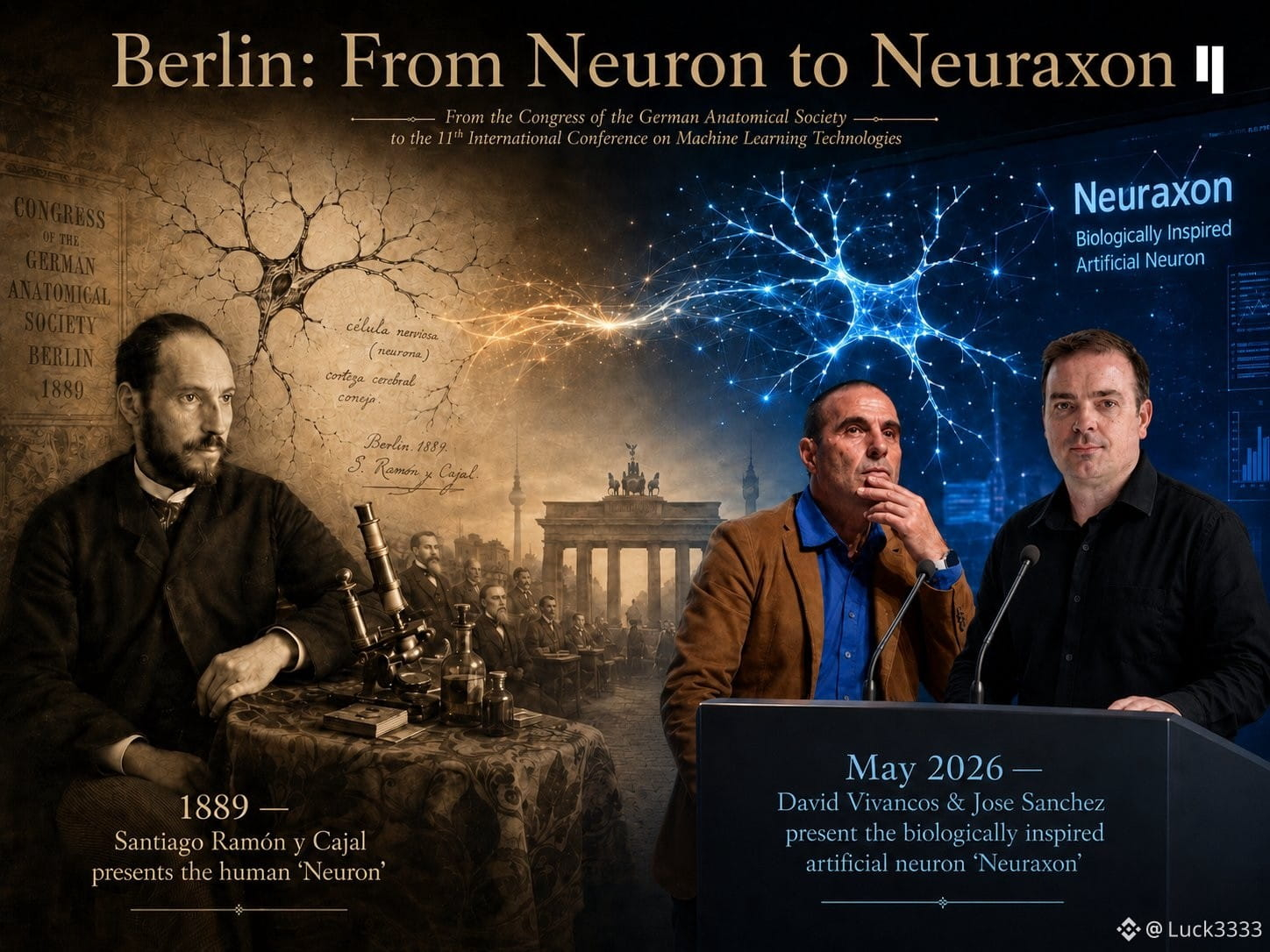
361
Log in to explore more content
Join global crypto users on Binance Square
⚡️ Get latest and useful information about crypto.
💬 Trusted by the world’s largest crypto exchange.
👍 Discover real insights from verified creators.
Email / Phone number
Trending Topics
BTCReaches$80000
60,451 views
598 Discussing
Bitcoin is currently trading around $BTC $79,983.98, up about 0.45% over the past 24 hours on Binance Spot.$USDT Today’s range has been $79,442.00–$80,200.00.
#BTCReaches$80000 #ZECHitsANewAllTimeHigh #BitcoinETFsBiggestDailyInflowSinceJanuary #btc #usdt
Zaroo_Crypto_DE
·1 Likes
·36 views
ZECHitsANewAllTimeHigh
277,567 views
3,041 Discussing
LululemonTumbles20%OnWeakGuidance
124,856 views
2,035 Discussing