
Shin-obi
389 Posts

Shin-obi
👾
Frequent Trader
5.1 Years
0 Following
66 Followers
208 Liked
Posts
All
Quotes
PINNED
Hey mates 👋
I’m not here to drop technical analysis or push any bias.The goal is simple to build a solid day trading community where we can openly share strategies, ideas, and real market thoughts.
Let’s learn, adapt, and grow together #trading #TradingCommunity
I’m not here to drop technical analysis or push any bias.The goal is simple to build a solid day trading community where we can openly share strategies, ideas, and real market thoughts.
Let’s learn, adapt, and grow together #trading #TradingCommunity
$TAO has triggered a Strong Short setup.
Price is breaking down to $227.64 (↓), Open Interest is aggressively flushing from 290K to 278.4K (↓), and the Funding Rate has collapsed to 0.0003% (↓). This structure exposes a textbook long capitulation event driven by intense taker selling.
This severe de-leveraging was catalyzed by Binance updating its portfolio margin collateral ratios for TAO on August 28, 2026. Traders holding excessive leverage were forced to liquidate, cascading the open interest. However, while immediate mechanics are highly toxic and bearish, whales are actively absorbing this forced selling printing a massive 4.22 position ratio. With the RSI at an oversold 34.00, the downward momentum is nearing exhaustion as smart money buys the blood. Read the pattern. Trade with patience.
Price is breaking down to $227.64 (↓), Open Interest is aggressively flushing from 290K to 278.4K (↓), and the Funding Rate has collapsed to 0.0003% (↓). This structure exposes a textbook long capitulation event driven by intense taker selling.
This severe de-leveraging was catalyzed by Binance updating its portfolio margin collateral ratios for TAO on August 28, 2026. Traders holding excessive leverage were forced to liquidate, cascading the open interest. However, while immediate mechanics are highly toxic and bearish, whales are actively absorbing this forced selling printing a massive 4.22 position ratio. With the RSI at an oversold 34.00, the downward momentum is nearing exhaustion as smart money buys the blood. Read the pattern. Trade with patience.
Verified
$TUT WHAT IF THE NARRATIVE CAME AFTER THE TOKEN
I’ve been digging deeper into Tutorial ($TUT ), and its origin story is interesting.
NOT an accusation. Some points are speculation based on public and on-chain data.WHAT IS TUT? Today, TUT is positioned as an AI/Web3 education project focused on blockchain learning, AI tools and onboarding users into Web3.But its origin appears different.TUT reportedly started as a tutorial/demo showing how to create and deploy a token on BNB Chain. The project itself says it “all began with a simple tutorial video.”That raises an important question: Did the token come first, and the larger narrative come later?
THE EVOLUTION One possible sequence: tutorial token → community discovers it → trading interest grows → attention increases → broader AI/Web3 education narrative develops → liquidity and exchange exposure expand.This is a theory, not a confirmed fact.It doesn’t automatically make TUT a bad project. Crypto projects evolve. But investors should distinguish between what TUT originally was and what it wants to become today.THE BIGGEST QUESTION: WHO CONTROLS THE SUPPLY?TUT’s holder concentration looks extremely high. However, exchange wallets and the burn address account for a large portion, so saying “whales control everything” would be misleading.The real question is the major non-exchange wallets.One wallet reportedly holds around 219M TUT, roughly 22% of max supply.Who controls it? Team, early contributor, market maker, investor, or something else?Until that wallet is identified, I wouldn’t call this manipulation. But it is a major due-diligence point because whoever controls it could materially affect available supply and selling pressure.WHAT I WANT TO KNOW How many real users does the platform have? What are the actual products and revenues? How much value does TUT capture from the ecosystem? Who controls the major wallets? And how much of the current valuation comes from actual utility versus liquidity and speculation?
These questions matter more than short-term price action
I’ve been digging deeper into Tutorial ($TUT ), and its origin story is interesting.
NOT an accusation. Some points are speculation based on public and on-chain data.WHAT IS TUT? Today, TUT is positioned as an AI/Web3 education project focused on blockchain learning, AI tools and onboarding users into Web3.But its origin appears different.TUT reportedly started as a tutorial/demo showing how to create and deploy a token on BNB Chain. The project itself says it “all began with a simple tutorial video.”That raises an important question: Did the token come first, and the larger narrative come later?
THE EVOLUTION One possible sequence: tutorial token → community discovers it → trading interest grows → attention increases → broader AI/Web3 education narrative develops → liquidity and exchange exposure expand.This is a theory, not a confirmed fact.It doesn’t automatically make TUT a bad project. Crypto projects evolve. But investors should distinguish between what TUT originally was and what it wants to become today.THE BIGGEST QUESTION: WHO CONTROLS THE SUPPLY?TUT’s holder concentration looks extremely high. However, exchange wallets and the burn address account for a large portion, so saying “whales control everything” would be misleading.The real question is the major non-exchange wallets.One wallet reportedly holds around 219M TUT, roughly 22% of max supply.Who controls it? Team, early contributor, market maker, investor, or something else?Until that wallet is identified, I wouldn’t call this manipulation. But it is a major due-diligence point because whoever controls it could materially affect available supply and selling pressure.WHAT I WANT TO KNOW How many real users does the platform have? What are the actual products and revenues? How much value does TUT capture from the ecosystem? Who controls the major wallets? And how much of the current valuation comes from actual utility versus liquidity and speculation?
These questions matter more than short-term price action
$VELVET High OI + Major Liquidation Imbalance VELVET is currently trading around $0.10, while Open Interest has climbed above $7M, compared with roughly $3–4M previously.The interesting part: price has fallen heavily while OI remains elevated/increases. This tells us leverage is still building, but OI alone cannot confirm whether the new positions are longs or shorts.
The liquidation map shows a major imbalance:
🔹 Upside short liquidations: ~$1.1M–$1.25M
🔹 Downside long liquidations: only ~$50K
🔹 Major short clusters: $0.103 and $0.118
🔹 Downside clusters: roughly $0.094–$0.096
This suggests significantly more short-side liquidation exposure above the current price than long-side exposure below it.If price pushes through $0.103, the concentrated short liquidations could potentially create a cascade of forced buying toward higher liquidity zones.However, the key uncertainty remains who is behind the $7M+ OI. Until funding, OI changes, volume and liquidation data confirm the positioning, the liquidation map should be viewed as a potential volatility/squeeze setup—not a guaranteed direction.
High leverage + asymmetric liquidation structure = VELVET is worth watching closely.
The liquidation map shows a major imbalance:
🔹 Upside short liquidations: ~$1.1M–$1.25M
🔹 Downside long liquidations: only ~$50K
🔹 Major short clusters: $0.103 and $0.118
🔹 Downside clusters: roughly $0.094–$0.096
This suggests significantly more short-side liquidation exposure above the current price than long-side exposure below it.If price pushes through $0.103, the concentrated short liquidations could potentially create a cascade of forced buying toward higher liquidity zones.However, the key uncertainty remains who is behind the $7M+ OI. Until funding, OI changes, volume and liquidation data confirm the positioning, the liquidation map should be viewed as a potential volatility/squeeze setup—not a guaranteed direction.
High leverage + asymmetric liquidation structure = VELVET is worth watching closely.
A focused idiot achieves more, than a distracted genius👾
$DEXE recent +25% move isn’t the part I’m watching.
The bigger story is what happened before it.
DEXE reached nearly $49 in July 2026, before collapsing toward the $1.5–$2 area a drawdown of more than 95%.The decline happened in multiple stages rather than through a single event:
$49 → $30s → $20s → $16 → $10 → $5 → ~$2
There was no confirmed protocol hack identified as the catalyst. Instead, the crash coincided with heavy selling, large wallet activity, rapidly deteriorating liquidity and a significant derivatives unwind.One particularly notable development was the movement of a large amount of DEXE from custody-related wallets toward Binance during the crash period. However, a transfer to an exchange alone does not prove that the tokens were immediately sold.From a market-structure perspective, the combination of:
• Extremely strong preceding rally
• Concentrated token ownership
• Limited effective liquid supply
• Large exchange inflows
• Leveraged positioning
• Liquidations
• Falling liquidity
can create a powerful feedback loop where selling causes liquidations, and liquidations create additional selling.Now DEXE is trading around the $2–$2.5 region after one of the largest collapses among major DeFi governance tokens.The interesting question isn’t whether today’s bounce looks bullish.It’s whether $2–$3 represents a new fundamental valuation for DEXE or simply the aftermath of an extreme liquidation cycle.To answer that, the next things worth watching are DEXE’s actual protocol usage, revenue, treasury, token distribution, wallet concentration, and circulating supply.The chart tells us what happened.
The fundamentals should tell us whether DEXE deserves to recover.
The bigger story is what happened before it.
DEXE reached nearly $49 in July 2026, before collapsing toward the $1.5–$2 area a drawdown of more than 95%.The decline happened in multiple stages rather than through a single event:
$49 → $30s → $20s → $16 → $10 → $5 → ~$2
There was no confirmed protocol hack identified as the catalyst. Instead, the crash coincided with heavy selling, large wallet activity, rapidly deteriorating liquidity and a significant derivatives unwind.One particularly notable development was the movement of a large amount of DEXE from custody-related wallets toward Binance during the crash period. However, a transfer to an exchange alone does not prove that the tokens were immediately sold.From a market-structure perspective, the combination of:
• Extremely strong preceding rally
• Concentrated token ownership
• Limited effective liquid supply
• Large exchange inflows
• Leveraged positioning
• Liquidations
• Falling liquidity
can create a powerful feedback loop where selling causes liquidations, and liquidations create additional selling.Now DEXE is trading around the $2–$2.5 region after one of the largest collapses among major DeFi governance tokens.The interesting question isn’t whether today’s bounce looks bullish.It’s whether $2–$3 represents a new fundamental valuation for DEXE or simply the aftermath of an extreme liquidation cycle.To answer that, the next things worth watching are DEXE’s actual protocol usage, revenue, treasury, token distribution, wallet concentration, and circulating supply.The chart tells us what happened.
The fundamentals should tell us whether DEXE deserves to recover.
PCE is out and the market reaction is more important than the headline itself.
July PCE came in at 3.7% YoY, slightly above expectations, while Core PCE stayed at 3.3%. That keeps inflation sticky and makes the Fed’s path toward easier policy less straightforward.After the release, DXY pushed higher toward 99.12, while the US 2Y yield moved up toward 4.21%. Markets also increased the probability of a September rate hike. (Reuters)
BTC, however, is still holding around the $79K area rather than reacting with a major breakdown.
So the key now isn’t simply PCE bullish or bearish. I’m watching whether DXY and the 2Y continue higher while BTC loses support. If that happens, the macro pressure could become significant.If BTC continues holding despite higher dollar and yields, that would be a completely different signal it would show that crypto is absorbing the hawkish data.
For now: hawkish macro reaction, but BTC has not confirmed the downside.
July PCE came in at 3.7% YoY, slightly above expectations, while Core PCE stayed at 3.3%. That keeps inflation sticky and makes the Fed’s path toward easier policy less straightforward.After the release, DXY pushed higher toward 99.12, while the US 2Y yield moved up toward 4.21%. Markets also increased the probability of a September rate hike. (Reuters)
BTC, however, is still holding around the $79K area rather than reacting with a major breakdown.
So the key now isn’t simply PCE bullish or bearish. I’m watching whether DXY and the 2Y continue higher while BTC loses support. If that happens, the macro pressure could become significant.If BTC continues holding despite higher dollar and yields, that would be a completely different signal it would show that crypto is absorbing the hawkish data.
For now: hawkish macro reaction, but BTC has not confirmed the downside.
VELVET: The Previous On-Chain History Matters Before the latest crash, VELVET had already shown unusual on-chain activity.
In June, a wallet linked to the VELVET creator received around 72M VELVET, worth roughly $25M at the time. Between June 6–9, around $2.5M worth of VELVET was transferred to centralized exchanges, according to Bubblemaps reports. The project did not provide a specific explanation for those transfers and described the price movement as speculative behavior. (KuCoin)Days later, VELVET experienced an approximately 80% crash.
The important point is not that these transfers prove insider selling. They don’t. The significance is the timing: a creator-linked address moved a substantial amount of tokens toward exchanges before a major collapse.After that, VELVET recovered strongly and entered another period of aggressive speculation, with low spot liquidity and high leverage contributing to extremely large price movements. (Bitcoin Foundation)Now we’re seeing another major liquidation-driven collapse.So the interesting part of VELVET isn’t just today’s dump. The historical pattern shows how quickly large wallet movements, speculative momentum, thin liquidity and leveraged derivatives can interact.
The on-chain history is worth watching closely.
In June, a wallet linked to the VELVET creator received around 72M VELVET, worth roughly $25M at the time. Between June 6–9, around $2.5M worth of VELVET was transferred to centralized exchanges, according to Bubblemaps reports. The project did not provide a specific explanation for those transfers and described the price movement as speculative behavior. (KuCoin)Days later, VELVET experienced an approximately 80% crash.
The important point is not that these transfers prove insider selling. They don’t. The significance is the timing: a creator-linked address moved a substantial amount of tokens toward exchanges before a major collapse.After that, VELVET recovered strongly and entered another period of aggressive speculation, with low spot liquidity and high leverage contributing to extremely large price movements. (Bitcoin Foundation)Now we’re seeing another major liquidation-driven collapse.So the interesting part of VELVET isn’t just today’s dump. The historical pattern shows how quickly large wallet movements, speculative momentum, thin liquidity and leveraged derivatives can interact.
The on-chain history is worth watching closely.
VELVET just had an insane move from around $0.91 to $0.1756, an almost 81% drop.
I don’t see evidence of a token unlock or hack explaining this move. The structure looks much more like a liquidity and leverage event.
The interesting part is the thin order book. Once the initial selling started, leveraged longs could have been liquidated, creating forced selling and triggering more liquidations. That can create a cascade where the amount of futures exposure being closed is far larger than the actual spot liquidity available.
Funding is now around -0.1857%, showing how extreme the positioning has become after the crash.
The key question is still: what caused the first sell? Was it spot selling, aggressive futures selling, or a price/liquidity dislocation that triggered the liquidation cascade?
An 80% candle doesn’t necessarily mean 80% of the supply was sold. In a thin, highly leveraged market, a relatively small initial imbalance can cause a massive move.
This one is worth watching closely.
I don’t see evidence of a token unlock or hack explaining this move. The structure looks much more like a liquidity and leverage event.
The interesting part is the thin order book. Once the initial selling started, leveraged longs could have been liquidated, creating forced selling and triggering more liquidations. That can create a cascade where the amount of futures exposure being closed is far larger than the actual spot liquidity available.
Funding is now around -0.1857%, showing how extreme the positioning has become after the crash.
The key question is still: what caused the first sell? Was it spot selling, aggressive futures selling, or a price/liquidity dislocation that triggered the liquidation cascade?
An 80% candle doesn’t necessarily mean 80% of the supply was sold. In a thin, highly leveraged market, a relatively small initial imbalance can cause a massive move.
This one is worth watching closely.
$DOS The Risk I’m Watching Isn’t the Contract It’s the Market Structure After looking deeper into DOS, the biggest risk I see is the combination of concentrated supply, thin on-chain liquidity, aggressive futures leverage and upcoming unlocks.
DOS has a 1B total supply, but most of it sits in treasury, ecosystem, team/investor and vesting wallets. So the actual freely traded float is much smaller than the headline supply. With such a small effective float, relatively small buying or selling can create large price movements.Liquidity is another major issue. Ethereum DEX liquidity appears to be only tens of thousands of dollars, while BNB has much deeper liquidity. At the same time, most trading volume is happening on centralized exchanges.For example, if DOS is $0.40 on Binance and someone sells $50K into a very thin Ethereum pool, the DEX price can fall far below $0.40 because there simply aren’t enough buyers. Now you can have DOS at $0.40 on Binance and $0.25 on the DEX. That’s a price dislocation. Arbitrage traders will try to close the gap, but cross-chain transfers and limited liquidity can delay that process.
Now add 20× futures leverage.
A move from $0.47 to $0.42 can liquidate some leveraged longs. Those liquidations create forced selling, pushing price lower, which triggers more liquidations.
$0.42 → $0.38 → $0.32 → $0.25.
This can create a liquidation cascade without any hack or fundamental failure.The reverse is also possible: crowded shorts + rising spot demand can create a short squeeze and send DOS sharply higher.I’m also watching CEX inflows from large wallets and airdrop claims. If claimed tokens quickly move toward exchanges, holder growth doesn’t necessarily mean long-term accumulation it can become additional sell-side supply.The next important supply event is the scheduled ~14.58M DOS unlock around September 10. The unlock itself isn’t automatically bearish. The real signal is what happens around it: CEX inflows, spot demand, OI and funding.
DOS has a 1B total supply, but most of it sits in treasury, ecosystem, team/investor and vesting wallets. So the actual freely traded float is much smaller than the headline supply. With such a small effective float, relatively small buying or selling can create large price movements.Liquidity is another major issue. Ethereum DEX liquidity appears to be only tens of thousands of dollars, while BNB has much deeper liquidity. At the same time, most trading volume is happening on centralized exchanges.For example, if DOS is $0.40 on Binance and someone sells $50K into a very thin Ethereum pool, the DEX price can fall far below $0.40 because there simply aren’t enough buyers. Now you can have DOS at $0.40 on Binance and $0.25 on the DEX. That’s a price dislocation. Arbitrage traders will try to close the gap, but cross-chain transfers and limited liquidity can delay that process.
Now add 20× futures leverage.
A move from $0.47 to $0.42 can liquidate some leveraged longs. Those liquidations create forced selling, pushing price lower, which triggers more liquidations.
$0.42 → $0.38 → $0.32 → $0.25.
This can create a liquidation cascade without any hack or fundamental failure.The reverse is also possible: crowded shorts + rising spot demand can create a short squeeze and send DOS sharply higher.I’m also watching CEX inflows from large wallets and airdrop claims. If claimed tokens quickly move toward exchanges, holder growth doesn’t necessarily mean long-term accumulation it can become additional sell-side supply.The next important supply event is the scheduled ~14.58M DOS unlock around September 10. The unlock itself isn’t automatically bearish. The real signal is what happens around it: CEX inflows, spot demand, OI and funding.
Verified
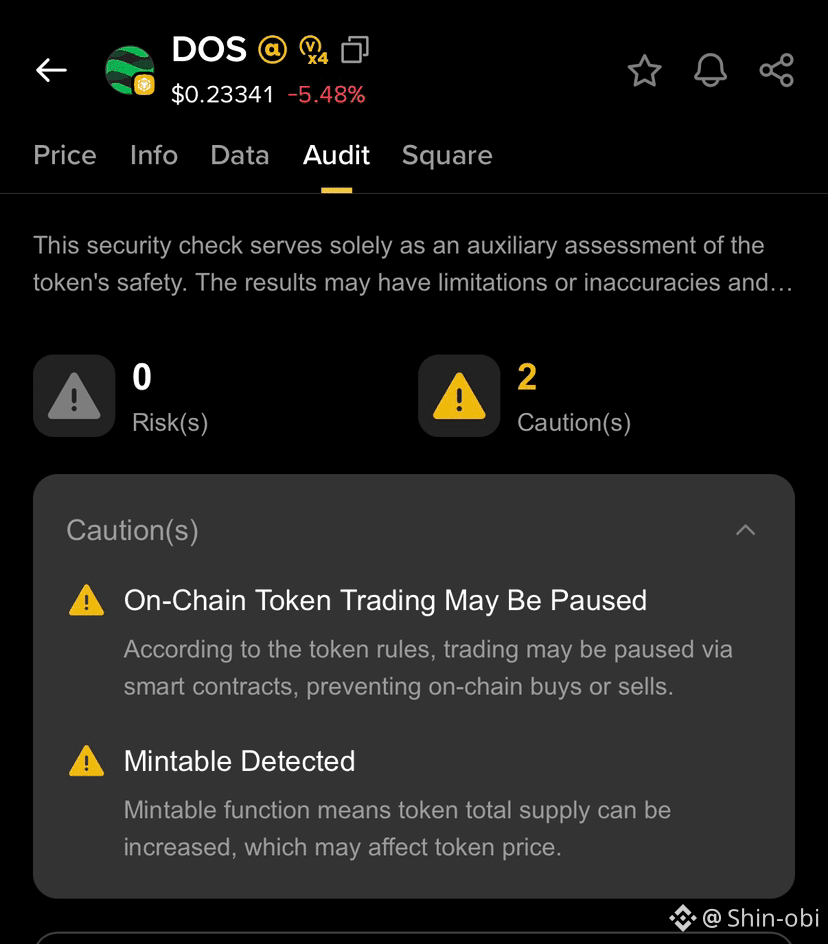
Binance currently shows 0 detected risks and 2 cautions: on chain trading may be paused, and DOS is mintable. Buy tax and sell tax are both 0%, so there is no obvious buy/sell tax issue.The important part is that “mintable” doesn’t automatically mean the team can mint unlimited DOS. What matters is who controls the mint function, whether there is a supply cap, and whether that permission can actually be exercised today. The same applies to the pause function we need to know who has the authority to stop transfers.From the market side, DOS has also seen rapid exchange expansion. Binance launched DOSUSDT perpetuals on August 11 with up to 20x leverage, while OKX, KuCoin and Bitget have also launched DOS perpetual markets.So I wouldn’t call the Binance audit a red flag by itself. But with a newly listed/high-volatility token, contract permissions and supply dynamics are definitely worth monitoring.For me, the next things to verify are mint authority, pause authority, maximum supply, recent minting activity, holder concentration and unlocks.Not saying DOS is unsafe just doing the due diligence before making a bigger move.
The Sandbox ($SAND) has been hit by a serious cross-chain exploit, and the numbers coming out of the incident are pretty wild.
The attacker appears to have compromised delegate permissions connected to the LayerZero-based SAND infrastructure on Base and BNB Chain. This allowed unauthorized minting of SAND through the affected OFT contracts.
Billions of SAND were then minted across hundreds of transactions. Some reports put the nominal value of the newly created tokens at nearly $49B, but this is important: $49B was NOT stolen. Those were unbacked tokens created through the exploit and didn’t represent $49B of real value.
The attacker did manage to extract real value, with early analysis pointing to around 14.75M SAND plus roughly 79.7 ETH.
The Sandbox has since contained the incident and suspended SAND bridging to and from Base and BNB Chain. Ethereum and Polygon SAND were reportedly not affected, and the team says the underlying Ethereum backing remains intact.
If you’re holding SAND on Base or BNB Chain, I’d be very careful right now. Avoid interacting with suspicious contracts or unofficial bridges until the situation is fully resolved.
What makes this incident interesting is that the token itself wasn’t necessarily “hacked.” The bigger problem was the cross-chain infrastructure and the permissions controlling how SAND could be minted and moved between networks.
The main thing I’m watching now is the attacker wallets, where the newly minted SAND is moving, how much liquidity was actually extracted, and what The Sandbox reveals in its final post-mortem.
This is a good reminder that in cross-chain crypto, the security of the bridge and its permissions can be just as important as the security of the token itself.
The attacker appears to have compromised delegate permissions connected to the LayerZero-based SAND infrastructure on Base and BNB Chain. This allowed unauthorized minting of SAND through the affected OFT contracts.
Billions of SAND were then minted across hundreds of transactions. Some reports put the nominal value of the newly created tokens at nearly $49B, but this is important: $49B was NOT stolen. Those were unbacked tokens created through the exploit and didn’t represent $49B of real value.
The attacker did manage to extract real value, with early analysis pointing to around 14.75M SAND plus roughly 79.7 ETH.
The Sandbox has since contained the incident and suspended SAND bridging to and from Base and BNB Chain. Ethereum and Polygon SAND were reportedly not affected, and the team says the underlying Ethereum backing remains intact.
If you’re holding SAND on Base or BNB Chain, I’d be very careful right now. Avoid interacting with suspicious contracts or unofficial bridges until the situation is fully resolved.
What makes this incident interesting is that the token itself wasn’t necessarily “hacked.” The bigger problem was the cross-chain infrastructure and the permissions controlling how SAND could be minted and moved between networks.
The main thing I’m watching now is the attacker wallets, where the newly minted SAND is moving, how much liquidity was actually extracted, and what The Sandbox reveals in its final post-mortem.
This is a good reminder that in cross-chain crypto, the security of the bridge and its permissions can be just as important as the security of the token itself.
Verified
The timing is too suspicious.
Today’s ~282M LAB unlock/claim event came right as the token started getting crushed, while circulating supply is only around 455M. That’s a massive potential supply shock hitting an already concentrated token.
And LAB has history here. Previous large wallet movements were followed by sharp selloffs, including a reported ~34% drop after millions of LAB moved to Aster-linked addresses.
I’m NOT saying “the team is dumping” there’s no proof of that. But the data points much more strongly toward LAB-specific supply pressure than a simple market-wide dump.
For me, the key question now isn’t “how cheap is LAB?”
It’s who is absorbing the unlocked supply? 👀
Unlock panic → absorption → relief bounce?
Or unlock → distribution → another lower low?
Let the market show us. $LAB
Today’s ~282M LAB unlock/claim event came right as the token started getting crushed, while circulating supply is only around 455M. That’s a massive potential supply shock hitting an already concentrated token.
And LAB has history here. Previous large wallet movements were followed by sharp selloffs, including a reported ~34% drop after millions of LAB moved to Aster-linked addresses.
I’m NOT saying “the team is dumping” there’s no proof of that. But the data points much more strongly toward LAB-specific supply pressure than a simple market-wide dump.
For me, the key question now isn’t “how cheap is LAB?”
It’s who is absorbing the unlocked supply? 👀
Unlock panic → absorption → relief bounce?
Or unlock → distribution → another lower low?
Let the market show us. $LAB
🇺🇸 US CPI DATA IS OUT 📊
inflation came in without any major upside surprise.
Headline CPI: 3.4% YoY vs 3.4% expected
Core CPI: 2.5% YoY vs 2.5% expected
Core CPI cooled from 2.6% → 2.5%
Monthly numbers also came in around expectations, which means inflation is continuing to ease without showing a fresh acceleration.
The big takeaway: no hotter-than-expected inflation shock. That keeps the macro picture relatively supportive for risk assets and gives markets more room to focus on the Fed’s next moves.
Now we watch yields, the dollar, and how the broader market reacts. 👀📈
#CPI #Inflation #Crypto #Macro #Markets
inflation came in without any major upside surprise.
Headline CPI: 3.4% YoY vs 3.4% expected
Core CPI: 2.5% YoY vs 2.5% expected
Core CPI cooled from 2.6% → 2.5%
Monthly numbers also came in around expectations, which means inflation is continuing to ease without showing a fresh acceleration.
The big takeaway: no hotter-than-expected inflation shock. That keeps the macro picture relatively supportive for risk assets and gives markets more room to focus on the Fed’s next moves.
Now we watch yields, the dollar, and how the broader market reacts. 👀📈
#CPI #Inflation #Crypto #Macro #Markets
$TAO is showing a pretty interesting divergence right now. Price bounced from around $198 and has reclaimed the $202 area, currently sitting around $202.92.
What caught my attention is what’s happening in derivatives. Open Interest has dropped from around 303.5K to 300.6K, while funding has flipped negative to around -0.0011%. So we’re seeing price recover while leverage is coming out of the market.
The Top Trader Long/Short Ratio by accounts also moved down from 2.51 to 2.37, while the ratio by positions slipped from 2.52 to 2.47. Basically, the long bias is cooling down even though TAO is holding above $200.
At the same time, Binance adding TAO to Simple Earn Locked Products, with up to 2.9% APR for 90 days, is an interesting fundamental factor. It could encourage more holders to lock up their TAO instead of keeping it immediately available in the market.
So right now we have price holding up, OI coming down, funding negative and trader positioning becoming less bullish. That’s a divergence I’m definitely keeping an eye on.
TAO still looks like a weak downtrend that could be forming a bottom, but I’m not rushing anything here. The next price action should tell us a lot.
Read the market, stay patient. 🐦
What caught my attention is what’s happening in derivatives. Open Interest has dropped from around 303.5K to 300.6K, while funding has flipped negative to around -0.0011%. So we’re seeing price recover while leverage is coming out of the market.
The Top Trader Long/Short Ratio by accounts also moved down from 2.51 to 2.37, while the ratio by positions slipped from 2.52 to 2.47. Basically, the long bias is cooling down even though TAO is holding above $200.
At the same time, Binance adding TAO to Simple Earn Locked Products, with up to 2.9% APR for 90 days, is an interesting fundamental factor. It could encourage more holders to lock up their TAO instead of keeping it immediately available in the market.
So right now we have price holding up, OI coming down, funding negative and trader positioning becoming less bullish. That’s a divergence I’m definitely keeping an eye on.
TAO still looks like a weak downtrend that could be forming a bottom, but I’m not rushing anything here. The next price action should tell us a lot.
Read the market, stay patient. 🐦
$TAO is under pressure as price tests the $189–$190 region, with selling momentum keeping the market defensive.The key now is whether this area attracts real spot demand or simply becomes another pause before further weakness. Derivatives positioning remains crowded, while traders continue trying to anticipate the next move.V440 and the broader Bittensor narrative remain constructive for the longer term but short-term price action still needs confirmation.
$189 is the level to watch.
A strong reclaim could change the tone quickly. A clean breakdown could open the door to deeper downside.
No rush. Let the market show its hand.
#TAO #Bittensor #TAOUSDT #Crypto #Trading
$189 is the level to watch.
A strong reclaim could change the tone quickly. A clean breakdown could open the door to deeper downside.
No rush. Let the market show its hand.
#TAO #Bittensor #TAOUSDT #Crypto #Trading
Log in to explore more content