
Jeeya_Awan
12.2k Posts

Jeeya_Awan
MPhil Student | 📚 🌍 Exploring crypto 💡 Excited to grow in digital finance | Let’s connect, learn & grow in blockchain 🚀
Open Trade
High-Frequency Trader
3.3 Years
557 Following
24.2K+ Followers
20.3K+ Liked
Posts
Portfolio
All
Quotes
Live
PINNED
Verified
#dusk $DUSK @Dusk
Piecrust: Dusk’s Smart Contract Virtual Machine
thought tonight that When people talk about smart contracts, the spotlight usually goes to the applications. But the execution layer underneath them matters just as much.
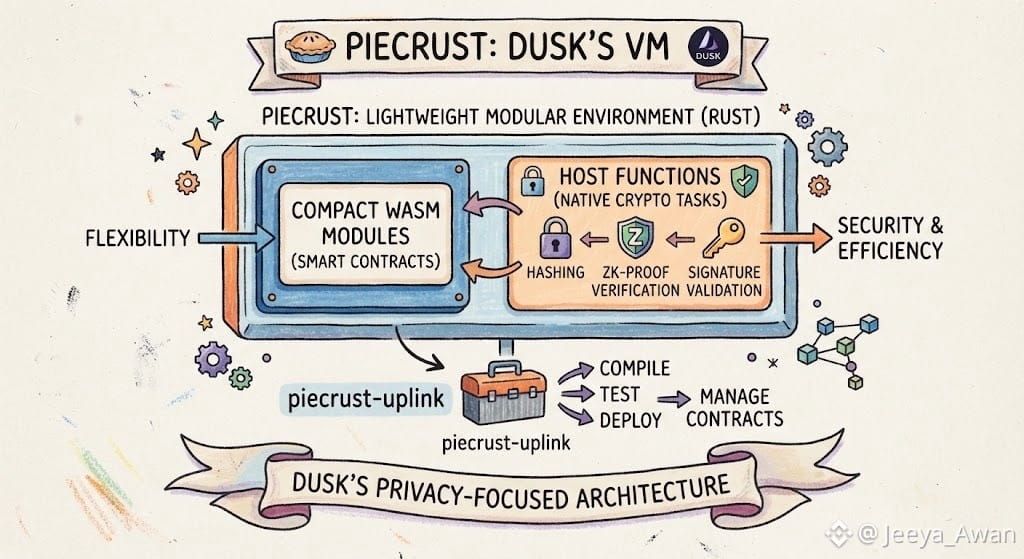
Dusk’s Piecrust VM takes a different approach: compact WASM modules run inside a lightweight, modular environment designed for secure and efficient smart contract execution. Written primarily in Rust, Piecrust is supported by piecrust-uplink, which helps developers compile, test, deploy, and manage contracts.
What caught my attention is how Piecrust handles heavy cryptographic work. Instead of forcing everything through WASM, host functions handle tasks such as hashing, ZK-proof verification, and signature validation.
That design connects smart contract flexibility with Dusk’s privacy-focused architecture.
Piecrust: Dusk’s Smart Contract Virtual Machine
thought tonight that When people talk about smart contracts, the spotlight usually goes to the applications. But the execution layer underneath them matters just as much.
Dusk’s Piecrust VM takes a different approach: compact WASM modules run inside a lightweight, modular environment designed for secure and efficient smart contract execution. Written primarily in Rust, Piecrust is supported by piecrust-uplink, which helps developers compile, test, deploy, and manage contracts.
What caught my attention is how Piecrust handles heavy cryptographic work. Instead of forcing everything through WASM, host functions handle tasks such as hashing, ZK-proof verification, and signature validation.
That design connects smart contract flexibility with Dusk’s privacy-focused architecture.
Verified
#dusk $DUSK @Dusk
Zedger: Bringing Private Securities and RWAs Onchain
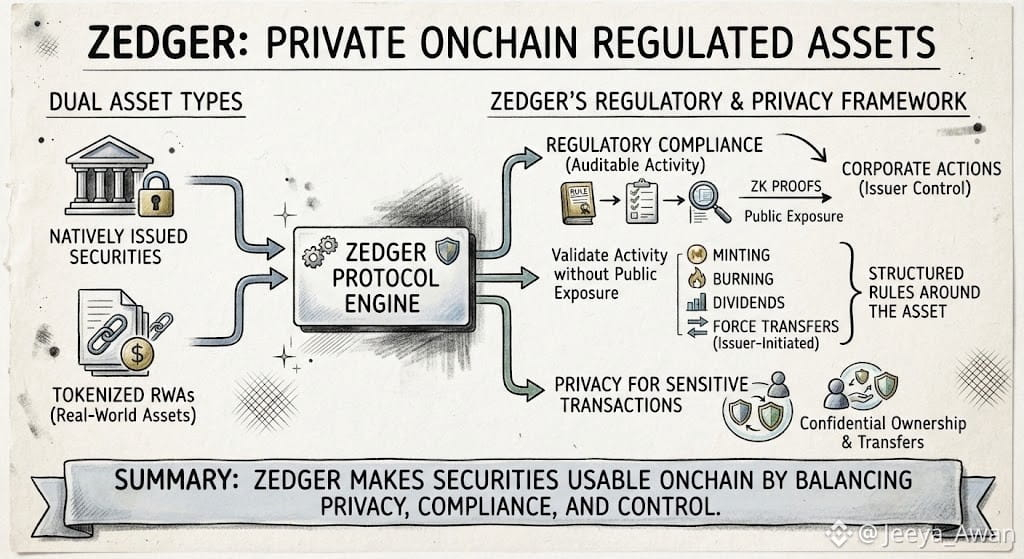
thought yesterday What interests me about Dusk is that it isn’t treating real-world assets as simple tokens. Its Zedger protocol is designed around the harder part: making securities and RWAs usable onchain while keeping privacy and regulatory requirements in view.
According to the Dusk Whitepaper, Zedger supports both tokenized and natively issued assets. It can handle actions such as minting, burning, dividends and issuer-initiated force transfers, while using ZK proofs and auditing capabilities to validate activity without making everything publicly exposed.
That creates an interesting model for financial markets: privacy for sensitive transactions, but still enough structure for compliance and auditability.
To me, Zedger shows that bringing securities onchain is not only about tokenization. It’s about building the rules around the asset too.
Zedger: Bringing Private Securities and RWAs Onchain
thought yesterday What interests me about Dusk is that it isn’t treating real-world assets as simple tokens. Its Zedger protocol is designed around the harder part: making securities and RWAs usable onchain while keeping privacy and regulatory requirements in view.
According to the Dusk Whitepaper, Zedger supports both tokenized and natively issued assets. It can handle actions such as minting, burning, dividends and issuer-initiated force transfers, while using ZK proofs and auditing capabilities to validate activity without making everything publicly exposed.
That creates an interesting model for financial markets: privacy for sensitive transactions, but still enough structure for compliance and auditability.
To me, Zedger shows that bringing securities onchain is not only about tokenization. It’s about building the rules around the asset too.
#dusk $DUSK @Dusk
Moonlight vs Phoenix: Two Transaction Models
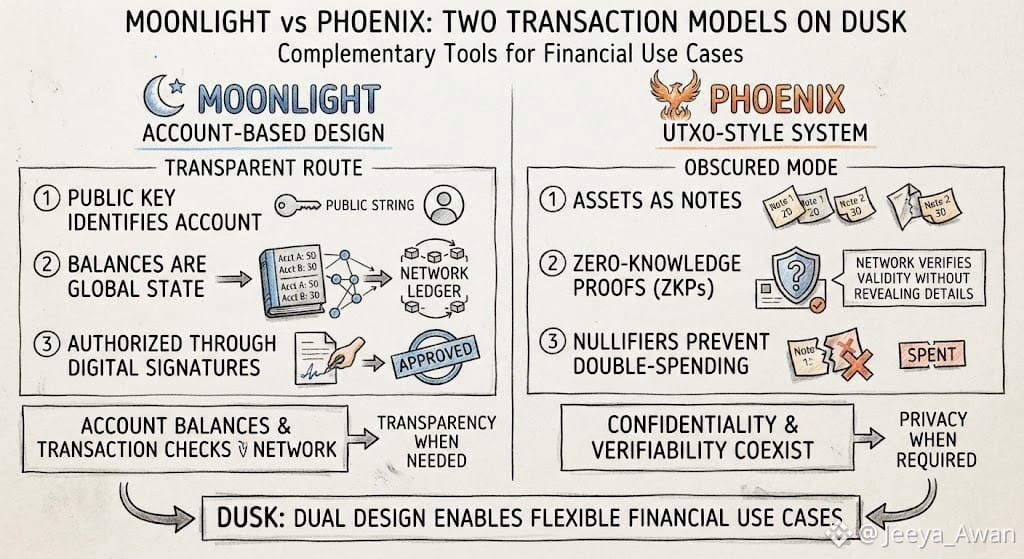
found out what makes Dusk interesting to me is that it doesn’t force every transaction into the same privacy model. Instead, it gives users two different paths.
Moonlight follows an account-based design. Your public key identifies the account, balances are maintained as global state, and transactions are authorized through digital signatures. It’s the more transparent route, making account balances and transaction checks visible to the network.
Phoenix takes a different approach. It uses a UTXO-style system where assets are represented as notes. In its obfuscated mode, zero-knowledge proofs let the network verify that a transaction is valid without directly revealing the underlying details. Nullifiers prevent the same note from being spent twice.
So I see Moonlight and Phoenix less as competitors and more as complementary tools: transparency when needed, privacy when required. That dual design gives Dusk a practical way to approach financial use cases where confidentiality and verifiability must coexist.
Moonlight vs Phoenix: Two Transaction Models
found out what makes Dusk interesting to me is that it doesn’t force every transaction into the same privacy model. Instead, it gives users two different paths.
Moonlight follows an account-based design. Your public key identifies the account, balances are maintained as global state, and transactions are authorized through digital signatures. It’s the more transparent route, making account balances and transaction checks visible to the network.
Phoenix takes a different approach. It uses a UTXO-style system where assets are represented as notes. In its obfuscated mode, zero-knowledge proofs let the network verify that a transaction is valid without directly revealing the underlying details. Nullifiers prevent the same note from being spent twice.
So I see Moonlight and Phoenix less as competitors and more as complementary tools: transparency when needed, privacy when required. That dual design gives Dusk a practical way to approach financial use cases where confidentiality and verifiability must coexist.
#dusk $DUSK @Dusk
Dusk’s Incentive and Slashing Mechanism
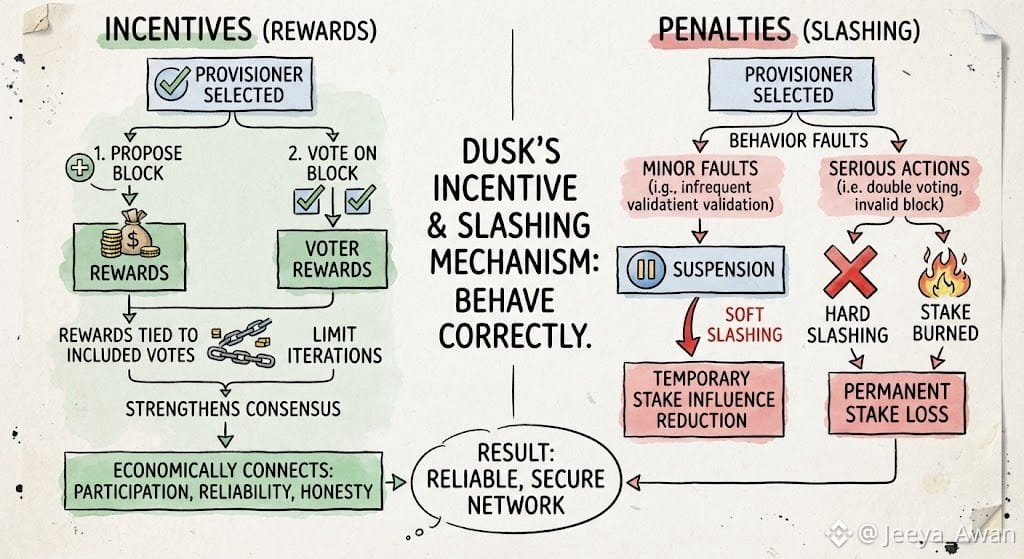
What stands out to me about Dusk is that its consensus incentives are designed around a simple idea: being selected is not enough, you need to behave correctly when selected.
Provisioners can earn from proposing and voting, while the protocol also addresses a subtle risk: future block generators could benefit from earlier iterations failing. Dusk counters this by rewarding voters, tying part of generator rewards to included votes, and limiting iterations.
The penalty side is equally structured. Minor faults can lead to suspension and soft slashing, reducing a provisioner’s influence. More serious actions, such as double voting or invalid block proposals, trigger hard slashing that burns stake.
The result is an incentive system where participation, reliability, and honest behavior are economically connected.
Dusk’s Incentive and Slashing Mechanism
What stands out to me about Dusk is that its consensus incentives are designed around a simple idea: being selected is not enough, you need to behave correctly when selected.
Provisioners can earn from proposing and voting, while the protocol also addresses a subtle risk: future block generators could benefit from earlier iterations failing. Dusk counters this by rewarding voters, tying part of generator rewards to included votes, and limiting iterations.
The penalty side is equally structured. Minor faults can lead to suspension and soft slashing, reducing a provisioner’s influence. More serious actions, such as double voting or invalid block proposals, trigger hard slashing that burns stake.
The result is an incentive system where participation, reliability, and honest behavior are economically connected.
#dusk $DUSK @Dusk
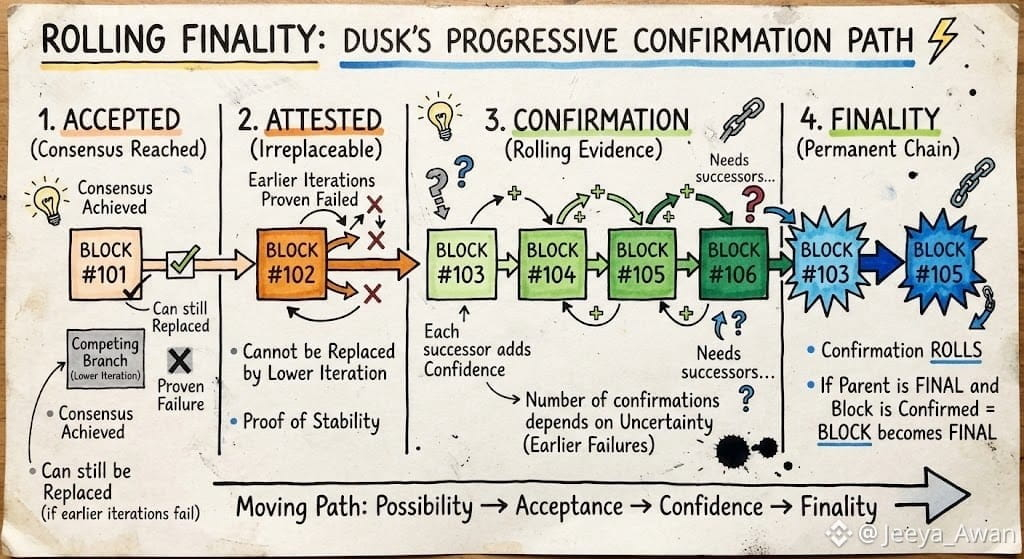
Rolling Finality: How Dusk Confirms Transactions
Not every block needs to jump from “accepted” to permanently final in a single moment. Dusk takes a more progressive approach through rolling finality.
A block may first be accepted, meaning consensus was reached, but a lower-iteration competing block could still replace it. If all earlier iterations are already proven to have failed, the block becomes attested and cannot be replaced by a lower-iteration alternative.
Then comes confirmation. Each suitable successor adds more evidence that provisioners are building on the same chain. For an accepted block, the number of required successors depends on the unresolved earlier iterations. The more uncertainty, the more confirmations needed.
Finally, confirmation rolls through the chain: once a block is confirmed and its parent is final, it can become final too.
The interesting part is that finality in Dusk is not treated as a simple timer or fixed confirmation count. It adapts to the block’s history and the evidence created by later consensus rounds.
That creates a moving path from possibility → acceptance → stronger confidence → finality.
Rolling Finality: How Dusk Confirms Transactions
Not every block needs to jump from “accepted” to permanently final in a single moment. Dusk takes a more progressive approach through rolling finality.
A block may first be accepted, meaning consensus was reached, but a lower-iteration competing block could still replace it. If all earlier iterations are already proven to have failed, the block becomes attested and cannot be replaced by a lower-iteration alternative.
Then comes confirmation. Each suitable successor adds more evidence that provisioners are building on the same chain. For an accepted block, the number of required successors depends on the unresolved earlier iterations. The more uncertainty, the more confirmations needed.
Finally, confirmation rolls through the chain: once a block is confirmed and its parent is final, it can become final too.
The interesting part is that finality in Dusk is not treated as a simple timer or fixed confirmation count. It adapts to the block’s history and the evidence created by later consensus rounds.
That creates a moving path from possibility → acceptance → stronger confidence → finality.
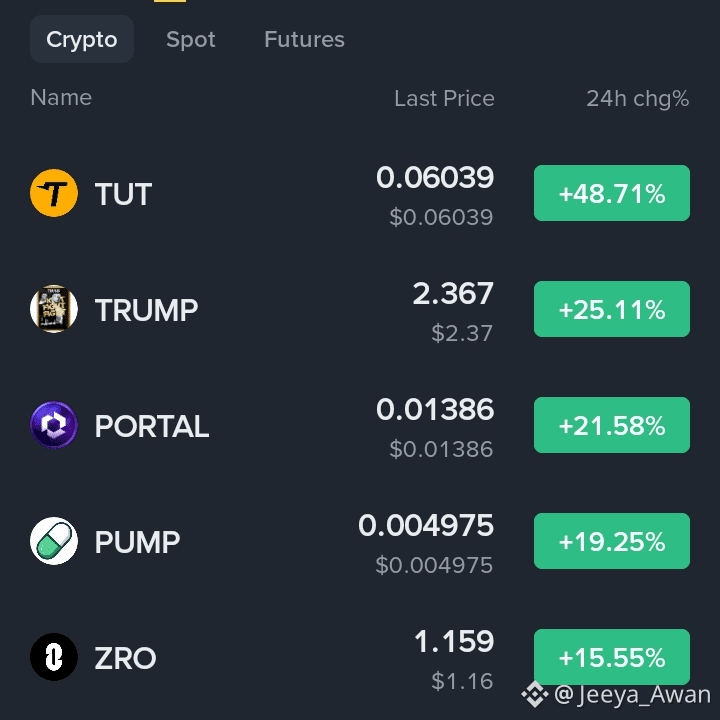
$ENA and $TUT are today's outperformer.
Jeeya_Awan
·
--
#dusk $DUSK @Dusk
Voting Committees and Attestations
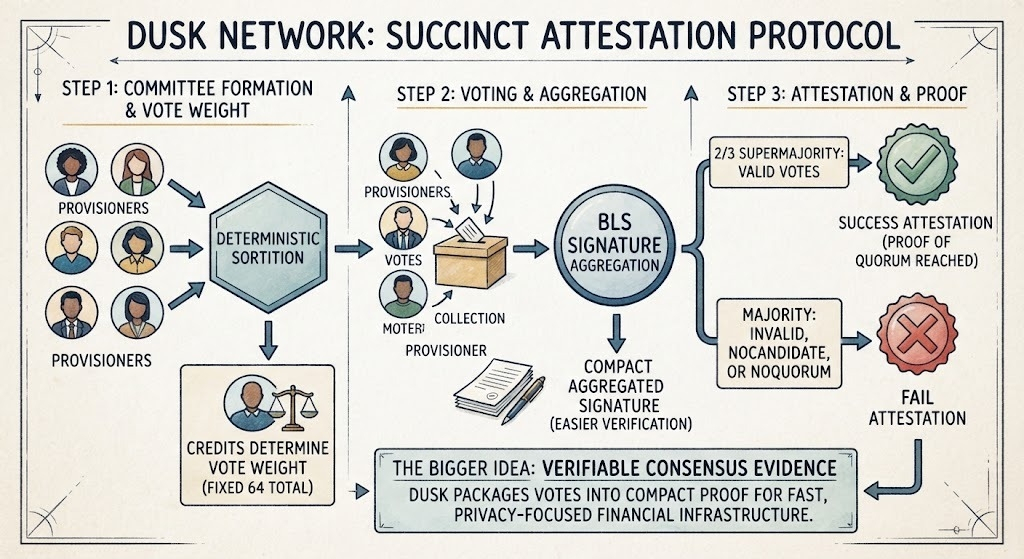
One part of Dusk Network’s consensus design I find especially interesting is how voting committees turn individual votes into compact proof.
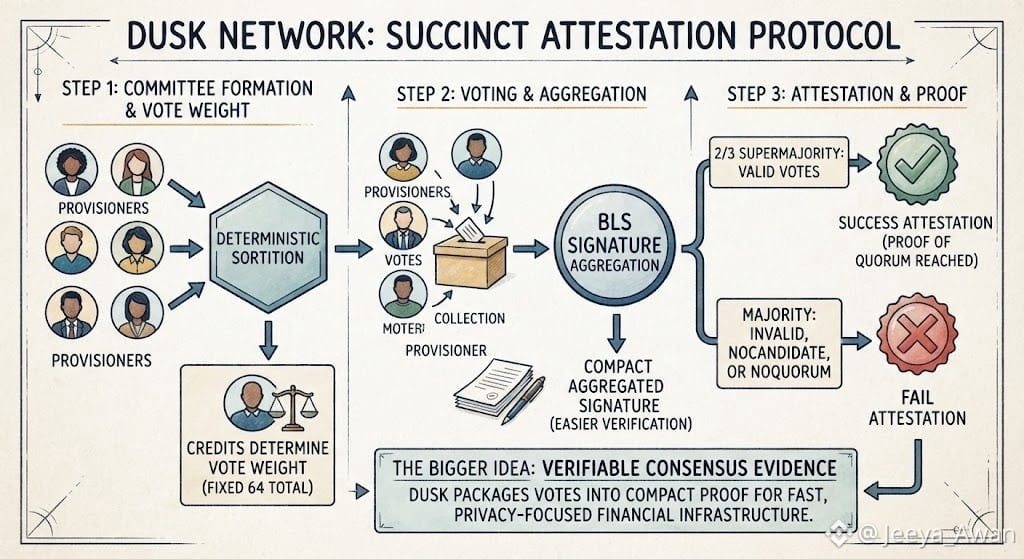
In Dusk’s Succinct Attestation protocol, provisioners are selected for validation and ratification committees through deterministic sortition. Committee members receive credits that determine the weight of their votes, with the committee using a fixed 64-credit structure in the whitepaper.
What makes the process more efficient is BLS signatures: votes from multiple provisioners can be aggregated into a single signature for easier verification.
An attestation then becomes proof that a quorum was reached. A 2/3 supermajority of Valid votes creates a success attestation, while a majority of Invalid, NoCandidate, or NoQuorum votes creates a fail attestation.
The bigger idea: Dusk doesn’t just collect votes, it packages consensus evidence into a verifiable structure that supports its approach to fast, privacy-focused financial infrastructure.
Voting Committees and Attestations
One part of Dusk Network’s consensus design I find especially interesting is how voting committees turn individual votes into compact proof.
In Dusk’s Succinct Attestation protocol, provisioners are selected for validation and ratification committees through deterministic sortition. Committee members receive credits that determine the weight of their votes, with the committee using a fixed 64-credit structure in the whitepaper.
What makes the process more efficient is BLS signatures: votes from multiple provisioners can be aggregated into a single signature for easier verification.
An attestation then becomes proof that a quorum was reached. A 2/3 supermajority of Valid votes creates a success attestation, while a majority of Invalid, NoCandidate, or NoQuorum votes creates a fail attestation.
The bigger idea: Dusk doesn’t just collect votes, it packages consensus evidence into a verifiable structure that supports its approach to fast, privacy-focused financial infrastructure.
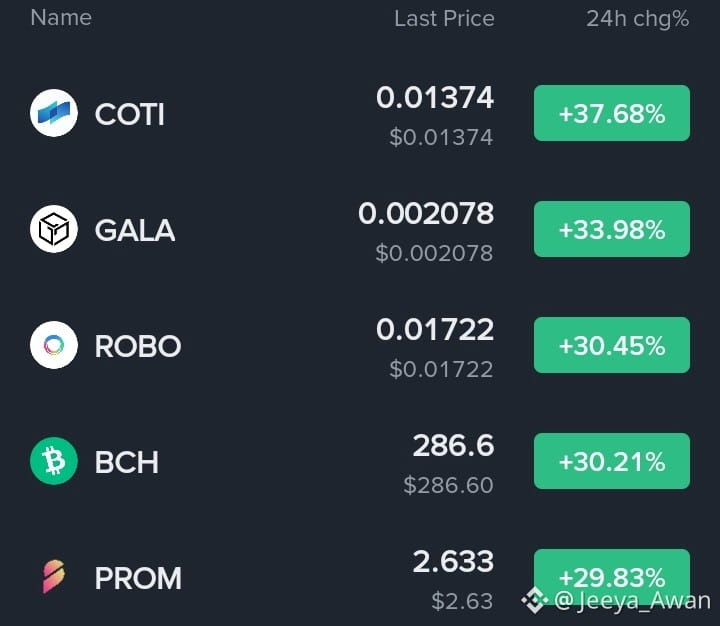
$COTI and $GALA are top gainers now.
Jeeya_Awan
·
--
#dusk $DUSK @Dusk
Voting Committees and Attestations
One part of Dusk Network’s consensus design I find especially interesting is how voting committees turn individual votes into compact proof.
In Dusk’s Succinct Attestation protocol, provisioners are selected for validation and ratification committees through deterministic sortition. Committee members receive credits that determine the weight of their votes, with the committee using a fixed 64-credit structure in the whitepaper.
What makes the process more efficient is BLS signatures: votes from multiple provisioners can be aggregated into a single signature for easier verification.
An attestation then becomes proof that a quorum was reached. A 2/3 supermajority of Valid votes creates a success attestation, while a majority of Invalid, NoCandidate, or NoQuorum votes creates a fail attestation.
The bigger idea: Dusk doesn’t just collect votes, it packages consensus evidence into a verifiable structure that supports its approach to fast, privacy-focused financial infrastructure.
Voting Committees and Attestations
One part of Dusk Network’s consensus design I find especially interesting is how voting committees turn individual votes into compact proof.
In Dusk’s Succinct Attestation protocol, provisioners are selected for validation and ratification committees through deterministic sortition. Committee members receive credits that determine the weight of their votes, with the committee using a fixed 64-credit structure in the whitepaper.
What makes the process more efficient is BLS signatures: votes from multiple provisioners can be aggregated into a single signature for easier verification.
An attestation then becomes proof that a quorum was reached. A 2/3 supermajority of Valid votes creates a success attestation, while a majority of Invalid, NoCandidate, or NoQuorum votes creates a fail attestation.
The bigger idea: Dusk doesn’t just collect votes, it packages consensus evidence into a verifiable structure that supports its approach to fast, privacy-focused financial infrastructure.

Verified
#dusk $DUSK @Dusk
Voting Committees and Attestations
One part of Dusk Network’s consensus design I find especially interesting is how voting committees turn individual votes into compact proof.
In Dusk’s Succinct Attestation protocol, provisioners are selected for validation and ratification committees through deterministic sortition. Committee members receive credits that determine the weight of their votes, with the committee using a fixed 64-credit structure in the whitepaper.
What makes the process more efficient is BLS signatures: votes from multiple provisioners can be aggregated into a single signature for easier verification.
An attestation then becomes proof that a quorum was reached. A 2/3 supermajority of Valid votes creates a success attestation, while a majority of Invalid, NoCandidate, or NoQuorum votes creates a fail attestation.
The bigger idea: Dusk doesn’t just collect votes, it packages consensus evidence into a verifiable structure that supports its approach to fast, privacy-focused financial infrastructure.
Voting Committees and Attestations
One part of Dusk Network’s consensus design I find especially interesting is how voting committees turn individual votes into compact proof.
In Dusk’s Succinct Attestation protocol, provisioners are selected for validation and ratification committees through deterministic sortition. Committee members receive credits that determine the weight of their votes, with the committee using a fixed 64-credit structure in the whitepaper.
What makes the process more efficient is BLS signatures: votes from multiple provisioners can be aggregated into a single signature for easier verification.
An attestation then becomes proof that a quorum was reached. A 2/3 supermajority of Valid votes creates a success attestation, while a majority of Invalid, NoCandidate, or NoQuorum votes creates a fail attestation.
The bigger idea: Dusk doesn’t just collect votes, it packages consensus evidence into a verifiable structure that supports its approach to fast, privacy-focused financial infrastructure.
Verified
#dusk $DUSK @Dusk
Deterministic Sortition: How Dusk Selects Validators
found one interesting detail about Dusk is that validator selection isn’t simply “more stake = always chosen.”
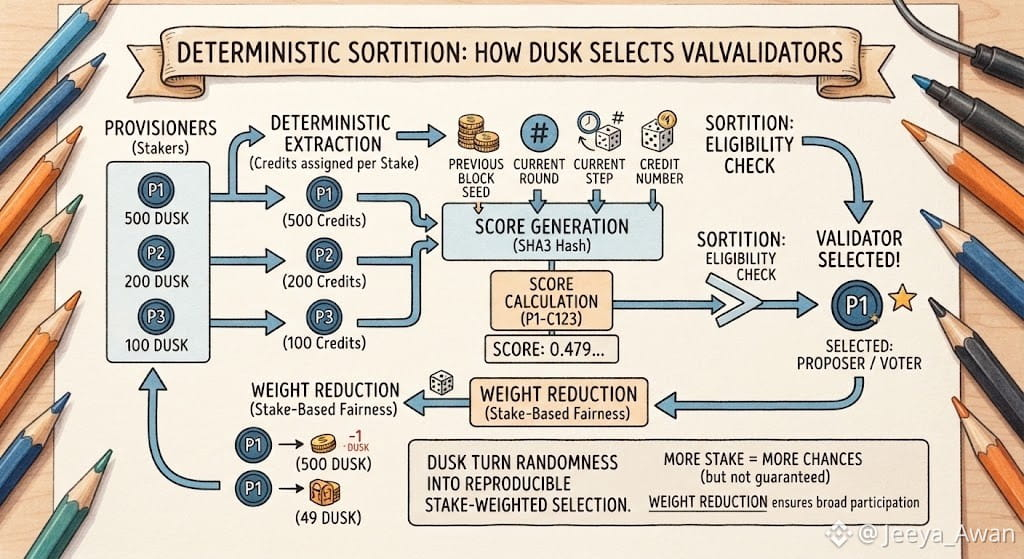
In Dusk’s Succinct Attestation consensus, stakers, called "provisioners", are selected through Deterministic Sortition (DS). The process uses deterministic extraction to assign credits based on stake, while a SHA3-generated score helps determine each selection. The score combines the previous block’s seed with the current round, step, and credit number.
The clever part is that a provisioner’s weight is reduced by 1 DUSK after receiving a credit, helping keep participation proportional to stake rather than repeatedly favoring the same participant.
So Dusk turns randomness into a reproducible, stake-weighted selection process, quietly powering who proposes and who votes on blocks.
Deterministic Sortition: How Dusk Selects Validators
found one interesting detail about Dusk is that validator selection isn’t simply “more stake = always chosen.”
In Dusk’s Succinct Attestation consensus, stakers, called "provisioners", are selected through Deterministic Sortition (DS). The process uses deterministic extraction to assign credits based on stake, while a SHA3-generated score helps determine each selection. The score combines the previous block’s seed with the current round, step, and credit number.
The clever part is that a provisioner’s weight is reduced by 1 DUSK after receiving a credit, helping keep participation proportional to stake rather than repeatedly favoring the same participant.
So Dusk turns randomness into a reproducible, stake-weighted selection process, quietly powering who proposes and who votes on blocks.
$HEMI and $RE are the top gainers now!
Jeeya_Awan
·
--
#dusk $DUSK @Dusk
Provisioners and Proof-of-Stake on Dusk
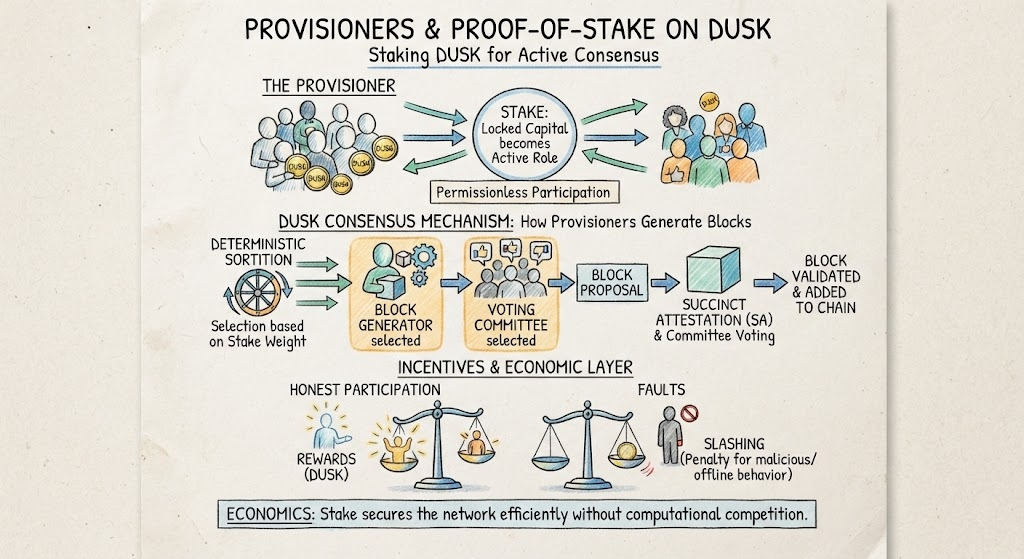
What makes Dusk’s Proof-of-Stake model interesting is how it turns staked DUSK into an active role in consensus. Stakers, called provisioners, can generate and validate blocks through Succinct Attestation (SA). Instead of relying on constant computational competition, Dusk uses Deterministic Sortition to select block generators and voting committees according to stake. The process is designed to be permissionless, while committee-based voting helps the network reach agreement efficiently. Provisioners also have incentives to participate in, with rewards for honest participation and penalties for faults. This creates an economic layer where stake is not just locked capital, it becomes part of the mechanism securing the network.
Provisioners and Proof-of-Stake on Dusk
What makes Dusk’s Proof-of-Stake model interesting is how it turns staked DUSK into an active role in consensus. Stakers, called provisioners, can generate and validate blocks through Succinct Attestation (SA). Instead of relying on constant computational competition, Dusk uses Deterministic Sortition to select block generators and voting committees according to stake. The process is designed to be permissionless, while committee-based voting helps the network reach agreement efficiently. Provisioners also have incentives to participate in, with rewards for honest participation and penalties for faults. This creates an economic layer where stake is not just locked capital, it becomes part of the mechanism securing the network.
#dusk $DUSK @Dusk
Dusk’s Succinct Attestation Consensus Mechanism
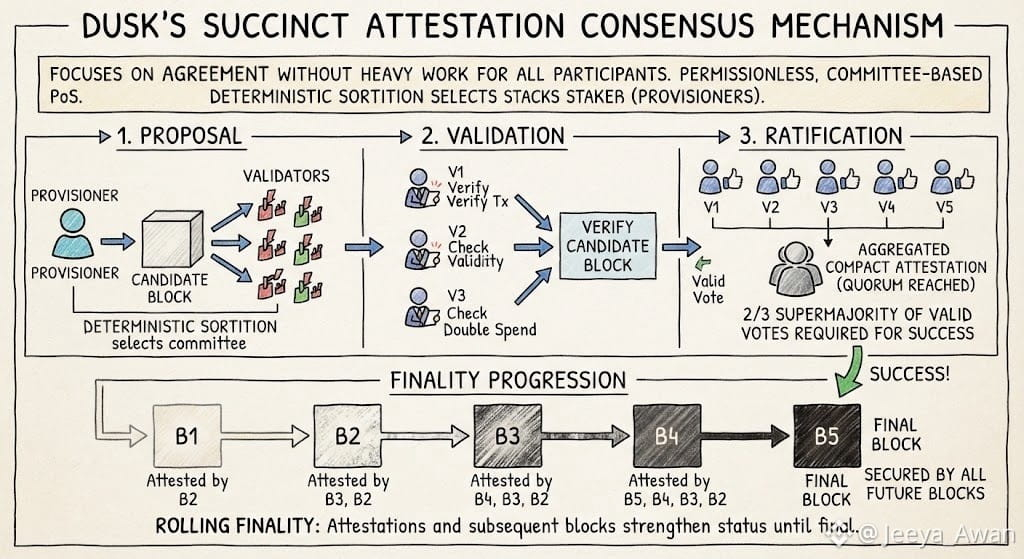
What stands out to me about Dusk’s consensus design is that it focuses on reaching agreement without making every participant do the same heavy work. Succinct Attestation (SA) is a permissionless, committee-based Proof-of-Stake mechanism where stakers, called provisioners, are selected through deterministic sortition.
A round moves through proposal, validation, and ratification. Voting committees verify the candidate block, and their signatures can be aggregated into a compact attestation proving that quorum was reached. A 2/3 supermajority of Valid votes can produce a success result.
The interesting part is how this connects to rolling finality: Dusk uses attestations and subsequent blocks to progressively strengthen a block’s status until it becomes final.
Dusk’s Succinct Attestation Consensus Mechanism
What stands out to me about Dusk’s consensus design is that it focuses on reaching agreement without making every participant do the same heavy work. Succinct Attestation (SA) is a permissionless, committee-based Proof-of-Stake mechanism where stakers, called provisioners, are selected through deterministic sortition.
A round moves through proposal, validation, and ratification. Voting committees verify the candidate block, and their signatures can be aggregated into a compact attestation proving that quorum was reached. A 2/3 supermajority of Valid votes can produce a success result.
The interesting part is how this connects to rolling finality: Dusk uses attestations and subsequent blocks to progressively strengthen a block’s status until it becomes final.
Verified
How Kadcast Improves Network Communication
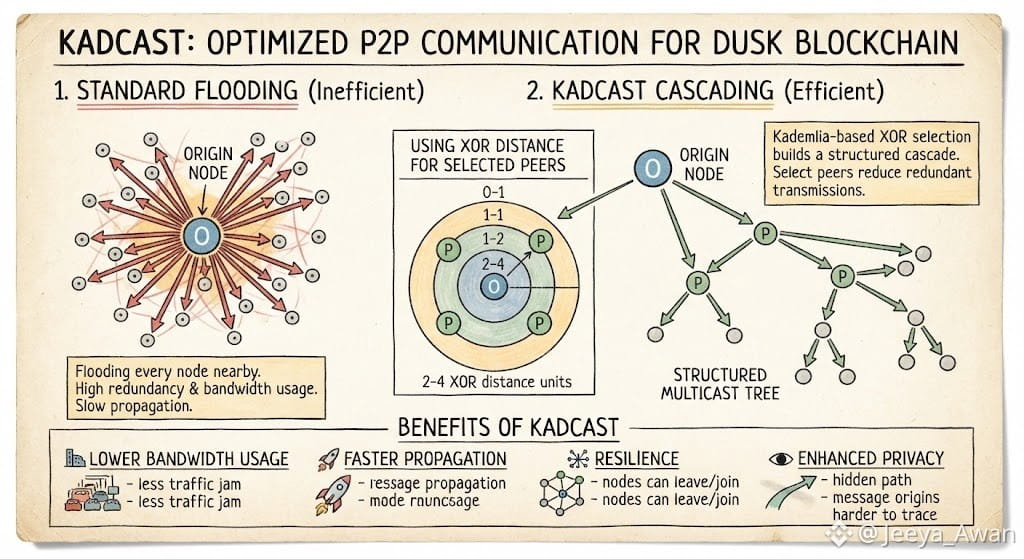
A blockchain can have strong consensus and privacy, but none of that matters if information moves inefficiently. @Dusk tackles this at the communication layer with Kadcast, a P2P protocol built on Kademlia’s DHT structure. Instead of flooding every nearby node with the same message, Kadcast uses XOR distance and selected peers to create a structured cascade. Multicast trees help spread blocks, transactions, and consensus votes with fewer redundant transmissions. The result is lower bandwidth usage, faster propagation, and better resilience when nodes join, leave, or fail. The whitepaper also highlights privacy benefits because message origins become harder to trace as data travels through selected peers.
#dusk $DUSK
A blockchain can have strong consensus and privacy, but none of that matters if information moves inefficiently. @Dusk tackles this at the communication layer with Kadcast, a P2P protocol built on Kademlia’s DHT structure. Instead of flooding every nearby node with the same message, Kadcast uses XOR distance and selected peers to create a structured cascade. Multicast trees help spread blocks, transactions, and consensus votes with fewer redundant transmissions. The result is lower bandwidth usage, faster propagation, and better resilience when nodes join, leave, or fail. The whitepaper also highlights privacy benefits because message origins become harder to trace as data travels through selected peers.
#dusk $DUSK
Verified
Kadcast: Dusk’s Efficient Peer-to-Peer Network
A blockchain can have strong consensus, but it still needs a smart way to move information between nodes. That’s where Kadcast becomes important for Dusk.
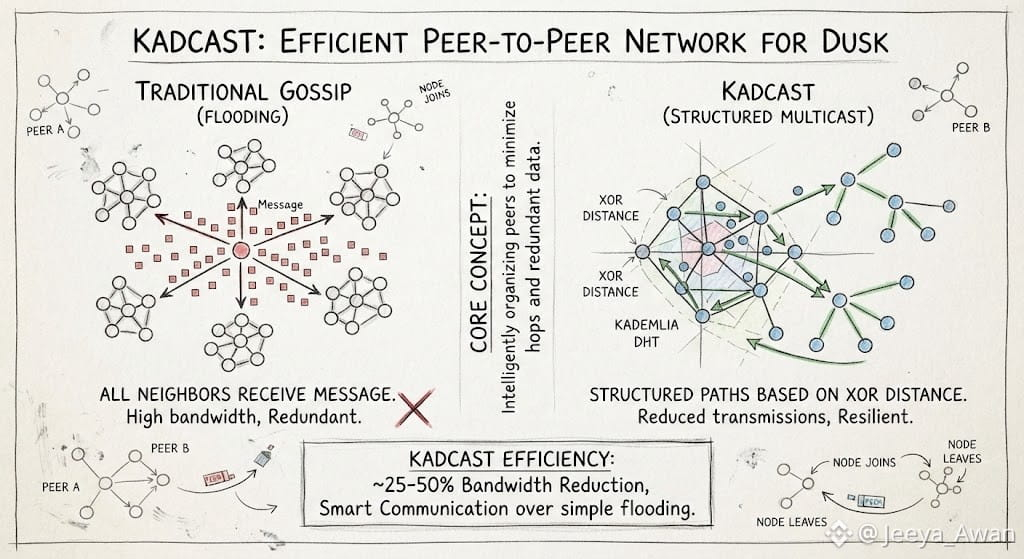
Built on Kademlia’s DHT structure, Kadcast organizes peers using XOR distance instead of simply flooding every neighbor with the same message. Blocks, transactions, and consensus votes can travel through selected peers using structured multicast paths, reducing unnecessary transmissions.
What I find interesting is that this design is not only about speed. The whitepaper notes that Kadcast can reduce bandwidth usage by roughly 25–50% compared with Gossip, while also improving resilience when nodes join, leave, or fail.
For me, Kadcast shows that blockchain efficiency isn’t only about consensus, it starts with how intelligently the network communicates.
@Dusk #dusk $DUSK
A blockchain can have strong consensus, but it still needs a smart way to move information between nodes. That’s where Kadcast becomes important for Dusk.
Built on Kademlia’s DHT structure, Kadcast organizes peers using XOR distance instead of simply flooding every neighbor with the same message. Blocks, transactions, and consensus votes can travel through selected peers using structured multicast paths, reducing unnecessary transmissions.
What I find interesting is that this design is not only about speed. The whitepaper notes that Kadcast can reduce bandwidth usage by roughly 25–50% compared with Gossip, while also improving resilience when nodes join, leave, or fail.
For me, Kadcast shows that blockchain efficiency isn’t only about consensus, it starts with how intelligently the network communicates.
@Dusk #dusk $DUSK
Verified
How Dusk Bridges Blockchain and Traditional Finance
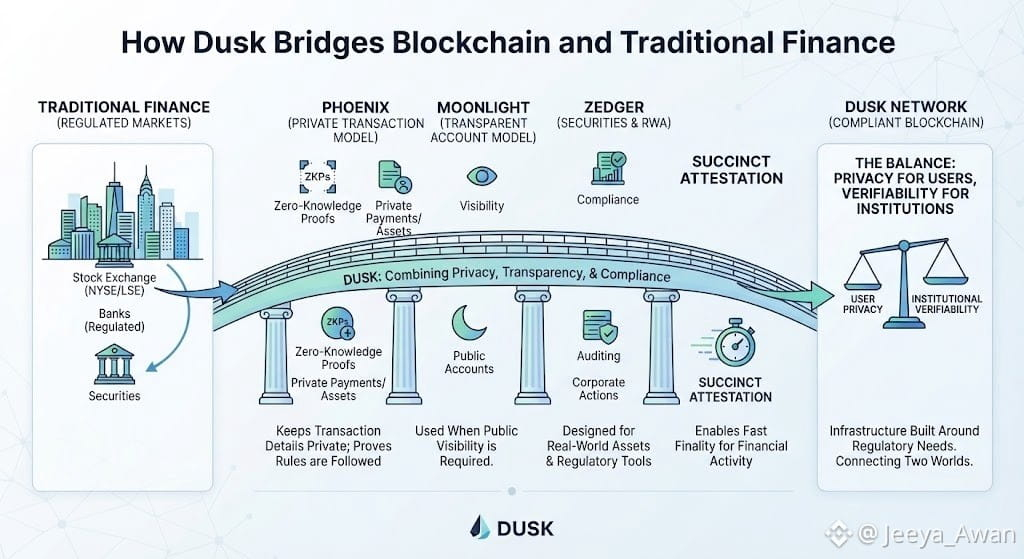
The real challenge for blockchain in traditional finance isn’t simply moving assets on-chain. It’s combining privacy with the transparency and controls that regulated markets require.
Dusk approaches this at the protocol level. Its Phoenix model can keep transaction details private through zero-knowledge proofs, while still proving that transactions follow network rules. Moonlight provides a transparent account-based model when visibility is needed.
Then there’s Zedger, designed for securities and real-world assets, with tools for compliance, auditing, corporate actions and private transactions. Dusk also uses Succinct Attestation to target fast finality for financial activity.
The interesting part is the balance: privacy for users, verifiability for institutions, and infrastructure built around regulatory needs.
That’s a different path toward connecting blockchain with traditional finance.
@Dusk #dusk $DUSK
The real challenge for blockchain in traditional finance isn’t simply moving assets on-chain. It’s combining privacy with the transparency and controls that regulated markets require.
Dusk approaches this at the protocol level. Its Phoenix model can keep transaction details private through zero-knowledge proofs, while still proving that transactions follow network rules. Moonlight provides a transparent account-based model when visibility is needed.
Then there’s Zedger, designed for securities and real-world assets, with tools for compliance, auditing, corporate actions and private transactions. Dusk also uses Succinct Attestation to target fast finality for financial activity.
The interesting part is the balance: privacy for users, verifiability for institutions, and infrastructure built around regulatory needs.
That’s a different path toward connecting blockchain with traditional finance.
@Dusk #dusk $DUSK
Log in to explore more content