Binance Square
FeryX Trades
16.4k Posts

FeryX Trades

Square Verified+
فريال | متداولة شرسة لا تعرف التراجع 📊🔥 أحلل بذكاء، أقتنص الفرص، وأبني نجاحي بثقة. هدفي الحرية المالية وصناعة اسمي بقوة في عالم التداول.
4.2K+ Following
36.9K+ Followers
33.2K+ Liked
Posts
PINNED
·
--
When Financial Rules Become Identifiable ObjectsFor a long time, I assumed software and the rules it followed were inseparable. If an application enforced a spending limit, checked permissions, or rejected risky transactions, I assumed those decisions simply lived inside the application itself. The software owned its own behavior. While reading through Newton Protocol's developer documentation, I found an implementation detail that made me question that assumption. At first it looked insignificant. A PolicyClient doesn't simply point to a Policy contract. After assigning the Policy contract address, it must also register a specific policy configuration through setPolicy(). That registration returns a policyId, and Newton's attestation validation checks that identifier when verifying whether an authorization decision was made under the expected registered policy. Initially, I treated policyId as little more than an implementation detail. The more I thought about it, the less it felt like bookkeeping. It felt like Newton was making the behavior itself identifiable. That distinction is subtle. A contract address tells you where policy logic exists. A policyId tells you which registered policy configuration produced the authorization that an attestation is claiming. Those are different questions. Without that distinction, a verifier could know which Policy contract was involved without necessarily knowing which registered configuration an authorization corresponded to. Newton appears to separate those ideas deliberately. That made me think about software differently. Most applications own the rules they enforce. Change the application and you change the behavior. Here, the application seems to reference a separately registered policy configuration instead. The software executes. The registered policy defines the conditions under which execution is allowed. That doesn't mean the application becomes unimportant. It still controls assets. It still performs execution. But part of the decision logic is no longer simply hidden inside the application itself. Instead, the authorization is tied to a specific registered configuration that both the application and the attestation can reference. That feels like more than modular software design. It feels like an attempt to make authorization itself something that can be identified rather than inferred. If that's true, the implications extend beyond cleaner engineering. When behavior has its own identity, different participants no longer have to talk vaguely about "the policy." They can refer to a specific registered configuration. Auditors can evaluate that configuration. Applications can intentionally reference it. Attestations can prove that evaluation occurred against it. Coordination becomes more precise because everyone is referring to the same identified object rather than an assumption about whatever logic currently exists inside a contract. Of course, that doesn't automatically solve every problem. An identifiable policy is not automatically a good policy. Registration doesn't guarantee sound judgment. Developers still have to design the right rules. Governance still matters. Trust still has to be earned. I'm also careful not to read more into the architecture than the documentation actually says. Newton documents how policyId is registered and validated during attestation verification. Whether this eventually changes how financial software is designed is still an open question, not an established conclusion. But I keep coming back to the architectural choice itself. Most people—including me—naturally think software owns its own behavior. Newton's design suggests another possibility. Perhaps the software doesn't need to own the rules it follows. Perhaps it only needs to execute them while proving exactly which registered policy those decisions came from. That is a much smaller implementation detail than I expected. It may also turn out to be a much larger shift in how programmable financial systems organize trust. Because once financial behavior has an identity of its own, the conversation slowly changes. It is no longer only about what the application did. It becomes about which specific policy authorized it—and whether everyone can independently verify that they are talking about the same one. @NewtonProtocol #Newt $NEWT {future}(NEWTUSDT)

When Financial Rules Become Identifiable Objects

For a long time, I assumed software and the rules it followed were inseparable.
If an application enforced a spending limit, checked permissions, or rejected risky transactions, I assumed those decisions simply lived inside the application itself. The software owned its own behavior.
While reading through Newton Protocol's developer documentation, I found an implementation detail that made me question that assumption.
At first it looked insignificant.
A PolicyClient doesn't simply point to a Policy contract. After assigning the Policy contract address, it must also register a specific policy configuration through setPolicy(). That registration returns a policyId, and Newton's attestation validation checks that identifier when verifying whether an authorization decision was made under the expected registered policy.
Initially, I treated policyId as little more than an implementation detail.
The more I thought about it, the less it felt like bookkeeping.
It felt like Newton was making the behavior itself identifiable.
That distinction is subtle.
A contract address tells you where policy logic exists.
A policyId tells you which registered policy configuration produced the authorization that an attestation is claiming.
Those are different questions.
Without that distinction, a verifier could know which Policy contract was involved without necessarily knowing which registered configuration an authorization corresponded to.
Newton appears to separate those ideas deliberately.
That made me think about software differently.
Most applications own the rules they enforce.
Change the application and you change the behavior.
Here, the application seems to reference a separately registered policy configuration instead.
The software executes.
The registered policy defines the conditions under which execution is allowed.
That doesn't mean the application becomes unimportant.
It still controls assets.
It still performs execution.
But part of the decision logic is no longer simply hidden inside the application itself.
Instead, the authorization is tied to a specific registered configuration that both the application and the attestation can reference.
That feels like more than modular software design.
It feels like an attempt to make authorization itself something that can be identified rather than inferred.
If that's true, the implications extend beyond cleaner engineering.
When behavior has its own identity, different participants no longer have to talk vaguely about "the policy."
They can refer to a specific registered configuration.
Auditors can evaluate that configuration.
Applications can intentionally reference it.
Attestations can prove that evaluation occurred against it.
Coordination becomes more precise because everyone is referring to the same identified object rather than an assumption about whatever logic currently exists inside a contract.
Of course, that doesn't automatically solve every problem.
An identifiable policy is not automatically a good policy.
Registration doesn't guarantee sound judgment.
Developers still have to design the right rules.
Governance still matters.
Trust still has to be earned.
I'm also careful not to read more into the architecture than the documentation actually says.
Newton documents how policyId is registered and validated during attestation verification.
Whether this eventually changes how financial software is designed is still an open question, not an established conclusion.
But I keep coming back to the architectural choice itself.
Most people—including me—naturally think software owns its own behavior.
Newton's design suggests another possibility.
Perhaps the software doesn't need to own the rules it follows.
Perhaps it only needs to execute them while proving exactly which registered policy those decisions came from.
That is a much smaller implementation detail than I expected.
It may also turn out to be a much larger shift in how programmable financial systems organize trust.
Because once financial behavior has an identity of its own, the conversation slowly changes.
It is no longer only about what the application did.
It becomes about which specific policy authorized it—and whether everyone can independently verify that they are talking about the same one.
@NewtonProtocol #Newt $NEWT
PINNED
Verified
I kept wondering what would happen if hundreds of independent teams eventually relied on exactly the same financial policy. After enough audits and enough real-world use, writing a new policy from scratch would probably stop feeling like the safest choice. Reusing the one everyone already trusted would. Then someone publishes a better version. Nothing breaks. But nobody is required to upgrade. That question kept coming back while I was reading Newton Protocol's policy architecture. Newton's documentation explains how applications select policies through setPolicy(), referencing a specific policyId. It documents policy versioning too. What I couldn't find was a documented mechanism explaining how independent adopters coordinate when a newer version appears. Maybe I missed it. But if that mechanism doesn't exist, different applications may quietly continue pointing to different policyIds while all believing they're enforcing the same policy. The policy didn't fail. The ecosystem stopped sharing the same standard. The value of a shared policy isn't only that people trust it. It's that they trust the same version. Once that shared confidence fragments, so do some of the economic advantages of reuse. Shared audits become less reusable. New adopters spend more time deciding which version deserves confidence instead of inheriting one already accepted by everyone. I don't know how significant this becomes in practice. Newton may already have a coordination mechanism that simply hasn't been documented. But I keep wondering: Who decides when a trusted policy has truly been replaced? Or does every application quietly make that decision on its own? @NewtonProtocol #Newt $NEWT {future}(NEWTUSDT)
I kept wondering what would happen if hundreds of independent teams eventually relied on exactly the same financial policy.
After enough audits and enough real-world use, writing a new policy from scratch would probably stop feeling like the safest choice. Reusing the one everyone already trusted would.
Then someone publishes a better version.
Nothing breaks.
But nobody is required to upgrade.
That question kept coming back while I was reading Newton Protocol's policy architecture.
Newton's documentation explains how applications select policies through setPolicy(), referencing a specific policyId. It documents policy versioning too. What I couldn't find was a documented mechanism explaining how independent adopters coordinate when a newer version appears.
Maybe I missed it.
But if that mechanism doesn't exist, different applications may quietly continue pointing to different policyIds while all believing they're enforcing the same policy.
The policy didn't fail.
The ecosystem stopped sharing the same standard.
The value of a shared policy isn't only that people trust it.
It's that they trust the same version.
Once that shared confidence fragments, so do some of the economic advantages of reuse. Shared audits become less reusable. New adopters spend more time deciding which version deserves confidence instead of inheriting one already accepted by everyone.
I don't know how significant this becomes in practice. Newton may already have a coordination mechanism that simply hasn't been documented.
But I keep wondering:
Who decides when a trusted policy has truly been replaced?
Or does every application quietly make that decision on its own?

@NewtonProtocol #Newt $NEWT
·
--
Bullish
Enter long on $BANANA immediately at 3.05-3.10; The upward move is coming in strong—don’t stop it, it’s a golden opportunity! We target 3.25 then 3.40 and finally 3.60. Set stop loss at only 2.92. Don’t hesitate—win now before everyone! 🚀🔥
Enter long on $BANANA immediately at 3.05-3.10;
The upward move is coming in strong—don’t stop it, it’s a golden opportunity!
We target 3.25 then 3.40 and finally 3.60.
Set stop loss at only 2.92.
Don’t hesitate—win now before everyone! 🚀🔥
·
--
Bearish
Enter a short at $SNX immediately at 0.230-0.238; The downward move is coming strongly—nothing can stop it, and this is a golden opportunity! We target 0.221 then 0.210, and finally 0.198. Set stop-loss at 0.255 only. Don’t hesitate—win now before everyone! 🚀🔥
Enter a short at $SNX immediately at 0.230-0.238;
The downward move is coming strongly—nothing can stop it, and this is a golden opportunity!
We target 0.221 then 0.210, and finally 0.198.
Set stop-loss at 0.255 only.
Don’t hesitate—win now before everyone! 🚀🔥
·
--
Bullish
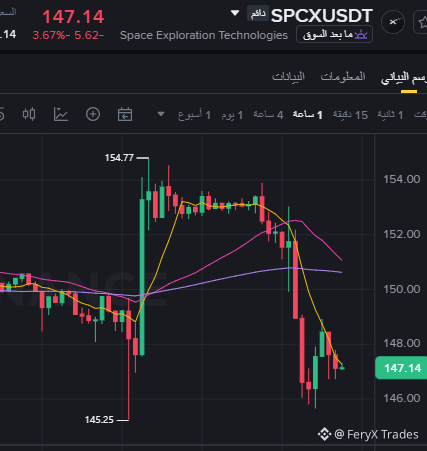
A violent upside breakout for $SPCX and the bulls prove the skeptics wrong! 🚀🔥 While everyone watches the latest pullback with anxiety, project $SPCX is preparing to prove the opposite entirely by bouncing from the Demand Zone after a healthy, liquidity-attracting correction. The price has returned again to the accumulation zone, where buyers absorb all the available sell orders. The current chart structure represents a continuation of the uptrend (Continuation) rather than a break in the path, opening the door to an aggressive price expansion targeting the liquidity stacked above the previous highs. We’re entering now with strong buy (Long) trades to capture the upcoming explosion wave: ← Entry range: 158 – 162 $ 🎯 ← Targets: 169 $ 🎯 178 $ 🎯 189 $ 💰 ❌ Stop Loss (SL): 147 $ 🛑 Secure your positions in the specified accumulation zone now before the price takes off and the completion of the violent rally is confirmed! 📈👇
A violent upside breakout for $SPCX and the bulls prove the skeptics wrong! 🚀🔥

While everyone watches the latest pullback with anxiety, project $SPCX is preparing to prove the opposite entirely by bouncing from the Demand Zone after a healthy, liquidity-attracting correction. The price has returned again to the accumulation zone, where buyers absorb all the available sell orders. The current chart structure represents a continuation of the uptrend (Continuation) rather than a break in the path, opening the door to an aggressive price expansion targeting the liquidity stacked above the previous highs.

We’re entering now with strong buy (Long) trades to capture the upcoming explosion wave:

← Entry range: 158 – 162 $ 🎯
← Targets: 169 $ 🎯 178 $ 🎯 189 $ 💰
❌ Stop Loss (SL): 147 $ 🛑

Secure your positions in the specified accumulation zone now before the price takes off and the completion of the violent rally is confirmed! 📈👇
·
--
Bullish
An imminent upward breakout for $M and the bulls are preparing to break through resistance after a strong breakout and explosive bullish momentum on the chart! 🚀 Positive momentum is increasing strongly with complete buyer control. We enter now with buy (Long) trades using up to 20x leverage to capture the quick upward wave, as long as the price maintains its stability and stays above the 1.80 $ levels—this opens the door for the rally to continue toward the higher targets. ← Entry zone: 1.80 – 1.83 $ 🎯 ← Targets: • Target 1: 1.95 $ 🎯 • Target 2: 2.10 $ 🎯 • Target 3: 2.30 $ 💎 ❌ Stop Loss (SL): 1.68 $ 🛑 Get positioned in the entry zone now before the price shoots up and the opportunity is gone—then ride the next upward wave! 📈👇 $M
An imminent upward breakout for $M and the bulls are preparing to break through resistance after a strong breakout and explosive bullish momentum on the chart! 🚀
Positive momentum is increasing strongly with complete buyer control. We enter now with buy (Long) trades using up to 20x leverage to capture the quick upward wave, as long as the price maintains its stability and stays above the 1.80 $ levels—this opens the door for the rally to continue toward the higher targets.
← Entry zone: 1.80 – 1.83 $ 🎯
← Targets:
• Target 1: 1.95 $ 🎯
• Target 2: 2.10 $ 🎯
• Target 3: 2.30 $ 💎
❌ Stop Loss (SL): 1.68 $ 🛑
Get positioned in the entry zone now before the price shoots up and the opportunity is gone—then ride the next upward wave! 📈👇
$M
·
--
Bearish
Open the "short" deal now on $TLM ; while everyone is busy chasing the latest highs, the chart whispers an undeniable truth: the price has returned again to the supply zone and the current resistance area, and it is getting ready for a cooling-off process, profit-taking, and an imminent downward move! We are tracking a strong bearish (SHORT) signal, with clear indicators confirming that the most recent bounce was only a temporary corrective move—and that the bears are preparing to sweep buy positions and push the price down toward lower support levels! 📉🔥 Positioning plan: Entry range: 0.00176 – 0.00179 $ 🎯 Stop Loss (SL): 0.00190 $ 🛡️ Targets (Take Profits): TP1: 0.00165 $ 💰 TP2: 0.00155 $ 💎 TP3: 0.00145 $ 🚀 Why now? After this latest recovery, price faced a tough resistance zone, and we are waiting for a clear rejection (Rejection) from it after buyers failed to confirm a breakout. The inability to build higher positions above this zone opens the door to a quick downswing aimed at hunting and liquidating the stacked liquidity below—making positioning from these levels a perfect opportunity with extremely controlled risk for a fast profit target. Don’t ignore the chart’s whisper—snipers are positioning themselves right now! 🦅📉 {future}(TLMUSDT)
Open the "short" deal now on $TLM ; while everyone is busy chasing the latest highs, the chart whispers an undeniable truth: the price has returned again to the supply zone and the current resistance area, and it is getting ready for a cooling-off process, profit-taking, and an imminent downward move! We are tracking a strong bearish (SHORT) signal, with clear indicators confirming that the most recent bounce was only a temporary corrective move—and that the bears are preparing to sweep buy positions and push the price down toward lower support levels! 📉🔥
Positioning plan:
Entry range: 0.00176 – 0.00179 $ 🎯
Stop Loss (SL): 0.00190 $ 🛡️
Targets (Take Profits):
TP1: 0.00165 $ 💰
TP2: 0.00155 $ 💎
TP3: 0.00145 $ 🚀
Why now?
After this latest recovery, price faced a tough resistance zone, and we are waiting for a clear rejection (Rejection) from it after buyers failed to confirm a breakout. The inability to build higher positions above this zone opens the door to a quick downswing aimed at hunting and liquidating the stacked liquidity below—making positioning from these levels a perfect opportunity with extremely controlled risk for a fast profit target. Don’t ignore the chart’s whisper—snipers are positioning themselves right now! 🦅📉
🎙️ Stay true to your初心 and regularly invest in BNB spot!
avatar
End
03 h 42 m 36 s
32.8k
35
37
·
--
Bullish
A rising and imminent explosion for $COLLECT , and the bulls are preparing to break resistance after a strong breakout and explosive bullish momentum on the chart! 🚀 Positive momentum is strengthening rapidly with complete control from buyers. Now we enter buy trades (Long) using a maximum leverage of 20x to capture the quick upward wave, as long as the price keeps stable and firm above the 0.03900 $ levels—opening the door for the rally to continue toward the higher targets. ← Entry zone: 0.03900 – 0.04000 $ 🎯 ← Targets: • Target 1: 0.04100 $ 🎯 • Target 2: 0.04200 $ 🎯 • Target 3: 0.04300 $ 💎 • Target 4: 0.04400 $ 💰 ❌ Stop Loss (SL): 0.03700 $ 🛑 Get positioned in the entry zone now before the price shoots up and the opportunity is gone—then ride the next upward wave! 📈👇 {future}(COLLECTUSDT)
A rising and imminent explosion for $COLLECT , and the bulls are preparing to break resistance after a strong breakout and explosive bullish momentum on the chart! 🚀
Positive momentum is strengthening rapidly with complete control from buyers. Now we enter buy trades (Long) using a maximum leverage of 20x to capture the quick upward wave, as long as the price keeps stable and firm above the 0.03900 $ levels—opening the door for the rally to continue toward the higher targets.
← Entry zone: 0.03900 – 0.04000 $ 🎯
← Targets:
• Target 1: 0.04100 $ 🎯
• Target 2: 0.04200 $ 🎯
• Target 3: 0.04300 $ 💎
• Target 4: 0.04400 $ 💰
❌ Stop Loss (SL): 0.03700 $ 🛑
Get positioned in the entry zone now before the price shoots up and the opportunity is gone—then ride the next upward wave! 📈👇
·
--
Bearish
Failed to break $ALLO and the bears take full control of the chart! 📉🚨 After the last failed rebound attempt and refusal from the higher levels, the coin completely lost its upward momentum at resistance, and the momentum began to weaken noticeably. Red candles started appearing, announcing the return of sellers to regain control—opening the door to a wave of decline and deeper pullback targeting the lower support levels once the 0.330$ level is broken. We are entering SHORT positions now to catch the coming bleed: ← Entry range: 0.338 – 0.345 $ 🎯 ← Targets: 0.325 $ 🎯 0.310 $ 🎯 0.295 $ 🎯 0.280 $ 💰 ❌ Stop Loss (SL): 0.358 $ 🛑 Open sell trades from the specified rebound zone before the drop accelerates and the chance to go lower is lost! 📉👇 {future}(ALLOUSDT)
Failed to break $ALLO and the bears take full control of the chart! 📉🚨
After the last failed rebound attempt and refusal from the higher levels, the coin completely lost its upward momentum at resistance, and the momentum began to weaken noticeably. Red candles started appearing, announcing the return of sellers to regain control—opening the door to a wave of decline and deeper pullback targeting the lower support levels once the 0.330$ level is broken.
We are entering SHORT positions now to catch the coming bleed:
← Entry range: 0.338 – 0.345 $ 🎯
← Targets: 0.325 $ 🎯 0.310 $ 🎯 0.295 $ 🎯 0.280 $ 💰
❌ Stop Loss (SL): 0.358 $ 🛑
Open sell trades from the specified rebound zone before the drop accelerates and the chance to go lower is lost! 📉👇
·
--
Bullish
The rebound at $TRX began after a successful breach of the short-term resistance level, and liquidity is increasing noticeably to push the price to break through the resistance level and reach new all-time highs! 🚀🔥 Buyers are dominating the market, and the upward momentum has firmly taken hold, paving the way for a strong bullish move—provided that buyers continue to support the market and enter strongly above the 0.3190 zone. I opened a leveraged buy position with 25x, and the setup is perfect: 🔹 Entry point: $0.3190 - $0.3200 🛑 Stop loss: $0.3145 🎯 Targets: $0.3230 | $0.3270 | $0.3320 | $0.3400 The next move will be extremely fast and violent once trading volume rises and the next bullish wave starts heading toward higher targets... Join the top investors now and you’ll see! 🦅⚡💰 {future}(TRXUSDT)
The rebound at $TRX began after a successful breach of the short-term resistance level, and liquidity is increasing noticeably to push the price to break through the resistance level and reach new all-time highs! 🚀🔥 Buyers are dominating the market, and the upward momentum has firmly taken hold, paving the way for a strong bullish move—provided that buyers continue to support the market and enter strongly above the 0.3190 zone.
I opened a leveraged buy position with 25x, and the setup is perfect:
🔹 Entry point: $0.3190 - $0.3200
🛑 Stop loss: $0.3145
🎯 Targets: $0.3230 | $0.3270 | $0.3320 | $0.3400
The next move will be extremely fast and violent once trading volume rises and the next bullish wave starts heading toward higher targets... Join the top investors now and you’ll see! 🦅⚡💰
🎙️ Will the market continue to rise?
avatar
End
03 h 16 m 08 s
19.7k
21
23
·
--
Bullish
A soon-to-happen explosive breakout for $M as the bulls prepare to break through resistance after a strong penetration and explosive bullish momentum on the chart! 🚀 Positive momentum is building hard with full control by buyers. We’re entering now with Buy (Long) orders using a max leverage of 20x to capture the quick upward wave, as long as the price holds steady and remains firm above the $1.75 level—opening the door for the rally to continue toward the higher targets. ← Entry zone: $1.75 – $1.80 🎯 ← Targets: • Target 1: $1.95 🎯 • Target 2: $2.10 🎯 • Target 3: $2.30 💎 • Target 4: $2.50 💰 ❌ Stop Loss (SL): $1.60 🛑 Position yourself in the entry zone now before the price rockets and the opportunity is gone—then the next upward wave begins! 📈👇
A soon-to-happen explosive breakout for $M as the bulls prepare to break through resistance after a strong penetration and explosive bullish momentum on the chart! 🚀
Positive momentum is building hard with full control by buyers. We’re entering now with Buy (Long) orders using a max leverage of 20x to capture the quick upward wave, as long as the price holds steady and remains firm above the $1.75 level—opening the door for the rally to continue toward the higher targets.
← Entry zone: $1.75 – $1.80 🎯
← Targets:
• Target 1: $1.95 🎯
• Target 2: $2.10 🎯
• Target 3: $2.30 💎
• Target 4: $2.50 💰
❌ Stop Loss (SL): $1.60 🛑
Position yourself in the entry zone now before the price rockets and the opportunity is gone—then the next upward wave begins! 📈👇
🎙️ Come on, come on—let’s chat and do some stuff together~
avatar
End
04 h 01 m 51 s
30.3k
34
25
Article
When Ownership Transfers, Does Trust Follow? The Hidden Cost of Shared Financial PoliciesFor a long time, I assumed ownership and trust naturally moved together. If a piece of infrastructure changed hands without breaking, I expected users to keep relying on it. The software still worked. The interfaces stayed the same. The documentation remained available. From a technical perspective, nothing important had changed. Lately, I'm not so sure. While reading about Newton Protocol, I found myself paying attention to something I hadn't expected. The protocol allows developers to publish reusable policies that other applications can adopt. Policy ownership can also change over time. A Policy Client can be updated, ownership transferred, and configurations migrated as systems evolve. Technically, that makes perfect sense. Real infrastructure needs continuity. Teams change. Companies are acquired. Contributors leave. Long-lived systems need ways to survive beyond their original creators. Newton appears to recognize that reality. What caught my attention wasn't the transfer itself. It was everything the transfer doesn't automatically move. Ownership is recorded onchain. Trust isn't. That distinction feels small until you imagine what success actually looks like. Suppose one financial policy becomes widely adopted. Not because anyone is forced to use it, but because years of reliable behavior convince developers that it consistently protects capital under difficult conditions. Vaults integrate it. Treasuries depend on it. AI agents execute within its boundaries. Institutions become comfortable relying on it. Eventually, the policy becomes less like an individual project and more like shared infrastructure. Then one day, ownership changes. Maybe the original developer sells the company. Maybe the founding team moves on. Maybe maintenance is handed to another organization. The blockchain can record that transition perfectly. Every signature can verify it. Every registry entry can reflect the new owner. Nothing about the technical system is broken. But an uncomfortable question quietly appears. Did trust transfer too? I'm not convinced that it does. History suggests otherwise. Open-source software has taught us that code and credibility are related, but they are not identical. Developers rarely trust a critical dependency simply because it has an active maintainer. They trust it because that maintainer has earned confidence over years of careful decisions, transparent communication, and responsible stewardship. Those qualities cannot be transferred with a transaction. They have to be rebuilt. Financial policies may prove even more demanding. Unlike a software library, a policy doesn't simply determine whether an application functions correctly. It helps determine whether money is allowed to move. If a trusted policy changes ownership, developers may naturally begin asking questions that no smart contract can answer. Will the new team make the same trade-offs? Will updates remain equally conservative during periods of market stress? Will commercial incentives eventually reshape decisions that users previously trusted? None of those questions have cryptographic proofs. They belong to human judgment. That observation changed how I think about reusable financial infrastructure. Much of blockchain innovation has focused on removing the need to trust individual people. Consensus reduces dependence on validators. Smart contracts reduce dependence on intermediaries. Cryptographic proofs reduce dependence on promises. Newton extends that philosophy into authorization by making financial policies verifiable before execution. That's an important step forward. Yet verification has natural limits. A protocol can prove who currently owns a policy. It cannot prove whether the market should grant that owner the same confidence accumulated by their predecessor. Trust remains something communities build gradually rather than something protocols migrate automatically. Ironically, success may make this question more important, not less. If only a handful of applications share policies, ownership changes affect relatively few participants. But if reusable financial policies become common infrastructure, a single transfer could influence hundreds of independent systems built on top of years of accumulated confidence. At that point, continuity becomes more than a technical problem. It becomes an economic one. Every ownership transfer may force downstream adopters to spend time, money, and governance effort deciding whether yesterday's trust still deserves today's capital. These verification costs never appear onchain, yet they become a real, recurring expense of maintaining confidence across shared financial infrastructure. The blockchain can transfer control instantly. But it cannot transfer confidence without cost. Perhaps future ecosystems will develop new ways to address it. Independent stewardship councils. Shared governance. Reputation systems for policy maintainers. Community review before major ownership transitions. I don't know which approach, if any, will become standard. What I do suspect is that programmable ownership may arrive before programmable trust. Those are different achievements. One belongs to protocol design. The other belongs to human behavior. The more I study Newton Protocol, the less I think its most interesting contribution is simply making authorization programmable. It may also force us to confront a question that software has wrestled with for decades, but finance has rarely needed to ask at this scale. When the infrastructure everyone depends on changes hands... who pays the cost of deciding whether it still deserves the same trust? #Newt $NEWT @NewtonProtocol

When Ownership Transfers, Does Trust Follow? The Hidden Cost of Shared Financial Policies

For a long time, I assumed ownership and trust naturally moved together.
If a piece of infrastructure changed hands without breaking, I expected users to keep relying on it. The software still worked. The interfaces stayed the same. The documentation remained available. From a technical perspective, nothing important had changed.
Lately, I'm not so sure.
While reading about Newton Protocol, I found myself paying attention to something I hadn't expected.
The protocol allows developers to publish reusable policies that other applications can adopt. Policy ownership can also change over time. A Policy Client can be updated, ownership transferred, and configurations migrated as systems evolve.
Technically, that makes perfect sense.
Real infrastructure needs continuity. Teams change. Companies are acquired. Contributors leave. Long-lived systems need ways to survive beyond their original creators.
Newton appears to recognize that reality.
What caught my attention wasn't the transfer itself.
It was everything the transfer doesn't automatically move.
Ownership is recorded onchain.
Trust isn't.
That distinction feels small until you imagine what success actually looks like.
Suppose one financial policy becomes widely adopted.
Not because anyone is forced to use it, but because years of reliable behavior convince developers that it consistently protects capital under difficult conditions.
Vaults integrate it.
Treasuries depend on it.
AI agents execute within its boundaries.
Institutions become comfortable relying on it.
Eventually, the policy becomes less like an individual project and more like shared infrastructure.
Then one day, ownership changes.
Maybe the original developer sells the company.
Maybe the founding team moves on.
Maybe maintenance is handed to another organization.
The blockchain can record that transition perfectly.
Every signature can verify it.
Every registry entry can reflect the new owner.
Nothing about the technical system is broken.
But an uncomfortable question quietly appears.
Did trust transfer too?
I'm not convinced that it does.
History suggests otherwise.
Open-source software has taught us that code and credibility are related, but they are not identical.
Developers rarely trust a critical dependency simply because it has an active maintainer.
They trust it because that maintainer has earned confidence over years of careful decisions, transparent communication, and responsible stewardship.
Those qualities cannot be transferred with a transaction.
They have to be rebuilt.
Financial policies may prove even more demanding.
Unlike a software library, a policy doesn't simply determine whether an application functions correctly.
It helps determine whether money is allowed to move.
If a trusted policy changes ownership, developers may naturally begin asking questions that no smart contract can answer.
Will the new team make the same trade-offs?
Will updates remain equally conservative during periods of market stress?
Will commercial incentives eventually reshape decisions that users previously trusted?
None of those questions have cryptographic proofs.
They belong to human judgment.
That observation changed how I think about reusable financial infrastructure.
Much of blockchain innovation has focused on removing the need to trust individual people.
Consensus reduces dependence on validators.
Smart contracts reduce dependence on intermediaries.
Cryptographic proofs reduce dependence on promises.
Newton extends that philosophy into authorization by making financial policies verifiable before execution.
That's an important step forward.
Yet verification has natural limits.
A protocol can prove who currently owns a policy.
It cannot prove whether the market should grant that owner the same confidence accumulated by their predecessor.
Trust remains something communities build gradually rather than something protocols migrate automatically.
Ironically, success may make this question more important, not less.
If only a handful of applications share policies, ownership changes affect relatively few participants.
But if reusable financial policies become common infrastructure, a single transfer could influence hundreds of independent systems built on top of years of accumulated confidence.
At that point, continuity becomes more than a technical problem.
It becomes an economic one.
Every ownership transfer may force downstream adopters to spend time, money, and governance effort deciding whether yesterday's trust still deserves today's capital. These verification costs never appear onchain, yet they become a real, recurring expense of maintaining confidence across shared financial infrastructure.
The blockchain can transfer control instantly.
But it cannot transfer confidence without cost.
Perhaps future ecosystems will develop new ways to address it.
Independent stewardship councils.
Shared governance.
Reputation systems for policy maintainers.
Community review before major ownership transitions.
I don't know which approach, if any, will become standard.
What I do suspect is that programmable ownership may arrive before programmable trust.
Those are different achievements.
One belongs to protocol design.
The other belongs to human behavior.
The more I study Newton Protocol, the less I think its most interesting contribution is simply making authorization programmable.
It may also force us to confront a question that software has wrestled with for decades, but finance has rarely needed to ask at this scale.
When the infrastructure everyone depends on changes hands...
who pays the cost of deciding whether it still deserves the same trust?
#Newt $NEWT @NewtonProtocol
·
--
Bullish
An imminent breakout for $RE as the bulls prepare to break resistance after a quiet, subtle signal from the EMA indicator on the 4-hour timeframe! 🚀 Positive momentum is building strongly with excellent technical indicators. We’re entering Long buy trades now with a leverage of up to 20x to catch the quick upward wave, where the RSI indicator provides great room for a breakout before reaching overbought levels—especially as the volatility rate (ATR) declines, which typically precedes strong breakouts. ← Entry zone: 0.6925669 – 0.7012331 $ 🎯 ← Targets: • Target 1: 0.7694732 $ 🎯 (a quick +10% upward wave) • Target 2: 0.8178554 $ 🎯 • Target 3: 0.8904286 $ 💰 ❌ Stop Loss (SL): 0.6001357 $ 🛑 Get positioned in the entry zone now before the price shoots up and the opportunity is gone! 📈👇
An imminent breakout for $RE as the bulls prepare to break resistance after a quiet, subtle signal from the EMA indicator on the 4-hour timeframe! 🚀

Positive momentum is building strongly with excellent technical indicators. We’re entering Long buy trades now with a leverage of up to 20x to catch the quick upward wave, where the RSI indicator provides great room for a breakout before reaching overbought levels—especially as the volatility rate (ATR) declines, which typically precedes strong breakouts.

← Entry zone: 0.6925669 – 0.7012331 $ 🎯
← Targets:
• Target 1: 0.7694732 $ 🎯 (a quick +10% upward wave)
• Target 2: 0.8178554 $ 🎯
• Target 3: 0.8904286 $ 💰
❌ Stop Loss (SL): 0.6001357 $ 🛑

Get positioned in the entry zone now before the price shoots up and the opportunity is gone! 📈👇
·
--
Bearish
Open a "SHORT" deal now at $ZRO ; while everyone is busy chasing the latest highs, the chart whispers a truth you can’t ignore: the price is preparing for a cooling-off and profit-taking move, and the drop has started now! We’re tracking a strong bearish (SHORT) signal, with clear indicators confirming that the last rebound was only a temporary corrective move, and that the bears are getting ready to sweep buy positions and push the price down toward lower support levels! 📉🔥 Positioning plan: Entry range: 0.8760 – 0.8800 $ 🎯 Stop Loss (SL): 0.9300 $ 🛡️ Take Profits: TP1: 0.8650 $ 💰 TP2: 0.8550 $ 💎 TP3: 0.8450 $ 🚀 TP4: 0.8400 $ 🏁 Why now? After this last rally, the price faced fierce selling pressure that buyers couldn’t break. The inability to build higher positions above the current resistance level opens the door to a fast downward journey aimed at catching and liquidating the accumulated liquidity below the previous lows, making positioning from these levels an ideal opportunity with very controlled risk. Don’t ignore the chart’s whisper—snipers are positioning now! 🦅📉
Open a "SHORT" deal now at $ZRO ; while everyone is busy chasing the latest highs, the chart whispers a truth you can’t ignore: the price is preparing for a cooling-off and profit-taking move, and the drop has started now! We’re tracking a strong bearish (SHORT) signal, with clear indicators confirming that the last rebound was only a temporary corrective move, and that the bears are getting ready to sweep buy positions and push the price down toward lower support levels! 📉🔥
Positioning plan:
Entry range: 0.8760 – 0.8800 $ 🎯
Stop Loss (SL): 0.9300 $ 🛡️
Take Profits:
TP1: 0.8650 $ 💰
TP2: 0.8550 $ 💎
TP3: 0.8450 $ 🚀
TP4: 0.8400 $ 🏁
Why now?
After this last rally, the price faced fierce selling pressure that buyers couldn’t break. The inability to build higher positions above the current resistance level opens the door to a fast downward journey aimed at catching and liquidating the accumulated liquidity below the previous lows, making positioning from these levels an ideal opportunity with very controlled risk. Don’t ignore the chart’s whisper—snipers are positioning now! 🦅📉
I originally thought the hardest part of Newton Protocol would be writing a good policy. Then I noticed something I hadn't considered. A developer can publish a policy that other protocols reuse instead of writing their own. At first, I assumed the value stayed with whoever created it. The more I followed that dependency, the less convinced I became. Once dozens of applications rely on the same policy, writing it may no longer be the difficult job. Maintaining it might be. Every improvement carries a hidden obligation. A policy update doesn't only change one application. It can trigger reviews, compatibility checks and fresh audits across every downstream team that depends on it. The author writes one update. Everyone else pays the coordination cost. That's a very different economy. We already pay people to maintain operating systems, cryptographic libraries and cloud infrastructure—not because they constantly invent something new, but because millions of users depend on them continuing to work tomorrow. I wonder if reusable authorization policies quietly create the same incentive. Not a market for writing rules. A market for maintaining trusted ones. I'm not sure Newton ever reaches that scale. But if shared policies become common, the scarce resource may not be the developer who publishes the first version. It may be the one everyone trusts to update it without breaking the systems built on top of it. $NEWT @NewtonProtocol #Newt
I originally thought the hardest part of Newton Protocol would be writing a good policy.
Then I noticed something I hadn't considered.
A developer can publish a policy that other protocols reuse instead of writing their own. At first, I assumed the value stayed with whoever created it.
The more I followed that dependency, the less convinced I became.
Once dozens of applications rely on the same policy, writing it may no longer be the difficult job.
Maintaining it might be.
Every improvement carries a hidden obligation. A policy update doesn't only change one application. It can trigger reviews, compatibility checks and fresh audits across every downstream team that depends on it. The author writes one update. Everyone else pays the coordination cost.
That's a very different economy.
We already pay people to maintain operating systems, cryptographic libraries and cloud infrastructure—not because they constantly invent something new, but because millions of users depend on them continuing to work tomorrow.
I wonder if reusable authorization policies quietly create the same incentive.
Not a market for writing rules.
A market for maintaining trusted ones.
I'm not sure Newton ever reaches that scale.
But if shared policies become common, the scarce resource may not be the developer who publishes the first version.
It may be the one everyone trusts to update it without breaking the systems built on top of it.

$NEWT @NewtonProtocol #Newt
🟢 Policy authors
100%
🔵 Policy maintainers
0%
3 votes • Voting closed
·
--
Bullish
The rebound started right now at $ALLO after a failed bearish pressure attempt. Smart liquidity is gathering strongly to clean the chart and successfully break the resistance! 🚀🔥 The bulls are asserting control, and the upward momentum is building silently in preparation for a strong rally—so long as buyers keep defending the 0.320$ zone. A Long position was opened with 25x leverage, isolated, and the setup is perfect: 🔹 Entry: 0.345 – 0.355 $ 🛑 Stop: 0.320 $ 🎯 Targets: 0.380 $ | 0.410 $ | 0.450 $ | 0.500 $ The next move will be very fast and violent once volume explodes and the rally continues toward the higher targets.. Position with the whales now and stick to my words! 🦅⚡💰 {future}(ALLOUSDT)
The rebound started right now at $ALLO after a failed bearish pressure attempt. Smart liquidity is gathering strongly to clean the chart and successfully break the resistance! 🚀🔥 The bulls are asserting control, and the upward momentum is building silently in preparation for a strong rally—so long as buyers keep defending the 0.320$ zone. A Long position was opened with 25x leverage, isolated, and the setup is perfect: 🔹 Entry: 0.345 – 0.355 $ 🛑 Stop: 0.320 $ 🎯 Targets: 0.380 $ | 0.410 $ | 0.450 $ | 0.500 $ The next move will be very fast and violent once volume explodes and the rally continues toward the higher targets.. Position with the whales now and stick to my words! 🦅⚡💰
·
--
Bullish
An imminent upward explosion for $EVAA , and the bulls are preparing to break resistance! 🚀 The positive momentum is strongly increasing at key support levels. We are entering now with buy (Long) trades using a maximum leverage of 20x to capture the quick upward wave. ← Entry zone: $1.01 – $1.03 🎯 ← Targets: $1.08 🎯 $1.15 💰 ❌ Stop Loss (SL): $0.96 🛑 Position yourselves in the entry zone now before the price shoots up and the opportunity is gone! 📈👇
An imminent upward explosion for $EVAA , and the bulls are preparing to break resistance! 🚀
The positive momentum is strongly increasing at key support levels. We are entering now with buy (Long) trades using a maximum leverage of 20x to capture the quick upward wave.
← Entry zone: $1.01 – $1.03 🎯 ← Targets: $1.08 🎯 $1.15 💰 ❌ Stop Loss (SL): $0.96 🛑
Position yourselves in the entry zone now before the price shoots up and the opportunity is gone! 📈👇
Log in to explore more content
Join global crypto users on Binance Square
⚡️ Get latest and useful information about crypto.
💬 Trusted by the world’s largest crypto exchange.
👍 Discover real insights from verified creators.
Email / Phone number
Sitemap
Cookie Preferences
Platform T&Cs