
ZeXo_0
13.3k Posts

ZeXo_0
 Square Verified+
Crypto Influencer, Trader & Investor @Binance Square Creator • DM For Business
Open Trade
Frequent Trader
1.7 Years
4 Following
31.6K+ Followers
29.7K+ Liked
Posts
Portfolio
Verified
#dusk @Dusk
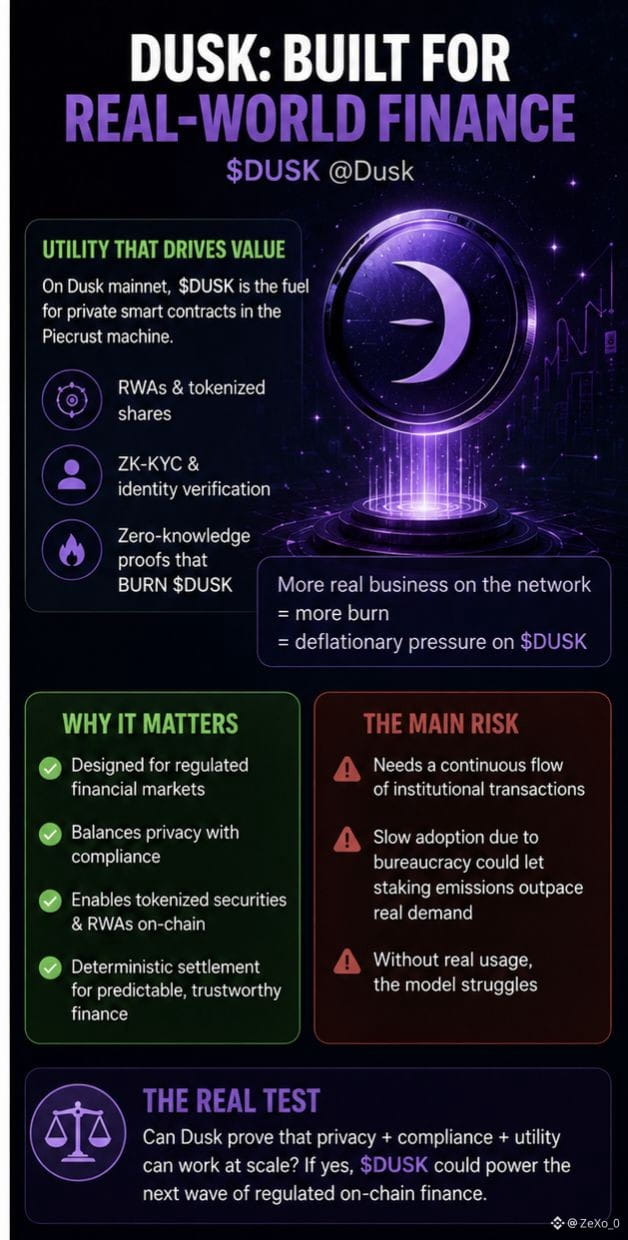
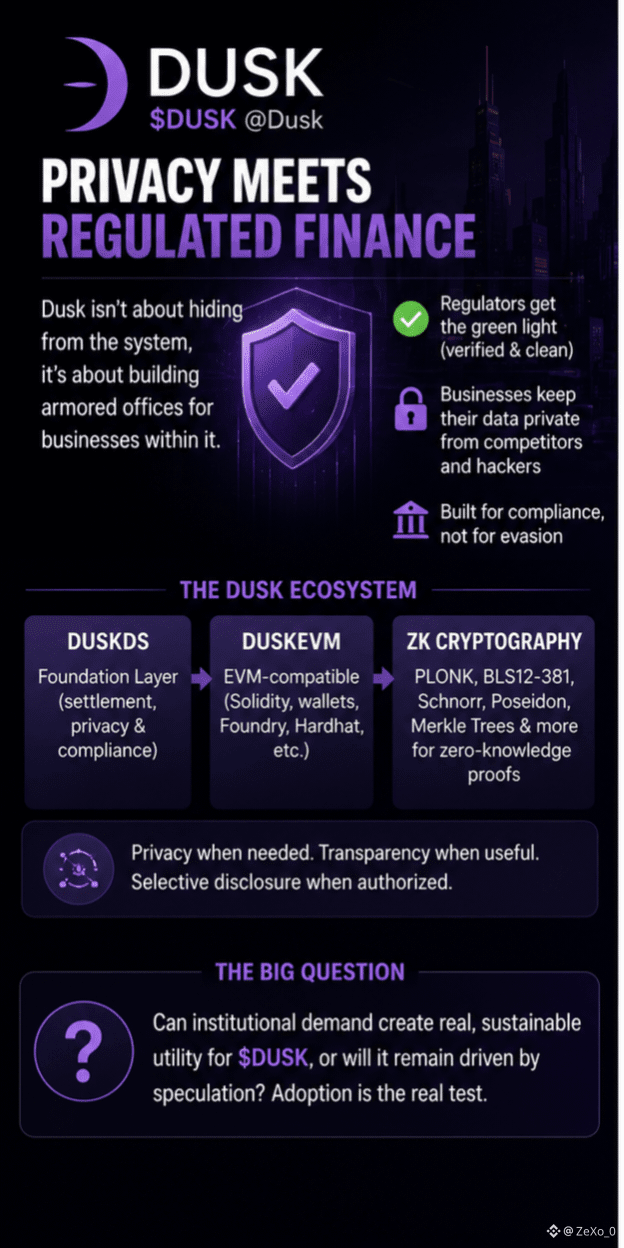
The more I look at Dusk, the more I think its real bet is not “privacy” alone, but making privacy usable for regulated finance.
DuskDS provides the settlement foundation, while DuskEVM keeps the developer experience familiar through Solidity, EVM wallets, and existing tools. Underneath that, zero-knowledge cryptography such as PLONK can support selective disclosure without exposing every piece of sensitive financial data.
That combination matters for tokenized securities and RWAs, where institutions need both confidentiality and compliance. It is a very different approach from privacy systems built around hiding everything.
The technology looks interesting. The real test is adoption. If regulated finance actually uses it at scale, Dusk could prove that privacy and compliance do not have to be opposites.
#HKJulyGoldNetExportsToMainland56.193Tons #KazakhstanCutsOilOutputForecastTo96MTons #JapanNoAdditionalOilReserveReleaseInSepOct #SamsungSKHynixLeveragedETFsPostFirstMonthlyOutflow
$TMX
$STAR
$DUSK
The more I look at Dusk, the more I think its real bet is not “privacy” alone, but making privacy usable for regulated finance.
DuskDS provides the settlement foundation, while DuskEVM keeps the developer experience familiar through Solidity, EVM wallets, and existing tools. Underneath that, zero-knowledge cryptography such as PLONK can support selective disclosure without exposing every piece of sensitive financial data.
That combination matters for tokenized securities and RWAs, where institutions need both confidentiality and compliance. It is a very different approach from privacy systems built around hiding everything.
The technology looks interesting. The real test is adoption. If regulated finance actually uses it at scale, Dusk could prove that privacy and compliance do not have to be opposites.
#HKJulyGoldNetExportsToMainland56.193Tons #KazakhstanCutsOilOutputForecastTo96MTons #JapanNoAdditionalOilReserveReleaseInSepOct #SamsungSKHynixLeveragedETFsPostFirstMonthlyOutflow
$TMX
$STAR
$DUSK
I’ve been looking into Dusk and Hedger, and honestly, I think their approach to privacy makes a lot of sense.
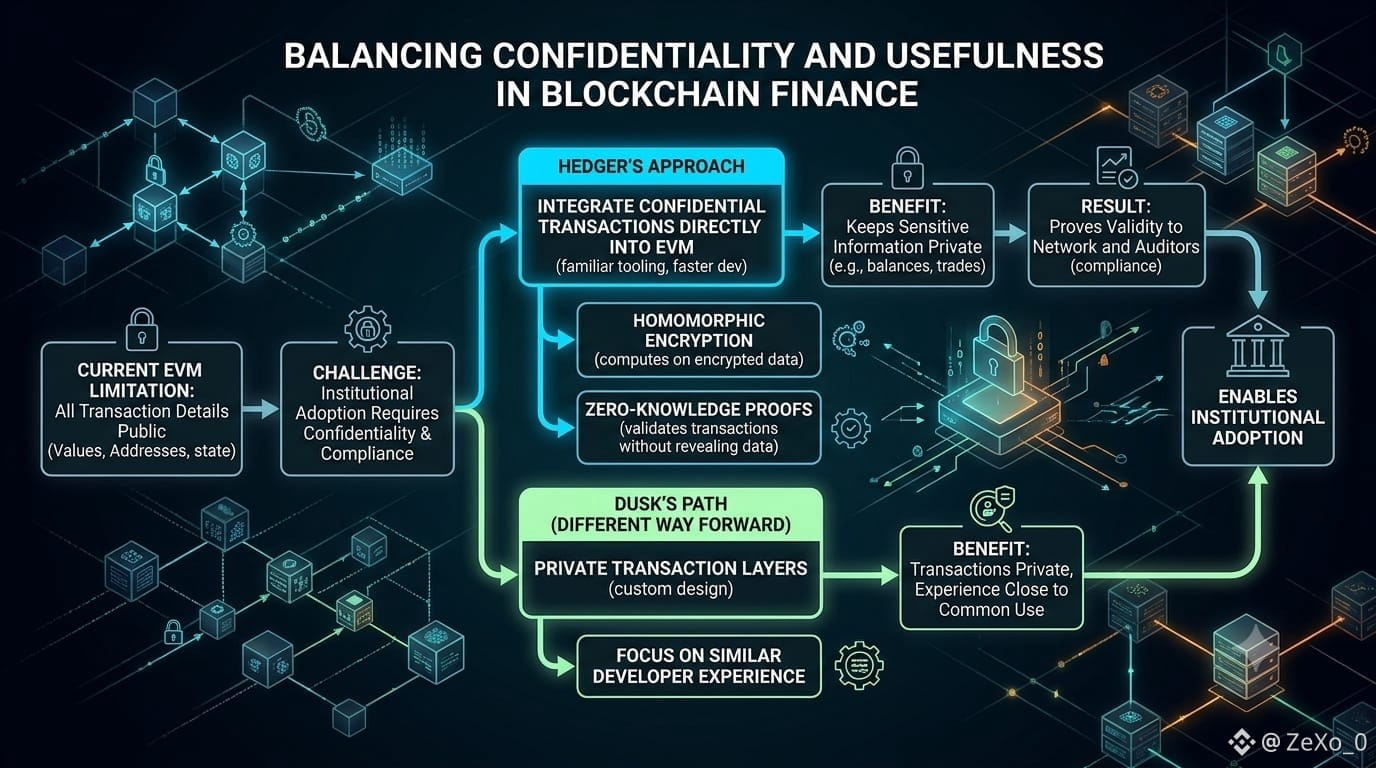
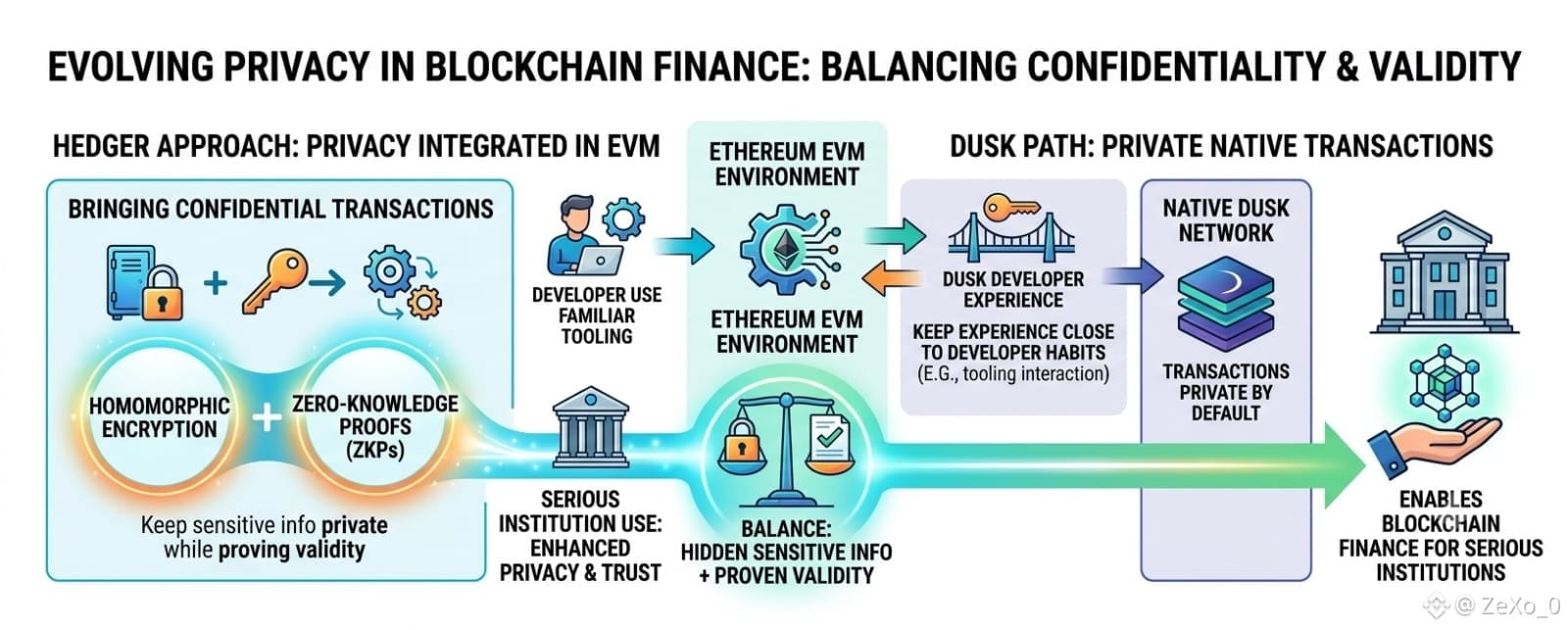
Instead of building privacy in a completely separate environment, Hedger is trying to bring confidential transactions into the EVM using homomorphic encryption and zero-knowledge proofs.
What I like is the focus on familiar Ethereum tooling.
Developers already know how the EVM works. Asking them to learn a whole new environment just to add privacy can slow things down.
Dusk seems to be taking a different path: make transactions private, but keep the experience closer to what developers already use.
Maybe that’s the better way forward.
Privacy doesn’t have to mean hiding everything. It can mean keeping sensitive information private while still proving that something is valid.
That balance feels important, especially if blockchain finance is going to be used by more serious institutions.
@Dusk
#dusk #BitcoinOpenInterestFallsToTwoMonthLow #BitcoinRises23.6%Weekly #AIHardwareStocksFallPreMarketAAOIDown11.66% #SP500FuturesFall
$DUSK
$STORJ
$PROM
Instead of building privacy in a completely separate environment, Hedger is trying to bring confidential transactions into the EVM using homomorphic encryption and zero-knowledge proofs.
What I like is the focus on familiar Ethereum tooling.
Developers already know how the EVM works. Asking them to learn a whole new environment just to add privacy can slow things down.
Dusk seems to be taking a different path: make transactions private, but keep the experience closer to what developers already use.
Maybe that’s the better way forward.
Privacy doesn’t have to mean hiding everything. It can mean keeping sensitive information private while still proving that something is valid.
That balance feels important, especially if blockchain finance is going to be used by more serious institutions.
@Dusk
#dusk #BitcoinOpenInterestFallsToTwoMonthLow #BitcoinRises23.6%Weekly #AIHardwareStocksFallPreMarketAAOIDown11.66% #SP500FuturesFall
$DUSK
$STORJ
$PROM
The Real Bottleneck May Be the Gap Between Builders and Institutions
At first, I thought the biggest breakthroughs in infrastructure came from building something entirely new. Then I looked at how the internet evolved. The core network kept doing its job while new layers made it easier for more people to build on top. That made me look at Dusk a little differently lately.
Dusk separates DuskDS, its settlement and data layer, from DuskEVM, the EVM execution layer. At first I assumed this was simply about attracting Ethereum developers with familiar tooling. The more I read, the more interesting the deeper tradeoff became.
Dusk can potentially keep its specialized settlement, privacy, and financial infrastructure underneath while making application development more accessible through an EVM environment. But this could also create a coordination challenge.
Developers may move faster than institutions, while institutional adoption depends on privacy, settlement certainty, and regulatory workflows that take much longer to mature.
Perhaps I'm focusing on the wrong thing, but the interface between these layers could eventually matter more than either layer alone. If builders can use familiar tools without losing access to Dusk's specialized infrastructure, the architecture becomes interesting.
Still, I'm not sure the hardest question is whether settlement and execution can be separated. The deeper question is whether both layers can evolve independently without eventually creating friction between the people building applications and the institutions expected to use them.
@Dusk
#dusk #BitcoinStrongestWeekSinceMarch2023 #AnthropicIPOCouldTopSpaceXRecordReportsSay #NvidiaAIServerPricesRiseOver15% #BSTREndsCantorSPACGoPublicPlan
$DUSK
$UAI
$TUT
At first, I thought the biggest breakthroughs in infrastructure came from building something entirely new. Then I looked at how the internet evolved. The core network kept doing its job while new layers made it easier for more people to build on top. That made me look at Dusk a little differently lately.
Dusk separates DuskDS, its settlement and data layer, from DuskEVM, the EVM execution layer. At first I assumed this was simply about attracting Ethereum developers with familiar tooling. The more I read, the more interesting the deeper tradeoff became.
Dusk can potentially keep its specialized settlement, privacy, and financial infrastructure underneath while making application development more accessible through an EVM environment. But this could also create a coordination challenge.
Developers may move faster than institutions, while institutional adoption depends on privacy, settlement certainty, and regulatory workflows that take much longer to mature.
Perhaps I'm focusing on the wrong thing, but the interface between these layers could eventually matter more than either layer alone. If builders can use familiar tools without losing access to Dusk's specialized infrastructure, the architecture becomes interesting.
Still, I'm not sure the hardest question is whether settlement and execution can be separated. The deeper question is whether both layers can evolve independently without eventually creating friction between the people building applications and the institutions expected to use them.
@Dusk
#dusk #BitcoinStrongestWeekSinceMarch2023 #AnthropicIPOCouldTopSpaceXRecordReportsSay #NvidiaAIServerPricesRiseOver15% #BSTREndsCantorSPACGoPublicPlan
$DUSK
$UAI
$TUT
Crypto feels different lately🤷♂️
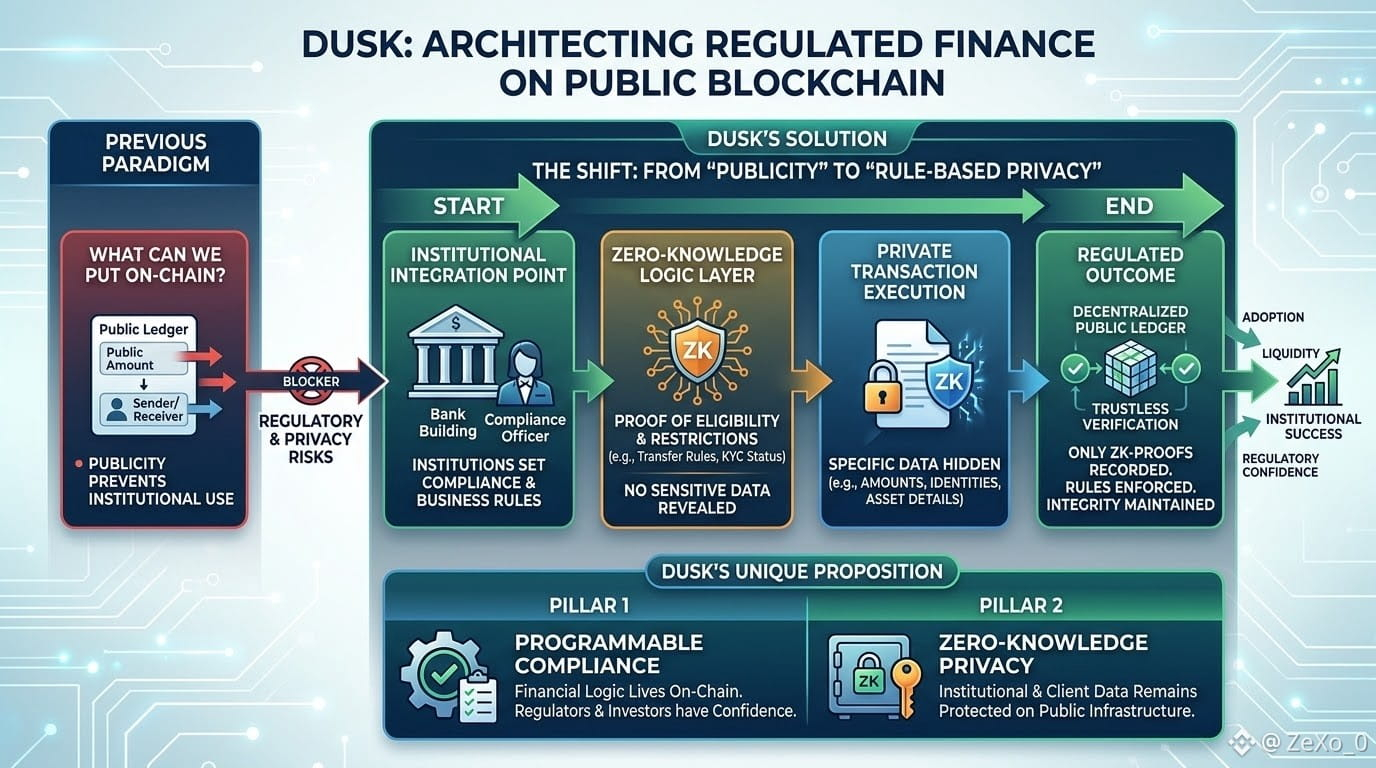
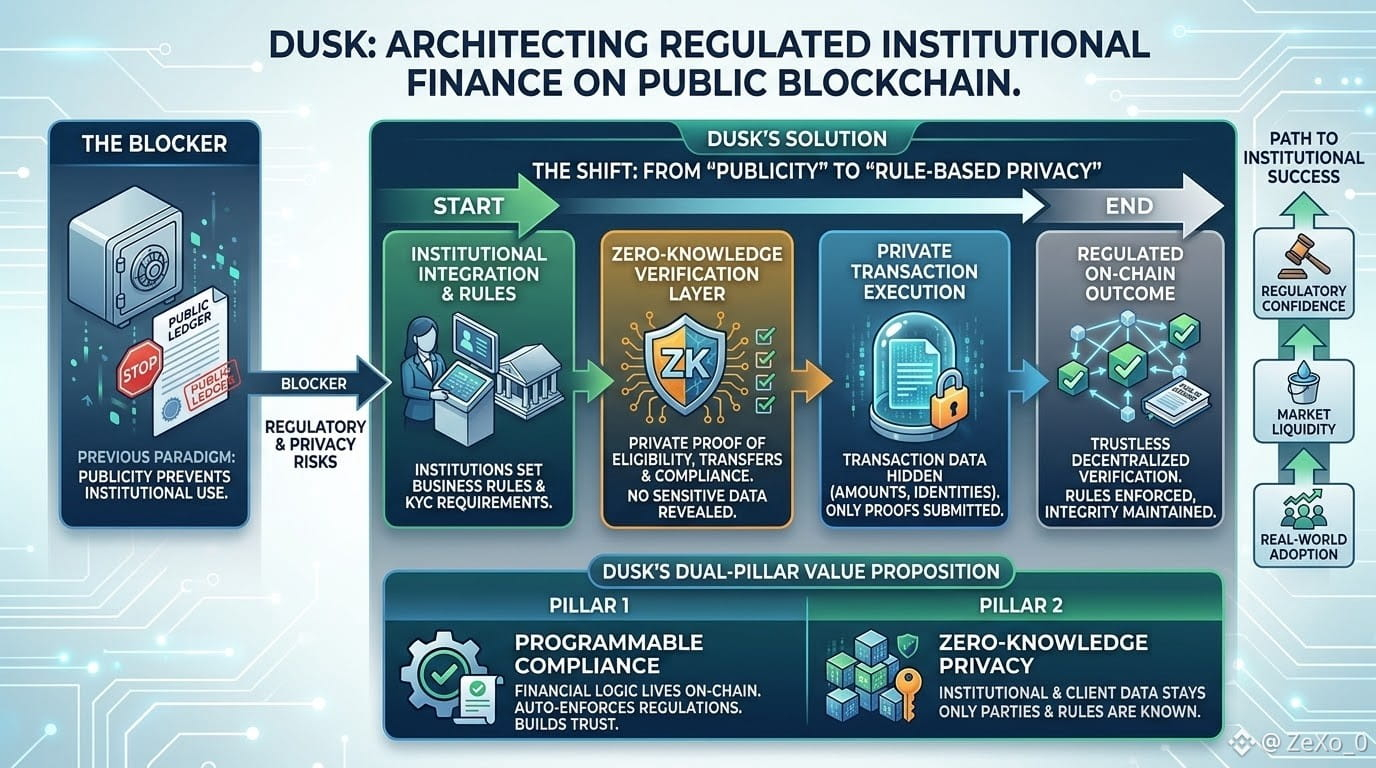
I’m seeing more attention move away from “what can we put on-chain?” toward a harder question: “what can institutions realistically put on-chain?”
That’s where Dusk caught my attention.
Financial assets need privacy, but they also need rules. An investor may need to prove eligibility, transfers may have restrictions, and regulators may require certain information. Putting everything publicly on a blockchain isn’t practical.
Dusk ’s approach is interesting because it tries to make privacy and compliance work together rather than treating them as opposites.
I think that’s the part many people miss.
Dusk isn’t simply saying, “make transactions private.” Its bigger bet is that financial logic itself can live on-chain while sensitive information stays protected.
I’ll be honest, the technology alone won’t win this market. Institutions already have permissioned systems, and convincing them to change will require real adoption, liquidity, reliability and regulatory confidence.
But from what I’ve seen, Dusk is competing on a deeper level than privacy.
It’s asking whether regulated finance can actually operate on public blockchain infrastructure without exposing everything.
If that works in practice, that could be far more important than another privacy narrative.
@Dusk
#dusk #USCanadaTradeTalksCollapseCanadaVowsRetaliation #SP500EndsWeeklyWinStreak #SandboxSANDSuspectedInfiniteMintFlawOnBase #GrayscaleFilesFifthZECETFAmendment
$DUSK
$TRUMP
$ZEC
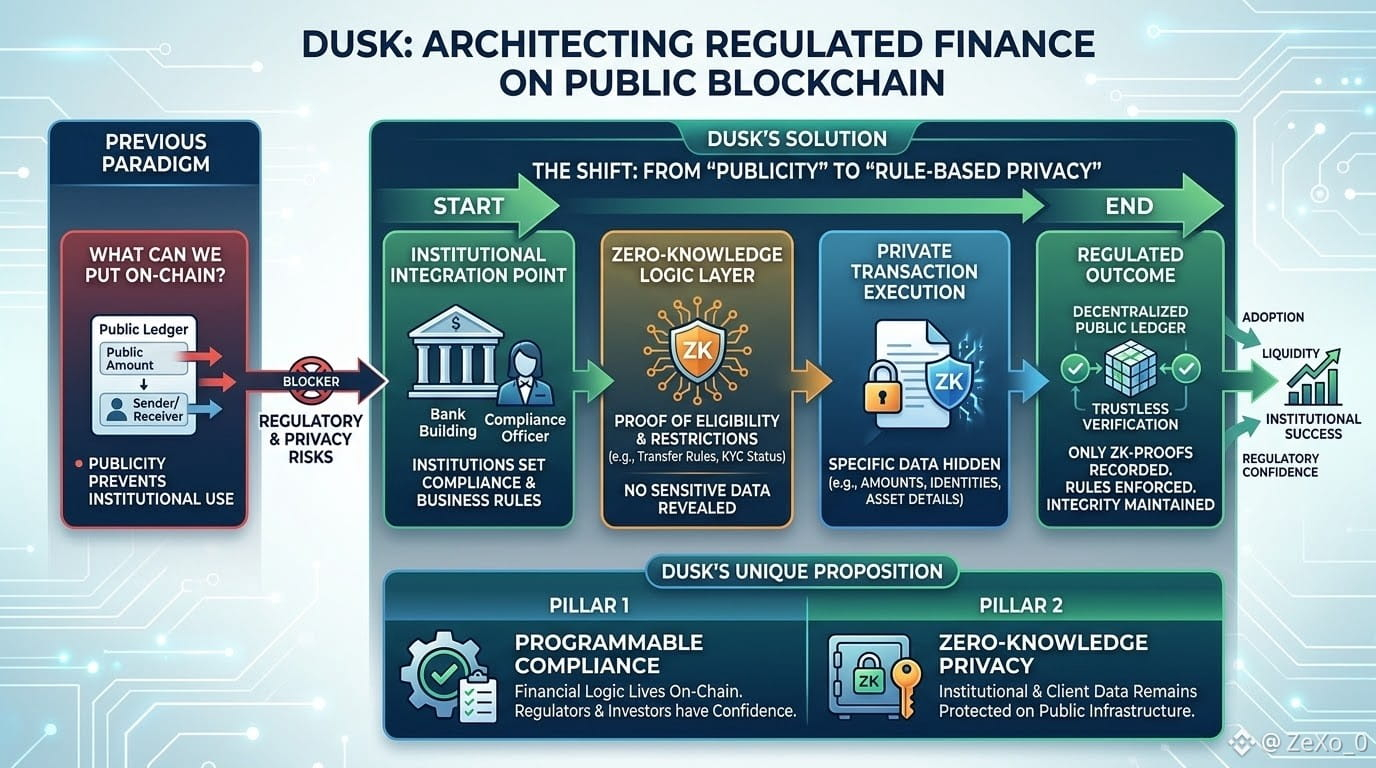
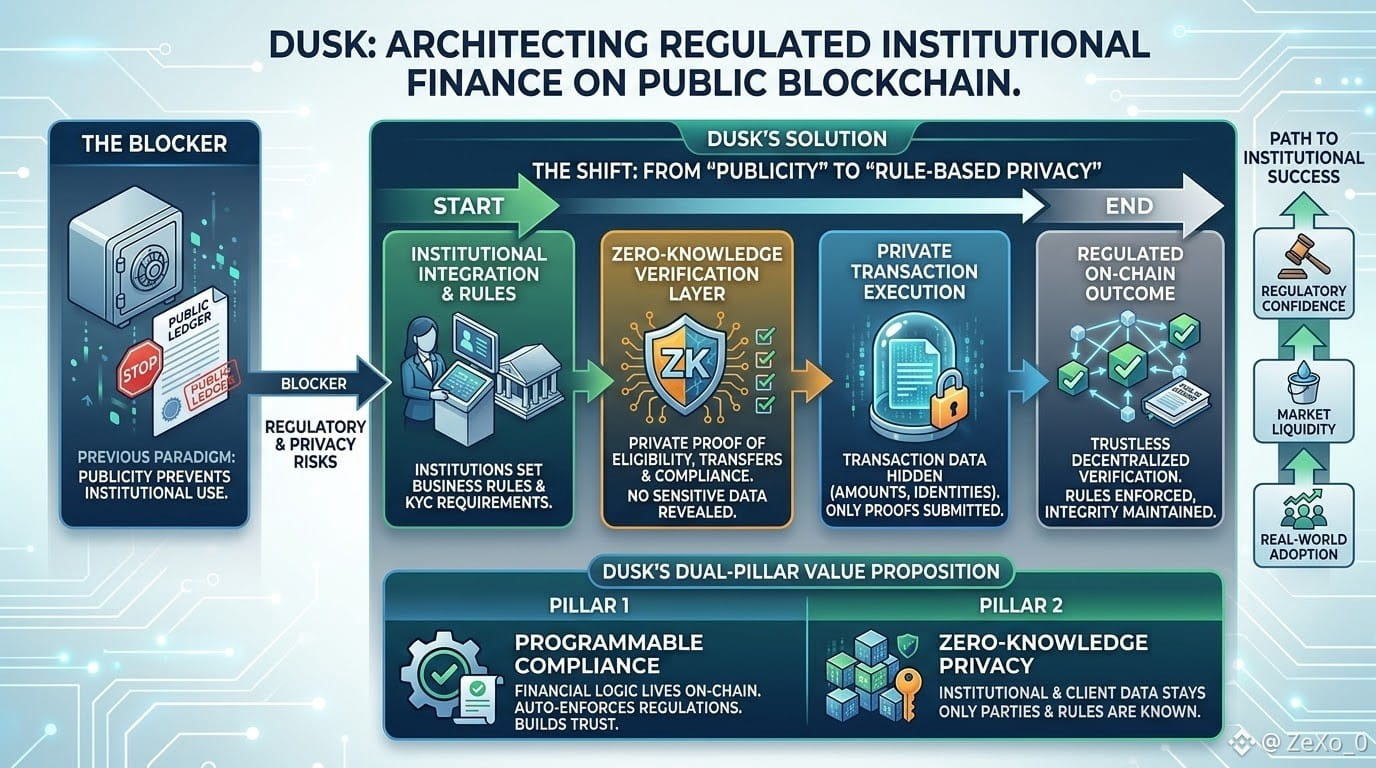
I’m seeing more attention move away from “what can we put on-chain?” toward a harder question: “what can institutions realistically put on-chain?”
That’s where Dusk caught my attention.
Financial assets need privacy, but they also need rules. An investor may need to prove eligibility, transfers may have restrictions, and regulators may require certain information. Putting everything publicly on a blockchain isn’t practical.
Dusk ’s approach is interesting because it tries to make privacy and compliance work together rather than treating them as opposites.
I think that’s the part many people miss.
Dusk isn’t simply saying, “make transactions private.” Its bigger bet is that financial logic itself can live on-chain while sensitive information stays protected.
I’ll be honest, the technology alone won’t win this market. Institutions already have permissioned systems, and convincing them to change will require real adoption, liquidity, reliability and regulatory confidence.
But from what I’ve seen, Dusk is competing on a deeper level than privacy.
It’s asking whether regulated finance can actually operate on public blockchain infrastructure without exposing everything.
If that works in practice, that could be far more important than another privacy narrative.
@Dusk
#dusk #USCanadaTradeTalksCollapseCanadaVowsRetaliation #SP500EndsWeeklyWinStreak #SandboxSANDSuspectedInfiniteMintFlawOnBase #GrayscaleFilesFifthZECETFAmendment
$DUSK
$TRUMP
$ZEC
Verified
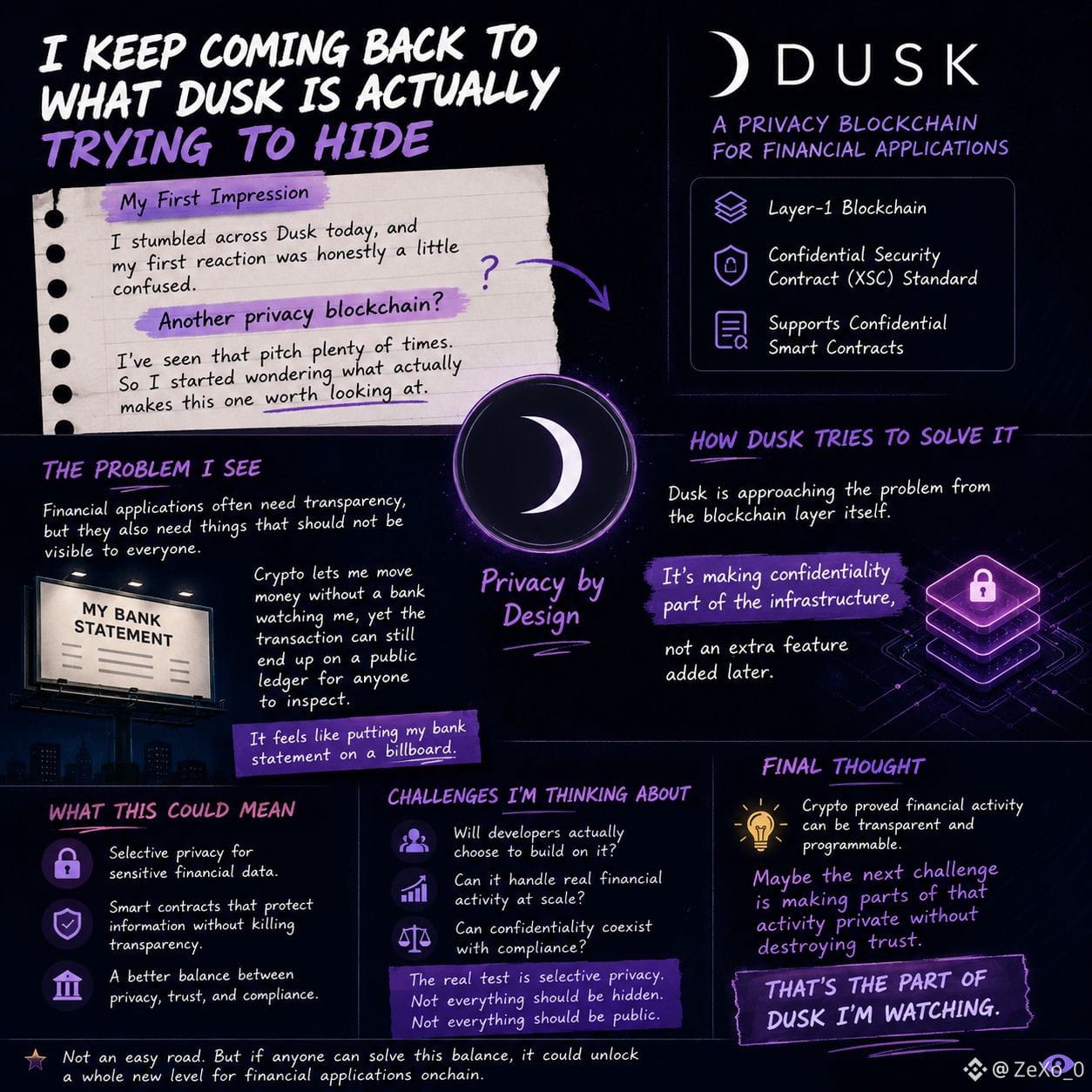
I KEEP COMING BACK TO WHAT DUSK IS ACTUALLY TRYING TO HIDE
I stumbled across Dusk today, and my first reaction was honestly a little confused.
Another privacy blockchain?
I’ve seen that pitch plenty of times. So I started wondering what actually makes this one worth looking at.
The more I read, the more I kept coming back to one simple idea: financial applications often need transparency, but they also need things that should not be visible to everyone.
That sounds obvious, but crypto still has a strange relationship with privacy.
I can move money without a bank watching me, yet the transaction can still end up sitting permanently on a public ledger for anyone to inspect.
That feels a bit like putting my bank statement on a billboard and saying, “At least I control the billboard.”
Dusk is approaching that problem from the blockchain layer itself.
It’s a Layer-1 focused on financial applications, with its Confidential Security Contract, or XSC, standard designed to support confidential smart contracts.
And this is where it got interesting for me.
I like that direction.
But I’m also cautious.
Privacy alone doesn’t make a blockchain useful. The harder question is whether developers actually want to build on it, whether the technology can handle real financial activity, and whether confidentiality can coexist with the compliance requirements that financial applications inevitably face.
That last part is probably the biggest test.
Because real financial markets don’t simply need “everything private.”
They need selective privacy.
Some information should stay hidden. Some information needs to be verifiable. And regulators may need controlled access without turning the entire system into a public database.
That balance is much harder than simply saying “privacy matters.”
So I’m not looking at Dusk and thinking I’ve found the next obvious winner.
@Dusk
#dusk
$DUSK
I stumbled across Dusk today, and my first reaction was honestly a little confused.
Another privacy blockchain?
I’ve seen that pitch plenty of times. So I started wondering what actually makes this one worth looking at.
The more I read, the more I kept coming back to one simple idea: financial applications often need transparency, but they also need things that should not be visible to everyone.
That sounds obvious, but crypto still has a strange relationship with privacy.
I can move money without a bank watching me, yet the transaction can still end up sitting permanently on a public ledger for anyone to inspect.
That feels a bit like putting my bank statement on a billboard and saying, “At least I control the billboard.”
Dusk is approaching that problem from the blockchain layer itself.
It’s a Layer-1 focused on financial applications, with its Confidential Security Contract, or XSC, standard designed to support confidential smart contracts.
And this is where it got interesting for me.
I like that direction.
But I’m also cautious.
Privacy alone doesn’t make a blockchain useful. The harder question is whether developers actually want to build on it, whether the technology can handle real financial activity, and whether confidentiality can coexist with the compliance requirements that financial applications inevitably face.
That last part is probably the biggest test.
Because real financial markets don’t simply need “everything private.”
They need selective privacy.
Some information should stay hidden. Some information needs to be verifiable. And regulators may need controlled access without turning the entire system into a public database.
That balance is much harder than simply saying “privacy matters.”
So I’m not looking at Dusk and thinking I’ve found the next obvious winner.
@Dusk
#dusk
$DUSK
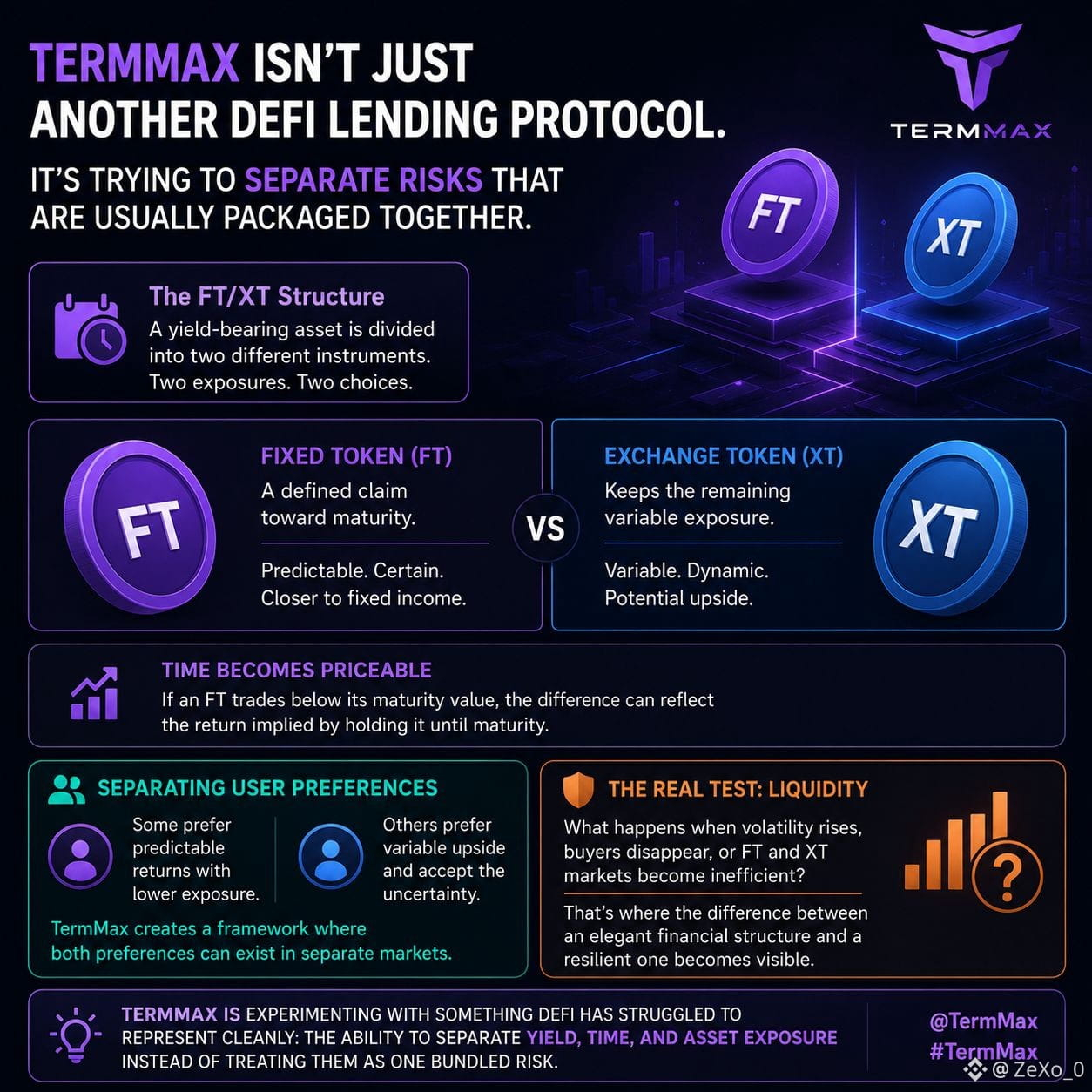
I’ve been digging into TermMax, and what stands out to me isn’t simply another way to borrow or lend in DeFi. It’s the attempt to break apart risks that are normally bundled into one position.
The FT/XT model is where it gets interesting.
A yield-bearing asset is divided into two exposures. The Fixed Token is tied to a defined value at maturity, while the Exchange Token represents the variable side of the position.
That creates a different way to think about yield.
Instead of only asking how much an asset can earn, you can start thinking about how much the market is willing to pay today for a claim that settles later. If an FT trades below its maturity value, that gap effectively represents the return for holding it through maturity.
To me, that makes the structure feel closer to fixed income than conventional floating-rate DeFi lending.
More importantly, it separates user preferences.
One participant can prioritize predictable returns, while another can take the variable exposure and pursue the upside.
But the real test won’t be the mechanism itself.
It will be liquidity.
When volatility spikes and market depth disappears, can FT and XT markets still function efficiently?
That’s where I’ll be watching TermMax most closely.
The interesting experiment here is whether DeFi can genuinely separate yield, time, and asset exposure instead of treating them as one combined risk.
@TermMax #TermMax $TMX
The FT/XT model is where it gets interesting.
A yield-bearing asset is divided into two exposures. The Fixed Token is tied to a defined value at maturity, while the Exchange Token represents the variable side of the position.
That creates a different way to think about yield.
Instead of only asking how much an asset can earn, you can start thinking about how much the market is willing to pay today for a claim that settles later. If an FT trades below its maturity value, that gap effectively represents the return for holding it through maturity.
To me, that makes the structure feel closer to fixed income than conventional floating-rate DeFi lending.
More importantly, it separates user preferences.
One participant can prioritize predictable returns, while another can take the variable exposure and pursue the upside.
But the real test won’t be the mechanism itself.
It will be liquidity.
When volatility spikes and market depth disappears, can FT and XT markets still function efficiently?
That’s where I’ll be watching TermMax most closely.
The interesting experiment here is whether DeFi can genuinely separate yield, time, and asset exposure instead of treating them as one combined risk.
@TermMax #TermMax $TMX
Verified
#dusk $DUSK @Dusk
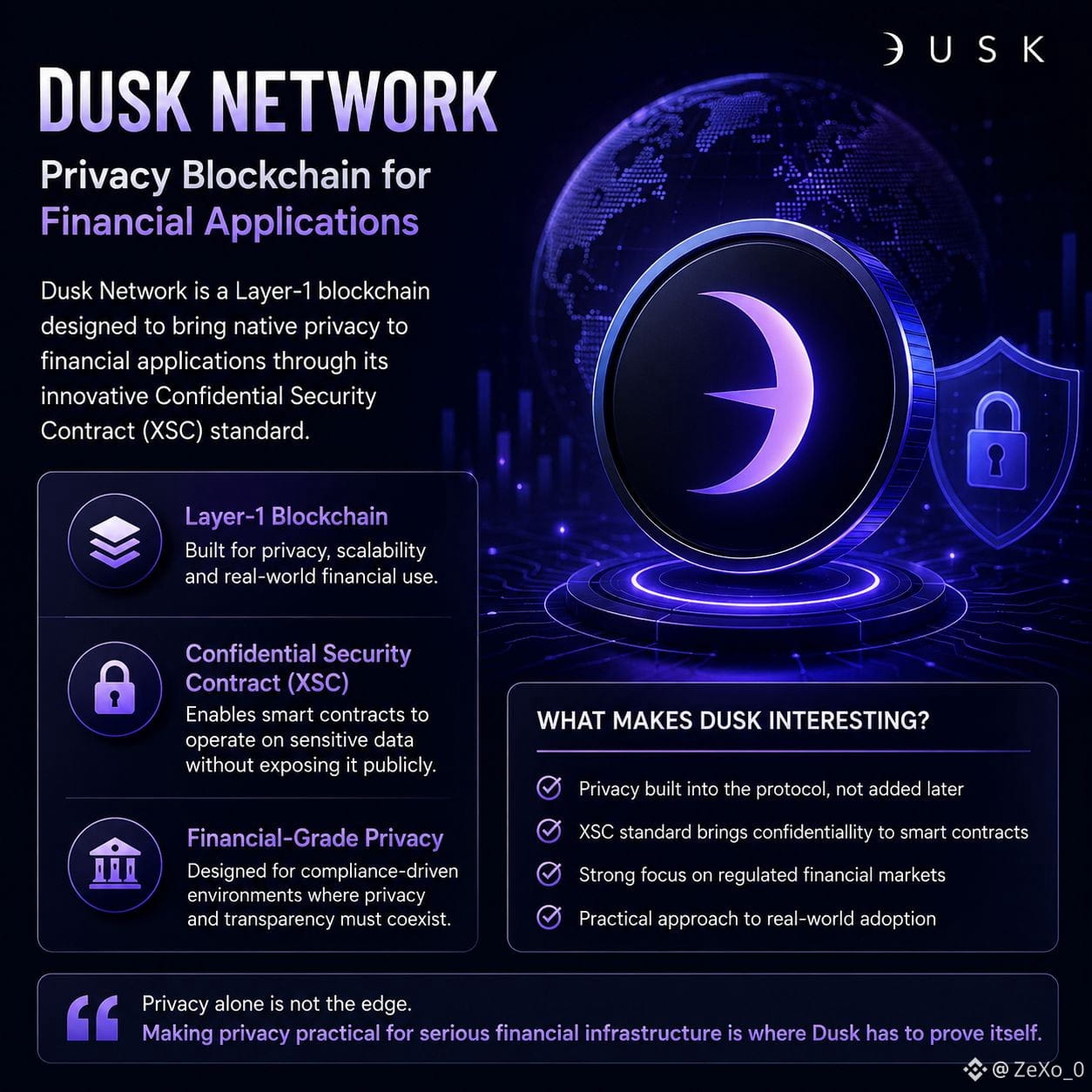
$DUSK Network is taking a focused approach to blockchain privacy, targeting financial applications where confidentiality is not optional but part of the infrastructure. Its Layer-1 design and Confidential Security Contract (XSC) standard are built around enabling smart contracts operating with sensitive data without exposing everything publicly.
That positioning makes DUSK more interesting than a generic privacy narrative. The real question is whether its technology can translate into meaningful adoption across regulated markets, where compliance, transparency, and privacy have to coexist rather than compete.
The strongest part of the thesis is the attempt to make confidentiality usable at the application level, instead of treating privacy as an isolated feature. But execution will matter more than the narrative. Network activity, developer traction, real-world financial use cases and sustained demand for DUSK will ultimately determine whether the ecosystem earns lasting relevance.
Privacy alone is not the edge. Making privacy practical for serious financial infrastructure is where Dusk has to prove itself.
@Dusk
#dusk
$DUSK
$DUSK Network is taking a focused approach to blockchain privacy, targeting financial applications where confidentiality is not optional but part of the infrastructure. Its Layer-1 design and Confidential Security Contract (XSC) standard are built around enabling smart contracts operating with sensitive data without exposing everything publicly.
That positioning makes DUSK more interesting than a generic privacy narrative. The real question is whether its technology can translate into meaningful adoption across regulated markets, where compliance, transparency, and privacy have to coexist rather than compete.
The strongest part of the thesis is the attempt to make confidentiality usable at the application level, instead of treating privacy as an isolated feature. But execution will matter more than the narrative. Network activity, developer traction, real-world financial use cases and sustained demand for DUSK will ultimately determine whether the ecosystem earns lasting relevance.
Privacy alone is not the edge. Making privacy practical for serious financial infrastructure is where Dusk has to prove itself.
@Dusk
#dusk
$DUSK
Verified
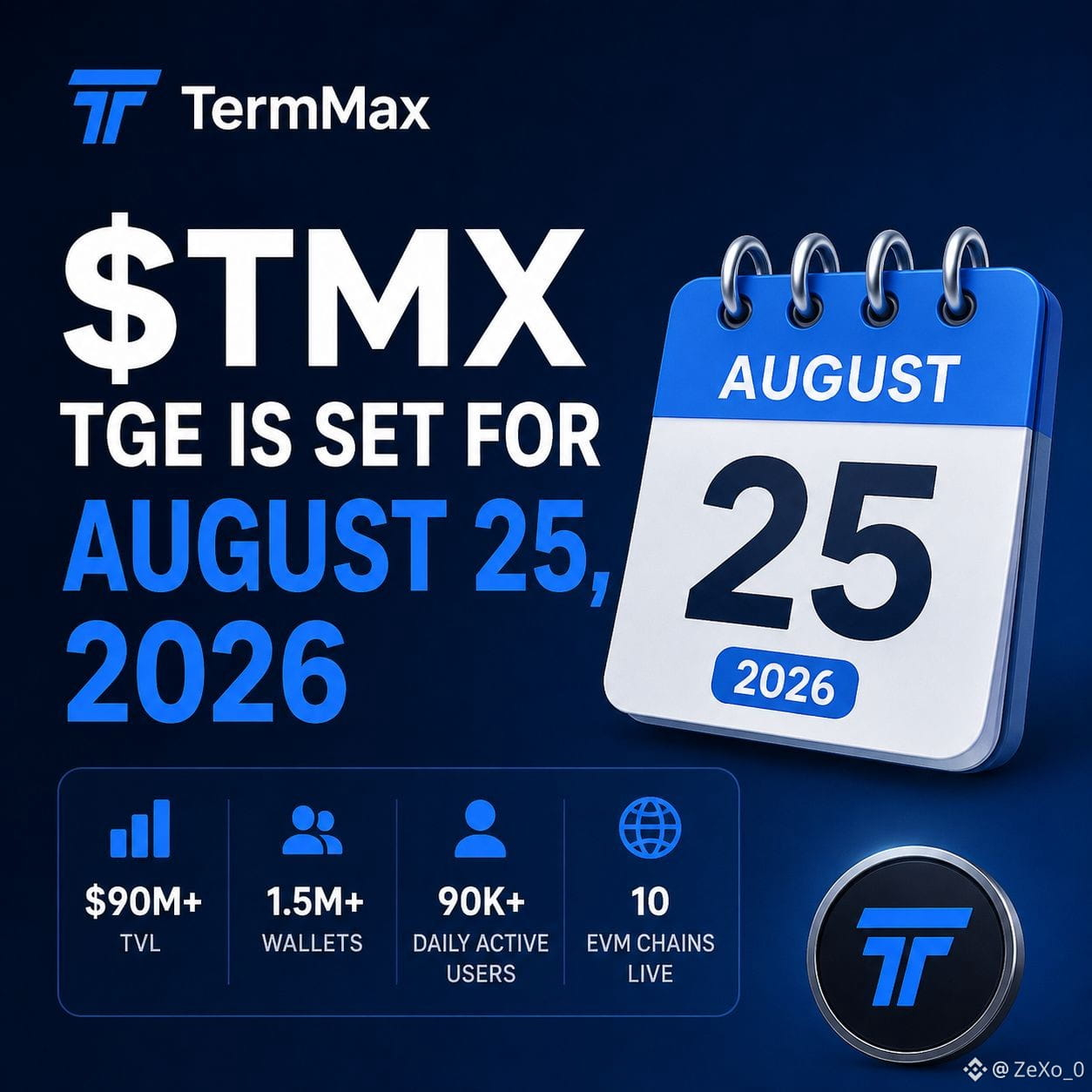
#termmax @TermMax I’ve been watching TermMax’s journey toward the $TMX TGE on August 25, and what stands out to me isn’t just the date.
It’s the pace of execution.
Since May, @TermMax has pushed through V2, expanded across multiple chains, introduced institutional-focused TermPrime on Canton, crossed $20M in the RLUSD vault, launched on HyperEVM, and brought tokenized equities as collateral to Robinhood Chain.
Now the numbers are getting interesting too:
$90M+ TVL
1.5M+ registered wallets
90K+ daily active users
10 EVM chains live
What I find more interesting is how the product keeps moving beyond a simple fixed-rate lending narrative. Lending limit orders, structured maturities, options vaults, tokenized assets, and institutional infrastructure all point toward a broader fixed-income DeFi market.
With $TMX TGE coming August 25, the next phase feels more important than the milestone itself.
For me, the real question is simple: can TermMax turn this momentum into durable liquidity and real user demand?
That’s what I’ll be watching next.
#TermMax $SKYAI $RE
It’s the pace of execution.
Since May, @TermMax has pushed through V2, expanded across multiple chains, introduced institutional-focused TermPrime on Canton, crossed $20M in the RLUSD vault, launched on HyperEVM, and brought tokenized equities as collateral to Robinhood Chain.
Now the numbers are getting interesting too:
$90M+ TVL
1.5M+ registered wallets
90K+ daily active users
10 EVM chains live
What I find more interesting is how the product keeps moving beyond a simple fixed-rate lending narrative. Lending limit orders, structured maturities, options vaults, tokenized assets, and institutional infrastructure all point toward a broader fixed-income DeFi market.
With $TMX TGE coming August 25, the next phase feels more important than the milestone itself.
For me, the real question is simple: can TermMax turn this momentum into durable liquidity and real user demand?
That’s what I’ll be watching next.
#TermMax $SKYAI $RE
Verified
Dusk Network is an interesting take on what privacy could look like when financial applications move on-chain. Rather than treating privacy as an optional feature, Dusk builds it into its Layer-1 architecture through the Confidential Security Contract (XSC) standard and support for confidential smart contracts.
What stands out to me is the focus on balancing blockchain transparency with the confidentiality financial activity often requires. That matters because institutions and serious financial users may not want every transaction, position, or piece of sensitive data exposed publicly.
The real question is whether Dusk can turn that technical approach into meaningful adoption and sustained demand for its network and token. Privacy alone is not enough. The ecosystem needs useful applications, liquidity, developers, and users.
If Dusk can connect confidentiality with practical financial utility, its value proposition becomes much more compelling. The technology is interesting, but adoption will ultimately decide whether the narrative becomes a real network effect.
@Dusk #dusk $DUSK
$BTC
$ETH
Dusk Network privacy check 😜
What are you hiding on-chain?
What stands out to me is the focus on balancing blockchain transparency with the confidentiality financial activity often requires. That matters because institutions and serious financial users may not want every transaction, position, or piece of sensitive data exposed publicly.
The real question is whether Dusk can turn that technical approach into meaningful adoption and sustained demand for its network and token. Privacy alone is not enough. The ecosystem needs useful applications, liquidity, developers, and users.
If Dusk can connect confidentiality with practical financial utility, its value proposition becomes much more compelling. The technology is interesting, but adoption will ultimately decide whether the narrative becomes a real network effect.
@Dusk #dusk $DUSK
$BTC
$ETH
Dusk Network privacy check 😜
What are you hiding on-chain?
My bags 😂
0%
My trades 👀
0%
My strategy 🧠
0%
Everything 😎
100%
1 votes • Voting closed
Verified
#termmax @TermMax
TermMax: FIXED-RATE DEFI WITHOUT THE GUESSWORK
I’ve been looking at TermMax, developed by Term Structure Labs, and what caught my attention is its attempt to bring more predictable fixed-income mechanics into DeFi.
Most lending markets rely on floating rates. That works, but borrowing costs can change quickly, making leverage and yield strategies harder to plan.
@TermMax takes a different approach with fixed-rate, fixed-term borrowing and lending, while also adding options-style trading through tokenized positions.
Its architecture is interesting:
• A customized AMM inspired by Uniswap V3 lets liquidity providers concentrate capital around specific interest-rate ranges and maturities.
• Its one-click leveraged yield engine combines borrowing, collateral management, swaps, and re-depositing into a simplified execution flow.
• Term-bound assets such as Zero-Coupon Bonds and Gearing Tokens make fixed-rate positions tradable before maturity, creating more flexibility for lenders, borrowers, and traders.
• TermPrime targets larger capital through managed vaults and customized maturity windows.
The bigger question for me is adoption. Fixed rates can make DeFi positions easier to model, but liquidity, risk management, smart-contract security, and demand across maturities will determine whether the model scales.
#TermMax is not just another lending protocol. It is trying to build a more structured interest-rate market for Web3.
$RICE
$BTW
$ACE
TermMax: FIXED-RATE DEFI WITHOUT THE GUESSWORK
I’ve been looking at TermMax, developed by Term Structure Labs, and what caught my attention is its attempt to bring more predictable fixed-income mechanics into DeFi.
Most lending markets rely on floating rates. That works, but borrowing costs can change quickly, making leverage and yield strategies harder to plan.
@TermMax takes a different approach with fixed-rate, fixed-term borrowing and lending, while also adding options-style trading through tokenized positions.
Its architecture is interesting:
• A customized AMM inspired by Uniswap V3 lets liquidity providers concentrate capital around specific interest-rate ranges and maturities.
• Its one-click leveraged yield engine combines borrowing, collateral management, swaps, and re-depositing into a simplified execution flow.
• Term-bound assets such as Zero-Coupon Bonds and Gearing Tokens make fixed-rate positions tradable before maturity, creating more flexibility for lenders, borrowers, and traders.
• TermPrime targets larger capital through managed vaults and customized maturity windows.
The bigger question for me is adoption. Fixed rates can make DeFi positions easier to model, but liquidity, risk management, smart-contract security, and demand across maturities will determine whether the model scales.
#TermMax is not just another lending protocol. It is trying to build a more structured interest-rate market for Web3.
$RICE
$BTW
$ACE
TermMax Worth Watching?
71%
DeFi Gets Structured?
29%
Fixed Rates Better?
0%
7 votes • Voting closed
I stumbled across Dusk today and honestly, my first thought was: privacy on a financial blockchain sounds useful, but how does it actually work?
The more I looked, the more interesting it became. Dusk is a Layer-1 focused on financial applications, using confidential smart contracts through its XSC standard.
I kept thinking about something I’ve seen in crypto before. Transparency is powerful, but financial data being completely exposed can become a problem when real businesses enter the picture.
That’s the gap Dusk seems to be exploring.
Instead of treating privacy as an afterthought, it tries to build it into the infrastructure itself.
That sounds sensible to me.
But I’m still cautious.
Privacy systems can be difficult to scale, regulate, and make easy enough for normal users and institutions.
So I’m not calling it a breakthrough yet.
I’m watching to see whether the technology can turn a good idea into something people actually use.
@Dusk
#dusk #BTC #ETH #StrategySellsStockToRepurchasePreferred #USMemoryStocksExtendGainsSanDiskUp10.5%
$DUSK $BTC
$ETH
I discovered Dusk and now I’m wondering: does crypto really need privacy this badly? 😂
What’s your take?
The more I looked, the more interesting it became. Dusk is a Layer-1 focused on financial applications, using confidential smart contracts through its XSC standard.
I kept thinking about something I’ve seen in crypto before. Transparency is powerful, but financial data being completely exposed can become a problem when real businesses enter the picture.
That’s the gap Dusk seems to be exploring.
Instead of treating privacy as an afterthought, it tries to build it into the infrastructure itself.
That sounds sensible to me.
But I’m still cautious.
Privacy systems can be difficult to scale, regulate, and make easy enough for normal users and institutions.
So I’m not calling it a breakthrough yet.
I’m watching to see whether the technology can turn a good idea into something people actually use.
@Dusk
#dusk #BTC #ETH #StrategySellsStockToRepurchasePreferred #USMemoryStocksExtendGainsSanDiskUp10.5%
$DUSK $BTC
$ETH
I discovered Dusk and now I’m wondering: does crypto really need privacy this badly? 😂
What’s your take?
A) Privacy = NEED IT
50%
B) Transparency = KEEP IT
0%
C) Both, please 😎
50%
D) I’m just here for the token
0%
2 votes • Voting closed
$DUSK NETWORK: THE HARD PART IS NOT THE CHAIN
At first glance, Dusk Network sounds new, but the pattern is familiar. Every cycle produces projects trying to build a new foundation, often wrapped in whatever language dominates the market at the time. DeFi emphasized financial infrastructure. Scalability focused on throughput. Now, privacy and confidential execution are becoming part of that conversation.
The reality of infrastructure is less exciting. Building a new foundation is one problem. Getting meaningful activity to actually move onto it is much harder. Established networks already handle enormous amounts of activity, but their real limits only become obvious when demand arrives unevenly and under pressure. Performance on paper is always conditional.
Dusk is targeting financial workloads where confidentiality matters. That makes the workload different from ordinary transaction flows. Financial activity can spike, go quiet, and behave unpredictably. A system designed around confidential smart contracts and the XSC standard can therefore make theoretical sense for a specific niche.
But architecture is not the final test. Adoption is. Will developers build there? Will users remain there? Will applications generate enough activity to create a durable ecosystem, or will participants eventually return to systems with deeper liquidity and established network effects?
That leaves Dusk with a straightforward test. It either fills a genuine infrastructure gap and gains enough gravity to matter, or becomes another technically interesting system that never reaches meaningful adoption.
@Dusk
#dusk
$DUSK $NVDAB
DUSK NETWORK POLL
What kills a new blockchain first?
At first glance, Dusk Network sounds new, but the pattern is familiar. Every cycle produces projects trying to build a new foundation, often wrapped in whatever language dominates the market at the time. DeFi emphasized financial infrastructure. Scalability focused on throughput. Now, privacy and confidential execution are becoming part of that conversation.
The reality of infrastructure is less exciting. Building a new foundation is one problem. Getting meaningful activity to actually move onto it is much harder. Established networks already handle enormous amounts of activity, but their real limits only become obvious when demand arrives unevenly and under pressure. Performance on paper is always conditional.
Dusk is targeting financial workloads where confidentiality matters. That makes the workload different from ordinary transaction flows. Financial activity can spike, go quiet, and behave unpredictably. A system designed around confidential smart contracts and the XSC standard can therefore make theoretical sense for a specific niche.
But architecture is not the final test. Adoption is. Will developers build there? Will users remain there? Will applications generate enough activity to create a durable ecosystem, or will participants eventually return to systems with deeper liquidity and established network effects?
That leaves Dusk with a straightforward test. It either fills a genuine infrastructure gap and gains enough gravity to matter, or becomes another technically interesting system that never reaches meaningful adoption.
@Dusk
#dusk
$DUSK $NVDAB
DUSK NETWORK POLL
What kills a new blockchain first?
A. No users
0%
B. No liquidity
100%
C. Developers leave
0%
D. All of the above💀
0%
1 votes • Voting closed
DUSK NETWORK: THE HARD PART IS NOT BUILDING THE CHAIN
Dusk Network sounds like a new idea, but the pattern is familiar. Previous cycles built new foundations around the language of their time, whether DeFi, scalability, or other infrastructure narratives. The harder question has always been what actually moves onto them.
For Dusk, the focus is a privacy-oriented Layer-1 for financial applications, built around confidential smart contracts and the Confidential Security Contract standard. In theory, that targets workloads where ordinary transaction flows may not be enough. Financial activity can spike, remain quiet, and behave unevenly, so specialized infrastructure can make sense.
But architecture is only half the story. Established networks already handle enormous transaction demand, and their real limitations often appear under uneven pressure rather than ideal conditions.
The bigger test is adoption. Will developers build around confidential contracts? Will users remain there once alternatives are available?
Dusk either fills a real gap and gains lasting gravity, or becomes another technically interesting system that never reaches critical adoption.
@Dusk
#dusk
$DUSK
Dusk Network sounds like a new idea, but the pattern is familiar. Previous cycles built new foundations around the language of their time, whether DeFi, scalability, or other infrastructure narratives. The harder question has always been what actually moves onto them.
For Dusk, the focus is a privacy-oriented Layer-1 for financial applications, built around confidential smart contracts and the Confidential Security Contract standard. In theory, that targets workloads where ordinary transaction flows may not be enough. Financial activity can spike, remain quiet, and behave unevenly, so specialized infrastructure can make sense.
But architecture is only half the story. Established networks already handle enormous transaction demand, and their real limitations often appear under uneven pressure rather than ideal conditions.
The bigger test is adoption. Will developers build around confidential contracts? Will users remain there once alternatives are available?
Dusk either fills a real gap and gains lasting gravity, or becomes another technically interesting system that never reaches critical adoption.
@Dusk
#dusk
$DUSK
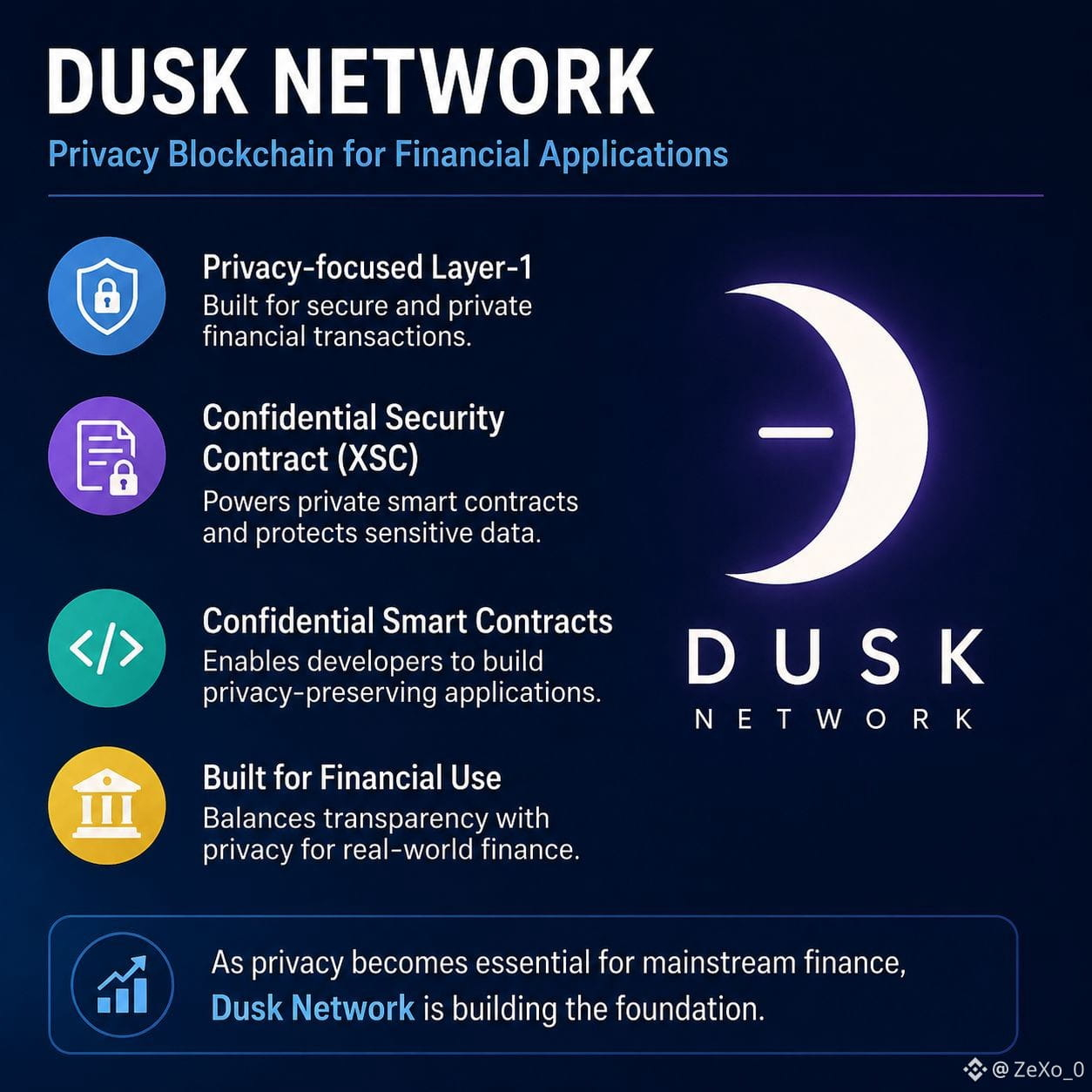
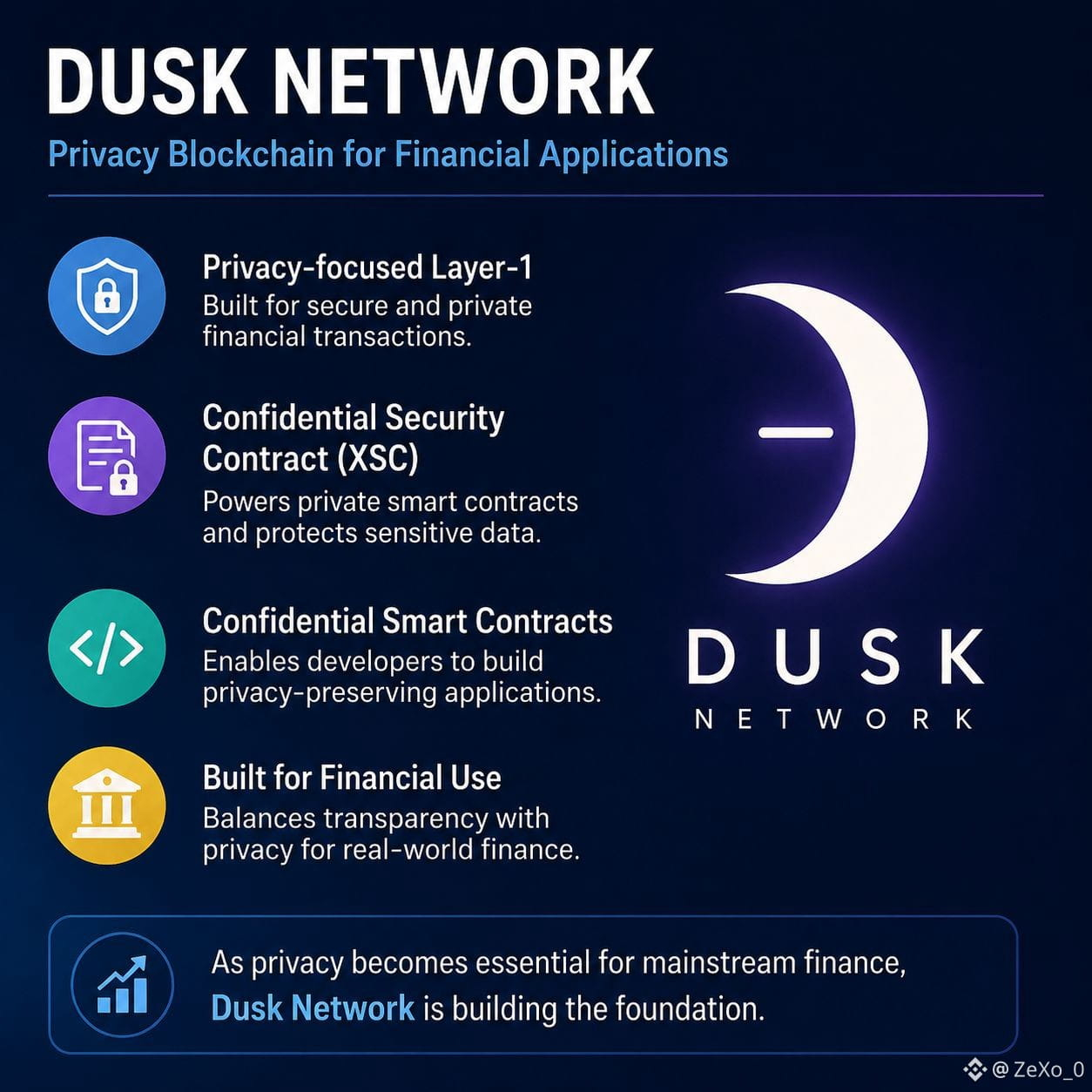
$DUSK Network is interesting for a reason that gets overlooked in a market obsessed with speed and speculation: it’s trying to make privacy useful for financial applications.
As a Layer-1, Dusk uses its Confidential Security Contract standard to support smart contracts where sensitive information doesn’t have to sit completely exposed on-chain.
That matters because the next phase of blockchain adoption probably won’t be driven only by more users or cheaper transactions. Financial institutions have a different problem: they need transparency and verifiability, but they also can’t treat every transaction like public data.
That’s where I think the Dusk narrative gets more relevant.
The real question isn’t whether privacy sounds good. It’s whether developers, businesses, and capital actually choose to build around it when the market gets competitive.
If liquidity starts rotating toward infrastructure with practical financial use cases, Dusk is one project I’d keep on the radar. Not because of noise, but because the underlying problem is real.
@Dusk
#dusk
$DUSK
As a Layer-1, Dusk uses its Confidential Security Contract standard to support smart contracts where sensitive information doesn’t have to sit completely exposed on-chain.
That matters because the next phase of blockchain adoption probably won’t be driven only by more users or cheaper transactions. Financial institutions have a different problem: they need transparency and verifiability, but they also can’t treat every transaction like public data.
That’s where I think the Dusk narrative gets more relevant.
The real question isn’t whether privacy sounds good. It’s whether developers, businesses, and capital actually choose to build around it when the market gets competitive.
If liquidity starts rotating toward infrastructure with practical financial use cases, Dusk is one project I’d keep on the radar. Not because of noise, but because the underlying problem is real.
@Dusk
#dusk
$DUSK
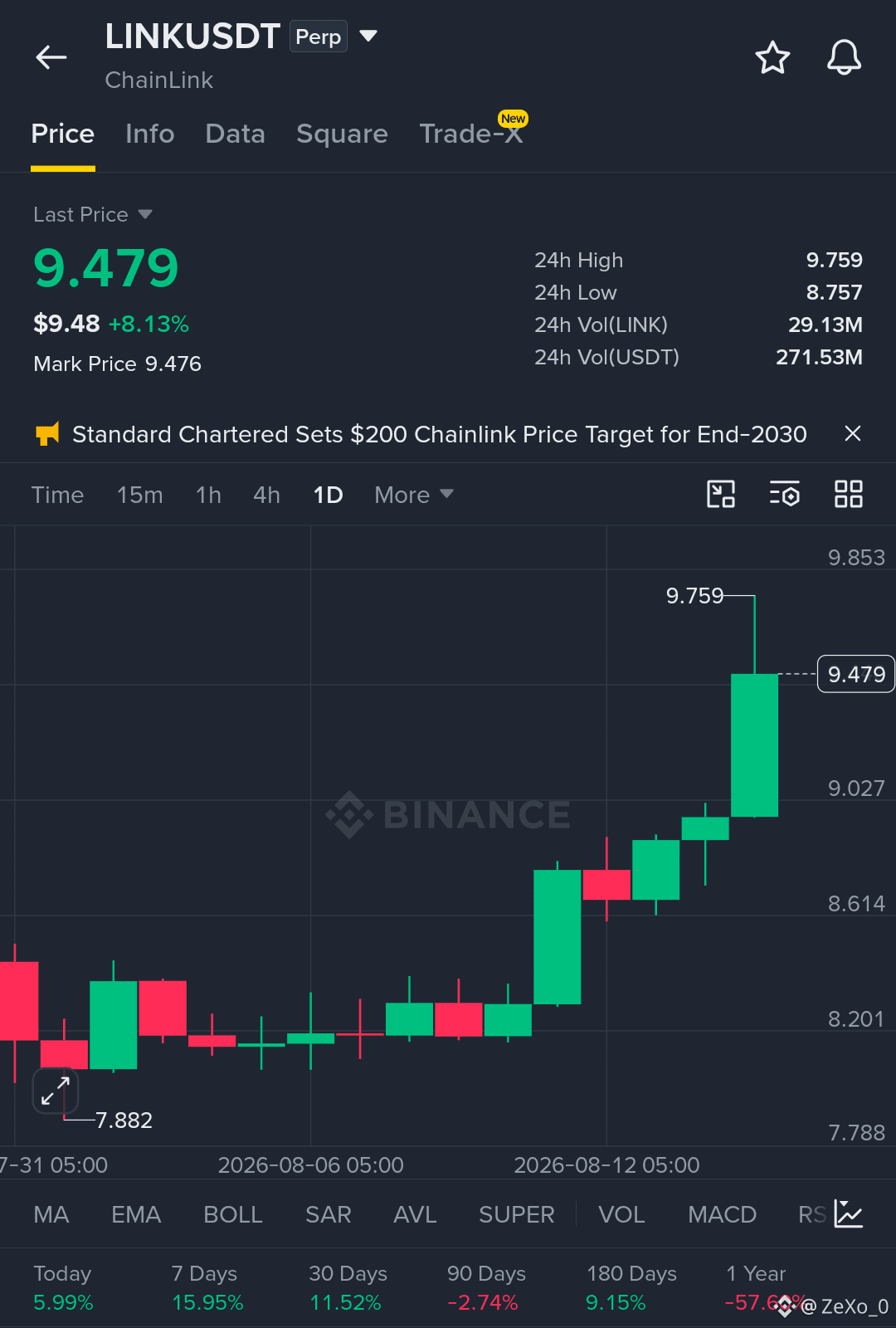
$LINK BREAKOUT RUNNING, BUT $9.76 IS THE TEST
LINK is trading at $9.479, up 8.13% in 24 hours, with $271.53M USDT volume. The daily chart shows a strong breakout from the $8.20-$8.60 area, followed by aggressive buying. Structure is clearly bullish, but price is now approaching resistance.
Support: $9.02, $8.61
Resistance: $9.76, $9.85
A clean break above $9.76 could extend the momentum toward TG1 $10.20, TG2 $10.60, TG3 $11.00. Losing $9.02 would weaken the setup and expose $8.61.
Long/short liquidation figures were not provided, so avoid assuming a squeeze.
Stop-loss: Below $8.90 for breakout trades.
Pro Trader Tip: Don't chase the candle. Wait for a breakout and retest confirmation before adding size.
#LINK🔥🔥🔥 #COWRises55.77%In24h #BNBChainToActivatePasteurHardFork #SaudiPIFDiscloses154.1MSpaceXShares #SanDiskRises7%OnRevenueGrowthOutlook
$LINK
$LIT
LINK is trading at $9.479, up 8.13% in 24 hours, with $271.53M USDT volume. The daily chart shows a strong breakout from the $8.20-$8.60 area, followed by aggressive buying. Structure is clearly bullish, but price is now approaching resistance.
Support: $9.02, $8.61
Resistance: $9.76, $9.85
A clean break above $9.76 could extend the momentum toward TG1 $10.20, TG2 $10.60, TG3 $11.00. Losing $9.02 would weaken the setup and expose $8.61.
Long/short liquidation figures were not provided, so avoid assuming a squeeze.
Stop-loss: Below $8.90 for breakout trades.
Pro Trader Tip: Don't chase the candle. Wait for a breakout and retest confirmation before adding size.
#LINK🔥🔥🔥 #COWRises55.77%In24h #BNBChainToActivatePasteurHardFork #SaudiPIFDiscloses154.1MSpaceXShares #SanDiskRises7%OnRevenueGrowthOutlook
$LINK
$LIT
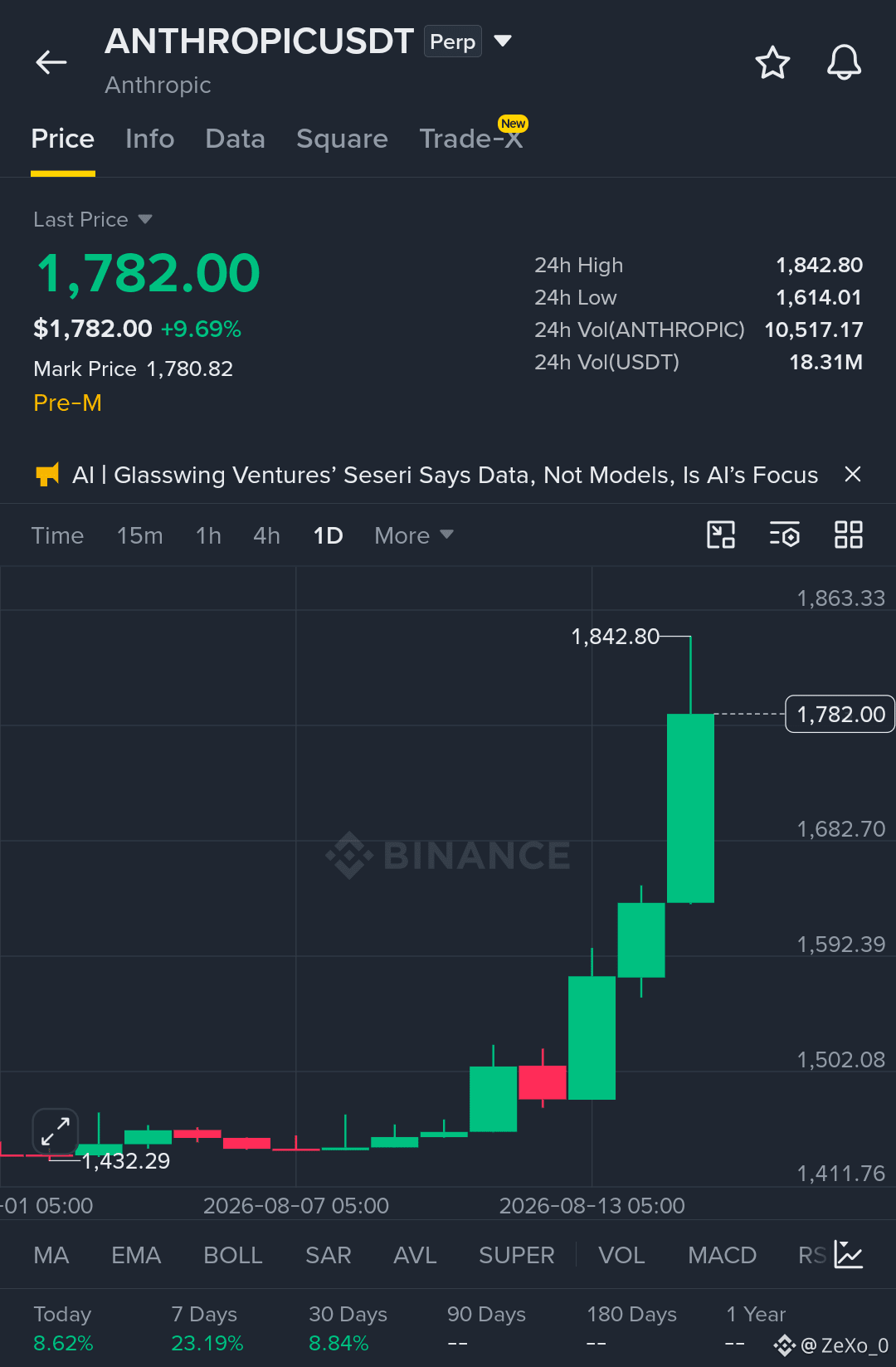
$ANTHROPIC PARABOLIC MOVE MEETS $1,843 RESISTANCE
Anthropic is trading at $1,782, up 9.69%, with $18.31M USDT volume. The daily structure is strongly bullish, with consecutive expansion candles pushing price rapidly from the $1,500 area. Buyers clearly control momentum, but the move is becoming extended.
Support: $1,683, $1,592
Resistance: $1,843, $1,863
A confirmed break above $1,843 could open TG1 $1,900, TG2 $1,980, TG3 $2,050. If $1,683 fails, momentum could cool toward $1,592.
No long/short liquidation data was supplied, so squeeze pressure cannot be confirmed.
Stop-loss: Below $1,650.
Pro Trader Tip: After a vertical rally, wait for a pullback and successful support retest instead of entering purely from FOMO.
#COWRises55.77%In24h #BNBChainToActivatePasteurHardFork #SaudiPIFDiscloses154.1MSpaceXShares #SanDiskRises7%OnRevenueGrowthOutlook
$ANTHROPIC
$AN.US
Anthropic is trading at $1,782, up 9.69%, with $18.31M USDT volume. The daily structure is strongly bullish, with consecutive expansion candles pushing price rapidly from the $1,500 area. Buyers clearly control momentum, but the move is becoming extended.
Support: $1,683, $1,592
Resistance: $1,843, $1,863
A confirmed break above $1,843 could open TG1 $1,900, TG2 $1,980, TG3 $2,050. If $1,683 fails, momentum could cool toward $1,592.
No long/short liquidation data was supplied, so squeeze pressure cannot be confirmed.
Stop-loss: Below $1,650.
Pro Trader Tip: After a vertical rally, wait for a pullback and successful support retest instead of entering purely from FOMO.
#COWRises55.77%In24h #BNBChainToActivatePasteurHardFork #SaudiPIFDiscloses154.1MSpaceXShares #SanDiskRises7%OnRevenueGrowthOutlook
$ANTHROPIC
$AN.US
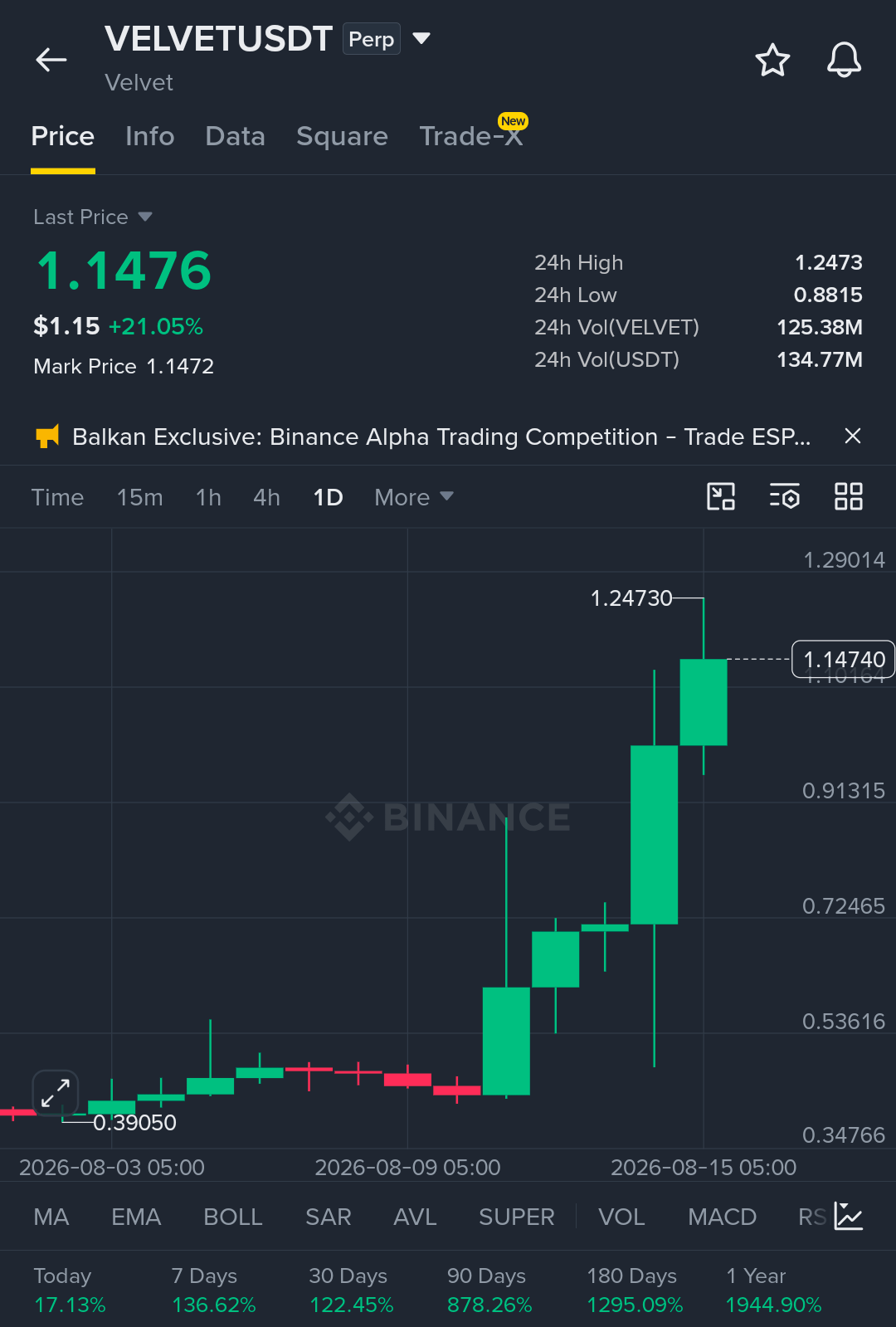
$VELVET +21% SURGE PUTS $1.25 IN FOCUS
VELVET is trading at $1.1476, up 21.05%, with massive $134.77M USDT volume. The daily chart shows a powerful breakout from below $0.75, followed by another strong expansion candle. Buyers remain aggressive, but volatility is extremely high.
Support: $1.02, $0.91
Resistance: $1.247, $1.29
A decisive move above $1.247 could push toward TG1 $1.35, TG2 $1.45, TG3 $1.60. Losing $1.02 would signal cooling momentum and potentially expose $0.91.
Liquidation figures were not provided, so the size of any long or short squeeze cannot be verified.
Stop-loss: Below $0.98.
Pro Trader Tip: Reduce leverage after a 20%+ daily move. Protect capital first, chase momentum second.
#VELVET_BECOME_TO_MOON #COWRises55.77%In24h #BNBChainToActivatePasteurHardFork #SaudiPIFDiscloses154.1MSpaceXShares #SanDiskRises7%OnRevenueGrowthOutlook
$VELVET
$VET
VELVET is trading at $1.1476, up 21.05%, with massive $134.77M USDT volume. The daily chart shows a powerful breakout from below $0.75, followed by another strong expansion candle. Buyers remain aggressive, but volatility is extremely high.
Support: $1.02, $0.91
Resistance: $1.247, $1.29
A decisive move above $1.247 could push toward TG1 $1.35, TG2 $1.45, TG3 $1.60. Losing $1.02 would signal cooling momentum and potentially expose $0.91.
Liquidation figures were not provided, so the size of any long or short squeeze cannot be verified.
Stop-loss: Below $0.98.
Pro Trader Tip: Reduce leverage after a 20%+ daily move. Protect capital first, chase momentum second.
#VELVET_BECOME_TO_MOON #COWRises55.77%In24h #BNBChainToActivatePasteurHardFork #SaudiPIFDiscloses154.1MSpaceXShares #SanDiskRises7%OnRevenueGrowthOutlook
$VELVET
$VET
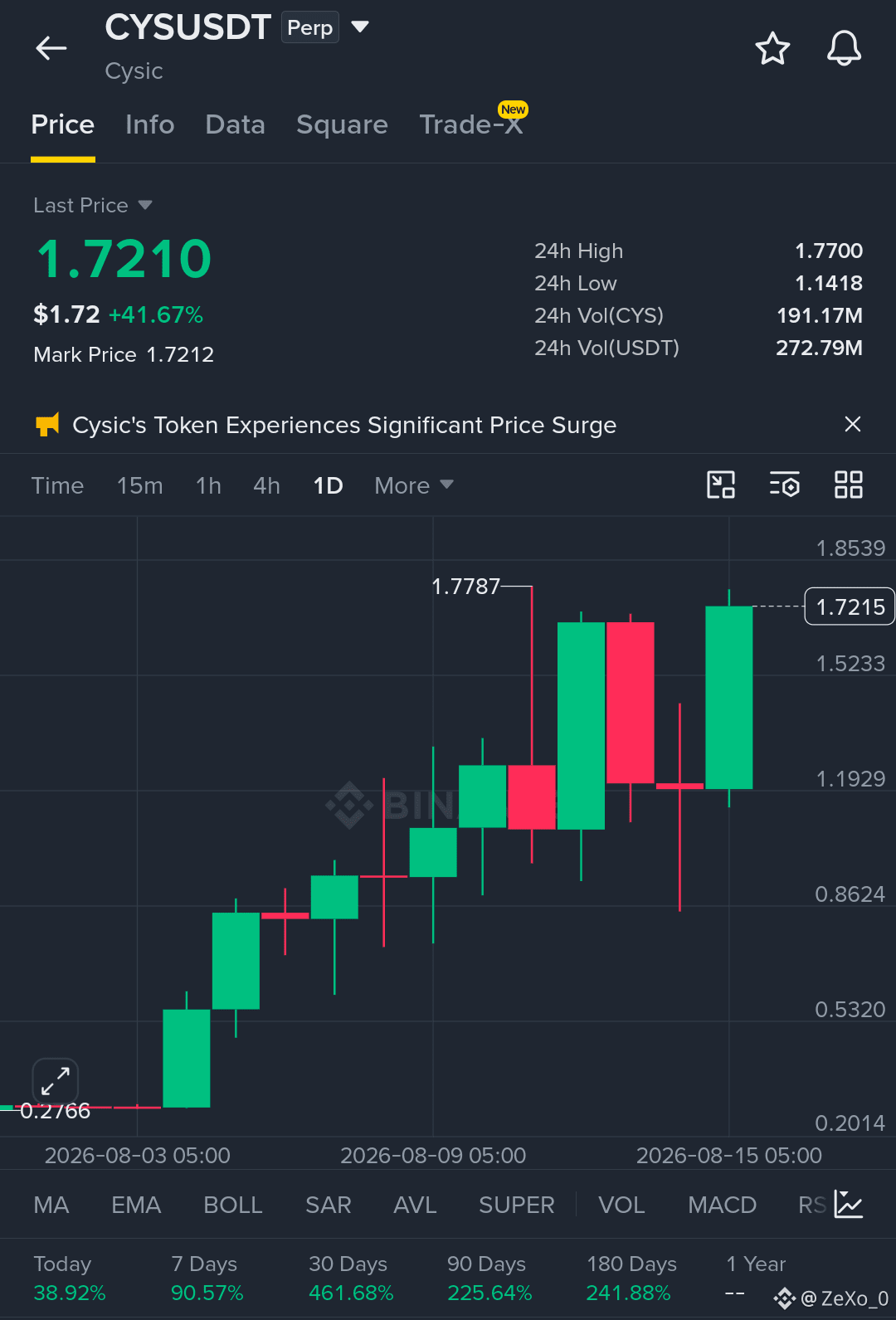
$CYS +43% EXPLOSION, EXTREME VOLATILITY AHEAD
CYSIC is trading at $1.7310, up 43.09%, with a huge $273.04M USDT volume. The daily chart shows explosive buying after reclaiming the $1.19 region. Momentum is powerful, but the long wicks show serious volatility and two-way trading.
Support: $1.52, $1.19
Resistance: $1.77, $1.85
A confirmed breakout above $1.77 could target TG1 $1.90, TG2 $2.05, TG3 $2.25. If $1.52 breaks, price could quickly revisit $1.19.
Long/short liquidation data is unavailable, so don't assume the rally is purely liquidation-driven.
Stop-loss: Below $1.48.
Pro Trader Tip: Wait for confirmation above $1.77. After a 43% move, leverage can turn a small pullback into a major loss.
#Cys #COWRises55.77%In24h #BNBChainToActivatePasteurHardFork #SaudiPIFDiscloses154.1MSpaceXShares #SanDiskRises7%OnRevenueGrowthOutlook
$CYS
$C
CYSIC is trading at $1.7310, up 43.09%, with a huge $273.04M USDT volume. The daily chart shows explosive buying after reclaiming the $1.19 region. Momentum is powerful, but the long wicks show serious volatility and two-way trading.
Support: $1.52, $1.19
Resistance: $1.77, $1.85
A confirmed breakout above $1.77 could target TG1 $1.90, TG2 $2.05, TG3 $2.25. If $1.52 breaks, price could quickly revisit $1.19.
Long/short liquidation data is unavailable, so don't assume the rally is purely liquidation-driven.
Stop-loss: Below $1.48.
Pro Trader Tip: Wait for confirmation above $1.77. After a 43% move, leverage can turn a small pullback into a major loss.
#Cys #COWRises55.77%In24h #BNBChainToActivatePasteurHardFork #SaudiPIFDiscloses154.1MSpaceXShares #SanDiskRises7%OnRevenueGrowthOutlook
$CYS
$C
$COW : 47% BREAKOUT HAS TRADERS WATCHING $0.165
COW is trading at $0.1473, up 47.89%, with an impressive $231.87M USDT volume. The daily chart shows a dramatic breakout from the $0.10 region, with price reaching $0.1649 before pulling back slightly. Buyers have completely shifted the short-term structure.
Support: $0.139, $0.124
Resistance: $0.1649, $0.1683
A clean breakout above $0.1649 could send COW toward TG1 $0.175, TG2 $0.190, TG3 $0.210. Failure to hold $0.139 could trigger a deeper retracement toward $0.124.
Liquidation figures were not provided, so squeeze intensity remains unconfirmed.
Stop-loss: Below $0.135.
Pro Trader Tip: After a vertical breakout, wait for a retest. Don't confuse momentum with guaranteed continuation.
#cows #COWRises55.77%In24h #BNBChainToActivatePasteurHardFork #SaudiPIFDiscloses154.1MSpaceXShares
$COW
$CL
COW is trading at $0.1473, up 47.89%, with an impressive $231.87M USDT volume. The daily chart shows a dramatic breakout from the $0.10 region, with price reaching $0.1649 before pulling back slightly. Buyers have completely shifted the short-term structure.
Support: $0.139, $0.124
Resistance: $0.1649, $0.1683
A clean breakout above $0.1649 could send COW toward TG1 $0.175, TG2 $0.190, TG3 $0.210. Failure to hold $0.139 could trigger a deeper retracement toward $0.124.
Liquidation figures were not provided, so squeeze intensity remains unconfirmed.
Stop-loss: Below $0.135.
Pro Trader Tip: After a vertical breakout, wait for a retest. Don't confuse momentum with guaranteed continuation.
#cows #COWRises55.77%In24h #BNBChainToActivatePasteurHardFork #SaudiPIFDiscloses154.1MSpaceXShares
$COW
$CL
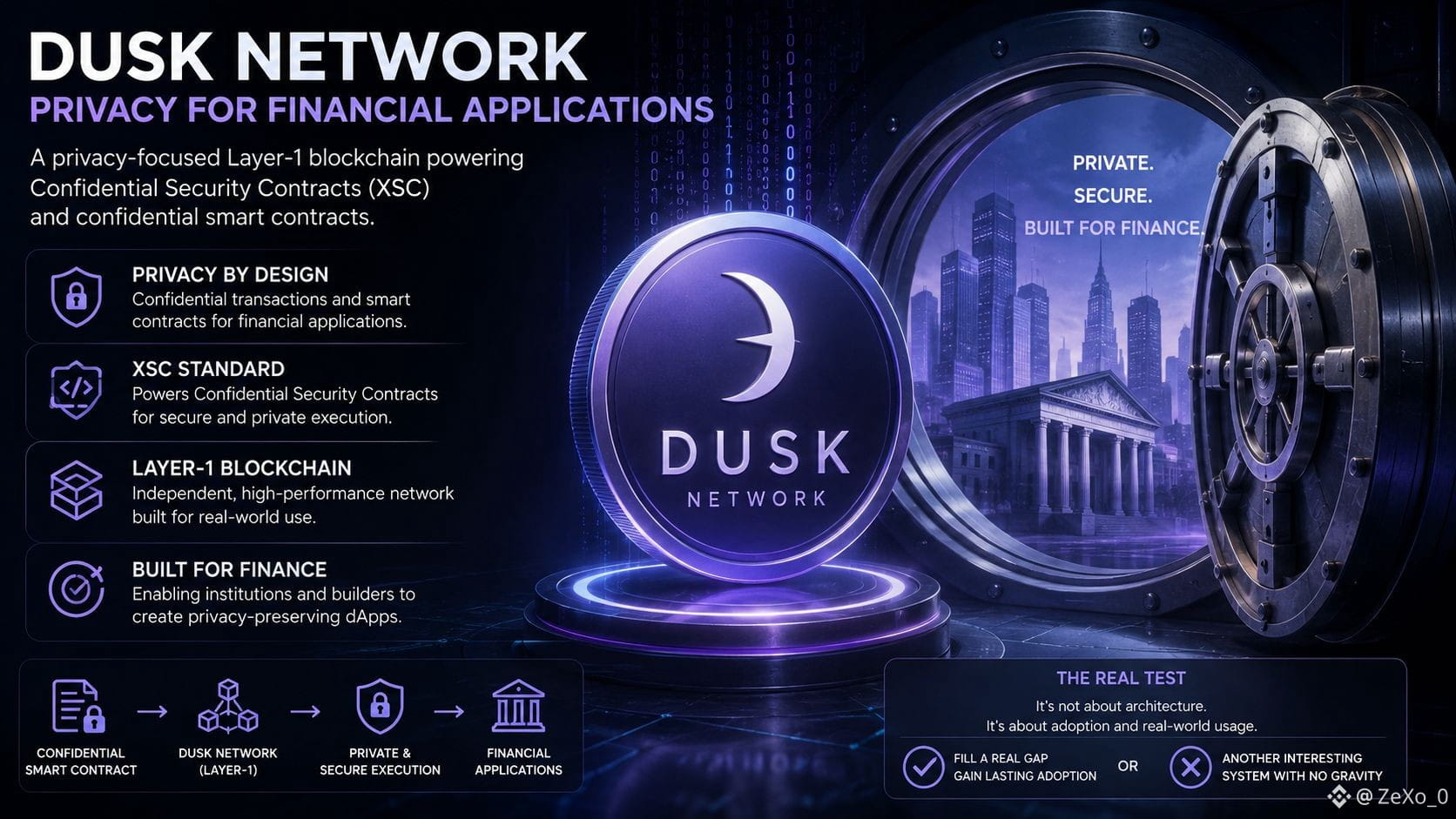
While $DUSK sounds new, the pattern is familiar: each cycle builds a new foundation around the language of its time. Dusk applies that idea to privacy-focused financial applications.
The easy part is designing another layer-1. The harder question is whether meaningful activity actually moves there. Established networks already show that performance looks different when real demand becomes uneven, unpredictable, or intense.
Dusk targets workloads where confidentiality matters, and those flows may not behave like simple, steady transactions. They can spike, slow down, and sit idle, which makes a dedicated system reasonable in theory.
But architecture alone does not create adoption. Developers still have to build, users have to stay, and applications need a reason not to return to existing networks.
That leaves Dusk with a straightforward test: does its design solve a real gap well enough to attract lasting activity, or does it remain another technically interesting system without enough gravity to matter?
@Dusk
#dusk
$DUSK
The easy part is designing another layer-1. The harder question is whether meaningful activity actually moves there. Established networks already show that performance looks different when real demand becomes uneven, unpredictable, or intense.
Dusk targets workloads where confidentiality matters, and those flows may not behave like simple, steady transactions. They can spike, slow down, and sit idle, which makes a dedicated system reasonable in theory.
But architecture alone does not create adoption. Developers still have to build, users have to stay, and applications need a reason not to return to existing networks.
That leaves Dusk with a straightforward test: does its design solve a real gap well enough to attract lasting activity, or does it remain another technically interesting system without enough gravity to matter?
@Dusk
#dusk
$DUSK
Log in to explore more content