Vanar is a Layer 1 blockchain created with a rare mindset in the Web3 world. It does not begin with charts, speculation, or technical bragging. It begins with people. Real people who play games, explore virtual worlds, interact with brands, create digital identities, and spend hours every day inside digital environments without ever thinking about blockchains. Vanar exists to meet those people exactly where they already are.
At its core, Vanar is designed for real world adoption, not theoretical adoption. It was built by a team with deep experience in gaming, entertainment, and brand driven digital ecosystems. That background matters because it shapes how Vanar thinks. Instead of asking users to learn Web3, Vanar quietly adapts Web3 to human behavior. It removes friction, hides complexity, and lets experiences speak louder than technology.
This approach is rooted in a powerful belief. The next wave of Web3 adoption will not come from teaching billions of people what a blockchain is. It will come from giving them experiences that feel rewarding, familiar, and emotionally engaging. Vanar is built to be the invisible infrastructure behind those experiences.
Vanar is a full Layer 1 blockchain, meaning it operates independently with its own network, consensus, and native token. But unlike many Layer 1 projects that position themselves as financial systems first, Vanar positions itself as an experience platform. Speed, scalability, and efficiency are not marketing slogans here. They are basic requirements. The real focus is on how applications feel to the end user.
The technology behind Vanar is designed to work quietly in the background. Transactions are fast, costs are predictable, and the network is structured to support large scale consumer applications without degrading performance. Developers are given flexibility and powerful tools, while users are shielded from complexity. The blockchain fades away, and what remains is the experience.
What makes Vanar especially distinctive is its approach to data and intelligence. Traditional blockchains store transactions as static records. Vanar is designed to store meaning. Data is structured in a way that allows applications to remember context, evolve over time, and interact intelligently with users. This opens the door for AI powered systems, adaptive virtual environments, and applications that feel alive instead of rigid.
This intelligence layer is critical for the kind of future Vanar is building. Games that remember player choices. Virtual worlds that evolve based on community behavior. Digital identities that grow rather than reset. These are not distant ideas. They are the logical outcome of a blockchain designed to handle context rather than just numbers.
Vanar is not an abstract concept. It is already anchored by real products that demonstrate its vision in action. One of the most prominent is Virtua Metaverse. Virtua is not built as a speculative metaverse designed to sell empty digital land. It focuses on immersion, recognizable digital experiences, and community driven interaction. Users do not just visit Virtua. They participate in it. They build memories, collect digital assets connected to meaning, and engage in worlds that feel intentional rather than empty.
Virtua shows how Vanar’s technology supports emotional engagement. Ownership inside the metaverse is not about flipping assets. It is about connection. About feeling part of something persistent. This is where Vanar’s philosophy becomes tangible. The blockchain supports the experience without demanding attention.
Alongside Virtua exists VGN Games Network, a gaming network designed to bridge developers and players under a shared infrastructure. VGN allows games to integrate ownership, rewards, and progression in a way that feels natural. Players are not forced to become traders. They are allowed to remain players. The economy exists, but it does not dominate the experience.
This matters deeply. Gaming is one of the most emotionally charged digital spaces in the world. It thrives on immersion, competition, achievement, and community. Vanar understands that if blockchain disrupts these emotions, it fails. VGN is designed so that blockchain enhances fun rather than replacing it.
Powering all of this is VANRY, the native token of the Vanar ecosystem. VANRY is not positioned as a speculative symbol. It is positioned as energy. It fuels transactions on the network, secures the chain through staking, and enables participation in governance. It moves through games, metaverse environments, and applications as a tool for interaction and value exchange.
VANRY’s role is practical and deeply integrated. It is used to pay for activity on the chain. It supports validators and network security. It allows the community to have a voice in how the ecosystem evolves. Most importantly, it aligns incentives across developers, users, and the network itself. When the ecosystem grows through usage, VANRY grows in relevance.
The design philosophy behind VANRY focuses on sustainability rather than hype. The supply structure reflects a project that is already in motion rather than one endlessly postponing utility. Instead of artificial scarcity narratives, VANRY is designed to circulate, to move, and to be used. This supports a healthier ecosystem over time.
Adoption is where Vanar’s vision truly stands apart. Many projects chase adoption by advertising features. Vanar pursues adoption by embedding itself into environments people already love. Gaming, entertainment, virtual worlds, brand interaction, and AI driven digital experiences are the gateways. Blockchain is not introduced as a concept. It is introduced as a feeling. Ownership feels empowering. Participation feels rewarding. Interaction feels seamless.
This approach dramatically lowers the barrier to entry. Users do not need to understand wallets or networks to enjoy the experience. They engage first. Understanding comes later, if at all. This is how mass adoption actually happens.
Vanar’s roadmap reflects patience and intention. Development focuses on strengthening the core network, expanding intelligent capabilities, and supporting real products rather than chasing trends. Future growth centers on deeper AI integration, more creator friendly tools, stronger brand solutions, and an increasingly cohesive ecosystem.
The vision is long term. Vanar is not racing toward short term attention. It is building infrastructure meant to last through multiple cycles of technological change.
No honest discussion would ignore risk. Vanar operates in an extremely competitive environment. Many Layer 1 blockchains compete for developers, users, and relevance. Market conditions fluctuate. Attention shifts quickly. The greatest challenge is not technological failure but execution at scale.
Adoption requires consistent delivery, meaningful partnerships, and experiences that remain emotionally relevant over time. Vanar must continue to prove that its philosophy translates into sustained usage. The pressure is real, but so is the opportunity.
What sets Vanar apart is its understanding of why people engage with technology. People do not fall in love with protocols. They fall in love with experiences. With moments of achievement. With places that feel familiar. With systems that respect their time and emotion.
Vanar does not try to change how people behave. It changes how technology behaves around people.
It imagines a future where blockchain is no longer something users talk about. It is something they simply benefit from. A future where games feel richer, virtual worlds feel alive, digital ownership feels natural, and intelligence is built into the fabric of interaction.
Vanar is quiet by design. But its ambition is massive.
Plasma and the Quiet Revolution of Trust, Speed, and Digital Money
There is a moment most people remember the first time digital money truly mattered to them. It is rarely about profit. It is usually about necessity. Sending money home. Paying someone across borders. Protecting savings from inflation. Escaping delays, fees, and systems that were never built with ordinary people in mind. Stablecoins quietly became the answer for millions because they worked when nothing else did. But the infrastructure beneath them has always felt incomplete. Too technical. Too fragile. Too expensive when usage grows.
Plasma exists because of that gap.
Plasma is not trying to redefine finance in theory. It is trying to fix something deeply practical. How money moves when people actually depend on it. This network is designed with a clear emotional understanding of money. That when someone sends value, they want certainty. When they receive it, they want finality. When they use it, they do not want to think about the system at all.
From its foundation, Plasma was built as a Layer 1 blockchain focused entirely on stablecoin settlement. That focus changes everything. Instead of adding payment features on top of a generalized blockchain, Plasma begins with stablecoins as the core purpose. The result is an architecture that feels calmer, more predictable, and more human than most systems in the space.
In many parts of the world, stablecoins are already used as digital dollars. They are savings. They are salaries. They are lifelines. Yet the chains that carry them were not designed for this responsibility. Congestion appears at the worst times. Fees spike without warning. Users are forced to hold volatile assets just to move stable value. This creates stress, not confidence.
Plasma removes that friction by asking a simple but powerful question. What if a blockchain treated stablecoins as first class citizens rather than guests.
At the heart of Plasma is a consensus design optimized for speed and certainty. Transactions finalize in under a second. This is not about chasing numbers. It is about removing doubt. When a transaction completes on Plasma, it is done. There is no waiting, no probability, no second guessing. For payments, this changes behavior entirely. People stop hesitating. Merchants stop worrying. Systems begin to feel dependable.
This sub second finality is paired with an execution environment fully compatible with Ethereum tooling. Developers do not need to abandon what they know. Smart contracts, wallets, and applications can move into Plasma without friction. But once deployed, they behave differently. Fees are predictable. Congestion is minimized. Stablecoins flow without interruption.
One of the most emotionally important design choices in Plasma is how it handles transaction costs. For many users, gas fees are confusing and intimidating. Being told that you cannot send money because you do not hold the correct token feels arbitrary and unfair. Plasma addresses this directly.
Basic stablecoin transfers can be gasless. A person can send stable value without paying a fee or holding any other asset. This restores a sense of normalcy. Money should move without barriers. For more advanced interactions, Plasma allows transaction costs to be paid using stablecoins themselves. This keeps the experience consistent and intuitive. Value in, value out, without unnecessary complexity.
Behind the scenes, Plasma maintains strong economic security through its native token. This token is used for staking, validator incentives, and governance. Validators commit value to secure the network, aligning their interests with its long term health. Token holders participate in shaping upgrades and parameters. But importantly, the token does not dominate the user experience. It supports the system quietly rather than demanding attention.
Security is further reinforced through Bitcoin anchored design. Plasma periodically commits state information to Bitcoin, borrowing strength from one of the most resilient decentralized networks ever created. This anchoring adds an extra layer of neutrality and resistance to interference. For a settlement network intended to operate across borders and systems, this matters deeply. It creates confidence that the rules will not change unexpectedly.
Plasma’s vision extends beyond individual users. It is designed to support real financial activity at scale. Merchants need predictable settlement. Payment platforms need reliability. Institutions need finality they can trust. Plasma speaks this language not through marketing, but through architecture.
Adoption is not treated as a viral event. It is treated as a gradual process of trust building. As stablecoin liquidity grows on the network, applications become more viable. As usage increases, the infrastructure remains steady rather than strained. This is intentional. Plasma is not designed to impress during quiet periods. It is designed to perform under pressure.
The roadmap reflects this philosophy. Early stages focus on network stability, validator decentralization, and staking mechanics. These are not glamorous milestones, but they are essential. From there, Plasma expands its ecosystem thoughtfully, supporting deeper integrations, more payment focused applications, and broader participation. The goal is not to rush into visibility, but to mature into reliability.
Of course, challenges remain. The stablecoin settlement space is competitive. Other networks already host large volumes. Regulation continues to evolve and may shape how such systems operate globally. Plasma must earn adoption through consistent performance rather than promises.
But what gives Plasma strength is clarity. It does not try to be everything. It does not chase every trend. It focuses on one fundamental need and executes it with discipline.
Money is emotional. It carries trust, fear, hope, and responsibility. Infrastructure that moves money must respect that. Plasma does. It removes noise. It reduces anxiety. It replaces friction with flow.
If blockchain technology is ever to fade into the background of everyday life, it will not be because it became louder. It will be because it became dependable. Plasma is building toward that future quietly, deliberately, and with an understanding that the most powerful systems are the ones people stop thinking about because they simply work.
In that sense, Plasma is not just another blockchain. It is an attempt to make digital money feel human again.
Una Blockchain Potente e Silenziosa Costruita per il Vero Mondo Finanziario
Quando guardo Dusk, sembra diverso dalla maggior parte dei progetti crypto di cui ho letto. Molti blockchain si concentrano sulla velocità, l'hype o le tendenze a breve termine. Dusk sembra più serio, come se stesse pensando a lungo termine e puntando a reali sistemi finanziari invece di semplici utenti crypto. Quando ho iniziato a leggerne, mi sono reso conto che non stanno cercando di sostituire le banche da un giorno all'altro. Stanno cercando di aiutare la vera finanza a muoversi sulla blockchain in un modo che abbia realmente senso.
L'idea principale dietro Dusk è semplice se la spiego in linguaggio quotidiano. Le aziende e le banche vogliono utilizzare la blockchain, ma non possono esporre dati privati a tutti. Allo stesso tempo, i regolatori devono vedere che le regole vengono rispettate. La maggior parte delle blockchain fallisce qui perché tutto è pubblico. Dusk esiste per risolvere questo esatto problema combinando privacy con conformità.
Amo come @Dusk sta portando la vera privacy finanziaria alla blockchain con $DUSK e contratti smart riservati che consentono alle istituzioni di emettere e scambiare beni in modo sicuro, mantenendo i dati privati e conformi, questo sembra un passo successivo per la vera finanza sulla blockchain #Dusk
Dusk Network The Quiet Architecture Powering the Next Era of Financial Trust
In the early days of blockchain, transparency was treated like a moral absolute. Everything visible. Everything permanent. Everything open for anyone to see. It felt revolutionary at first, like a system that could not lie. But as the technology matured and the conversation shifted from ideology to reality, a difficult truth emerged. Finance does not work this way. Real money does not move in public. Real institutions cannot expose every decision. Real people cannot live with their financial lives permanently on display.
This is the space where Dusk Network exists. Not as a reaction. Not as a rebellion. But as a correction.
Founded in 2018, Dusk was created with a rare level of honesty. Instead of asking how blockchain could disrupt finance, it asked how blockchain could actually support it. Not speculative finance. Not hype driven ecosystems. But regulated markets, institutional assets, and real world financial infrastructure. The kind that already moves trillions of dollars and cannot afford mistakes.
From the beginning, Dusk understood something most projects ignored. Privacy is not about hiding. Privacy is about dignity, legality, and functionality. Without privacy, finance becomes fragile. Without compliance, decentralization becomes irrelevant. And without trust, no system survives.
Dusk Network is a Layer 1 blockchain designed to reconcile these truths.
At its core, Dusk is built for a world where decentralization must coexist with regulation. Where institutions need confidentiality but regulators need assurance. Where users deserve privacy but markets demand integrity. This balance is not easy, and that is precisely why Dusk matters.
Traditional blockchains expose transaction data by default. Wallet balances, transfer histories, contract interactions all visible forever. For hobbyists, this may feel acceptable. For enterprises, funds, and financial institutions, it is unacceptable. Laws like data protection regulations, financial secrecy rules, and investor protection frameworks exist for a reason. Ignoring them does not create freedom. It creates exclusion.
Dusk does not ignore these realities. It embraces them.
The architecture of Dusk is privacy first by design. It uses advanced cryptographic techniques that allow transactions and smart contracts to be validated without revealing sensitive details. This means values can remain confidential. Participants can remain protected. Business logic can remain private. And yet the network can still confirm that everything follows the rules.
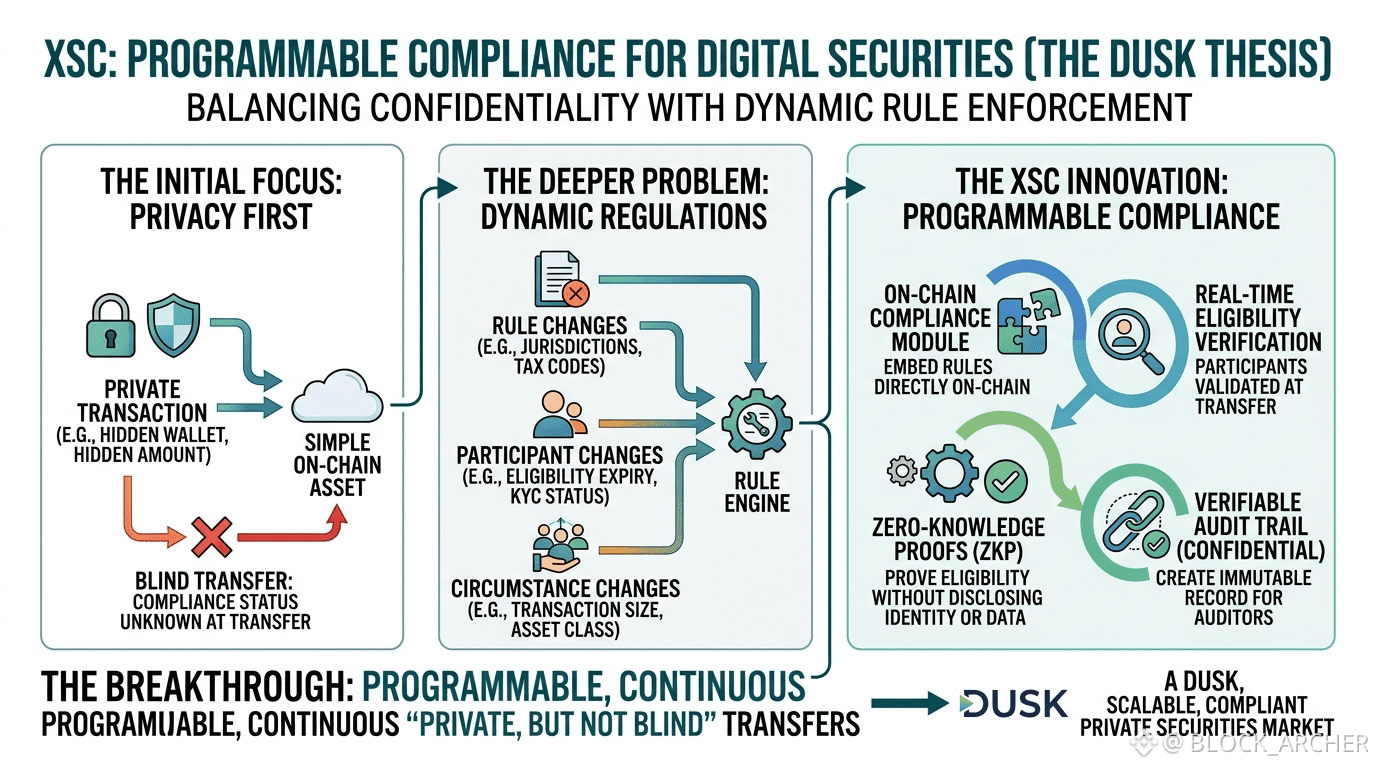
This is achieved through zero knowledge proofs, a form of cryptography that allows truth to be proven without revealing information. It is like showing that a balance exists without showing the amount. Proving eligibility without revealing identity. Confirming compliance without exposing data.
In financial markets, this is revolutionary.
Smart contracts on Dusk are not simple scripts that blindly execute code in public view. They are confidential agreements. They can enforce compliance rules, access restrictions, and regulatory logic while preserving privacy. This allows real financial instruments to exist on chain without violating laws or exposing sensitive information.
Think about what this unlocks.
A company can issue a digital security without revealing its entire investor list. A fund can distribute returns without exposing every transaction. An institution can settle trades on chain without broadcasting its strategies to competitors. Regulators can audit activity without breaching confidentiality. This is not theoretical. This is the foundation Dusk is building.
Consensus on Dusk is designed for finality. Financial systems require certainty. Once a transaction settles, it must stay settled. Dusk prioritizes fast and irreversible confirmation, reducing risk and increasing trust. This is not a playground for experimentation. It is infrastructure meant to last.
The modular nature of the network allows Dusk to evolve as laws change and markets grow. Financial regulation is not static. Technology must adapt. Dusk was built with this reality in mind, allowing components to improve without breaking the system as a whole.
At the center of this ecosystem is the DUSK token. Its purpose is practical, not symbolic. It secures the network through staking. It pays for computation and transactions. It rewards those who maintain the integrity of the blockchain. It aligns incentives across validators, developers, and users.
The value of the token is tied to real usage, not promises. As more financial applications are built. As more assets are tokenized. As more institutions participate. The demand for network activity grows organically.
One of the most powerful use cases Dusk enables is the tokenization of real world assets. Traditional assets like shares, bonds, and structured financial products can be represented on chain in a compliant manner. Ownership can be fractional. Settlement can be instant. Access can be global. And yet privacy and regulation are respected.
This changes the nature of financial inclusion. Assets that were once limited by geography or minimum investment sizes become accessible. Capital moves more efficiently. Markets become more fluid. But without sacrificing legal protections.
Dusk also enables a new form of decentralized finance. Not open to everyone by default. But accessible to those who meet defined criteria. This allows regulated lending, borrowing, and trading platforms to exist on chain. It is decentralized where it matters, and controlled where it must be.
This approach may not appeal to those who believe decentralization means chaos. But for finance to scale, order is not optional.
Adoption for Dusk is intentional and measured. It does not chase attention. It builds credibility. Institutions move slowly because they must. Dusk respects that pace. Instead of promising instant transformation, it offers stable infrastructure that can be trusted over time.
The roadmap of Dusk reflects this maturity. Focus is placed on improving developer tools, expanding support for compliant assets, enhancing scalability while preserving privacy, strengthening decentralization, and aligning with evolving legal frameworks. Progress is steady, not rushed.
There are risks. Regulation around privacy technologies remains complex. Institutional adoption takes time. Competition exists from other Layer 1 platforms. Market cycles influence perception. But these risks are inseparable from the ambition of the project.
Dusk chose to solve hard problems instead of easy ones.
The future of blockchain is not defined by how loud a project is. It is defined by how well it integrates into the systems that already shape the world. Finance is not going away. Regulation is not going away. Privacy will only become more important.
Dusk Network stands at the intersection of these forces.
It is not trying to replace the financial system overnight. It is building a parallel foundation that can support it when the time is right. Quietly. Carefully. Correctly.
In a world where transparency alone is no longer enough, Dusk offers something deeper. Trust without exposure. Compliance without control. Decentralization with responsibility.
Crepuscolo Una Rivoluzione Silenziosa che Sta Plasmando il Futuro della Finanza Digitale Regolamentata
Nei primi giorni della blockchain, la promessa era forte e dirompente. Tutto sarebbe stato trasparente. Ogni transazione sarebbe stata visibile. Ogni sistema sarebbe stato sfidato. Quella promessa ha acceso un movimento e attirato milioni di credenti in tutto il mondo. Ma mentre il rumore si placava e il denaro reale iniziava a prestare attenzione, è emersa una domanda più profonda, a cui molti non erano pronti a rispondere.
Come può esistere una vera finanza su una blockchain completamente pubblica?
La vera finanza non si basa su un'apertura radicale. Si basa su discrezione, responsabilità, fiducia e regole. Le istituzioni non espongono le loro transazioni. I gestori di asset non pubblicizzano strategie. I governi non operano senza privacy. Eppure, richiedono anche responsabilità, auditabilità e conformità. Questa tensione tra privacy e trasparenza è dove molte blockchain falliscono silenziosamente.
Dusk Network and the Future of Private Trust in Regulated Digital Finance
Dusk NetworkIn every era of financial change, there is a silent shift that happens before the world truly notices. It begins not with noise, but with necessity. It begins when old systems start to feel fragile, when trust erodes, when privacy disappears, and when people realize that progress without responsibility creates more harm than freedom. Dusk Network was born inside that realization.
Founded in 2018, Dusk did not emerge from a desire to compete for attention. It emerged from a deeper understanding of how finance actually works and why it repeatedly fails people. The team behind Dusk saw something most ignored. Traditional finance struggles not because it lacks rules, but because it relies on layers of intermediaries that slow everything down. Blockchain finance struggles not because it lacks speed, but because it ignores privacy and regulation. Dusk chose a third path, one that few dared to walk. A path where privacy is protected, regulation is respected, and decentralization is not sacrificed.
From the very beginning, Dusk was built for a future where financial systems would no longer be able to choose between transparency and confidentiality. In the real world, people expect both. They expect their transactions to be private. They expect institutions to follow the law. They expect systems to be fair, auditable, and secure. Dusk exists because this balance was missing.
At its heart, Dusk is not just a blockchain. It is a statement. A statement that privacy is not something to be hidden in dark corners of the internet. Privacy is normal. It is human. It is necessary for dignity. At the same time, Dusk understands that regulation is not an enemy. Regulation exists because societies demand accountability. Ignoring that reality does not create freedom. It creates chaos. Dusk does not run from rules. It builds them directly into code.
One of the most powerful emotional triggers in finance is fear. Fear of exposure. Fear of misuse. Fear of losing control. In most blockchains, every transaction is permanently visible to everyone. Wallet balances, contract logic, and user behavior are exposed forever. For individuals, this feels invasive. For institutions, it is unacceptable. Dusk changes this emotional dynamic entirely. On Dusk, privacy is the default state. Transactions are confidential. Balances are protected. Business logic is shielded. Yet this privacy is not blind. It is intelligent.
Dusk introduces a model where data is encrypted but verifiable. This means transactions can be validated without revealing sensitive information. When legally required, authorized parties can audit activity without exposing it to the public. This is not a compromise. It is alignment with how real financial systems already operate. Banks do not publish customer balances. Investment firms do not broadcast every trade. But audits still happen. Accountability still exists. Dusk simply brings this reality on chain.
This is why Dusk feels different at an emotional level. It does not treat users as potential criminals who must be watched at all times. It treats them as participants in a system that respects their privacy while maintaining responsibility. That subtle shift changes everything. It creates trust, and trust is the foundation of all finance.
Dusk was designed for serious financial activity, not temporary trends. It does not chase short lived excitement. It focuses on infrastructure that can support assets with long life cycles and real value. Tokenized equities, bonds, funds, and other real world assets require more than smart contracts that execute openly. They require confidentiality. They require compliance. They require systems that institutions can rely on for years, not months.
On Dusk, the entire lifecycle of a financial asset can live on chain. From issuance to settlement, from trading to reporting, everything can be managed through programmable logic that respects regulatory requirements. This reduces friction, lowers costs, and removes unnecessary intermediaries. More importantly, it reduces human error. Rules are enforced by code. Permissions are automated. Compliance becomes part of the system rather than an afterthought.
The emotional impact of this cannot be overstated. For institutions, it removes fear. Fear of regulatory mistakes. Fear of data leaks. Fear of adopting technology that moves faster than the law. For individuals, it restores a sense of ownership. Ownership of assets. Ownership of privacy. Ownership of participation in modern finance without sacrificing personal dignity.
Under the surface, Dusk is powered by advanced cryptography designed to support this vision. Zero knowledge technology allows the network to verify correctness without revealing information. Smart contracts can execute privately while still being provably valid. Validators can confirm transactions without knowing sensitive details. This creates an environment where confidentiality and trust coexist naturally.
Every design choice within Dusk is guided by long term thinking. Speed matters, but not at the cost of security. Scalability matters, but not at the cost of decentralization. Innovation matters, but not at the cost of responsibility. This mindset separates infrastructure projects from experiments. Dusk belongs firmly in the first category.
The DUSK token plays a functional role within this ecosystem. It is not designed to distract or speculate. It exists to secure the network, to pay for operations, and to incentivize validators who maintain integrity. Staking aligns participants with the long term health of the network. Transaction fees ensure sustainability. Governance mechanisms allow the ecosystem to evolve without central control.
Token economics on Dusk reflect patience. Emissions are structured with the future in mind. The goal is not rapid inflation or artificial scarcity. The goal is stability and alignment. This approach mirrors the broader philosophy of Dusk. Build systems that last. Build systems that institutions and users can rely on even when market sentiment shifts.
Adoption within the Dusk ecosystem is focused on meaningful integration rather than noise. The network is positioned to serve regulated markets that demand clarity and structure. As tokenization of real world assets becomes inevitable, infrastructure that supports compliance and privacy will not be optional. It will be required. Dusk is prepared for that moment.
When financial institutions explore blockchain, their biggest concerns are not speed or novelty. Their concerns are risk, regulation, and reputation. Dusk addresses these concerns at a foundational level. By aligning with regulatory frameworks and offering auditable privacy, it removes the largest psychological barriers to adoption.
The future vision of Dusk is quiet but powerful. A world where financial systems operate efficiently behind the scenes. Where settlement happens quickly without headlines. Where privacy is respected without suspicion. Where regulation is enforced without bureaucracy. In this future, users may never even know they are interacting with Dusk. And that is the point. True infrastructure becomes invisible when it works.
There are risks, and acknowledging them is part of being honest. Regulation can change. Privacy focused technology requires constant refinement. Institutional adoption takes time. But these risks are the natural cost of building something real. They are not signs of weakness. They are signs of seriousness.
Dusk Network is not trying to replace the financial system overnight. It is not trying to shock the world. It is trying to do something far more difficult. It is trying to rebuild trust quietly.
In a world where financial data is increasingly exposed, where systems move faster than laws, and where individuals feel powerless inside global markets, Dusk offers a different promise. A promise that progress does not have to come at the cost of privacy. A promise that compliance does not have to mean control. A promise that decentralization can coexist with responsibility.
When regulated finance finally moves fully on chain, many projects will rush to adapt. Dusk will not need to. It was built for that future from the very beginning. #DUSK @Dusk $DUSK
Dusk Network and the Quiet Revolution of Trust in Digital Finance
There are moments in history when technology advances faster than the values meant to guide it. In those moments, progress feels exciting but unstable, powerful yet incomplete. Blockchain has lived in that tension for years. It promised transparency, efficiency, and freedom, but often ignored something deeply human and deeply necessary: discretion. Not secrecy, not hiding, but the right to protect sensitive information while still being accountable. This is the emotional and philosophical space where Dusk Network came into existence.
Founded in 2018, Dusk Network was not created to win attention or follow trends. It was born from a realization that something essential was missing in decentralized finance. While many blockchains focused on openness above all else, Dusk asked a quieter but far more difficult question. How can regulated finance move on chain without losing its integrity, confidentiality, and legal responsibility? How can institutions participate in decentralized systems without exposing their internal mechanics to the entire world?
To understand Dusk, one must first understand the emotional reality of finance. Real financial systems carry weight. They hold the savings of families, the capital of companies, the pensions of workers, and the stability of economies. Decisions made in these systems are not experiments. They are obligations. In such an environment, radical transparency is not always a virtue. It can be a liability. Revealing balances, strategies, identities, and counterparties can destroy trust rather than create it.
Public blockchains, by design, made everything visible. Every transaction could be traced. Every wallet could be analyzed. This openness empowered individuals but made institutions uneasy. Banks, funds, issuers, and regulated entities could not simply step into this world without breaking rules they are legally bound to follow. The result was a growing gap between what blockchain technology could do and what real world finance was allowed to do.
Dusk Network was designed to close that gap.
From its earliest architecture decisions, Dusk treated privacy as infrastructure rather than a feature. It recognized that confidentiality is not an enemy of transparency, but a different expression of it. On Dusk, transactions can remain private while still being verifiable. Smart contracts can execute without exposing sensitive data. Financial instruments can exist on chain without becoming public spectacles. At the same time, compliance is not ignored. The system allows for selective disclosure, meaning authorized parties such as regulators or auditors can access required information without compromising everyone else.
This balance between privacy and auditability is the emotional heart of Dusk. It restores dignity to participants. It respects the reality that trust is built not by exposing everything, but by knowing that exposure is possible when it is justified.
Technologically, Dusk is a Layer 1 blockchain, meaning it operates as an independent base network. It does not borrow security from another chain. It defines its own rules, consensus, and economic model. This independence matters because regulated finance cannot depend on unstable or experimental foundations. Institutions need predictability. They need finality. They need systems that behave the same way today, tomorrow, and years from now.
Dusk uses advanced cryptographic techniques that allow proofs of correctness without revealing underlying information. In practice, this means the network can confirm that a transaction follows the rules without showing amounts, identities, or business logic. This is not about hiding wrongdoing. It is about enabling legitimate activity to happen safely in public infrastructure.
The architecture of Dusk reflects restraint and intention. Instead of forcing every function into a single layer, the network separates concerns so that settlement, execution, and privacy can evolve without breaking each other. This modular approach allows developers to build sophisticated financial applications while maintaining confidentiality where it matters most. It also makes the system more adaptable as regulatory frameworks and business needs change over time.
Consensus on Dusk is designed for stability and efficiency. The network relies on a proof of stake based mechanism that aligns participants economically with the health of the chain. Validators secure the network by committing value and acting honestly, rather than by expending massive amounts of energy. This design choice reflects a broader philosophy. Finance should be precise, not wasteful. Sustainable systems earn trust by being reliable, not by being loud.
The native token of the network plays a central but understated role. It secures the blockchain through staking, pays for network operations, and incentivizes long term participation. The emission model is deliberately extended across many years. This slow release is not accidental. It is a signal of intent. Dusk is not designed for short cycles of excitement and collapse. It is designed to exist long enough to matter.
Token economics often reveal the true priorities of a project. In Dusk’s case, the priorities are alignment and longevity. Validators are rewarded for securing the network. Developers are supported for building meaningful applications. Users pay for resources in a predictable way. There is no dependency on constant speculation to sustain the system. Instead, value is meant to come from utility and adoption.
Where Dusk becomes truly compelling is in its real world applications. The network is particularly suited for tokenized financial instruments. Traditional assets such as securities, bonds, and regulated investment products can be issued directly on chain while respecting legal requirements. This transforms how financial markets operate. Settlement can become faster. Intermediaries can be reduced. Compliance can be embedded into the asset itself rather than enforced externally.
For institutions, this is not a revolution in the dramatic sense. It is an upgrade. Processes that once took days can take minutes. Reconciliation can happen automatically. Ownership can be tracked with cryptographic certainty. Yet none of this requires exposing sensitive information to the public. This is what makes Dusk practical rather than theoretical.
The same philosophy extends into decentralized finance. On many networks, participation in DeFi means exposing positions, strategies, and balances to anyone who cares to look. This may be acceptable for individuals experimenting with small amounts, but it is unacceptable for professional market participants. Dusk enables a different form of DeFi, one where confidentiality is preserved and risk can be managed responsibly. This opens the door for funds, enterprises, and institutions that have remained on the sidelines.
Adoption, however, is never instant. Institutions move carefully, especially when regulation is involved. Legal frameworks differ across regions. Privacy technologies are often misunderstood. There is also competition from other blockchain platforms attempting to serve similar markets. These challenges are real, and Dusk does not pretend otherwise.
What distinguishes Dusk is its patience. The roadmap focuses on incremental improvement rather than dramatic announcements. Developer tools are refined to make building easier and safer. Privacy mechanisms are reviewed and strengthened. Integrations with regulated environments are expanded thoughtfully. Growth is pursued through trust, not pressure.
The future vision of Dusk is not about replacing existing financial systems overnight. It is about becoming a trusted layer beneath them. A place where assets can move with speed and precision, where rules are enforced by code, and where privacy is respected rather than sacrificed. If successful, Dusk may become invisible to end users. People may benefit from faster settlement, lower costs, and better security without ever knowing the name of the network that makes it possible.
That kind of invisibility is not failure. It is maturity.
In a world where financial confidence is fragile and systems are constantly tested, Dusk offers something rare in the blockchain space. It offers calm. It offers structure. It offers a recognition that technology must serve people, laws, and responsibilities, not just ideals.
Dusk Network is not chasing attention. It is preparing for permanence. #DUSK @Dusk $DUSK
Dusk Network and the Long Road Toward Trustworthy Blockchain Finance
Money is not just numbers moving across screens. It carries fear, hope, responsibility, and memory. Every salary paid, every investment made, every asset protected represents years of effort and trust. When people hand their wealth to a system, they are not asking for excitement. They are asking for safety, discretion, and fairness.
Blockchain arrived with a bold promise. A system with no gatekeepers, no favoritism, no closed doors. For a moment, it felt revolutionary. But as the technology matured, a painful truth became clear. Radical transparency may be powerful, but it is not human. Real financial systems cannot exist where every transaction, every balance, and every strategy is permanently exposed to the world.
This is the quiet space where Dusk Network chose to build.
Founded in 2018, Dusk was never meant to compete with loud narratives or speculative hype. It was designed for something slower, heavier, and far more difficult. It set out to build blockchain infrastructure that regulated finance could actually use without shame, fear, or compromise. Instead of asking institutions to adapt to crypto culture, Dusk asked a harder question. What if blockchain grew up?
From the beginning, Dusk focused on privacy not as secrecy, but as protection. In real finance, privacy is not optional. It is the foundation of dignity. Businesses guard trade secrets because exposure destroys competitiveness. Investors protect portfolios because visibility invites exploitation. Institutions follow regulation because history has shown what happens when trust collapses.
Most public blockchains treat privacy as an obstacle. Dusk treats it as a responsibility.
The architecture of Dusk reflects this philosophy at every layer. As a Layer 1 blockchain, it does not rely on another network for settlement or security. It controls its own rules, timing, and guarantees. This autonomy matters because regulated systems require predictability. They cannot depend on external upgrades, social consensus drama, or shifting incentives.
At the heart of the network is a privacy preserving design that allows transactions to remain confidential while still being verifiable. Transaction amounts are shielded. Participant identities can remain protected. Smart contract logic does not leak sensitive data. Yet none of this creates a blind system. Dusk supports selective disclosure, meaning authorized parties such as regulators or auditors can access information when legally required.
This balance is what separates Dusk from anonymous systems. It does not aim to hide activity from the law. It aims to protect participants from unnecessary exposure while maintaining accountability. This distinction is critical. It transforms privacy from a controversial feature into a compliance tool.
Dusk’s smart contract environment is built for real agreements, not experiments. In many blockchains, smart contracts are fully transparent by default. Every step of execution is visible. Every variable can be inspected. That openness may be acceptable for simple protocols, but it fails in real business environments. No company wants competitors watching contract logic in real time. No institution wants internal mechanics exposed to the public.
Confidential smart contracts on Dusk change that dynamic. They allow logic to execute privately while still settling securely on chain. This makes it possible to tokenize regulated assets, manage complex financial workflows, and enforce compliance conditions without exposing sensitive data. It feels less like a public demo and more like a professional system.
Consensus on Dusk follows the same mature logic. Validators secure the network by staking value, aligning incentives with long term stability. Blocks finalize with certainty. Fork risk is minimized. Energy waste is avoided. The system behaves in a way financial institutions expect infrastructure to behave. Quietly. Reliably. Without surprises.
The DUSK token exists to support this structure, not to distract from it. It is used to pay transaction fees, secure the network through staking, and participate in governance. Its emission schedule is intentionally long. Decades, not years. This choice reflects an understanding many projects ignore. Financial infrastructure is not built quickly. It earns trust slowly.
There is no artificial scarcity theater. No rushed unlocks designed to excite markets. Instead, Dusk rewards patience and participation. Those who stake support the network. Those who hold align with its long term health. Value accrues not from hype, but from utility and adoption.
One of the most meaningful directions for Dusk is its focus on real world assets. Traditional financial instruments are already digital, but they remain trapped in slow, fragmented systems. Settlement takes days. Reconciliation is manual. Transparency is limited. Errors are costly.
Dusk offers a path to bring these assets on chain without breaking the rules that protect investors. Equities, bonds, and other regulated instruments can be issued, managed, and settled with blockchain efficiency while remaining compliant with legal frameworks. Ownership can be updated instantly. Corporate actions can be automated. Settlement risk can be reduced dramatically.
This is not a fantasy future. It is a practical upgrade to systems that have not meaningfully changed in decades.
Adoption in this world does not happen through trends. It happens through trust. Dusk’s approach reflects that reality. Instead of chasing attention, it focuses on partnerships, pilots, and regulatory alignment. Institutions move carefully. They test extensively. They demand clarity. Dusk meets them where they are.
This kind of progress rarely creates noise. It does not dominate social feeds. But it creates deep roots. Once infrastructure is trusted, it is not easily replaced.
There are, of course, risks. Regulation is never static. Privacy technologies are often misunderstood. Institutional adoption is slow and unforgiving. Competing platforms are also racing to capture regulated finance. Visibility can lag innovation. Markets can ignore substance longer than expected.
But history is unkind to systems built only for attention. Sustainable infrastructure is rarely glamorous. It is boring in the best way. It works when no one is watching.
Dusk is building for a future where blockchain does not exist at the edge of finance, but beneath it. Invisible, reliable, and essential. A future where people can trust digital systems with real value because those systems respect human limits.
If early blockchains proved that trustless systems were possible, Dusk is proving that trusted systems can be decentralized.
And in the long run, finance always chooses trust. #DUSK @Dusk $DUSK
There is a moment that arrives sooner or later for every financial system. A moment when people stop caring about theories, ideologies, and technical debates, and start caring only about one thing: does it work when I need it to work? In the world of blockchain, that moment arrived through stablecoins. Not through speculation, not through hype, but through necessity. Stablecoins became the tool people actually used to move value, protect purchasing power, and escape friction. Plasma was created by recognizing this reality and refusing to ignore it.
Plasma is not trying to reinvent money for philosophical reasons. It is trying to fix the experience of money for human reasons. Behind every transaction there is a person who needs certainty, speed, and clarity. A worker sending money home. A merchant settling daily revenue. A business managing cash flow across borders. For these people, blockchain is not an experiment. It is infrastructure that either functions or fails. Plasma chooses to function.
Most blockchains were built as multipurpose systems. They are flexible, programmable, and powerful, but they were never designed with money as the center of gravity. Stablecoins were layered on top of these systems, inheriting complexity they did not need and volatility they were never meant to touch. The result was a strange contradiction. Digital dollars that behave like modern money, running on networks that behave like experimental laboratories. Plasma was born from the understanding that this contradiction could not last.
At its core, Plasma is a Layer 1 blockchain purpose built for stablecoin settlement. This may sound subtle, but it changes everything. When money becomes the primary concern, priorities shift. Speed becomes non negotiable. Costs must be predictable. Finality must be clear. User experience must feel natural, even to someone who has never heard the word blockchain before. Plasma does not add these qualities later. They are baked into the foundation.
One of the deepest emotional frictions in crypto has always been the idea of gas. Explaining to a user that they must hold a volatile asset just to move a stable one creates confusion and distrust. It feels wrong because it is wrong. Money should not require permission from speculation. Plasma addresses this by allowing stablecoin transfers to function without traditional gas fees. For the user, this means something profound. It means freedom from preparation. Freedom from failure. Freedom from anxiety. Money moves because money should move.
This design choice is not cosmetic. It reshapes behavior. When sending value feels effortless, people stop hesitating. They stop delaying. They stop worrying. This is how financial systems scale in the real world. Not through incentives alone, but through trust built by consistent experience. Plasma understands that trust is emotional before it is technical.
Behind the scenes, Plasma remains fully compatible with the Ethereum execution environment. Developers do not need to abandon familiar tools. Smart contracts behave as expected. Infrastructure providers can integrate without rebuilding their stacks. This compatibility is deliberate. Adoption does not happen when builders are forced to start from zero. It happens when innovation feels like continuation rather than disruption.
But while developers feel familiarity, users feel simplicity. This duality is where Plasma quietly excels. Complexity exists where it belongs, under the hood. On the surface, interaction feels intuitive. This separation is critical for reaching beyond crypto native circles into the broader world where stablecoins already operate as daily financial tools.
Finality is another emotional anchor. When someone sends money, they want closure. They want to know it is done. Plasma delivers sub second finality that removes doubt entirely. Once confirmed, a transaction does not linger in uncertainty. It does not require faith in probabilities. It is settled. This matters deeply for commerce, for payroll, for settlement between institutions where ambiguity carries real cost.
Security is where Plasma reveals its long term mindset. Instead of relying solely on internal mechanisms, Plasma anchors its state to Bitcoin. This choice is not about borrowing attention. It is about borrowing neutrality. Bitcoin represents the most hardened, censorship resistant, and politically neutral ledger humanity has produced. By anchoring to it, Plasma strengthens its credibility and resilience. It signals that rules should not change quietly and power should not concentrate easily.
This anchoring creates an emotional signal as much as a technical one. It tells users and institutions alike that Plasma values permanence over convenience. That it understands the responsibility of handling money. That it does not treat security as a marketing feature, but as a moral obligation.
The native token of the network exists to serve this mission rather than overshadow it. Its role is to secure the network, align validators, and guide governance over time. It is not designed to replace stablecoins or compete with them for attention. This separation is intentional and mature. By keeping money and infrastructure distinct, Plasma avoids forcing users into unnecessary exposure and keeps the system honest.
Adoption for Plasma is not driven by noise. It grows quietly through relevance. In regions where stablecoins are already used as everyday tools, Plasma reduces friction and restores dignity to financial interaction. For businesses, it offers settlement without dependency. For institutions, it provides a neutral rail that aligns with compliance while preserving decentralization.
The roadmap reflects patience. Early stages focus on network strength, validator diversity, and usability. The middle phase deepens integrations and expands functionality without sacrificing simplicity. The long term vision positions Plasma as a global settlement layer for stable value, a foundation beneath applications rather than a spotlight above them.
There are risks, and Plasma does not pretend otherwise. Competing networks already command liquidity and mindshare. Regulatory landscapes continue to evolve. Gasless experiences must remain economically sustainable. These challenges are real, but they are also the challenges of building something meaningful. Easy problems do not shape the future of finance.
What Plasma understands better than most is that money is not abstract. It carries emotion. It carries fear, hope, urgency, and relief. People do not want to think about block times and fees when they are paying rent or supporting family. They want reliability. They want fairness. They want systems that respect the gravity of what is being moved.
Blockchain promised freedom, but freedom without usability is just theory. Plasma brings that promise closer to reality by aligning technology with human needs. It does not chase trends. It does not overpromise revolutions. It focuses on the quiet work of making money behave the way people already expect it to behave.
If the future of finance is digital, then the rails beneath it must be invisible, dependable, and neutral. Plasma is building those rails patiently, intentionally, and with respect for the responsibility that comes with moving real value. That is not loud innovation. It is lasting innovation. #plasma @Plasma $XPL
Dusk Network e l'Architettura Silenziosa della Fiducia in un Mondo Finanziario Rumoroso
La finanza non è mai stata solo una questione di numeri. È sempre stata una questione di fiducia, paura, ambizione, segretezza e sopravvivenza. Molto prima che esistessero i sistemi digitali, le persone proteggevano le informazioni finanziarie perché l'esposizione significava vulnerabilità. Le strategie potevano essere copiate, la ricchezza poteva essere presa di mira e il potere poteva essere abusato. Quando è emersa la tecnologia blockchain, ha promesso una rivoluzione, ma ha anche privato la finanza di qualcosa di essenziale. La privacy.
In un mondo in cui tutto è diventato visibile per impostazione predefinita, l'industria finanziaria ha raggiunto una contraddizione. La trasparenza ha creato innovazione, ma ha anche creato rischio. Questo è lo spazio in cui è nato Dusk Network. Non rumorosamente. Non emotivamente. Ma con intento.
Dusk Network and the Silent Evolution of Global Financial Infrastructure
In every generation of finance, there comes a moment when the existing system shows its limits. It becomes slow where it should be precise. It becomes exposed where it should be private. It becomes rigid where it should be adaptable. Blockchain technology emerged as a response to these limits, but most blockchains solved only half the problem. They introduced transparency and decentralization, yet ignored the realities of regulation, confidentiality, and institutional trust. This is the gap where Dusk Network was born.
Founded in 2018, Dusk Network was not created to chase trends or short term attention. It was created to answer a question that traditional finance, regulators, and serious institutions were all asking quietly. How can financial markets move on chain without sacrificing privacy, compliance, and legal certainty. Instead of avoiding this question, Dusk embraced it fully.
Dusk is a Layer 1 blockchain designed specifically for regulated financial infrastructure. It is built for a world where finance does not disappear, but evolves. A world where laws still exist, where institutions still manage risk, and where trust is built through accountability rather than exposure. This is not a blockchain that assumes finance will become anarchic. It assumes finance will become more efficient, more programmable, and more secure.
At the heart of Dusk is the understanding that privacy is not secrecy. Privacy is protection. In financial systems, privacy protects businesses from competitors, investors from unnecessary risk, and individuals from exploitation. Public blockchains made everything visible by default, assuming transparency would automatically equal trust. In reality, excessive visibility often creates fragility. Institutions cannot operate when every move is exposed. Markets cannot function when strategies are revealed in real time. Dusk was built to restore this balance.
On Dusk, transactions and smart contracts can operate confidentially. Sensitive information does not need to be broadcast to the entire world in order to be valid. Advanced cryptographic systems allow verification without disclosure. This means a transaction can be proven correct without revealing amounts, identities, or internal logic to unauthorized observers. This is essential for any serious financial use case.
Yet privacy alone is not enough. A financial system without accountability collapses into chaos. Dusk solves this by enabling selective transparency. Regulators and auditors can verify compliance when required, without forcing full public exposure. This creates a system where rules can be enforced, laws can be respected, and trust can be maintained without destroying confidentiality. This is one of the most important distinctions between Dusk and most other blockchains.
The architecture of Dusk reflects the complexity of real finance. Financial instruments are not simple tokens. They have legal meaning, conditions, lifecycles, and obligations. A bond is not just transferable value. It has issuance terms, settlement schedules, and reporting requirements. Equity carries ownership rights and governance implications. Dusk is built to handle these realities at the protocol level.
This makes Dusk particularly suited for tokenized real world assets. Assets such as securities, funds, and structured financial products can exist on chain without losing their legal identity. Institutions can issue, manage, and trade these assets while remaining compliant with the frameworks they operate under. This is not theoretical. It is the foundation of Dusk’s design.
The modular structure of the network allows it to separate concerns effectively. The base layer focuses on security, consensus, and settlement. It provides deterministic finality, meaning once a transaction is finalized, it cannot be reversed. This is critical for financial markets where uncertainty introduces systemic risk. Above this base layer, execution environments allow smart contracts to operate confidentially. This separation ensures that performance, privacy, and compliance do not compete with each other.
Smart contracts on Dusk are designed for real financial logic, not just simple automation. They can represent complex agreements, conditional settlements, and regulated workflows. Because these contracts can remain confidential, businesses can automate processes without exposing internal strategies or sensitive data. This opens the door to institutional grade decentralized finance that operates within legal boundaries.
The DUSK token plays a supporting role in this ecosystem. It secures the network through staking, incentivizes validators to act honestly, and powers transactions and smart contract execution. Its emission model is designed for long term sustainability rather than rapid dilution. This aligns with the broader philosophy of the network. Dusk is not built for explosive short term growth. It is built for endurance.
As the ecosystem matures, the token is expected to support governance functions. This would allow participants to influence protocol upgrades and parameter adjustments responsibly. Governance in regulated environments must be cautious and deliberate. Dusk recognizes this and approaches decentralization with maturity rather than haste.
Adoption of Dusk follows a different path from most blockchain projects. There is no obsession with hype cycles. Progress often happens quietly through integrations with regulated entities and financial service providers. This type of adoption is slower, but it is also more durable. Institutions do not move quickly, but when they commit, they commit seriously.
As more real world assets move on chain, the need for compliant infrastructure becomes unavoidable. Markets will not migrate to systems that ignore regulation. They will migrate to systems that respect it while offering efficiency gains. Dusk positions itself as infrastructure that institutions can rely on when the stakes are high.
The roadmap of Dusk reflects patience and discipline. Development focuses on improving confidential smart contracts, expanding developer tooling, enhancing identity and compliance layers, and strengthening the overall stability of the network. There are no abrupt pivots or narrative shifts. The direction remains consistent because the problem Dusk is solving does not change with market sentiment.
This long term approach is not without challenges. Regulation evolves slowly and differs across jurisdictions. Institutional adoption requires education and trust. Competing technologies continue to emerge. But these challenges also create barriers that few projects are willing to face. Building for regulated finance is harder than building for open experimentation. It requires legal awareness, technical precision, and strategic restraint.
Dusk chose this path deliberately. It chose to build where the real capital, real assets, and real responsibility exist. This choice may not generate constant attention, but it creates relevance that lasts.
In the broader context of global finance, Dusk represents a shift from ideological blockchain design to pragmatic blockchain infrastructure. It does not attempt to eliminate regulation. It attempts to make regulation programmable. It does not assume transparency solves everything. It recognizes that trust is built through balance.
In a future where financial markets increasingly rely on digital infrastructure, the question will not be whether blockchain exists. It will be whether blockchain can handle privacy, compliance, and scale simultaneously. Dusk was built for that future from the beginning.
This is not a network designed to replace finance overnight. It is designed to become part of its foundation. Quietly. Reliably. Permanently. #DUSK @Dusk $DUSK
Dusk Network and the Quiet Rebirth of Trust in Digital Finance
Founded in 2018, Dusk Network emerged at a moment when the blockchain industry was loud, fast, and emotionally charged, yet strangely disconnected from how real financial systems actually function. While many projects chased attention through speed promises and speculative narratives, Dusk chose silence, patience, and depth. Its mission was not to excite markets overnight, but to rebuild something far more fragile and valuable than price momentum. Trust.
Trust is the invisible foundation of finance. Without it, markets collapse, institutions fail, and individuals retreat into fear. Traditional financial systems rely on trust enforced by regulation, intermediaries, and legal frameworks. Early blockchains tried to replace that with radical transparency, believing that if everything was visible, trust would be automatic. Over time, the cracks appeared. Total transparency exposed users, businesses, and institutions in ways that felt unsafe, unrealistic, and unsustainable.
Dusk was created because someone finally said what many were thinking but few dared to build around. Real finance is not fully transparent. It is selectively private. Salaries are private. Corporate strategies are private. Investment positions are private. Yet at the same time, compliance, audits, and oversight still exist. Dusk did not try to reinvent finance by ignoring these truths. It embraced them.
From the beginning, Dusk was designed as a layer one blockchain built specifically for regulated and privacy focused financial infrastructure. This distinction matters deeply. It was not built as a general playground for experimentation. It was built as a foundation layer, something stable enough for institutions to stand on, yet flexible enough to evolve with changing laws and technologies.
At the technical level, Dusk uses a modular architecture. This means the system is not a single rigid structure but a collection of components that can be upgraded independently. Consensus, execution, privacy logic, and compliance features can all evolve without forcing the network into disruptive resets. This design choice reflects a long term mindset. Financial infrastructure must survive decades, not months. It must adapt without breaking trust.
Privacy on Dusk is not absolute secrecy, nor is it cosmetic encryption layered on top of public data. It is cryptographic privacy built using zero knowledge proofs. This allows transactions and smart contract interactions to remain confidential while still being mathematically verifiable. In simple human terms, this means something powerful. Activity can be proven correct without being exposed. Rules can be enforced without revealing personal or sensitive information.
This emotional balance between privacy and accountability is where Dusk feels different. Users are not treated as data points to be exposed, and regulators are not treated as enemies to be bypassed. Both are respected. Both are part of the system. That respect is embedded into code rather than promised in marketing.
Smart contracts on Dusk reflect this same philosophy. They are designed to support confidential logic from the ground up. This enables decentralized financial applications that can follow real world rules. Identity checks, jurisdiction limits, investor qualifications, and compliance constraints can all be enforced privately. Sensitive data never needs to live on a public ledger for the world to inspect forever.
This is why Dusk is often associated with the idea of compliant decentralized finance. It allows financial products to exist on chain without abandoning the legal and ethical frameworks that protect participants in traditional markets. Lending, trading, and asset management can happen in ways that feel familiar, safe, and legally sound, while still benefiting from the efficiency and programmability of blockchain technology.
One of the most transformative areas Dusk focuses on is the tokenization of real world assets. Financial markets already trade representations of value. Shares represent ownership. Bonds represent debt. Funds represent pooled capital. Blockchain does not replace this concept. It enhances it. Dusk enables these assets to be issued, managed, and transferred digitally while preserving confidentiality and enforcing compliance rules automatically.
This matters because mass adoption of tokenization will not come from retail speculation alone. It will come from institutions seeking efficiency, transparency where appropriate, and privacy where necessary. Dusk provides a path where tokenized assets can coexist with existing legal structures instead of fighting them.
The native token within the Dusk ecosystem is designed with purpose rather than hype. It secures the network through staking, incentivizes validators who maintain consensus, pays for transactions, and enables participation in governance. Governance is particularly important because it gives stakeholders a voice in how the protocol evolves. This is not about control. It is about shared responsibility.
Token supply dynamics are structured to reward long term commitment. Inflation is not unlimited. Emissions are designed to decrease over time, encouraging early security while pushing the network toward sustainability. This reflects a belief that value should be built slowly, through usage and trust, rather than extracted quickly through speculation.
Adoption for Dusk follows a different rhythm than most blockchain projects. It does not grow through viral trends or sudden surges of attention. It grows through careful conversations, pilot programs, regulatory discussions, and real world testing. This kind of adoption can feel invisible to the public eye, but it is often the most durable.
Institutions move slowly because they must. They carry responsibility for people’s savings, retirements, and livelihoods. When they adopt infrastructure, they do so with caution. But once adopted, that infrastructure becomes deeply embedded. Dusk is positioning itself for this kind of deep integration rather than shallow popularity.
The long term vision behind Dusk is not limited to crypto native finance. It imagines a world where global financial markets operate on cryptographic rails that respect human privacy and legal accountability simultaneously. A world where ownership can be proven without exposure. Where compliance is automatic rather than bureaucratic. Where trust is mathematical but still feels human.
In that future, blockchain fades into the background. It becomes invisible infrastructure, much like the internet today. People do not think about protocols. They think about outcomes. Speed. Safety. Fairness. Confidence.
This path is not easy. Regulation remains fragmented across jurisdictions. Laws evolve. Standards change. Education takes time. Cryptographic privacy is complex and often misunderstood. Competition exists from other networks pursuing similar goals. None of these risks are ignored by Dusk. They are accepted as the cost of building something meaningful.
There is also a philosophical challenge. In a space fueled by rebellion and disruption, Dusk chooses reconciliation and integration. It does not reject the existing financial system outright. It acknowledges its flaws and works to repair them from within. This approach may not satisfy those seeking instant revolution, but it resonates deeply with those who understand how change actually happens.
Dusk represents a maturation of blockchain thinking. It signals a shift away from extremes and toward balance. Away from noise and toward substance. Away from short term excitement and toward long term relevance.
At its core, Dusk is not just a technical project. It is an emotional statement. It says that privacy is a right, not a loophole. That compliance is not oppression, but protection. That trust can be engineered without being dehumanized.
Whether Dusk becomes a dominant layer in global finance or a quiet pillar supporting unseen systems, its contribution is already significant. It proves that blockchain can grow up without losing its soul. That innovation does not have to be reckless. And that the future of finance can be both cryptographically secure and deeply human. #DUSK @Dusk $DUSK
Vanar The Silent Bridge Between Human Experience and the Web3 Future
Vanar was not created to impress charts or dominate conversations for a single market cycle. It was born from something much deeper and more human a realization that technology only succeeds when people forget they are even using it. In a world where blockchain often feels loud, complex, and intimidating, Vanar moves in the opposite direction. Quiet. Purposeful. Human first. It is designed not for traders staring at screens all day, but for gamers, creators, brands, and everyday users who simply want digital experiences to feel meaningful, fair, and alive.
At its core, Vanar is a Layer 1 blockchain built specifically for real world adoption. That phrase is often overused in crypto, yet rarely delivered with sincerity. Vanar takes it seriously. The team behind it comes from gaming, entertainment, and brand focused industries where success is measured not by transactions per second, but by emotion, retention, and trust. They understand that people do not adopt technology because it is decentralized. They adopt it because it gives them something they value enjoyment, ownership, identity, and connection.
This philosophy defines Vanar from the ground up. It does not ask users to learn crypto language or change their habits. Instead, it meets them where they already are and gently introduces Web3 as a natural extension of experiences they already love. That is how mass adoption truly begins.
Vanar’s architecture is built to support this vision without compromise. As a Layer 1 blockchain, it provides the foundation for smart contracts, decentralized applications, and complex digital ecosystems. But unlike many chains that focus purely on speed or raw performance, Vanar prioritizes flow. In gaming, metaverse environments, and AI driven applications, flow is everything. The moment a user feels lag, friction, or confusion, the emotional connection breaks. Vanar is optimized to prevent that break.
Transactions on the network are fast and efficient, designed to handle constant interaction without overwhelming users with costs or delays. This makes Vanar especially suitable for high activity environments where micro interactions happen continuously. Gaming economies, virtual worlds, and interactive applications require a blockchain that stays out of the way while still doing its job. Vanar achieves this balance by focusing on usability first and complexity behind the scenes.
Sustainability also plays a role in this design. Vanar is built to be energy efficient, recognizing that long term adoption cannot exist in isolation from responsibility. A future where billions use blockchain requires infrastructure that can scale without harming the world it aims to improve. This awareness strengthens Vanar’s position as a long term ecosystem rather than a short lived experiment.
Where Vanar truly becomes more than just infrastructure is in its ecosystem. This is not a blockchain waiting for developers to imagine use cases someday. It already has living products, active communities, and emotional engagement.
One of the most powerful expressions of this ecosystem is Virtua Metaverse. Virtua is not just a digital space layered with blockchain features. It is a universe designed to feel personal. In Virtua, users do not simply hold assets. They build identity. They create memories. Ownership becomes emotional rather than technical. This shift is critical. When users feel attached to what they own, they stay. They participate. They invest their time and creativity.
Virtua demonstrates how Vanar approaches the metaverse not as a trend, but as a long term digital home. A place where entertainment, social interaction, and digital ownership blend seamlessly. It shows how blockchain can enhance immersion rather than interrupt it.
Alongside Virtua stands VGN, the gaming network built to support multiple titles, studios, and communities within the Vanar ecosystem. Gaming has always been about emotion excitement, competition, achievement, and belonging. VGN recognizes that players already understand value in digital environments. Vanar simply gives that value permanence and freedom.
Through VGN, developers can build games where players truly own what they earn. Assets are not locked into a single title or controlled entirely by centralized systems. Instead, they exist on the blockchain, giving players a sense of agency that traditional gaming rarely offers. This creates a powerful emotional shift. Time spent playing no longer feels disposable. It feels meaningful.
Artificial intelligence adds another deeply human layer to Vanar’s vision. AI within the Vanar ecosystem is not about replacing creativity or removing choice. It is about enhancing experiences. Making worlds more responsive. Making systems more adaptive. Making interactions feel alive. AI allows applications to respond to user behavior in real time, creating personalized experiences that grow with the user.
This AI native approach positions Vanar ahead of many blockchains that treat intelligence as an afterthought. By integrating AI into its infrastructure and ecosystem, Vanar enables developers to build applications that feel less mechanical and more intuitive. This matters because the future of Web3 is not just decentralized. It is intelligent.
For brands, Vanar offers something rare in the blockchain space clarity. Brands do not want complexity. They want connection. Vanar provides tools that allow brands to engage audiences through digital ownership, immersive experiences, and transparent interactions without forcing them to become blockchain experts. Whether through virtual spaces, digital collectibles, or community driven experiences, Vanar enables brands to meet users emotionally rather than transactionally.
All of this activity is powered by the VANRY token. VANRY is the heartbeat of the Vanar ecosystem. It is used to power transactions, run applications, and participate in governance. But beyond utility, VANRY represents participation. Holding it means being part of the ecosystem’s direction and future.
The token structure is designed to support long term growth rather than short term hype. A defined maximum supply creates scarcity, while distribution mechanisms support ecosystem development, network security, and community alignment. VANRY is woven into every experience on the network. From gaming interactions to metaverse activity to application execution, its value is tied directly to usage.
Governance through VANRY gives users a voice. This matters emotionally. People care more when they feel heard. By allowing token holders to influence decisions, Vanar fosters a sense of shared ownership. The network does not belong to a distant entity. It belongs to the people who build and use it.
As adoption grows, demand for VANRY is expected to emerge naturally from activity rather than speculation. Players using it in games. Creators launching experiences. Brands engaging communities. This creates an economic loop based on participation and value creation rather than artificial incentives.
Accessibility also plays a role in adoption. VANRY has gained visibility through listings, including on Binance, which helps introduce the ecosystem to a broader audience. This exposure supports liquidity and awareness while still keeping the focus on long term utility rather than short term price movement.
Looking ahead, Vanar’s future is shaped by patience and intention. The roadmap emphasizes strengthening infrastructure, expanding AI capabilities, and empowering developers to build emotionally resonant experiences. Developer programs and partnerships are focused on quality over quantity, encouraging builders who understand user experience rather than chasing trends.
Challenges remain, and Vanar does not pretend otherwise. The blockchain space is competitive. User attention is fragmented. Markets are emotional and unpredictable. Regulation continues to evolve. But Vanar’s strength lies in its clarity. It is not trying to dominate every sector. It is focused on becoming meaningful where it matters.
At its deepest level, Vanar is about trust. Trust that digital ownership can feel safe. Trust that time spent in virtual worlds is not wasted. Trust that technology can serve people rather than overwhelm them. This trust is built slowly, through consistency, delivery, and genuine care for user experience.
The future of Web3 will not be defined by the loudest voices or the fastest promises. It will be shaped by ecosystems that feel human. That feel welcoming. That respect the time and emotion of their users. Vanar is building toward that future quietly, deliberately, and with a clear understanding that adoption is not about forcing change, but about making change feel natural.
Vanar is not just building a blockchain. It is building a place where people can belong in the digital age. #Vanar @Vanarchain $VANRY
Plasma The Quiet Foundation of a World That Moves on Stable Money
There is a moment many people experience when they first try to move money digitally across borders. The excitement fades quickly and is replaced by confusion, delays, unexpected costs, and fear of making a mistake that cannot be reversed. Money is emotional. It carries trust, safety, effort, and often survival. When technology gets in the way of that, people lose confidence, no matter how powerful the system claims to be.
Plasma was born from this emotional gap.
It is not the result of chasing trends or copying what already exists. Plasma comes from a deeper understanding that stablecoins have already won the battle for relevance, but the infrastructure supporting them is still immature. Stablecoins are no longer experiments. They are wages, savings, remittances, merchant payments, and financial lifelines for millions. Yet most blockchains still treat them as just another token competing for block space.
Plasma does not.
Plasma is a Layer 1 blockchain designed from the first line of code around stablecoin settlement. This single focus defines everything that follows. It shapes the technology, the user experience, the economic model, and even the philosophy behind the network.
This is not about speculation. This is about reliability.
From the outside, Plasma may look like another technical project. From the inside, it feels like infrastructure that understands people.
Money that moves without anxiety Security that feels solid rather than theoretical Speed that feels natural instead of rushed Simplicity that respects users rather than testing them
That is the emotional core of Plasma.
When you strip away marketing and noise, Plasma is built around a simple promise. If stablecoins are the digital version of cash, then the network that carries them must feel invisible, dependable, and always ready.
Plasma starts by accepting a truth many platforms avoid. Most people do not want to learn about blockchain. They want it to work. They want to send value and know it has arrived. They want confirmation without waiting and fees without surprises. They want money to behave like money.
This understanding led Plasma to design a settlement layer where stablecoins are first class citizens. Transactions are fast not just in theory but in practice. Fees are predictable and can be paid directly in stablecoins. Simple transfers can be gasless, removing one of the most stressful parts of crypto for everyday users.
Gas anxiety is more than a technical inconvenience. It is a psychological barrier. The fear of not having the right token at the right moment stops adoption before it begins. Plasma removes that fear.
Imagine sending digital dollars the same way you send a message. No preparation. No conversions. No mental overhead. Just action and confirmation. Plasma makes that possible by design rather than by workaround.
Speed is another area where Plasma feels different. Many networks promise speed but rely on delayed finality or probabilistic settlement. Plasma uses a consensus mechanism designed for immediacy. PlasmaBFT delivers sub second finality, meaning once a transaction is confirmed, it is done. There is no waiting for comfort. There is no second guessing.
This matters deeply in real life. A merchant needs certainty. A business needs settlement it can rely on. A family sending money needs confidence that the transfer is complete. Plasma does not ask users to trust that things will be fine later. It gives them clarity now.
Underneath this speed lies an equally important foundation. Security.
Plasma anchors its state to the Bitcoin blockchain. This decision reflects maturity. Instead of trying to replace the strongest security system ever built, Plasma builds on top of it. This anchoring provides an immutable reference point that reinforces censorship resistance and long term integrity.
Speed without security feels reckless. Security without speed feels unusable. Plasma refuses to choose between the two.
By combining fast execution with deep anchoring, Plasma creates a balance that feels emotionally reassuring. Users may never see this mechanism, but they feel its effect. Confidence grows when systems behave consistently and predictably.
Plasma also respects builders. Innovation cannot thrive when developers are forced to abandon everything they know. Plasma is fully EVM compatible, allowing developers to bring existing tools, knowledge, and applications without friction. This is not just a technical convenience. It is an emotional signal to builders that their time and experience are valued.
When developers feel supported, ecosystems grow organically. Plasma does not force creativity through narrow pathways. It opens familiar doors and lets innovation flow naturally.
Privacy is another layer where Plasma shows its humanity. Money is deeply personal. Not every transaction should be public theater. Plasma supports confidential transaction capabilities that protect sensitive information while maintaining necessary transparency. This balance is especially important for institutions that require discretion without violating trust.
Privacy here is not secrecy. It is respect.
Plasma understands that financial dignity matters as much as financial access.
Behind the scenes, the network is secured by validators who stake the native token to participate in consensus. This token exists to protect the network, not to burden users. Plasma deliberately separates the user experience from protocol mechanics. Everyday users are not forced to understand staking or token economics just to move stable value.
Security remains strong, but simplicity remains sacred.
This design philosophy speaks volumes about Plasma’s intent. It is not trying to impress users with complexity. It is trying to earn trust through clarity.
The people Plasma is built for are not abstract demographics. They are real.
They are individuals in high adoption regions who use stablecoins because local systems have failed them. They are merchants who want instant settlement without volatility. They are freelancers paid across borders. They are businesses that need reliable payment rails. They are institutions that require neutrality, performance, and security.
Plasma does not ask these users to change their behavior. It meets them where they already are.
Adoption, for Plasma, is not a marketing event. It is a natural outcome of usefulness. The network is designed to launch with liquidity, integrations, and tools that make it functional immediately. Empty ecosystems create doubt. Plasma avoids that.
As usage grows, the ecosystem is expected to expand around payments, settlement focused financial applications, and capital efficient protocols. Rather than chasing unsustainable incentives, Plasma aims to grow through real demand.
The roadmap reflects patience and intention. Early phases prioritize stability, validator growth, and smooth user experience. Later phases introduce deeper privacy features, stronger Bitcoin integrations, and broader ecosystem functionality.
This is infrastructure thinking, not hype thinking.
Of course, challenges exist. Competition is real. Established networks already process massive stablecoin volume. Trust takes time. Habits change slowly. Regulation remains uncertain across regions, and any platform centered around stablecoins must navigate this carefully.
Decentralization is also a journey. Plasma will be judged not just by its launch, but by how it evolves, distributes power, and strengthens neutrality over time.
Acknowledging these realities does not weaken Plasma’s vision. It grounds it.
What makes Plasma stand out is not loud promises or aggressive narratives. It is restraint. It feels like a system built by people who understand that money is not a game.
Plasma does not try to redefine finance overnight. It quietly builds a foundation strong enough to carry it forward. #plasma @Plasma $XPL
Dusk Rebuilding Financial Trust in a World That Demands Privacy
Founded in 2018, Dusk Network did not emerge from hype or speculation. It was born from a deep understanding of how real financial systems work and why most blockchains were never designed for them. From the beginning, Dusk set out to solve a problem that many in the crypto industry preferred to ignore. Finance cannot function without privacy. Regulation cannot function without auditability. And institutions cannot operate in environments built only for radical transparency.
Dusk was created to bridge these worlds without compromise.
While many blockchains chase retail activity, fast narratives, or short term attention, Dusk took the harder road. It focused on building infrastructure for regulated financial markets where confidentiality is essential, compliance is mandatory, and trust must be engineered rather than assumed. This decision shaped every technical, economic, and philosophical choice the project made.
At its core, Dusk is a Layer 1 blockchain designed specifically for privacy focused and regulation aware financial applications. It does not attempt to retrofit compliance into an open system. It embeds it directly into the architecture. This single design decision places Dusk in a category of its own.
Traditional finance runs on private ledgers. Transactions are not public. Contracts are confidential. Yet the system works because there are clear rules, audits, and enforcement mechanisms. Public blockchains inverted this logic by making everything visible to everyone. While this radical transparency unlocked innovation, it also made many real world financial use cases impossible.
Dusk exists because finance needs a middle ground. A place where privacy and trust can coexist. A place where institutions can move capital without exposing strategies. A place where regulators can verify compliance without violating confidentiality. A place where blockchain can finally step into the real economy.
The architecture of Dusk reflects this vision. The network is modular by design. This means different components such as privacy layers, settlement mechanisms, and compliance logic can evolve independently. Financial infrastructure must last decades. Laws change. Standards change. Markets evolve. A rigid blockchain cannot survive this reality. Dusk was built to adapt without breaking.
Privacy is not an optional feature on Dusk. It is the foundation. Using advanced zero knowledge cryptography, the network allows transactions to be validated without revealing sensitive information. Amounts can remain hidden. Participants can remain confidential. Contract logic can execute without leaking proprietary data. Yet the network remains verifiable, secure, and auditable where required.
This balance is not just technical. It is emotional. For institutions, exposure equals risk. Risk slows adoption. Dusk removes that fear by allowing participation without sacrifice. Confidentiality does not mean opacity. It means controlled disclosure. And that control is what financial markets demand.
Smart contracts on Dusk reflect a mature understanding of finance. They are confidential by default. This allows complex financial rules to exist on chain without being broadcast to the world. Ownership restrictions, compliance checks, and transfer conditions can be enforced automatically. This is not just automation. It is protection.
In most blockchain systems, smart contracts expose everything. For regulated finance, this is unacceptable. Dusk changes the equation. Contracts behave more like real world agreements. Private. Enforceable. Auditable when necessary. This makes it possible to bring securities, funds, and financial instruments on chain without breaking legal frameworks.
The consensus mechanism that secures Dusk is built around responsibility and long term alignment. Validators stake the native token to participate in securing the network. This creates a system where those who protect the network have real economic commitment. Security is not rented. It is earned.
This approach mirrors traditional finance. Trust is built through accountability. Dusk does not sacrifice decentralization to achieve compliance. Instead, it aligns incentives so that decentralization can exist responsibly. Energy efficiency, fast finality, and resilience are not marketing points. They are necessities for financial infrastructure.
One of the most transformative applications of Dusk lies in real world asset tokenization. Financial assets such as equities, bonds, funds, and other instruments can be represented digitally on chain. But unlike most tokenization platforms, Dusk does not expose ownership records or transaction history publicly. This is critical.
In real markets, privacy is protection. Institutional investors do not reveal positions in real time. Companies do not expose capitalization structures openly. Dusk enables tokenization that respects these realities. Assets can be issued, traded, and settled on chain while remaining compliant with regulatory requirements.
Settlement becomes faster. Middlemen are reduced. Compliance becomes programmable. And markets become more efficient without becoming more dangerous.
Decentralized finance has often promised efficiency but delivered uncertainty. Dusk takes a different path. On this network, decentralized finance does not mean lawless finance. It means automated finance within clearly defined rules.
Identity requirements can be enforced without public exposure. Compliance logic can run silently in the background. Auditors can verify outcomes without seeing private data. This is not a compromise. It is an evolution.
For institutions, this is emotionally significant. It removes the conflict between innovation and responsibility. They no longer need to choose between efficiency and safety. Dusk offers both.
The DUSK token plays a fundamental role in this ecosystem. It is not a speculative instrument by design. It is a utility and security mechanism. The token is used for staking, transaction fees, and smart contract execution. It aligns participants around the long term health of the network.
Supply is released gradually over many years. This encourages long term participation rather than short term behavior. Validators are rewarded for consistency. Developers are incentivized to build sustainably. Governance mechanisms allow the community to influence the evolution of the protocol responsibly.
This token model reflects the values of the network. Stability over hype. Commitment over speculation. Trust over noise.
Adoption for Dusk is not measured in daily transaction spikes or viral moments. It is measured in integrations, partnerships, and real world usage. The network is built for institutions, infrastructure providers, and regulated entities. These actors move slowly, but when they move, they bring scale.
This patience is intentional. Financial systems do not change overnight. They evolve through trust. Dusk understands this deeply. It builds quietly, focusing on robustness rather than visibility.
There are challenges, of course. Operating at the intersection of privacy, regulation, and blockchain is complex. Regulatory environments evolve. Institutions move cautiously. Privacy technology attracts scrutiny. But these challenges are not unexpected. They are the price of building something meaningful.
Dusk does not attempt to avoid regulation. It engages with it. It does not fear scrutiny. It was designed for it.
The future that Dusk is preparing for is not speculative. It is practical. A world where financial markets run on programmable infrastructure. Where compliance is automatic. Where privacy is respected. Where trust is mathematical rather than institutional.
This future will not arrive with noise. It will arrive because it works.
Dusk is not trying to replace finance. It is trying to rebuild its foundation in a way that reflects modern realities. Digital assets. Global markets. Regulatory oversight. Human trust.
In an industry obsessed with speed, Dusk chose correctness. In a space driven by visibility, it chose discretion. In a market ruled by emotion, it chose discipline.
And that is precisely why it matters. #DUSK @Dusk $DUSK
Dusk Network and the Quiet Rise of Private Regulated Finance on Blockchain
Founded in 2018, Dusk Network was never meant to be loud. It was never designed to compete for attention in a space dominated by speculation, hype cycles, and short lived trends. Dusk was built for something deeper, something slower, something far more difficult. It was built for real finance.
At a time when most blockchains celebrated radical transparency, Dusk asked a question that few were brave enough to ask. What happens when transparency becomes a liability. What happens when every transaction reveals strategy, identity, and intent. What happens when financial privacy disappears entirely.
In the real world, finance does not survive without discretion. Markets need privacy to function. Institutions need confidentiality to operate. Individuals need protection to participate with dignity. Dusk was born from this understanding.
This is not a story about speed or hype. It is a story about trust.
Dusk exists because traditional finance and public blockchains never truly met in the middle. On one side stood legacy systems slow but compliant, private but inefficient. On the other stood public blockchains open and transparent but unsuitable for regulated environments. Dusk positioned itself exactly between these worlds, refusing to sacrifice privacy for decentralization or compliance for innovation.
The philosophy behind Dusk is profoundly human. People deserve financial privacy. Businesses deserve confidentiality. Regulators deserve auditability. Instead of forcing one side to lose, Dusk redesigned the system so all could coexist.
Privacy on Dusk is not an optional feature toggled on when convenient. It is part of the foundation. Transactions are designed so they can be validated without exposing sensitive information. This is not secrecy for secrecy’s sake. It is selective disclosure. Only what needs to be known is known. Nothing more. Nothing less.
This approach changes how financial activity feels on blockchain. It removes fear. Fear of exposure. Fear of being tracked. Fear of having strategies copied or identities revealed. When fear disappears, participation grows. This is how real economies form.
Dusk’s architecture reflects a deep respect for financial reality. The network is modular, meaning components can evolve without breaking the system. This is essential for long term infrastructure. Finance does not reinvent itself every year. It adapts slowly, carefully, and with precision. Dusk was designed to survive decades, not cycles.
At the heart of the network lies cryptographic privacy technology that allows transactions and smart contracts to be verified without revealing the underlying data. This is not about hiding wrongdoing. It is about protecting legitimate activity. In regulated markets, privacy and compliance are not opposites. They are partners.
One of the most transformative ideas Dusk brings to blockchain is confidential smart contracts. Traditional smart contracts expose everything. Every input, every condition, every outcome is visible. This may work for simple applications, but it fails completely for complex financial agreements.
Confidential smart contracts on Dusk allow logic to execute privately while still producing verifiable outcomes. This means financial agreements can be automated without exposing sensitive details. Lending terms, settlement conditions, internal calculations, and proprietary strategies remain protected. This opens doors to real financial products, not experiments, but instruments that institutions recognize and trust.
Another defining pillar of Dusk is its focus on tokenized real world assets. While many platforms treat tokenization as a marketing concept, Dusk approaches it as a legal and structural challenge. Real world assets are governed by laws, jurisdictions, and compliance requirements. Ignoring this reality leads to fragile systems.
Dusk respects the rules of traditional finance and builds blockchain infrastructure that can support them. Assets issued on Dusk can follow regulatory frameworks while benefiting from blockchain efficiency. This creates a bridge between the old world and the new, not a battlefield.
The consensus mechanism used by Dusk reflects the same philosophy. It is designed to prioritize finality, fairness, and resistance to manipulation. In finance, a transaction must be final when confirmed. There is no room for ambiguity. Dusk ensures that once a transaction is validated, it is settled with certainty. This reliability is essential for markets that move value at scale.
The DUSK token plays a central role in the network’s life. It is not decoration. It is infrastructure. The token secures the network through staking, aligns incentives between participants, and powers transactions and smart contract execution. Its purpose is tied directly to usage. As the network grows, the token becomes more relevant because it represents participation in a living financial system.
What makes Dusk unique is not just its technology, but its patience. Adoption in regulated environments takes time. Trust cannot be rushed. Dusk has chosen to grow quietly, focusing on correctness rather than attention. This may seem slow in an industry obsessed with instant results, but this is exactly how real finance adopts new infrastructure.
Financial institutions do not experiment lightly. They test, verify, audit, and then commit. When they commit, they do so for the long term. Dusk has positioned itself for that moment.
The roadmap ahead is deliberate and focused. Improvements to developer tools, enhancements to privacy systems, better performance, deeper compliance support, and stronger interoperability are all part of the network’s evolution. Each upgrade serves a purpose. Each step moves closer to institutional readiness.
Of course, the path is not without challenges. Privacy focused infrastructure faces regulatory scrutiny. Market volatility can distort perception. Competition is intense. Adoption cycles are long. But these challenges exist because the goal is meaningful. Building infrastructure for regulated finance is hard precisely because it matters.
Dusk is not trying to replace banks or overthrow systems. It is trying to give those systems a better foundation. One that is more efficient, more secure, and more respectful of privacy.
The emotional truth behind Dusk is simple. People want to use blockchain without fear. Fear of exposure. Fear of non compliance. Fear of instability. Dusk replaces fear with structure.
In the future, the most important financial infrastructure will not be the loudest. It will be the most reliable. It will operate quietly in the background, enabling markets to function without drawing attention to itself.
Dusk Network is building that future.
Not with noise. Not with hype. But with intention, patience, and respect for how finance truly works. #Dusk @Dusk $DUSK
Dusk Network and the Human Future of Private and Regulated Digital Finance
There are moments in technological history where innovation does not arrive with noise, hype, or chaos, but with quiet precision and deep intention. Dusk Network belongs to this rare category. It is not a blockchain that tries to shock the world. It is a blockchain that tries to understand it.
Dusk Network was founded in 2018 at a time when blockchain narratives were dominated by extremes. On one side was radical transparency where every transaction, balance, and contract detail lived forever in public view. On the other side was absolute secrecy where privacy existed but accountability disappeared. Neither extreme could realistically support the financial systems that move the global economy.
Dusk was created because real finance lives in the middle.
Finance is not just numbers on a screen. It represents livelihoods, trust, legal responsibility, and long term stability. Banks do not operate in public. Corporations do not publish every internal agreement. Regulators do not demand exposure of every detail, only proof that rules are followed. This reality shaped Dusk from its very first design decisions.
The mission of Dusk is not to replace finance. It is to modernize it without destroying the principles that keep it functioning.
At the heart of Dusk lies a deeply human understanding. Privacy is not secrecy for wrongdoing. Privacy is safety. Privacy is dignity. Privacy is protection from unnecessary exposure. At the same time, regulation is not oppression. Regulation is structure. Regulation is accountability. Regulation is trust at scale. Dusk recognizes that these two forces do not need to fight each other. They can coexist.
This belief is embedded into the very architecture of the network.
Dusk is a Layer One blockchain built specifically for regulated and privacy focused financial infrastructure. From issuance of assets to settlement of transactions, every component is designed with the assumption that the system will be used by institutions, not just individuals experimenting with technology. This assumption changes everything.
Instead of exposing transaction details, Dusk uses advanced cryptographic proofs that allow the network to verify correctness without revealing sensitive information. Transactions can be validated. Smart contracts can execute. Assets can change hands. Yet balances, identities, and contract logic remain protected. This is not an afterthought layered on top of the system. It is the system.
What makes this approach powerful is that it does not remove oversight. It redefines it. Regulators can verify compliance without seeing what they are not legally entitled to see. Institutions can operate without broadcasting sensitive data. Users can participate without sacrificing their privacy. Trust is enforced by mathematics rather than promises.
The consensus mechanism that secures Dusk reflects this same philosophy. It is designed for reliability, fairness, and finality. Financial markets cannot afford uncertainty. Settlement delays create risk. Reversible outcomes create chaos. Dusk ensures that once a transaction is finalized, it stays finalized. Validators are incentivized not only to secure the network, but to act in its long term interest.
This is where the DUSK token plays its role. The token is not positioned as a speculative instrument first. Its primary purpose is utility and security. It is used to pay transaction fees, reward validators, and maintain the integrity of the network. Staking aligns participants with the health of the ecosystem. Long term emission models discourage short term exploitation. The design reflects patience, not urgency.
Dusk does not try to attract users with instant gratification. It attracts them with reliability.
One of the most transformative elements of the network is its approach to smart contracts. Traditional smart contracts expose their logic and execution publicly. While this is acceptable for open experiments, it becomes a liability in professional environments. Financial contracts often include sensitive conditions, proprietary logic, and legally protected information.
Dusk introduces confidential smart contracts. These contracts can execute on chain without exposing their internal logic to the world. This allows businesses to deploy real agreements digitally while respecting intellectual property and legal boundaries. For institutions, this removes one of the largest psychological barriers to blockchain adoption.
This capability unlocks an entirely new class of applications. Tokenized securities. Regulated financial instruments. Private funds. On chain settlement systems that mirror real world legal structures. These are not theoretical ideas. They are practical use cases that require privacy by default.
Tokenization is where Dusk truly shines. The future of finance is not built solely on abstract digital assets. It is built on real world value represented digitally. Ownership, debt, equity, and obligations all benefit from the efficiency of blockchain, but only if they can exist within legal frameworks.
Dusk allows assets to be issued with rules embedded directly into the protocol. Transfer restrictions. Eligibility requirements. Compliance checks. All enforced automatically. This reduces friction, removes human error, and lowers operational costs. More importantly, it creates confidence.
Confidence is the currency of finance.
Adoption in this environment does not happen overnight. Institutions move slowly because they must. They test. They audit. They verify. Dusk was built for this pace. It does not attempt to force adoption through hype. It allows adoption through trust.
This is why Dusk’s growth may appear quiet to outsiders. There are no loud promises of overnight transformation. There are no unrealistic claims of instant global dominance. Instead, there is steady development, careful engineering, and deliberate alignment with regulatory realities.
The roadmap reflects this maturity. Rather than focusing on flashy features, Dusk prioritizes stability, scalability, and developer tooling. It invests in infrastructure that can support real volume and real responsibility. It prepares for a future where digital finance is not experimental, but foundational.
Challenges remain. Regulations differ across regions. Privacy technology is complex and often misunderstood. Education is required. Time is required. But these challenges exist precisely because Dusk operates where stakes are highest.
Easy problems attract crowds. Hard problems attract builders.
The broader vision of Dusk is not limited to one market cycle. It is measured in decades. It imagines a world where blockchain is no longer viewed as an alternative system, but as an upgrade to existing ones. A world where compliance does not require inefficiency. A world where privacy does not require opacity. A world where trust is built into code.
This is not a revolution driven by destruction. It is evolution driven by responsibility.
Dusk does not ask institutions to abandon everything they know. It meets them where they are and offers a better foundation. In doing so, it creates a bridge between traditional finance and decentralized technology that few others have successfully attempted.
As the world moves toward digitization, systems like Dusk will become increasingly important. Not because they are loud, but because they are right.
In the end, the most impactful technologies are rarely the ones that shout the loudest. They are the ones that endure.
Vanar was never created to impress charts, trends, or short attention spans. It was created to solve a deeper problem that has quietly slowed the entire blockchain industry. For years, Web3 promised freedom, ownership, and opportunity, yet for most people it felt cold, confusing, and distant. Vanar exists because someone finally asked a different question. What if blockchain felt natural instead of technical. What if people could step into Web3 without fear, without education, without pressure. What if technology learned to adapt to humans instead of humans adapting to technology.
At its core, Vanar is a Layer 1 blockchain designed from the ground up for real world adoption. Not theoretical adoption. Not future adoption. Real people, real emotions, real usage. The builders behind Vanar come from backgrounds in gaming, entertainment, digital experiences, and brand engagement. They understand how users behave, what excites them, what bores them, and what makes them stay. That understanding is woven into every layer of the chain.
Vanar does not demand that users learn what a blockchain is. It does not expect them to care about consensus mechanisms or technical jargon. Instead, it invites them into experiences that feel familiar and rewarding. Games that respect time. Worlds that remember you. Digital ownership that feels personal. This is the quiet power of Vanar. It does not shout. It invites.
Most blockchains were built for developers first and users later. Vanar flips this order completely. The goal is not to attract the loudest voices in crypto but to welcome the silent majority who simply want better digital experiences. Gamers, creators, fans, collectors, and communities who may never call themselves crypto users are the real audience. Vanar is not trying to convert them. It is trying to serve them.
The technology behind Vanar is advanced, but it is intentionally invisible. As a Layer 1 blockchain, Vanar supports smart contracts, decentralized applications, and on chain execution. But its true innovation lies in how it handles data and intelligence. Traditional blockchains store data as static records. Vanar gives data memory and meaning. Through intelligent data layers and AI native design, applications built on Vanar can understand past interactions, adapt to user behavior, and evolve over time.
This means a game on Vanar can feel alive. A virtual world can change based on how people use it. A digital identity can grow richer instead of resetting with every login. The user does not see the complexity. They only feel that the platform understands them. That feeling is rare in technology. And it creates emotional attachment.
Vanar was built with the belief that the next phase of the internet will not be powered by speed alone. It will be powered by intelligence, empathy, and memory. That is why artificial intelligence is not an add on in Vanar. It is part of the foundation. AI on Vanar is not about replacing people. It is about supporting experiences that feel more responsive and more human.
One of the strongest proofs of Vanar’s philosophy is that it already powers live products. This is not a story about potential alone. It is a story about presence. Virtua Metaverse exists as a living digital environment where users explore, collect, and interact. Ownership inside Virtua is not abstract. Assets feel meaningful because they are connected to experiences and memories. People do not feel like they are managing tokens. They feel like they are building a digital life.
Alongside this, VGN Games Network represents Vanar’s commitment to gaming as a gateway to Web3. Gaming is one of the most emotionally powerful forms of digital interaction. People invest time, effort, and identity into games. VGN respects that investment. It allows progress, value, and rewards to travel with the player. Time spent matters. Skill matters. Participation matters.
These products show that Vanar is not waiting for adoption to happen someday. It is already happening quietly, organically, and without pressure.
At the center of this ecosystem lives VANRY. VANRY is not designed to be loud. It is designed to be useful. It powers transactions on the network. It enables interactions across games and virtual environments. It aligns participants, builders, and infrastructure into a single economic flow. Its value is not meant to be forced. It is meant to emerge from usage.
VANRY has a fixed maximum supply, designed to create long term balance rather than short term inflation. The token is embedded into the ecosystem in a way that reflects real demand. As more users interact with Vanar powered experiences, as more applications grow, the relevance of VANRY grows naturally. This is slow building. But slow building lasts.
Adoption is where Vanar truly separates itself. Instead of targeting crypto natives only, Vanar focuses on comfort. Onboarding is designed to feel familiar. Interfaces are designed to reduce fear. Blockchain mechanics are hidden until users are ready. People are not asked to believe in crypto. They are invited to enjoy something meaningful. Over time, ownership becomes obvious. Value becomes personal. Trust is built quietly.
This approach is especially powerful for brands and entertainment partners. Vanar allows them to explore Web3 without exposing their audiences to complexity or risk. Digital engagement becomes deeper. Loyalty becomes programmable. Communities become active participants rather than passive consumers. All of this happens without breaking the emotional connection brands work so hard to build.
Vanar’s roadmap reflects patience and maturity. Early stages focused on building a stable Layer 1 foundation and proving that real products can exist on top of it. The current phase expands intelligent infrastructure and developer tooling, making it easier to build advanced experiences without deep technical barriers. Future phases focus on scale. Not just technical scale, but human scale. More users. More experiences. More reasons to stay.
There are risks, and Vanar does not hide from them. Competition in the Layer 1 space is intense. Execution must remain consistent. Building for mainstream users requires flawless experience design. Market cycles can test confidence. But these are execution risks, not vision risks. And execution improves with time, feedback, and patience.
What makes Vanar emotionally compelling is that it respects the user. It respects attention. It respects time. It respects curiosity. It does not rush people. It does not shout at them. It does not demand belief. It earns it.
Vanar is building a future where blockchain disappears into the background and meaning comes forward. Where AI supports rather than dominates. Where ownership feels personal instead of technical. Where digital life feels fairer, calmer, and more rewarding.
If that future arrives, Vanar will not need to explain itself.
People will already be living inside it.
Not because they chose blockchain.
But because they chose experiences that finally felt right. #Vanar @Vanarchain $VANRY