
Zyra Vale
3.4k Posts

Zyra Vale
Report
Block User
Catching waves before they break. Join the journey to the next big thing. | Meme Coins Lover | Market Analyst | X: @Chain_pilot1
323 Following
10.6K+ Followers
20.0K+ Liked
Posts
All
Quotes
Live
·
--
Article
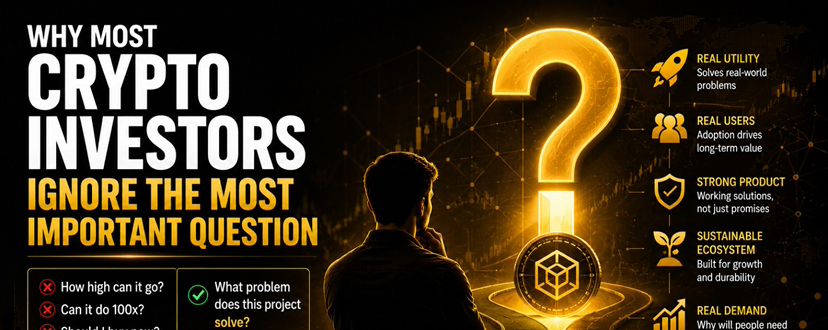
Why Most Crypto Investors Ignore the Most Important QuestionWhen people discover a new cryptocurrency, they usually ask:
❌ "How high can it go?"
❌ "Can it do 100x?"
❌ "Should I buy now?"
But experienced investors often start with a different question:
✅ "What problem does this project solve?"
This simple shift in thinking can completely change how you evaluate crypto projects.
Blockchain networks, tokens, and decentralized applications aren't valuable just because they're popular. Long-term value is usually created when a project solves a real problem—whether that's enabling faster payments, improving security, supporting decentralized finance, or powering digital ownership.
Before investing in any cryptocurrency, consider:
What is the project's purpose?
Who actually uses it?
Does it have a working product?
Is there a sustainable ecosystem around it?
Why would demand for this token increase over time?
Many projects attract attention during market hype cycles, but only a smaller number continue building, growing users, and delivering real utility.
Binance Academy regularly emphasizes understanding a project's fundamentals before making investment decisions. Learning how blockchain networks create value can help investors look beyond price movements and make more informed choices.
💡 Key Takeaway
The best investors don't just ask whether a token's price can rise—they ask why it should rise.
The next time you research a crypto project, focus on its utility before its price chart.
What's the most useful blockchain project you've come across recently, and what real-world problem does it solve?
#BinanceSquare #cryptoeducation #blockchain
Why Most Crypto Investors Ignore the Most Important Question
When people discover a new cryptocurrency, they usually ask:
❌ "How high can it go?"
❌ "Can it do 100x?"
❌ "Should I buy now?"
But experienced investors often start with a different question:
✅ "What problem does this project solve?"
This simple shift in thinking can completely change how you evaluate crypto projects.
Blockchain networks, tokens, and decentralized applications aren't valuable just because they're popular. Long-term value is usually created when a project solves a real problem—whether that's enabling faster payments, improving security, supporting decentralized finance, or powering digital ownership.
Before investing in any cryptocurrency, consider:
What is the project's purpose?
Who actually uses it?
Does it have a working product?
Is there a sustainable ecosystem around it?
Why would demand for this token increase over time?
Many projects attract attention during market hype cycles, but only a smaller number continue building, growing users, and delivering real utility.
Binance Academy regularly emphasizes understanding a project's fundamentals before making investment decisions. Learning how blockchain networks create value can help investors look beyond price movements and make more informed choices.
💡 Key Takeaway
The best investors don't just ask whether a token's price can rise—they ask why it should rise.
The next time you research a crypto project, focus on its utility before its price chart.
What's the most useful blockchain project you've come across recently, and what real-world problem does it solve?
#BinanceSquare #cryptoeducation #blockchain
❌ "How high can it go?"
❌ "Can it do 100x?"
❌ "Should I buy now?"
But experienced investors often start with a different question:
✅ "What problem does this project solve?"
This simple shift in thinking can completely change how you evaluate crypto projects.
Blockchain networks, tokens, and decentralized applications aren't valuable just because they're popular. Long-term value is usually created when a project solves a real problem—whether that's enabling faster payments, improving security, supporting decentralized finance, or powering digital ownership.
Before investing in any cryptocurrency, consider:
What is the project's purpose?
Who actually uses it?
Does it have a working product?
Is there a sustainable ecosystem around it?
Why would demand for this token increase over time?
Many projects attract attention during market hype cycles, but only a smaller number continue building, growing users, and delivering real utility.
Binance Academy regularly emphasizes understanding a project's fundamentals before making investment decisions. Learning how blockchain networks create value can help investors look beyond price movements and make more informed choices.
💡 Key Takeaway
The best investors don't just ask whether a token's price can rise—they ask why it should rise.
The next time you research a crypto project, focus on its utility before its price chart.
What's the most useful blockchain project you've come across recently, and what real-world problem does it solve?
#BinanceSquare #cryptoeducation #blockchain
144
·
--
Article
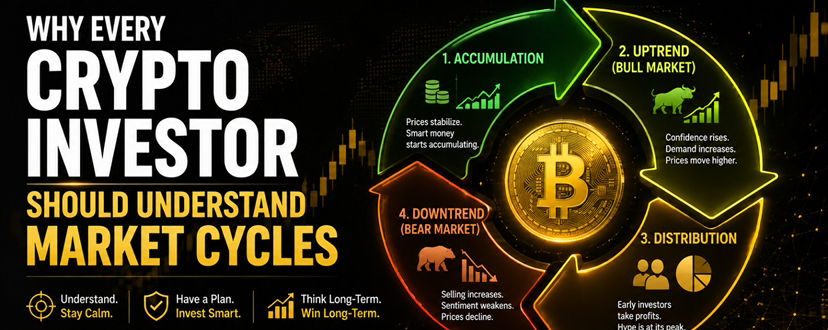
Why Every Crypto Investor Should Understand Market CyclesHave you noticed that crypto markets often move from extreme excitement to extreme fear?
One month, everyone is talking about new highs and life-changing gains. A few months later, people start saying crypto is finished. Yet this pattern has repeated many times throughout crypto's history.
These shifts are known as market cycles.
A typical cycle consists of four phases:
📈 Accumulation – Prices stabilize after a decline, and long-term investors quietly begin buying.
🚀 Uptrend (Bull Market) – Confidence returns, demand increases, and prices move higher.
⚠️ Distribution – Early investors start taking profits while public excitement reaches its peak.
📉 Downtrend (Bear Market) – Selling pressure increases, sentiment weakens, and prices decline.
The challenge is that most people do the opposite of what they should. They become interested during the excitement phase and lose interest during periods when valuable learning and research can happen.
Understanding market cycles doesn't mean you can predict every price move. However, it can help you avoid emotional decisions and maintain a longer-term perspective. Binance Academy frequently highlights the importance of market psychology and understanding how sentiment influences investor behavior.
The most successful investors aren't necessarily the ones who perfectly time the market. They're often the ones who remain patient, continue learning, and stick to a plan regardless of short-term noise.
💡 Key Takeaway
Markets change, but human emotions remain surprisingly consistent. Learning to recognize market cycles can help you make more rational decisions and avoid getting swept up in hype or fear.
Which phase of the crypto market do you think we're in right now?
#BinanceSquare #MarketCycles
Why Every Crypto Investor Should Understand Market Cycles
Have you noticed that crypto markets often move from extreme excitement to extreme fear?
One month, everyone is talking about new highs and life-changing gains. A few months later, people start saying crypto is finished. Yet this pattern has repeated many times throughout crypto's history.
These shifts are known as market cycles.
A typical cycle consists of four phases:
📈 Accumulation – Prices stabilize after a decline, and long-term investors quietly begin buying.
🚀 Uptrend (Bull Market) – Confidence returns, demand increases, and prices move higher.
⚠️ Distribution – Early investors start taking profits while public excitement reaches its peak.
📉 Downtrend (Bear Market) – Selling pressure increases, sentiment weakens, and prices decline.
The challenge is that most people do the opposite of what they should. They become interested during the excitement phase and lose interest during periods when valuable learning and research can happen.
Understanding market cycles doesn't mean you can predict every price move. However, it can help you avoid emotional decisions and maintain a longer-term perspective. Binance Academy frequently highlights the importance of market psychology and understanding how sentiment influences investor behavior.
The most successful investors aren't necessarily the ones who perfectly time the market. They're often the ones who remain patient, continue learning, and stick to a plan regardless of short-term noise.
💡 Key Takeaway
Markets change, but human emotions remain surprisingly consistent. Learning to recognize market cycles can help you make more rational decisions and avoid getting swept up in hype or fear.
Which phase of the crypto market do you think we're in right now?
#BinanceSquare #MarketCycles
One month, everyone is talking about new highs and life-changing gains. A few months later, people start saying crypto is finished. Yet this pattern has repeated many times throughout crypto's history.
These shifts are known as market cycles.
A typical cycle consists of four phases:
📈 Accumulation – Prices stabilize after a decline, and long-term investors quietly begin buying.
🚀 Uptrend (Bull Market) – Confidence returns, demand increases, and prices move higher.
⚠️ Distribution – Early investors start taking profits while public excitement reaches its peak.
📉 Downtrend (Bear Market) – Selling pressure increases, sentiment weakens, and prices decline.
The challenge is that most people do the opposite of what they should. They become interested during the excitement phase and lose interest during periods when valuable learning and research can happen.
Understanding market cycles doesn't mean you can predict every price move. However, it can help you avoid emotional decisions and maintain a longer-term perspective. Binance Academy frequently highlights the importance of market psychology and understanding how sentiment influences investor behavior.
The most successful investors aren't necessarily the ones who perfectly time the market. They're often the ones who remain patient, continue learning, and stick to a plan regardless of short-term noise.
💡 Key Takeaway
Markets change, but human emotions remain surprisingly consistent. Learning to recognize market cycles can help you make more rational decisions and avoid getting swept up in hype or fear.
Which phase of the crypto market do you think we're in right now?
#BinanceSquare #MarketCycles
151
·
--

Article
Why Market Cap Matters More Than Coin PriceOne of the biggest mistakes new crypto investors make is thinking that a cheap coin has more potential than an expensive one.
But in reality, price alone doesn't tell the whole story.
Imagine two cryptocurrencies:
Coin A costs $0.10
Coin B costs $2,000
At first glance, Coin A might seem like the better opportunity.
However, what really matters is market capitalization (market cap)—the total value of all coins in circulation.
Market Cap = Current Price × Circulating Supply
For example, if a token costs $0.10 but has 500 billion coins in circulation, its market cap is already enormous. That means it may require a massive amount of new investment to significantly increase in value.
On the other hand, a higher-priced cryptocurrency with a much smaller circulating supply could have a lower market cap and potentially more room for growth.
This is why experienced investors compare projects based on market cap, utility, adoption, and fundamentals, rather than focusing only on the price per coin. Binance Academy also emphasizes understanding core metrics before making investment decisions.
💡 Key Takeaway
A low coin price doesn't automatically mean a better investment.
Always look beyond the price and understand the project's market cap, supply, and real-world utility before investing.
Have you ever judged a cryptocurrency by its price alone?
#BinanceSquare #cryptoeducation #marketcap
Why Market Cap Matters More Than Coin Price
One of the biggest mistakes new crypto investors make is thinking that a cheap coin has more potential than an expensive one.
But in reality, price alone doesn't tell the whole story.
Imagine two cryptocurrencies:
Coin A costs $0.10
Coin B costs $2,000
At first glance, Coin A might seem like the better opportunity.
However, what really matters is market capitalization (market cap)—the total value of all coins in circulation.
Market Cap = Current Price × Circulating Supply
For example, if a token costs $0.10 but has 500 billion coins in circulation, its market cap is already enormous. That means it may require a massive amount of new investment to significantly increase in value.
On the other hand, a higher-priced cryptocurrency with a much smaller circulating supply could have a lower market cap and potentially more room for growth.
This is why experienced investors compare projects based on market cap, utility, adoption, and fundamentals, rather than focusing only on the price per coin. Binance Academy also emphasizes understanding core metrics before making investment decisions.
💡 Key Takeaway
A low coin price doesn't automatically mean a better investment.
Always look beyond the price and understand the project's market cap, supply, and real-world utility before investing.
Have you ever judged a cryptocurrency by its price alone?
#BinanceSquare #cryptoeducation #marketcap
But in reality, price alone doesn't tell the whole story.
Imagine two cryptocurrencies:
Coin A costs $0.10
Coin B costs $2,000
At first glance, Coin A might seem like the better opportunity.
However, what really matters is market capitalization (market cap)—the total value of all coins in circulation.
Market Cap = Current Price × Circulating Supply
For example, if a token costs $0.10 but has 500 billion coins in circulation, its market cap is already enormous. That means it may require a massive amount of new investment to significantly increase in value.
On the other hand, a higher-priced cryptocurrency with a much smaller circulating supply could have a lower market cap and potentially more room for growth.
This is why experienced investors compare projects based on market cap, utility, adoption, and fundamentals, rather than focusing only on the price per coin. Binance Academy also emphasizes understanding core metrics before making investment decisions.
💡 Key Takeaway
A low coin price doesn't automatically mean a better investment.
Always look beyond the price and understand the project's market cap, supply, and real-world utility before investing.
Have you ever judged a cryptocurrency by its price alone?
#BinanceSquare #cryptoeducation #marketcap
1
201
·
--
Article
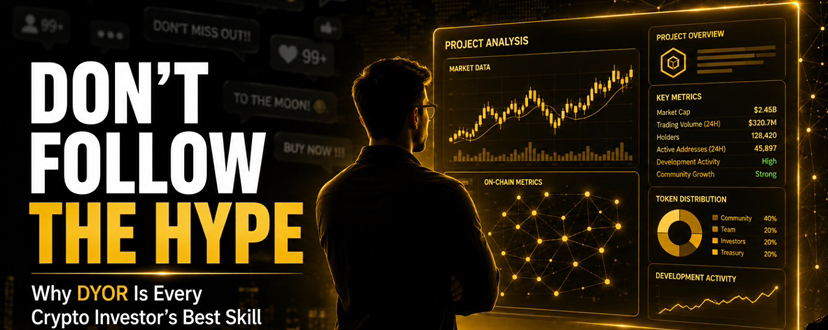
Why "Do Your Own Research" (DYOR) Matters More Than EverIf you've spent any time in crypto, you've probably seen people say:
"DYOR – Do Your Own Research."
It sounds simple, but it's one of the most valuable habits you can develop as an investor.
Every day, social media is filled with predictions, price targets, and "next 100x coin" recommendations. While some creators share useful insights, others may be driven by hype or personal interests. Following investment advice without understanding the project can expose you to unnecessary risk.
Doing your own research doesn't mean you need to read hundreds of pages of technical documents. Start with the basics:
What problem does the project solve?
Is there a real product or use case?
Is the development team actively building?
Does the project have a growing community?
What are the potential risks?
Even spending 15–20 minutes researching before investing can help you make more informed decisions.
Remember, successful investing isn't about following the loudest voice—it's about understanding why you're investing in the first place.
💡 Key Takeaway
The best investment decision is one you understand. Knowledge won't remove risk, but it can help you avoid making decisions based purely on hype.
Before buying your next cryptocurrency, ask yourself: "Do I understand this project, or am I simply following the crowd?"
#BinanceSquare #cryptoeducation #dyor
Why "Do Your Own Research" (DYOR) Matters More Than Ever
If you've spent any time in crypto, you've probably seen people say:
"DYOR – Do Your Own Research."
It sounds simple, but it's one of the most valuable habits you can develop as an investor.
Every day, social media is filled with predictions, price targets, and "next 100x coin" recommendations. While some creators share useful insights, others may be driven by hype or personal interests. Following investment advice without understanding the project can expose you to unnecessary risk.
Doing your own research doesn't mean you need to read hundreds of pages of technical documents. Start with the basics:
What problem does the project solve?
Is there a real product or use case?
Is the development team actively building?
Does the project have a growing community?
What are the potential risks?
Even spending 15–20 minutes researching before investing can help you make more informed decisions.
Remember, successful investing isn't about following the loudest voice—it's about understanding why you're investing in the first place.
💡 Key Takeaway
The best investment decision is one you understand. Knowledge won't remove risk, but it can help you avoid making decisions based purely on hype.
Before buying your next cryptocurrency, ask yourself: "Do I understand this project, or am I simply following the crowd?"
#BinanceSquare #cryptoeducation #dyor
"DYOR – Do Your Own Research."
It sounds simple, but it's one of the most valuable habits you can develop as an investor.
Every day, social media is filled with predictions, price targets, and "next 100x coin" recommendations. While some creators share useful insights, others may be driven by hype or personal interests. Following investment advice without understanding the project can expose you to unnecessary risk.
Doing your own research doesn't mean you need to read hundreds of pages of technical documents. Start with the basics:
What problem does the project solve?
Is there a real product or use case?
Is the development team actively building?
Does the project have a growing community?
What are the potential risks?
Even spending 15–20 minutes researching before investing can help you make more informed decisions.
Remember, successful investing isn't about following the loudest voice—it's about understanding why you're investing in the first place.
💡 Key Takeaway
The best investment decision is one you understand. Knowledge won't remove risk, but it can help you avoid making decisions based purely on hype.
Before buying your next cryptocurrency, ask yourself: "Do I understand this project, or am I simply following the crowd?"
#BinanceSquare #cryptoeducation #dyor
1
177
·
--
Article
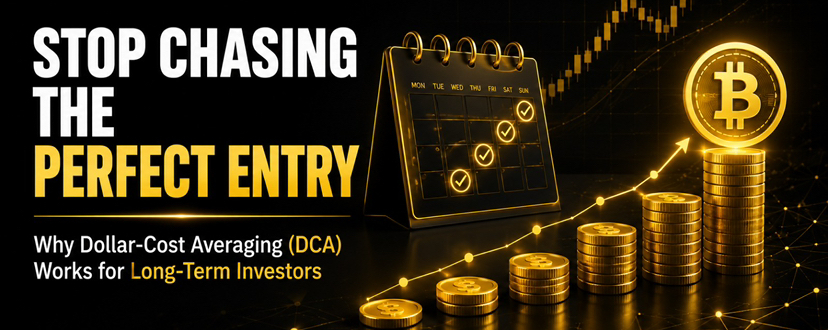
Why Dollar-Cost Averaging (DCA) Is One of Crypto's Simplest StrategiesHave you ever bought a cryptocurrency only to watch the price drop the next day?
It happens to almost every investor.
Trying to buy at the perfect moment sounds great, but in reality, it's extremely difficult—even for experienced traders. That's why many long-term investors use a strategy called Dollar-Cost Averaging (DCA).
DCA simply means investing a fixed amount of money at regular intervals, regardless of whether the market is up or down. For example, instead of investing $1,200 all at once, you could invest $100 every month.
When prices are lower, your fixed amount buys more of the asset. When prices are higher, it buys less. Over time, this helps smooth out the impact of short-term price swings and removes much of the emotion from investing. Binance Academy highlights DCA as a disciplined approach that can help investors avoid trying to time the market.
Of course, DCA doesn't guarantee profits or eliminate risk. If the asset performs poorly over the long term, losses are still possible. That's why it's important to combine DCA with research and only invest money you can afford to keep invested.
💡 Key Takeaway
You don't have to predict the perfect entry point to become a disciplined investor. Consistency often matters more than perfect timing.
How do you invest in crypto—do you buy regularly or wait for price dips?
#BinanceSquare #cryptoeducation #Investing
Why Dollar-Cost Averaging (DCA) Is One of Crypto's Simplest Strategies
Have you ever bought a cryptocurrency only to watch the price drop the next day?
It happens to almost every investor.
Trying to buy at the perfect moment sounds great, but in reality, it's extremely difficult—even for experienced traders. That's why many long-term investors use a strategy called Dollar-Cost Averaging (DCA).
DCA simply means investing a fixed amount of money at regular intervals, regardless of whether the market is up or down. For example, instead of investing $1,200 all at once, you could invest $100 every month.
When prices are lower, your fixed amount buys more of the asset. When prices are higher, it buys less. Over time, this helps smooth out the impact of short-term price swings and removes much of the emotion from investing. Binance Academy highlights DCA as a disciplined approach that can help investors avoid trying to time the market.
Of course, DCA doesn't guarantee profits or eliminate risk. If the asset performs poorly over the long term, losses are still possible. That's why it's important to combine DCA with research and only invest money you can afford to keep invested.
💡 Key Takeaway
You don't have to predict the perfect entry point to become a disciplined investor. Consistency often matters more than perfect timing.
How do you invest in crypto—do you buy regularly or wait for price dips?
#BinanceSquare #cryptoeducation #Investing
It happens to almost every investor.
Trying to buy at the perfect moment sounds great, but in reality, it's extremely difficult—even for experienced traders. That's why many long-term investors use a strategy called Dollar-Cost Averaging (DCA).
DCA simply means investing a fixed amount of money at regular intervals, regardless of whether the market is up or down. For example, instead of investing $1,200 all at once, you could invest $100 every month.
When prices are lower, your fixed amount buys more of the asset. When prices are higher, it buys less. Over time, this helps smooth out the impact of short-term price swings and removes much of the emotion from investing. Binance Academy highlights DCA as a disciplined approach that can help investors avoid trying to time the market.
Of course, DCA doesn't guarantee profits or eliminate risk. If the asset performs poorly over the long term, losses are still possible. That's why it's important to combine DCA with research and only invest money you can afford to keep invested.
💡 Key Takeaway
You don't have to predict the perfect entry point to become a disciplined investor. Consistency often matters more than perfect timing.
How do you invest in crypto—do you buy regularly or wait for price dips?
#BinanceSquare #cryptoeducation #Investing
1
202
·
--
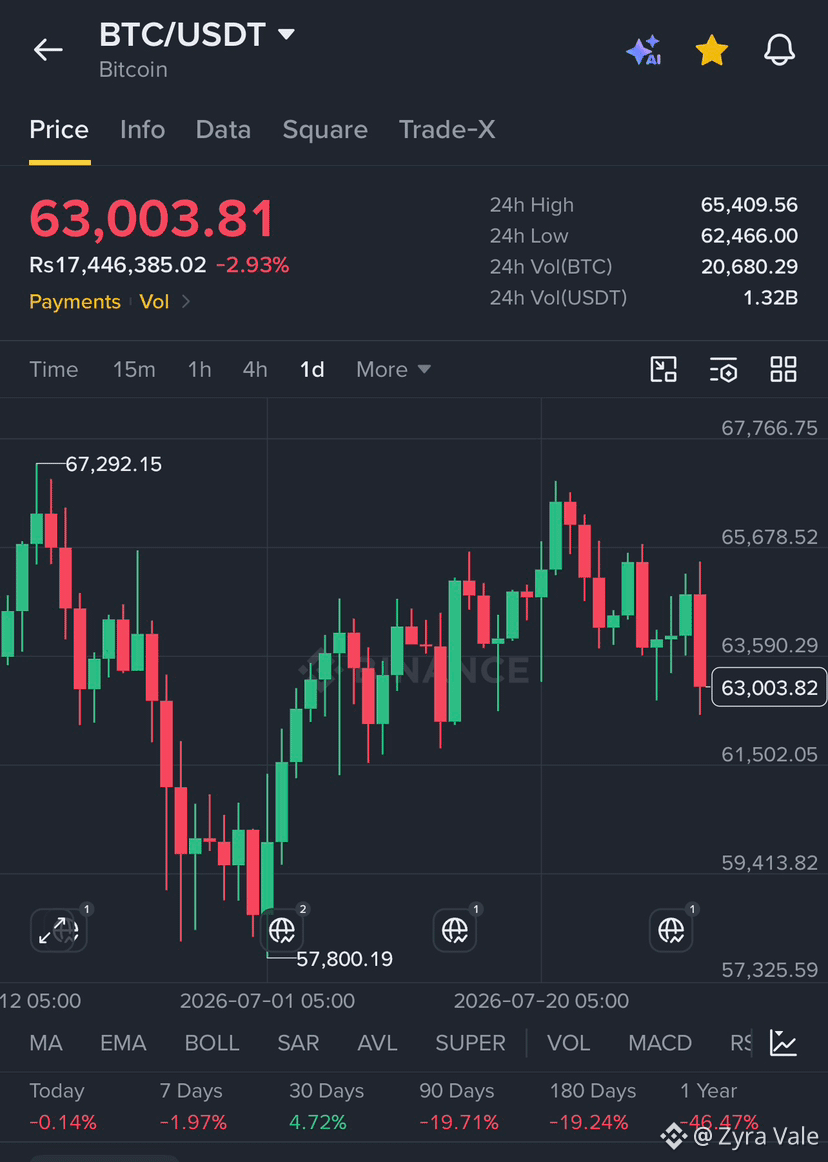
$BTC is currently consolidating around $63,003, down 2.93% after pulling back from a 24-hour high of $65,409.
Trading volume remains strong at $1.32B USDT, reflecting active engagement as price tests key intermediate levels.
BTC is holding above its 24-hour low of $62,466, balancing between resistance near $65,500 and the major structural support level at $57,800.
Reclaiming the $64,500–$65,000 zone will be essential for buyers to regain upward momentum, while a breach below $62,400 could risk a deeper retest toward macro support.
#BTC #BTC70K✈️
$BTC is currently consolidating around $63,003, down 2.93% after pulling back from a 24-hour high of $65,409.
Trading volume remains strong at $1.32B USDT, reflecting active engagement as price tests key intermediate levels.
BTC is holding above its 24-hour low of $62,466, balancing between resistance near $65,500 and the major structural support level at $57,800.
Reclaiming the $64,500–$65,000 zone will be essential for buyers to regain upward momentum, while a breach below $62,400 could risk a deeper retest toward macro support.
#BTC #BTC70K✈️
Trading volume remains strong at $1.32B USDT, reflecting active engagement as price tests key intermediate levels.
BTC is holding above its 24-hour low of $62,466, balancing between resistance near $65,500 and the major structural support level at $57,800.
Reclaiming the $64,500–$65,000 zone will be essential for buyers to regain upward momentum, while a breach below $62,400 could risk a deeper retest toward macro support.
#BTC #BTC70K✈️
1
96
·
--
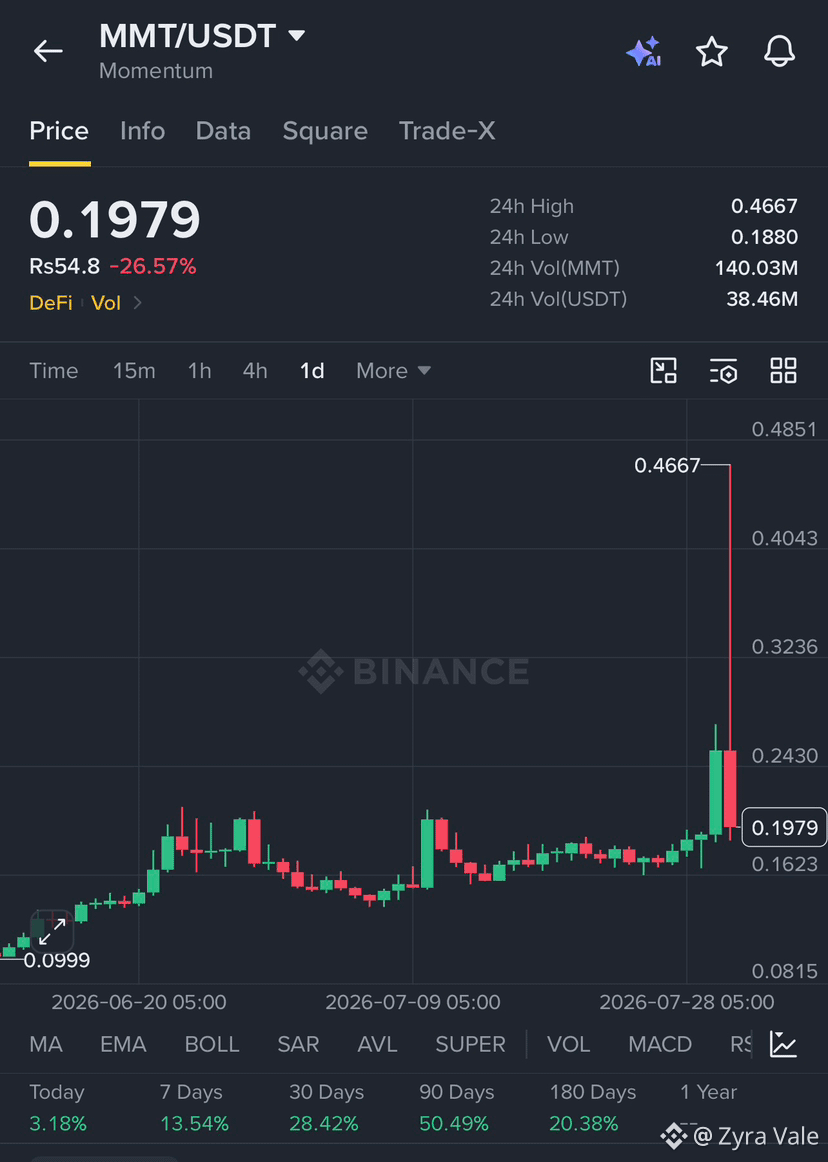
$MMT saw extreme volatility today, spiking to a local high of $0.4667 before sharp profit-taking pulled the price back to $0.1979 a 26% drop on heavy trading volume of over $38 million USDT.
This pullback returns the token to its established accumulation zone between $0.1623 and $0.2000.
Despite the single-day drop, MMT remains up over 28% for the month.
Key levels to watch include immediate support at $0.1880, with major resistance overhead between $0.2430 and $0.2500.
#MMT #Market_Update
$MMT saw extreme volatility today, spiking to a local high of $0.4667 before sharp profit-taking pulled the price back to $0.1979 a 26% drop on heavy trading volume of over $38 million USDT.
This pullback returns the token to its established accumulation zone between $0.1623 and $0.2000.
Despite the single-day drop, MMT remains up over 28% for the month.
Key levels to watch include immediate support at $0.1880, with major resistance overhead between $0.2430 and $0.2500.
#MMT #Market_Update
This pullback returns the token to its established accumulation zone between $0.1623 and $0.2000.
Despite the single-day drop, MMT remains up over 28% for the month.
Key levels to watch include immediate support at $0.1880, with major resistance overhead between $0.2430 and $0.2500.
#MMT #Market_Update
1
299
·
--

Article
Your Crypto Wallet Isn't an Investment It's Your Digital VaultMost people spend hours researching which cryptocurrency to buy.
But very few spend the same amount of time thinking about where they'll keep it.
That's a mistake that every crypto investor should avoid.
When you own cryptocurrency, your wallet is what gives you access to your assets. Whether you're holding Bitcoin, BNB, or other digital assets, understanding the difference between hot wallets and cold wallets is one of the first lessons every investor should learn.
A hot wallet is connected to the internet. It's convenient for everyday transactions, trading, and interacting with decentralized applications. Because it's always online, it's easier to access but it also requires extra attention to security.
A cold wallet, on the other hand, stores your private keys offline. Since it isn't continuously connected to the internet, it provides an additional layer of protection for long-term holdings. Many experienced investors prefer using cold storage for assets they don't plan to move frequently.
Neither option is "better" for everyone.
If you're actively trading, convenience may matter more.
If you're investing for the long term, stronger security could be the priority.
The most important habit isn't choosing the perfect wallet it's protecting your recovery phrase, enabling two-factor authentication wherever available, and never sharing sensitive information with anyone.
💡 Key Takeaway
The first step to protecting your crypto isn't finding the next big coin it's securing the coins you already own.
What matters more to you when choosing a wallet: convenience or maximum security?
#BinanceSquare #CryptoSecurity #wallets
Your Crypto Wallet Isn't an Investment It's Your Digital Vault
Most people spend hours researching which cryptocurrency to buy.
But very few spend the same amount of time thinking about where they'll keep it.
That's a mistake that every crypto investor should avoid.
When you own cryptocurrency, your wallet is what gives you access to your assets. Whether you're holding Bitcoin, BNB, or other digital assets, understanding the difference between hot wallets and cold wallets is one of the first lessons every investor should learn.
A hot wallet is connected to the internet. It's convenient for everyday transactions, trading, and interacting with decentralized applications. Because it's always online, it's easier to access but it also requires extra attention to security.
A cold wallet, on the other hand, stores your private keys offline. Since it isn't continuously connected to the internet, it provides an additional layer of protection for long-term holdings. Many experienced investors prefer using cold storage for assets they don't plan to move frequently.
Neither option is "better" for everyone.
If you're actively trading, convenience may matter more.
If you're investing for the long term, stronger security could be the priority.
The most important habit isn't choosing the perfect wallet it's protecting your recovery phrase, enabling two-factor authentication wherever available, and never sharing sensitive information with anyone.
💡 Key Takeaway
The first step to protecting your crypto isn't finding the next big coin it's securing the coins you already own.
What matters more to you when choosing a wallet: convenience or maximum security?
#BinanceSquare #CryptoSecurity #wallets
But very few spend the same amount of time thinking about where they'll keep it.
That's a mistake that every crypto investor should avoid.
When you own cryptocurrency, your wallet is what gives you access to your assets. Whether you're holding Bitcoin, BNB, or other digital assets, understanding the difference between hot wallets and cold wallets is one of the first lessons every investor should learn.
A hot wallet is connected to the internet. It's convenient for everyday transactions, trading, and interacting with decentralized applications. Because it's always online, it's easier to access but it also requires extra attention to security.
A cold wallet, on the other hand, stores your private keys offline. Since it isn't continuously connected to the internet, it provides an additional layer of protection for long-term holdings. Many experienced investors prefer using cold storage for assets they don't plan to move frequently.
Neither option is "better" for everyone.
If you're actively trading, convenience may matter more.
If you're investing for the long term, stronger security could be the priority.
The most important habit isn't choosing the perfect wallet it's protecting your recovery phrase, enabling two-factor authentication wherever available, and never sharing sensitive information with anyone.
💡 Key Takeaway
The first step to protecting your crypto isn't finding the next big coin it's securing the coins you already own.
What matters more to you when choosing a wallet: convenience or maximum security?
#BinanceSquare #CryptoSecurity #wallets
1
242
·
--
Why Every Crypto Investor Should Understand Market Cycles?Have you ever wondered why people become excited about crypto near the top of the market and fearful near the bottom?
The answer often comes down to market psychology.
Crypto prices don't move only because of technology or news. Emotions like fear, greed, optimism, and panic also influence how people buy and sell. Understanding these market cycles can help you make more rational decisions instead of reacting emotionally.
A typical market cycle begins with optimism, where confidence slowly builds. As prices continue rising, excitement grows and many new investors enter the market. Eventually, excessive confidence can lead to unrealistic expectations, and when prices start falling, fear replaces optimism. Some investors panic and sell at a loss, while experienced investors often use this period to reassess opportunities.
The important lesson isn't trying to predict every market move it's learning to recognise where emotions may be influencing your decisions.
Before making any investment, ask yourself:
Am I investing because I've done my research?
Or am I simply following the crowd?
Making decisions based on knowledge instead of emotions can help you stay focused on your long-term goals.
💡 Key Takeaway
Successful investing isn't just about choosing the right cryptocurrency. It's also about managing your emotions during both rising and falling markets.
What's your biggest challenge during volatile markets staying patient or resisting FOMO?
#BinanceSquare #cryptoeducation #Marketpsychology
Why Every Crypto Investor Should Understand Market Cycles?
Have you ever wondered why people become excited about crypto near the top of the market and fearful near the bottom?
The answer often comes down to market psychology.
Crypto prices don't move only because of technology or news. Emotions like fear, greed, optimism, and panic also influence how people buy and sell. Understanding these market cycles can help you make more rational decisions instead of reacting emotionally.
A typical market cycle begins with optimism, where confidence slowly builds. As prices continue rising, excitement grows and many new investors enter the market. Eventually, excessive confidence can lead to unrealistic expectations, and when prices start falling, fear replaces optimism. Some investors panic and sell at a loss, while experienced investors often use this period to reassess opportunities.
The important lesson isn't trying to predict every market move it's learning to recognise where emotions may be influencing your decisions.
Before making any investment, ask yourself:
Am I investing because I've done my research?
Or am I simply following the crowd?
Making decisions based on knowledge instead of emotions can help you stay focused on your long-term goals.
💡 Key Takeaway
Successful investing isn't just about choosing the right cryptocurrency. It's also about managing your emotions during both rising and falling markets.
What's your biggest challenge during volatile markets staying patient or resisting FOMO?
#BinanceSquare #cryptoeducation #Marketpsychology
The answer often comes down to market psychology.
Crypto prices don't move only because of technology or news. Emotions like fear, greed, optimism, and panic also influence how people buy and sell. Understanding these market cycles can help you make more rational decisions instead of reacting emotionally.
A typical market cycle begins with optimism, where confidence slowly builds. As prices continue rising, excitement grows and many new investors enter the market. Eventually, excessive confidence can lead to unrealistic expectations, and when prices start falling, fear replaces optimism. Some investors panic and sell at a loss, while experienced investors often use this period to reassess opportunities.
The important lesson isn't trying to predict every market move it's learning to recognise where emotions may be influencing your decisions.
Before making any investment, ask yourself:
Am I investing because I've done my research?
Or am I simply following the crowd?
Making decisions based on knowledge instead of emotions can help you stay focused on your long-term goals.
💡 Key Takeaway
Successful investing isn't just about choosing the right cryptocurrency. It's also about managing your emotions during both rising and falling markets.
What's your biggest challenge during volatile markets staying patient or resisting FOMO?
#BinanceSquare #cryptoeducation #Marketpsychology
119
·
--
Why Do Some Crypto Projects Succeed While Others Disappear?Every week, new crypto projects enter the market. Some attract thousands of investors, while others fade away within months. So, what separates the winners from the rest?
The answer isn't always a higher token price or flashy marketing. Strong projects are usually built on three key foundations.
1. They solve a real problem.
The most successful blockchain projects aren't created just to launch a token. They offer solutions that people actually use whether it's making payments faster, improving decentralised finance (DeFi), enabling gaming, or supporting AI applications.
Before investing, ask yourself a simple question:
"If this token didn't exist, would anyone still need the product?"
If the answer is no, that's worth thinking about.
2. They have a strong ecosystem.
A project grows when developers continue building, users stay active, and the community remains engaged. Even the best technology can struggle if there's no real adoption.
This is one reason why ecosystems like BNB Chain, Ethereum, and Bitcoin continue to attract attention they've built communities and infrastructure that support long-term growth.
3. They focus on the long term.
Crypto moves quickly, but sustainable projects don't chase every trend. They release updates, improve security, listen to their communities, and continue developing through both bull and bear markets.
As an investor, it's easy to get distracted by price movements. But looking beyond the charts can help you make more informed decisions.
Key Takeaway
A project's long-term value is driven by its utility, ecosystem, and consistent development not by short-term hype.
What do you think?
When you research a crypto project, what's the first thing you look at: the team, the technology, the community, or the token's price.
#Blockchain #cryptoeducation #Web3
Why Do Some Crypto Projects Succeed While Others Disappear?
Every week, new crypto projects enter the market. Some attract thousands of investors, while others fade away within months. So, what separates the winners from the rest?
The answer isn't always a higher token price or flashy marketing. Strong projects are usually built on three key foundations.
1. They solve a real problem.
The most successful blockchain projects aren't created just to launch a token. They offer solutions that people actually use whether it's making payments faster, improving decentralised finance (DeFi), enabling gaming, or supporting AI applications.
Before investing, ask yourself a simple question:
"If this token didn't exist, would anyone still need the product?"
If the answer is no, that's worth thinking about.
2. They have a strong ecosystem.
A project grows when developers continue building, users stay active, and the community remains engaged. Even the best technology can struggle if there's no real adoption.
This is one reason why ecosystems like BNB Chain, Ethereum, and Bitcoin continue to attract attention they've built communities and infrastructure that support long-term growth.
3. They focus on the long term.
Crypto moves quickly, but sustainable projects don't chase every trend. They release updates, improve security, listen to their communities, and continue developing through both bull and bear markets.
As an investor, it's easy to get distracted by price movements. But looking beyond the charts can help you make more informed decisions.
Key Takeaway
A project's long-term value is driven by its utility, ecosystem, and consistent development not by short-term hype.
What do you think?
When you research a crypto project, what's the first thing you look at: the team, the technology, the community, or the token's price.
#Blockchain #cryptoeducation #Web3
The answer isn't always a higher token price or flashy marketing. Strong projects are usually built on three key foundations.
1. They solve a real problem.
The most successful blockchain projects aren't created just to launch a token. They offer solutions that people actually use whether it's making payments faster, improving decentralised finance (DeFi), enabling gaming, or supporting AI applications.
Before investing, ask yourself a simple question:
"If this token didn't exist, would anyone still need the product?"
If the answer is no, that's worth thinking about.
2. They have a strong ecosystem.
A project grows when developers continue building, users stay active, and the community remains engaged. Even the best technology can struggle if there's no real adoption.
This is one reason why ecosystems like BNB Chain, Ethereum, and Bitcoin continue to attract attention they've built communities and infrastructure that support long-term growth.
3. They focus on the long term.
Crypto moves quickly, but sustainable projects don't chase every trend. They release updates, improve security, listen to their communities, and continue developing through both bull and bear markets.
As an investor, it's easy to get distracted by price movements. But looking beyond the charts can help you make more informed decisions.
Key Takeaway
A project's long-term value is driven by its utility, ecosystem, and consistent development not by short-term hype.
What do you think?
When you research a crypto project, what's the first thing you look at: the team, the technology, the community, or the token's price.
#Blockchain #cryptoeducation #Web3
132
·
--
Everyone talks about AI getting smarter.
Very few talk about where the intelligence actually comes from.
Models don't improve in a vacuum.
They improve because someone contributes data, knowledge, feedback, and expertise behind the scenes.
That creates an interesting question:
If data is becoming one of the most valuable assets in the AI economy, who gets rewarded for providing it?
This is why projects like Genius are interesting to watch.
They're exploring a future where intelligence creation becomes an open economy instead of a closed system controlled by a handful of companies.
Contributors provide value.
Networks coordinate it.
Rewards flow back to the people helping improve the ecosystem.
The long term AI race may not be about building the biggest model.
It may be about building the best incentive system around intelligence itself.
That's where the real moat gets created.
#genius $GENIUS @GeniusOfficial
Everyone talks about AI getting smarter.
Very few talk about where the intelligence actually comes from.
Models don't improve in a vacuum.
They improve because someone contributes data, knowledge, feedback, and expertise behind the scenes.
That creates an interesting question:
If data is becoming one of the most valuable assets in the AI economy, who gets rewarded for providing it?
This is why projects like Genius are interesting to watch.
They're exploring a future where intelligence creation becomes an open economy instead of a closed system controlled by a handful of companies.
Contributors provide value.
Networks coordinate it.
Rewards flow back to the people helping improve the ecosystem.
The long term AI race may not be about building the biggest model.
It may be about building the best incentive system around intelligence itself.
That's where the real moat gets created.
#genius $GENIUS @GeniusOfficial
Very few talk about where the intelligence actually comes from.
Models don't improve in a vacuum.
They improve because someone contributes data, knowledge, feedback, and expertise behind the scenes.
That creates an interesting question:
If data is becoming one of the most valuable assets in the AI economy, who gets rewarded for providing it?
This is why projects like Genius are interesting to watch.
They're exploring a future where intelligence creation becomes an open economy instead of a closed system controlled by a handful of companies.
Contributors provide value.
Networks coordinate it.
Rewards flow back to the people helping improve the ecosystem.
The long term AI race may not be about building the biggest model.
It may be about building the best incentive system around intelligence itself.
That's where the real moat gets created.
#genius $GENIUS @GeniusOfficial
1
3
157
·
--
Most DeFi protocols are competing for liquidity.
Bedrock is competing for idle capital.
That’s a much bigger game.
The reason liquid restaking keeps gaining attention isn’t just APY. It’s because users are tired of choosing between security, yield, and flexibility. Capital sitting inactive is basically dead weight in this market.
Bedrock is positioning itself around that exact behavior shift.
Instead of the old model:
stake assets → lock them → wait
the newer model is becoming:
stake assets → keep liquidity → reuse capital across ecosystems
That changes user psychology completely.
Protocols that reduce “capital friction” usually grow faster because they align with how people actually use crypto during volatile markets. Users want exposure, optionality, and yield at the same time.
And honestly, this is where a lot of people still underestimate BR.
The biggest winners in the next cycle may not be the loudest chains or the flashiest memes. It could be the infrastructure quietly making capital more efficient underneath everything else.
That layer compounds value slowly until suddenly everyone depends on it.
#genius $GENIUS @GeniusOfficial
Most DeFi protocols are competing for liquidity.
Bedrock is competing for idle capital.
That’s a much bigger game.
The reason liquid restaking keeps gaining attention isn’t just APY. It’s because users are tired of choosing between security, yield, and flexibility. Capital sitting inactive is basically dead weight in this market.
Bedrock is positioning itself around that exact behavior shift.
Instead of the old model:
stake assets → lock them → wait
the newer model is becoming:
stake assets → keep liquidity → reuse capital across ecosystems
That changes user psychology completely.
Protocols that reduce “capital friction” usually grow faster because they align with how people actually use crypto during volatile markets. Users want exposure, optionality, and yield at the same time.
And honestly, this is where a lot of people still underestimate BR.
The biggest winners in the next cycle may not be the loudest chains or the flashiest memes. It could be the infrastructure quietly making capital more efficient underneath everything else.
That layer compounds value slowly until suddenly everyone depends on it.
#genius $GENIUS @GeniusOfficial
Bedrock is competing for idle capital.
That’s a much bigger game.
The reason liquid restaking keeps gaining attention isn’t just APY. It’s because users are tired of choosing between security, yield, and flexibility. Capital sitting inactive is basically dead weight in this market.
Bedrock is positioning itself around that exact behavior shift.
Instead of the old model:
stake assets → lock them → wait
the newer model is becoming:
stake assets → keep liquidity → reuse capital across ecosystems
That changes user psychology completely.
Protocols that reduce “capital friction” usually grow faster because they align with how people actually use crypto during volatile markets. Users want exposure, optionality, and yield at the same time.
And honestly, this is where a lot of people still underestimate BR.
The biggest winners in the next cycle may not be the loudest chains or the flashiest memes. It could be the infrastructure quietly making capital more efficient underneath everything else.
That layer compounds value slowly until suddenly everyone depends on it.
#genius $GENIUS @GeniusOfficial
2
165
·
--
Why OpenLedger Feels Different From Most AI Narratives Right NowLately I’ve been noticing that most AI discussions in crypto still revolve around the same topics.
Better models.
More automation.
Faster outputs.
And honestly that makes sense because those are the easiest improvements to notice immediately.
But the longer I watch the AI sector develop, the more it feels like another layer is slowly becoming important too.
The coordination layer underneath all the outputs.
Mainly:
how contributions are tracked,
how data is organized,
and how ecosystems manage participation as they scale.
That’s partly why OpenLedger started catching my attention recently.
The attribution angle feels more relevant the more AI adoption grows.
Because once more users, applications, and datasets interact across ecosystems, contribution tracking probably becomes a much bigger conversation.
Crypto already showed how quickly online behavior evolves when networks start scaling.
Early communities usually feel simple and organic.
Then ecosystems grow.
More users arrive.
Participation increases.
And gradually infrastructure around coordination becomes more important.
That pattern shows up in almost every cycle.
Which is why I think AI infrastructure may eventually depend on more than just generation capability alone.
The systems organizing participation and attribution could matter just as much over time.
That’s the part of OpenLedger I find interesting.
The project seems directionally focused on infrastructure supporting contribution coordination rather than only surface-level AI outputs.
And honestly, infrastructure narratives usually take longer for the market to fully appreciate.
Most people naturally pay attention to visible applications first.
That happens every cycle in crypto.
But later on, the underlying systems supporting ecosystem growth often become much more important than they initially appeared.
Still early obviously.
AI infrastructure is moving extremely fast and different projects are approaching the sector from different angles.
But I do think attribution, contribution tracking, and coordination systems could become larger themes as AI ecosystems continue expanding.
Especially as more digital activity becomes AI-assisted over time.
Feels like the market is still heavily focused on what AI can generate.
But the infrastructure supporting how ecosystems coordinate around those outputs may quietly become just as important later.
That’s mainly why I’ve been watching OpenLedger recently.
$OPEN #OpenLedger @Openledger
Why OpenLedger Feels Different From Most AI Narratives Right Now
Lately I’ve been noticing that most AI discussions in crypto still revolve around the same topics.
Better models.
More automation.
Faster outputs.
And honestly that makes sense because those are the easiest improvements to notice immediately.
But the longer I watch the AI sector develop, the more it feels like another layer is slowly becoming important too.
The coordination layer underneath all the outputs.
Mainly:
how contributions are tracked,
how data is organized,
and how ecosystems manage participation as they scale.
That’s partly why OpenLedger started catching my attention recently.
The attribution angle feels more relevant the more AI adoption grows.
Because once more users, applications, and datasets interact across ecosystems, contribution tracking probably becomes a much bigger conversation.
Crypto already showed how quickly online behavior evolves when networks start scaling.
Early communities usually feel simple and organic.
Then ecosystems grow.
More users arrive.
Participation increases.
And gradually infrastructure around coordination becomes more important.
That pattern shows up in almost every cycle.
Which is why I think AI infrastructure may eventually depend on more than just generation capability alone.
The systems organizing participation and attribution could matter just as much over time.
That’s the part of OpenLedger I find interesting.
The project seems directionally focused on infrastructure supporting contribution coordination rather than only surface-level AI outputs.
And honestly, infrastructure narratives usually take longer for the market to fully appreciate.
Most people naturally pay attention to visible applications first.
That happens every cycle in crypto.
But later on, the underlying systems supporting ecosystem growth often become much more important than they initially appeared.
Still early obviously.
AI infrastructure is moving extremely fast and different projects are approaching the sector from different angles.
But I do think attribution, contribution tracking, and coordination systems could become larger themes as AI ecosystems continue expanding.
Especially as more digital activity becomes AI-assisted over time.
Feels like the market is still heavily focused on what AI can generate.
But the infrastructure supporting how ecosystems coordinate around those outputs may quietly become just as important later.
That’s mainly why I’ve been watching OpenLedger recently.
$OPEN #OpenLedger @Openledger
Better models.
More automation.
Faster outputs.
And honestly that makes sense because those are the easiest improvements to notice immediately.
But the longer I watch the AI sector develop, the more it feels like another layer is slowly becoming important too.
The coordination layer underneath all the outputs.
Mainly:
how contributions are tracked,
how data is organized,
and how ecosystems manage participation as they scale.
That’s partly why OpenLedger started catching my attention recently.
The attribution angle feels more relevant the more AI adoption grows.
Because once more users, applications, and datasets interact across ecosystems, contribution tracking probably becomes a much bigger conversation.
Crypto already showed how quickly online behavior evolves when networks start scaling.
Early communities usually feel simple and organic.
Then ecosystems grow.
More users arrive.
Participation increases.
And gradually infrastructure around coordination becomes more important.
That pattern shows up in almost every cycle.
Which is why I think AI infrastructure may eventually depend on more than just generation capability alone.
The systems organizing participation and attribution could matter just as much over time.
That’s the part of OpenLedger I find interesting.
The project seems directionally focused on infrastructure supporting contribution coordination rather than only surface-level AI outputs.
And honestly, infrastructure narratives usually take longer for the market to fully appreciate.
Most people naturally pay attention to visible applications first.
That happens every cycle in crypto.
But later on, the underlying systems supporting ecosystem growth often become much more important than they initially appeared.
Still early obviously.
AI infrastructure is moving extremely fast and different projects are approaching the sector from different angles.
But I do think attribution, contribution tracking, and coordination systems could become larger themes as AI ecosystems continue expanding.
Especially as more digital activity becomes AI-assisted over time.
Feels like the market is still heavily focused on what AI can generate.
But the infrastructure supporting how ecosystems coordinate around those outputs may quietly become just as important later.
That’s mainly why I’ve been watching OpenLedger recently.
$OPEN #OpenLedger @Openledger
3
118
·
--
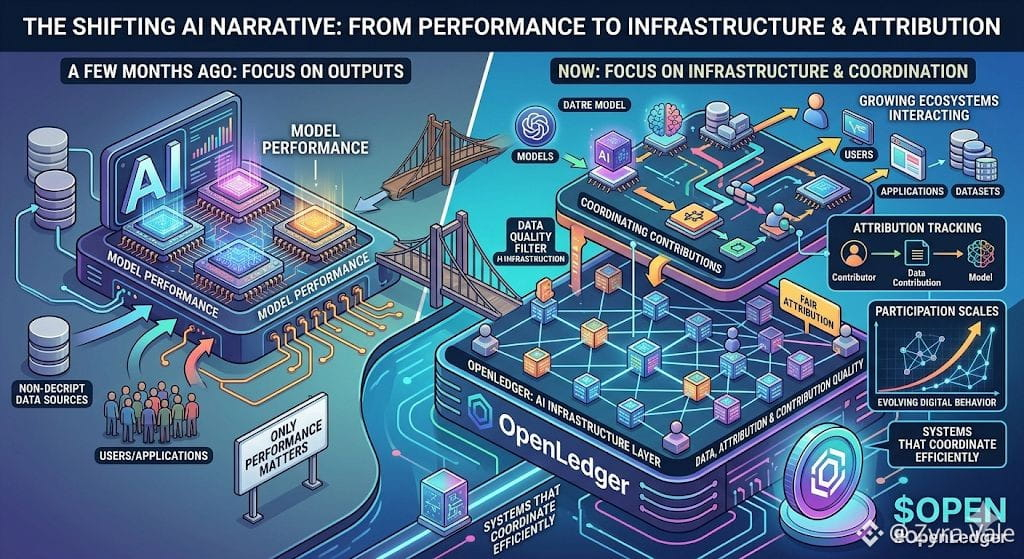
Feels like the AI narrative is slowly shifting lately.
a few months ago most people only cared about model performance.
now I’m noticing more discussions around data, attribution, and contribution quality too.
that’s partly why OpenLedger started standing out to me recently.
the project feels focused on a layer of AI infrastructure that probably becomes more important as ecosystems grow.
especially once more users, applications, and datasets start interacting across networks.
crypto already showed how fast digital behavior evolves once participation scales.
so systems that can coordinate contributions and attribution more efficiently could end up becoming a pretty important part of the AI ecosystem later on.
still early obviously.
but feels like the market is gradually starting to pay more attention to the infrastructure underneath AI instead of only the outputs.
that’s mainly why I’ve been watching $OPEN lately.
#openledger $OPEN @Openledger
Feels like the AI narrative is slowly shifting lately.
a few months ago most people only cared about model performance.
now I’m noticing more discussions around data, attribution, and contribution quality too.
that’s partly why OpenLedger started standing out to me recently.
the project feels focused on a layer of AI infrastructure that probably becomes more important as ecosystems grow.
especially once more users, applications, and datasets start interacting across networks.
crypto already showed how fast digital behavior evolves once participation scales.
so systems that can coordinate contributions and attribution more efficiently could end up becoming a pretty important part of the AI ecosystem later on.
still early obviously.
but feels like the market is gradually starting to pay more attention to the infrastructure underneath AI instead of only the outputs.
that’s mainly why I’ve been watching $OPEN lately.
#openledger $OPEN @OpenLedger
a few months ago most people only cared about model performance.
now I’m noticing more discussions around data, attribution, and contribution quality too.
that’s partly why OpenLedger started standing out to me recently.
the project feels focused on a layer of AI infrastructure that probably becomes more important as ecosystems grow.
especially once more users, applications, and datasets start interacting across networks.
crypto already showed how fast digital behavior evolves once participation scales.
so systems that can coordinate contributions and attribution more efficiently could end up becoming a pretty important part of the AI ecosystem later on.
still early obviously.
but feels like the market is gradually starting to pay more attention to the infrastructure underneath AI instead of only the outputs.
that’s mainly why I’ve been watching $OPEN lately.
#openledger $OPEN @OpenLedger
2
174
·
--
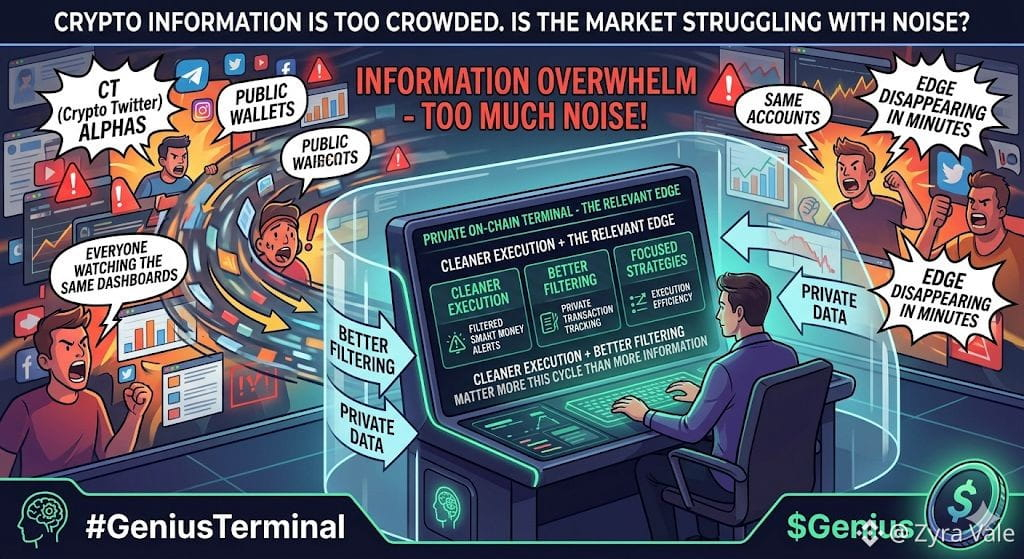
kinda feels like crypto became too crowded from an information perspective lately.
everyone watching the same wallets.
same dashboards.
same “alpha” accounts.
sometimes news spreads across CT so fast that any edge disappears within minutes.
that’s partly why Genius Terminal started making more sense to me recently.
the private on-chain terminal angle actually feels pretty relevant in this environment.
because the market is no longer struggling with lack of data.
if anything, there’s probably too much noise now.
and honestly, cleaner execution + better filtering might matter more this cycle than just having more information.
feels like more traders are slowly realizing that.
that’s mainly why I’ve been watching $GENIUS lately.
#genius $GENIUS @GeniusOfficial
kinda feels like crypto became too crowded from an information perspective lately.
everyone watching the same wallets.
same dashboards.
same “alpha” accounts.
sometimes news spreads across CT so fast that any edge disappears within minutes.
that’s partly why Genius Terminal started making more sense to me recently.
the private on-chain terminal angle actually feels pretty relevant in this environment.
because the market is no longer struggling with lack of data.
if anything, there’s probably too much noise now.
and honestly, cleaner execution + better filtering might matter more this cycle than just having more information.
feels like more traders are slowly realizing that.
that’s mainly why I’ve been watching $GENIUS lately.
#genius $GENIUS @GeniusOfficial
everyone watching the same wallets.
same dashboards.
same “alpha” accounts.
sometimes news spreads across CT so fast that any edge disappears within minutes.
that’s partly why Genius Terminal started making more sense to me recently.
the private on-chain terminal angle actually feels pretty relevant in this environment.
because the market is no longer struggling with lack of data.
if anything, there’s probably too much noise now.
and honestly, cleaner execution + better filtering might matter more this cycle than just having more information.
feels like more traders are slowly realizing that.
that’s mainly why I’ve been watching $GENIUS lately.
#genius $GENIUS @GeniusOfficial
2
133
·
--
Article
Why OpenLedger Started Catching My Attention RecentlyI’ve noticed something lately with AI discussions in crypto.
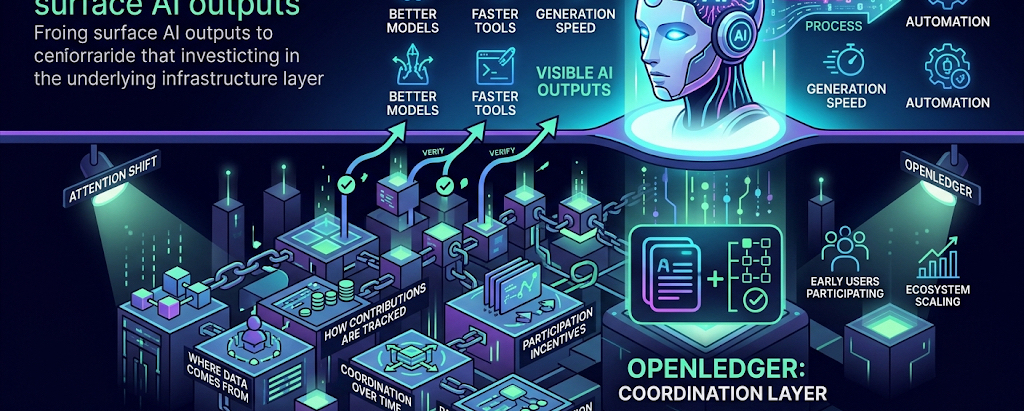
Almost everyone focuses on the same things:
better models,
faster tools,
more automation.
Which makes sense because that’s the easiest part to notice.
But the more AI adoption grows, the more I keep thinking about the layer underneath all of it.
Mainly:
where the data comes from,
how contributions are tracked,
and how ecosystems coordinate participation over time.
That’s honestly one reason OpenLedger started standing out to me recently.
The attribution side feels underrated right now.
I think most people still view AI mainly through outputs.
What the model can generate.
How fast it works.
How advanced the responses look.
But as ecosystems grow larger, contribution tracking and coordination may become much more important too.
Crypto already showed how quickly online behavior changes once incentives scale.
You can usually see the same pattern:
early users participate naturally,
then ecosystems grow,
then behavior gradually adapts around whatever gets rewarded most.
That’s not even criticism honestly.
It’s just how digital systems evolve over time.
Which is why infrastructure around attribution and contribution coordination feels increasingly relevant to me.
Especially for AI-related ecosystems where data and participation are becoming larger parts of the conversation.
What I find interesting with OpenLedger is that the project seems directionally focused on this layer rather than only the surface AI narrative.
Not just:
How powerful is the AI?
But also:
how are contributions organized and tracked across the network?
Feels like that becomes more important later than people currently expect.
And usually in crypto, the infrastructure layer looks less exciting early on.
The market naturally pays more attention to visible products first.
That happens every cycle.
But over time, coordination systems often become the foundation supporting everything else around them.
Still early obviously.
AI infrastructure is evolving very quickly and the sector is still experimenting with different models.
But I do think attribution, contribution tracking, and participation coordination could become much bigger themes as AI ecosystems continue expanding.
That’s mainly the angle I’ve been watching with OpenLedger recently.
$OPEN #OpenLedger @Openledger
Why OpenLedger Started Catching My Attention Recently
I’ve noticed something lately with AI discussions in crypto.
Almost everyone focuses on the same things:
better models,
faster tools,
more automation.
Which makes sense because that’s the easiest part to notice.
But the more AI adoption grows, the more I keep thinking about the layer underneath all of it.
Mainly:
where the data comes from,
how contributions are tracked,
and how ecosystems coordinate participation over time.
That’s honestly one reason OpenLedger started standing out to me recently.
The attribution side feels underrated right now.
I think most people still view AI mainly through outputs.
What the model can generate.
How fast it works.
How advanced the responses look.
But as ecosystems grow larger, contribution tracking and coordination may become much more important too.
Crypto already showed how quickly online behavior changes once incentives scale.
You can usually see the same pattern:
early users participate naturally,
then ecosystems grow,
then behavior gradually adapts around whatever gets rewarded most.
That’s not even criticism honestly.
It’s just how digital systems evolve over time.
Which is why infrastructure around attribution and contribution coordination feels increasingly relevant to me.
Especially for AI-related ecosystems where data and participation are becoming larger parts of the conversation.
What I find interesting with OpenLedger is that the project seems directionally focused on this layer rather than only the surface AI narrative.
Not just:
How powerful is the AI?
But also:
how are contributions organized and tracked across the network?
Feels like that becomes more important later than people currently expect.
And usually in crypto, the infrastructure layer looks less exciting early on.
The market naturally pays more attention to visible products first.
That happens every cycle.
But over time, coordination systems often become the foundation supporting everything else around them.
Still early obviously.
AI infrastructure is evolving very quickly and the sector is still experimenting with different models.
But I do think attribution, contribution tracking, and participation coordination could become much bigger themes as AI ecosystems continue expanding.
That’s mainly the angle I’ve been watching with OpenLedger recently.
$OPEN #OpenLedger @Openledger
Almost everyone focuses on the same things:
better models,
faster tools,
more automation.
Which makes sense because that’s the easiest part to notice.
But the more AI adoption grows, the more I keep thinking about the layer underneath all of it.
Mainly:
where the data comes from,
how contributions are tracked,
and how ecosystems coordinate participation over time.
That’s honestly one reason OpenLedger started standing out to me recently.
The attribution side feels underrated right now.
I think most people still view AI mainly through outputs.
What the model can generate.
How fast it works.
How advanced the responses look.
But as ecosystems grow larger, contribution tracking and coordination may become much more important too.
Crypto already showed how quickly online behavior changes once incentives scale.
You can usually see the same pattern:
early users participate naturally,
then ecosystems grow,
then behavior gradually adapts around whatever gets rewarded most.
That’s not even criticism honestly.
It’s just how digital systems evolve over time.
Which is why infrastructure around attribution and contribution coordination feels increasingly relevant to me.
Especially for AI-related ecosystems where data and participation are becoming larger parts of the conversation.
What I find interesting with OpenLedger is that the project seems directionally focused on this layer rather than only the surface AI narrative.
Not just:
How powerful is the AI?
But also:
how are contributions organized and tracked across the network?
Feels like that becomes more important later than people currently expect.
And usually in crypto, the infrastructure layer looks less exciting early on.
The market naturally pays more attention to visible products first.
That happens every cycle.
But over time, coordination systems often become the foundation supporting everything else around them.
Still early obviously.
AI infrastructure is evolving very quickly and the sector is still experimenting with different models.
But I do think attribution, contribution tracking, and participation coordination could become much bigger themes as AI ecosystems continue expanding.
That’s mainly the angle I’ve been watching with OpenLedger recently.
$OPEN #OpenLedger @Openledger
1
115
·
--
OpenLedger is one of the few AI projects lately that actually made me pause for a bit.
Not because of hype.
Mostly because the attribution angle feels more important the longer I think about it.
Everyone keeps talking about smarter AI models.
But once AI content becomes everywhere, people will probably care a lot more about:
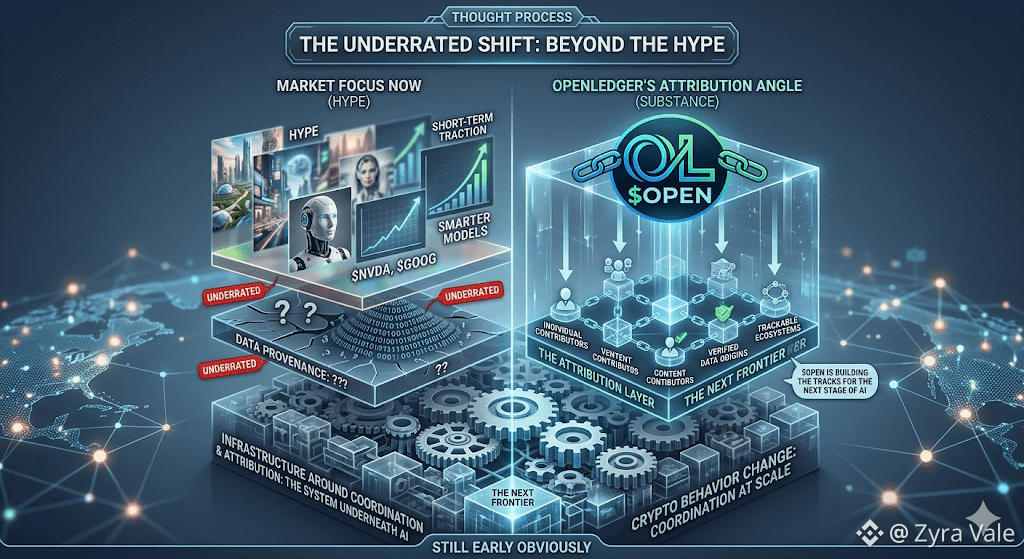
where the data came from,
who contributed,
and how contribution is tracked.
Feels like that side of AI is still underrated.
Crypto already showed how fast online behavior changes once ecosystems grow.
So infrastructure around coordination and attribution could end up becoming a much bigger topic later.
Still early obviously.
But I think the market is paying way more attention to AI outputs than the systems underneath them.
That’s mainly why I’ve been watching $OPEN recently.
$OPEN #OpenLedger @Openledger
OpenLedger is one of the few AI projects lately that actually made me pause for a bit.
Not because of hype.
Mostly because the attribution angle feels more important the longer I think about it.
Everyone keeps talking about smarter AI models.
But once AI content becomes everywhere, people will probably care a lot more about:
where the data came from,
who contributed,
and how contribution is tracked.
Feels like that side of AI is still underrated.
Crypto already showed how fast online behavior changes once ecosystems grow.
So infrastructure around coordination and attribution could end up becoming a much bigger topic later.
Still early obviously.
But I think the market is paying way more attention to AI outputs than the systems underneath them.
That’s mainly why I’ve been watching $OPEN recently.
$OPEN #OpenLedger @OpenLedger
Not because of hype.
Mostly because the attribution angle feels more important the longer I think about it.
Everyone keeps talking about smarter AI models.
But once AI content becomes everywhere, people will probably care a lot more about:
where the data came from,
who contributed,
and how contribution is tracked.
Feels like that side of AI is still underrated.
Crypto already showed how fast online behavior changes once ecosystems grow.
So infrastructure around coordination and attribution could end up becoming a much bigger topic later.
Still early obviously.
But I think the market is paying way more attention to AI outputs than the systems underneath them.
That’s mainly why I’ve been watching $OPEN recently.
$OPEN #OpenLedger @OpenLedger
3
186
·
--
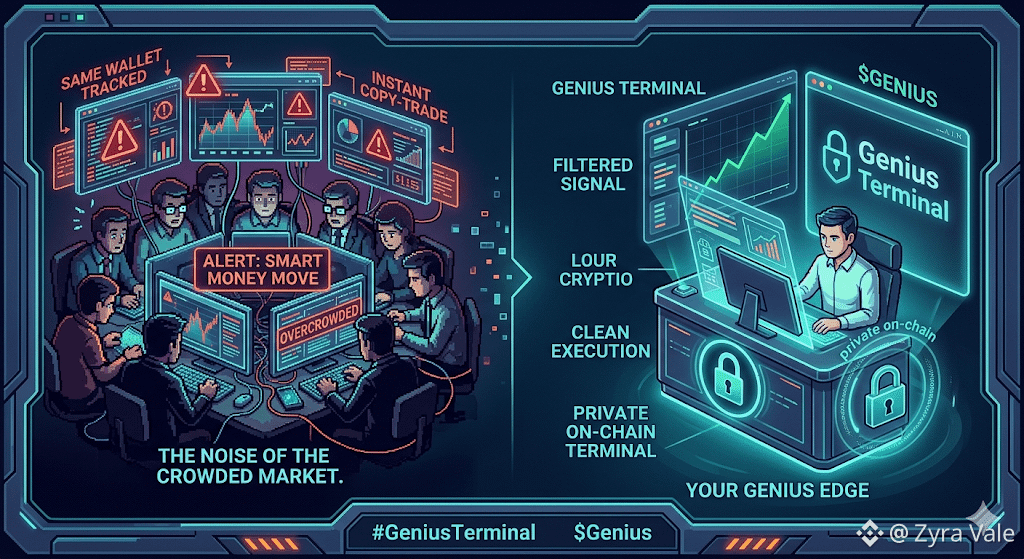
lowkey feels like everyone in crypto is watching the same wallets now lol
same dashboards
same alerts
same smart money accounts
sometimes it feels like the whole market reacts to the exact same information at the exact same time.
that’s partly why Genius Terminal caught my attention recently.
the private on-chain terminal angle actually feels more relevant this cycle than people realize.
because once markets become overcrowded with observers, having cleaner execution and less noise around decision-making starts mattering a lot more.
not even saying this from a trading guru perspective.
just feels harder now to keep any real edge when every move gets tracked instantly across CT.
feels like tools helping users filter signal better could become much more useful going forward.
that’s mainly the angle I’ve been watching with $GENIUS lately.
#Genius @GeniusOfficial
lowkey feels like everyone in crypto is watching the same wallets now lol
same dashboards
same alerts
same smart money accounts
sometimes it feels like the whole market reacts to the exact same information at the exact same time.
that’s partly why Genius Terminal caught my attention recently.
the private on-chain terminal angle actually feels more relevant this cycle than people realize.
because once markets become overcrowded with observers, having cleaner execution and less noise around decision-making starts mattering a lot more.
not even saying this from a trading guru perspective.
just feels harder now to keep any real edge when every move gets tracked instantly across CT.
feels like tools helping users filter signal better could become much more useful going forward.
that’s mainly the angle I’ve been watching with $GENIUS lately.
#Genius @GeniusOfficial
same dashboards
same alerts
same smart money accounts
sometimes it feels like the whole market reacts to the exact same information at the exact same time.
that’s partly why Genius Terminal caught my attention recently.
the private on-chain terminal angle actually feels more relevant this cycle than people realize.
because once markets become overcrowded with observers, having cleaner execution and less noise around decision-making starts mattering a lot more.
not even saying this from a trading guru perspective.
just feels harder now to keep any real edge when every move gets tracked instantly across CT.
feels like tools helping users filter signal better could become much more useful going forward.
that’s mainly the angle I’ve been watching with $GENIUS lately.
#Genius @GeniusOfficial
167
·
--
Most “genius” platforms don’t fail because people aren’t smart enough.
They fail because everyone starts optimizing to *look* smart.
That shift happens fast.
At the start, you get real thinking. Rough ideas, imperfect takes, actual effort.
Then incentives show up.
And suddenly it’s all polished threads, recycled insights, and safe takes that perform well.
I’ve seen this pattern since 2023 across different platforms. The moment rewards are visible, originality drops and formatting improves.
Looks better.
Gets worse.
So when I look at Genius, I’m not asking how many people contribute.
I’m watching what kind of thinking survives under pressure.
If it rewards depth, it builds something rare.
If it rewards appearance, it becomes just another content loop.
$GENIUS #genius @GeniusOfficial
Most “genius” platforms don’t fail because people aren’t smart enough.
They fail because everyone starts optimizing to *look* smart.
That shift happens fast.
At the start, you get real thinking. Rough ideas, imperfect takes, actual effort.
Then incentives show up.
And suddenly it’s all polished threads, recycled insights, and safe takes that perform well.
I’ve seen this pattern since 2023 across different platforms. The moment rewards are visible, originality drops and formatting improves.
Looks better.
Gets worse.
So when I look at Genius, I’m not asking how many people contribute.
I’m watching what kind of thinking survives under pressure.
If it rewards depth, it builds something rare.
If it rewards appearance, it becomes just another content loop.
$GENIUS #genius @GeniusOfficial
They fail because everyone starts optimizing to *look* smart.
That shift happens fast.
At the start, you get real thinking. Rough ideas, imperfect takes, actual effort.
Then incentives show up.
And suddenly it’s all polished threads, recycled insights, and safe takes that perform well.
I’ve seen this pattern since 2023 across different platforms. The moment rewards are visible, originality drops and formatting improves.
Looks better.
Gets worse.
So when I look at Genius, I’m not asking how many people contribute.
I’m watching what kind of thinking survives under pressure.
If it rewards depth, it builds something rare.
If it rewards appearance, it becomes just another content loop.
$GENIUS #genius @GeniusOfficial
1
166
·
--
The Real Risk in Decentralized AI Isn’t Model Failure. It’s Data DecayI Didn’t Take This Seriously at First
Everyone was focused on models.
Bigger, faster, cheaper. That was the race.
Decentralized AI came in with a different angle. More data, more contributors, open participation.
Sounded strong.
I bought into that idea for a while.
Then I started thinking about what actually happens when you open the gates.
More Contributors Doesn’t Mean Better Data
It usually means the opposite.
Not immediately. At first, you get real input. People experimenting, trying things, adding value.
Then incentives kick in.
And everything shifts.
You’re no longer attracting contributors. You’re attracting optimizers.
I’ve Seen This Pattern Too Many Times
Crypto already ran this experiment.
Airdrops. Points systems. Liquidity incentives.
Same cycle.
Early users explore.
Then people figure out the reward mechanics.
After that, behavior compresses into whatever extracts the most value.
Doesn’t matter if it’s useful.
Only matters if it pays.
Now Apply That to AI
This is where it gets uncomfortable.
If contribution is incentivized, people will find the fastest way to contribute.
Not the best way.
You start seeing:
low effort data submissionsslightly modified duplicatesAI-generated content feeding other AI systems
It looks like growth.
But it’s not signal.
It’s volume.
I Had Doubts About This Back in 2023
There was a moment where I started questioning the whole “decentralized intelligence” idea.
Not because the models weren’t improving.
Because the input layer looked fragile.
If the system rewards participation without strongly filtering quality, it drifts.
Slowly at first.
Then all at once.
This Is Where OpenLedger Gets Interesting
Not because it’s another AI project.
Because it sits directly on this problem.
It’s not just about building models.
It’s about managing contribution quality under incentive pressure.
That’s harder than it sounds.
The Core Tension
You want openness.
But openness invites exploitation.
You want scale.
But scale amplifies noise.
So you’re stuck balancing two forces that naturally work against each other.
Most systems pick one and ignore the other.
That’s where they break.
I’m Not Fully Convinced It’s Solved
Because I haven’t seen a system handle this perfectly yet.
Even strong filtering mechanisms can be gamed over time.
People adapt fast when there’s money involved.
Faster than most teams expect.
But This Is the Right Problem to Focus On
If decentralized AI fails, it won’t be because the models couldn’t compete.
It’ll be because the data layer degraded.
Quietly.
No big crash. Just slower outputs. Lower quality. Less trust.
By the time it’s obvious, it’s already deep in the system.
What Actually Matters Going Forward
Not just:
how many contributorshow much datahow fast models improve
But:
what kind of behavior the system createshow resistant it is to low-effort scalingwhether quality can survive incentives
That’s the real test.
Final Thought
I stopped thinking about AI as a model problem.
Started thinking about it as a behavior problem.
Because models learn from what we feed them.
And if the system trains people to feed it noise, that’s what it becomes.
OpenLedger hasn’t proven it can solve this yet.
But at least it’s positioned at the layer where the real risk exists.
And that’s more important than most people realize.
$OPEN #OpenLedger @Openledger
{spot}(OPENUSDT)
The Real Risk in Decentralized AI Isn’t Model Failure. It’s Data Decay
I Didn’t Take This Seriously at First
Everyone was focused on models.
Bigger, faster, cheaper. That was the race.
Decentralized AI came in with a different angle. More data, more contributors, open participation.
Sounded strong.
I bought into that idea for a while.
Then I started thinking about what actually happens when you open the gates.
More Contributors Doesn’t Mean Better Data
It usually means the opposite.
Not immediately. At first, you get real input. People experimenting, trying things, adding value.
Then incentives kick in.
And everything shifts.
You’re no longer attracting contributors. You’re attracting optimizers.
I’ve Seen This Pattern Too Many Times
Crypto already ran this experiment.
Airdrops. Points systems. Liquidity incentives.
Same cycle.
Early users explore.
Then people figure out the reward mechanics.
After that, behavior compresses into whatever extracts the most value.
Doesn’t matter if it’s useful.
Only matters if it pays.
Now Apply That to AI
This is where it gets uncomfortable.
If contribution is incentivized, people will find the fastest way to contribute.
Not the best way.
You start seeing:
low effort data submissionsslightly modified duplicatesAI-generated content feeding other AI systems
It looks like growth.
But it’s not signal.
It’s volume.
I Had Doubts About This Back in 2023
There was a moment where I started questioning the whole “decentralized intelligence” idea.
Not because the models weren’t improving.
Because the input layer looked fragile.
If the system rewards participation without strongly filtering quality, it drifts.
Slowly at first.
Then all at once.
This Is Where OpenLedger Gets Interesting
Not because it’s another AI project.
Because it sits directly on this problem.
It’s not just about building models.
It’s about managing contribution quality under incentive pressure.
That’s harder than it sounds.
The Core Tension
You want openness.
But openness invites exploitation.
You want scale.
But scale amplifies noise.
So you’re stuck balancing two forces that naturally work against each other.
Most systems pick one and ignore the other.
That’s where they break.
I’m Not Fully Convinced It’s Solved
Because I haven’t seen a system handle this perfectly yet.
Even strong filtering mechanisms can be gamed over time.
People adapt fast when there’s money involved.
Faster than most teams expect.
But This Is the Right Problem to Focus On
If decentralized AI fails, it won’t be because the models couldn’t compete.
It’ll be because the data layer degraded.
Quietly.
No big crash. Just slower outputs. Lower quality. Less trust.
By the time it’s obvious, it’s already deep in the system.
What Actually Matters Going Forward
Not just:
how many contributorshow much datahow fast models improve
But:
what kind of behavior the system createshow resistant it is to low-effort scalingwhether quality can survive incentives
That’s the real test.
Final Thought
I stopped thinking about AI as a model problem.
Started thinking about it as a behavior problem.
Because models learn from what we feed them.
And if the system trains people to feed it noise, that’s what it becomes.
OpenLedger hasn’t proven it can solve this yet.
But at least it’s positioned at the layer where the real risk exists.
And that’s more important than most people realize.
$OPEN #OpenLedger @OpenLedger
Everyone was focused on models.
Bigger, faster, cheaper. That was the race.
Decentralized AI came in with a different angle. More data, more contributors, open participation.
Sounded strong.
I bought into that idea for a while.
Then I started thinking about what actually happens when you open the gates.
More Contributors Doesn’t Mean Better Data
It usually means the opposite.
Not immediately. At first, you get real input. People experimenting, trying things, adding value.
Then incentives kick in.
And everything shifts.
You’re no longer attracting contributors. You’re attracting optimizers.
I’ve Seen This Pattern Too Many Times
Crypto already ran this experiment.
Airdrops. Points systems. Liquidity incentives.
Same cycle.
Early users explore.
Then people figure out the reward mechanics.
After that, behavior compresses into whatever extracts the most value.
Doesn’t matter if it’s useful.
Only matters if it pays.
Now Apply That to AI
This is where it gets uncomfortable.
If contribution is incentivized, people will find the fastest way to contribute.
Not the best way.
You start seeing:
low effort data submissionsslightly modified duplicatesAI-generated content feeding other AI systems
It looks like growth.
But it’s not signal.
It’s volume.
I Had Doubts About This Back in 2023
There was a moment where I started questioning the whole “decentralized intelligence” idea.
Not because the models weren’t improving.
Because the input layer looked fragile.
If the system rewards participation without strongly filtering quality, it drifts.
Slowly at first.
Then all at once.
This Is Where OpenLedger Gets Interesting
Not because it’s another AI project.
Because it sits directly on this problem.
It’s not just about building models.
It’s about managing contribution quality under incentive pressure.
That’s harder than it sounds.
The Core Tension
You want openness.
But openness invites exploitation.
You want scale.
But scale amplifies noise.
So you’re stuck balancing two forces that naturally work against each other.
Most systems pick one and ignore the other.
That’s where they break.
I’m Not Fully Convinced It’s Solved
Because I haven’t seen a system handle this perfectly yet.
Even strong filtering mechanisms can be gamed over time.
People adapt fast when there’s money involved.
Faster than most teams expect.
But This Is the Right Problem to Focus On
If decentralized AI fails, it won’t be because the models couldn’t compete.
It’ll be because the data layer degraded.
Quietly.
No big crash. Just slower outputs. Lower quality. Less trust.
By the time it’s obvious, it’s already deep in the system.
What Actually Matters Going Forward
Not just:
how many contributorshow much datahow fast models improve
But:
what kind of behavior the system createshow resistant it is to low-effort scalingwhether quality can survive incentives
That’s the real test.
Final Thought
I stopped thinking about AI as a model problem.
Started thinking about it as a behavior problem.
Because models learn from what we feed them.
And if the system trains people to feed it noise, that’s what it becomes.
OpenLedger hasn’t proven it can solve this yet.
But at least it’s positioned at the layer where the real risk exists.
And that’s more important than most people realize.
$OPEN #OpenLedger @OpenLedger
2
3
83
Log in to explore more content
Join global crypto users on Binance Square
⚡️ Get latest and useful information about crypto.
💬 Trusted by the world’s largest crypto exchange.
👍 Discover real insights from verified creators.
Email / Phone number
Trending Topics
RussiaUkraine72-hourCeasefire
140,378 views
2,081 Discussing
#russiaukraine72-hourceasefire
Ceasefire Declared: How Will Global Markets & Crypto React in the Next 72 Hours?
A dramatic 72-hour ceasefire has just been announced between Russia and Ukraine, offering a potential—if brief—break in hostilities. For global markets and the cryptocurrency sector, this news is a massive shift in sentiment.
How will investors react in the next 72 hours? Here are the key narratives playing out right now:
Risk-On Bounce: Will the sudden easing of geopolitical tension drive a rotation back into "risk-on" assets like growth stocks and high-beta altcoins? We often see markets rally on news of peace, even if it's temporary.
The Safe-Haven Dilemma: Paradoxically, Bitcoin ($BTC) and Gold ($GLD) often act as safe-haven assets during crises. While peace is good, will it dampen the "crisis hedging" demand for Bitcoin in the immediate term?
Oil and Commodities: Energy prices are likely to experience high volatility. A cooling of tensions could mean a reduction in supply fears.
My Take: While this is a temporary window, expect extreme volatility in both directions. Traders will be highly reactive to any news indicating whether the ceasefire is holding. I anticipate a short-term rally in crypto, but sustainable momentum depends on longer-term outcomes.
What are your predictions for the next 72 hours? Is this the start of a broader de-escalation, or just a temporary pause before more chaos?
👇 Let’s discuss in the comments below! 👇
$BTC
#RussiaUkraineWar #CryptoNews #bitcoin
Lily星星
·6 Likes
·1.9k views
CNPYAirdropOnBinanceAlpha
32,333 views
618 Discussing
ZEC'sMarketCapSurpassedDOGE
76,766 views
727 Discussing