
老腊肉1688-kevin
4.6k Posts

老腊肉1688-kevin
 Square Verified+
X:@cryptokevin1688|邀请码|Bind invite code :KEVIN1688|美股投研 · 主流币分析 | US Stock Investment Research, Major Crypto Analysis
Open Trade
High-Frequency Trader
9.9 Months
315 Following
46.3K+ Followers
24.0K+ Liked
Posts
Portfolio
All
Quotes
Videos
PINNED
Binance Wb3 Wallet Rewards
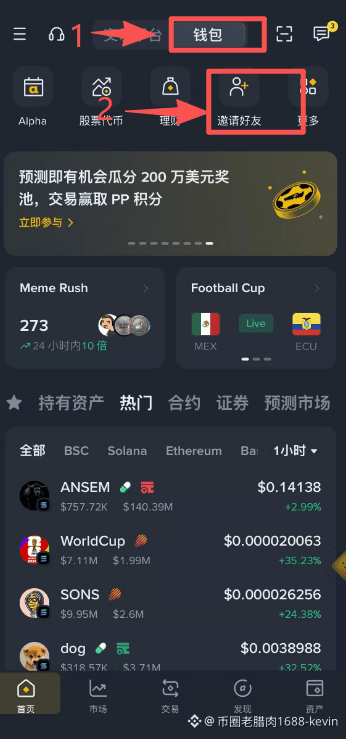
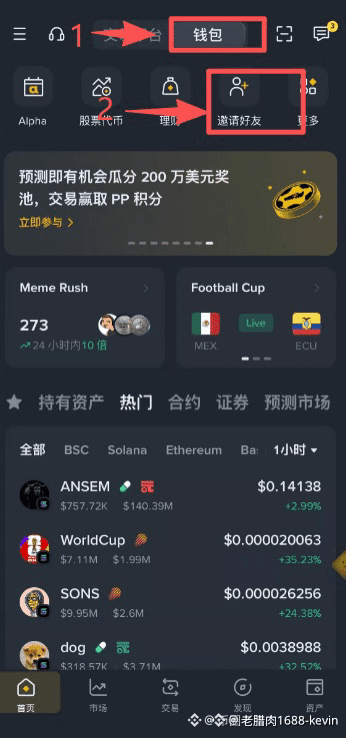
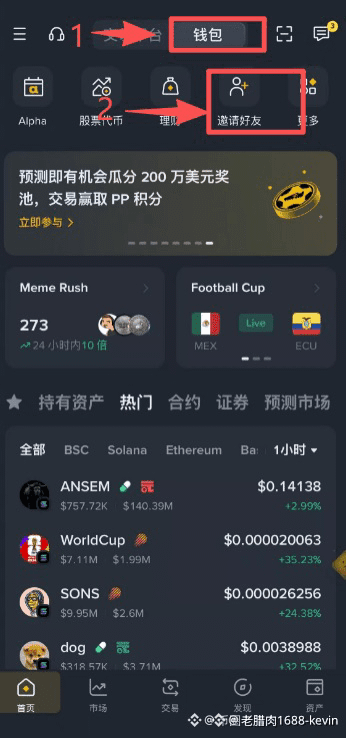
Brothers, let me tell you a great way to save 30% on trading fees (follow the instructions as shown in the picture)
In the Binance app, select Home Page; at the top, there are two options: Trading Platform and Wallet
Step 1: Choose Wallet and switch to Wallet;
Step 2: Choose Invite Friends
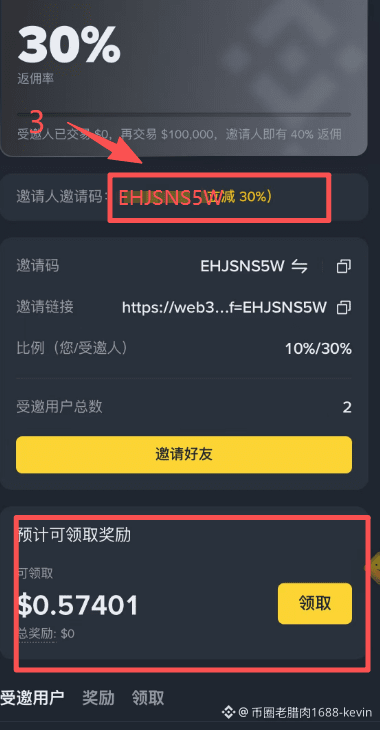
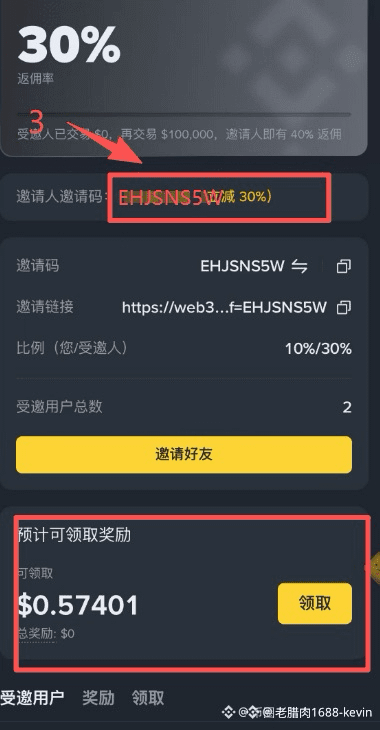
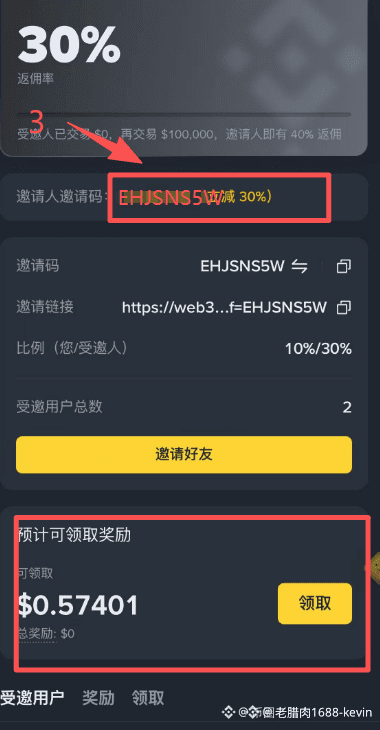
Step 3: Enter the invitation code: EHJSNS5W (copy it to the position shown in the picture)
Step 4: Claim the reward below
Especially for brothers who like on-chain memecoin gambling and do high-frequency trading—remember to bind the invitation code: EHJSNS5W to get a 30% reward. If you trade less, you can get 5u or 10u; if you trade more, you can get dozens of u, or even 100u
点击钱包,赶紧去绑定邀请码:EHJSNS5W ,领取奖励吧!
Brothers, let me tell you a great way to save 30% on trading fees (follow the instructions as shown in the picture)
In the Binance app, select Home Page; at the top, there are two options: Trading Platform and Wallet
Step 1: Choose Wallet and switch to Wallet;
Step 2: Choose Invite Friends
Step 3: Enter the invitation code: EHJSNS5W (copy it to the position shown in the picture)
Step 4: Claim the reward below
Especially for brothers who like on-chain memecoin gambling and do high-frequency trading—remember to bind the invitation code: EHJSNS5W to get a 30% reward. If you trade less, you can get 5u or 10u; if you trade more, you can get dozens of u, or even 100u
点击钱包,赶紧去绑定邀请码:EHJSNS5W ,领取奖励吧!
US Stock Market Wrap: A “Switch” as Powell Speaks; Stocks, Bonds, FX All Repriced
At his first appearance at Jackson Hole, Powell delivered a firm message defending the 2% inflation target, triggering what markets interpreted as a sudden “turnaround” in expectations.
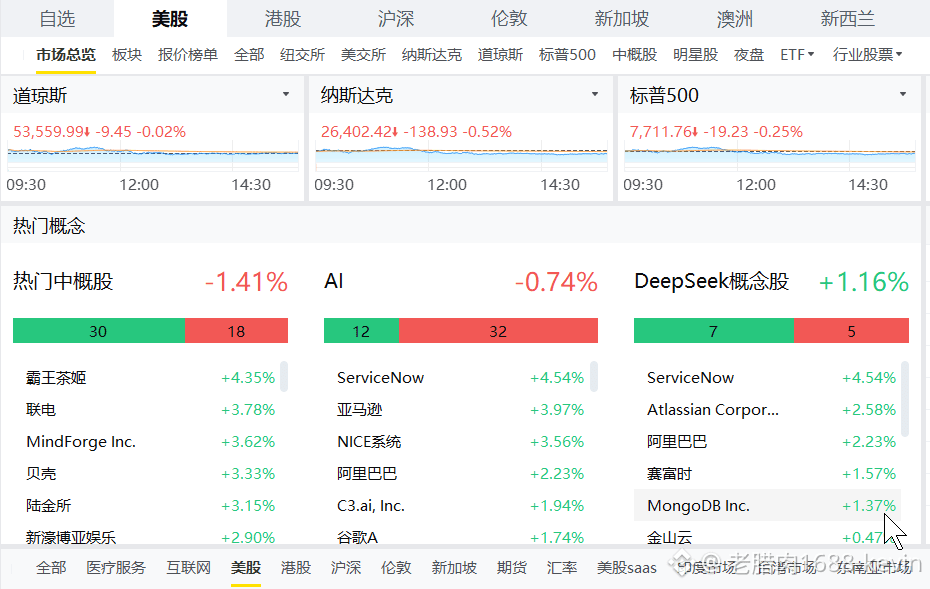
On Friday, the three major U.S. stock indexes closed lower, giving back part of the prior day’s gains driven by Nvidia’s earnings. The Nasdaq fell 0.52%; the S&P 500 dropped 0.27%; and the Dow Jones ended nearly flat. Markets rapidly repriced the probability of a September rate hike from around 35% to roughly 60%, which became the core logic driving performance across asset classes.
In terms of asset performance, Powell’s “hawkish” stance disrupted the previous rhythm:
- Stock market: clear divergence in structure. AI infrastructure and related names were hit hardest. Nvidia sank 4.57%, MicroStrategy tumbled more than 10%, and the Philadelphia Semiconductor Index fell 2.69%.
- Flows did not leave the market; they rotated. Funds moved into software and cloud services. Amazon rose nearly 4%, while Salesforce, Microsoft, Google, and others climbed more than 1.5% against the trend—indicating a shift from richly valued hardware toward more resilient software as rate-hike expectations rose.
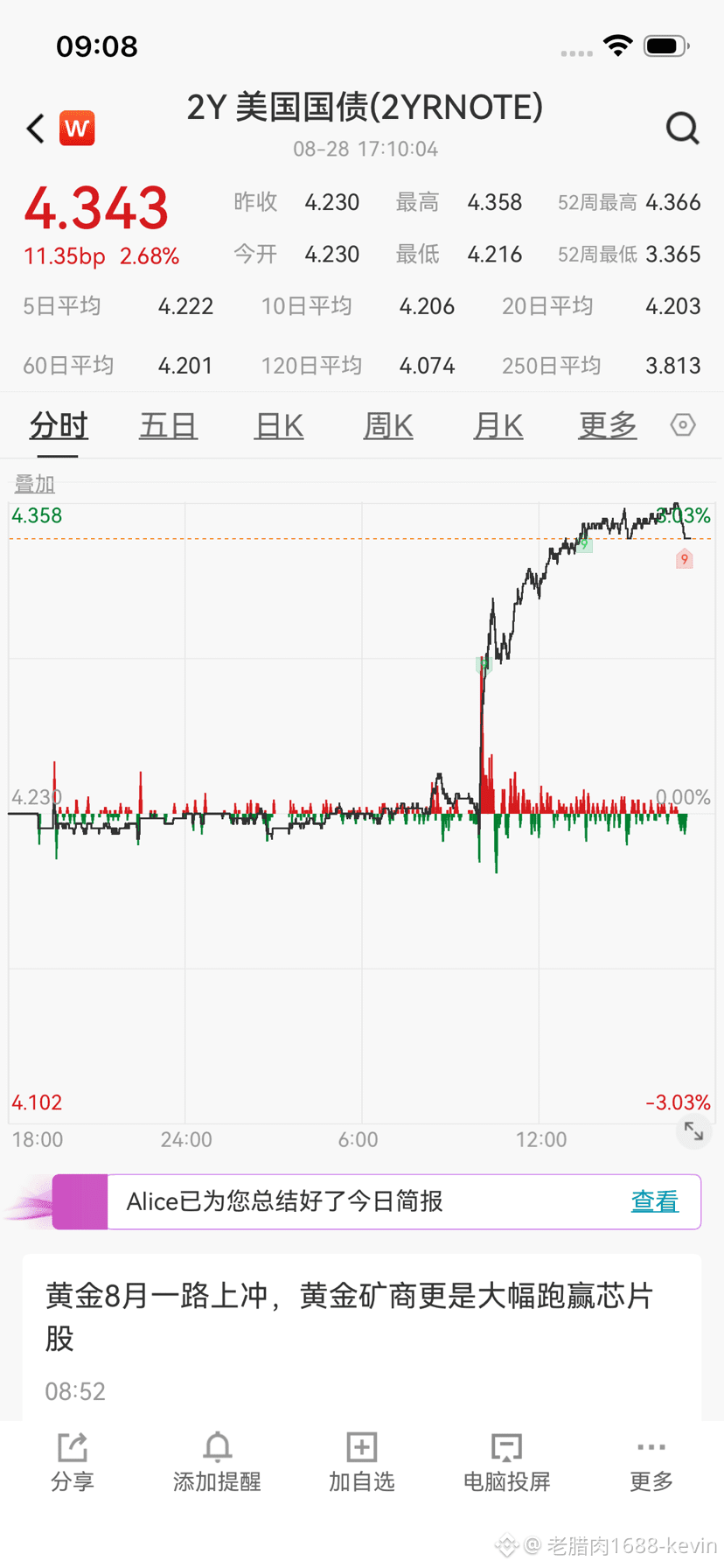
- Bond market: sharp reaction. The 2-year U.S. Treasury yield—the most sensitive to policy—spiked by 11 basis points in a single day to 4.34%, a one-month high. Meanwhile, the 10-year yield stayed around 4.72%. The yield curve flattened, reflecting a reduced risk that markets will “de-anchor” long-term inflation expectations.
- Commodities and gold: under pressure. Higher real rates and a stronger dollar (U.S. Dollar Index up to 99.66) weighed on demand. Spot gold plunged nearly 3%, fell below the $4,500 level, and broke under the 200-day moving average—its worst single-day performance since June.
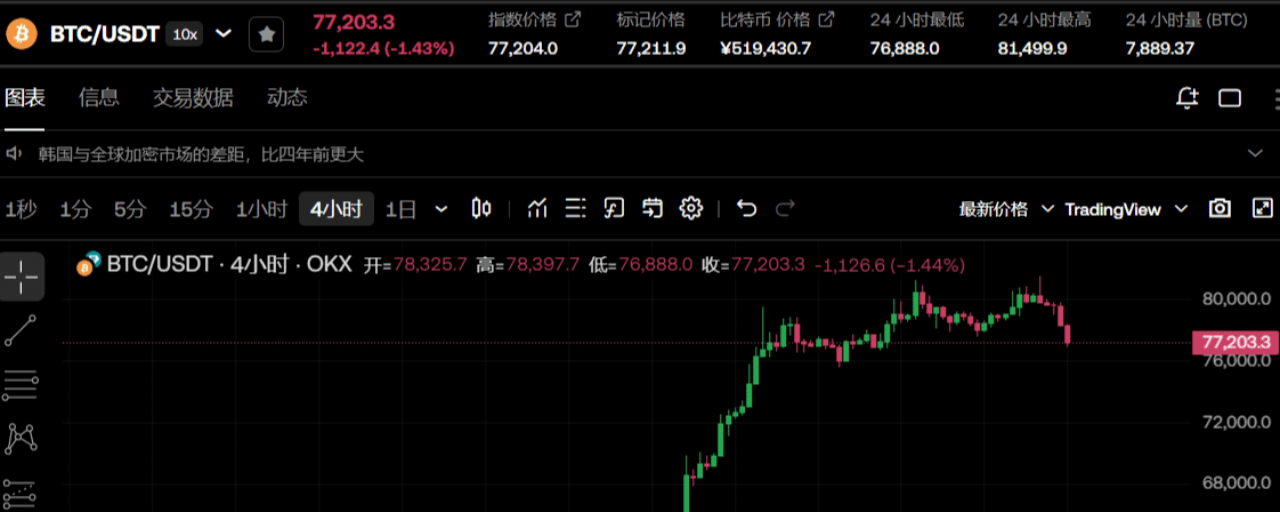
Bitcoin also fell more than 3.5% to above $77,000, signaling pressure for deleveraging in risk assets. Crude oil dropped about 5% over the week, ending the two-week streak of consecutive gains.
Powell’s remarks reignited rate-hike expectations, and market trading quickly shifted from “inflation has peaked” to “rates stay higher for longer.”
In the near term, tighter-money expectations are suppressing risk appetite. High-valued technology hardware is under pressure, while software leaders with steadier cash flows and short-term bonds have shown more defensive appeal.#特朗普达成委内瑞拉17油田开发协议 #阿富汗塔利班据报全国禁止加密交易 #ICBA反对CLARITY法案稳定币奖励漏洞 #XRP现货ETF创2026年最大周流入 #比特币现货ETF结束9日净流入 $BTC $XAU $SOXL
At his first appearance at Jackson Hole, Powell delivered a firm message defending the 2% inflation target, triggering what markets interpreted as a sudden “turnaround” in expectations.
On Friday, the three major U.S. stock indexes closed lower, giving back part of the prior day’s gains driven by Nvidia’s earnings. The Nasdaq fell 0.52%; the S&P 500 dropped 0.27%; and the Dow Jones ended nearly flat. Markets rapidly repriced the probability of a September rate hike from around 35% to roughly 60%, which became the core logic driving performance across asset classes.
In terms of asset performance, Powell’s “hawkish” stance disrupted the previous rhythm:
- Stock market: clear divergence in structure. AI infrastructure and related names were hit hardest. Nvidia sank 4.57%, MicroStrategy tumbled more than 10%, and the Philadelphia Semiconductor Index fell 2.69%.
- Flows did not leave the market; they rotated. Funds moved into software and cloud services. Amazon rose nearly 4%, while Salesforce, Microsoft, Google, and others climbed more than 1.5% against the trend—indicating a shift from richly valued hardware toward more resilient software as rate-hike expectations rose.
- Bond market: sharp reaction. The 2-year U.S. Treasury yield—the most sensitive to policy—spiked by 11 basis points in a single day to 4.34%, a one-month high. Meanwhile, the 10-year yield stayed around 4.72%. The yield curve flattened, reflecting a reduced risk that markets will “de-anchor” long-term inflation expectations.
- Commodities and gold: under pressure. Higher real rates and a stronger dollar (U.S. Dollar Index up to 99.66) weighed on demand. Spot gold plunged nearly 3%, fell below the $4,500 level, and broke under the 200-day moving average—its worst single-day performance since June.
Bitcoin also fell more than 3.5% to above $77,000, signaling pressure for deleveraging in risk assets. Crude oil dropped about 5% over the week, ending the two-week streak of consecutive gains.
Powell’s remarks reignited rate-hike expectations, and market trading quickly shifted from “inflation has peaked” to “rates stay higher for longer.”
In the near term, tighter-money expectations are suppressing risk appetite. High-valued technology hardware is under pressure, while software leaders with steadier cash flows and short-term bonds have shown more defensive appeal.#特朗普达成委内瑞拉17油田开发协议 #阿富汗塔利班据报全国禁止加密交易 #ICBA反对CLARITY法案稳定币奖励漏洞 #XRP现货ETF创2026年最大周流入 #比特币现货ETF结束9日净流入 $BTC $XAU $SOXL
US Stock Market Close Summary: Waller’s Hawkish Stance Pressures Tech Stocks, Amazon Leads the Big Seven Upside Despite the Weakness
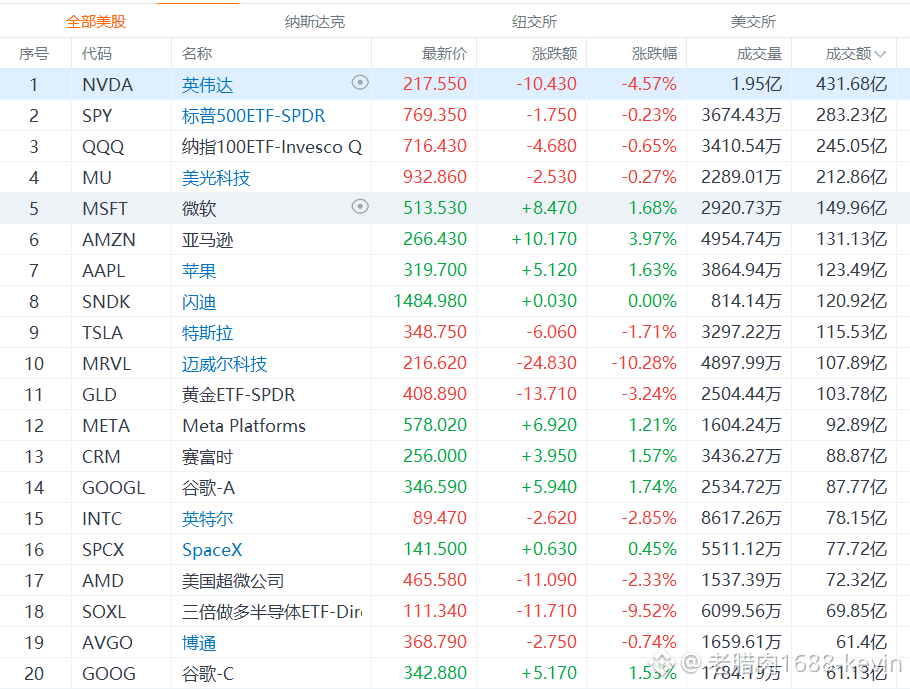
On Friday, the three major US stock indices diverged as the market re-priced rate-hike expectations following remarks from Federal Reserve Chair Waller, who sounded hawkish. Among the top 20 by trading value, tech leaders saw mixed gains and losses; AI chip stocks were clearly under pressure, while consumer and software sectors showed resilience.
Judging by both trading value and price moves, capital was sharply divided:
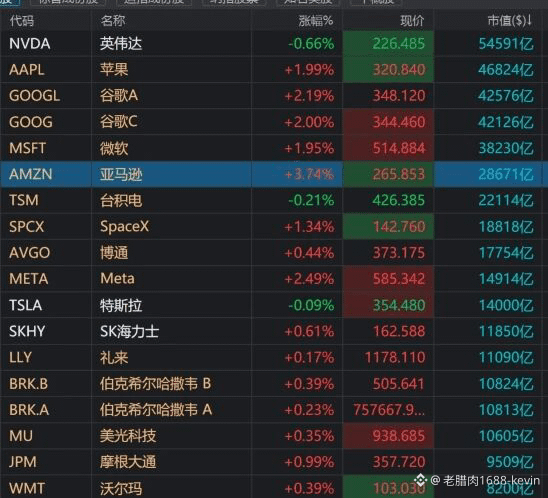
AI chip dual leaders plunge: NVIDIA fell 4.57%, with $42.8 billion in turnover, ranking first
In the news, AI cloud service provider Lambda issued debt to purchase its chips, but the company paused some AI cloud revenue-sharing agreements, raising concerns.
Millerway Technology plunged 10.28%. Despite an earnings report that beat expectations, the market believes revenue from its Google-customized chip order will not show up until fiscal 2029, turning a potential positive into a negative.
Big Seven diverge: Amazon rose nearly 4% to lead the group despite the overall weakness, with $13 billion in turnover; Apple gained 1.63% after announcing higher Apple TV and One subscription prices; Microsoft rose 1.68% as it reassured data-center controversy internally. Tesla, however, fell 1.71%, performing relatively weakly.
Other notable movers: Salesforce climbed for multiple sessions post-earnings, adding 22% over the week. Strategy slumped 7.34% as Bitcoin broke below $80,000, with its decline exceeding that of crypto itself.
Key headline catalyst: At the Jackson Hole annual symposium, Waller emphasized that the 2% inflation target is “firm and fixed,” saying recent data is insufficient to prove the trend has improved, and that the Fed “still has work to do.”
This directly sparked renewed rate-hike expectations. At one point, the probability of a hike in September rose to nearly 60%, pushing short-term Treasury yields higher and cooling any rebound in risk assets.
Waller’s remarks reshaped the “higher for longer” rate narrative: the market rapidly switched from “trading for rate cuts” to “pricing rate hikes.” Going forward, AI optimism will need stronger fundamentals support, while consumer and software leaders are showing relatively defensive value amid the rate-hike gloom.$MRVL $BTC $MSTR #比特币现货ETF结束9日净流入 #纽约白银期货跌3% #日元跌破160创一个月新低 #ICBA反对CLARITY法案稳定币奖励漏洞 #阿富汗塔利班据报全国禁止加密交易
On Friday, the three major US stock indices diverged as the market re-priced rate-hike expectations following remarks from Federal Reserve Chair Waller, who sounded hawkish. Among the top 20 by trading value, tech leaders saw mixed gains and losses; AI chip stocks were clearly under pressure, while consumer and software sectors showed resilience.
Judging by both trading value and price moves, capital was sharply divided:
AI chip dual leaders plunge: NVIDIA fell 4.57%, with $42.8 billion in turnover, ranking first
In the news, AI cloud service provider Lambda issued debt to purchase its chips, but the company paused some AI cloud revenue-sharing agreements, raising concerns.
Millerway Technology plunged 10.28%. Despite an earnings report that beat expectations, the market believes revenue from its Google-customized chip order will not show up until fiscal 2029, turning a potential positive into a negative.
Big Seven diverge: Amazon rose nearly 4% to lead the group despite the overall weakness, with $13 billion in turnover; Apple gained 1.63% after announcing higher Apple TV and One subscription prices; Microsoft rose 1.68% as it reassured data-center controversy internally. Tesla, however, fell 1.71%, performing relatively weakly.
Other notable movers: Salesforce climbed for multiple sessions post-earnings, adding 22% over the week. Strategy slumped 7.34% as Bitcoin broke below $80,000, with its decline exceeding that of crypto itself.
Key headline catalyst: At the Jackson Hole annual symposium, Waller emphasized that the 2% inflation target is “firm and fixed,” saying recent data is insufficient to prove the trend has improved, and that the Fed “still has work to do.”
This directly sparked renewed rate-hike expectations. At one point, the probability of a hike in September rose to nearly 60%, pushing short-term Treasury yields higher and cooling any rebound in risk assets.
Waller’s remarks reshaped the “higher for longer” rate narrative: the market rapidly switched from “trading for rate cuts” to “pricing rate hikes.” Going forward, AI optimism will need stronger fundamentals support, while consumer and software leaders are showing relatively defensive value amid the rate-hike gloom.$MRVL $BTC $MSTR #比特币现货ETF结束9日净流入 #纽约白银期货跌3% #日元跌破160创一个月新低 #ICBA反对CLARITY法案稳定币奖励漏洞 #阿富汗塔利班据报全国禁止加密交易
Verified
#美国短期国债收益率上涨 Vowsh opened his mouth, and the market shook in three shakes: the rate-hike ghost is back—big Dow and U.S. stocks had better take it easy
Vowsh’s remarks at Jackson Hole directly split the rate-hike expectations down the middle. In plain terms, it means one thing: if inflation doesn’t bow, I’ll hike—don’t expect me to tell you the answer early.
The market understood it. The probability of a September hike jumped from around 35% before his speech to close to 60%, and it even started pricing in two hikes by early next year.
Break it down: his “hawkish” tone has three layers:
First, he’s going to lock onto the 2% inflation target. Vowsh said inflation must fall “clearly and quickly,” otherwise the Fed “still has work to do.” In other words, the “rate hike” option is laid out on the table.
Second, he doesn’t think the economy will be broken by hikes. What he sees is corporate profit growth of 20%, strong consumption, and an unemployment rate holding steady at 4.1%. Financial conditions aren’t tightening at all. The message is: the economy can take it—don’t try to scare me with a recession.
Third, don’t try to squeeze “which month” out of his mouth. He explicitly opposes giving forward guidance early, saying they need to maintain “discipline.” That makes the market most uncomfortable, because uncertainty is highest—so traders can only guess based on the data.
So, did the market believe him? The best answer is the path of interest-rate futures and SOFR—real money is moving. Traders have started pricing one hike this year and two by early next year. This isn’t a joke.
In terms of how to trade, the core idea is: “expectations turn, defend first.”
U.S. stocks (S&P 500): higher-for-longer rates are a hard hit to high-valuation tech stocks.
Big pie (BTC): as rate-hike expectations heat up, the dollar and real yields strengthen—risk assets are hit first.
Trading-wise: if a rebound meets resistance in the $79,500–$80,000 range, it may be worth attempting a short. Stop-loss: above $81,500. Take-profit: first look at $77,000; if it breaks, then $75,000.
Vowsh turned rate-hike expectations from a “low-probability” scenario into a “50-50” one, and the market now has to price in higher rates. In the coming weeks, inflation data will be the judge—but before that, both U.S. stocks and BTC need to “step back half a step” to digest this hawkish shock. Trade with the trend: short rallies is safer than trying to bottom-pick.
$BTC $ETH $XRP #XRP现货ETF创2026年最大周流入
Vowsh’s remarks at Jackson Hole directly split the rate-hike expectations down the middle. In plain terms, it means one thing: if inflation doesn’t bow, I’ll hike—don’t expect me to tell you the answer early.
The market understood it. The probability of a September hike jumped from around 35% before his speech to close to 60%, and it even started pricing in two hikes by early next year.
Break it down: his “hawkish” tone has three layers:
First, he’s going to lock onto the 2% inflation target. Vowsh said inflation must fall “clearly and quickly,” otherwise the Fed “still has work to do.” In other words, the “rate hike” option is laid out on the table.
Second, he doesn’t think the economy will be broken by hikes. What he sees is corporate profit growth of 20%, strong consumption, and an unemployment rate holding steady at 4.1%. Financial conditions aren’t tightening at all. The message is: the economy can take it—don’t try to scare me with a recession.
Third, don’t try to squeeze “which month” out of his mouth. He explicitly opposes giving forward guidance early, saying they need to maintain “discipline.” That makes the market most uncomfortable, because uncertainty is highest—so traders can only guess based on the data.
So, did the market believe him? The best answer is the path of interest-rate futures and SOFR—real money is moving. Traders have started pricing one hike this year and two by early next year. This isn’t a joke.
In terms of how to trade, the core idea is: “expectations turn, defend first.”
U.S. stocks (S&P 500): higher-for-longer rates are a hard hit to high-valuation tech stocks.
Big pie (BTC): as rate-hike expectations heat up, the dollar and real yields strengthen—risk assets are hit first.
Trading-wise: if a rebound meets resistance in the $79,500–$80,000 range, it may be worth attempting a short. Stop-loss: above $81,500. Take-profit: first look at $77,000; if it breaks, then $75,000.
Vowsh turned rate-hike expectations from a “low-probability” scenario into a “50-50” one, and the market now has to price in higher rates. In the coming weeks, inflation data will be the judge—but before that, both U.S. stocks and BTC need to “step back half a step” to digest this hawkish shock. Trade with the trend: short rallies is safer than trying to bottom-pick.
$BTC $ETH $XRP #XRP现货ETF创2026年最大周流入
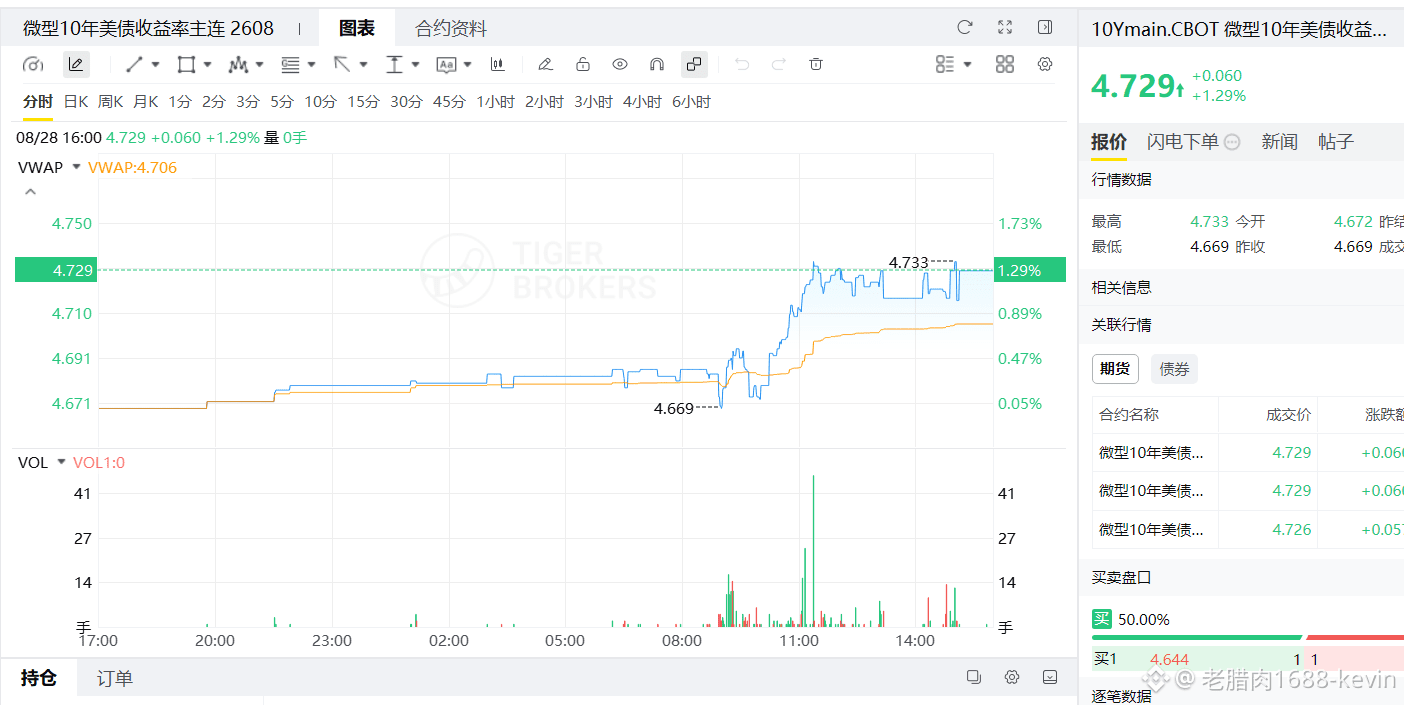
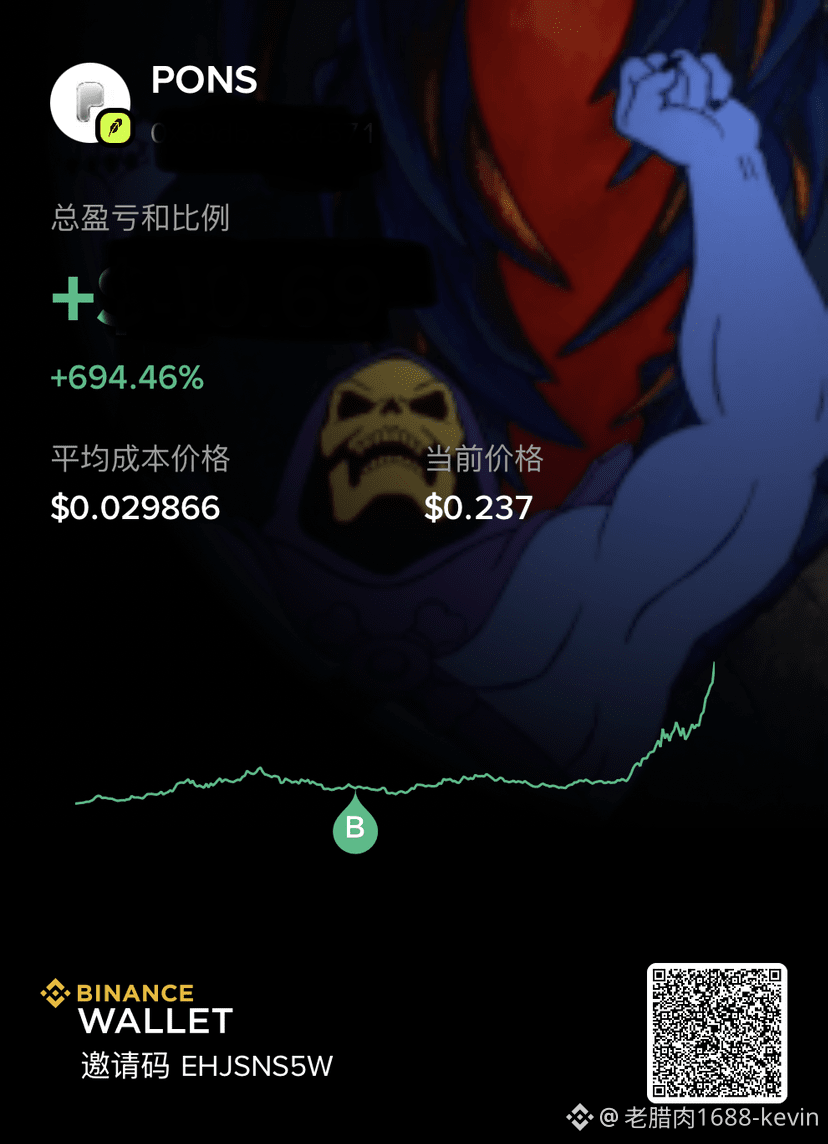
$PONS $PONS is up 10x
Still a bit of a diamond-hand type, huh
I’ve held onto it for quite a while and haven’t really paid attention to it
With such good momentum and distribution speed
It feels like spot is about to be up, right?
Once it lists on spot, seeing a market cap of 1 billion should be no problem
Still a bit of a diamond-hand type, huh
I’ve held onto it for quite a while and haven’t really paid attention to it
With such good momentum and distribution speed
It feels like spot is about to be up, right?
Once it lists on spot, seeing a market cap of 1 billion should be no problem
$4 $GIGGLE $我踏马来了 The weekend mainstream has no liquidity left
Everyone is now trading knockoffs
Especially the Binance-backed knockoffs
The AI sector is led by the crayfish
The next three lackeys followed
Everyone is now trading knockoffs
Especially the Binance-backed knockoffs
The AI sector is led by the crayfish
The next three lackeys followed
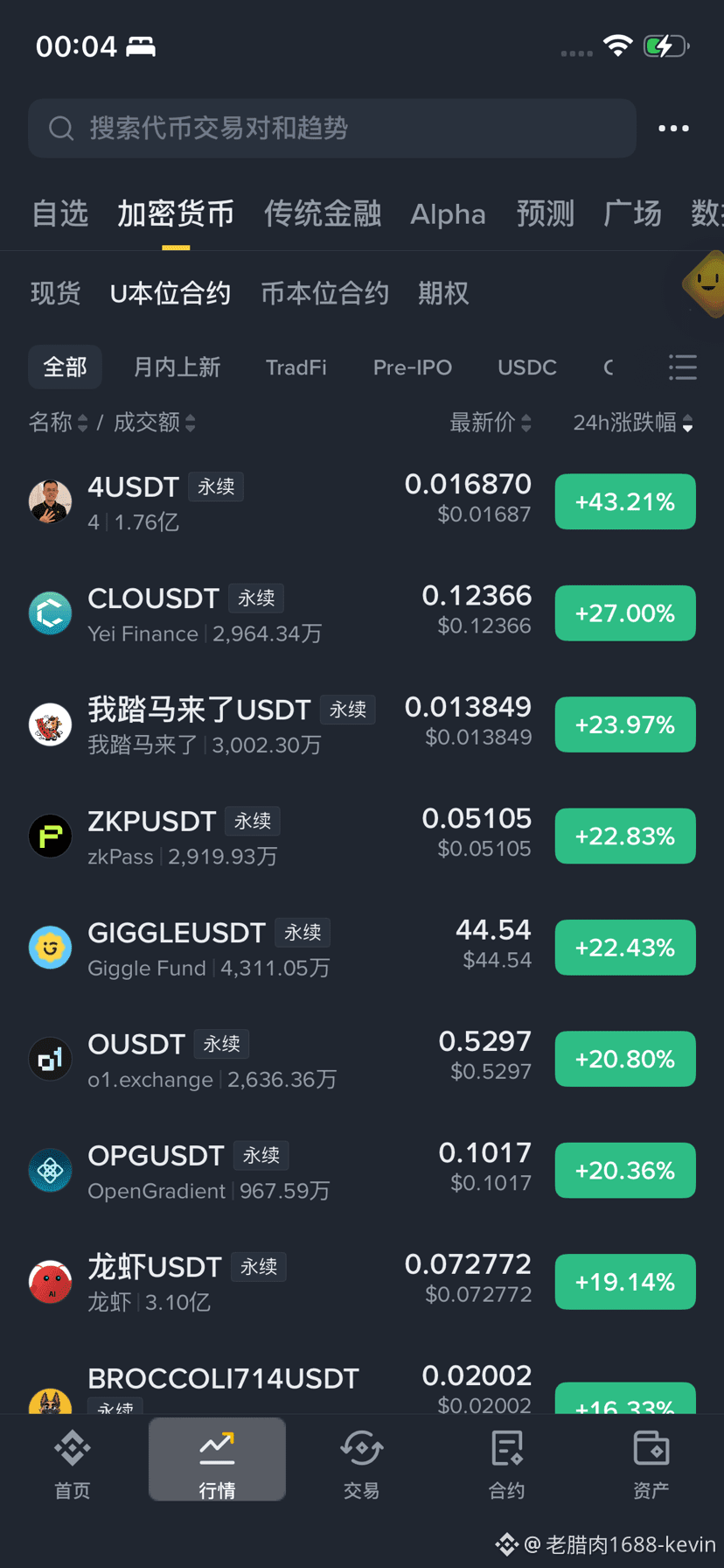
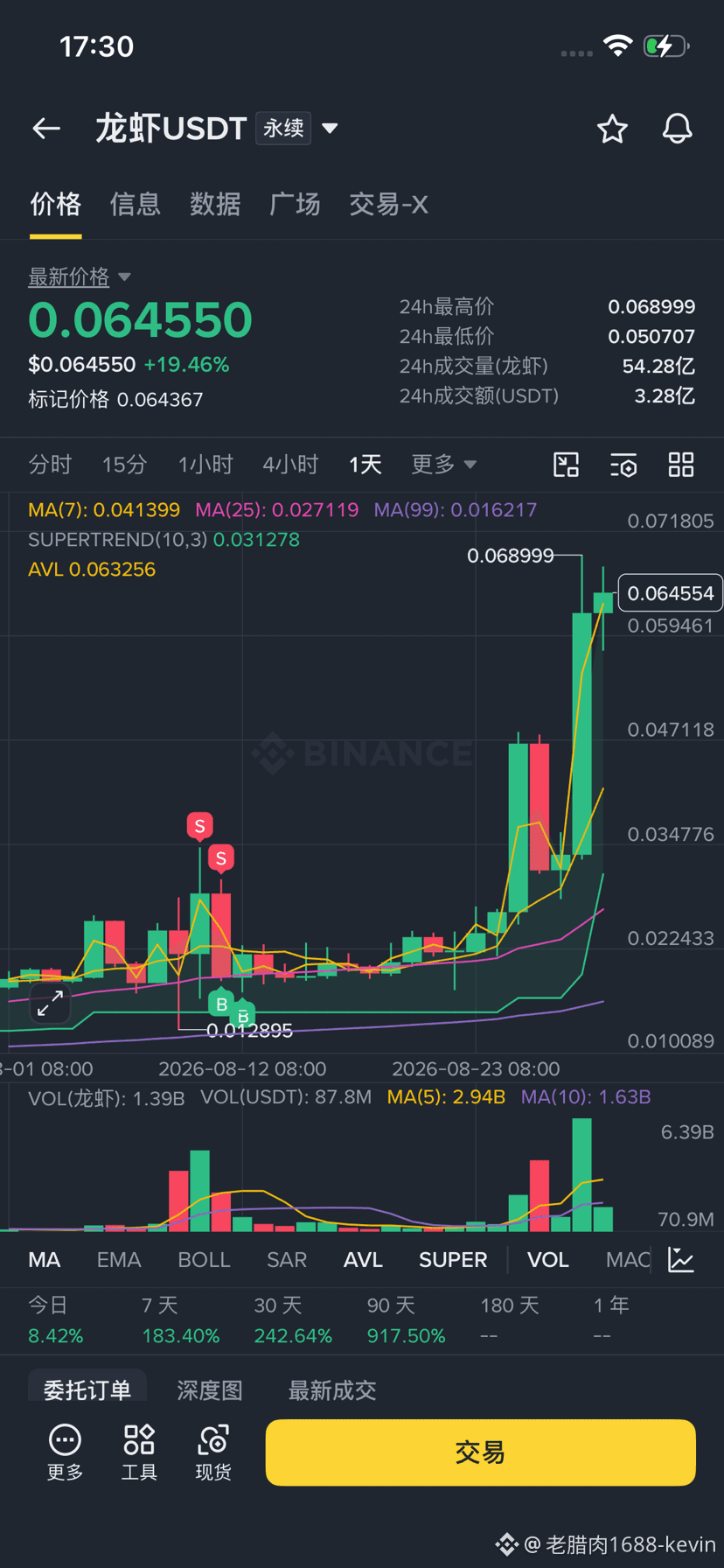
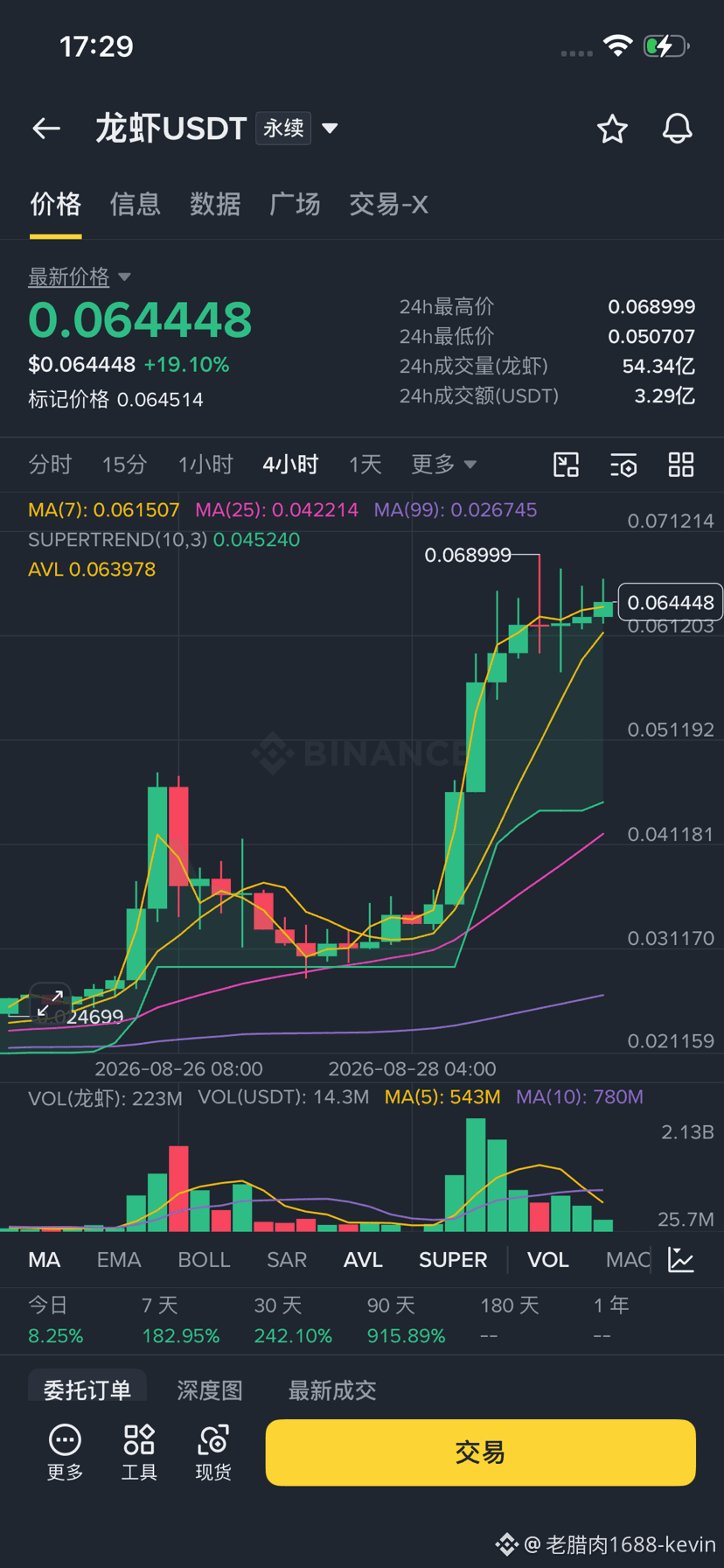
$龙虾 on the square there are so many brothers shorting
how do I feel that it can still be pushed up a bit
how do I feel that it can still be pushed up a bit
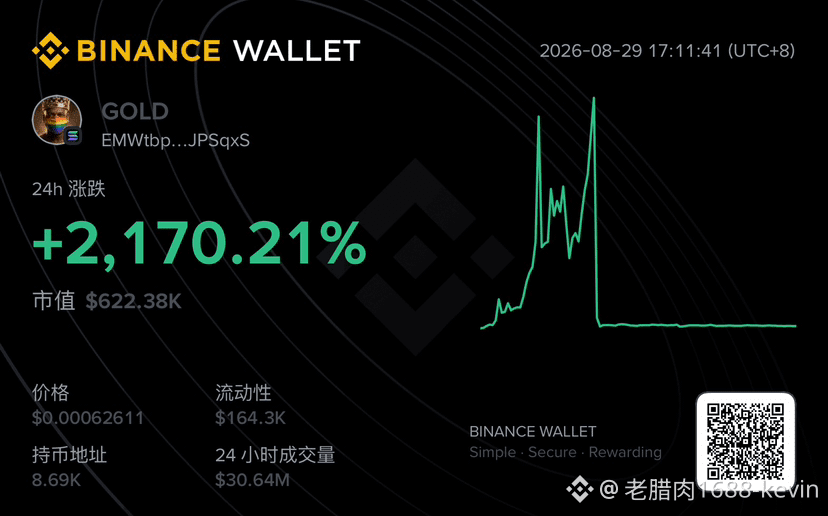
$GOLD All of the brothers on the whole network have been made fools of
It’s all a massive loss—zeroed out in a minute
Brothers, remember to link your wallet for cashback commissions
This can help reduce losses
It’s all a massive loss—zeroed out in a minute
Brothers, remember to link your wallet for cashback commissions
This can help reduce losses
Very important
老腊肉1688-kevin
·
--
In one sentence from Wosh, crypto shakes three times: Is $80K BTC a starting point or an endpoint?
When the Fed chair said, “We still have work to do,” the frenzy of Bitcoin breaking through $80,000 suddenly went quiet.
At 22:00 on August 28 Beijing time, Federal Reserve Chair Kevin Wosh delivered a speech titled “The Age We Live In” at the Jackson Hole Global Central Bank Conference.
Before the words even left his mouth, gold plunged by 50 dollars, and market expectations for a September rate hike surged from 35% to 60%. A few days earlier, meanwhile, Bitcoin had just soared past the $80,000 mark, hitting a three-month high—up 28% so far in August.
On the surface, it’s a continuation of a liquidity feast; in reality, the Fed has already started pulling the tablecloth away.
At 22:00 on August 28 Beijing time, Federal Reserve Chair Kevin Wosh delivered a speech titled “The Age We Live In” at the Jackson Hole Global Central Bank Conference.
Before the words even left his mouth, gold plunged by 50 dollars, and market expectations for a September rate hike surged from 35% to 60%. A few days earlier, meanwhile, Bitcoin had just soared past the $80,000 mark, hitting a three-month high—up 28% so far in August.
On the surface, it’s a continuation of a liquidity feast; in reality, the Fed has already started pulling the tablecloth away.
Verified
$XAU $BTC $SOL Jackson Hole takes a hawkish turn: the September rate-hike probability soars to 60%!
On the evening of August 28, Beijing time, Federal Reserve Chair <c-1/> delivered his first keynote address since taking office at the Jackson Hole Global Central Bank Conference, clearly rejecting forward guidance. He stressed that inflation remains high and that financial conditions are not restrictive enough.
Market reaction:
· All three major US stock indexes closed lower across the board: the Nasdaq fell 0.52%, the S&P 500 declined 0.25%, and the Dow closed almost flat.
· Sector performance was mixed: semiconductors plunged 3.47%, and technology fell 1.29%; telecommunications and discretionary consumption rose more than 1.5% against the trend.
· Individual stocks: Nvidia fell 4.6%, Micron Technology dropped 10.3%, and PayPal slid 12.7%; but Amazon rose 4%.
· US Treasury yields: the 2-year yield jumped 11bp to 4.34%, the highest in a month.
· The US dollar rose 0.4% to 99.48, while spot gold tumbled by about 3%.
The next batch of August jobs and inflation data will determine whether a real rate hike happens in September
#沃什称通胀是美联储首要关注 #SOL本周上涨20% #黄金8月上涨约14%
On the evening of August 28, Beijing time, Federal Reserve Chair <c-1/> delivered his first keynote address since taking office at the Jackson Hole Global Central Bank Conference, clearly rejecting forward guidance. He stressed that inflation remains high and that financial conditions are not restrictive enough.
Market reaction:
· All three major US stock indexes closed lower across the board: the Nasdaq fell 0.52%, the S&P 500 declined 0.25%, and the Dow closed almost flat.
· Sector performance was mixed: semiconductors plunged 3.47%, and technology fell 1.29%; telecommunications and discretionary consumption rose more than 1.5% against the trend.
· Individual stocks: Nvidia fell 4.6%, Micron Technology dropped 10.3%, and PayPal slid 12.7%; but Amazon rose 4%.
· US Treasury yields: the 2-year yield jumped 11bp to 4.34%, the highest in a month.
· The US dollar rose 0.4% to 99.48, while spot gold tumbled by about 3%.
The next batch of August jobs and inflation data will determine whether a real rate hike happens in September
#沃什称通胀是美联储首要关注 #SOL本周上涨20% #黄金8月上涨约14%
Partly True
$GOOGL $AMZN $SOXL US large technology stocks collectively rise strongly aside from AI hardware
Apple shares up 2%, Google-A shares up 2.05%, Microsoft shares up 1.92%
Amazon shares up 3.6%, Meta shares up 2.37%.
Meanwhile, US AI hardware stocks are relatively weaker, with the Philadelphia Semiconductor Index currently down 1.4%.
Apple shares up 2%, Google-A shares up 2.05%, Microsoft shares up 1.92%
Amazon shares up 3.6%, Meta shares up 2.37%.
Meanwhile, US AI hardware stocks are relatively weaker, with the Philadelphia Semiconductor Index currently down 1.4%.
$BTC $XAU $XAG Federal Reserve Chair Waller warns that
Inflation has not shown meaningful slowing, and policymakers must be sure that inflation is moving in the right direction; otherwise, the central bank “has more work to do.”
Waller reiterated that the Fed will bring the inflation rate back to its 2% target.
He said this is a clear and fixed goal. Waller said, “My benchmark is that we must be sure that underlying inflation is moving toward our target, and that the pace must be clear enough and fast enough. Otherwise, we have more work to do.
Inflation has not shown meaningful slowing, and policymakers must be sure that inflation is moving in the right direction; otherwise, the central bank “has more work to do.”
Waller reiterated that the Fed will bring the inflation rate back to its 2% target.
He said this is a clear and fixed goal. Waller said, “My benchmark is that we must be sure that underlying inflation is moving toward our target, and that the pace must be clear enough and fast enough. Otherwise, we have more work to do.
Verified
$XAU Federal Reserve Chair Powell's remarks
During the spot gold session, the decline widened rapidly; it is currently down more than 1%, and has fallen below $4,550.
The yield on U.S. two-year Treasury notes rose to 4.294%, the highest level since August 3.
Market pricing shows that the probability of a rate hike by the Federal Reserve in September is now estimated at around 50%.$BTC
During the spot gold session, the decline widened rapidly; it is currently down more than 1%, and has fallen below $4,550.
The yield on U.S. two-year Treasury notes rose to 4.294%, the highest level since August 3.
Market pricing shows that the probability of a rate hike by the Federal Reserve in September is now estimated at around 50%.$BTC
Verified
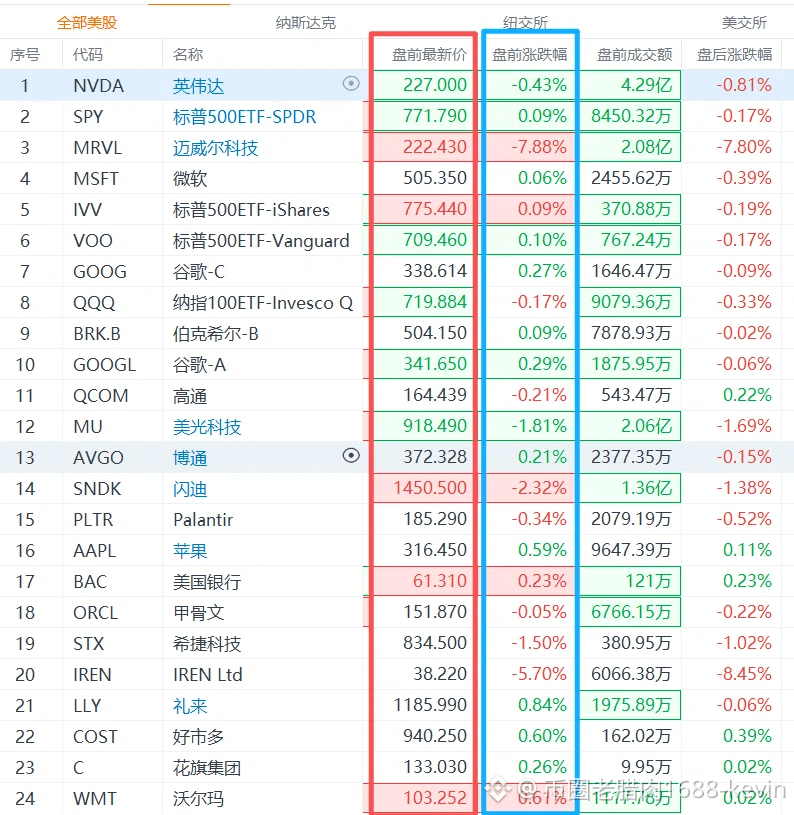
Before Wach’s remarks, tech stocks got scared, and MRVL plunged 8% after earnings! What are the big players in the pre-market really betting on? #美国企业利润创历史新高 #SOL本周上涨20%
The pre-market situation is kind of interesting. Last night, Nvidia surged with tech stocks, and the Nasdaq rose 1.57%, but today the pre-market mood flipped instantly—the Nasdaq futures turned green-to-red, down 0.28%.
The key is that everyone is waiting for Wach’s speech tonight at 10:00 p.m., and money clearly backed off.
First, let’s talk about MRVL, which you probably care about most. Its earnings report showed revenue of 2.74 billion, and it earned 0.94 dollars per share—slightly above expectations—but it still got hammered 8% in pre-market, trading around $220.8.
Why? It’s like an exam: if you usually score 100, this time you get 95—the teacher doesn’t scold you, but the market basically flips the table.
The main issue is that its custom chip collaboration with Google won’t really contribute until fiscal year 2029, and the capital thinks that’s too far away and lacks patience. On top of that, in the pre-market, an institution bought 1,300 contracts of out-of-the-money put options with a strike price of $160—this is the real, hard-money bearish signal.
Now look at the sector effect. Storage and optical communications both got wiped out—Micron, SanDisk, and Seagate all fell by nearly 2% in pre-market.
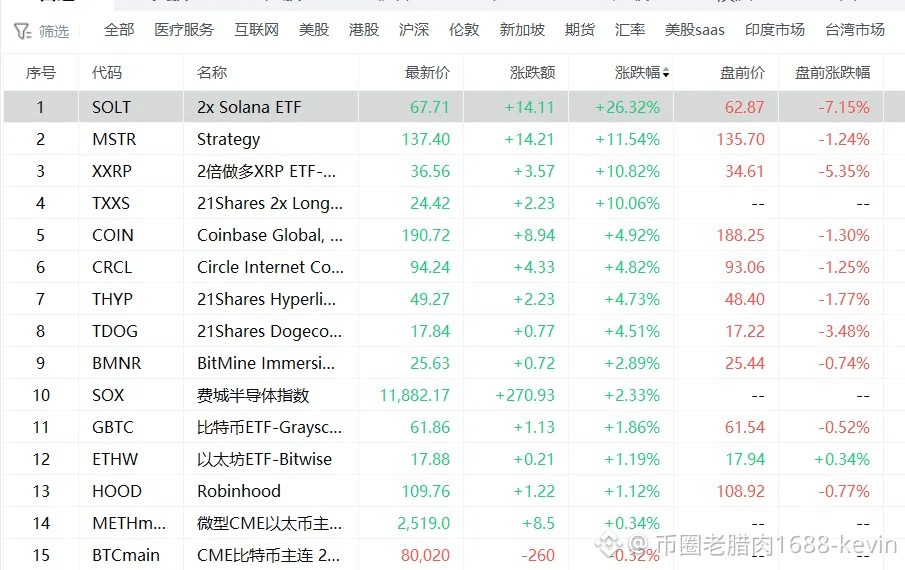
On the other hand, in crypto-related stocks: Bitcoin broke above $80,000, and MSTR’s underlying stock surged 11.54% yesterday. The options Put/Call Ratio also jumped straight to 0.46, suggesting bullish sentiment is one-sided. But this thing has too much correlation—if BTC isn’t stable, you’ve got to run.
The big prerequisite is Wach’s speech. Tonight at 10:00 p.m., this guy makes his first appearance at Jackson Hole, and there will also be a Nonfarm Payrolls baseline benchmark revision. Goldman predicts the update could raise the figure by 50,000 to 450,000. If it really comes in higher, inflation stickiness will remain, which is bad news for high-multiple tech stocks.
Trading ideas:
MRVL (Marvell Technology): In the $220 area pre-market, don’t rush to bottom-pick yet. Key support is at 210—if it drops there and holds, you can try a small long position with low risk. Put your stop-loss at 205. If you want to short, and it can’t break up to $230–232 on the rebound, you can go for one trade—stop-loss at 235, target around 215.
SOXL (3x leveraged semiconductor bull): If the Philadelphia Semiconductor Index keeps getting hammered, SOXL’s pre-market low is 130.06. If you want to catch a falling knife, wait until around 130 and volume thins while it stabilizes before entering.
The 2x leveraged SOL ETF is already down nearly 8%, and crypto stocks have pulled back across the board—you can short at higher levels to bet on further downside.
$SOL $SOXL $MRVL
The pre-market situation is kind of interesting. Last night, Nvidia surged with tech stocks, and the Nasdaq rose 1.57%, but today the pre-market mood flipped instantly—the Nasdaq futures turned green-to-red, down 0.28%.
The key is that everyone is waiting for Wach’s speech tonight at 10:00 p.m., and money clearly backed off.
First, let’s talk about MRVL, which you probably care about most. Its earnings report showed revenue of 2.74 billion, and it earned 0.94 dollars per share—slightly above expectations—but it still got hammered 8% in pre-market, trading around $220.8.
Why? It’s like an exam: if you usually score 100, this time you get 95—the teacher doesn’t scold you, but the market basically flips the table.
The main issue is that its custom chip collaboration with Google won’t really contribute until fiscal year 2029, and the capital thinks that’s too far away and lacks patience. On top of that, in the pre-market, an institution bought 1,300 contracts of out-of-the-money put options with a strike price of $160—this is the real, hard-money bearish signal.
Now look at the sector effect. Storage and optical communications both got wiped out—Micron, SanDisk, and Seagate all fell by nearly 2% in pre-market.
On the other hand, in crypto-related stocks: Bitcoin broke above $80,000, and MSTR’s underlying stock surged 11.54% yesterday. The options Put/Call Ratio also jumped straight to 0.46, suggesting bullish sentiment is one-sided. But this thing has too much correlation—if BTC isn’t stable, you’ve got to run.
The big prerequisite is Wach’s speech. Tonight at 10:00 p.m., this guy makes his first appearance at Jackson Hole, and there will also be a Nonfarm Payrolls baseline benchmark revision. Goldman predicts the update could raise the figure by 50,000 to 450,000. If it really comes in higher, inflation stickiness will remain, which is bad news for high-multiple tech stocks.
Trading ideas:
MRVL (Marvell Technology): In the $220 area pre-market, don’t rush to bottom-pick yet. Key support is at 210—if it drops there and holds, you can try a small long position with low risk. Put your stop-loss at 205. If you want to short, and it can’t break up to $230–232 on the rebound, you can go for one trade—stop-loss at 235, target around 215.
SOXL (3x leveraged semiconductor bull): If the Philadelphia Semiconductor Index keeps getting hammered, SOXL’s pre-market low is 130.06. If you want to catch a falling knife, wait until around 130 and volume thins while it stabilizes before entering.
The 2x leveraged SOL ETF is already down nearly 8%, and crypto stocks have pulled back across the board—you can short at higher levels to bet on further downside.
$SOL $SOXL $MRVL
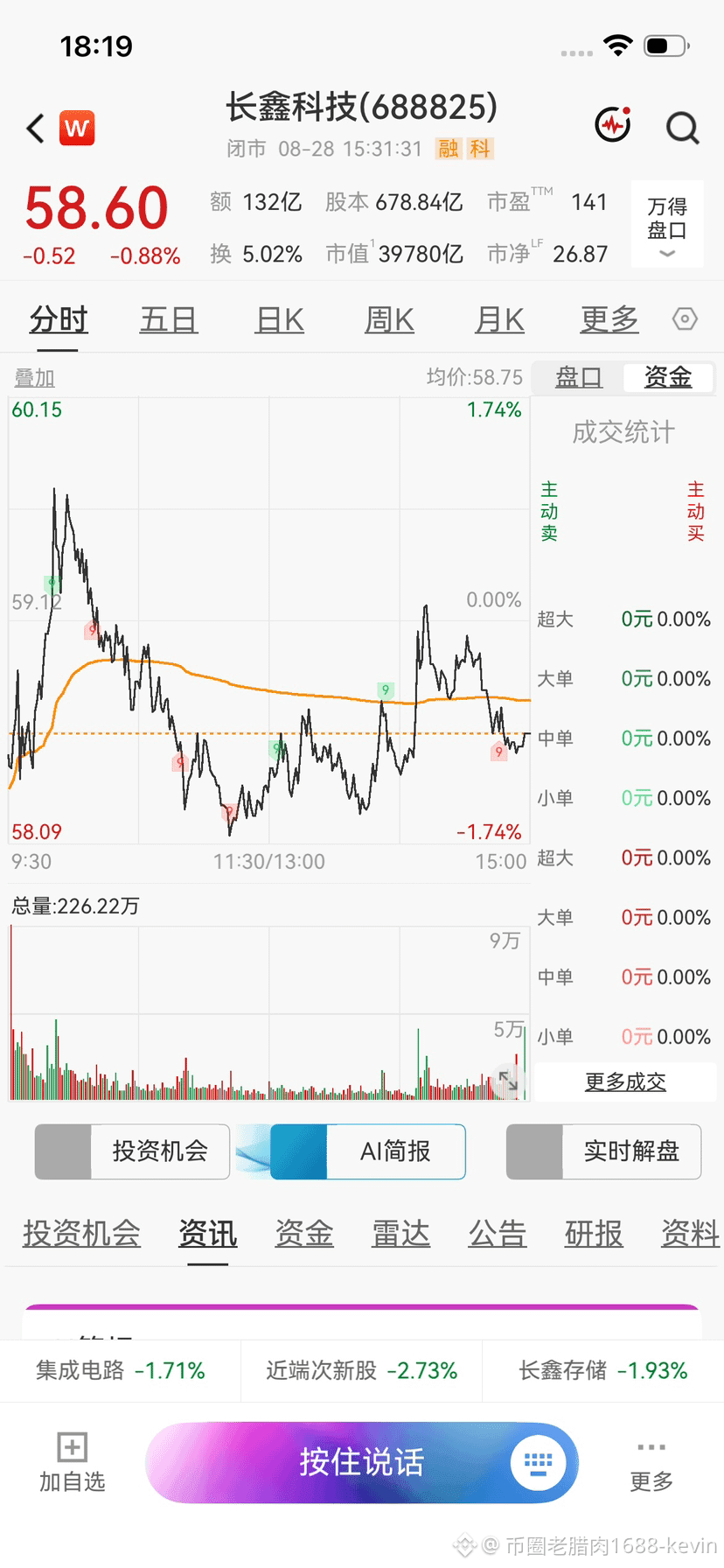
$CXMT $NVDA $SNDK Next Monday’s tech sector should go up
Because Jing Tian’s favorite is still Zhang Jike
If you reverse Zhang Jike’s name, it spells “tech rise”…
Because Jing Tian’s favorite is still Zhang Jike
If you reverse Zhang Jike’s name, it spells “tech rise”…

Verified
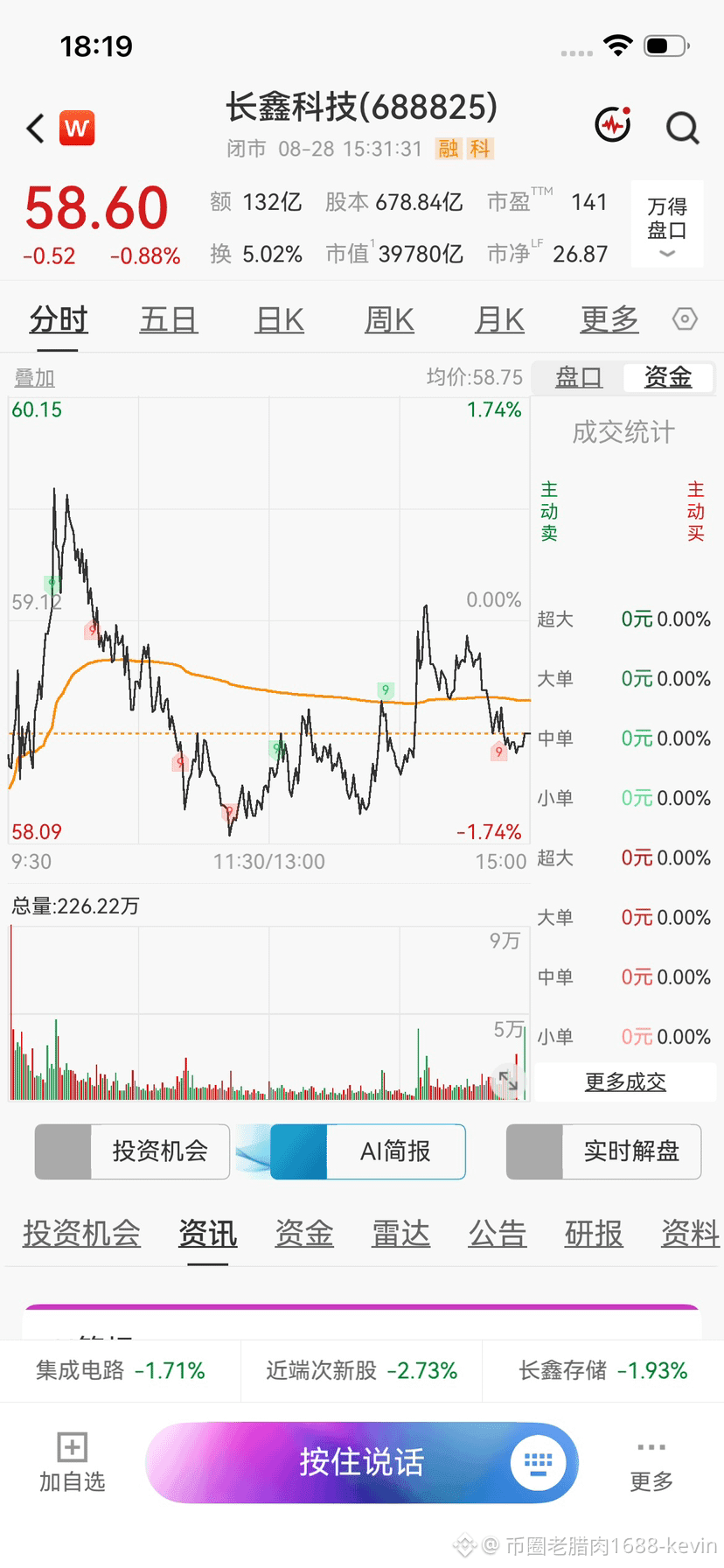
Changxin Tech’s actual performance far exceeded market expectations.
According to the 2026 interim report released on August 28, its core metrics comprehensively outperformed both the company’s earlier guidance and market forecasts:
Actual performance vs. prior expectations
First-half revenue: RMB 150.31 billion (previously expected RMB 110–120 billion)
First-half net profit attributable to shareholders: RMB 77.605 billion (previously expected RMB 50–57 billion)
Q2 single-quarter net profit: RMB 52.843 billion (up 113% QoQ)
The company’s earlier forecast for first-half performance has been greatly surpassed. Institutions such as Mizuho Securities had also clearly expected that its Q2 results would be “significantly above expectations.” The key driving force is a simultaneous rise in DRAM volume and pricing $CXMT
According to the 2026 interim report released on August 28, its core metrics comprehensively outperformed both the company’s earlier guidance and market forecasts:
Actual performance vs. prior expectations
First-half revenue: RMB 150.31 billion (previously expected RMB 110–120 billion)
First-half net profit attributable to shareholders: RMB 77.605 billion (previously expected RMB 50–57 billion)
Q2 single-quarter net profit: RMB 52.843 billion (up 113% QoQ)
The company’s earlier forecast for first-half performance has been greatly surpassed. Institutions such as Mizuho Securities had also clearly expected that its Q2 results would be “significantly above expectations.” The key driving force is a simultaneous rise in DRAM volume and pricing $CXMT
Changxin Technology’s performance explodes! Net profit expected to increase more than 22x in half a year, earning nearly 400 million yuan per day
On May 17, China’s homegrown DRAM leader Changxin Technology updated its Sci-Tech Innovation Board IPO prospectus, delivering an astonishing set of results:
In Q1, revenue was 50.8 billion yuan, up 719.13% year-on-year
In Q1, net profit was 33.012 billion yuan, up 1268.45% year-on-year
Net profit attributable to shareholders was 24.762 billion yuan, up 1688.30% year-on-year
Earnings guidance for the first half: revenue of 110 billion to 120 billion yuan, up 612% to 677%; net profit attributable to shareholders of 50 billion to 57 billion yuan, up 2244% to 2544%
From a loss of 16.3 billion yuan in 2023, to a loss of 7.1 billion yuan in 2024, to turning profitable in 2025 with a gain of 1.875 billion yuan, and now earning more than 33 billion yuan in a single quarter—this chip company that burned over 30 billion yuan over three years is now staging what could be the most insane performance turnaround in semiconductor history.
The surge in AI compute demand, combined with a sharp rise in DRAM prices, helped Changxin Technology catch the timing of the cyclical upturn. Its global market share has risen to 7.67%, ranking fourth worldwide. The company plans to raise 29.5 billion yuan to accelerate its drive to catch up with international giants.$CXMT
On May 17, China’s homegrown DRAM leader Changxin Technology updated its Sci-Tech Innovation Board IPO prospectus, delivering an astonishing set of results:
In Q1, revenue was 50.8 billion yuan, up 719.13% year-on-year
In Q1, net profit was 33.012 billion yuan, up 1268.45% year-on-year
Net profit attributable to shareholders was 24.762 billion yuan, up 1688.30% year-on-year
Earnings guidance for the first half: revenue of 110 billion to 120 billion yuan, up 612% to 677%; net profit attributable to shareholders of 50 billion to 57 billion yuan, up 2244% to 2544%
From a loss of 16.3 billion yuan in 2023, to a loss of 7.1 billion yuan in 2024, to turning profitable in 2025 with a gain of 1.875 billion yuan, and now earning more than 33 billion yuan in a single quarter—this chip company that burned over 30 billion yuan over three years is now staging what could be the most insane performance turnaround in semiconductor history.
The surge in AI compute demand, combined with a sharp rise in DRAM prices, helped Changxin Technology catch the timing of the cyclical upturn. Its global market share has risen to 7.67%, ranking fourth worldwide. The company plans to raise 29.5 billion yuan to accelerate its drive to catch up with international giants.$CXMT
Meituan’s Q2 performance explodes! Revenue tops 100 billion, profit far exceeds expectations
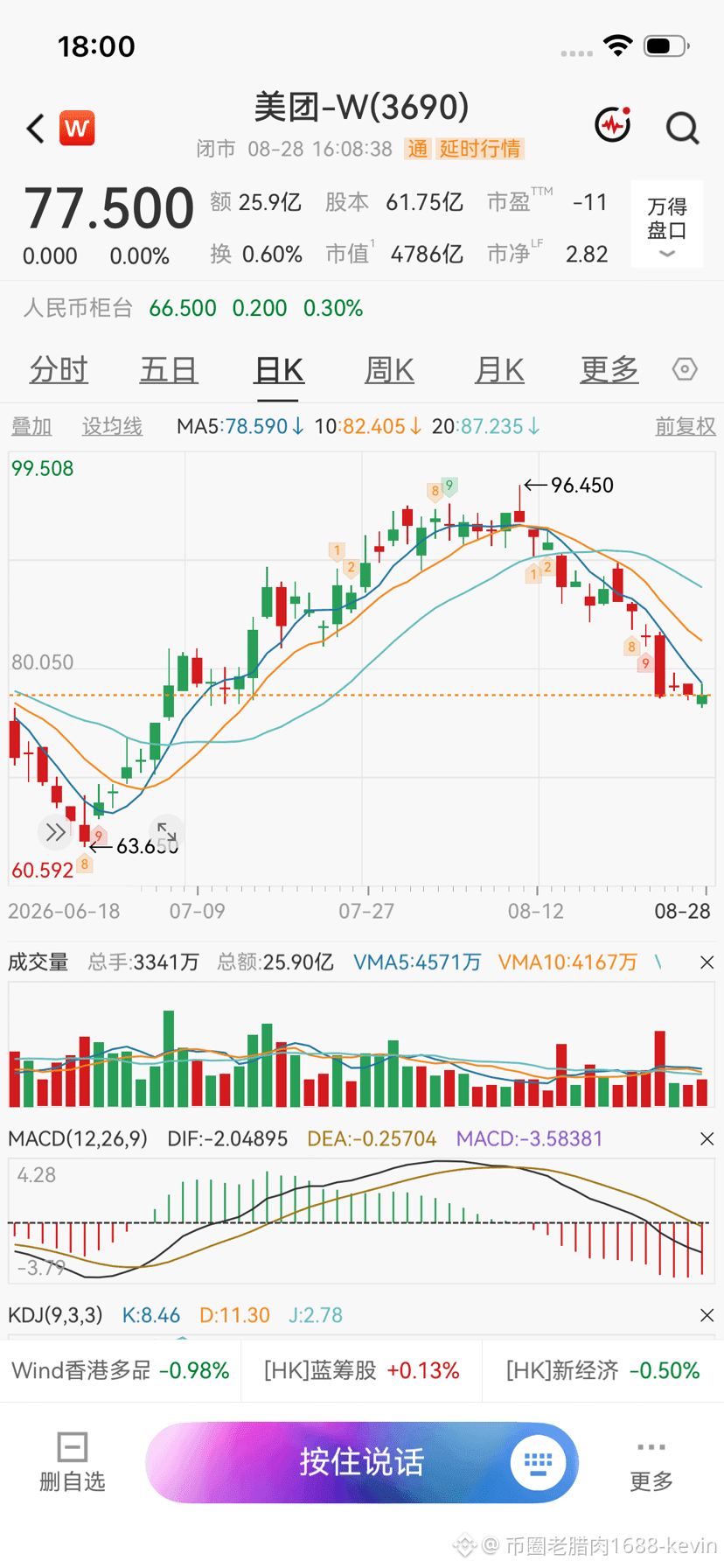
On August 28, Meituan released its 2026 Q2 results:
Revenue was RMB 104.6 billion, up 14.4% year over year, about RMB 3.5 billion above market expectations
Adjusted net profit was RMB 2.52 billion, up 69% year over year; market expectation was only RMB 340 million
Profit for the period was RMB 2.155 billion, surging 490% year over year
All businesses recovered across the board: core local commerce revenue reached RMB 71.5 billion, with operating profit turning from negative to positive quarter over quarter; new business revenue was RMB 33.1 billion, with losses narrowing to RMB 1.7 billion. Meituan continued to increase AI investment, with R&D spending of RMB 7.7 billion, up 22.5%.
After several quarters of intense competition, the company returned to profitability and the turning point in operations has been confirmed. Wang Xing said that Meituan will firmly advance the integration of AI into real business scenarios
#美国企业利润创历史新高 $MEITUAN
On August 28, Meituan released its 2026 Q2 results:
Revenue was RMB 104.6 billion, up 14.4% year over year, about RMB 3.5 billion above market expectations
Adjusted net profit was RMB 2.52 billion, up 69% year over year; market expectation was only RMB 340 million
Profit for the period was RMB 2.155 billion, surging 490% year over year
All businesses recovered across the board: core local commerce revenue reached RMB 71.5 billion, with operating profit turning from negative to positive quarter over quarter; new business revenue was RMB 33.1 billion, with losses narrowing to RMB 1.7 billion. Meituan continued to increase AI investment, with R&D spending of RMB 7.7 billion, up 22.5%.
After several quarters of intense competition, the company returned to profitability and the turning point in operations has been confirmed. Wang Xing said that Meituan will firmly advance the integration of AI into real business scenarios
#美国企业利润创历史新高 $MEITUAN
Log in to explore more content