

As blockchain technology matures, speculative cycles alone are no longer enough to sustain long-term value creation. The next wave of adoption is being driven by institutions, regulated markets, and tokenized versions of real-world financial instruments. At the center of this transition sits the Dusk Foundation, a project that has spent years architecting a blockchain capable of supporting confidentiality, regulatory oversight, and enterprise-grade financial workflows.
In 2026, Dusk is no longer positioning itself merely as a privacy-focused Layer-1. Instead, it is emerging as a full-stack financial infrastructure platform — one designed to connect traditional finance, blockchain automation, and decentralized liquidity through cryptographic guarantees. The Foundation’s strategic direction highlights a belief that privacy must coexist with compliance, and that tokenized capital markets will demand networks built for that reality from day one.
This article explores how Dusk’s institutional bridges, real-world asset initiatives, and market-facing infrastructure are shaping its long-term role in the evolving crypto economy.
🌉 Bridging Traditional Finance and On-Chain Markets
One of the most significant narratives surrounding Dusk in 2026 is its deliberate focus on institutional onboarding rather than retail speculation alone. Financial institutions — from exchanges to custodians and asset issuers — require systems that meet strict regulatory standards while protecting sensitive transactional data. Public blockchains, where every trade and balance is visible to the world, often fail this requirement.
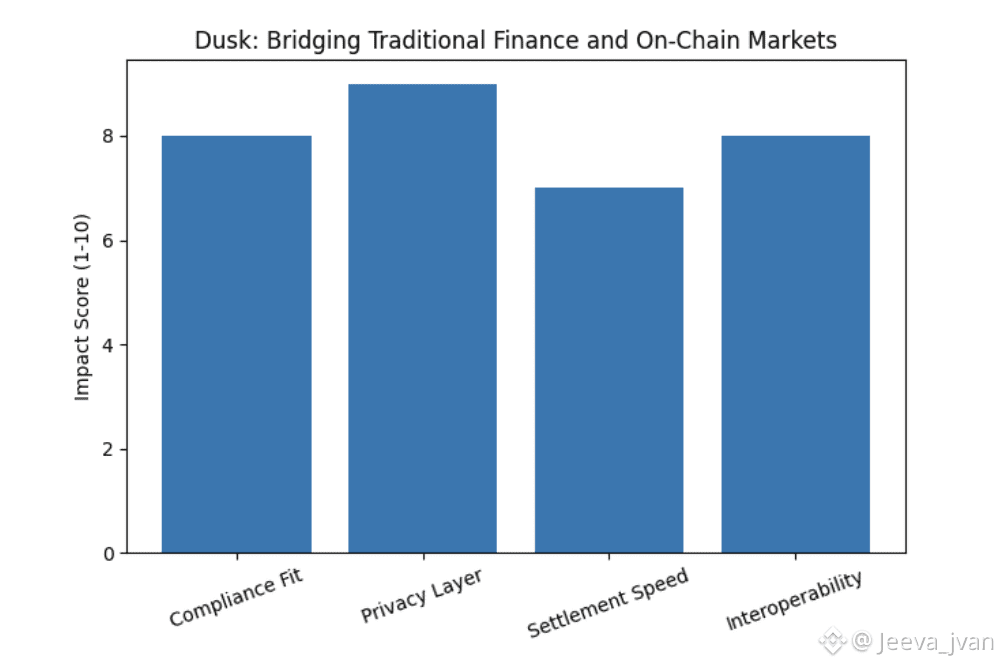
Dusk’s confidential smart contract model provides a solution: financial operations can be executed privately on chain while still being provably correct and auditable by authorized parties. This enables workflows that closely resemble existing TradFi systems, but without centralized intermediaries.
The Dusk Foundation has emphasized that regulated capital will not move on chain unless networks support:
• selective disclosure
• identity-aware asset issuance
• private settlement
• regulator-accessible audit trails
• automated compliance logic
By embedding these features into the protocol layer rather than bolting them on later, Dusk seeks to remove friction for institutions exploring tokenization.
🏦 Tokenizing Real-World Assets on Dusk
The rise of Real-World Assets (RWAs) — tokenized bonds, equities, funds, commodities, and private credit — is one of the most powerful trends in crypto today. Governments and financial firms increasingly view blockchain as a settlement rail, but only if legal protections and data confidentiality can be preserved.
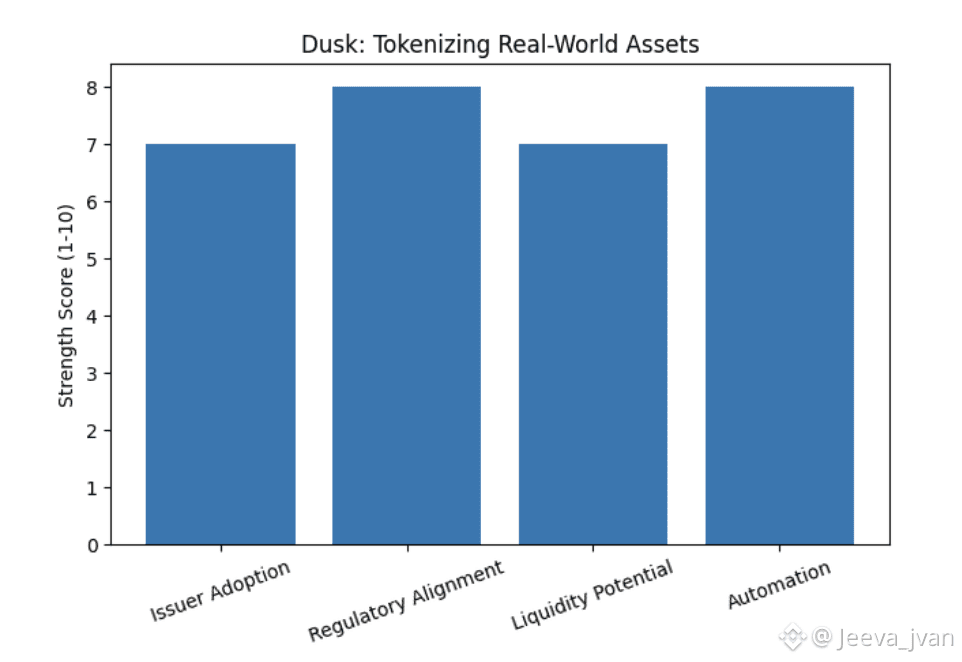
Dusk’s infrastructure is tailored for this use case.
Through partnerships with regulated exchanges and financial service providers, Dusk is creating frameworks where securities can be issued natively on chain, traded confidentially, and settled instantly. These tokenized instruments are not synthetic DeFi derivatives; they are legally recognized assets backed by off-chain contracts and regulatory approvals.
In this architecture:
• issuers mint compliant tokens
• investors trade them privately
• settlement occurs on chain
• regulators retain audit access
• compliance rules execute automatically
This design eliminates reconciliation delays and middle-office complexity while preserving legal certainty — one of the holy grails of financial modernization.
🔗 Interoperability and Data Infrastructure
Another pillar of Dusk Foundation’s institutional strategy is interoperability. Tokenized assets must move across chains, interact with decentralized liquidity, and integrate with enterprise software stacks.
Dusk’s adoption of cross-chain communication layers and oracle frameworks enables RWAs to plug into broader Web3 ecosystems without compromising confidentiality. Market data, corporate actions, interest payments, and reporting obligations can all be triggered by smart contracts using cryptographically verified inputs.
This transforms blockchain from a static ledger into a programmable financial machine — capable of issuing, servicing, and settling complex instruments autonomously.
The Foundation has repeatedly stressed that infrastructure maturity — not hype cycles — will determine which networks capture institutional flows in the long run.
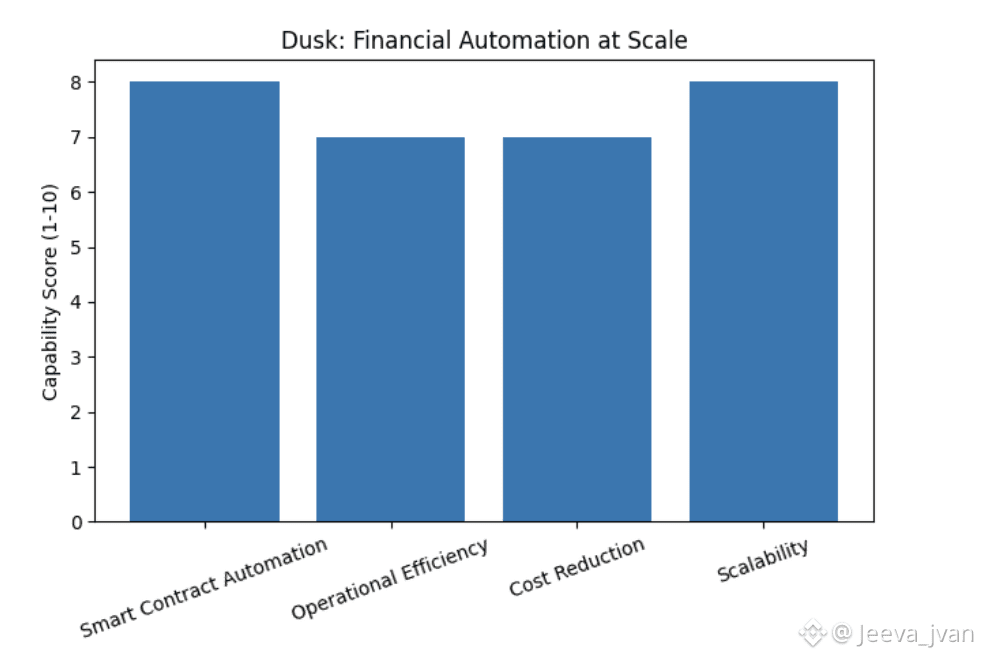
🧠 Building Financial Automation at Scale
Beyond asset issuance, Dusk is investing heavily in automated financial workflows.
Corporate actions like dividend distributions, shareholder votes, compliance checks, and disclosure reporting can be embedded directly into confidential smart contracts. Instead of relying on legal firms, transfer agents, and clearinghouses to coordinate these events manually, Dusk’s blockchain can execute them programmatically.
This automation could radically lower operating costs for issuers while improving transparency and settlement speed.
For example:
• dividends can be distributed instantly to token holders
• voting can occur privately but verifiably
• regulatory filings can be generated automatically
• lockups and vesting schedules can be enforced by code
In regulated finance, these functions represent billions of dollars in back-office overhead — making automation one of the strongest adoption drivers for blockchain infrastructure.
📊 Institutional Narrative Meets Market Attention
As these developments have accelerated, market participants have begun to reframe Dusk’s narrative.
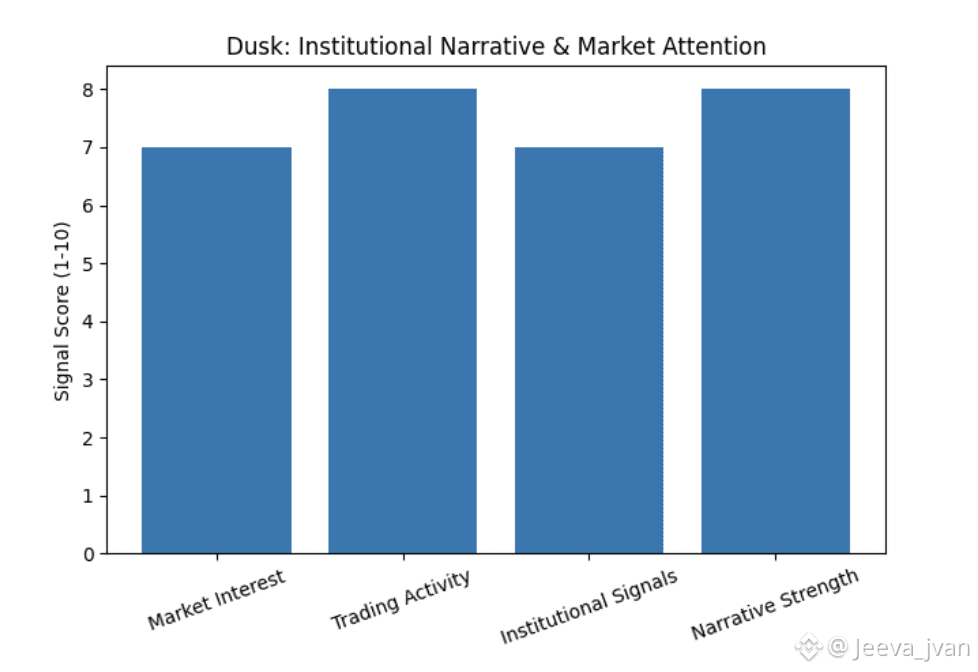
Instead of being categorized purely alongside privacy coins like Monero or Zcash, DUSK is increasingly discussed as part of the RWA and institutional infrastructure sector. This shift is significant: it changes how long-term investors evaluate the network’s potential.
Market rallies in early 2026 coincided with announcements around tokenization pilots, compliance tooling, and enterprise-focused upgrades. Trading volumes surged as capital rotated into projects with real-world narratives rather than speculative meme cycles.
However, Dusk’s leadership has consistently emphasized that price action is secondary to infrastructure adoption. The Foundation’s public communications focus more on partnerships, developer tooling, and regulatory engagement than on token performance.
That tone signals a project positioning itself for multi-year relevance rather than short-term hype.
🧭 Strategic Positioning for the Next Financial Cycle
Looking ahead, Dusk Foundation’s institutional roadmap suggests a long-term vision: becoming the default confidential settlement layer for tokenized markets.
As governments roll out clearer digital-asset frameworks and banks expand tokenization pilots, the demand for compliant privacy infrastructure is likely to surge. Few public blockchains are built for that environment from the ground up.
If Dusk succeeds, it could occupy a role similar to what clearing networks and settlement rails play in today’s financial system — but powered by cryptography instead of centralized intermediaries.
In that world, blockchains cease to be experimental platforms and become core financial infrastructure.
🎯 Final Thoughts
The Dusk Foundation’s 2026 strategy revolves around three tightly linked pillars:
• confidential smart contracts
• real-world asset tokenization
• institutional-grade compliance tooling
Together, they form a thesis that blockchain adoption will not be driven by anonymity or speculation alone, but by networks that mirror traditional finance’s requirements while surpassing it in efficiency.
Whether Dusk becomes a dominant institutional layer will depend on execution, developer adoption, and regulatory alignment across jurisdictions. But its positioning — at the crossroads of privacy and compliance — places it squarely inside one of the most powerful narratives shaping crypto’s next decade. @Dusk #dusk $DUSK
