


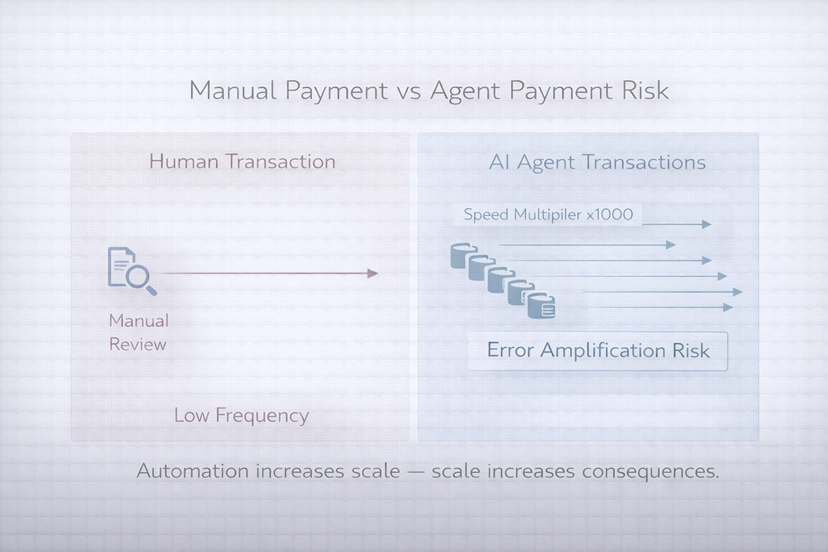
When humans are talking about AI agents on chain, they usually refer to speed, fees, and loud demonstrations. However, the initial actual problem I observe is safety. Cryptocurrency transfers already involve people making mistakes due to the length of the wallet address that is not forgiving. Suppose agents transfer payment at speed and scale and many times over. In the absence of guardrails we will have an economy of permanent errors rather than agent economy.
This is why I am paying special attention to a more subtle aspect of Vanar direction identity, uniqueness and safer routing. It is not glitzy, yet it will dictate how ordinary individuals and companies will consider money automation.
Transferring Money to Hex Strings Is a Human Bug Just Waiting to Be an Agent Disaster.
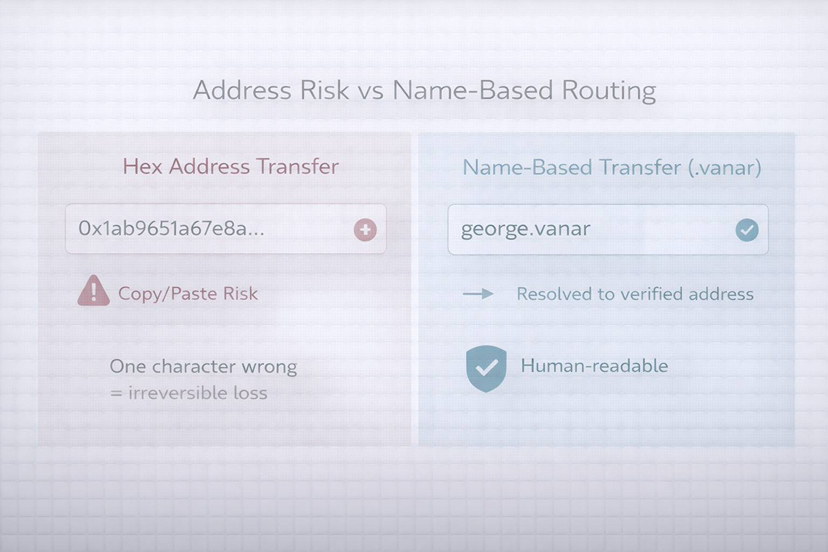
The address format used today 0x... is machine friendly but inhumane to humans. Even cautious users commit copy-pasting errors, address the wrong recipient, or are unable to check whoever they are transacting with. The most bad thing is that when the money is dispatched it is gone.
In agent-driven systems, the risk is increased. Agents do not stop to scan a hex string thrice as a suspicious human. They are speed and completion-oriented. The challenge is then the following one: how do we allow the agents to transfer money fast without having to coin-flip each transaction?
One of the solutions proposed by vanar-aligned builders is human-readable names which are routed over wallet integrations. There would be no longer be send to a hex, but send to a name. There are public mentions, such as readable style names of the type.vanar and MetaMask Snap-based name resolution, including george.vanar. With such UX, automation is ensured.
The Second Threat: Bots are not only harvesting Airdrops - they are poisoning Markets.
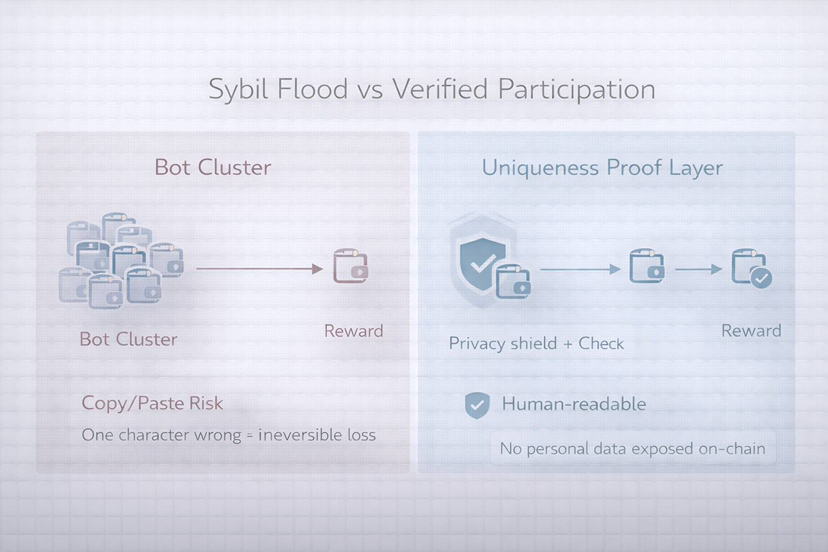
Individuals do not recognize the extent to which on-chain systems are hurt by bots. They cultivate prizes, however, what is more significant they corrupt exploration and faith. When a marketplace, PayFi app or even an agent service is overwhelmed with fake users, the system turns noisy, unfair and easily manipulated.
Sybil resistance is also important here, but it is not a buzzword, it is a fundamental safety measure. When your application fails to differentiate between a real person and ten thousand wallets, reward systems, reputation systems or agent processes are gamed. When that occurs, hardcore users drop.
The ecosystem created by Vanar relies on a certain tool: Biomapper created by Humanode. It provides privacy-preserving sybil resistance, which can be implemented with dApps with minimal code. Humanode reported the implementation of Biomapper on Vanar and states that it enables it to provide biometric sybil protection without exposing user data.
This can only scale with Sybil Resistance Without KYC.
This is the fine line because complete KYC of all of them will kill adoption. A lack of identity and anonymity portends bot farms. We must have a middle ground: demonstrate uniqueness but not by making us all paperwork.
The Biomapper messaging of Humanode can be seen as intriguing as it provides sybil resistance without revealing personal data to the on-chain. It is important: not only enterprises and actual users do not want to see their names in public books, but also not to have their systems exploited by robots and counterfeit accounts.
This is where also Vanar makes his thesis more real-life. To get PayFi, market access and consumer apps to work, you require a mechanism that will block bots without creating a surveillance machine.
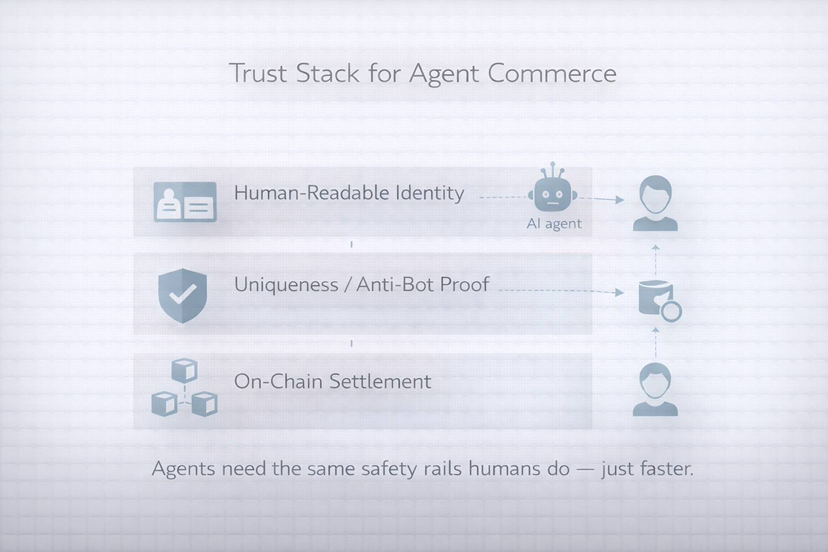
Name + Uniqueness + Settlement Names + Uniqueness + Settlement The Stacks I Believe Will Win Customers Use The Trust Stack
In perspective, the most secure system of agent trading resembles a three-layered stack:
First, there is the readability of human identity in terms of payments and permissions. Second, uniqueness tests to eliminate gaming. Third, expedited financing to render automation helpful.
The ecosystem of Vanar encompasses all three. When referring to names, community: On naming, reference to the .vanar -style name and Snap-based resolution minimizes routing errors. On uniqueness, Biomapper allows dApps to filter bots without impacting privacy. About networking, in documentation Vanar emphasizes standard support of EVM wallets using public RPCs and common wallet implementations, meaning that identity and uniqueness layers do not need to re-implement a common set of workflows.
The thing is: guardrails only work when they can be implemented in a regular working process.
Why This Angle Is More Important Than Another TPS Claim.
A lot of chains can boast of speed and a lot can boast of a low price. However, the trick lies in the trust at scale particularly when automation comes into play.
I do not simply inquire, Is it fast? in case I am a business. I ask:
Am I able to make my users make payments to the correct individual?
Can bots drain my incentives?
Is it possible to establish equitable access without revealing confidential identity?
This is why I consider identity and sybil resistance as the main infrastructure and not fringe benefits. In their absence, you have a crowd that is thrilled momentarily and system that is abused permanently, rather than a healthy user base.
The Vanar public ecosystem pages introduce the chain as the AI-based infrastructure of PayFi and actual application, but the long-term credibility will require a secure user experience on non-cryptocurrency individuals.
My Thesis: Safety, not Hype, Will Be the First Agent Chains Winner.
I believe that the initial wave of the real agent commerce will appear rather pedestrian on the surface. It will be:
Names instead of hex.
Less KYC uniqueness checks.
Applications that prevent the blocking of bot clusters but not actual users.
Routing which minimizes irreversible errors.
That’s why I’m optimistic. Chains that become popular with the mainstreams will not clam the loudest but will silently fix ugly issues that we all attempt to ignore.
Whenever I think of Vanar I do not limit it to a single feature. I envision a greater direction: it must be made on-chain activity automatable.
By making name based routing normal, enabling privacy friendly uniqueness proof and making such protections lightweight to builders, Vanar will not simply construct an AI-native story. It will pave the way of agent commerce to become normal.
