


The majority of them discuss AI-native blockchains as something of just memory (data) and reasoning (logic). That is fact, but not the whole picture. And in case AI agents will transfer money, open positions, collect rewards, or do business without human supervision, the chain also requires something uninspiring but essential, namely identity rails which are resistant to bots, scammery, and human errors.
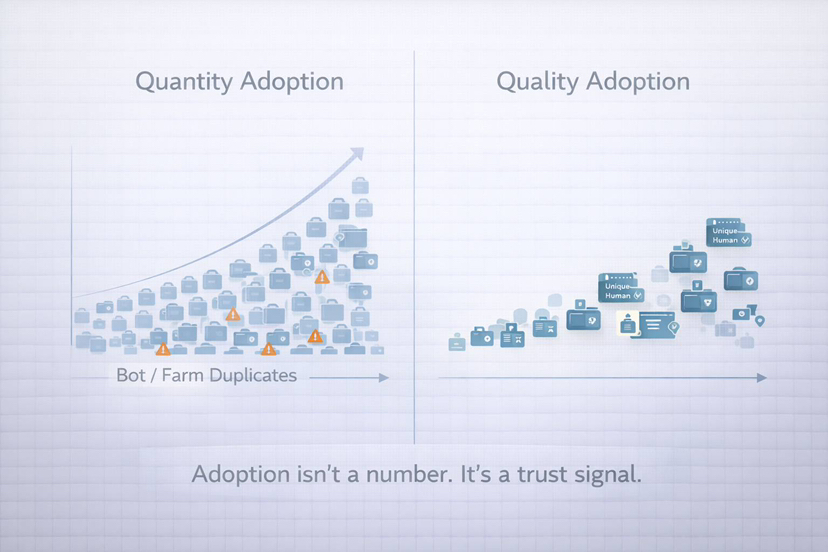
That is the silent issue of Web3 nowadays. As the adoption increases, you do not merely have more users but more fake users. Airdrop farms. Referral abuse. Marketplace wash activity. "One person, fifty wallets." And once the AI agents come into the picture, the attack surface is again widened: bots that appear to be agents, agents that become deceived, and bots that can be used in large numbers.
Therefore, it is not that Vanar should be interested in answering the question: can it do AI? It is: will AI-driven finance be honest enough to be of any real-world use?
The importance of bots in agent arrival case.
In applications that are operated by humans, friction tends to reduce the pace of fraud. People get tired. People make mistakes. People hesitate. Agents don't. You just leave a loophole that is profitable to a bot and the bot will pound it 50,000 times before lunch.
This is why agent rails require two characteristics simultaneously; low friction by users, and high friction by fake users. When you only make the best as fast and cheap, you end up creating the ideal playground to be used by robots. Optimizing on strict identity checks only transforms the product into a KYC form.
The ecosystem in Vanar has been shifting towards a third course; evidence of uniqueness and usability upgrades, which minimize the number of human errors, without compelling every experience to become show passport to continue.
Biomapper on Vanar: made unique without making all things KYC
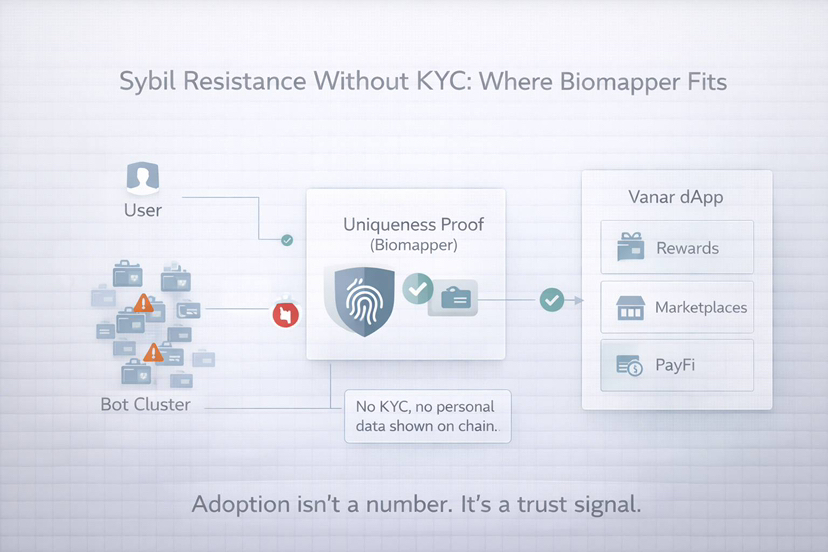
The use of Humanode Biomapper c1 SDK on Vanar is one of the most tangible ones I have been exposed to. Humanode defines Biomapper as a privacy-saving, biometric-based Sybil-resistance mechanism that can be embedded into dApps--they are supposed to ensure that a user is a unique human being, and no KYC is required.
What is important to builders is, this is not merely a blog release, it also comes with a real integration guide and SDK flow, which demonstrates how a dApp can call to determine whether this wallet is linked to a unique human proof. inside Solidity.
This is important to the direction Vanar will take, as it goes directly to the type of apps Vanar continues to be drawn to: marketplaces, PayFi, the real world flows, where bots not only are disruptive of metrics but are incentive thieves and trust corruptors. Humanode goes as far as to present the use case to Vanar builders explicitly: ensuring bots are not involved in financial flows, facilitating equal access, and ensuring the ability to access tokenized assets without any form of KYC.
The name layer issue: AI Pseudonym payment is unsafe to a 0x... string.
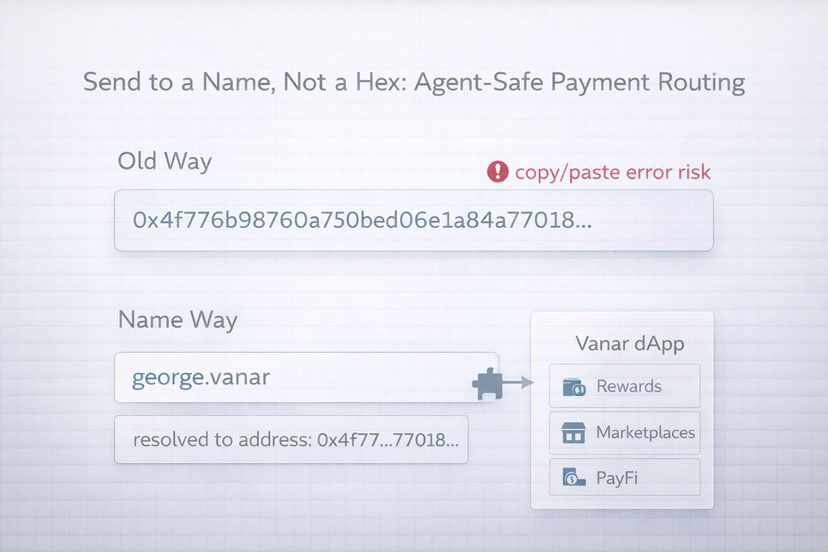
Something more practicable, now, we will discuss. In case I require your wallet address you will send me a long hex string. When my AI agent wishes to pay your AI agent, it will encounter the same thing, except that agents will pay your AI agent more and much more quickly, and in vast amounts. That is not a UX issue, that is a risk issue.
Since errors in this case are not oops typo. They're "money gone."
This is why I believe human readable names to be a serious infrastructure primitive in the agent age. This has been orchestrated by Vanar using MetaMask Snaps the extension system that MetaMask markets in order to add new wallets.
As well as there is a given Snap available which is linked to coNFT domain name resolution that allows users to send tokens in the form of readable domain names instead of addresses of considerable length. And announcements made by Vanar community suggest the usability of human-readable names of the format of .vanar through ConftApp + MetaMask Snaps (such as george.vanar).
The marketing aside, the implication of infrastructure is high, once you are matching agents and payments, you desire identity that is simple to retrieve, difficult to imitate, and easy to counterfeit. Names help humans. They also contribute to the safe routing of value by the agents.
The way this fits into the larger real-life story of Vanar.
Many chains claim to be real-world adopted. They usually mean by this that they want partnerships. However, there exists an ugly condition in the real world adoption: systems need to be able to deal with abuse gracefully.
You can have fair gaming rewards, but you cannot do it without Sybil resistance. To trust PayFi rails, you have to have bot resistance. In order to make tokenized commerce useful, you must have identity and uniqueness assertions that do not ruin UX.
That is why I perceive the Biomapper integration + name-based wallet routing as not just the nice add-ons. It is the lack of plumbing on the AI-agent direction. In its absence, the autonomous finance becomes the autonomous exploitation. Along with it, that at least provides a plausible route to: one person = one participant, and no payments based on copy-paste chance.
An example of a useful mental model: Vanar is not merely creating AI, it is creating guardrails.
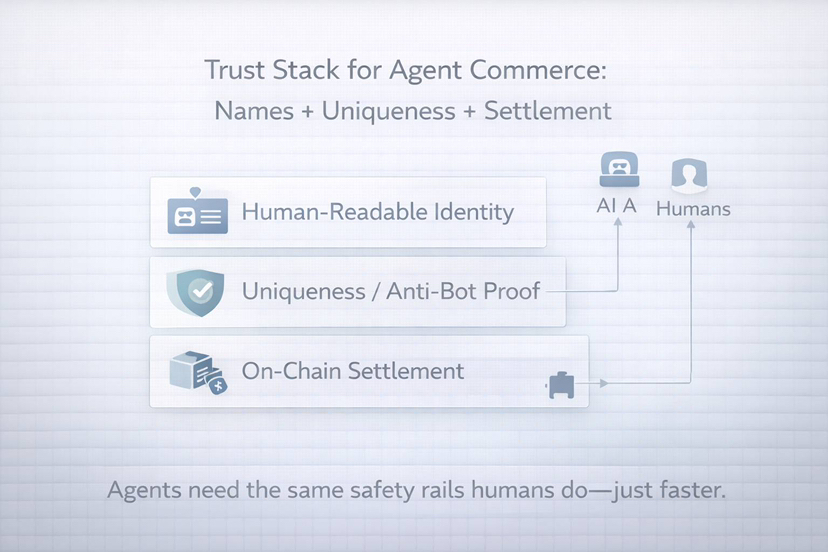
I believe that the best bet by Vanar is not attempting to win on the category of hype (fastest, cheapest, most partnerships). The further bet is the construction of guardrails that would render the use of AI believable:
Names minimize transmission of errors.
Uniqueness demonstrations decrease bot armies.
Extensibility through Snaps allows bridging the gap between Web2 UX and Web3 settlement.
And in the case of a chain with an objective of agents + commerce, they are not optional. They are what make a demo look and act like a long-lasting system.
Unless AI agents really become economic actors, we will be deciding by the chains on the basis of TPS less and on one basis only. Can you trust what happens when no-one is looking? One of the more serious answers I have encountered developing is the direction on identity-and-uniqueness, by Vanar.
