

Most platforms celebrate change.
New features. New upgrades. New versions. New roadmaps. The rhythm of many ecosystems is built around motion, and motion becomes the proof that something is alive. If nothing changes, people assume nothing is happening.
Vanar Chain gives off a different impression.
It doesn’t feel like a system that is trying to maximize how often things change. It feels like a system that is trying to minimize the damage change can do.
That’s a subtle distinction, but it reshapes everything around it.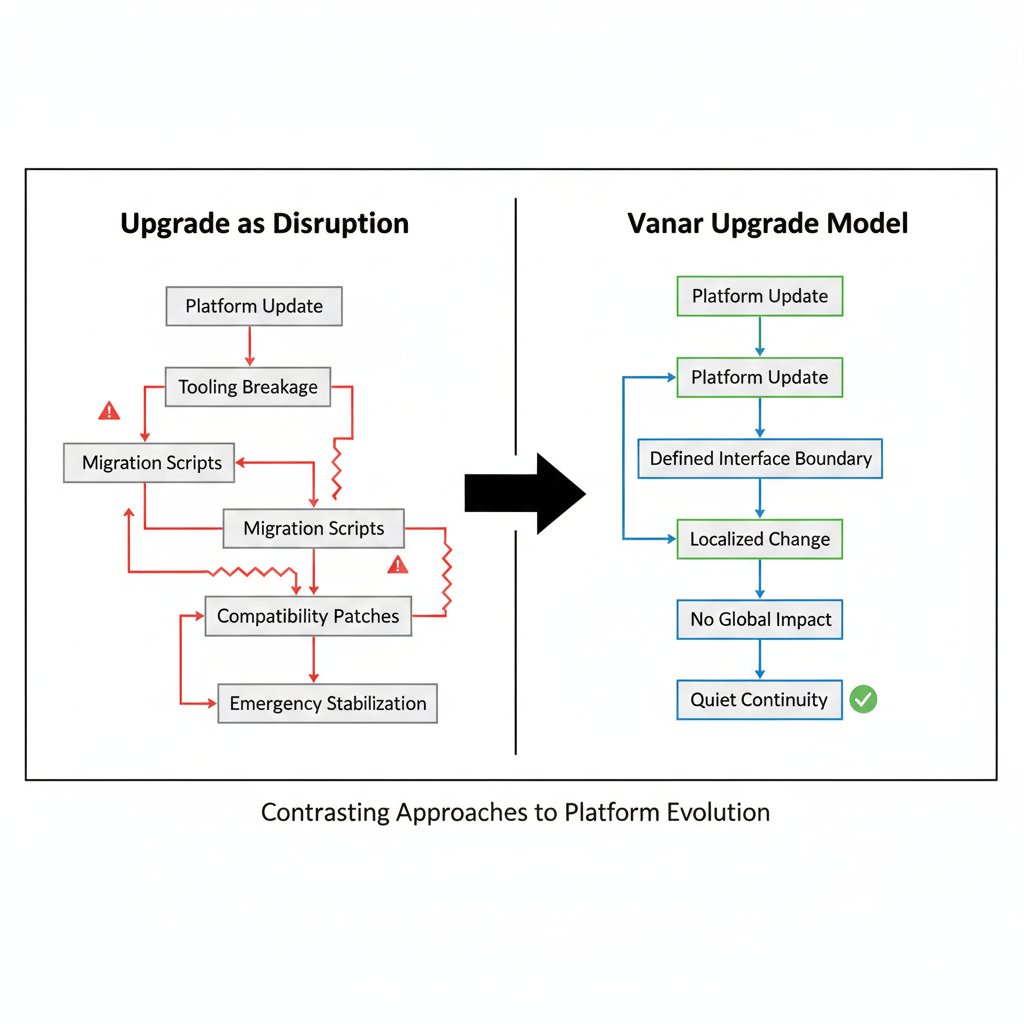
In many infrastructures, upgrades are treated like achievements. They’re shipped, announced, and then the ecosystem scrambles to adapt. Tooling breaks. Assumptions shift. Edge cases appear. Teams spend weeks stabilizing what was supposed to be an improvement.
Over time, this creates a strange dynamic: progress becomes something you prepare to survive, not something you quietly absorb.
Vanar seems to be built with a different emotional target in mind: change should feel boring.
Not because it’s unimportant, but because the system should already be shaped to receive it.
There’s a big difference between a platform that says, “Here’s what’s new,” and a platform that makes you think, “Oh, that changed? I barely noticed.”
That second reaction usually means the architecture is doing its job.
When change is expensive, teams avoid it. When change is chaotic, teams fear it. When change is unpredictable, teams build layers of process just to protect themselves from their own platform.
Vanar’s design posture suggests it wants to make change mechanical instead of emotional.
You don’t brace for it.
You don’t hold meetings about how scary it might be.
You don’t pause everything else just to make room for it.
You just let it pass through the system.
That requires discipline upstream.
It means being conservative about interfaces.
It means being careful about assumptions.
It means preferring evolution over replacement.
None of those choices are glamorous. They don’t produce dramatic before-and-after screenshots. They don’t generate hype cycles. But they do produce something much rarer in infrastructure: continuity.
Continuity is what allows long-lived systems to exist without constantly re-teaching their users how to survive them.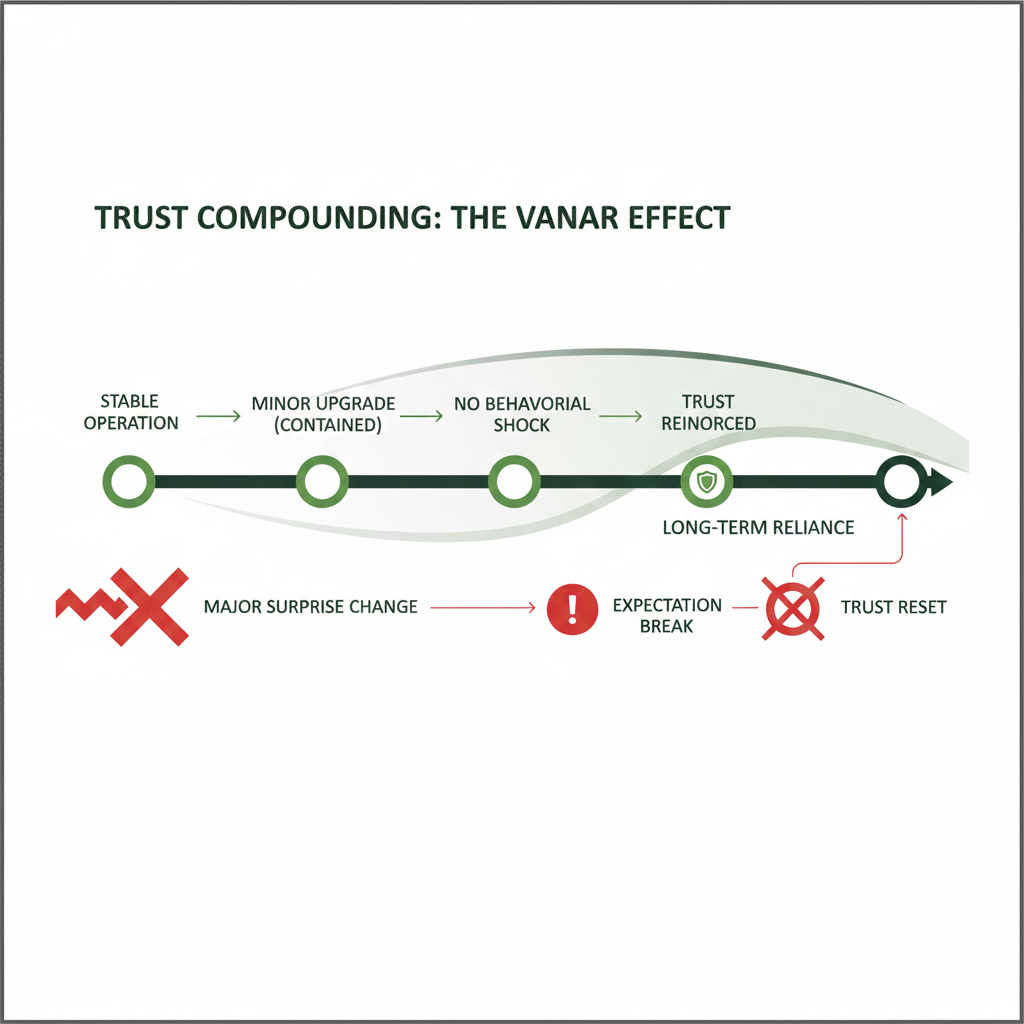
There’s also a trust dimension here.
Every time a platform changes in a way that breaks expectations, it spends trust. Users become cautious. Developers add defensive code. Organizations delay upgrades. The system becomes something you approach carefully instead of something you rely on.
When change is absorbed quietly, trust compounds instead of resets.
Vanar feels like it’s aiming for that compounding effect.
Not by freezing itself in place, but by making movement predictable enough that people stop watching every step.
This shows up in how you imagine operating on top of it.
In fast-moving platforms, teams often build upgrade buffers: compatibility layers, version checks, migration scripts, rollback plans. All necessary. All expensive. All signs that the platform itself is a moving target.
In a system that treats change as something to be contained, those buffers start to shrink. Not because risk disappears, but because risk becomes localized and legible instead of global and surprising.
That has real economic consequences.
Less time spent adapting to the platform means more time spent building on it.
Less fear around upgrades means less fragmentation.
Less operational drama means fewer hidden costs that never show up in benchmarks.
Over years, those differences compound more than any single feature ever could.
There’s also a cultural effect.
Platforms that move loudly train their ecosystems to chase motion. Every new release becomes a moment. Every change becomes a conversation. That can be energizing, but it also creates fatigue. People start waiting to see what breaks before they commit to anything long-term.
Platforms that move quietly train their ecosystems to expect stability and plan for continuity. The conversation shifts from “What changed?” to “What can we build now that we can rely on this?”
That’s a very different kind of momentum.
It’s the kind that produces boring businesses, boring integrations, boring workflows.
And boring, in infrastructure, is usually a compliment.
None of this means Vanar is anti-change.
It means Vanar seems to treat change as something that must earn the right to be introduced by proving it won’t disturb the shape of the system.
That’s a higher bar than most platforms set. And it’s a bar that gets harder to maintain as ecosystems grow.
But if you get it right, you don’t just get faster shipping.
You get longer memory.
You get systems that can carry assumptions forward instead of constantly resetting them. You get users who stop asking, “Will this still work next year?” because experience has taught them that the answer is usually yes.
In the long run, that may be one of Vanar’s quietest advantages.
Not that it changes quickly.
But that when it changes, it doesn’t ask everyone else to change with it.
In infrastructure, that restraint often matters more than ambition.
Because the platforms that last aren’t the ones that move the fastest.
They’re the ones that let everyone else keep moving while they evolve underneath.
