

Introduction
Short selling allows traders to profit from the decline in the price of an asset. This is a very common way to manage downside risk, hedge existing positions, or simply express a bearish outlook on the market.
However, short selling can sometimes be an exceptionally risky trading strategy. Not only because there is no upper limit for the price of an asset, but also because of short selling. A forced liquidation can be described as a sudden increase in prices. When this happens, many short sellers become “trapped” and rush to try to cover or exit their positions.
Naturally, if you want to understand what a forced liquidation is, you must first understand what selling short (or short) is. If you are unfamiliar with short selling and how it works, see What is Short Selling in Financial Markets?.
In this article, we will look at what a forced liquidation is, how to prepare for it and even profit from it in a long position.
What is a forced liquidation?
A forced liquidation occurs when the price of an asset increases significantly due to a large number of short sellers having their positions liquidated.
Short sellers bet that the price of an asset will fall. If instead the price increases, short positions begin to accumulate an unrealized loss. When the price increases, short sellers may be forced to close their positions. This can be done through Stop-loss triggers, liquidations (for margin contracts and futures contracts). This can also happen simply because traders manually close their positions to avoid even greater losses.
So how do short sellers close their positions? They buy. This is why a forced liquidation results in a sharp rise in prices. As short sellers close their positions, a cascading effect of buy orders adds fuel to the fire. Therefore, a forced liquidation is usually accompanied by an equivalent spike in trading volume.
Here's another thing to consider. The greater the short interest, the easier it is to trap short sellers and force them to close their positions. In other words, the more liquidity there is to trap, the greater the increase in volatility may be due to forced liquidation. In this sense, a forced liquidation is a temporary increase in demand while supply decreases.
The opposite of a forced liquidation is a forced liquidation of long positions, although it is less common. A forced liquidation of long positions is a similar effect that occurs when long positions become trapped by cascading selling pressure, causing prices to fall sharply.
How does a forced liquidation of short positions occur?
A forced liquidation occurs when there is a sudden increase in buying pressure. If you've read our article on short selling, you know that it can be a high-risk strategy. However, what makes a forced liquidation a particularly volatile event is the sudden rush to quickly cover short positions (via buy orders). This includes many stop-loss orders triggering at a significant price level, and many short sellers manually closing their positions at the same time.
Forced liquidation can occur in virtually any financial market where a short position can be taken. At the same time, the lack of options to short a market can also lead to significant price bubbles. After all, if there isn't a good way to bet against an asset, it can go up for an extended period of time.
A prerequisite for a forced liquidation may be the existence of a majority of short positions rather than long positions. Naturally, if there are many more short positions than long positions, there is more liquidity available to fuel the fire. This is why the long/short ratio can be a useful tool for traders who want to keep an eye on market sentiment. If you want to check the real-time long/short ratio for Binance Futures, you can do so on this page.
Some seasoned traders will look for potential forced liquidation opportunities to benefit from a rapid price rise. This strategy involves accumulating a position before forced liquidation occurs and using the rapid rise to sell at a higher price.
➟Do you want to get started with cryptocurrencies? Buy Bitcoins on Binance!
Examples of forced liquidation
Forced liquidations are very common in the stock market. This typically involves negative sentiment around a company, a perceived high stock price, and a large number of short positions. If, for example, some unexpected positive news arises, all of these short positions are forced to buy, causing the stock price to increase. Even so, a forced liquidation is more of a technical pattern than a fundamental event.
By some estimates, Tesla (TSLA) stock has been one of the most shorted stocks in history. However, the price has undergone a number of significant increases, likely trapping many short sellers.
Short selling is also quite common in cryptocurrency markets, particularly in Bitcoin markets. The Bitcoin derivatives market uses highly leveraged positions, and these can be trapped or liquidated with relatively small price movements. This is why forced liquidations of short and long positions are common in Bitcoin markets. If you want to avoid being liquidated or trapped in such moves, consider the leverage you are using. You must also adopt an appropriate risk management strategy.
Take a look at the Bitcoin price range below, from early 2019. The price has been range-bound after a strong downward move. Market sentiment was likely relatively poor as many investors were in short positions, anticipating a continuation of the downtrend.
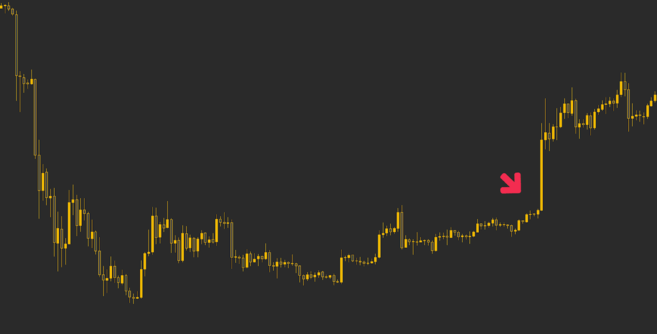
Potential forced liquidation in the BTC/USD market.
However, the price crossed the range with such speed that the zone has not even been retested for a long time. It was not retested until a few years later, during the coronavirus pandemic (also known as “Black Thursday”). This rapid move was most likely due to heavy short covering.
To conclude
In summary, a forced liquidation occurs when short sellers become trapped and are forced to cover their positions, causing prices to rise sharply.
Forced liquidations can be particularly volatile in highly leveraged markets. When many traders and investors use high leverage, price movements also tend to be sharper, as cascading liquidations can lead to a snowball effect.
Make sure you understand the implications of a forced liquidation before entering a short position. Otherwise, you may suffer huge losses. If you want to learn more about short selling and many other trading techniques, check out the Complete Guide to Cryptocurrency Trading for Beginners.