

RUB3
319 Posting

RUB3
Laporkan
Blokir Pengguna
| Real-world value, decentralized vision |
138 Mengikuti
1.1K+ Pengikut
570 Disukai
Posting
Semua
Kuotasi
Live
·
--
Bullish
#baby $BABY
{future}(BABYUSDT)
Integrasi Babylon dengan Aave v4 menunjukkan mengapa masa depan BTCFi mungkin tidak bergantung pada satu protokol yang mengendalikan semuanya.
Babylon tidak perlu menjadi pemberi pinjaman, membangun pool likuiditasnya sendiri, atau menciptakan ulang seluruh pasar kredit dari nol. Perannya lebih terfokus dan lebih mendasar: menjadikan Bitcoin native dapat digunakan sebagai jaminan tanpa harus mengubahnya menjadi aset wrapped terlebih dahulu.
Melalui Trustless Bitcoin Vaults, Babylon mengelola siklus hidup jaminan. Native BTC dikunci di Bitcoin, brankas menjadi aktif di bawah kondisi yang telah ditetapkan, dan struktur yang sama mengatur pembayaran kembali, penebusan, dan likuidasi.
Aave v4 menangani tanggung jawab yang berbeda.
Setelah brankas diverifikasi, sebuah adapter memungkinkan Aave mengenali posisi aktif tersebut sebagai jaminan. Dari sana, Aave menyediakan lingkungan pinjaman, akses likuiditas, serta kontrol risiko pada tingkat pasar.
Pembagian ini penting:
Babylon membuat Bitcoin native dapat dibaca oleh pasar kredit.
Aave mengubah jaminan itu menjadi daya pinjam yang bisa digunakan.
Desain modular inilah yang memberi TBV potensi skala nyata.
Babylon tidak harus bersaing dengan protokol pinjaman yang sudah mapan dalam hal pengguna dan likuiditas. Sebaliknya, ia bisa menjadi jalur jaminan berbasis Bitcoin yang native untuk dihubungkan oleh berbagai pasar. Aave v4 adalah contoh besar pertama, tetapi fondasi yang sama dapat mendukung pinjaman suku bunga tetap, pembiayaan treasury, dan produk kredit khusus lainnya.
Bagi saya, bagian terkuat dari model ini bukan sekadar bahwa BTC bisa dipinjam dengan jaminan. Tetapi bahwa lapisan jaminan dan pasar kredit dapat tetap terpisah, sehingga masing-masing protokol dapat melakukan yang terbaik.
Itu jauh lebih kuat daripada memaksa utilitas Bitcoin, likuiditas, dan pemberian pinjaman masuk ke satu sistem tertutup.
@babylonlabs_io
Apa yang memberi Babylon TBV keunggulan terbesar?
#baby $BABY
Integrasi Babylon dengan Aave v4 menunjukkan mengapa masa depan BTCFi mungkin tidak bergantung pada satu protokol yang mengendalikan semuanya.
Babylon tidak perlu menjadi pemberi pinjaman, membangun pool likuiditasnya sendiri, atau menciptakan ulang seluruh pasar kredit dari nol. Perannya lebih terfokus dan lebih mendasar: menjadikan Bitcoin native dapat digunakan sebagai jaminan tanpa harus mengubahnya menjadi aset wrapped terlebih dahulu.
Melalui Trustless Bitcoin Vaults, Babylon mengelola siklus hidup jaminan. Native BTC dikunci di Bitcoin, brankas menjadi aktif di bawah kondisi yang telah ditetapkan, dan struktur yang sama mengatur pembayaran kembali, penebusan, dan likuidasi.
Aave v4 menangani tanggung jawab yang berbeda.
Setelah brankas diverifikasi, sebuah adapter memungkinkan Aave mengenali posisi aktif tersebut sebagai jaminan. Dari sana, Aave menyediakan lingkungan pinjaman, akses likuiditas, serta kontrol risiko pada tingkat pasar.
Pembagian ini penting:
Babylon membuat Bitcoin native dapat dibaca oleh pasar kredit.
Aave mengubah jaminan itu menjadi daya pinjam yang bisa digunakan.
Desain modular inilah yang memberi TBV potensi skala nyata.
Babylon tidak harus bersaing dengan protokol pinjaman yang sudah mapan dalam hal pengguna dan likuiditas. Sebaliknya, ia bisa menjadi jalur jaminan berbasis Bitcoin yang native untuk dihubungkan oleh berbagai pasar. Aave v4 adalah contoh besar pertama, tetapi fondasi yang sama dapat mendukung pinjaman suku bunga tetap, pembiayaan treasury, dan produk kredit khusus lainnya.
Bagi saya, bagian terkuat dari model ini bukan sekadar bahwa BTC bisa dipinjam dengan jaminan. Tetapi bahwa lapisan jaminan dan pasar kredit dapat tetap terpisah, sehingga masing-masing protokol dapat melakukan yang terbaik.
Itu jauh lebih kuat daripada memaksa utilitas Bitcoin, likuiditas, dan pemberian pinjaman masuk ke satu sistem tertutup.
@BabylonLabs_io
Apa yang memberi Babylon TBV keunggulan terbesar?
Integrasi Babylon dengan Aave v4 menunjukkan mengapa masa depan BTCFi mungkin tidak bergantung pada satu protokol yang mengendalikan semuanya.
Babylon tidak perlu menjadi pemberi pinjaman, membangun pool likuiditasnya sendiri, atau menciptakan ulang seluruh pasar kredit dari nol. Perannya lebih terfokus dan lebih mendasar: menjadikan Bitcoin native dapat digunakan sebagai jaminan tanpa harus mengubahnya menjadi aset wrapped terlebih dahulu.
Melalui Trustless Bitcoin Vaults, Babylon mengelola siklus hidup jaminan. Native BTC dikunci di Bitcoin, brankas menjadi aktif di bawah kondisi yang telah ditetapkan, dan struktur yang sama mengatur pembayaran kembali, penebusan, dan likuidasi.
Aave v4 menangani tanggung jawab yang berbeda.
Setelah brankas diverifikasi, sebuah adapter memungkinkan Aave mengenali posisi aktif tersebut sebagai jaminan. Dari sana, Aave menyediakan lingkungan pinjaman, akses likuiditas, serta kontrol risiko pada tingkat pasar.
Pembagian ini penting:
Babylon membuat Bitcoin native dapat dibaca oleh pasar kredit.
Aave mengubah jaminan itu menjadi daya pinjam yang bisa digunakan.
Desain modular inilah yang memberi TBV potensi skala nyata.
Babylon tidak harus bersaing dengan protokol pinjaman yang sudah mapan dalam hal pengguna dan likuiditas. Sebaliknya, ia bisa menjadi jalur jaminan berbasis Bitcoin yang native untuk dihubungkan oleh berbagai pasar. Aave v4 adalah contoh besar pertama, tetapi fondasi yang sama dapat mendukung pinjaman suku bunga tetap, pembiayaan treasury, dan produk kredit khusus lainnya.
Bagi saya, bagian terkuat dari model ini bukan sekadar bahwa BTC bisa dipinjam dengan jaminan. Tetapi bahwa lapisan jaminan dan pasar kredit dapat tetap terpisah, sehingga masing-masing protokol dapat melakukan yang terbaik.
Itu jauh lebih kuat daripada memaksa utilitas Bitcoin, likuiditas, dan pemberian pinjaman masuk ke satu sistem tertutup.
@BabylonLabs_io
Apa yang memberi Babylon TBV keunggulan terbesar?
Native BTC collateral
50%
Aave liquidity access
0%
Modular architecture
0%
No wrapped BTC dependency
50%
2 Voting • Voting ditutup
1
122
·
--
Bullish
#opg $OPG
{future}(OPGUSDT)
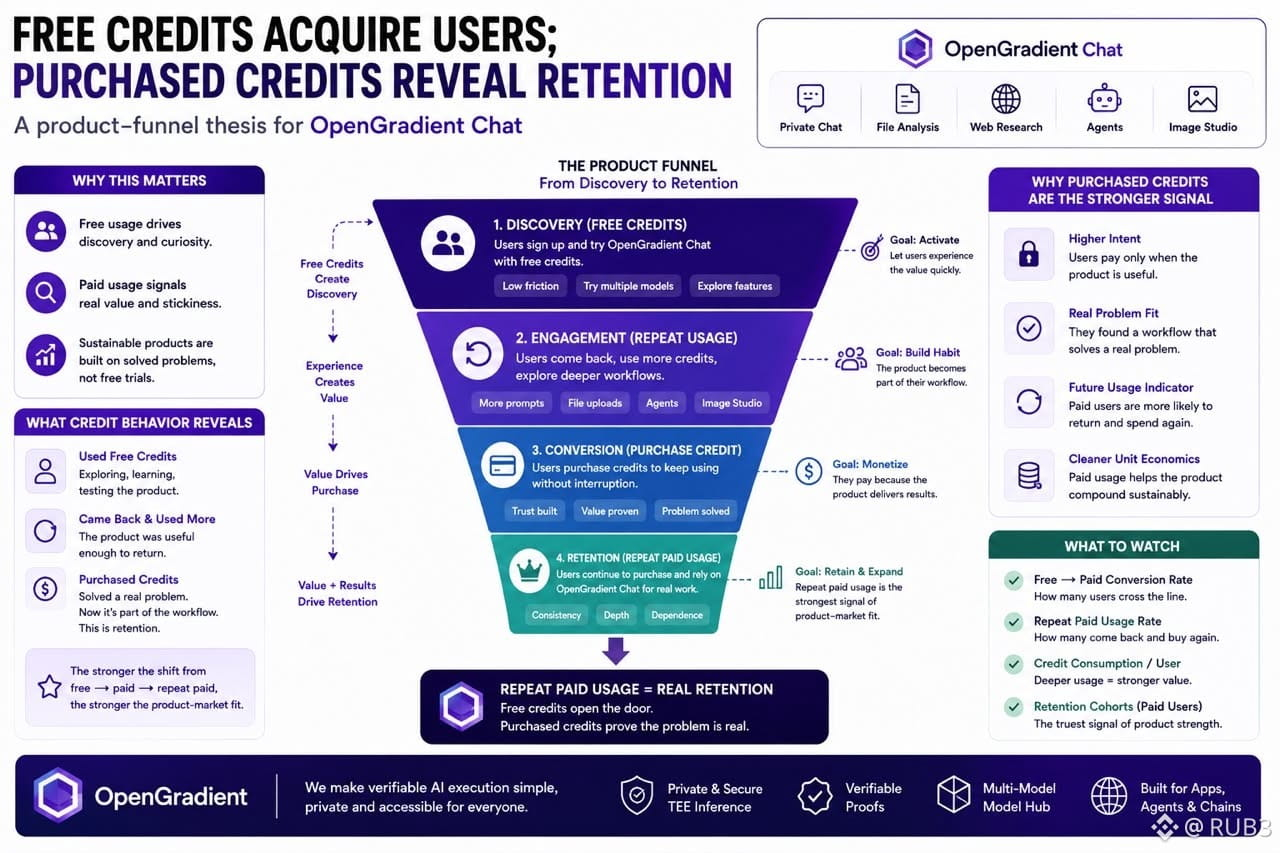
Kredit gratis bikin orang penasaran.
Kredit yang dibeli adalah di mana cerita menjadi lebih jujur.
Gue mikir tentang ini sambil liat OpenGradient Chat, karena penggunaan gratis bisa bikin produk terlihat aktif untuk sementara. Orang-orang nyobain, klik sana-sini, coba beberapa prompt dan lihat apa hype-nya.
Itu namanya penemuan.
Bermanfaat, tapi belum cukup.
Pertanyaan yang lebih menarik muncul setelah saldo gratis habis.
Apakah pengguna pergi, atau mereka memutuskan produk ini menyelesaikan sesuatu yang bener-bener layak dibayar untuk permintaan selanjutnya?
Itu sebabnya kredit di chat.opengradient.ai lebih dari sekedar detail pembayaran buat gue. Mereka mengubah penggunaan menjadi sinyal produk.
Kalau ada yang beli kredit untuk terus menggunakan chat pribadi, analisis file, riset web, switching model atau Image Studio, itu bilang sesuatu yang berbeda dari kunjungan sekali saja.
Artinya alur kerja punya nilai lebih dari kampanye.
@OpenGradient juga dapet funnel yang lebih bersih karena pengguna bisa masuk dengan friksi rendah, memahami produk dulu, dan baru kemudian beralih ke aktivitas berbayar.
Untuk $OPG, gue nggak bakal cuma ngeliatin pengguna gratis.
Gue bakal ngeliatin celah antara rasa penasaran dan penggunaan berbayar yang berulang.
Celah itu ngasih tau apakah OpenGradient Chat cuma menarik perhatian atau apakah orang mulai menganggapnya sebagai bagian dari pekerjaan mereka yang sebenarnya.
Kredit gratis bisa menarik pengguna masuk.
Kredit yang dibeli ngungkapin apakah mereka nemuin alasan untuk tetap tinggal.
#opg $OPG
Kredit gratis bikin orang penasaran.
Kredit yang dibeli adalah di mana cerita menjadi lebih jujur.
Gue mikir tentang ini sambil liat OpenGradient Chat, karena penggunaan gratis bisa bikin produk terlihat aktif untuk sementara. Orang-orang nyobain, klik sana-sini, coba beberapa prompt dan lihat apa hype-nya.
Itu namanya penemuan.
Bermanfaat, tapi belum cukup.
Pertanyaan yang lebih menarik muncul setelah saldo gratis habis.
Apakah pengguna pergi, atau mereka memutuskan produk ini menyelesaikan sesuatu yang bener-bener layak dibayar untuk permintaan selanjutnya?
Itu sebabnya kredit di chat.opengradient.ai lebih dari sekedar detail pembayaran buat gue. Mereka mengubah penggunaan menjadi sinyal produk.
Kalau ada yang beli kredit untuk terus menggunakan chat pribadi, analisis file, riset web, switching model atau Image Studio, itu bilang sesuatu yang berbeda dari kunjungan sekali saja.
Artinya alur kerja punya nilai lebih dari kampanye.
@OpenGradient juga dapet funnel yang lebih bersih karena pengguna bisa masuk dengan friksi rendah, memahami produk dulu, dan baru kemudian beralih ke aktivitas berbayar.
Untuk $OPG , gue nggak bakal cuma ngeliatin pengguna gratis.
Gue bakal ngeliatin celah antara rasa penasaran dan penggunaan berbayar yang berulang.
Celah itu ngasih tau apakah OpenGradient Chat cuma menarik perhatian atau apakah orang mulai menganggapnya sebagai bagian dari pekerjaan mereka yang sebenarnya.
Kredit gratis bisa menarik pengguna masuk.
Kredit yang dibeli ngungkapin apakah mereka nemuin alasan untuk tetap tinggal.
Kredit gratis bikin orang penasaran.
Kredit yang dibeli adalah di mana cerita menjadi lebih jujur.
Gue mikir tentang ini sambil liat OpenGradient Chat, karena penggunaan gratis bisa bikin produk terlihat aktif untuk sementara. Orang-orang nyobain, klik sana-sini, coba beberapa prompt dan lihat apa hype-nya.
Itu namanya penemuan.
Bermanfaat, tapi belum cukup.
Pertanyaan yang lebih menarik muncul setelah saldo gratis habis.
Apakah pengguna pergi, atau mereka memutuskan produk ini menyelesaikan sesuatu yang bener-bener layak dibayar untuk permintaan selanjutnya?
Itu sebabnya kredit di chat.opengradient.ai lebih dari sekedar detail pembayaran buat gue. Mereka mengubah penggunaan menjadi sinyal produk.
Kalau ada yang beli kredit untuk terus menggunakan chat pribadi, analisis file, riset web, switching model atau Image Studio, itu bilang sesuatu yang berbeda dari kunjungan sekali saja.
Artinya alur kerja punya nilai lebih dari kampanye.
@OpenGradient juga dapet funnel yang lebih bersih karena pengguna bisa masuk dengan friksi rendah, memahami produk dulu, dan baru kemudian beralih ke aktivitas berbayar.
Untuk $OPG , gue nggak bakal cuma ngeliatin pengguna gratis.
Gue bakal ngeliatin celah antara rasa penasaran dan penggunaan berbayar yang berulang.
Celah itu ngasih tau apakah OpenGradient Chat cuma menarik perhatian atau apakah orang mulai menganggapnya sebagai bagian dari pekerjaan mereka yang sebenarnya.
Kredit gratis bisa menarik pengguna masuk.
Kredit yang dibeli ngungkapin apakah mereka nemuin alasan untuk tetap tinggal.
2
1
89
·
--
Bullish
#opg $OPG
{future}(OPGUSDT)
Saya hampir menganggap Image Studio sebagai fitur sampingan.
Kemudian saya berpikir tentang seberapa sering teks hanya setengah dari pekerjaan.
Seorang pengguna bisa meminta AI untuk menjelaskan ide kampanye, tetapi cepat atau lambat mereka butuh poster.
Seorang pendiri bisa merancang cerita produk, tetapi kemudian butuh visual untuk dek.
Seorang kreator bisa membentuk pesan, lalu butuh gambar yang membuat orang berhenti scroll.
Di sinilah Image Studio di dalam chat.opengradient.ai menjadi lebih menarik.
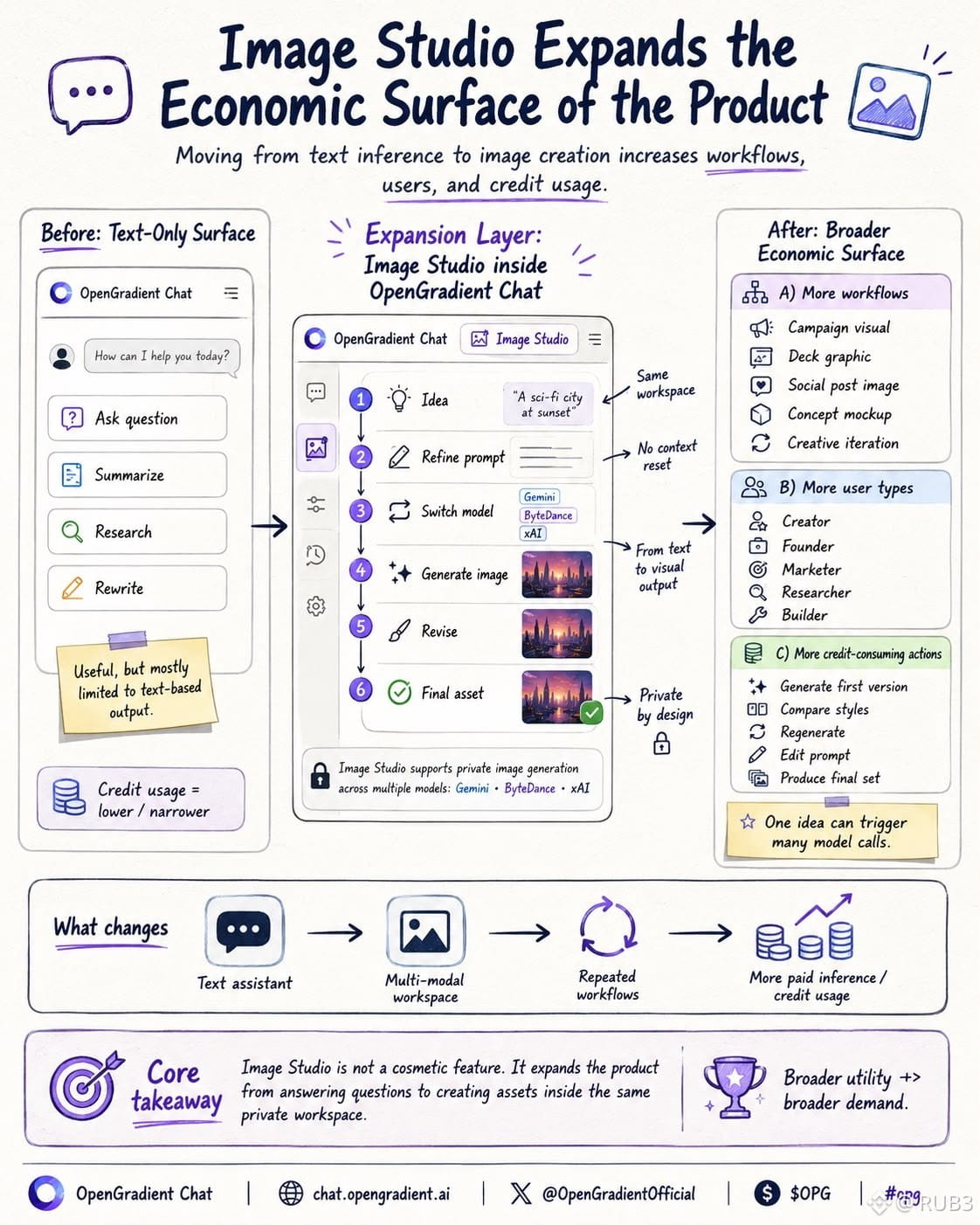
Ini mengembangkan OpenGradient Chat dari sekadar menjawab pertanyaan menjadi memproduksi aset.
Bukan hanya inferensi teks lagi.
Sekarang ruang kerja pribadi yang sama bisa bergerak dari ide, ke prompt, hingga generasi gambar di berbagai model seperti Gemini, ByteDance, dan xAI. Pengguna tidak perlu meninggalkan produk tepat saat pekerjaan menjadi visual.
Itu mengubah permukaan ekonomi @OpenGradient .
Asisten yang hanya berbasis teks sebagian besar menghabiskan kredit ketika orang bertanya, merangkum, meneliti, atau menulis ulang. Begitu generasi gambar masuk ke dalam alur kerja, pengguna yang sama mungkin akan menguji gaya, membandingkan output, merevisi prompt, menghasilkan versi ulang, dan membangun aset kreatif akhir.
Satu ide bisa menjadi banyak panggilan model berbayar.
Itu bukan kosmetik.
Itu lebih banyak alur kerja, lebih banyak tipe pengguna, dan lebih banyak alasan untuk kredit dihabiskan di dalam produk.
Untuk $OPG, saya rasa ini penting karena permintaan yang berguna jarang berasal dari satu prompt sempurna. Itu berasal dari upaya berulang ketika pengguna membangun sesuatu.
Image Studio membuat OpenGradient Chat terasa kurang seperti kotak pertanyaan dan lebih seperti permukaan produksi.
Pertanyaannya sekarang sederhana:
Akankah pengguna datang untuk chat pribadi, tetapi tetap tinggal karena seluruh proyek bisa dibuat di sana?
#opg $OPG
Saya hampir menganggap Image Studio sebagai fitur sampingan.
Kemudian saya berpikir tentang seberapa sering teks hanya setengah dari pekerjaan.
Seorang pengguna bisa meminta AI untuk menjelaskan ide kampanye, tetapi cepat atau lambat mereka butuh poster.
Seorang pendiri bisa merancang cerita produk, tetapi kemudian butuh visual untuk dek.
Seorang kreator bisa membentuk pesan, lalu butuh gambar yang membuat orang berhenti scroll.
Di sinilah Image Studio di dalam chat.opengradient.ai menjadi lebih menarik.
Ini mengembangkan OpenGradient Chat dari sekadar menjawab pertanyaan menjadi memproduksi aset.
Bukan hanya inferensi teks lagi.
Sekarang ruang kerja pribadi yang sama bisa bergerak dari ide, ke prompt, hingga generasi gambar di berbagai model seperti Gemini, ByteDance, dan xAI. Pengguna tidak perlu meninggalkan produk tepat saat pekerjaan menjadi visual.
Itu mengubah permukaan ekonomi @OpenGradient .
Asisten yang hanya berbasis teks sebagian besar menghabiskan kredit ketika orang bertanya, merangkum, meneliti, atau menulis ulang. Begitu generasi gambar masuk ke dalam alur kerja, pengguna yang sama mungkin akan menguji gaya, membandingkan output, merevisi prompt, menghasilkan versi ulang, dan membangun aset kreatif akhir.
Satu ide bisa menjadi banyak panggilan model berbayar.
Itu bukan kosmetik.
Itu lebih banyak alur kerja, lebih banyak tipe pengguna, dan lebih banyak alasan untuk kredit dihabiskan di dalam produk.
Untuk $OPG , saya rasa ini penting karena permintaan yang berguna jarang berasal dari satu prompt sempurna. Itu berasal dari upaya berulang ketika pengguna membangun sesuatu.
Image Studio membuat OpenGradient Chat terasa kurang seperti kotak pertanyaan dan lebih seperti permukaan produksi.
Pertanyaannya sekarang sederhana:
Akankah pengguna datang untuk chat pribadi, tetapi tetap tinggal karena seluruh proyek bisa dibuat di sana?
Saya hampir menganggap Image Studio sebagai fitur sampingan.
Kemudian saya berpikir tentang seberapa sering teks hanya setengah dari pekerjaan.
Seorang pengguna bisa meminta AI untuk menjelaskan ide kampanye, tetapi cepat atau lambat mereka butuh poster.
Seorang pendiri bisa merancang cerita produk, tetapi kemudian butuh visual untuk dek.
Seorang kreator bisa membentuk pesan, lalu butuh gambar yang membuat orang berhenti scroll.
Di sinilah Image Studio di dalam chat.opengradient.ai menjadi lebih menarik.
Ini mengembangkan OpenGradient Chat dari sekadar menjawab pertanyaan menjadi memproduksi aset.
Bukan hanya inferensi teks lagi.
Sekarang ruang kerja pribadi yang sama bisa bergerak dari ide, ke prompt, hingga generasi gambar di berbagai model seperti Gemini, ByteDance, dan xAI. Pengguna tidak perlu meninggalkan produk tepat saat pekerjaan menjadi visual.
Itu mengubah permukaan ekonomi @OpenGradient .
Asisten yang hanya berbasis teks sebagian besar menghabiskan kredit ketika orang bertanya, merangkum, meneliti, atau menulis ulang. Begitu generasi gambar masuk ke dalam alur kerja, pengguna yang sama mungkin akan menguji gaya, membandingkan output, merevisi prompt, menghasilkan versi ulang, dan membangun aset kreatif akhir.
Satu ide bisa menjadi banyak panggilan model berbayar.
Itu bukan kosmetik.
Itu lebih banyak alur kerja, lebih banyak tipe pengguna, dan lebih banyak alasan untuk kredit dihabiskan di dalam produk.
Untuk $OPG , saya rasa ini penting karena permintaan yang berguna jarang berasal dari satu prompt sempurna. Itu berasal dari upaya berulang ketika pengguna membangun sesuatu.
Image Studio membuat OpenGradient Chat terasa kurang seperti kotak pertanyaan dan lebih seperti permukaan produksi.
Pertanyaannya sekarang sederhana:
Akankah pengguna datang untuk chat pribadi, tetapi tetap tinggal karena seluruh proyek bisa dibuat di sana?
2
2
107
·
--
Bullish
#opg $OPG
{future}(OPGUSDT)
Sebuah pertanyaan aneh menghampiriku saat membaca tentang verifiable AI:
Bagaimana jika jawabannya nyata, tetapi prompt-nya diam-diam diubah sebelum model melihatnya?
Kedengarannya kecil sampai kamu membayangkan sebuah agen AI yang menyetujui sebuah transaksi, memeriksa dokumen, atau menjelaskan sebuah keputusan yang memengaruhi uang.
Jawaban AI biasa memberi tahu apa yang kembali.
Namun itu tidak selalu membuktikan pertanyaan mana yang benar-benar dijawab.
Di sinilah OpenGradient menjadi lebih menarik daripada produk obrolan biasa.
Di dalam jalur inferensi privat OpenGradient, respons dapat ditandatangani oleh enclave atas tiga hal: hash permintaan, hash output, dan sebuah timestamp.
Artinya, klien tidak hanya menerima jawaban.
Ia bisa memeriksa apakah jawaban tersebut terikat pada prompt yang sama yang awalnya dikirim, apakah output telah diubah, dan apakah tanda tangan berasal dari lingkungan attested yang diharapkan.
Itu adalah model kepercayaan yang sangat berbeda.
Alih-alih mengatakan, “Ini hasilnya, percaya pada server,” @OpenGradient memberi sistem cara untuk berkata, “Ini hasilnya, dan ini bukti kriptografis tentang permintaan mana yang menghasilkannya.”
Saya pikir ini paling penting untuk agen.
Manusia mungkin memaafkan jawaban yang janggal dan meminta lagi. Tapi agen bisa bertindak langsung. Jika prompt ditukar, tindakan itu masih bisa terlihat valid dari luar sementara sebenarnya didasarkan pada instruksi yang salah.
chat.opengradient.ai membuat sisi pengguna jadi sederhana, tetapi lapisan verifikasi inilah yang membuat infrastrukturnya serius.
Apakah kamu akan lebih percaya pada agen AI jika setiap output bisa membuktikan prompt mana yang membuatnya?
#opg $OPG
Sebuah pertanyaan aneh menghampiriku saat membaca tentang verifiable AI:
Bagaimana jika jawabannya nyata, tetapi prompt-nya diam-diam diubah sebelum model melihatnya?
Kedengarannya kecil sampai kamu membayangkan sebuah agen AI yang menyetujui sebuah transaksi, memeriksa dokumen, atau menjelaskan sebuah keputusan yang memengaruhi uang.
Jawaban AI biasa memberi tahu apa yang kembali.
Namun itu tidak selalu membuktikan pertanyaan mana yang benar-benar dijawab.
Di sinilah OpenGradient menjadi lebih menarik daripada produk obrolan biasa.
Di dalam jalur inferensi privat OpenGradient, respons dapat ditandatangani oleh enclave atas tiga hal: hash permintaan, hash output, dan sebuah timestamp.
Artinya, klien tidak hanya menerima jawaban.
Ia bisa memeriksa apakah jawaban tersebut terikat pada prompt yang sama yang awalnya dikirim, apakah output telah diubah, dan apakah tanda tangan berasal dari lingkungan attested yang diharapkan.
Itu adalah model kepercayaan yang sangat berbeda.
Alih-alih mengatakan, “Ini hasilnya, percaya pada server,” @OpenGradient memberi sistem cara untuk berkata, “Ini hasilnya, dan ini bukti kriptografis tentang permintaan mana yang menghasilkannya.”
Saya pikir ini paling penting untuk agen.
Manusia mungkin memaafkan jawaban yang janggal dan meminta lagi. Tapi agen bisa bertindak langsung. Jika prompt ditukar, tindakan itu masih bisa terlihat valid dari luar sementara sebenarnya didasarkan pada instruksi yang salah.
chat.opengradient.ai membuat sisi pengguna jadi sederhana, tetapi lapisan verifikasi inilah yang membuat infrastrukturnya serius.
Apakah kamu akan lebih percaya pada agen AI jika setiap output bisa membuktikan prompt mana yang membuatnya?
Sebuah pertanyaan aneh menghampiriku saat membaca tentang verifiable AI:
Bagaimana jika jawabannya nyata, tetapi prompt-nya diam-diam diubah sebelum model melihatnya?
Kedengarannya kecil sampai kamu membayangkan sebuah agen AI yang menyetujui sebuah transaksi, memeriksa dokumen, atau menjelaskan sebuah keputusan yang memengaruhi uang.
Jawaban AI biasa memberi tahu apa yang kembali.
Namun itu tidak selalu membuktikan pertanyaan mana yang benar-benar dijawab.
Di sinilah OpenGradient menjadi lebih menarik daripada produk obrolan biasa.
Di dalam jalur inferensi privat OpenGradient, respons dapat ditandatangani oleh enclave atas tiga hal: hash permintaan, hash output, dan sebuah timestamp.
Artinya, klien tidak hanya menerima jawaban.
Ia bisa memeriksa apakah jawaban tersebut terikat pada prompt yang sama yang awalnya dikirim, apakah output telah diubah, dan apakah tanda tangan berasal dari lingkungan attested yang diharapkan.
Itu adalah model kepercayaan yang sangat berbeda.
Alih-alih mengatakan, “Ini hasilnya, percaya pada server,” @OpenGradient memberi sistem cara untuk berkata, “Ini hasilnya, dan ini bukti kriptografis tentang permintaan mana yang menghasilkannya.”
Saya pikir ini paling penting untuk agen.
Manusia mungkin memaafkan jawaban yang janggal dan meminta lagi. Tapi agen bisa bertindak langsung. Jika prompt ditukar, tindakan itu masih bisa terlihat valid dari luar sementara sebenarnya didasarkan pada instruksi yang salah.
chat.opengradient.ai membuat sisi pengguna jadi sederhana, tetapi lapisan verifikasi inilah yang membuat infrastrukturnya serius.
Apakah kamu akan lebih percaya pada agen AI jika setiap output bisa membuktikan prompt mana yang membuatnya?
Yes, hashes matter
100%
No, answer quality is enough
0%
1 Voting • Voting ditutup
1
76
·
--
Bearish
#opg $OPG
{future}(OPGUSDT)
Ada pertanyaan yang lebih baik saya biarkan tidak terjawab daripada mengetiknya di kotak AI biasa.
Bukan karena topiknya aneh.
Karena topiknya terlalu terhubung dengan hidup saya.
Sebuah gejala yang membuat saya khawatir.
Sebuah kesalahan pajak yang saya tidak sepenuhnya pahami.
Sebuah situasi hukum yang belum siap saya diskusikan.
Sebuah keputusan finansial yang terasa memalukan bahkan sebelum ada yang menilai.
Ini adalah momen-momen di mana AI bisa membantu saya mengorganisir pikiran sebelum berbicara dengan profesional sungguhan.
Tapi ini juga momen di mana saya paling ragu.
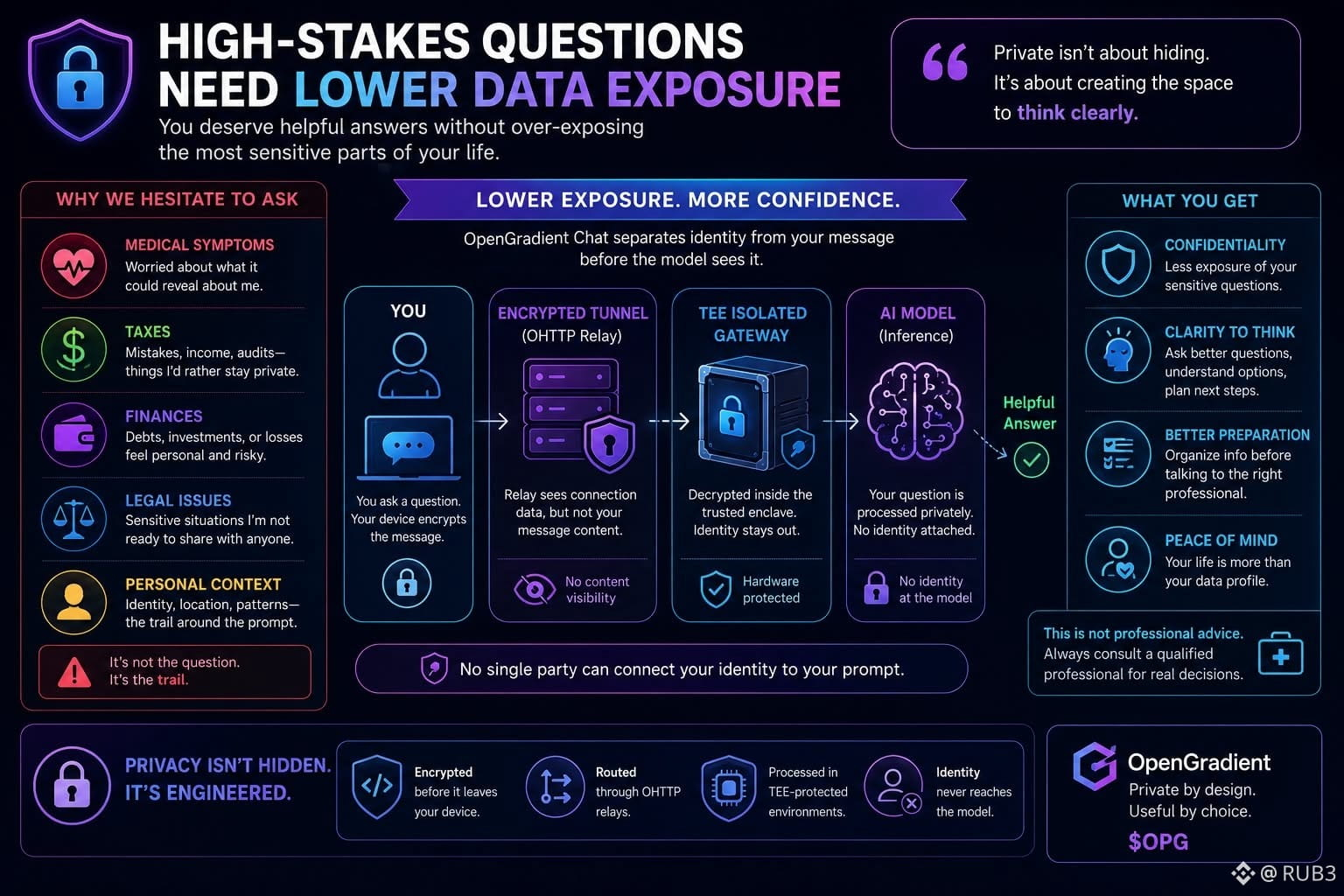
Masalahnya bukan hanya pada prompt. Ini adalah jejak di sekitar prompt: akun, identitas, perangkat, sejarah, waktu, dan pola dari apa yang terus saya tanyakan.
Itulah mengapa chat.opengradient.ai terasa menarik bagi saya.
OpenGradient Chat tidak berusaha menggantikan dokter, pengacara, akuntan, atau penasihat keuangan. Saya tidak akan pernah memperlakukannya seperti itu.
Nilainya berbeda.
Ini memberi saya tempat dengan eksposur yang lebih rendah untuk menyiapkan pertanyaan yang lebih baik, memahami informasi apa yang penting, dan berhenti panik sebelum mengambil langkah nyata berikutnya.
@OpenGradient merutekan permintaan sehingga identitas dan konten terpisah sebelum model menangani. Prompt tersebut dienkripsi, relay melihat data koneksi tanpa pesan, dan gerbang terlindungi memproses permintaan tanpa identitas jaringan asli saya.
Itu mengubah biaya emosional dari bertanya.
Pertanyaan dengan taruhannya tinggi membutuhkan lebih dari sekadar kecerdasan.
Mereka membutuhkan eksposur yang tidak perlu lebih sedikit.
Bagi saya, AI pribadi berguna ketika membantu saya berpikir jernih tanpa mengubah setiap ketakutan, rencana, atau kesalahan menjadi profil permanen.
Apakah Anda akan bertanya lebih hati-hati jika sistem perlu tahu lebih sedikit tentang siapa yang bertanya?
#opg $OPG
Ada pertanyaan yang lebih baik saya biarkan tidak terjawab daripada mengetiknya di kotak AI biasa.
Bukan karena topiknya aneh.
Karena topiknya terlalu terhubung dengan hidup saya.
Sebuah gejala yang membuat saya khawatir.
Sebuah kesalahan pajak yang saya tidak sepenuhnya pahami.
Sebuah situasi hukum yang belum siap saya diskusikan.
Sebuah keputusan finansial yang terasa memalukan bahkan sebelum ada yang menilai.
Ini adalah momen-momen di mana AI bisa membantu saya mengorganisir pikiran sebelum berbicara dengan profesional sungguhan.
Tapi ini juga momen di mana saya paling ragu.
Masalahnya bukan hanya pada prompt. Ini adalah jejak di sekitar prompt: akun, identitas, perangkat, sejarah, waktu, dan pola dari apa yang terus saya tanyakan.
Itulah mengapa chat.opengradient.ai terasa menarik bagi saya.
OpenGradient Chat tidak berusaha menggantikan dokter, pengacara, akuntan, atau penasihat keuangan. Saya tidak akan pernah memperlakukannya seperti itu.
Nilainya berbeda.
Ini memberi saya tempat dengan eksposur yang lebih rendah untuk menyiapkan pertanyaan yang lebih baik, memahami informasi apa yang penting, dan berhenti panik sebelum mengambil langkah nyata berikutnya.
@OpenGradient merutekan permintaan sehingga identitas dan konten terpisah sebelum model menangani. Prompt tersebut dienkripsi, relay melihat data koneksi tanpa pesan, dan gerbang terlindungi memproses permintaan tanpa identitas jaringan asli saya.
Itu mengubah biaya emosional dari bertanya.
Pertanyaan dengan taruhannya tinggi membutuhkan lebih dari sekadar kecerdasan.
Mereka membutuhkan eksposur yang tidak perlu lebih sedikit.
Bagi saya, AI pribadi berguna ketika membantu saya berpikir jernih tanpa mengubah setiap ketakutan, rencana, atau kesalahan menjadi profil permanen.
Apakah Anda akan bertanya lebih hati-hati jika sistem perlu tahu lebih sedikit tentang siapa yang bertanya?
Ada pertanyaan yang lebih baik saya biarkan tidak terjawab daripada mengetiknya di kotak AI biasa.
Bukan karena topiknya aneh.
Karena topiknya terlalu terhubung dengan hidup saya.
Sebuah gejala yang membuat saya khawatir.
Sebuah kesalahan pajak yang saya tidak sepenuhnya pahami.
Sebuah situasi hukum yang belum siap saya diskusikan.
Sebuah keputusan finansial yang terasa memalukan bahkan sebelum ada yang menilai.
Ini adalah momen-momen di mana AI bisa membantu saya mengorganisir pikiran sebelum berbicara dengan profesional sungguhan.
Tapi ini juga momen di mana saya paling ragu.
Masalahnya bukan hanya pada prompt. Ini adalah jejak di sekitar prompt: akun, identitas, perangkat, sejarah, waktu, dan pola dari apa yang terus saya tanyakan.
Itulah mengapa chat.opengradient.ai terasa menarik bagi saya.
OpenGradient Chat tidak berusaha menggantikan dokter, pengacara, akuntan, atau penasihat keuangan. Saya tidak akan pernah memperlakukannya seperti itu.
Nilainya berbeda.
Ini memberi saya tempat dengan eksposur yang lebih rendah untuk menyiapkan pertanyaan yang lebih baik, memahami informasi apa yang penting, dan berhenti panik sebelum mengambil langkah nyata berikutnya.
@OpenGradient merutekan permintaan sehingga identitas dan konten terpisah sebelum model menangani. Prompt tersebut dienkripsi, relay melihat data koneksi tanpa pesan, dan gerbang terlindungi memproses permintaan tanpa identitas jaringan asli saya.
Itu mengubah biaya emosional dari bertanya.
Pertanyaan dengan taruhannya tinggi membutuhkan lebih dari sekadar kecerdasan.
Mereka membutuhkan eksposur yang tidak perlu lebih sedikit.
Bagi saya, AI pribadi berguna ketika membantu saya berpikir jernih tanpa mengubah setiap ketakutan, rencana, atau kesalahan menjadi profil permanen.
Apakah Anda akan bertanya lebih hati-hati jika sistem perlu tahu lebih sedikit tentang siapa yang bertanya?
2
1
104
·
--
Bullish
#opg $OPG
{future}(OPGUSDT)
Dulu, saya suka menilai AI yang dapat diverifikasi dengan satu aturan malas:
Bukti terkuat harus menjadi bukti terbaik.
Kemudian saya melihat bagaimana @OpenGradient menangani berbagai beban kerja dan menyadari bahwa aturan itu akan membuat AI hampir tidak dapat digunakan.
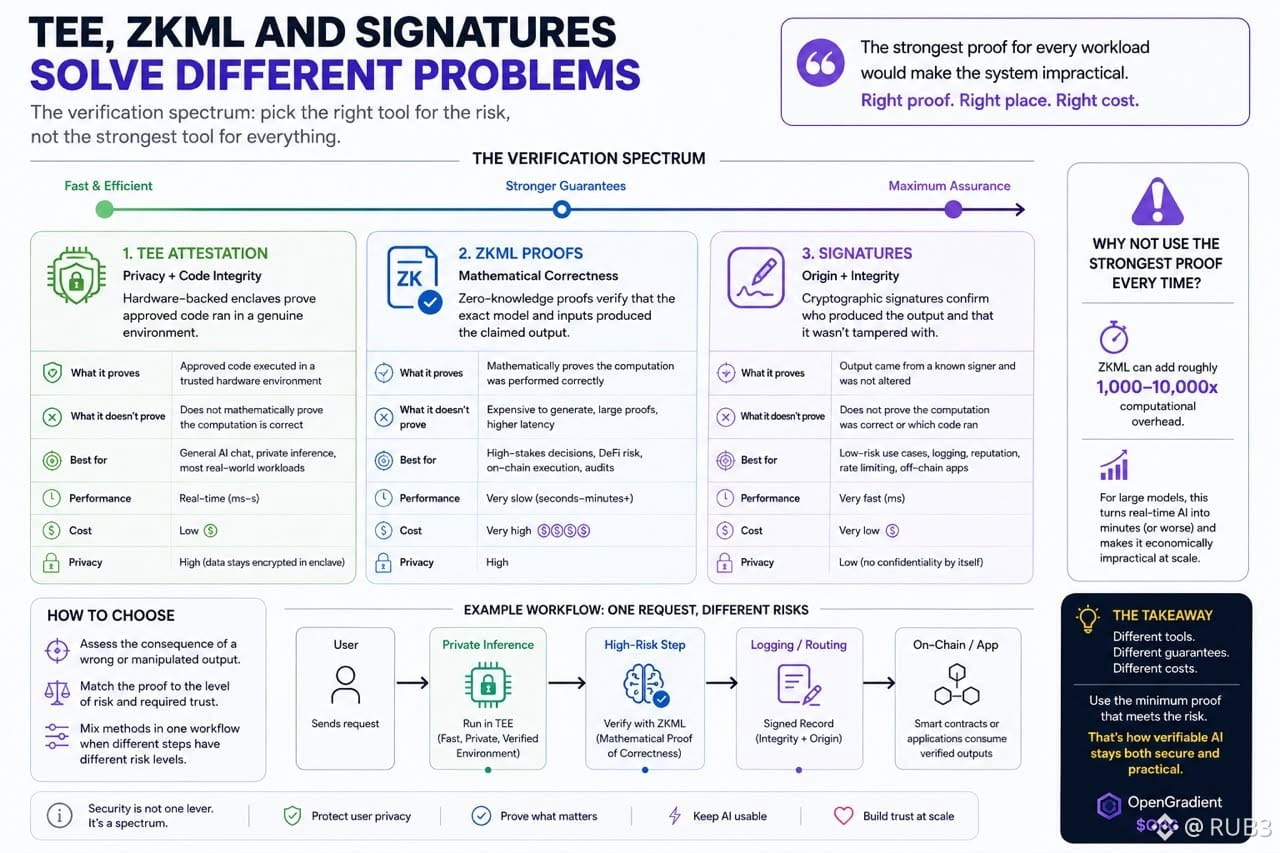
Percakapan normal di chat.opengradient.ai memerlukan privasi, bukti bahwa kode yang disetujui menangani permintaan, dan jawaban yang cukup cepat agar terasa seperti chat. TEE cocok untuk pekerjaan itu karena menyediakan attestation yang didukung perangkat keras tanpa memaksa pengguna menunggu melalui pembuatan bukti yang berat.
ZKML menyelesaikan masalah yang lebih sulit.
Ini dapat membuktikan secara matematis bahwa model tertentu menghasilkan hasil tertentu. Tingkat kepastian itu masuk akal ketika output ML dapat memicu likuidasi, memindahkan dana, atau mengubah keputusan on-chain.
Namun, menghasilkan bukti itu bisa menghabiskan biaya ribuan kali lebih banyak komputasi.
Letakkan ZKML di belakang setiap kalimat dari LLM dan asisten yang "aman" menjadi ruang tunggu yang mahal.
Kemudian ada tanda tangan. Mereka dapat menunjukkan node mana yang mengembalikan output dan apakah itu telah diubah, tetapi mereka tidak membuktikan bahwa eksekusi itu sendiri benar. Itu mungkin masih cukup untuk eksperimen atau tugas berisiko rendah.
Apa yang membuat saya tercerahkan adalah bahwa ini bukan versi yang lebih kuat dan lebih lemah dari alat yang sama.
Mereka melindungi terhadap berbagai kegagalan.
Keunggulan OpenGradient adalah memungkinkan verifikasi untuk mencocokkan konsekuensi dari jawaban bahkan mencampur metode ketika satu alur kerja memiliki tingkat risiko yang berbeda.
Pertanyaannya bukan, "Mengapa tidak semuanya menggunakan bukti terkuat?"
Tapi, "Apa yang sebenarnya akan hilang jika jawaban spesifik ini salah?"
Itu terasa seperti fondasi yang jauh lebih praktis untuk $OPG.
#opg $OPG
Dulu, saya suka menilai AI yang dapat diverifikasi dengan satu aturan malas:
Bukti terkuat harus menjadi bukti terbaik.
Kemudian saya melihat bagaimana @OpenGradient menangani berbagai beban kerja dan menyadari bahwa aturan itu akan membuat AI hampir tidak dapat digunakan.
Percakapan normal di chat.opengradient.ai memerlukan privasi, bukti bahwa kode yang disetujui menangani permintaan, dan jawaban yang cukup cepat agar terasa seperti chat. TEE cocok untuk pekerjaan itu karena menyediakan attestation yang didukung perangkat keras tanpa memaksa pengguna menunggu melalui pembuatan bukti yang berat.
ZKML menyelesaikan masalah yang lebih sulit.
Ini dapat membuktikan secara matematis bahwa model tertentu menghasilkan hasil tertentu. Tingkat kepastian itu masuk akal ketika output ML dapat memicu likuidasi, memindahkan dana, atau mengubah keputusan on-chain.
Namun, menghasilkan bukti itu bisa menghabiskan biaya ribuan kali lebih banyak komputasi.
Letakkan ZKML di belakang setiap kalimat dari LLM dan asisten yang "aman" menjadi ruang tunggu yang mahal.
Kemudian ada tanda tangan. Mereka dapat menunjukkan node mana yang mengembalikan output dan apakah itu telah diubah, tetapi mereka tidak membuktikan bahwa eksekusi itu sendiri benar. Itu mungkin masih cukup untuk eksperimen atau tugas berisiko rendah.
Apa yang membuat saya tercerahkan adalah bahwa ini bukan versi yang lebih kuat dan lebih lemah dari alat yang sama.
Mereka melindungi terhadap berbagai kegagalan.
Keunggulan OpenGradient adalah memungkinkan verifikasi untuk mencocokkan konsekuensi dari jawaban bahkan mencampur metode ketika satu alur kerja memiliki tingkat risiko yang berbeda.
Pertanyaannya bukan, "Mengapa tidak semuanya menggunakan bukti terkuat?"
Tapi, "Apa yang sebenarnya akan hilang jika jawaban spesifik ini salah?"
Itu terasa seperti fondasi yang jauh lebih praktis untuk $OPG .
Dulu, saya suka menilai AI yang dapat diverifikasi dengan satu aturan malas:
Bukti terkuat harus menjadi bukti terbaik.
Kemudian saya melihat bagaimana @OpenGradient menangani berbagai beban kerja dan menyadari bahwa aturan itu akan membuat AI hampir tidak dapat digunakan.
Percakapan normal di chat.opengradient.ai memerlukan privasi, bukti bahwa kode yang disetujui menangani permintaan, dan jawaban yang cukup cepat agar terasa seperti chat. TEE cocok untuk pekerjaan itu karena menyediakan attestation yang didukung perangkat keras tanpa memaksa pengguna menunggu melalui pembuatan bukti yang berat.
ZKML menyelesaikan masalah yang lebih sulit.
Ini dapat membuktikan secara matematis bahwa model tertentu menghasilkan hasil tertentu. Tingkat kepastian itu masuk akal ketika output ML dapat memicu likuidasi, memindahkan dana, atau mengubah keputusan on-chain.
Namun, menghasilkan bukti itu bisa menghabiskan biaya ribuan kali lebih banyak komputasi.
Letakkan ZKML di belakang setiap kalimat dari LLM dan asisten yang "aman" menjadi ruang tunggu yang mahal.
Kemudian ada tanda tangan. Mereka dapat menunjukkan node mana yang mengembalikan output dan apakah itu telah diubah, tetapi mereka tidak membuktikan bahwa eksekusi itu sendiri benar. Itu mungkin masih cukup untuk eksperimen atau tugas berisiko rendah.
Apa yang membuat saya tercerahkan adalah bahwa ini bukan versi yang lebih kuat dan lebih lemah dari alat yang sama.
Mereka melindungi terhadap berbagai kegagalan.
Keunggulan OpenGradient adalah memungkinkan verifikasi untuk mencocokkan konsekuensi dari jawaban bahkan mencampur metode ketika satu alur kerja memiliki tingkat risiko yang berbeda.
Pertanyaannya bukan, "Mengapa tidak semuanya menggunakan bukti terkuat?"
Tapi, "Apa yang sebenarnya akan hilang jika jawaban spesifik ini salah?"
Itu terasa seperti fondasi yang jauh lebih praktis untuk $OPG .
3
1
92
·
--
Bullish
#opg $OPG
{future}(OPGUSDT)
Enkripsi terdengar lengkap bagi saya sampai saya mengajukan pertanyaan yang sedikit tidak nyaman:
Enkripsi untuk siapa?
Sebuah pesan bisa saja tertutup sempurna dan tetap dikirim ke mesin yang salah. Jika saya menerima kunci publik apapun yang diberikan server kepada saya, saya melindungi prompt dalam perjalanan tanpa membuktikan siapa yang bisa membukanya.
Itu adalah detail dalam OpenGradient Chat yang hampir saya abaikan.
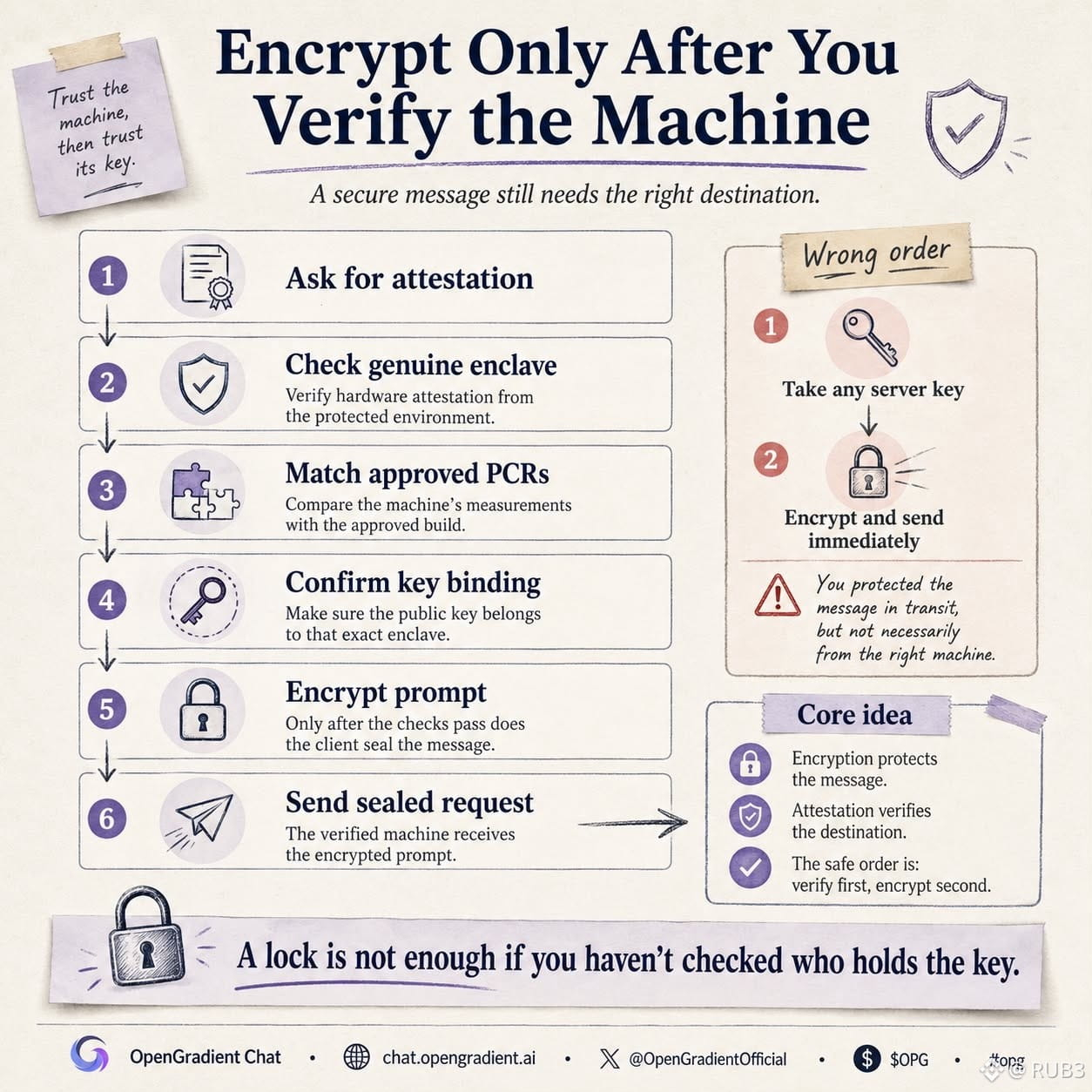
Sebelum chat.opengradient.ai mengenkripsi permintaan pribadi, klien memeriksa enclave terlebih dahulu.
Ia memverifikasi bahwa attestation perangkat keras datang dari infrastruktur AWS Nitro yang asli. Ia membandingkan pengukuran PCR mesin dengan build yang disetujui yang direkam dalam registry TEE OpenGradient. Ia juga mengonfirmasi bahwa kunci enkripsi dibuat di dalam enclave yang tepat itu dan bukan secara sembunyi-sembunyi diganti di luar sana.
Hanya setelah semua pemeriksaan itu lolos, prompt akan disegel.
Pesanan ini mengubah cara saya berpikir tentang "enkripsi ujung-ke-ujung."
Enkripsi saja mengatakan bahwa orang luar tidak dapat membaca pesan itu.
Attestation menanyakan apakah penerima yang dimaksud benar-benar menjalankan perangkat lunak yang diklaimnya jalankan.
Pertanyaan kedua itu penting karena koneksi yang aman ke kode yang dimodifikasi tetaplah koneksi yang aman ke kode yang dimodifikasi.
@OpenGradient membuat klien memverifikasi tujuan sebelum mempercayai kunci. SDK menangani pemeriksaan sulit itu dengan tenang, tetapi pengguna mendapat manfaat dari hasilnya: sebuah build yang tidak disetujui seharusnya tidak menerima prompt sensitif sama sekali.
Bagi saya, itu lebih kuat daripada ikon kunci lainnya.
Apakah Anda lebih suka mempercayai enkripsi itu sendiri, atau membuat perangkat Anda memverifikasi mesin sebelum mengirimkan apapun?
Ini adalah jenis infrastruktur tersembunyi yang memberikan $OPG konteks produk yang sebenarnya.
#opg $OPG
Enkripsi terdengar lengkap bagi saya sampai saya mengajukan pertanyaan yang sedikit tidak nyaman:
Enkripsi untuk siapa?
Sebuah pesan bisa saja tertutup sempurna dan tetap dikirim ke mesin yang salah. Jika saya menerima kunci publik apapun yang diberikan server kepada saya, saya melindungi prompt dalam perjalanan tanpa membuktikan siapa yang bisa membukanya.
Itu adalah detail dalam OpenGradient Chat yang hampir saya abaikan.
Sebelum chat.opengradient.ai mengenkripsi permintaan pribadi, klien memeriksa enclave terlebih dahulu.
Ia memverifikasi bahwa attestation perangkat keras datang dari infrastruktur AWS Nitro yang asli. Ia membandingkan pengukuran PCR mesin dengan build yang disetujui yang direkam dalam registry TEE OpenGradient. Ia juga mengonfirmasi bahwa kunci enkripsi dibuat di dalam enclave yang tepat itu dan bukan secara sembunyi-sembunyi diganti di luar sana.
Hanya setelah semua pemeriksaan itu lolos, prompt akan disegel.
Pesanan ini mengubah cara saya berpikir tentang "enkripsi ujung-ke-ujung."
Enkripsi saja mengatakan bahwa orang luar tidak dapat membaca pesan itu.
Attestation menanyakan apakah penerima yang dimaksud benar-benar menjalankan perangkat lunak yang diklaimnya jalankan.
Pertanyaan kedua itu penting karena koneksi yang aman ke kode yang dimodifikasi tetaplah koneksi yang aman ke kode yang dimodifikasi.
@OpenGradient membuat klien memverifikasi tujuan sebelum mempercayai kunci. SDK menangani pemeriksaan sulit itu dengan tenang, tetapi pengguna mendapat manfaat dari hasilnya: sebuah build yang tidak disetujui seharusnya tidak menerima prompt sensitif sama sekali.
Bagi saya, itu lebih kuat daripada ikon kunci lainnya.
Apakah Anda lebih suka mempercayai enkripsi itu sendiri, atau membuat perangkat Anda memverifikasi mesin sebelum mengirimkan apapun?
Ini adalah jenis infrastruktur tersembunyi yang memberikan $OPG konteks produk yang sebenarnya.
Enkripsi terdengar lengkap bagi saya sampai saya mengajukan pertanyaan yang sedikit tidak nyaman:
Enkripsi untuk siapa?
Sebuah pesan bisa saja tertutup sempurna dan tetap dikirim ke mesin yang salah. Jika saya menerima kunci publik apapun yang diberikan server kepada saya, saya melindungi prompt dalam perjalanan tanpa membuktikan siapa yang bisa membukanya.
Itu adalah detail dalam OpenGradient Chat yang hampir saya abaikan.
Sebelum chat.opengradient.ai mengenkripsi permintaan pribadi, klien memeriksa enclave terlebih dahulu.
Ia memverifikasi bahwa attestation perangkat keras datang dari infrastruktur AWS Nitro yang asli. Ia membandingkan pengukuran PCR mesin dengan build yang disetujui yang direkam dalam registry TEE OpenGradient. Ia juga mengonfirmasi bahwa kunci enkripsi dibuat di dalam enclave yang tepat itu dan bukan secara sembunyi-sembunyi diganti di luar sana.
Hanya setelah semua pemeriksaan itu lolos, prompt akan disegel.
Pesanan ini mengubah cara saya berpikir tentang "enkripsi ujung-ke-ujung."
Enkripsi saja mengatakan bahwa orang luar tidak dapat membaca pesan itu.
Attestation menanyakan apakah penerima yang dimaksud benar-benar menjalankan perangkat lunak yang diklaimnya jalankan.
Pertanyaan kedua itu penting karena koneksi yang aman ke kode yang dimodifikasi tetaplah koneksi yang aman ke kode yang dimodifikasi.
@OpenGradient membuat klien memverifikasi tujuan sebelum mempercayai kunci. SDK menangani pemeriksaan sulit itu dengan tenang, tetapi pengguna mendapat manfaat dari hasilnya: sebuah build yang tidak disetujui seharusnya tidak menerima prompt sensitif sama sekali.
Bagi saya, itu lebih kuat daripada ikon kunci lainnya.
Apakah Anda lebih suka mempercayai enkripsi itu sendiri, atau membuat perangkat Anda memverifikasi mesin sebelum mengirimkan apapun?
Ini adalah jenis infrastruktur tersembunyi yang memberikan $OPG konteks produk yang sebenarnya.
3
2
111
·
--
Bearish
#opg $OPG
{future}(OPGUSDT)
Dulu saya mengira ikon kunci adalah akhir dari cerita privasi.
Namun kemudian saya melihat sesuatu dalam desain OpenGradient yang terasa lebih penting: sistem memeriksa kode apa yang sedang berjalan sebelum prompt saya dienkripsi dan dikirim.
Itulah yang akhirnya saya pahami sebagai remote attestation.
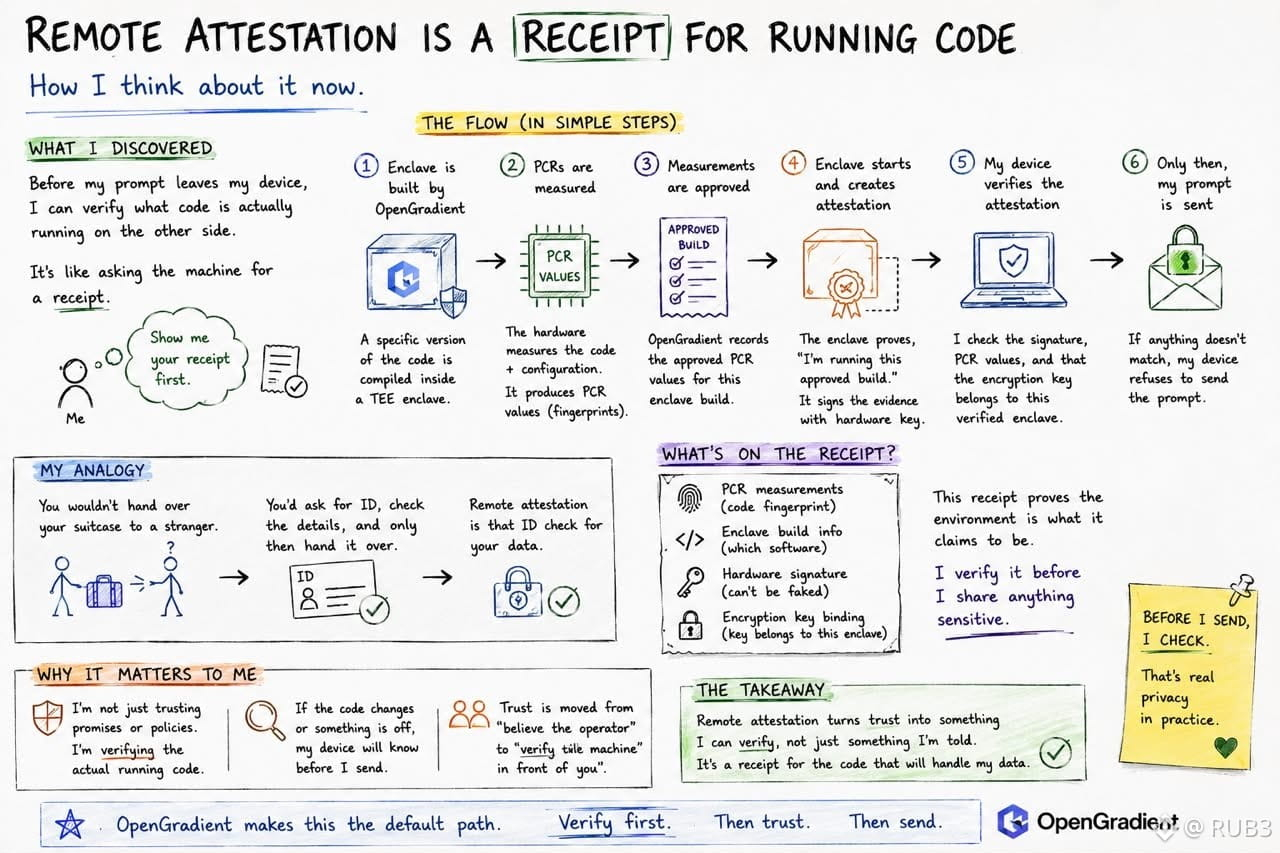
Bukan sekadar badge. Lebih seperti meminta mesin memberi tanda terima sebelum menyerahkan apa pun yang sensitif.
Saat sebuah enclave OpenGradient yang disetujui dibangun, perangkat lunaknya meninggalkan sidik jari yang dapat diukur yang disebut nilai PCR. Sidik jari itu dicatat sebagai yang disetujui. Ketika enclave dijalankan, ia menghasilkan bukti yang ditandatangani perangkat keras yang menunjukkan build mana yang benar-benar sedang berjalan serta kunci enkripsi mana yang menjadi miliknya.
Klien memeriksa bukti itu terlebih dahulu.
Jika pengukuran tidak cocok dengan build yang disetujui, kunci tidak boleh dipercaya dan prompt tidak boleh dikirim.
Saya suka urutan itu.
Kebanyakan platform meminta saya membagikan data dulu, lalu percaya pada penjelasan mereka tentang apa yang terjadi di balik layar. Di chat.opengradient.ai, verifikasi dimaksudkan terjadi sebelum bagian yang sensitif meninggalkan perangkat saya.
@OpenGradient bukan hanya mengatakan bahwa lingkungan yang terlindungi itu ada. Klien bisa memeriksa bahwa perangkat lunak yang diharapkan benar-benar berada di dalamnya.
Itu tidak membuat semua risiko hilang. Saya tetap perlu berhati-hati dengan informasi yang benar-benar sensitif.
Namun ini mengubah kepercayaan dari “percayai operator” menjadi “verifikasi mesin yang sedang berjalan.”
Apakah Anda akan lebih percaya pada AI privat jika perangkat Anda bisa menolak mengirim prompt ketika kodenya tidak cocok?
Itu terasa seperti infrastruktur penting di balik $OPG.
#opg $OPG
Dulu saya mengira ikon kunci adalah akhir dari cerita privasi.
Namun kemudian saya melihat sesuatu dalam desain OpenGradient yang terasa lebih penting: sistem memeriksa kode apa yang sedang berjalan sebelum prompt saya dienkripsi dan dikirim.
Itulah yang akhirnya saya pahami sebagai remote attestation.
Bukan sekadar badge. Lebih seperti meminta mesin memberi tanda terima sebelum menyerahkan apa pun yang sensitif.
Saat sebuah enclave OpenGradient yang disetujui dibangun, perangkat lunaknya meninggalkan sidik jari yang dapat diukur yang disebut nilai PCR. Sidik jari itu dicatat sebagai yang disetujui. Ketika enclave dijalankan, ia menghasilkan bukti yang ditandatangani perangkat keras yang menunjukkan build mana yang benar-benar sedang berjalan serta kunci enkripsi mana yang menjadi miliknya.
Klien memeriksa bukti itu terlebih dahulu.
Jika pengukuran tidak cocok dengan build yang disetujui, kunci tidak boleh dipercaya dan prompt tidak boleh dikirim.
Saya suka urutan itu.
Kebanyakan platform meminta saya membagikan data dulu, lalu percaya pada penjelasan mereka tentang apa yang terjadi di balik layar. Di chat.opengradient.ai, verifikasi dimaksudkan terjadi sebelum bagian yang sensitif meninggalkan perangkat saya.
@OpenGradient bukan hanya mengatakan bahwa lingkungan yang terlindungi itu ada. Klien bisa memeriksa bahwa perangkat lunak yang diharapkan benar-benar berada di dalamnya.
Itu tidak membuat semua risiko hilang. Saya tetap perlu berhati-hati dengan informasi yang benar-benar sensitif.
Namun ini mengubah kepercayaan dari “percayai operator” menjadi “verifikasi mesin yang sedang berjalan.”
Apakah Anda akan lebih percaya pada AI privat jika perangkat Anda bisa menolak mengirim prompt ketika kodenya tidak cocok?
Itu terasa seperti infrastruktur penting di balik $OPG .
Dulu saya mengira ikon kunci adalah akhir dari cerita privasi.
Namun kemudian saya melihat sesuatu dalam desain OpenGradient yang terasa lebih penting: sistem memeriksa kode apa yang sedang berjalan sebelum prompt saya dienkripsi dan dikirim.
Itulah yang akhirnya saya pahami sebagai remote attestation.
Bukan sekadar badge. Lebih seperti meminta mesin memberi tanda terima sebelum menyerahkan apa pun yang sensitif.
Saat sebuah enclave OpenGradient yang disetujui dibangun, perangkat lunaknya meninggalkan sidik jari yang dapat diukur yang disebut nilai PCR. Sidik jari itu dicatat sebagai yang disetujui. Ketika enclave dijalankan, ia menghasilkan bukti yang ditandatangani perangkat keras yang menunjukkan build mana yang benar-benar sedang berjalan serta kunci enkripsi mana yang menjadi miliknya.
Klien memeriksa bukti itu terlebih dahulu.
Jika pengukuran tidak cocok dengan build yang disetujui, kunci tidak boleh dipercaya dan prompt tidak boleh dikirim.
Saya suka urutan itu.
Kebanyakan platform meminta saya membagikan data dulu, lalu percaya pada penjelasan mereka tentang apa yang terjadi di balik layar. Di chat.opengradient.ai, verifikasi dimaksudkan terjadi sebelum bagian yang sensitif meninggalkan perangkat saya.
@OpenGradient bukan hanya mengatakan bahwa lingkungan yang terlindungi itu ada. Klien bisa memeriksa bahwa perangkat lunak yang diharapkan benar-benar berada di dalamnya.
Itu tidak membuat semua risiko hilang. Saya tetap perlu berhati-hati dengan informasi yang benar-benar sensitif.
Namun ini mengubah kepercayaan dari “percayai operator” menjadi “verifikasi mesin yang sedang berjalan.”
Apakah Anda akan lebih percaya pada AI privat jika perangkat Anda bisa menolak mengirim prompt ketika kodenya tidak cocok?
Itu terasa seperti infrastruktur penting di balik $OPG .
1
2
98
·
--
Bullish
#opg $OPG
{future}(OPGUSDT)
Saya berhenti melihat $OPG sebagai token untuk sesaat dan mengikuti satu permintaan AI sebagai gantinya.
Itu membuat perannya menjadi jauh lebih jelas.
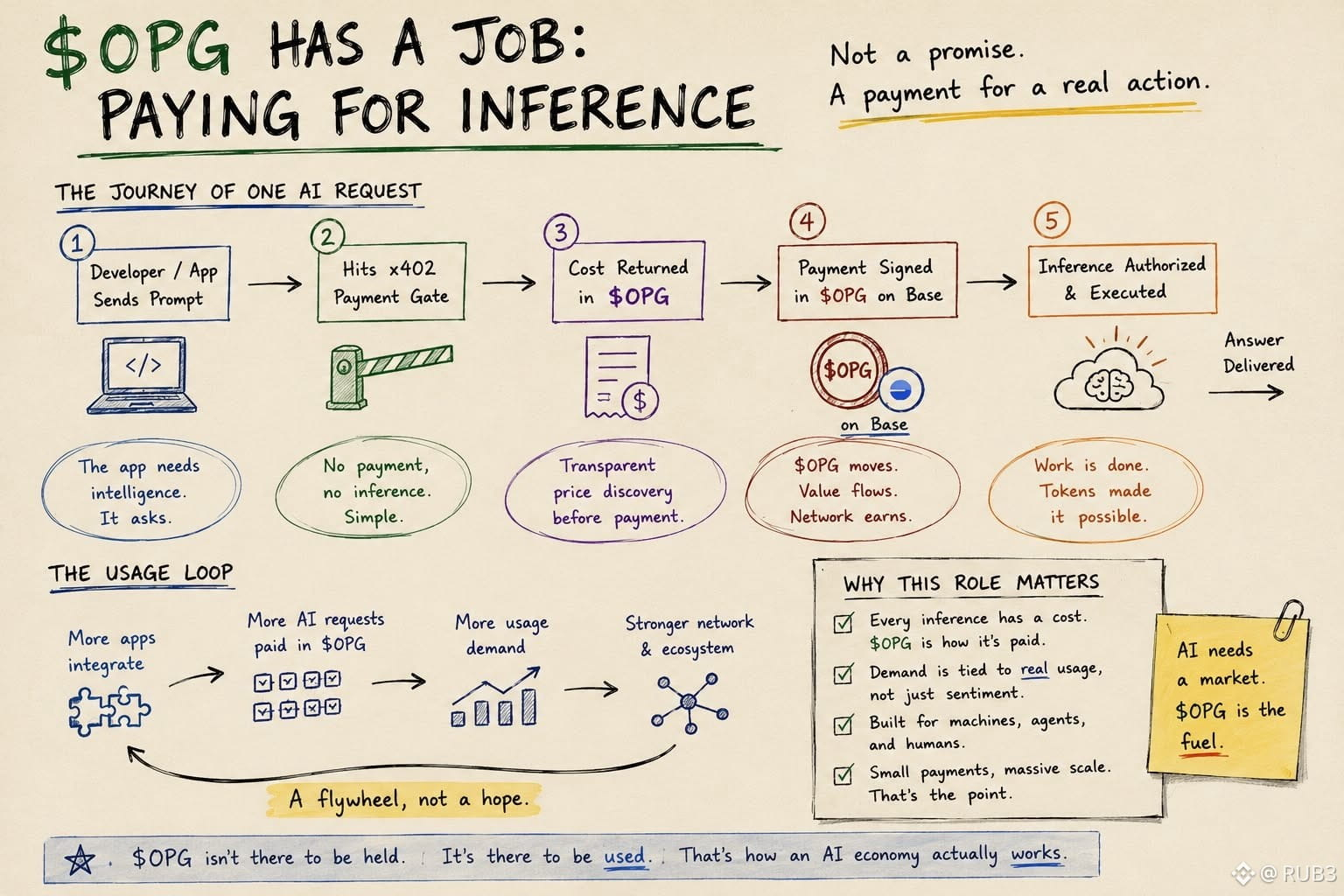
Seorang pengembang mengirimkan prompt melalui OpenGradient. Permintaan tersebut memenuhi gerbang pembayaran x402. Biaya dikembalikan, pembayaran ditandatangani dalam OPG di Base, dan hanya setelah itu inferensi diotorisasi.
Token tersebut tidak menunggu untuk suara pemerintahan yang sesekali.
Ia membayar untuk pekerjaan.
Perbedaan itu penting karena penggunaan AI bersifat repetitif secara alami. Satu orang bisa mengajukan sepuluh pertanyaan. Sebuah aplikasi bisa melakukan ribuan panggilan model. Sebuah agen otonom bisa terus membeli inferensi setiap kali ia perlu menganalisis, memverifikasi sesuatu, atau memutuskan tindakan berikutnya.
Setiap permintaan kecil.
Bersama-sama, mereka membentuk sebuah ekonomi.
Ini adalah kali pertama tesis OPG terasa praktis bagi saya. Permintaan tidak harus dimulai dengan seseorang membeli token karena mereka percaya pada narasi. Itu bisa dimulai dengan perangkat lunak yang membutuhkan jawaban dan membayar untuk komputasi yang diperlukan untuk memproduksinya.
Unit yang perlu diperhatikan mungkin bukan jumlah pemegang.
Ini mungkin jumlah inferensi berbayar yang bergerak melalui @OpenGradient
chat.opengradient.ai memberikan cara bagi pengguna biasa untuk masuk ke produk, sementara x402 memberikan aplikasi cara untuk membayar kecerdasan tanpa berhenti untuk langganan, faktur, atau persetujuan manual setiap kali.
Itu adalah pekerjaan yang jauh lebih bersih untuk sebuah token.
Sekarang pertanyaan yang lebih sulit adalah apakah OpenGradient bisa mengubah loop pembayaran ini menjadi cukup penggunaan berulang agar permintaan fungsional menjadi terlihat di skala jaringan.
#opg $OPG
Saya berhenti melihat $OPG sebagai token untuk sesaat dan mengikuti satu permintaan AI sebagai gantinya.
Itu membuat perannya menjadi jauh lebih jelas.
Seorang pengembang mengirimkan prompt melalui OpenGradient. Permintaan tersebut memenuhi gerbang pembayaran x402. Biaya dikembalikan, pembayaran ditandatangani dalam OPG di Base, dan hanya setelah itu inferensi diotorisasi.
Token tersebut tidak menunggu untuk suara pemerintahan yang sesekali.
Ia membayar untuk pekerjaan.
Perbedaan itu penting karena penggunaan AI bersifat repetitif secara alami. Satu orang bisa mengajukan sepuluh pertanyaan. Sebuah aplikasi bisa melakukan ribuan panggilan model. Sebuah agen otonom bisa terus membeli inferensi setiap kali ia perlu menganalisis, memverifikasi sesuatu, atau memutuskan tindakan berikutnya.
Setiap permintaan kecil.
Bersama-sama, mereka membentuk sebuah ekonomi.
Ini adalah kali pertama tesis OPG terasa praktis bagi saya. Permintaan tidak harus dimulai dengan seseorang membeli token karena mereka percaya pada narasi. Itu bisa dimulai dengan perangkat lunak yang membutuhkan jawaban dan membayar untuk komputasi yang diperlukan untuk memproduksinya.
Unit yang perlu diperhatikan mungkin bukan jumlah pemegang.
Ini mungkin jumlah inferensi berbayar yang bergerak melalui @OpenGradient
chat.opengradient.ai memberikan cara bagi pengguna biasa untuk masuk ke produk, sementara x402 memberikan aplikasi cara untuk membayar kecerdasan tanpa berhenti untuk langganan, faktur, atau persetujuan manual setiap kali.
Itu adalah pekerjaan yang jauh lebih bersih untuk sebuah token.
Sekarang pertanyaan yang lebih sulit adalah apakah OpenGradient bisa mengubah loop pembayaran ini menjadi cukup penggunaan berulang agar permintaan fungsional menjadi terlihat di skala jaringan.
Saya berhenti melihat $OPG sebagai token untuk sesaat dan mengikuti satu permintaan AI sebagai gantinya.
Itu membuat perannya menjadi jauh lebih jelas.
Seorang pengembang mengirimkan prompt melalui OpenGradient. Permintaan tersebut memenuhi gerbang pembayaran x402. Biaya dikembalikan, pembayaran ditandatangani dalam OPG di Base, dan hanya setelah itu inferensi diotorisasi.
Token tersebut tidak menunggu untuk suara pemerintahan yang sesekali.
Ia membayar untuk pekerjaan.
Perbedaan itu penting karena penggunaan AI bersifat repetitif secara alami. Satu orang bisa mengajukan sepuluh pertanyaan. Sebuah aplikasi bisa melakukan ribuan panggilan model. Sebuah agen otonom bisa terus membeli inferensi setiap kali ia perlu menganalisis, memverifikasi sesuatu, atau memutuskan tindakan berikutnya.
Setiap permintaan kecil.
Bersama-sama, mereka membentuk sebuah ekonomi.
Ini adalah kali pertama tesis OPG terasa praktis bagi saya. Permintaan tidak harus dimulai dengan seseorang membeli token karena mereka percaya pada narasi. Itu bisa dimulai dengan perangkat lunak yang membutuhkan jawaban dan membayar untuk komputasi yang diperlukan untuk memproduksinya.
Unit yang perlu diperhatikan mungkin bukan jumlah pemegang.
Ini mungkin jumlah inferensi berbayar yang bergerak melalui @OpenGradient
chat.opengradient.ai memberikan cara bagi pengguna biasa untuk masuk ke produk, sementara x402 memberikan aplikasi cara untuk membayar kecerdasan tanpa berhenti untuk langganan, faktur, atau persetujuan manual setiap kali.
Itu adalah pekerjaan yang jauh lebih bersih untuk sebuah token.
Sekarang pertanyaan yang lebih sulit adalah apakah OpenGradient bisa mengubah loop pembayaran ini menjadi cukup penggunaan berulang agar permintaan fungsional menjadi terlihat di skala jaringan.
4
97
·
--
Bearish
#opg $OPG
{future}(OPGUSDT)
Dulu, saya sering menghapus percakapan AI yang sensitif dan merasa lega ketika thread itu hilang.
Baru-baru ini, saya menyadari bahwa saya memperlakukan layar kosong sebagai bukti privasi.
Tapi menghapus chat terjadi di akhir.
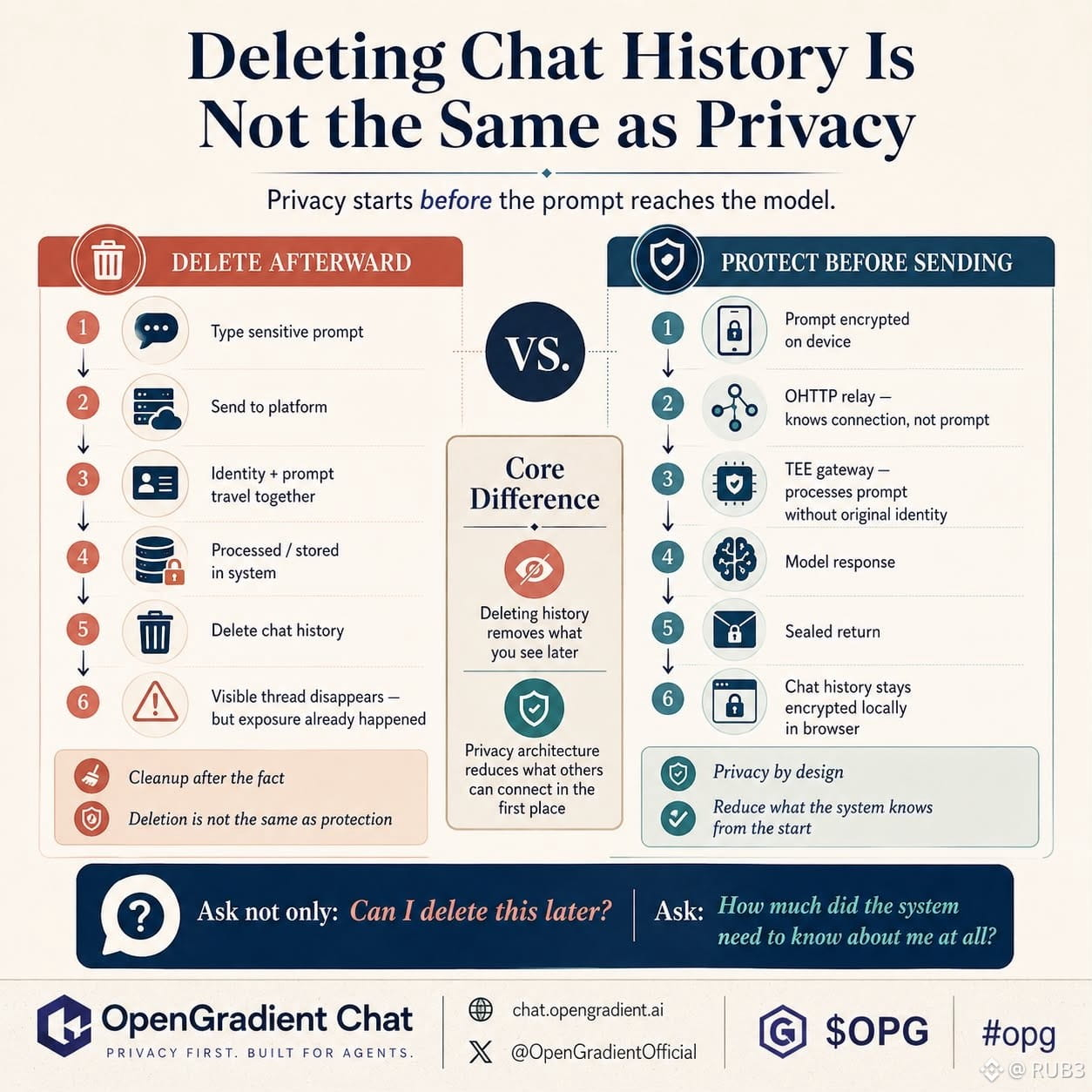
Prompt sudah meninggalkan perangkat saya. Ia sudah bepergian melalui sistem orang lain, terhubung dengan akun atau informasi jaringan apapun yang menyertainya. Menghapus percakapan yang terlihat kemudian tidak mengubah bagaimana ia sampai di sana.
Itulah mengapa desain di balik OpenGradient Chat menarik perhatian saya.
Di chat.opengradient.ai, privasi dimulai sebelum saya menekan kirim.
Prompt dienkripsi di perangkat saya. Sebuah relay OHTTP memisahkan identitas jaringan saya dari pesan, kemudian gateway TEE yang dilindungi menangani permintaan tanpa menerima kedua bagian tersebut bersama-sama.
Riwayat saya juga tetap tersegel di dalam browser saya alih-alih menjadi arsip yang terhubung dengan akun lain di tempat lain.
Ini mengubah pertanyaan bagi saya.
Saya tidak lagi hanya bertanya, "Bisakah saya menghapus ini setelahnya?"
Saya bertanya, "Seberapa banyak sistem perlu tahu tentang saya sejak awal?"
Itu terasa seperti tes privasi yang lebih jujur.
@OpenGradient melindungi percakapan saat sedang dibuat, bukan menawarkan tombol pembersih setelah bagian sensitif sudah bepergian.
Menghapus riwayat dapat menghapus apa yang saya lihat.
Arsitektur yang baik mengurangi apa yang bisa dihubungkan orang lain sejak awal.
Apakah Anda akan merasa lebih aman karena percakapan dapat dihapus, atau karena identitas Anda tidak pernah terikat pada prompt sejak awal?
#opg $OPG
Dulu, saya sering menghapus percakapan AI yang sensitif dan merasa lega ketika thread itu hilang.
Baru-baru ini, saya menyadari bahwa saya memperlakukan layar kosong sebagai bukti privasi.
Tapi menghapus chat terjadi di akhir.
Prompt sudah meninggalkan perangkat saya. Ia sudah bepergian melalui sistem orang lain, terhubung dengan akun atau informasi jaringan apapun yang menyertainya. Menghapus percakapan yang terlihat kemudian tidak mengubah bagaimana ia sampai di sana.
Itulah mengapa desain di balik OpenGradient Chat menarik perhatian saya.
Di chat.opengradient.ai, privasi dimulai sebelum saya menekan kirim.
Prompt dienkripsi di perangkat saya. Sebuah relay OHTTP memisahkan identitas jaringan saya dari pesan, kemudian gateway TEE yang dilindungi menangani permintaan tanpa menerima kedua bagian tersebut bersama-sama.
Riwayat saya juga tetap tersegel di dalam browser saya alih-alih menjadi arsip yang terhubung dengan akun lain di tempat lain.
Ini mengubah pertanyaan bagi saya.
Saya tidak lagi hanya bertanya, "Bisakah saya menghapus ini setelahnya?"
Saya bertanya, "Seberapa banyak sistem perlu tahu tentang saya sejak awal?"
Itu terasa seperti tes privasi yang lebih jujur.
@OpenGradient melindungi percakapan saat sedang dibuat, bukan menawarkan tombol pembersih setelah bagian sensitif sudah bepergian.
Menghapus riwayat dapat menghapus apa yang saya lihat.
Arsitektur yang baik mengurangi apa yang bisa dihubungkan orang lain sejak awal.
Apakah Anda akan merasa lebih aman karena percakapan dapat dihapus, atau karena identitas Anda tidak pernah terikat pada prompt sejak awal?
Dulu, saya sering menghapus percakapan AI yang sensitif dan merasa lega ketika thread itu hilang.
Baru-baru ini, saya menyadari bahwa saya memperlakukan layar kosong sebagai bukti privasi.
Tapi menghapus chat terjadi di akhir.
Prompt sudah meninggalkan perangkat saya. Ia sudah bepergian melalui sistem orang lain, terhubung dengan akun atau informasi jaringan apapun yang menyertainya. Menghapus percakapan yang terlihat kemudian tidak mengubah bagaimana ia sampai di sana.
Itulah mengapa desain di balik OpenGradient Chat menarik perhatian saya.
Di chat.opengradient.ai, privasi dimulai sebelum saya menekan kirim.
Prompt dienkripsi di perangkat saya. Sebuah relay OHTTP memisahkan identitas jaringan saya dari pesan, kemudian gateway TEE yang dilindungi menangani permintaan tanpa menerima kedua bagian tersebut bersama-sama.
Riwayat saya juga tetap tersegel di dalam browser saya alih-alih menjadi arsip yang terhubung dengan akun lain di tempat lain.
Ini mengubah pertanyaan bagi saya.
Saya tidak lagi hanya bertanya, "Bisakah saya menghapus ini setelahnya?"
Saya bertanya, "Seberapa banyak sistem perlu tahu tentang saya sejak awal?"
Itu terasa seperti tes privasi yang lebih jujur.
@OpenGradient melindungi percakapan saat sedang dibuat, bukan menawarkan tombol pembersih setelah bagian sensitif sudah bepergian.
Menghapus riwayat dapat menghapus apa yang saya lihat.
Arsitektur yang baik mengurangi apa yang bisa dihubungkan orang lain sejak awal.
Apakah Anda akan merasa lebih aman karena percakapan dapat dihapus, atau karena identitas Anda tidak pernah terikat pada prompt sejak awal?
6
5
172
·
--
Bullish
#opg $OPG
{future}(OPGUSDT)
Saya menghabiskan waktu membaca tentang node, atestasi, dan arsitektur inferensi privat OpenGradient.
Teknologi yang menarik, tetapi kemudian saya punya pemikiran yang lebih sederhana:
Kebanyakan orang tidak akan pernah membaca semuanya itu.
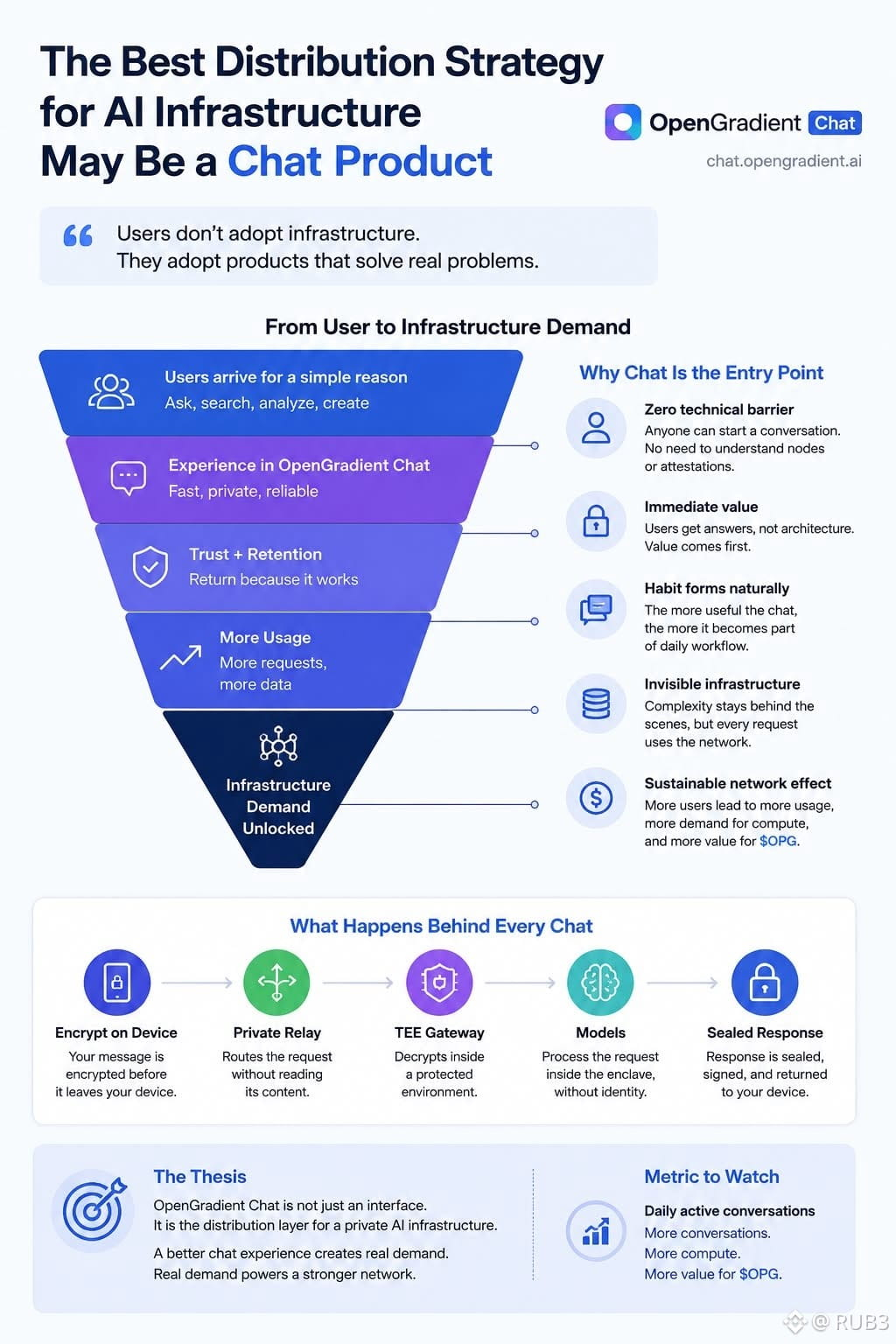
Mereka akan membuka chat.opengradient.ai karena membutuhkan jawaban, ingin membandingkan model, meneliti sesuatu, atau membuat gambar. Jika produknya bekerja dengan baik, mereka akan kembali. Hanya nanti mungkin mereka jadi penasaran tentang apa yang terjadi di balik layar.
Itulah mungkin keunggulan distribusi nyata dari OpenGradient Chat.
@OpenGradient tidak perlu setiap pengguna memahami infrastruktur terlebih dahulu. Chat memberi orang titik awal yang terasa familiar sementara sistem teknis diam-diam menangani pekerjaan sulit di baliknya.
Saya pikir banyak proyek infrastruktur melakukan urutan ini dengan keliru.
Mereka menjelaskan jaringan, arsitektur, dan token sebelum memberi pengguna biasa alasan untuk peduli.
OpenGradient Chat membalik itu.
Pertama, pengguna mendapatkan sesuatu yang bermanfaat.
Lalu percakapan yang berulang menciptakan permintaan nyata untuk infrastruktur yang mendukungnya.
Karena itu saya melihat Chat sebagai lebih dari sekadar tampilan depan. Chat bisa menjadi tempat orang menemukan OpenGradient tanpa pernah mencari infrastruktur AI terdesentralisasi.
Metrik yang ingin saya pantau bukanlah berapa banyak orang membaca dokumentasi teknis.
Melainkan berapa banyak orang yang menggunakan chat, kembali keesokan harinya, dan akhirnya memutuskan produk ini cukup bermanfaat untuk membeli lebih banyak kredit.
Di sanalah permintaan nyata untuk $OPG dapat mulai.
#opg $OPG
Saya menghabiskan waktu membaca tentang node, atestasi, dan arsitektur inferensi privat OpenGradient.
Teknologi yang menarik, tetapi kemudian saya punya pemikiran yang lebih sederhana:
Kebanyakan orang tidak akan pernah membaca semuanya itu.
Mereka akan membuka chat.opengradient.ai karena membutuhkan jawaban, ingin membandingkan model, meneliti sesuatu, atau membuat gambar. Jika produknya bekerja dengan baik, mereka akan kembali. Hanya nanti mungkin mereka jadi penasaran tentang apa yang terjadi di balik layar.
Itulah mungkin keunggulan distribusi nyata dari OpenGradient Chat.
@OpenGradient tidak perlu setiap pengguna memahami infrastruktur terlebih dahulu. Chat memberi orang titik awal yang terasa familiar sementara sistem teknis diam-diam menangani pekerjaan sulit di baliknya.
Saya pikir banyak proyek infrastruktur melakukan urutan ini dengan keliru.
Mereka menjelaskan jaringan, arsitektur, dan token sebelum memberi pengguna biasa alasan untuk peduli.
OpenGradient Chat membalik itu.
Pertama, pengguna mendapatkan sesuatu yang bermanfaat.
Lalu percakapan yang berulang menciptakan permintaan nyata untuk infrastruktur yang mendukungnya.
Karena itu saya melihat Chat sebagai lebih dari sekadar tampilan depan. Chat bisa menjadi tempat orang menemukan OpenGradient tanpa pernah mencari infrastruktur AI terdesentralisasi.
Metrik yang ingin saya pantau bukanlah berapa banyak orang membaca dokumentasi teknis.
Melainkan berapa banyak orang yang menggunakan chat, kembali keesokan harinya, dan akhirnya memutuskan produk ini cukup bermanfaat untuk membeli lebih banyak kredit.
Di sanalah permintaan nyata untuk $OPG dapat mulai.
Saya menghabiskan waktu membaca tentang node, atestasi, dan arsitektur inferensi privat OpenGradient.
Teknologi yang menarik, tetapi kemudian saya punya pemikiran yang lebih sederhana:
Kebanyakan orang tidak akan pernah membaca semuanya itu.
Mereka akan membuka chat.opengradient.ai karena membutuhkan jawaban, ingin membandingkan model, meneliti sesuatu, atau membuat gambar. Jika produknya bekerja dengan baik, mereka akan kembali. Hanya nanti mungkin mereka jadi penasaran tentang apa yang terjadi di balik layar.
Itulah mungkin keunggulan distribusi nyata dari OpenGradient Chat.
@OpenGradient tidak perlu setiap pengguna memahami infrastruktur terlebih dahulu. Chat memberi orang titik awal yang terasa familiar sementara sistem teknis diam-diam menangani pekerjaan sulit di baliknya.
Saya pikir banyak proyek infrastruktur melakukan urutan ini dengan keliru.
Mereka menjelaskan jaringan, arsitektur, dan token sebelum memberi pengguna biasa alasan untuk peduli.
OpenGradient Chat membalik itu.
Pertama, pengguna mendapatkan sesuatu yang bermanfaat.
Lalu percakapan yang berulang menciptakan permintaan nyata untuk infrastruktur yang mendukungnya.
Karena itu saya melihat Chat sebagai lebih dari sekadar tampilan depan. Chat bisa menjadi tempat orang menemukan OpenGradient tanpa pernah mencari infrastruktur AI terdesentralisasi.
Metrik yang ingin saya pantau bukanlah berapa banyak orang membaca dokumentasi teknis.
Melainkan berapa banyak orang yang menggunakan chat, kembali keesokan harinya, dan akhirnya memutuskan produk ini cukup bermanfaat untuk membeli lebih banyak kredit.
Di sanalah permintaan nyata untuk $OPG dapat mulai.
1
2
119
·
--
Bearish
#bedrock $BR
{future}(BRUSDT)
Saya dulu berpikir keamanan protokol berakhir di kontrak. audit lolos, cadangan cocok, pencetakan tetap terkontrol & logika jembatan bertahan.
kemudian pengguna menandatangani satu transaksi yang tidak dapat dibaca dan tiba-tiba arsitektur teraman di dunia bergantung pada sebuah tebak-tebakan.
itulah yang membuat ERC-7730 terhubung bagi saya di dalam @Bedrock
itu melindungi bagian sistem yang sepenuhnya berbeda.
bukan cadangan.
bukan brankas.
bukan jembatan.
momen persetujuan.
karena ketika dompet menunjukkan calldata mentah, pengguna sebenarnya tidak menyetujui tindakan yang mereka pahami.
mereka menyetujui sebuah interpretasi.
ini mungkin transaksi Bedrock yang saya maksud untuk dibuat.
persetujuan itu mungkin terbatas.
kontrak ini mungkin melakukan apa yang dikatakan antarmuka.
mungkin.
kata itu membawa terlalu banyak Bitcoin.
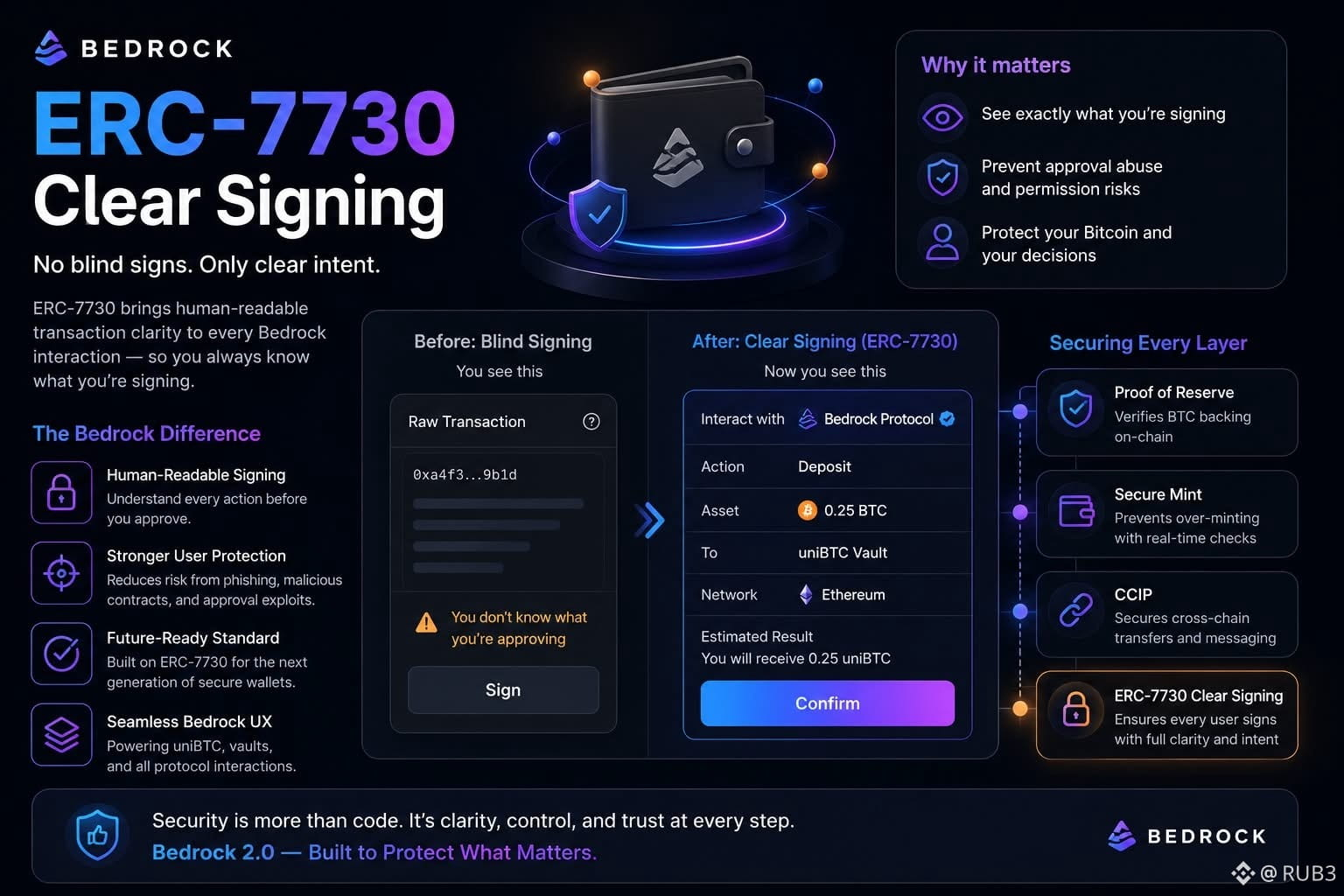
ERC-7730 mengubah permukaan tanda tangan dengan memberikan dompet yang kompatibel metadata terstruktur untuk panggilan kontrak Bedrock.
mesin masih menerima calldata.
tapi orang melihat niat.
fungsi apa yang dipanggil.
aset mana yang bergerak.
izin apa yang diberikan.
protokol mana interaksi tersebut milik.
itu terasa kecil sampai Anda memperhatikan di mana posisinya dalam arsitektur.
Chainlink Proof of Reserve, Secure Mint, CCIP tidak ada yang dapat memberi tahu pengguna bahwa transaksi di depan mereka bukanlah transaksi yang mereka pikir mereka tandatangani.
ERC-7730 menutup kesenjangan manusia itu.
mungkin itu cara yang lebih segar untuk membaca tumpukan keamanan Bedrock.
satu lapisan melindungi aset.
satu melindungi penerbitan.
satu melindungi pergerakan.
yang ini melindungi makna.
karena sebuah transaksi dapat secara teknis valid dan tetap sepenuhnya salah bagi orang yang menyetujuinya.
Bedrock ingin uniBTC bergerak melalui lebih banyak brankas, lebih banyak strategi & lebih banyak rantai.
perluasan itu menciptakan lebih banyak interaksi kontrak, bukan lebih sedikit.
jadi penandatanganan yang jelas bukan hanya pengalaman pengguna dompet yang lebih baik.
itu adalah titik di mana infrastruktur Bedrock akhirnya menjadi dapat dibaca bagi penulis manusia yang mengotorisasinya.
tidak ada kepercayaan buta.
tidak ada tanda tangan kosong.
sistem harus tahu apa yang dilakukannya.
pengguna juga harus tahu.
#bedrock $BR
Saya dulu berpikir keamanan protokol berakhir di kontrak. audit lolos, cadangan cocok, pencetakan tetap terkontrol & logika jembatan bertahan.
kemudian pengguna menandatangani satu transaksi yang tidak dapat dibaca dan tiba-tiba arsitektur teraman di dunia bergantung pada sebuah tebak-tebakan.
itulah yang membuat ERC-7730 terhubung bagi saya di dalam @Bedrock
itu melindungi bagian sistem yang sepenuhnya berbeda.
bukan cadangan.
bukan brankas.
bukan jembatan.
momen persetujuan.
karena ketika dompet menunjukkan calldata mentah, pengguna sebenarnya tidak menyetujui tindakan yang mereka pahami.
mereka menyetujui sebuah interpretasi.
ini mungkin transaksi Bedrock yang saya maksud untuk dibuat.
persetujuan itu mungkin terbatas.
kontrak ini mungkin melakukan apa yang dikatakan antarmuka.
mungkin.
kata itu membawa terlalu banyak Bitcoin.
ERC-7730 mengubah permukaan tanda tangan dengan memberikan dompet yang kompatibel metadata terstruktur untuk panggilan kontrak Bedrock.
mesin masih menerima calldata.
tapi orang melihat niat.
fungsi apa yang dipanggil.
aset mana yang bergerak.
izin apa yang diberikan.
protokol mana interaksi tersebut milik.
itu terasa kecil sampai Anda memperhatikan di mana posisinya dalam arsitektur.
Chainlink Proof of Reserve, Secure Mint, CCIP tidak ada yang dapat memberi tahu pengguna bahwa transaksi di depan mereka bukanlah transaksi yang mereka pikir mereka tandatangani.
ERC-7730 menutup kesenjangan manusia itu.
mungkin itu cara yang lebih segar untuk membaca tumpukan keamanan Bedrock.
satu lapisan melindungi aset.
satu melindungi penerbitan.
satu melindungi pergerakan.
yang ini melindungi makna.
karena sebuah transaksi dapat secara teknis valid dan tetap sepenuhnya salah bagi orang yang menyetujuinya.
Bedrock ingin uniBTC bergerak melalui lebih banyak brankas, lebih banyak strategi & lebih banyak rantai.
perluasan itu menciptakan lebih banyak interaksi kontrak, bukan lebih sedikit.
jadi penandatanganan yang jelas bukan hanya pengalaman pengguna dompet yang lebih baik.
itu adalah titik di mana infrastruktur Bedrock akhirnya menjadi dapat dibaca bagi penulis manusia yang mengotorisasinya.
tidak ada kepercayaan buta.
tidak ada tanda tangan kosong.
sistem harus tahu apa yang dilakukannya.
pengguna juga harus tahu.
Saya dulu berpikir keamanan protokol berakhir di kontrak. audit lolos, cadangan cocok, pencetakan tetap terkontrol & logika jembatan bertahan.
kemudian pengguna menandatangani satu transaksi yang tidak dapat dibaca dan tiba-tiba arsitektur teraman di dunia bergantung pada sebuah tebak-tebakan.
itulah yang membuat ERC-7730 terhubung bagi saya di dalam @Bedrock
itu melindungi bagian sistem yang sepenuhnya berbeda.
bukan cadangan.
bukan brankas.
bukan jembatan.
momen persetujuan.
karena ketika dompet menunjukkan calldata mentah, pengguna sebenarnya tidak menyetujui tindakan yang mereka pahami.
mereka menyetujui sebuah interpretasi.
ini mungkin transaksi Bedrock yang saya maksud untuk dibuat.
persetujuan itu mungkin terbatas.
kontrak ini mungkin melakukan apa yang dikatakan antarmuka.
mungkin.
kata itu membawa terlalu banyak Bitcoin.
ERC-7730 mengubah permukaan tanda tangan dengan memberikan dompet yang kompatibel metadata terstruktur untuk panggilan kontrak Bedrock.
mesin masih menerima calldata.
tapi orang melihat niat.
fungsi apa yang dipanggil.
aset mana yang bergerak.
izin apa yang diberikan.
protokol mana interaksi tersebut milik.
itu terasa kecil sampai Anda memperhatikan di mana posisinya dalam arsitektur.
Chainlink Proof of Reserve, Secure Mint, CCIP tidak ada yang dapat memberi tahu pengguna bahwa transaksi di depan mereka bukanlah transaksi yang mereka pikir mereka tandatangani.
ERC-7730 menutup kesenjangan manusia itu.
mungkin itu cara yang lebih segar untuk membaca tumpukan keamanan Bedrock.
satu lapisan melindungi aset.
satu melindungi penerbitan.
satu melindungi pergerakan.
yang ini melindungi makna.
karena sebuah transaksi dapat secara teknis valid dan tetap sepenuhnya salah bagi orang yang menyetujuinya.
Bedrock ingin uniBTC bergerak melalui lebih banyak brankas, lebih banyak strategi & lebih banyak rantai.
perluasan itu menciptakan lebih banyak interaksi kontrak, bukan lebih sedikit.
jadi penandatanganan yang jelas bukan hanya pengalaman pengguna dompet yang lebih baik.
itu adalah titik di mana infrastruktur Bedrock akhirnya menjadi dapat dibaca bagi penulis manusia yang mengotorisasinya.
tidak ada kepercayaan buta.
tidak ada tanda tangan kosong.
sistem harus tahu apa yang dilakukannya.
pengguna juga harus tahu.
2
1
75
·
--
Bearish
#bedrock $BR @Bedrock
{future}(BRUSDT)
saya dulu berpikir proof of reserve berarti sistem sudah terlindungi.
cadangan terlihat.
angka-angka cocok.
cukup baik. tapi ada celah yang tersembunyi di dalam pemikiran itu.
mengetahui dukungan ada tidak sama dengan memaksa kontrak minting untuk menghormatinya.
dashboard bisa menunjukkan kebenaran dan sistem masih bisa membuat langkah yang salah.
itulah yang membuat setup Chainlink Bedrock terasa pas bagi saya.
Proof of Reserve sedang mengawasi sisi BTC.
Secure Mint berdiri di pintu penerbitan.
& CCIP membawa logika keamanan yang sama ke dalam pergerakan antar rantai.
mereka bukan tiga integrasi acak yang duduk di samping satu sama lain.
mereka menutup tiga tempat berbeda di mana uniBTC bisa kehilangan maknanya.
pertama, apakah cadangan itu ada?
lalu, apakah mint baru benar-benar diizinkan oleh cadangan itu?
kemudian, dapatkah aset bergerak tanpa jalur antar rantai menjadi bagian terlemah?
langkah tengah mungkin yang sering dilewati orang dalam pikiran mereka.
karena transparansi cadangan terdengar meyakinkan.
tapi transparansi setelah mint yang buruk akan menjadi jenis kenyamanan yang sangat terlambat.
Secure Mint mengubah itu.
sebelum uniBTC baru dibuat, kontrak memeriksa apakah pasokan yang ada ditambah jumlah baru masih cocok di dalam cadangan yang terverifikasi.
jika tidak, transaksi tidak menjadi peringatan.
itu menjadi penolakan.
perbedaan itu terasa penting.
satu sistem memberi tahu Anda bahwa ada yang salah.
sistem lainnya menolak membiarkan keadaan yang salah ada.
& untuk Bedrock 2.0, ini lebih dalam dari sekedar pemasaran keamanan.
uniBTC seharusnya menjadi aset masuk untuk berbagai jalur yield Bitcoin.
jika aset dasar bisa diterbitkan berlebihan, setiap vault di atasnya mewarisi asumsi yang sama yang rusak.
kredit bisa disusun.
strategi bisa dikelola.
BRclaw bisa memantau risiko.
tidak ada dari itu yang memperbaiki lapisan minting yang lemah di bawah.
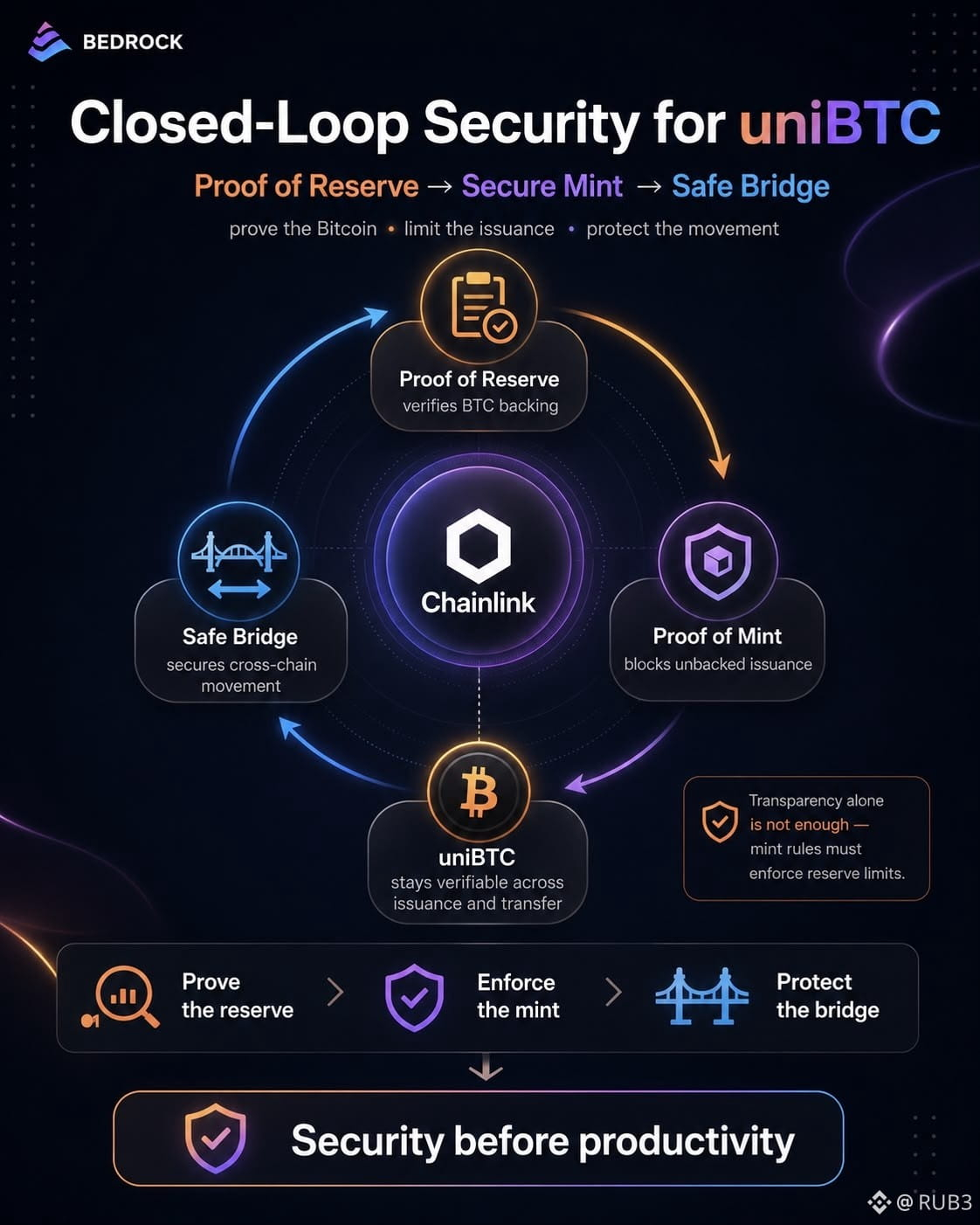
jadi mungkin arsitektur yang sebenarnya bukanlah
Proof of Reserve → Secure Mint → CCIP.
mungkin itu adalah
buktikan Bitcoin.
batasi penerbitan.
lindungi pergerakan.
dalam loop tertutup sebelum uniBTC diminta untuk menjadi produktif di tempat lain.
#bedrock $BR @Bedrock
saya dulu berpikir proof of reserve berarti sistem sudah terlindungi.
cadangan terlihat.
angka-angka cocok.
cukup baik. tapi ada celah yang tersembunyi di dalam pemikiran itu.
mengetahui dukungan ada tidak sama dengan memaksa kontrak minting untuk menghormatinya.
dashboard bisa menunjukkan kebenaran dan sistem masih bisa membuat langkah yang salah.
itulah yang membuat setup Chainlink Bedrock terasa pas bagi saya.
Proof of Reserve sedang mengawasi sisi BTC.
Secure Mint berdiri di pintu penerbitan.
& CCIP membawa logika keamanan yang sama ke dalam pergerakan antar rantai.
mereka bukan tiga integrasi acak yang duduk di samping satu sama lain.
mereka menutup tiga tempat berbeda di mana uniBTC bisa kehilangan maknanya.
pertama, apakah cadangan itu ada?
lalu, apakah mint baru benar-benar diizinkan oleh cadangan itu?
kemudian, dapatkah aset bergerak tanpa jalur antar rantai menjadi bagian terlemah?
langkah tengah mungkin yang sering dilewati orang dalam pikiran mereka.
karena transparansi cadangan terdengar meyakinkan.
tapi transparansi setelah mint yang buruk akan menjadi jenis kenyamanan yang sangat terlambat.
Secure Mint mengubah itu.
sebelum uniBTC baru dibuat, kontrak memeriksa apakah pasokan yang ada ditambah jumlah baru masih cocok di dalam cadangan yang terverifikasi.
jika tidak, transaksi tidak menjadi peringatan.
itu menjadi penolakan.
perbedaan itu terasa penting.
satu sistem memberi tahu Anda bahwa ada yang salah.
sistem lainnya menolak membiarkan keadaan yang salah ada.
& untuk Bedrock 2.0, ini lebih dalam dari sekedar pemasaran keamanan.
uniBTC seharusnya menjadi aset masuk untuk berbagai jalur yield Bitcoin.
jika aset dasar bisa diterbitkan berlebihan, setiap vault di atasnya mewarisi asumsi yang sama yang rusak.
kredit bisa disusun.
strategi bisa dikelola.
BRclaw bisa memantau risiko.
tidak ada dari itu yang memperbaiki lapisan minting yang lemah di bawah.
jadi mungkin arsitektur yang sebenarnya bukanlah
Proof of Reserve → Secure Mint → CCIP.
mungkin itu adalah
buktikan Bitcoin.
batasi penerbitan.
lindungi pergerakan.
dalam loop tertutup sebelum uniBTC diminta untuk menjadi produktif di tempat lain.
saya dulu berpikir proof of reserve berarti sistem sudah terlindungi.
cadangan terlihat.
angka-angka cocok.
cukup baik. tapi ada celah yang tersembunyi di dalam pemikiran itu.
mengetahui dukungan ada tidak sama dengan memaksa kontrak minting untuk menghormatinya.
dashboard bisa menunjukkan kebenaran dan sistem masih bisa membuat langkah yang salah.
itulah yang membuat setup Chainlink Bedrock terasa pas bagi saya.
Proof of Reserve sedang mengawasi sisi BTC.
Secure Mint berdiri di pintu penerbitan.
& CCIP membawa logika keamanan yang sama ke dalam pergerakan antar rantai.
mereka bukan tiga integrasi acak yang duduk di samping satu sama lain.
mereka menutup tiga tempat berbeda di mana uniBTC bisa kehilangan maknanya.
pertama, apakah cadangan itu ada?
lalu, apakah mint baru benar-benar diizinkan oleh cadangan itu?
kemudian, dapatkah aset bergerak tanpa jalur antar rantai menjadi bagian terlemah?
langkah tengah mungkin yang sering dilewati orang dalam pikiran mereka.
karena transparansi cadangan terdengar meyakinkan.
tapi transparansi setelah mint yang buruk akan menjadi jenis kenyamanan yang sangat terlambat.
Secure Mint mengubah itu.
sebelum uniBTC baru dibuat, kontrak memeriksa apakah pasokan yang ada ditambah jumlah baru masih cocok di dalam cadangan yang terverifikasi.
jika tidak, transaksi tidak menjadi peringatan.
itu menjadi penolakan.
perbedaan itu terasa penting.
satu sistem memberi tahu Anda bahwa ada yang salah.
sistem lainnya menolak membiarkan keadaan yang salah ada.
& untuk Bedrock 2.0, ini lebih dalam dari sekedar pemasaran keamanan.
uniBTC seharusnya menjadi aset masuk untuk berbagai jalur yield Bitcoin.
jika aset dasar bisa diterbitkan berlebihan, setiap vault di atasnya mewarisi asumsi yang sama yang rusak.
kredit bisa disusun.
strategi bisa dikelola.
BRclaw bisa memantau risiko.
tidak ada dari itu yang memperbaiki lapisan minting yang lemah di bawah.
jadi mungkin arsitektur yang sebenarnya bukanlah
Proof of Reserve → Secure Mint → CCIP.
mungkin itu adalah
buktikan Bitcoin.
batasi penerbitan.
lindungi pergerakan.
dalam loop tertutup sebelum uniBTC diminta untuk menjadi produktif di tempat lain.
2
1
137
·
--
Bullish
#bedrock $BR
{future}(BRUSDT)
Dulu, saya memisahkan yield dan keamanan dalam pikiran saya.
Yield itu bagian yang mengasyikkan.
Keamanan hanya latar belakang.
Tapi dengan Bedrock, saya rasa pemisahan itu tidak lagi berlaku.
Jika modal Bitcoin bergerak melalui brankas, jalur uniBTC, dan strategi BTCfi, maka lapisan keamanan bukanlah "tambahan."
Ia adalah bagian dari yield itu sendiri.
Itulah sebabnya Chainlink Proof of Reserve Secure Mint terasa penting di sini.
Risikonya bukan hanya peretasan dalam arti biasa.
Risiko yang lebih dalam adalah ketidakcocokan.
Lebih banyak aset yang dicetak daripada yang sebenarnya didukung.
Sebuah brankas yang terlihat sehat dari depan sementara lapisan dukungannya tidak bersih di belakangnya.
Bagi pemegang Bitcoin, jenis risiko itu berbahaya karena segala sesuatunya bisa terlihat normal sampai kepercayaan runtuh.
Jadi saya tidak melihat upgrade ini hanya sebagai centang teknis.
Saya melihatnya sebagai @Bedrock berusaha memastikan BTC yang produktif tidak menjadi BTC yang buta.
Sebelum modal mengejar jalur, lapisan dasar harus membuktikan bahwa sisi asetnya sehat.
Itulah bagian yang saya suka.
Bedrock 2.0 mendorong pergerakan modal Bitcoin yang cerdas, tapi itu hanya penting jika logika pencetakan dan dukungan tetap disiplin.
Yield bisa menarik pengguna.
Keamanan menjaga mereka.
Dan di BTCfi, kepercayaan tidak dibangun oleh APY yang keras.
Itu dibangun dengan memastikan mesin tidak bisa diam-diam menjanjikan lebih dari apa yang tidak dimiliki.
Apa yang paling penting untuk kepercayaan BTCfi?
#bedrock $BR
Dulu, saya memisahkan yield dan keamanan dalam pikiran saya.
Yield itu bagian yang mengasyikkan.
Keamanan hanya latar belakang.
Tapi dengan Bedrock, saya rasa pemisahan itu tidak lagi berlaku.
Jika modal Bitcoin bergerak melalui brankas, jalur uniBTC, dan strategi BTCfi, maka lapisan keamanan bukanlah "tambahan."
Ia adalah bagian dari yield itu sendiri.
Itulah sebabnya Chainlink Proof of Reserve Secure Mint terasa penting di sini.
Risikonya bukan hanya peretasan dalam arti biasa.
Risiko yang lebih dalam adalah ketidakcocokan.
Lebih banyak aset yang dicetak daripada yang sebenarnya didukung.
Sebuah brankas yang terlihat sehat dari depan sementara lapisan dukungannya tidak bersih di belakangnya.
Bagi pemegang Bitcoin, jenis risiko itu berbahaya karena segala sesuatunya bisa terlihat normal sampai kepercayaan runtuh.
Jadi saya tidak melihat upgrade ini hanya sebagai centang teknis.
Saya melihatnya sebagai @Bedrock berusaha memastikan BTC yang produktif tidak menjadi BTC yang buta.
Sebelum modal mengejar jalur, lapisan dasar harus membuktikan bahwa sisi asetnya sehat.
Itulah bagian yang saya suka.
Bedrock 2.0 mendorong pergerakan modal Bitcoin yang cerdas, tapi itu hanya penting jika logika pencetakan dan dukungan tetap disiplin.
Yield bisa menarik pengguna.
Keamanan menjaga mereka.
Dan di BTCfi, kepercayaan tidak dibangun oleh APY yang keras.
Itu dibangun dengan memastikan mesin tidak bisa diam-diam menjanjikan lebih dari apa yang tidak dimiliki.
Apa yang paling penting untuk kepercayaan BTCfi?
Dulu, saya memisahkan yield dan keamanan dalam pikiran saya.
Yield itu bagian yang mengasyikkan.
Keamanan hanya latar belakang.
Tapi dengan Bedrock, saya rasa pemisahan itu tidak lagi berlaku.
Jika modal Bitcoin bergerak melalui brankas, jalur uniBTC, dan strategi BTCfi, maka lapisan keamanan bukanlah "tambahan."
Ia adalah bagian dari yield itu sendiri.
Itulah sebabnya Chainlink Proof of Reserve Secure Mint terasa penting di sini.
Risikonya bukan hanya peretasan dalam arti biasa.
Risiko yang lebih dalam adalah ketidakcocokan.
Lebih banyak aset yang dicetak daripada yang sebenarnya didukung.
Sebuah brankas yang terlihat sehat dari depan sementara lapisan dukungannya tidak bersih di belakangnya.
Bagi pemegang Bitcoin, jenis risiko itu berbahaya karena segala sesuatunya bisa terlihat normal sampai kepercayaan runtuh.
Jadi saya tidak melihat upgrade ini hanya sebagai centang teknis.
Saya melihatnya sebagai @Bedrock berusaha memastikan BTC yang produktif tidak menjadi BTC yang buta.
Sebelum modal mengejar jalur, lapisan dasar harus membuktikan bahwa sisi asetnya sehat.
Itulah bagian yang saya suka.
Bedrock 2.0 mendorong pergerakan modal Bitcoin yang cerdas, tapi itu hanya penting jika logika pencetakan dan dukungan tetap disiplin.
Yield bisa menarik pengguna.
Keamanan menjaga mereka.
Dan di BTCfi, kepercayaan tidak dibangun oleh APY yang keras.
Itu dibangun dengan memastikan mesin tidak bisa diam-diam menjanjikan lebih dari apa yang tidak dimiliki.
Apa yang paling penting untuk kepercayaan BTCfi?
Proof of Reserve
100%
Secure minting
0%
Vault backing
0%
Risk controls
0%
2 Voting • Voting ditutup
1
2
87
·
--
Bullish
#bedrock $BR
{future}(BRUSDT)
Hasil kredit adalah bagian dari BTCfi yang saya tidak suka baca terlalu cepat.
Karena itu bisa terlihat bersih di permukaan.
Sebuah vault menunjukkan hasil.
Modal digunakan.
Rutenya terdengar stabil.
Tapi kredit tidak pernah hanya tentang hasil.
Ini tentang siapa yang menggunakan modal, apa yang melindungi sisi pemberi pinjaman, dan apakah risikonya sebenarnya terstruktur atau hanya tersembunyi di balik angka yang bagus.
Itulah mengapa sisi Kap dari Bedrock 2.0 terasa penting bagi saya.
Ini membuat rute kredit terasa kurang seperti “BTC pergi ke suatu tempat dan menghasilkan.”
Ada jalur yang lebih jelas.
uniBTC menjaga modal Bitcoin terhubung ke Bedrock.
Kap membawa struktur kredit yang tertutup.
Modal tidak hanya mengejar peluang pinjaman yang samar. Itu bergerak melalui kerangka kerja di mana underwriting, logika jaminan, dan permintaan kredit sangat penting.
Itu mengubah cara saya membaca vault.
Saya tidak hanya melihat hasil lagi.
Saya melihat apakah rutenya memiliki disiplin.
Karena risiko kredit yang tersembunyi biasanya terlihat baik sampai pasar mengalami tekanan. @Bedrock
Kemudian tiba-tiba semua orang mulai mengajukan pertanyaan yang seharusnya mereka tanyakan sebelum masuk.
Bedrock 2.0 terasa lebih kuat ketika kredit diperlakukan dengan cara ini.
Bukan sebagai kategori hasil yang mengkilap.
Sebagai jalur terstruktur untuk modal Bitcoin.
Bagi saya, itulah yang membuat hasil BTC lebih serius.
Kurang misteri.
Lebih jelas dalam rute.
Apa yang paling penting dalam kredit BTC?
#bedrock $BR
Hasil kredit adalah bagian dari BTCfi yang saya tidak suka baca terlalu cepat.
Karena itu bisa terlihat bersih di permukaan.
Sebuah vault menunjukkan hasil.
Modal digunakan.
Rutenya terdengar stabil.
Tapi kredit tidak pernah hanya tentang hasil.
Ini tentang siapa yang menggunakan modal, apa yang melindungi sisi pemberi pinjaman, dan apakah risikonya sebenarnya terstruktur atau hanya tersembunyi di balik angka yang bagus.
Itulah mengapa sisi Kap dari Bedrock 2.0 terasa penting bagi saya.
Ini membuat rute kredit terasa kurang seperti “BTC pergi ke suatu tempat dan menghasilkan.”
Ada jalur yang lebih jelas.
uniBTC menjaga modal Bitcoin terhubung ke Bedrock.
Kap membawa struktur kredit yang tertutup.
Modal tidak hanya mengejar peluang pinjaman yang samar. Itu bergerak melalui kerangka kerja di mana underwriting, logika jaminan, dan permintaan kredit sangat penting.
Itu mengubah cara saya membaca vault.
Saya tidak hanya melihat hasil lagi.
Saya melihat apakah rutenya memiliki disiplin.
Karena risiko kredit yang tersembunyi biasanya terlihat baik sampai pasar mengalami tekanan. @Bedrock
Kemudian tiba-tiba semua orang mulai mengajukan pertanyaan yang seharusnya mereka tanyakan sebelum masuk.
Bedrock 2.0 terasa lebih kuat ketika kredit diperlakukan dengan cara ini.
Bukan sebagai kategori hasil yang mengkilap.
Sebagai jalur terstruktur untuk modal Bitcoin.
Bagi saya, itulah yang membuat hasil BTC lebih serius.
Kurang misteri.
Lebih jelas dalam rute.
Apa yang paling penting dalam kredit BTC?
Hasil kredit adalah bagian dari BTCfi yang saya tidak suka baca terlalu cepat.
Karena itu bisa terlihat bersih di permukaan.
Sebuah vault menunjukkan hasil.
Modal digunakan.
Rutenya terdengar stabil.
Tapi kredit tidak pernah hanya tentang hasil.
Ini tentang siapa yang menggunakan modal, apa yang melindungi sisi pemberi pinjaman, dan apakah risikonya sebenarnya terstruktur atau hanya tersembunyi di balik angka yang bagus.
Itulah mengapa sisi Kap dari Bedrock 2.0 terasa penting bagi saya.
Ini membuat rute kredit terasa kurang seperti “BTC pergi ke suatu tempat dan menghasilkan.”
Ada jalur yang lebih jelas.
uniBTC menjaga modal Bitcoin terhubung ke Bedrock.
Kap membawa struktur kredit yang tertutup.
Modal tidak hanya mengejar peluang pinjaman yang samar. Itu bergerak melalui kerangka kerja di mana underwriting, logika jaminan, dan permintaan kredit sangat penting.
Itu mengubah cara saya membaca vault.
Saya tidak hanya melihat hasil lagi.
Saya melihat apakah rutenya memiliki disiplin.
Karena risiko kredit yang tersembunyi biasanya terlihat baik sampai pasar mengalami tekanan. @Bedrock
Kemudian tiba-tiba semua orang mulai mengajukan pertanyaan yang seharusnya mereka tanyakan sebelum masuk.
Bedrock 2.0 terasa lebih kuat ketika kredit diperlakukan dengan cara ini.
Bukan sebagai kategori hasil yang mengkilap.
Sebagai jalur terstruktur untuk modal Bitcoin.
Bagi saya, itulah yang membuat hasil BTC lebih serius.
Kurang misteri.
Lebih jelas dalam rute.
Apa yang paling penting dalam kredit BTC?
Underwriting
0%
Clear route
50%
Real demand
50%
Risk control
0%
2 Voting • Voting ditutup
2
126
·
--
Bullish
#genius $GENIUS
{future}(GENIUSUSDT)
Dulu saya berpikir trading lintas rantai hanya berarti memindahkan aset dari satu jaringan ke jaringan lainnya.
Jembatan dulu.
Trading kemudian.
Itu normal bagi saya.
Tapi setelah melakukannya cukup sering, mulai terasa ada yang tidak beres.
@GeniusOfficial
Sebuah ide trading bisa sederhana, tapi jalannya menjadi berat. Saya melihat peluang di satu rantai, dana terparkir di rantai lain, likuiditas lebih baik di tempat lain, dan tiba-tiba saya tidak lagi trading. Saya sedang mengelola pergerakan.
Penundaan itu mengubah segalanya.
Pada saat modal sampai ke tempat yang tepat, kutipan bisa bergerak, rute bisa melemah, dan setup mungkin tidak lagi terasa sama.
Inilah mengapa bagian lintas rantai dari Genius sangat penting bagi saya.
Ini bukan hanya tentang mendukung banyak rantai.
Ini tentang membuat jalur trading terasa kurang terpisah.
Solana, Ethereum, Base, Avalanche, Arbitrum, Optimism, BNB, Polygon, dan Sonic seharusnya tidak terasa seperti ruangan terpisah setiap kali seorang trader ingin bertindak. Untuk eksekusi yang serius, sistem harus memahami bahwa peluang tidak menunggu jembatan manual.
Di sinilah Genius Bridge Protocol cocok dalam arsitektur yang lebih besar.
Terminal melihat niat.
Jembatan menangani pergerakan.
Routing mencari likuiditas yang dapat digunakan.
Gh0st melindungi jalur dompet.
Eksekusi berusaha untuk mendaratkan trade tanpa membuat pengguna membawa setiap langkah tingkat rantai sendirian.
Bagi saya, itu adalah masalah lintas rantai nyata yang dihadapi Genius.
Bukan hanya memindahkan aset.
Memindahkan niat dengan bersih dari satu rantai ke rantai lain sebelum trade kehilangan keunggulannya.
Apa yang paling menyakitkan dalam trading lintas rantai?
#genius $GENIUS
Dulu saya berpikir trading lintas rantai hanya berarti memindahkan aset dari satu jaringan ke jaringan lainnya.
Jembatan dulu.
Trading kemudian.
Itu normal bagi saya.
Tapi setelah melakukannya cukup sering, mulai terasa ada yang tidak beres.
@GeniusOfficial
Sebuah ide trading bisa sederhana, tapi jalannya menjadi berat. Saya melihat peluang di satu rantai, dana terparkir di rantai lain, likuiditas lebih baik di tempat lain, dan tiba-tiba saya tidak lagi trading. Saya sedang mengelola pergerakan.
Penundaan itu mengubah segalanya.
Pada saat modal sampai ke tempat yang tepat, kutipan bisa bergerak, rute bisa melemah, dan setup mungkin tidak lagi terasa sama.
Inilah mengapa bagian lintas rantai dari Genius sangat penting bagi saya.
Ini bukan hanya tentang mendukung banyak rantai.
Ini tentang membuat jalur trading terasa kurang terpisah.
Solana, Ethereum, Base, Avalanche, Arbitrum, Optimism, BNB, Polygon, dan Sonic seharusnya tidak terasa seperti ruangan terpisah setiap kali seorang trader ingin bertindak. Untuk eksekusi yang serius, sistem harus memahami bahwa peluang tidak menunggu jembatan manual.
Di sinilah Genius Bridge Protocol cocok dalam arsitektur yang lebih besar.
Terminal melihat niat.
Jembatan menangani pergerakan.
Routing mencari likuiditas yang dapat digunakan.
Gh0st melindungi jalur dompet.
Eksekusi berusaha untuk mendaratkan trade tanpa membuat pengguna membawa setiap langkah tingkat rantai sendirian.
Bagi saya, itu adalah masalah lintas rantai nyata yang dihadapi Genius.
Bukan hanya memindahkan aset.
Memindahkan niat dengan bersih dari satu rantai ke rantai lain sebelum trade kehilangan keunggulannya.
Apa yang paling menyakitkan dalam trading lintas rantai?
Dulu saya berpikir trading lintas rantai hanya berarti memindahkan aset dari satu jaringan ke jaringan lainnya.
Jembatan dulu.
Trading kemudian.
Itu normal bagi saya.
Tapi setelah melakukannya cukup sering, mulai terasa ada yang tidak beres.
@GeniusOfficial
Sebuah ide trading bisa sederhana, tapi jalannya menjadi berat. Saya melihat peluang di satu rantai, dana terparkir di rantai lain, likuiditas lebih baik di tempat lain, dan tiba-tiba saya tidak lagi trading. Saya sedang mengelola pergerakan.
Penundaan itu mengubah segalanya.
Pada saat modal sampai ke tempat yang tepat, kutipan bisa bergerak, rute bisa melemah, dan setup mungkin tidak lagi terasa sama.
Inilah mengapa bagian lintas rantai dari Genius sangat penting bagi saya.
Ini bukan hanya tentang mendukung banyak rantai.
Ini tentang membuat jalur trading terasa kurang terpisah.
Solana, Ethereum, Base, Avalanche, Arbitrum, Optimism, BNB, Polygon, dan Sonic seharusnya tidak terasa seperti ruangan terpisah setiap kali seorang trader ingin bertindak. Untuk eksekusi yang serius, sistem harus memahami bahwa peluang tidak menunggu jembatan manual.
Di sinilah Genius Bridge Protocol cocok dalam arsitektur yang lebih besar.
Terminal melihat niat.
Jembatan menangani pergerakan.
Routing mencari likuiditas yang dapat digunakan.
Gh0st melindungi jalur dompet.
Eksekusi berusaha untuk mendaratkan trade tanpa membuat pengguna membawa setiap langkah tingkat rantai sendirian.
Bagi saya, itu adalah masalah lintas rantai nyata yang dihadapi Genius.
Bukan hanya memindahkan aset.
Memindahkan niat dengan bersih dari satu rantai ke rantai lain sebelum trade kehilangan keunggulannya.
Apa yang paling menyakitkan dalam trading lintas rantai?
Bridge delay
0%
Bad routing
0%
Lost quotes
0%
Wallet leaks
100%
2 Voting • Voting ditutup
2
154
·
--
Bullish
#bedrock $BR
{future}(BRUSDT)
Ketika saya melihat BTCfi sekarang, saya tidak hanya bertanya:
"Apa APY-nya?"
Saya bertanya sesuatu yang lain terlebih dahulu.
Siapa yang mengelola jalur risiko?
Pertanyaan itu mengubah cara saya memandang Bedrock 2.0.
Karena yield hanyalah angka di depan. Cerita sebenarnya adalah apa yang terjadi di baliknya.
Di mana modal Bitcoin masuk?
Jalur mana yang dilaluinya?
Siapa yang menangani strategi?
Lapisan mana yang melindungi struktur?
Dan apa yang terjadi ketika kondisi pasar berhenti bersahabat?
Di sinilah @Bedrock terasa lebih kuat bagi saya dibandingkan produk yield BTC biasa.
uniBTC tidak hanya diparkir di suatu tempat untuk mendapatkan return sederhana.
Ia menjadi lapisan modal.
Kemudian Bedrock menghubungkan modal itu ke berbagai jalur seperti strategi netral pasar, kredit, yield asli DeFi, dan eksposur RWA.
Tetapi bagian pentingnya bukan hanya jumlah jalur.
Ini adalah kepercayaan di sekitar jalur-jalur tersebut.
Cap itu penting karena kredit membutuhkan struktur.
Selini itu penting karena eksekusi membutuhkan pengalaman.
Simbiotik itu penting karena brankas institusional membutuhkan asumsi keamanan yang lebih kuat.
BRclaw itu penting karena pengguna perlu memahami risiko sebelum modal bergerak.
Itulah gambaran utuh yang saya suka.
Bedrock 2.0 tidak meminta pengguna untuk mempercayai APY yang menarik.
Ia membangun jalur + mitra + kerangka risiko di sekitar modal Bitcoin.
Bagi saya, itulah yang seharusnya terlihat seperti BTCfi yang matang.
Bukan hanya "dapatkan lebih banyak."
Tetapi tahu ke mana BTC Anda pergi, siapa yang mengelola jalurnya, dan sistem apa yang berdiri di belakang yield.
Apa yang paling penting sebelum mempercayai brankas BTCfi?
#bedrock $BR
Ketika saya melihat BTCfi sekarang, saya tidak hanya bertanya:
"Apa APY-nya?"
Saya bertanya sesuatu yang lain terlebih dahulu.
Siapa yang mengelola jalur risiko?
Pertanyaan itu mengubah cara saya memandang Bedrock 2.0.
Karena yield hanyalah angka di depan. Cerita sebenarnya adalah apa yang terjadi di baliknya.
Di mana modal Bitcoin masuk?
Jalur mana yang dilaluinya?
Siapa yang menangani strategi?
Lapisan mana yang melindungi struktur?
Dan apa yang terjadi ketika kondisi pasar berhenti bersahabat?
Di sinilah @Bedrock terasa lebih kuat bagi saya dibandingkan produk yield BTC biasa.
uniBTC tidak hanya diparkir di suatu tempat untuk mendapatkan return sederhana.
Ia menjadi lapisan modal.
Kemudian Bedrock menghubungkan modal itu ke berbagai jalur seperti strategi netral pasar, kredit, yield asli DeFi, dan eksposur RWA.
Tetapi bagian pentingnya bukan hanya jumlah jalur.
Ini adalah kepercayaan di sekitar jalur-jalur tersebut.
Cap itu penting karena kredit membutuhkan struktur.
Selini itu penting karena eksekusi membutuhkan pengalaman.
Simbiotik itu penting karena brankas institusional membutuhkan asumsi keamanan yang lebih kuat.
BRclaw itu penting karena pengguna perlu memahami risiko sebelum modal bergerak.
Itulah gambaran utuh yang saya suka.
Bedrock 2.0 tidak meminta pengguna untuk mempercayai APY yang menarik.
Ia membangun jalur + mitra + kerangka risiko di sekitar modal Bitcoin.
Bagi saya, itulah yang seharusnya terlihat seperti BTCfi yang matang.
Bukan hanya "dapatkan lebih banyak."
Tetapi tahu ke mana BTC Anda pergi, siapa yang mengelola jalurnya, dan sistem apa yang berdiri di belakang yield.
Apa yang paling penting sebelum mempercayai brankas BTCfi?
Ketika saya melihat BTCfi sekarang, saya tidak hanya bertanya:
"Apa APY-nya?"
Saya bertanya sesuatu yang lain terlebih dahulu.
Siapa yang mengelola jalur risiko?
Pertanyaan itu mengubah cara saya memandang Bedrock 2.0.
Karena yield hanyalah angka di depan. Cerita sebenarnya adalah apa yang terjadi di baliknya.
Di mana modal Bitcoin masuk?
Jalur mana yang dilaluinya?
Siapa yang menangani strategi?
Lapisan mana yang melindungi struktur?
Dan apa yang terjadi ketika kondisi pasar berhenti bersahabat?
Di sinilah @Bedrock terasa lebih kuat bagi saya dibandingkan produk yield BTC biasa.
uniBTC tidak hanya diparkir di suatu tempat untuk mendapatkan return sederhana.
Ia menjadi lapisan modal.
Kemudian Bedrock menghubungkan modal itu ke berbagai jalur seperti strategi netral pasar, kredit, yield asli DeFi, dan eksposur RWA.
Tetapi bagian pentingnya bukan hanya jumlah jalur.
Ini adalah kepercayaan di sekitar jalur-jalur tersebut.
Cap itu penting karena kredit membutuhkan struktur.
Selini itu penting karena eksekusi membutuhkan pengalaman.
Simbiotik itu penting karena brankas institusional membutuhkan asumsi keamanan yang lebih kuat.
BRclaw itu penting karena pengguna perlu memahami risiko sebelum modal bergerak.
Itulah gambaran utuh yang saya suka.
Bedrock 2.0 tidak meminta pengguna untuk mempercayai APY yang menarik.
Ia membangun jalur + mitra + kerangka risiko di sekitar modal Bitcoin.
Bagi saya, itulah yang seharusnya terlihat seperti BTCfi yang matang.
Bukan hanya "dapatkan lebih banyak."
Tetapi tahu ke mana BTC Anda pergi, siapa yang mengelola jalurnya, dan sistem apa yang berdiri di belakang yield.
Apa yang paling penting sebelum mempercayai brankas BTCfi?
Risk path
33%
Partners
0%
Security layer
0%
Strategy route
67%
3 Voting • Voting ditutup
1
2
192
·
--
Bullish
#genius $GENIUS
{future}(GENIUSUSDT)
Dulu, saya menilai produk trading berdasarkan fitur.
Dukungan spot.
Dukungan perps.
Tampilan portofolio.
Limit order.
Analitik.
Tapi setelah menggunakan DeFi cukup lama, saya sadar bahwa fitur saja tidak menciptakan terminal yang serius.
Pertanyaan yang sebenarnya adalah apakah semua bagian tersebut bekerja sama saat trader berada di bawah tekanan.
Itulah mengapa @GeniusOfficial menarik bagi saya.
Pasar spot dan perpetual dalam satu antarmuka non-kustodial bukan hanya sekadar kenyamanan. Itu penting karena trader profesional tidak berpikir dalam tab yang terpisah. Mereka berpikir dalam posisi, eksposur, waktu, dan pergerakan modal.
Tampilan portofolio yang terintegrasi itu penting karena saldo yang tersebar di berbagai jaringan membuat risiko lebih sulit dibaca.
Order lanjutan itu penting karena tidak semua strategi harus dieksekusi sebagai swap pasar yang terburu-buru.
Analitik waktu nyata itu penting karena informasi yang basi bisa membuat setup yang bersih berubah buruk dengan cepat.
Dan non-kustody itu penting karena inti dari ini adalah untuk mendapatkan pengalaman trading yang lebih kuat tanpa memberikan kendali atas aset.
Ini adalah arah Genius yang lebih besar bagi saya.
Ini berusaha untuk membawa perilaku trading seperti CEX ke pasar onchain tanpa menyalin model kustodi.
Itu tidak mudah.
Karena CEX mengendalikan segalanya dalam satu sistem tertutup.
Genius harus menciptakan perasaan yang mirip sambil mengarahkan di DeFi yang terbuka dan terfragmentasi.
Jika berhasil, nilainya bukan hanya ada di token.
Nilainya ada di membuat trading onchain terasa kurang rusak bagi pengguna serius.
#genius $GENIUS
Dulu, saya menilai produk trading berdasarkan fitur.
Dukungan spot.
Dukungan perps.
Tampilan portofolio.
Limit order.
Analitik.
Tapi setelah menggunakan DeFi cukup lama, saya sadar bahwa fitur saja tidak menciptakan terminal yang serius.
Pertanyaan yang sebenarnya adalah apakah semua bagian tersebut bekerja sama saat trader berada di bawah tekanan.
Itulah mengapa @GeniusOfficial menarik bagi saya.
Pasar spot dan perpetual dalam satu antarmuka non-kustodial bukan hanya sekadar kenyamanan. Itu penting karena trader profesional tidak berpikir dalam tab yang terpisah. Mereka berpikir dalam posisi, eksposur, waktu, dan pergerakan modal.
Tampilan portofolio yang terintegrasi itu penting karena saldo yang tersebar di berbagai jaringan membuat risiko lebih sulit dibaca.
Order lanjutan itu penting karena tidak semua strategi harus dieksekusi sebagai swap pasar yang terburu-buru.
Analitik waktu nyata itu penting karena informasi yang basi bisa membuat setup yang bersih berubah buruk dengan cepat.
Dan non-kustody itu penting karena inti dari ini adalah untuk mendapatkan pengalaman trading yang lebih kuat tanpa memberikan kendali atas aset.
Ini adalah arah Genius yang lebih besar bagi saya.
Ini berusaha untuk membawa perilaku trading seperti CEX ke pasar onchain tanpa menyalin model kustodi.
Itu tidak mudah.
Karena CEX mengendalikan segalanya dalam satu sistem tertutup.
Genius harus menciptakan perasaan yang mirip sambil mengarahkan di DeFi yang terbuka dan terfragmentasi.
Jika berhasil, nilainya bukan hanya ada di token.
Nilainya ada di membuat trading onchain terasa kurang rusak bagi pengguna serius.
Dulu, saya menilai produk trading berdasarkan fitur.
Dukungan spot.
Dukungan perps.
Tampilan portofolio.
Limit order.
Analitik.
Tapi setelah menggunakan DeFi cukup lama, saya sadar bahwa fitur saja tidak menciptakan terminal yang serius.
Pertanyaan yang sebenarnya adalah apakah semua bagian tersebut bekerja sama saat trader berada di bawah tekanan.
Itulah mengapa @GeniusOfficial menarik bagi saya.
Pasar spot dan perpetual dalam satu antarmuka non-kustodial bukan hanya sekadar kenyamanan. Itu penting karena trader profesional tidak berpikir dalam tab yang terpisah. Mereka berpikir dalam posisi, eksposur, waktu, dan pergerakan modal.
Tampilan portofolio yang terintegrasi itu penting karena saldo yang tersebar di berbagai jaringan membuat risiko lebih sulit dibaca.
Order lanjutan itu penting karena tidak semua strategi harus dieksekusi sebagai swap pasar yang terburu-buru.
Analitik waktu nyata itu penting karena informasi yang basi bisa membuat setup yang bersih berubah buruk dengan cepat.
Dan non-kustody itu penting karena inti dari ini adalah untuk mendapatkan pengalaman trading yang lebih kuat tanpa memberikan kendali atas aset.
Ini adalah arah Genius yang lebih besar bagi saya.
Ini berusaha untuk membawa perilaku trading seperti CEX ke pasar onchain tanpa menyalin model kustodi.
Itu tidak mudah.
Karena CEX mengendalikan segalanya dalam satu sistem tertutup.
Genius harus menciptakan perasaan yang mirip sambil mengarahkan di DeFi yang terbuka dan terfragmentasi.
Jika berhasil, nilainya bukan hanya ada di token.
Nilainya ada di membuat trading onchain terasa kurang rusak bagi pengguna serius.
Bullish ⬆️
50%
Bearish ⬇️
50%
2 Voting • Voting ditutup
1
174
·
--
Bearish
#genius $GENIUS
{future}(GENIUSUSDT)
Saya mulai melihat Genius dengan cara berbeda ketika saya berhenti menganggapnya sebagai satu produk trading.
Rasanya lebih seperti jalur penuh.
Data → Privasi → Likuiditas → Eksekusi.
Urutan itu penting.
Karena setiap perdagangan dimulai sebagai data sebelum menjadi transaksi.
Ketika saya membuka terminal dan mempersiapkan perdagangan, saya sudah menciptakan sinyal. Pilihan pasangan, riwayat dompet, ukuran, waktu, batas slippage, preferensi rute. Bahkan sebelum saya mengklik, perdagangan sudah memiliki bentuk.
Di sinilah sebagian besar sistem DeFi terasa lemah bagi saya.
Mereka menganggap eksekusi sebagai acara utama, tetapi mereka mengabaikan seberapa banyak informasi bocor sebelum eksekusi terjadi.
Itulah mengapa peta Genius masuk akal.
Pertama, sistem harus memahami data niat tanpa membiarkannya menjadi sinyal yang mudah.
Kemudian privasi menjadi penting, bukan sebagai fitur acak, tetapi sebagai perlindungan di sekitar pola trader. Gh0st cocok di sini karena perilaku dompet dapat mengungkapkan lebih dari yang orang pikirkan. Sebuah dompet tidak perlu nama Anda untuk mengekspos bagaimana Anda berdagang.
Kemudian likuiditas menjadi penting.
Tapi bukan hanya "lebih banyak likuiditas."
Likuiditas yang dapat digunakan.
Likuiditas yang dapat diarahkan ke tempat-tempat terfragmentasi tanpa membuat trader berjuang secara manual di setiap kolam, jembatan, dan tempat.
Kemudian eksekusi menjadi ujian terakhir.
Jika kutipan sudah usang, rute lemah atau logika pasar terlalu jauh dari penyelesaian, perdagangan kehilangan nilai di langkah terakhir.
Inilah mengapa @GeniusOfficial terasa menarik bagi saya.
Ini tidak hanya membangun terminal tempat trader mengklik.
Ini mencoba mengendalikan seluruh pergerakan perdagangan dari niat pribadi hingga likuiditas yang dapat digunakan hingga pengisian akhir.
Bagi saya, itulah arsitektur yang sebenarnya.
Bukan sekadar layar.
Sebuah sistem yang melindungi perdagangan sebelum pasar memiliki kesempatan untuk membacanya.
Lapisan mana yang paling penting untuk Genius?
#genius $GENIUS
Saya mulai melihat Genius dengan cara berbeda ketika saya berhenti menganggapnya sebagai satu produk trading.
Rasanya lebih seperti jalur penuh.
Data → Privasi → Likuiditas → Eksekusi.
Urutan itu penting.
Karena setiap perdagangan dimulai sebagai data sebelum menjadi transaksi.
Ketika saya membuka terminal dan mempersiapkan perdagangan, saya sudah menciptakan sinyal. Pilihan pasangan, riwayat dompet, ukuran, waktu, batas slippage, preferensi rute. Bahkan sebelum saya mengklik, perdagangan sudah memiliki bentuk.
Di sinilah sebagian besar sistem DeFi terasa lemah bagi saya.
Mereka menganggap eksekusi sebagai acara utama, tetapi mereka mengabaikan seberapa banyak informasi bocor sebelum eksekusi terjadi.
Itulah mengapa peta Genius masuk akal.
Pertama, sistem harus memahami data niat tanpa membiarkannya menjadi sinyal yang mudah.
Kemudian privasi menjadi penting, bukan sebagai fitur acak, tetapi sebagai perlindungan di sekitar pola trader. Gh0st cocok di sini karena perilaku dompet dapat mengungkapkan lebih dari yang orang pikirkan. Sebuah dompet tidak perlu nama Anda untuk mengekspos bagaimana Anda berdagang.
Kemudian likuiditas menjadi penting.
Tapi bukan hanya "lebih banyak likuiditas."
Likuiditas yang dapat digunakan.
Likuiditas yang dapat diarahkan ke tempat-tempat terfragmentasi tanpa membuat trader berjuang secara manual di setiap kolam, jembatan, dan tempat.
Kemudian eksekusi menjadi ujian terakhir.
Jika kutipan sudah usang, rute lemah atau logika pasar terlalu jauh dari penyelesaian, perdagangan kehilangan nilai di langkah terakhir.
Inilah mengapa @GeniusOfficial terasa menarik bagi saya.
Ini tidak hanya membangun terminal tempat trader mengklik.
Ini mencoba mengendalikan seluruh pergerakan perdagangan dari niat pribadi hingga likuiditas yang dapat digunakan hingga pengisian akhir.
Bagi saya, itulah arsitektur yang sebenarnya.
Bukan sekadar layar.
Sebuah sistem yang melindungi perdagangan sebelum pasar memiliki kesempatan untuk membacanya.
Lapisan mana yang paling penting untuk Genius?
Saya mulai melihat Genius dengan cara berbeda ketika saya berhenti menganggapnya sebagai satu produk trading.
Rasanya lebih seperti jalur penuh.
Data → Privasi → Likuiditas → Eksekusi.
Urutan itu penting.
Karena setiap perdagangan dimulai sebagai data sebelum menjadi transaksi.
Ketika saya membuka terminal dan mempersiapkan perdagangan, saya sudah menciptakan sinyal. Pilihan pasangan, riwayat dompet, ukuran, waktu, batas slippage, preferensi rute. Bahkan sebelum saya mengklik, perdagangan sudah memiliki bentuk.
Di sinilah sebagian besar sistem DeFi terasa lemah bagi saya.
Mereka menganggap eksekusi sebagai acara utama, tetapi mereka mengabaikan seberapa banyak informasi bocor sebelum eksekusi terjadi.
Itulah mengapa peta Genius masuk akal.
Pertama, sistem harus memahami data niat tanpa membiarkannya menjadi sinyal yang mudah.
Kemudian privasi menjadi penting, bukan sebagai fitur acak, tetapi sebagai perlindungan di sekitar pola trader. Gh0st cocok di sini karena perilaku dompet dapat mengungkapkan lebih dari yang orang pikirkan. Sebuah dompet tidak perlu nama Anda untuk mengekspos bagaimana Anda berdagang.
Kemudian likuiditas menjadi penting.
Tapi bukan hanya "lebih banyak likuiditas."
Likuiditas yang dapat digunakan.
Likuiditas yang dapat diarahkan ke tempat-tempat terfragmentasi tanpa membuat trader berjuang secara manual di setiap kolam, jembatan, dan tempat.
Kemudian eksekusi menjadi ujian terakhir.
Jika kutipan sudah usang, rute lemah atau logika pasar terlalu jauh dari penyelesaian, perdagangan kehilangan nilai di langkah terakhir.
Inilah mengapa @GeniusOfficial terasa menarik bagi saya.
Ini tidak hanya membangun terminal tempat trader mengklik.
Ini mencoba mengendalikan seluruh pergerakan perdagangan dari niat pribadi hingga likuiditas yang dapat digunakan hingga pengisian akhir.
Bagi saya, itulah arsitektur yang sebenarnya.
Bukan sekadar layar.
Sebuah sistem yang melindungi perdagangan sebelum pasar memiliki kesempatan untuk membacanya.
Lapisan mana yang paling penting untuk Genius?
Data control
0%
Gh0st privacy
67%
Liquidity route
33%
Final execution
0%
3 Voting • Voting ditutup
3
73
·
--
Bullish
#bedrock $BR
{future}(BRUSDT)
FOMO yang sebenarnya mungkin bukan harga.
Mungkin membuka Bedrock nanti dan menyadari bahwa vault yang kamu inginkan sudah penuh.
Itu bagian yang terus saya pikirkan tentang Bedrock 2.0.
Karena dalam crypto, kita biasanya mengaitkan FOMO dengan velas.
Kamu melihat harga bergerak, kamu panik, kamu masuk terlambat.
Tapi akses vault memiliki tekanan yang berbeda.
Lebih tenang.
Tidak ada candlestick besar.
Tidak ada breakout yang ribut.
Hanya jendela strategi terbatas yang perlahan-lahan menutup sementara semua orang masih memutuskan.
Itulah sebabnya tier BR terasa lebih serius bagi saya di sini.
Jika @Bedrock membawa uniBTC ke jalur gaya institusional, maka beberapa vault tidak dapat berperilaku seperti kolam tak terbatas.
Strategi yang baik memiliki batas.
Terlalu banyak modal dapat memenuhi perdagangan.
Terlalu banyak deposit dapat melemahkan keunggulan.
Masuk terlalu terlambat bisa berarti jendela bersih sudah hilang.
Jadi BR tidak hanya tentang memegang token untuk mendapatkan reward.
Di dalam Bedrock 2.0, itu bisa menjadi perbedaan antara berdiri dekat depan antrean vault atau melihat rute terbaik terisi sebelum BTC kamu sampai di sana.
Itu adalah utilitas yang berbeda.
Ini menghubungkan BR dengan waktu, akses, dan permintaan vault yang nyata.
Bagi saya, di sinilah FOMO menjadi lebih analitis.
Bukan “apakah harga akan pump?”
Tapi “apakah saya akan memiliki akses ketika vault Bedrock terkuat dibuka?”
Apa yang membuat $BR akses menjadi sangat penting?
#bedrock $BR
FOMO yang sebenarnya mungkin bukan harga.
Mungkin membuka Bedrock nanti dan menyadari bahwa vault yang kamu inginkan sudah penuh.
Itu bagian yang terus saya pikirkan tentang Bedrock 2.0.
Karena dalam crypto, kita biasanya mengaitkan FOMO dengan velas.
Kamu melihat harga bergerak, kamu panik, kamu masuk terlambat.
Tapi akses vault memiliki tekanan yang berbeda.
Lebih tenang.
Tidak ada candlestick besar.
Tidak ada breakout yang ribut.
Hanya jendela strategi terbatas yang perlahan-lahan menutup sementara semua orang masih memutuskan.
Itulah sebabnya tier BR terasa lebih serius bagi saya di sini.
Jika @Bedrock membawa uniBTC ke jalur gaya institusional, maka beberapa vault tidak dapat berperilaku seperti kolam tak terbatas.
Strategi yang baik memiliki batas.
Terlalu banyak modal dapat memenuhi perdagangan.
Terlalu banyak deposit dapat melemahkan keunggulan.
Masuk terlalu terlambat bisa berarti jendela bersih sudah hilang.
Jadi BR tidak hanya tentang memegang token untuk mendapatkan reward.
Di dalam Bedrock 2.0, itu bisa menjadi perbedaan antara berdiri dekat depan antrean vault atau melihat rute terbaik terisi sebelum BTC kamu sampai di sana.
Itu adalah utilitas yang berbeda.
Ini menghubungkan BR dengan waktu, akses, dan permintaan vault yang nyata.
Bagi saya, di sinilah FOMO menjadi lebih analitis.
Bukan “apakah harga akan pump?”
Tapi “apakah saya akan memiliki akses ketika vault Bedrock terkuat dibuka?”
Apa yang membuat $BR akses menjadi sangat penting?
FOMO yang sebenarnya mungkin bukan harga.
Mungkin membuka Bedrock nanti dan menyadari bahwa vault yang kamu inginkan sudah penuh.
Itu bagian yang terus saya pikirkan tentang Bedrock 2.0.
Karena dalam crypto, kita biasanya mengaitkan FOMO dengan velas.
Kamu melihat harga bergerak, kamu panik, kamu masuk terlambat.
Tapi akses vault memiliki tekanan yang berbeda.
Lebih tenang.
Tidak ada candlestick besar.
Tidak ada breakout yang ribut.
Hanya jendela strategi terbatas yang perlahan-lahan menutup sementara semua orang masih memutuskan.
Itulah sebabnya tier BR terasa lebih serius bagi saya di sini.
Jika @Bedrock membawa uniBTC ke jalur gaya institusional, maka beberapa vault tidak dapat berperilaku seperti kolam tak terbatas.
Strategi yang baik memiliki batas.
Terlalu banyak modal dapat memenuhi perdagangan.
Terlalu banyak deposit dapat melemahkan keunggulan.
Masuk terlalu terlambat bisa berarti jendela bersih sudah hilang.
Jadi BR tidak hanya tentang memegang token untuk mendapatkan reward.
Di dalam Bedrock 2.0, itu bisa menjadi perbedaan antara berdiri dekat depan antrean vault atau melihat rute terbaik terisi sebelum BTC kamu sampai di sana.
Itu adalah utilitas yang berbeda.
Ini menghubungkan BR dengan waktu, akses, dan permintaan vault yang nyata.
Bagi saya, di sinilah FOMO menjadi lebih analitis.
Bukan “apakah harga akan pump?”
Tapi “apakah saya akan memiliki akses ketika vault Bedrock terkuat dibuka?”
Apa yang membuat $BR akses menjadi sangat penting?
Vault fills fast
0%
Early entry
33%
Tier priority
67%
Strategy demand
0%
3 Voting • Voting ditutup
1
2
128
Masuk untuk menjelajahi konten lainnya
Bergabunglah dengan pengguna kripto global di Binance Square
⚡️ Dapatkan informasi terbaru dan berguna tentang kripto.
💬 Dipercayai oleh bursa kripto terbesar di dunia.
👍 Temukan wawasan nyata dari kreator terverifikasi.
Email/Nomor Ponsel
Topik Sedang Tren
ZcashETFPostsFirstWeeklyOutflow$93.6M
30,251 penayangan
89 Berdiskusi
#ZcashETFPostsFirstWeeklyOutflow$93.6M
🚨🚨🚨🚨🚨🚨🚨🚨🚨🚨🚨🚨🚨🚨✅ 🚨 ARUS DANA ZCASH ETF BERBALIK MENJADI NEGATIF UNTUK PERTAMA KALINYA! 📉
$ZEC sedang menghadapi perubahan penting pada arus dana institusional, dengan produk investasi Zcash mencatat arus keluar bersih mingguan pertama sejak diluncurkan pada bulan Agustus.
Berdasarkan data arus dana, sekitar $93,6M ditarik dari produk Zcash selama pekan terbaru, sementara pergerakan harga ZEC juga mendingin secara signifikan.
📊 APA YANG TERJADI?
• Arus keluar mingguan Zcash ETF: $93,6M
• Arus keluar harian 30 September: $30,25M
• ZCSH sebelumnya menarik sekitar $98,2M dalam satu minggu
• ZEC diperdagangkan mendekati $1.300
• Puncak terbaru: sekitar $1.690
• Penurunan mingguan: sekitar 17%+
🔍 LEVEL YANG PERLU DIPERHATIKAN
🟢 Support: $1.280–$1.300
🔴 Resistance: $1.450–$1.500
Pertanyaan kunci sekarang adalah apakah area $1.300 bisa bertahan dan menarik pembeli baru.
Arus dana institusional juga akan menjadi faktor penting. Kembalinya arus masuk yang positif dan konsisten dapat menandakan kepercayaan yang kembali, sementara arus keluar yang berlanjut bisa terus menekan $ZEC .
👀 Apakah ini hanya aksi ambil untung setelah reli besar ZEC, atau kita bisa melihat koreksi yang lebih dalam sebelum pembeli kembali?
Bagikan pendapat Anda di bawah. 👇
#Zcash #ZEC #ZcashETF #Crypto
#analysis
owhggwiohsjowve
·Disukai 0 Kali
·133 penayangan
GreekPoliceBustCryptoScamRingArrest17
53,443 penayangan
551 Berdiskusi
BitcoinRejectedAt$87K
111,618 penayangan
148 Berdiskusi