

Blockonomi
28.2k Posting

Blockonomi
 Square Terverifikasi+
Laporkan
Blokir Pengguna
A guide to Cryptocurrencies, Technology and the Blockchain Economy #cryptocurrency #blockchain #fintech
0 Mengikuti
15.8K+ Pengikut
12.8K+ Disukai
Posting
·
--
Lihat terjemahan
Kraken’s Parent Payward Taps SGB for Instant Crypto SettlementTLDR:
Payward will offer 24/7 instant settlement through SGB Net to selected institutional clients.
The service initially supports U.S. dollar transactions across selected Asian and Gulf markets.
SGB Net now processes more than $20 billion in fiat transactions each month.
SGB will use Kraken Prime for digital-asset liquidity and pricing for its customers.
Payward, the parent company of Kraken, has partnered with Singapore Gulf Bank (SGB) to provide 24/7 instant settlement for institutional digital asset clients in selected Asian and Gulf markets.
The partnership connects Payward to SGB Net, SGB’s real-time, multi-currency clearing network. The service will initially support U.S. dollar transactions for a select group of clients, with more clients and currencies planned.
How Payward’s 24/7 Settlement Network Works
SGB Net allows institutional clients to move funds between banking and digital asset infrastructure without waiting for traditional banking cut-off times.
Historically, bank settlement has followed business hours and fixed processing windows. Digital asset markets, however, operate continuously throughout the week.
Under the new arrangement, an SGB client can deposit funds with Payward and deploy them instantly. This could reduce delays between funding an account and accessing digital asset markets.
The initial rollout covers U.S. dollar transactions for selected clients in specific jurisdictions across Asia and the Gulf region. Payward and SGB plan to expand the service over time.
SGB Net launched in 2025 for digital asset businesses with increasing operational requirements. According to the companies, the network now processes more than $20 billion in fiat transactions each month.
The partnership also links SGB with Kraken Prime, Payward’s full-service prime brokerage platform. SGB will use Kraken Prime as an additional source of digital asset liquidity and pricing for its customers.
Kraken parent company Payward and Singapore Gulf Bank (SGB), a fully licensed digital bank regulated by the Central Bank of Bahrain, have announced a strategic partnership. Payward has integrated SGB’s real-time, multi-currency clearing network, SGB Net, to provide institutional…
— Wu Blockchain (@WuBlockchain) October 5, 2026
Payward Banking Expansion Connects Settlement and Liquidity
The partnership extends Payward’s broader effort to strengthen its banking infrastructure for institutional clients.
Payward Banking serves as the money layer supporting deposits, payments, cards, custody, and lending across the platform. Adding regulated banking partners can help connect traditional financial services with continuously operating digital asset markets.
For institutional traders, the key change is the timing of capital movement. Faster settlement can allow eligible clients to fund digital asset activity without waiting for the next banking window.
SGB is regulated by the Central Bank of Bahrain and is backed by Bahrain’s sovereign wealth fund Mumtalakat and Singapore’s Whampoa Group.
SGB Chief Executive Officer Shawn Chan said liquidity becomes more useful when clients can move funds when needed. The partnership therefore combines two important parts of institutional crypto infrastructure: access to liquidity and access to settlement.
For traders and institutions, the immediate offering remains limited to selected clients and U.S. dollar transactions. Its broader significance depends on whether Payward expands access across additional jurisdictions and currencies.
The SGB Net handles real-time fiat clearing while Kraken Prime provides digital asset market access. Together, the infrastructure will bring banking settlement closer to the continuous operating model of crypto markets.
The post Kraken’s Parent Payward Taps SGB for Instant Crypto Settlement appeared first on Blockonomi.
Kraken’s Parent Payward Taps SGB for Instant Crypto Settlement
TLDR:
Payward will offer 24/7 instant settlement through SGB Net to selected institutional clients.
The service initially supports U.S. dollar transactions across selected Asian and Gulf markets.
SGB Net now processes more than $20 billion in fiat transactions each month.
SGB will use Kraken Prime for digital-asset liquidity and pricing for its customers.
Payward, the parent company of Kraken, has partnered with Singapore Gulf Bank (SGB) to provide 24/7 instant settlement for institutional digital asset clients in selected Asian and Gulf markets.
The partnership connects Payward to SGB Net, SGB’s real-time, multi-currency clearing network. The service will initially support U.S. dollar transactions for a select group of clients, with more clients and currencies planned.
How Payward’s 24/7 Settlement Network Works
SGB Net allows institutional clients to move funds between banking and digital asset infrastructure without waiting for traditional banking cut-off times.
Historically, bank settlement has followed business hours and fixed processing windows. Digital asset markets, however, operate continuously throughout the week.
Under the new arrangement, an SGB client can deposit funds with Payward and deploy them instantly. This could reduce delays between funding an account and accessing digital asset markets.
The initial rollout covers U.S. dollar transactions for selected clients in specific jurisdictions across Asia and the Gulf region. Payward and SGB plan to expand the service over time.
SGB Net launched in 2025 for digital asset businesses with increasing operational requirements. According to the companies, the network now processes more than $20 billion in fiat transactions each month.
The partnership also links SGB with Kraken Prime, Payward’s full-service prime brokerage platform. SGB will use Kraken Prime as an additional source of digital asset liquidity and pricing for its customers.
Kraken parent company Payward and Singapore Gulf Bank (SGB), a fully licensed digital bank regulated by the Central Bank of Bahrain, have announced a strategic partnership. Payward has integrated SGB’s real-time, multi-currency clearing network, SGB Net, to provide institutional…
— Wu Blockchain (@WuBlockchain) October 5, 2026
Payward Banking Expansion Connects Settlement and Liquidity
The partnership extends Payward’s broader effort to strengthen its banking infrastructure for institutional clients.
Payward Banking serves as the money layer supporting deposits, payments, cards, custody, and lending across the platform. Adding regulated banking partners can help connect traditional financial services with continuously operating digital asset markets.
For institutional traders, the key change is the timing of capital movement. Faster settlement can allow eligible clients to fund digital asset activity without waiting for the next banking window.
SGB is regulated by the Central Bank of Bahrain and is backed by Bahrain’s sovereign wealth fund Mumtalakat and Singapore’s Whampoa Group.
SGB Chief Executive Officer Shawn Chan said liquidity becomes more useful when clients can move funds when needed. The partnership therefore combines two important parts of institutional crypto infrastructure: access to liquidity and access to settlement.
For traders and institutions, the immediate offering remains limited to selected clients and U.S. dollar transactions. Its broader significance depends on whether Payward expands access across additional jurisdictions and currencies.
The SGB Net handles real-time fiat clearing while Kraken Prime provides digital asset market access. Together, the infrastructure will bring banking settlement closer to the continuous operating model of crypto markets.
The post Kraken’s Parent Payward Taps SGB for Instant Crypto Settlement appeared first on Blockonomi.
Payward will offer 24/7 instant settlement through SGB Net to selected institutional clients.
The service initially supports U.S. dollar transactions across selected Asian and Gulf markets.
SGB Net now processes more than $20 billion in fiat transactions each month.
SGB will use Kraken Prime for digital-asset liquidity and pricing for its customers.
Payward, the parent company of Kraken, has partnered with Singapore Gulf Bank (SGB) to provide 24/7 instant settlement for institutional digital asset clients in selected Asian and Gulf markets.
The partnership connects Payward to SGB Net, SGB’s real-time, multi-currency clearing network. The service will initially support U.S. dollar transactions for a select group of clients, with more clients and currencies planned.
How Payward’s 24/7 Settlement Network Works
SGB Net allows institutional clients to move funds between banking and digital asset infrastructure without waiting for traditional banking cut-off times.
Historically, bank settlement has followed business hours and fixed processing windows. Digital asset markets, however, operate continuously throughout the week.
Under the new arrangement, an SGB client can deposit funds with Payward and deploy them instantly. This could reduce delays between funding an account and accessing digital asset markets.
The initial rollout covers U.S. dollar transactions for selected clients in specific jurisdictions across Asia and the Gulf region. Payward and SGB plan to expand the service over time.
SGB Net launched in 2025 for digital asset businesses with increasing operational requirements. According to the companies, the network now processes more than $20 billion in fiat transactions each month.
The partnership also links SGB with Kraken Prime, Payward’s full-service prime brokerage platform. SGB will use Kraken Prime as an additional source of digital asset liquidity and pricing for its customers.
Kraken parent company Payward and Singapore Gulf Bank (SGB), a fully licensed digital bank regulated by the Central Bank of Bahrain, have announced a strategic partnership. Payward has integrated SGB’s real-time, multi-currency clearing network, SGB Net, to provide institutional…
— Wu Blockchain (@WuBlockchain) October 5, 2026
Payward Banking Expansion Connects Settlement and Liquidity
The partnership extends Payward’s broader effort to strengthen its banking infrastructure for institutional clients.
Payward Banking serves as the money layer supporting deposits, payments, cards, custody, and lending across the platform. Adding regulated banking partners can help connect traditional financial services with continuously operating digital asset markets.
For institutional traders, the key change is the timing of capital movement. Faster settlement can allow eligible clients to fund digital asset activity without waiting for the next banking window.
SGB is regulated by the Central Bank of Bahrain and is backed by Bahrain’s sovereign wealth fund Mumtalakat and Singapore’s Whampoa Group.
SGB Chief Executive Officer Shawn Chan said liquidity becomes more useful when clients can move funds when needed. The partnership therefore combines two important parts of institutional crypto infrastructure: access to liquidity and access to settlement.
For traders and institutions, the immediate offering remains limited to selected clients and U.S. dollar transactions. Its broader significance depends on whether Payward expands access across additional jurisdictions and currencies.
The SGB Net handles real-time fiat clearing while Kraken Prime provides digital asset market access. Together, the infrastructure will bring banking settlement closer to the continuous operating model of crypto markets.
The post Kraken’s Parent Payward Taps SGB for Instant Crypto Settlement appeared first on Blockonomi.
6
·
--
Lihat terjemahan
S&P Global (SPGI) Stock: New Vault Risk Tool Targets $10B Crypto MarketTLDR
S&P Global launches a new risk tool for the $10 billion crypto vault market.
The framework assesses six major risks across digital asset lending vaults.
Crypto vault deposits surged from $1.5 billion in 2024 to $10 billion in 2026.
SPGI stock closed 0.49% lower before edging 0.07% higher in pre-market trade.
The launch extends S&P Global’s broader push into blockchain finance and data.
S&P Global has launched a new risk assessment framework for digital asset lending vaults, targeting a rapidly expanding $10 billion market. The move strengthens the company’s growing role in blockchain-based finance and expands its analytical services beyond traditional credit markets. SPGI stock closed at $386.27, down 0.49%, before rising 0.07% to $386.54 in pre-market trading.
S&P Global Inc., SPGI
S&P Global Launches Vault Risk Assessment
S&P Global Ratings introduced the Vault Risk Assessment to evaluate impairment risks linked to digital asset lending vaults. The framework provides forward-looking analysis designed to improve transparency across blockchain-based pooled investment structures. It also addresses limited strategy and risk disclosures across many existing vault products.
The assessment covers six major areas that influence the overall risk profile of a digital asset vault. These include portfolio credit quality, liquidity mismatches, curator exposure, blockchain risks, protocol weaknesses, and governance security. S&P Global designed the approach to offer a standardized view across different vault structures.
However, the company does not classify the assessment as a traditional credit rating. The framework also avoids evaluating potential yields offered through specific vault strategies. Instead, it measures relative impairment risks affecting deposited capital and positions within individual vaults.
Digital Asset Vault Market Reaches $10 Billion
Digital asset lending vaults have expanded rapidly as blockchain finance attracts more institutional activity. Total deposits reached about $10 billion by September 2026, according to S&P Global. That figure stood near $1.5 billion during September 2024.
Vaults pool digital asset deposits and deploy those funds under defined lending or investment strategies. Smart contracts can manage these strategies automatically, while human managers can also control allocations. Depositors generally receive blockchain tokens representing their proportional ownership of underlying vault assets.
These structures increasingly mirror products found across traditional financial markets. Their functions can resemble money market funds, private credit vehicles, private equity structures, or hedge funds. However, blockchain technology allows these pooled strategies to operate directly through onchain infrastructure.
S&P Global Expands Digital Asset Strategy
The new product extends S&P Global’s broader expansion into digital asset risk, data, and blockchain infrastructure. The company previously introduced stablecoin assessments and issued a credit rating covering decentralized finance protocol Sky. It also rated a Bitcoin-backed structured finance transaction linked to digital asset lender Ledn.
S&P Dow Jones Indices has also worked with Kaiko to tokenize the iBoxx U.S. Treasuries Index. Meanwhile, S&P Global led a strategic investment in Kaiko during September 2026. That transaction deepened the company’s exposure to digital asset data, indices, and market infrastructure.
S&P Global also announced an agreement to acquire blockchain security company OpenZeppelin during September. The planned acquisition adds security expertise to its expanding portfolio of digital asset services. S&P Global Ratings plans to publish its first Vault Risk Assessments through future announcements.
The post S&P Global (SPGI) Stock: New Vault Risk Tool Targets $10B Crypto Market appeared first on Blockonomi.
S&P Global (SPGI) Stock: New Vault Risk Tool Targets $10B Crypto Market
TLDR
S&P Global launches a new risk tool for the $10 billion crypto vault market.
The framework assesses six major risks across digital asset lending vaults.
Crypto vault deposits surged from $1.5 billion in 2024 to $10 billion in 2026.
SPGI stock closed 0.49% lower before edging 0.07% higher in pre-market trade.
The launch extends S&P Global’s broader push into blockchain finance and data.
S&P Global has launched a new risk assessment framework for digital asset lending vaults, targeting a rapidly expanding $10 billion market. The move strengthens the company’s growing role in blockchain-based finance and expands its analytical services beyond traditional credit markets. SPGI stock closed at $386.27, down 0.49%, before rising 0.07% to $386.54 in pre-market trading.
S&P Global Inc., SPGI
S&P Global Launches Vault Risk Assessment
S&P Global Ratings introduced the Vault Risk Assessment to evaluate impairment risks linked to digital asset lending vaults. The framework provides forward-looking analysis designed to improve transparency across blockchain-based pooled investment structures. It also addresses limited strategy and risk disclosures across many existing vault products.
The assessment covers six major areas that influence the overall risk profile of a digital asset vault. These include portfolio credit quality, liquidity mismatches, curator exposure, blockchain risks, protocol weaknesses, and governance security. S&P Global designed the approach to offer a standardized view across different vault structures.
However, the company does not classify the assessment as a traditional credit rating. The framework also avoids evaluating potential yields offered through specific vault strategies. Instead, it measures relative impairment risks affecting deposited capital and positions within individual vaults.
Digital Asset Vault Market Reaches $10 Billion
Digital asset lending vaults have expanded rapidly as blockchain finance attracts more institutional activity. Total deposits reached about $10 billion by September 2026, according to S&P Global. That figure stood near $1.5 billion during September 2024.
Vaults pool digital asset deposits and deploy those funds under defined lending or investment strategies. Smart contracts can manage these strategies automatically, while human managers can also control allocations. Depositors generally receive blockchain tokens representing their proportional ownership of underlying vault assets.
These structures increasingly mirror products found across traditional financial markets. Their functions can resemble money market funds, private credit vehicles, private equity structures, or hedge funds. However, blockchain technology allows these pooled strategies to operate directly through onchain infrastructure.
S&P Global Expands Digital Asset Strategy
The new product extends S&P Global’s broader expansion into digital asset risk, data, and blockchain infrastructure. The company previously introduced stablecoin assessments and issued a credit rating covering decentralized finance protocol Sky. It also rated a Bitcoin-backed structured finance transaction linked to digital asset lender Ledn.
S&P Dow Jones Indices has also worked with Kaiko to tokenize the iBoxx U.S. Treasuries Index. Meanwhile, S&P Global led a strategic investment in Kaiko during September 2026. That transaction deepened the company’s exposure to digital asset data, indices, and market infrastructure.
S&P Global also announced an agreement to acquire blockchain security company OpenZeppelin during September. The planned acquisition adds security expertise to its expanding portfolio of digital asset services. S&P Global Ratings plans to publish its first Vault Risk Assessments through future announcements.
The post S&P Global (SPGI) Stock: New Vault Risk Tool Targets $10B Crypto Market appeared first on Blockonomi.
S&P Global launches a new risk tool for the $10 billion crypto vault market.
The framework assesses six major risks across digital asset lending vaults.
Crypto vault deposits surged from $1.5 billion in 2024 to $10 billion in 2026.
SPGI stock closed 0.49% lower before edging 0.07% higher in pre-market trade.
The launch extends S&P Global’s broader push into blockchain finance and data.
S&P Global has launched a new risk assessment framework for digital asset lending vaults, targeting a rapidly expanding $10 billion market. The move strengthens the company’s growing role in blockchain-based finance and expands its analytical services beyond traditional credit markets. SPGI stock closed at $386.27, down 0.49%, before rising 0.07% to $386.54 in pre-market trading.
S&P Global Inc., SPGI
S&P Global Launches Vault Risk Assessment
S&P Global Ratings introduced the Vault Risk Assessment to evaluate impairment risks linked to digital asset lending vaults. The framework provides forward-looking analysis designed to improve transparency across blockchain-based pooled investment structures. It also addresses limited strategy and risk disclosures across many existing vault products.
The assessment covers six major areas that influence the overall risk profile of a digital asset vault. These include portfolio credit quality, liquidity mismatches, curator exposure, blockchain risks, protocol weaknesses, and governance security. S&P Global designed the approach to offer a standardized view across different vault structures.
However, the company does not classify the assessment as a traditional credit rating. The framework also avoids evaluating potential yields offered through specific vault strategies. Instead, it measures relative impairment risks affecting deposited capital and positions within individual vaults.
Digital Asset Vault Market Reaches $10 Billion
Digital asset lending vaults have expanded rapidly as blockchain finance attracts more institutional activity. Total deposits reached about $10 billion by September 2026, according to S&P Global. That figure stood near $1.5 billion during September 2024.
Vaults pool digital asset deposits and deploy those funds under defined lending or investment strategies. Smart contracts can manage these strategies automatically, while human managers can also control allocations. Depositors generally receive blockchain tokens representing their proportional ownership of underlying vault assets.
These structures increasingly mirror products found across traditional financial markets. Their functions can resemble money market funds, private credit vehicles, private equity structures, or hedge funds. However, blockchain technology allows these pooled strategies to operate directly through onchain infrastructure.
S&P Global Expands Digital Asset Strategy
The new product extends S&P Global’s broader expansion into digital asset risk, data, and blockchain infrastructure. The company previously introduced stablecoin assessments and issued a credit rating covering decentralized finance protocol Sky. It also rated a Bitcoin-backed structured finance transaction linked to digital asset lender Ledn.
S&P Dow Jones Indices has also worked with Kaiko to tokenize the iBoxx U.S. Treasuries Index. Meanwhile, S&P Global led a strategic investment in Kaiko during September 2026. That transaction deepened the company’s exposure to digital asset data, indices, and market infrastructure.
S&P Global also announced an agreement to acquire blockchain security company OpenZeppelin during September. The planned acquisition adds security expertise to its expanding portfolio of digital asset services. S&P Global Ratings plans to publish its first Vault Risk Assessments through future announcements.
The post S&P Global (SPGI) Stock: New Vault Risk Tool Targets $10B Crypto Market appeared first on Blockonomi.
SPGIUS+0,66%
17
·
--
Lihat terjemahan
Metaplanet Inc. (3350.T) Stock: Climbs on 85% Bitcoin Allocation Plan TLDR
Metaplanet stock gains 2.06% as Bitcoin stays central to its treasury strategy.
Metaplanet plans to keep 85% to 90% of its total assets allocated to Bitcoin.
Bitcoin-related credit facility borrowings will stay below about 10% of BTC NAV.
Strategic investments will account for about 10% to 15% of total company assets.
Project Nova targets recurring cash flow to support further Bitcoin purchases.
Metaplanet Inc. (3350.T) stock closed at ¥297.00, gaining 2.06% after recovering from early session weakness. The gain followed a revised capital allocation policy that keeps Bitcoin at the center of the company’s balance sheet. Metaplanet plans to hold roughly 85% to 90% of total assets in Bitcoin under the updated framework.
Metaplanet Inc., 3350.T
Metaplanet Stock Gains as Bitcoin Remains Core Asset
Metaplanet revised its capital allocation policy as its Bitcoin treasury strategy expands into a broader financial platform. The company originally established the policy in October 2025 and revised several provisions in March 2026. The latest changes now cover both capital raising and asset allocation across the group.
Bitcoin will remain Metaplanet’s primary treasury reserve asset under the updated structure. The company plans to allocate approximately 85% to 90% of total assets to Bitcoin. It will also continue using BTC Yield to measure growth in Bitcoin holdings per share.
Metaplanet held 44,000 BTC as of September 30, up from 30,823 BTC in October 2025. The increase reflects continued Bitcoin purchases funded through equity, bonds, and credit facilities. Management now plans to support further accumulation through permanent capital and recurring cash flows.
Capital Policy Limits Dilution and Bitcoin Leverage
Metaplanet plans to rely mainly on perpetual preferred stock and selected common stock issuance for Bitcoin purchases. The company generally will avoid issuing common shares when its mNAV falls below 1.0 times. However, it may use rights offerings when large Bitcoin purchases support longer-term shareholder interests.
The company also set a guideline limiting Bitcoin-related credit facility borrowings to about 10% of BTC net asset value. Metaplanet views its Bitcoin-backed credit facility as temporary financing rather than a permanent funding source. Therefore, it plans to shift longer-term financing toward preferred stock and other permanent equity capital.
Metaplanet may also conduct share buybacks when mNAV drops below 1.0 times. Management can authorize buybacks above that level when it considers the shares materially undervalued. Funding could come from cash, preferred stock proceeds, credit facilities, or Bitcoin income activities.
Project Nova Expands Cash Flow Strategy
Metaplanet will allocate roughly 10% to 15% of total assets toward strategic investments. These assets may include acquisitions, income-producing securities, and capital for its planned asset management business. The company expects these investments to support recurring cash flow and strengthen future financing capacity.
Project Nova already includes Metaplanet Securities and a planned investment in Nasdaq-listed Super League Enterprise. Metaplanet plans to contribute 2,100 BTC and $2.5 million for securities issued by SLE. The transaction could give Metaplanet control of SLE after regulatory and shareholder approvals.
Metaplanet will also introduce a Net Interest Income Strategy to generate recurring returns from income-producing assets. The strategy will target yields above the company’s financing costs while matching liabilities with related asset cash flows. Management plans to use resulting income to support obligations, financing capacity, and additional Bitcoin purchases.
The post Metaplanet Inc. (3350.T) Stock: Climbs on 85% Bitcoin Allocation Plan appeared first on Blockonomi.
Metaplanet Inc. (3350.T) Stock: Climbs on 85% Bitcoin Allocation Plan
TLDR
Metaplanet stock gains 2.06% as Bitcoin stays central to its treasury strategy.
Metaplanet plans to keep 85% to 90% of its total assets allocated to Bitcoin.
Bitcoin-related credit facility borrowings will stay below about 10% of BTC NAV.
Strategic investments will account for about 10% to 15% of total company assets.
Project Nova targets recurring cash flow to support further Bitcoin purchases.
Metaplanet Inc. (3350.T) stock closed at ¥297.00, gaining 2.06% after recovering from early session weakness. The gain followed a revised capital allocation policy that keeps Bitcoin at the center of the company’s balance sheet. Metaplanet plans to hold roughly 85% to 90% of total assets in Bitcoin under the updated framework.
Metaplanet Inc., 3350.T
Metaplanet Stock Gains as Bitcoin Remains Core Asset
Metaplanet revised its capital allocation policy as its Bitcoin treasury strategy expands into a broader financial platform. The company originally established the policy in October 2025 and revised several provisions in March 2026. The latest changes now cover both capital raising and asset allocation across the group.
Bitcoin will remain Metaplanet’s primary treasury reserve asset under the updated structure. The company plans to allocate approximately 85% to 90% of total assets to Bitcoin. It will also continue using BTC Yield to measure growth in Bitcoin holdings per share.
Metaplanet held 44,000 BTC as of September 30, up from 30,823 BTC in October 2025. The increase reflects continued Bitcoin purchases funded through equity, bonds, and credit facilities. Management now plans to support further accumulation through permanent capital and recurring cash flows.
Capital Policy Limits Dilution and Bitcoin Leverage
Metaplanet plans to rely mainly on perpetual preferred stock and selected common stock issuance for Bitcoin purchases. The company generally will avoid issuing common shares when its mNAV falls below 1.0 times. However, it may use rights offerings when large Bitcoin purchases support longer-term shareholder interests.
The company also set a guideline limiting Bitcoin-related credit facility borrowings to about 10% of BTC net asset value. Metaplanet views its Bitcoin-backed credit facility as temporary financing rather than a permanent funding source. Therefore, it plans to shift longer-term financing toward preferred stock and other permanent equity capital.
Metaplanet may also conduct share buybacks when mNAV drops below 1.0 times. Management can authorize buybacks above that level when it considers the shares materially undervalued. Funding could come from cash, preferred stock proceeds, credit facilities, or Bitcoin income activities.
Project Nova Expands Cash Flow Strategy
Metaplanet will allocate roughly 10% to 15% of total assets toward strategic investments. These assets may include acquisitions, income-producing securities, and capital for its planned asset management business. The company expects these investments to support recurring cash flow and strengthen future financing capacity.
Project Nova already includes Metaplanet Securities and a planned investment in Nasdaq-listed Super League Enterprise. Metaplanet plans to contribute 2,100 BTC and $2.5 million for securities issued by SLE. The transaction could give Metaplanet control of SLE after regulatory and shareholder approvals.
Metaplanet will also introduce a Net Interest Income Strategy to generate recurring returns from income-producing assets. The strategy will target yields above the company’s financing costs while matching liabilities with related asset cash flows. Management plans to use resulting income to support obligations, financing capacity, and additional Bitcoin purchases.
The post Metaplanet Inc. (3350.T) Stock: Climbs on 85% Bitcoin Allocation Plan appeared first on Blockonomi.
Metaplanet stock gains 2.06% as Bitcoin stays central to its treasury strategy.
Metaplanet plans to keep 85% to 90% of its total assets allocated to Bitcoin.
Bitcoin-related credit facility borrowings will stay below about 10% of BTC NAV.
Strategic investments will account for about 10% to 15% of total company assets.
Project Nova targets recurring cash flow to support further Bitcoin purchases.
Metaplanet Inc. (3350.T) stock closed at ¥297.00, gaining 2.06% after recovering from early session weakness. The gain followed a revised capital allocation policy that keeps Bitcoin at the center of the company’s balance sheet. Metaplanet plans to hold roughly 85% to 90% of total assets in Bitcoin under the updated framework.
Metaplanet Inc., 3350.T
Metaplanet Stock Gains as Bitcoin Remains Core Asset
Metaplanet revised its capital allocation policy as its Bitcoin treasury strategy expands into a broader financial platform. The company originally established the policy in October 2025 and revised several provisions in March 2026. The latest changes now cover both capital raising and asset allocation across the group.
Bitcoin will remain Metaplanet’s primary treasury reserve asset under the updated structure. The company plans to allocate approximately 85% to 90% of total assets to Bitcoin. It will also continue using BTC Yield to measure growth in Bitcoin holdings per share.
Metaplanet held 44,000 BTC as of September 30, up from 30,823 BTC in October 2025. The increase reflects continued Bitcoin purchases funded through equity, bonds, and credit facilities. Management now plans to support further accumulation through permanent capital and recurring cash flows.
Capital Policy Limits Dilution and Bitcoin Leverage
Metaplanet plans to rely mainly on perpetual preferred stock and selected common stock issuance for Bitcoin purchases. The company generally will avoid issuing common shares when its mNAV falls below 1.0 times. However, it may use rights offerings when large Bitcoin purchases support longer-term shareholder interests.
The company also set a guideline limiting Bitcoin-related credit facility borrowings to about 10% of BTC net asset value. Metaplanet views its Bitcoin-backed credit facility as temporary financing rather than a permanent funding source. Therefore, it plans to shift longer-term financing toward preferred stock and other permanent equity capital.
Metaplanet may also conduct share buybacks when mNAV drops below 1.0 times. Management can authorize buybacks above that level when it considers the shares materially undervalued. Funding could come from cash, preferred stock proceeds, credit facilities, or Bitcoin income activities.
Project Nova Expands Cash Flow Strategy
Metaplanet will allocate roughly 10% to 15% of total assets toward strategic investments. These assets may include acquisitions, income-producing securities, and capital for its planned asset management business. The company expects these investments to support recurring cash flow and strengthen future financing capacity.
Project Nova already includes Metaplanet Securities and a planned investment in Nasdaq-listed Super League Enterprise. Metaplanet plans to contribute 2,100 BTC and $2.5 million for securities issued by SLE. The transaction could give Metaplanet control of SLE after regulatory and shareholder approvals.
Metaplanet will also introduce a Net Interest Income Strategy to generate recurring returns from income-producing assets. The strategy will target yields above the company’s financing costs while matching liabilities with related asset cash flows. Management plans to use resulting income to support obligations, financing capacity, and additional Bitcoin purchases.
The post Metaplanet Inc. (3350.T) Stock: Climbs on 85% Bitcoin Allocation Plan appeared first on Blockonomi.
35
·
--
Lihat terjemahan
CoinShares PLC (CSHR) Stock: Gains as Crypto Survey Signals Strong DemandTLDR
CSHR stock gains 0.41% as CoinShares publishes a major affluent crypto survey.
Crypto ownership reaches 70% in the US, UK, and Germany, with Sweden at 54%.
Current holders in the US, UK, and Germany show 91% intent to raise exposure.
Bitcoin remains dominant, while 89% of Bitcoin holders also own other crypto.
About 69% would consider wealth managers with specialist digital asset expertise.
CoinShares PLC stock ended Monday at $4.95, gaining 0.41% as the company released a major digital asset survey. The research covered 2,230 affluent participants across seven major markets in Europe and the United States. Results showed widespread crypto ownership, rising allocation plans, and strong demand for professional digital asset services.
CoinShares PLC Ordinary Shares, CSHR
CoinShares PLC Stock Gains Following Crypto Survey
CoinShares PLC shares added $0.02 during the session, placing CSHR stock at $4.95 by the close. The move followed the release of the CoinShares Affluent Investor Crypto Report. CoinShares conducted the research with strategic consultancy Vardaxoglou Advisory.
The study surveyed respondents across the US, UK, France, Germany, Italy, Sweden, and Switzerland. Digital asset ownership reached about 70% in the US, UK, Germany, and Switzerland. Sweden recorded the lowest ownership rate, although 54% of respondents still held digital assets.
The results also showed resilient demand following the sharp February 2026 market downturn. Germany recorded the strongest response, with 54% becoming more likely to allocate funds afterward. Only 23% of German respondents reported lower investment interest following the market decline.
Crypto Demand Remains Strong Across Major Markets
Current crypto holders showed strong plans to increase their digital asset exposure during 2026. The US, UK, and Germany each recorded a 91% rate among current holders. France followed at 87%, while Italy recorded an 85% rate.
Portfolio allocations also reflected a longer-term approach rather than short-term trading activity. Average digital asset exposure clustered around 10% of portfolios across the surveyed markets. Only 6% of respondents identified short-term trading as their main approach.
Bitcoin remained the dominant digital asset, with 80% of crypto holders owning the asset on average. However, 89% of Bitcoin holders also owned other digital assets, showing broader portfolio diversification. Bitcoin-only portfolios represented just 5% of US crypto holders and 15% in France.
Regulation and Wealth Services Support Market Growth
Government policy also influenced digital asset demand across the seven surveyed markets. About 79% supported stronger regulation, while US policy developments produced the strongest positive response. The US Administration’s crypto agenda increased investment intent among 68% to 79% of respondents.
Demand for wealth management services also emerged as a major theme in the CoinShares report. About 69% would consider working with wealth managers offering specialist digital asset knowledge. Meanwhile, 88% acknowledged they lacked enough knowledge to allocate funds with full confidence.
Younger respondents also reported higher portfolio allocations than older groups across every surveyed market. Those aged 18 to 44 allocated roughly twice as much in four markets. Their stronger participation could become significant as trillions of dollars move toward younger generations.
CoinShares has conducted digital asset research since 2013 across wealth management, mining, protocols, and hybrid finance. The latest study expands that research toward affluent market participants and their portfolio decisions. For CSHR stock, the report highlights demand trends linked directly to CoinShares’ core digital asset business.
The post CoinShares PLC (CSHR) Stock: Gains as Crypto Survey Signals Strong Demand appeared first on Blockonomi.
CoinShares PLC (CSHR) Stock: Gains as Crypto Survey Signals Strong Demand
TLDR
CSHR stock gains 0.41% as CoinShares publishes a major affluent crypto survey.
Crypto ownership reaches 70% in the US, UK, and Germany, with Sweden at 54%.
Current holders in the US, UK, and Germany show 91% intent to raise exposure.
Bitcoin remains dominant, while 89% of Bitcoin holders also own other crypto.
About 69% would consider wealth managers with specialist digital asset expertise.
CoinShares PLC stock ended Monday at $4.95, gaining 0.41% as the company released a major digital asset survey. The research covered 2,230 affluent participants across seven major markets in Europe and the United States. Results showed widespread crypto ownership, rising allocation plans, and strong demand for professional digital asset services.
CoinShares PLC Ordinary Shares, CSHR
CoinShares PLC Stock Gains Following Crypto Survey
CoinShares PLC shares added $0.02 during the session, placing CSHR stock at $4.95 by the close. The move followed the release of the CoinShares Affluent Investor Crypto Report. CoinShares conducted the research with strategic consultancy Vardaxoglou Advisory.
The study surveyed respondents across the US, UK, France, Germany, Italy, Sweden, and Switzerland. Digital asset ownership reached about 70% in the US, UK, Germany, and Switzerland. Sweden recorded the lowest ownership rate, although 54% of respondents still held digital assets.
The results also showed resilient demand following the sharp February 2026 market downturn. Germany recorded the strongest response, with 54% becoming more likely to allocate funds afterward. Only 23% of German respondents reported lower investment interest following the market decline.
Crypto Demand Remains Strong Across Major Markets
Current crypto holders showed strong plans to increase their digital asset exposure during 2026. The US, UK, and Germany each recorded a 91% rate among current holders. France followed at 87%, while Italy recorded an 85% rate.
Portfolio allocations also reflected a longer-term approach rather than short-term trading activity. Average digital asset exposure clustered around 10% of portfolios across the surveyed markets. Only 6% of respondents identified short-term trading as their main approach.
Bitcoin remained the dominant digital asset, with 80% of crypto holders owning the asset on average. However, 89% of Bitcoin holders also owned other digital assets, showing broader portfolio diversification. Bitcoin-only portfolios represented just 5% of US crypto holders and 15% in France.
Regulation and Wealth Services Support Market Growth
Government policy also influenced digital asset demand across the seven surveyed markets. About 79% supported stronger regulation, while US policy developments produced the strongest positive response. The US Administration’s crypto agenda increased investment intent among 68% to 79% of respondents.
Demand for wealth management services also emerged as a major theme in the CoinShares report. About 69% would consider working with wealth managers offering specialist digital asset knowledge. Meanwhile, 88% acknowledged they lacked enough knowledge to allocate funds with full confidence.
Younger respondents also reported higher portfolio allocations than older groups across every surveyed market. Those aged 18 to 44 allocated roughly twice as much in four markets. Their stronger participation could become significant as trillions of dollars move toward younger generations.
CoinShares has conducted digital asset research since 2013 across wealth management, mining, protocols, and hybrid finance. The latest study expands that research toward affluent market participants and their portfolio decisions. For CSHR stock, the report highlights demand trends linked directly to CoinShares’ core digital asset business.
The post CoinShares PLC (CSHR) Stock: Gains as Crypto Survey Signals Strong Demand appeared first on Blockonomi.
CSHR stock gains 0.41% as CoinShares publishes a major affluent crypto survey.
Crypto ownership reaches 70% in the US, UK, and Germany, with Sweden at 54%.
Current holders in the US, UK, and Germany show 91% intent to raise exposure.
Bitcoin remains dominant, while 89% of Bitcoin holders also own other crypto.
About 69% would consider wealth managers with specialist digital asset expertise.
CoinShares PLC stock ended Monday at $4.95, gaining 0.41% as the company released a major digital asset survey. The research covered 2,230 affluent participants across seven major markets in Europe and the United States. Results showed widespread crypto ownership, rising allocation plans, and strong demand for professional digital asset services.
CoinShares PLC Ordinary Shares, CSHR
CoinShares PLC Stock Gains Following Crypto Survey
CoinShares PLC shares added $0.02 during the session, placing CSHR stock at $4.95 by the close. The move followed the release of the CoinShares Affluent Investor Crypto Report. CoinShares conducted the research with strategic consultancy Vardaxoglou Advisory.
The study surveyed respondents across the US, UK, France, Germany, Italy, Sweden, and Switzerland. Digital asset ownership reached about 70% in the US, UK, Germany, and Switzerland. Sweden recorded the lowest ownership rate, although 54% of respondents still held digital assets.
The results also showed resilient demand following the sharp February 2026 market downturn. Germany recorded the strongest response, with 54% becoming more likely to allocate funds afterward. Only 23% of German respondents reported lower investment interest following the market decline.
Crypto Demand Remains Strong Across Major Markets
Current crypto holders showed strong plans to increase their digital asset exposure during 2026. The US, UK, and Germany each recorded a 91% rate among current holders. France followed at 87%, while Italy recorded an 85% rate.
Portfolio allocations also reflected a longer-term approach rather than short-term trading activity. Average digital asset exposure clustered around 10% of portfolios across the surveyed markets. Only 6% of respondents identified short-term trading as their main approach.
Bitcoin remained the dominant digital asset, with 80% of crypto holders owning the asset on average. However, 89% of Bitcoin holders also owned other digital assets, showing broader portfolio diversification. Bitcoin-only portfolios represented just 5% of US crypto holders and 15% in France.
Regulation and Wealth Services Support Market Growth
Government policy also influenced digital asset demand across the seven surveyed markets. About 79% supported stronger regulation, while US policy developments produced the strongest positive response. The US Administration’s crypto agenda increased investment intent among 68% to 79% of respondents.
Demand for wealth management services also emerged as a major theme in the CoinShares report. About 69% would consider working with wealth managers offering specialist digital asset knowledge. Meanwhile, 88% acknowledged they lacked enough knowledge to allocate funds with full confidence.
Younger respondents also reported higher portfolio allocations than older groups across every surveyed market. Those aged 18 to 44 allocated roughly twice as much in four markets. Their stronger participation could become significant as trillions of dollars move toward younger generations.
CoinShares has conducted digital asset research since 2013 across wealth management, mining, protocols, and hybrid finance. The latest study expands that research toward affluent market participants and their portfolio decisions. For CSHR stock, the report highlights demand trends linked directly to CoinShares’ core digital asset business.
The post CoinShares PLC (CSHR) Stock: Gains as Crypto Survey Signals Strong Demand appeared first on Blockonomi.
CSHRUS+0,40%
10
·
--
Lihat terjemahan
Oracle (ORCL) Stock: Surges as $10M Backs Nashville SymphonyTLDR
Oracle stock rose 3.06% to $142.30, then added another 0.44% in pre-market trade.
Oracle pledged $10 million to support Nashville Symphony restructuring efforts.
The funding restores the 2026-27 season and reverses planned October furloughs.
Oracle links the partnership to its expanding headquarters presence in Nashville.
Nashville Symphony reaches 550,000 people yearly and 13 million global listeners.
Oracle stock gained 3.06% to $142.30 at Monday’s close before rising another 0.44% to $143.15 pre-market. Oracle announced a $10 million investment and strategic partnership with the Nashville Symphony. The funding will support the orchestra’s restructuring and help restore its suspended 2026-27 season.
Oracle $10M Investment Supports Symphony Restructuring
Oracle’s investment will address immediate financial pressures facing the Nashville Symphony during its ongoing restructuring process. The partnership will also help the organization resume operations at the Schermerhorn Symphony Center. Consequently, musicians and staff affected by planned furloughs can return to work.
The Symphony previously planned furloughs for its full-time employees and orchestra members beginning October 18. However, Oracle’s financial support allows management to reinstate the 2026-27 season and resume scheduled activities. The funding therefore provides immediate stability while the organization develops a longer-term financial plan.
The partnership also expands Oracle’s corporate involvement within Nashville as the technology company increases its local presence. Oracle is developing its new headquarters on Nashville’s East Bank as part of that expansion. Therefore, the Symphony investment connects the company’s business growth with broader community support.
Oracle Expands Its Role in Nashville Community
Oracle said the partnership reflects its commitment to supporting institutions that contribute to Nashville’s cultural environment. The company views the Symphony as an important part of the city’s arts community. Its funding will therefore help preserve performances while management works through the current financial challenges.
Nashville city officials also welcomed the investment because it prevents the cancellation of the upcoming season. The funding protects scheduled performances and helps maintain employment within the orchestra and its supporting operations. Moreover, it provides additional time for the organization to strengthen its financial structure.
Oracle’s Nashville expansion gives the company another reason to support local institutions and community programs. The East Bank headquarters project represents a major long-term commitment to the Tennessee city. As a result, Oracle continues building relationships with organizations outside its core technology operations.
Nashville Symphony Maintains Strong Regional Presence
The Nashville Symphony has operated since 1946 and performs at the Schermerhorn Symphony Center. It focuses on orchestral performances, contemporary American music, education programs, and community outreach. The organization has also built a large audience across Middle Tennessee through accessible programming.
Its education and community programs reach nearly 550,000 people across Middle Tennessee each year. Meanwhile, recordings, broadcasts, and streaming services connect the orchestra with almost 13 million listeners worldwide. The Symphony has also earned 14 Grammy Awards and received 27 nominations.
The new Oracle partnership gives the organization financial support while leadership works toward a more sustainable operating model. The investment also prevents immediate disruption to musicians, employees, scheduled performances, and community programs. Meanwhile, Oracle strengthens its Nashville presence beyond its expanding technology and headquarters operations.
The post Oracle (ORCL) Stock: Surges as $10M Backs Nashville Symphony appeared first on Blockonomi.
Oracle (ORCL) Stock: Surges as $10M Backs Nashville Symphony
TLDR
Oracle stock rose 3.06% to $142.30, then added another 0.44% in pre-market trade.
Oracle pledged $10 million to support Nashville Symphony restructuring efforts.
The funding restores the 2026-27 season and reverses planned October furloughs.
Oracle links the partnership to its expanding headquarters presence in Nashville.
Nashville Symphony reaches 550,000 people yearly and 13 million global listeners.
Oracle stock gained 3.06% to $142.30 at Monday’s close before rising another 0.44% to $143.15 pre-market. Oracle announced a $10 million investment and strategic partnership with the Nashville Symphony. The funding will support the orchestra’s restructuring and help restore its suspended 2026-27 season.
Oracle $10M Investment Supports Symphony Restructuring
Oracle’s investment will address immediate financial pressures facing the Nashville Symphony during its ongoing restructuring process. The partnership will also help the organization resume operations at the Schermerhorn Symphony Center. Consequently, musicians and staff affected by planned furloughs can return to work.
The Symphony previously planned furloughs for its full-time employees and orchestra members beginning October 18. However, Oracle’s financial support allows management to reinstate the 2026-27 season and resume scheduled activities. The funding therefore provides immediate stability while the organization develops a longer-term financial plan.
The partnership also expands Oracle’s corporate involvement within Nashville as the technology company increases its local presence. Oracle is developing its new headquarters on Nashville’s East Bank as part of that expansion. Therefore, the Symphony investment connects the company’s business growth with broader community support.
Oracle Expands Its Role in Nashville Community
Oracle said the partnership reflects its commitment to supporting institutions that contribute to Nashville’s cultural environment. The company views the Symphony as an important part of the city’s arts community. Its funding will therefore help preserve performances while management works through the current financial challenges.
Nashville city officials also welcomed the investment because it prevents the cancellation of the upcoming season. The funding protects scheduled performances and helps maintain employment within the orchestra and its supporting operations. Moreover, it provides additional time for the organization to strengthen its financial structure.
Oracle’s Nashville expansion gives the company another reason to support local institutions and community programs. The East Bank headquarters project represents a major long-term commitment to the Tennessee city. As a result, Oracle continues building relationships with organizations outside its core technology operations.
Nashville Symphony Maintains Strong Regional Presence
The Nashville Symphony has operated since 1946 and performs at the Schermerhorn Symphony Center. It focuses on orchestral performances, contemporary American music, education programs, and community outreach. The organization has also built a large audience across Middle Tennessee through accessible programming.
Its education and community programs reach nearly 550,000 people across Middle Tennessee each year. Meanwhile, recordings, broadcasts, and streaming services connect the orchestra with almost 13 million listeners worldwide. The Symphony has also earned 14 Grammy Awards and received 27 nominations.
The new Oracle partnership gives the organization financial support while leadership works toward a more sustainable operating model. The investment also prevents immediate disruption to musicians, employees, scheduled performances, and community programs. Meanwhile, Oracle strengthens its Nashville presence beyond its expanding technology and headquarters operations.
The post Oracle (ORCL) Stock: Surges as $10M Backs Nashville Symphony appeared first on Blockonomi.
Oracle stock rose 3.06% to $142.30, then added another 0.44% in pre-market trade.
Oracle pledged $10 million to support Nashville Symphony restructuring efforts.
The funding restores the 2026-27 season and reverses planned October furloughs.
Oracle links the partnership to its expanding headquarters presence in Nashville.
Nashville Symphony reaches 550,000 people yearly and 13 million global listeners.
Oracle stock gained 3.06% to $142.30 at Monday’s close before rising another 0.44% to $143.15 pre-market. Oracle announced a $10 million investment and strategic partnership with the Nashville Symphony. The funding will support the orchestra’s restructuring and help restore its suspended 2026-27 season.
Oracle $10M Investment Supports Symphony Restructuring
Oracle’s investment will address immediate financial pressures facing the Nashville Symphony during its ongoing restructuring process. The partnership will also help the organization resume operations at the Schermerhorn Symphony Center. Consequently, musicians and staff affected by planned furloughs can return to work.
The Symphony previously planned furloughs for its full-time employees and orchestra members beginning October 18. However, Oracle’s financial support allows management to reinstate the 2026-27 season and resume scheduled activities. The funding therefore provides immediate stability while the organization develops a longer-term financial plan.
The partnership also expands Oracle’s corporate involvement within Nashville as the technology company increases its local presence. Oracle is developing its new headquarters on Nashville’s East Bank as part of that expansion. Therefore, the Symphony investment connects the company’s business growth with broader community support.
Oracle Expands Its Role in Nashville Community
Oracle said the partnership reflects its commitment to supporting institutions that contribute to Nashville’s cultural environment. The company views the Symphony as an important part of the city’s arts community. Its funding will therefore help preserve performances while management works through the current financial challenges.
Nashville city officials also welcomed the investment because it prevents the cancellation of the upcoming season. The funding protects scheduled performances and helps maintain employment within the orchestra and its supporting operations. Moreover, it provides additional time for the organization to strengthen its financial structure.
Oracle’s Nashville expansion gives the company another reason to support local institutions and community programs. The East Bank headquarters project represents a major long-term commitment to the Tennessee city. As a result, Oracle continues building relationships with organizations outside its core technology operations.
Nashville Symphony Maintains Strong Regional Presence
The Nashville Symphony has operated since 1946 and performs at the Schermerhorn Symphony Center. It focuses on orchestral performances, contemporary American music, education programs, and community outreach. The organization has also built a large audience across Middle Tennessee through accessible programming.
Its education and community programs reach nearly 550,000 people across Middle Tennessee each year. Meanwhile, recordings, broadcasts, and streaming services connect the orchestra with almost 13 million listeners worldwide. The Symphony has also earned 14 Grammy Awards and received 27 nominations.
The new Oracle partnership gives the organization financial support while leadership works toward a more sustainable operating model. The investment also prevents immediate disruption to musicians, employees, scheduled performances, and community programs. Meanwhile, Oracle strengthens its Nashville presence beyond its expanding technology and headquarters operations.
The post Oracle (ORCL) Stock: Surges as $10M Backs Nashville Symphony appeared first on Blockonomi.
55
·
--
Lihat terjemahan
US Sanctions French Charities Over Alleged Crypto Transfers to HamasTLDR
OFAC sanctioned two France-based charities and three individuals on October 2 over alleged Hamas financing.
Treasury says two French fundraisers sent hundreds of thousands of dollars in crypto to a Hamas commander in Gaza.
The network allegedly raised more than $2 million for Hamas between 2020 and 2026.
US crypto firms must block assets tied to the sanctioned parties and report them within 10 business days.
Foreign financial institutions could face secondary sanctions for knowingly helping the network.
The US Treasury Department has sanctioned two charities in France and three people it says helped send cryptocurrency and other funds to Hamas.
The Office of Foreign Assets Control, known as OFAC, added the names to its sanctions list on October 2. The move expands the list of parties that US crypto exchanges and payment firms must screen.
The charities named are Association Baraka and Ensemble C Mieux. The three individuals are Faouzi Barika, Amel Oualid and Saleem Abdallah Saleem al-Zaq.
How Treasury Says the Crypto Moved
Treasury alleges that Barika and Oualid, who are both based in France, sent hundreds of thousands of dollars in cryptocurrency to al-Zaq.
The agency described al-Zaq as a Gaza-based deputy battalion commander in Hamas’ military wing.
According to Treasury, the two fundraisers and their linked groups collected more than $2 million for Hamas between 2020 and 2026.
The agency did not say that the full $2 million moved through digital assets. It kept that wider fundraising total separate from the crypto transfers it tied to Barika and Oualid.
US authorities are tracing digital asset transfers alongside bank transfers and cash as part of efforts to disrupt Hamas funding. The new designations place the sanctioned parties under existing OFAC rules covering property held by US persons or moving through US jurisdiction.
What Crypto Firms Must Do Now
US exchanges, custodians and payment processors must block any property the designated parties have an interest in once it comes under their control. This applies unless an OFAC license or exemption covers it.
The rule also covers companies owned 50% or more, directly or indirectly, by one or more blocked persons. That means compliance teams may need to look beyond the five names Treasury published.
OFAC treats digital assets the same way it treats regular currency and other property under its sanctions rules.
A US-regulated crypto company that finds assets belonging to a blocked person must deny access to them. It must report the property to OFAC within 10 business days, and blocked assets must also be reported each year.
Firms do not have to convert frozen crypto into dollars. Custodians can hold the assets in their current form while keeping sanctioned parties from using or moving them.
The sanctions may also reach beyond the US. Treasury warned that foreign financial institutions could face secondary sanctions if they knowingly handle major transactions for the designated parties.
That warning does not freeze every blockchain transaction linked to the network worldwide. Enforcement depends on jurisdiction, ownership, whether blocked property is involved and, in some cases, what was known about a transaction.
Crypto firms are now watching whether US authorities will name more wallet addresses, intermediaries or entities tied to the network. Any new disclosures could widen screening work and lead exchanges to review past exposure to the alleged fundraising operation.
The post US Sanctions French Charities Over Alleged Crypto Transfers to Hamas appeared first on Blockonomi.
US Sanctions French Charities Over Alleged Crypto Transfers to Hamas
TLDR
OFAC sanctioned two France-based charities and three individuals on October 2 over alleged Hamas financing.
Treasury says two French fundraisers sent hundreds of thousands of dollars in crypto to a Hamas commander in Gaza.
The network allegedly raised more than $2 million for Hamas between 2020 and 2026.
US crypto firms must block assets tied to the sanctioned parties and report them within 10 business days.
Foreign financial institutions could face secondary sanctions for knowingly helping the network.
The US Treasury Department has sanctioned two charities in France and three people it says helped send cryptocurrency and other funds to Hamas.
The Office of Foreign Assets Control, known as OFAC, added the names to its sanctions list on October 2. The move expands the list of parties that US crypto exchanges and payment firms must screen.
The charities named are Association Baraka and Ensemble C Mieux. The three individuals are Faouzi Barika, Amel Oualid and Saleem Abdallah Saleem al-Zaq.
How Treasury Says the Crypto Moved
Treasury alleges that Barika and Oualid, who are both based in France, sent hundreds of thousands of dollars in cryptocurrency to al-Zaq.
The agency described al-Zaq as a Gaza-based deputy battalion commander in Hamas’ military wing.
According to Treasury, the two fundraisers and their linked groups collected more than $2 million for Hamas between 2020 and 2026.
The agency did not say that the full $2 million moved through digital assets. It kept that wider fundraising total separate from the crypto transfers it tied to Barika and Oualid.
US authorities are tracing digital asset transfers alongside bank transfers and cash as part of efforts to disrupt Hamas funding. The new designations place the sanctioned parties under existing OFAC rules covering property held by US persons or moving through US jurisdiction.
What Crypto Firms Must Do Now
US exchanges, custodians and payment processors must block any property the designated parties have an interest in once it comes under their control. This applies unless an OFAC license or exemption covers it.
The rule also covers companies owned 50% or more, directly or indirectly, by one or more blocked persons. That means compliance teams may need to look beyond the five names Treasury published.
OFAC treats digital assets the same way it treats regular currency and other property under its sanctions rules.
A US-regulated crypto company that finds assets belonging to a blocked person must deny access to them. It must report the property to OFAC within 10 business days, and blocked assets must also be reported each year.
Firms do not have to convert frozen crypto into dollars. Custodians can hold the assets in their current form while keeping sanctioned parties from using or moving them.
The sanctions may also reach beyond the US. Treasury warned that foreign financial institutions could face secondary sanctions if they knowingly handle major transactions for the designated parties.
That warning does not freeze every blockchain transaction linked to the network worldwide. Enforcement depends on jurisdiction, ownership, whether blocked property is involved and, in some cases, what was known about a transaction.
Crypto firms are now watching whether US authorities will name more wallet addresses, intermediaries or entities tied to the network. Any new disclosures could widen screening work and lead exchanges to review past exposure to the alleged fundraising operation.
The post US Sanctions French Charities Over Alleged Crypto Transfers to Hamas appeared first on Blockonomi.
OFAC sanctioned two France-based charities and three individuals on October 2 over alleged Hamas financing.
Treasury says two French fundraisers sent hundreds of thousands of dollars in crypto to a Hamas commander in Gaza.
The network allegedly raised more than $2 million for Hamas between 2020 and 2026.
US crypto firms must block assets tied to the sanctioned parties and report them within 10 business days.
Foreign financial institutions could face secondary sanctions for knowingly helping the network.
The US Treasury Department has sanctioned two charities in France and three people it says helped send cryptocurrency and other funds to Hamas.
The Office of Foreign Assets Control, known as OFAC, added the names to its sanctions list on October 2. The move expands the list of parties that US crypto exchanges and payment firms must screen.
The charities named are Association Baraka and Ensemble C Mieux. The three individuals are Faouzi Barika, Amel Oualid and Saleem Abdallah Saleem al-Zaq.
How Treasury Says the Crypto Moved
Treasury alleges that Barika and Oualid, who are both based in France, sent hundreds of thousands of dollars in cryptocurrency to al-Zaq.
The agency described al-Zaq as a Gaza-based deputy battalion commander in Hamas’ military wing.
According to Treasury, the two fundraisers and their linked groups collected more than $2 million for Hamas between 2020 and 2026.
The agency did not say that the full $2 million moved through digital assets. It kept that wider fundraising total separate from the crypto transfers it tied to Barika and Oualid.
US authorities are tracing digital asset transfers alongside bank transfers and cash as part of efforts to disrupt Hamas funding. The new designations place the sanctioned parties under existing OFAC rules covering property held by US persons or moving through US jurisdiction.
What Crypto Firms Must Do Now
US exchanges, custodians and payment processors must block any property the designated parties have an interest in once it comes under their control. This applies unless an OFAC license or exemption covers it.
The rule also covers companies owned 50% or more, directly or indirectly, by one or more blocked persons. That means compliance teams may need to look beyond the five names Treasury published.
OFAC treats digital assets the same way it treats regular currency and other property under its sanctions rules.
A US-regulated crypto company that finds assets belonging to a blocked person must deny access to them. It must report the property to OFAC within 10 business days, and blocked assets must also be reported each year.
Firms do not have to convert frozen crypto into dollars. Custodians can hold the assets in their current form while keeping sanctioned parties from using or moving them.
The sanctions may also reach beyond the US. Treasury warned that foreign financial institutions could face secondary sanctions if they knowingly handle major transactions for the designated parties.
That warning does not freeze every blockchain transaction linked to the network worldwide. Enforcement depends on jurisdiction, ownership, whether blocked property is involved and, in some cases, what was known about a transaction.
Crypto firms are now watching whether US authorities will name more wallet addresses, intermediaries or entities tied to the network. Any new disclosures could widen screening work and lead exchanges to review past exposure to the alleged fundraising operation.
The post US Sanctions French Charities Over Alleged Crypto Transfers to Hamas appeared first on Blockonomi.
5
·
--
ETF Bitcoin Terus Unggul, Sementara ETF Ether Kehilangan $138 JutaRingkasan
ETF Bitcoin spot AS menerima arus masuk sebesar $241,1 juta pekan lalu, menandai pekan ketiga berturut-turut dengan arus masuk bersih.
ETF Ether mencatat arus keluar bersih sebesar $138 juta setelah menerima $690 juta pada pekan sebelumnya.
Dana Zcash mencatat arus keluar mingguan pertama sejak pencatatan dimulai, dengan kehilangan sekitar $94 juta.
ETF Solana dan XRP memperpanjang tren arus masuknya dengan masing-masing $2,4 juta dan $4,7 juta.
Indeks Crypto Fear & Greed tetap berada di wilayah “Greed” pada angka 70, turun dari 74.
Dana yang diperdagangkan di bursa (ETF) Bitcoin spot AS mencatat pekan ketiga berturut-turut dengan arus masuk bersih pekan lalu. ETF Ether bergerak ke arah sebaliknya, mencatat arus keluar bersih setelah pekan sebelumnya membukukan hasil yang kuat.
ETF Bitcoin Terus Unggul, Sementara ETF Ether Kehilangan $138 Juta
Ringkasan
ETF Bitcoin spot AS menerima arus masuk sebesar $241,1 juta pekan lalu, menandai pekan ketiga berturut-turut dengan arus masuk bersih.
ETF Ether mencatat arus keluar bersih sebesar $138 juta setelah menerima $690 juta pada pekan sebelumnya.
Dana Zcash mencatat arus keluar mingguan pertama sejak pencatatan dimulai, dengan kehilangan sekitar $94 juta.
ETF Solana dan XRP memperpanjang tren arus masuknya dengan masing-masing $2,4 juta dan $4,7 juta.
Indeks Crypto Fear & Greed tetap berada di wilayah “Greed” pada angka 70, turun dari 74.
Dana yang diperdagangkan di bursa (ETF) Bitcoin spot AS mencatat pekan ketiga berturut-turut dengan arus masuk bersih pekan lalu. ETF Ether bergerak ke arah sebaliknya, mencatat arus keluar bersih setelah pekan sebelumnya membukukan hasil yang kuat.
ETF Bitcoin spot AS menerima arus masuk sebesar $241,1 juta pekan lalu, menandai pekan ketiga berturut-turut dengan arus masuk bersih.
ETF Ether mencatat arus keluar bersih sebesar $138 juta setelah menerima $690 juta pada pekan sebelumnya.
Dana Zcash mencatat arus keluar mingguan pertama sejak pencatatan dimulai, dengan kehilangan sekitar $94 juta.
ETF Solana dan XRP memperpanjang tren arus masuknya dengan masing-masing $2,4 juta dan $4,7 juta.
Indeks Crypto Fear & Greed tetap berada di wilayah “Greed” pada angka 70, turun dari 74.
Dana yang diperdagangkan di bursa (ETF) Bitcoin spot AS mencatat pekan ketiga berturut-turut dengan arus masuk bersih pekan lalu. ETF Ether bergerak ke arah sebaliknya, mencatat arus keluar bersih setelah pekan sebelumnya membukukan hasil yang kuat.
163
·
--
Hong Kong Akan Mengajukan RUU Perizinan Kripto Sebelum Akhir 2026Ringkasan
Hong Kong berencana mengajukan rancangan undang-undang sebelum akhir 2026 untuk membentuk empat rezim perizinan kripto baru.
Lisensi tersebut akan mencakup layanan perdagangan aset virtual, penitipan, konsultasi, dan pengelolaan.
Aturan konsultasi dan pengelolaan secara umum akan mengikuti standar perizinan sekuritas yang sudah berlaku.
Hong Kong sudah menerapkan perizinan bagi platform perdagangan kripto dan penerbit stablecoin melalui kerangka kerja terpisah.
SFC berencana menerapkan pengawasan penitipan baru pada 2026, dengan lebih banyak perangkat pemantauan yang akan tersedia pada 2027.
Hong Kong berencana mengajukan undang-undang sebelum akhir 2026 yang akan membentuk rezim perizinan baru untuk empat jenis layanan kripto. Rencana tersebut mencakup perdagangan aset virtual, penitipan, konsultasi, dan pengelolaan.
Hong Kong Akan Mengajukan RUU Perizinan Kripto Sebelum Akhir 2026
Ringkasan
Hong Kong berencana mengajukan rancangan undang-undang sebelum akhir 2026 untuk membentuk empat rezim perizinan kripto baru.
Lisensi tersebut akan mencakup layanan perdagangan aset virtual, penitipan, konsultasi, dan pengelolaan.
Aturan konsultasi dan pengelolaan secara umum akan mengikuti standar perizinan sekuritas yang sudah berlaku.
Hong Kong sudah menerapkan perizinan bagi platform perdagangan kripto dan penerbit stablecoin melalui kerangka kerja terpisah.
SFC berencana menerapkan pengawasan penitipan baru pada 2026, dengan lebih banyak perangkat pemantauan yang akan tersedia pada 2027.
Hong Kong berencana mengajukan undang-undang sebelum akhir 2026 yang akan membentuk rezim perizinan baru untuk empat jenis layanan kripto. Rencana tersebut mencakup perdagangan aset virtual, penitipan, konsultasi, dan pengelolaan.
Hong Kong berencana mengajukan rancangan undang-undang sebelum akhir 2026 untuk membentuk empat rezim perizinan kripto baru.
Lisensi tersebut akan mencakup layanan perdagangan aset virtual, penitipan, konsultasi, dan pengelolaan.
Aturan konsultasi dan pengelolaan secara umum akan mengikuti standar perizinan sekuritas yang sudah berlaku.
Hong Kong sudah menerapkan perizinan bagi platform perdagangan kripto dan penerbit stablecoin melalui kerangka kerja terpisah.
SFC berencana menerapkan pengawasan penitipan baru pada 2026, dengan lebih banyak perangkat pemantauan yang akan tersedia pada 2027.
Hong Kong berencana mengajukan undang-undang sebelum akhir 2026 yang akan membentuk rezim perizinan baru untuk empat jenis layanan kripto. Rencana tersebut mencakup perdagangan aset virtual, penitipan, konsultasi, dan pengelolaan.
66
·
--
Lihat terjemahan
Philippine Court Freezes 25 Crypto Wallets in Flood Control Corruption ProbeTLDR
The Philippine Court of Appeals froze 25 crypto wallets, 86 bank accounts, and other assets in a flood-control corruption probe.
The assets are linked to an unnamed prominent lawmaker, a corporation, and several individuals and entities.
Authorities have not disclosed the value, type of crypto, or wallet addresses involved.
Investigators say funds moved through banks, intermediaries, crypto platforms, and private wallets to make tracing harder.
The freeze can initially last 20 days and may be extended through court proceedings.
The Philippine Court of Appeals has frozen 25 crypto wallets as part of an investigation into alleged corruption tied to the country’s flood-control projects. The order also covers 86 bank accounts and other financial assets.
The Anti-Money Laundering Council (AMLC) said the assets are linked to an unnamed prominent lawmaker, a corporation, and several individuals and entities. The court found probable cause that the assets were connected to alleged plunder under Republic Act No. 7080.
In total, the order covers 116 accounts and assets. Besides the 25 wallets and 86 bank accounts, it includes four investment accounts and one insurance policy.
What the Freeze Order Covers
The order stops the assets from being withdrawn, transferred, or otherwise disposed of while the investigation continues. A freeze order is a temporary step meant to preserve assets that may be tied to unlawful activity.
PHILIPPINES: The Court of Appeals froze 25 crypto wallets and 91 other bank and investment accounts tied to an unnamed lawmaker in a flood-control plunder investigation.#Philippines #Regulation #Crypto pic.twitter.com/Ke8Ak1VaDx
— BullishMarketCap (@BullishMarktCap) October 4, 2026
It does not, on its own, prove that the account holders committed a crime. The AMLC has kept the names of the lawmaker and others private, citing legal limits on disclosure.
Authorities have not shared the value of the crypto in the 25 wallets. They also have not named the cryptocurrencies involved or released the wallet addresses.
The AMLC has not identified the virtual asset service provider linked to the case. Public information does not show that any specific crypto exchange was involved in wrongdoing.
How Funds Allegedly Moved
The AMLC said funds connected to the case moved through several channels. These included individual intermediaries, corporations, commercial bank accounts, money service businesses, virtual asset service providers, and multiple crypto wallets.
According to the council, using many recipients and channels made the money harder to trace. It also put more distance between the transactions and their alleged source.
Investigators said the people and entities under review did not appear to have enough operating revenue to support the size of the investments found. The AMLC did not disclose the total value of those investments.
Crypto had already come up in the wider probe. In December 2025, officials said people tied to the scandal allegedly converted large amounts of Philippine pesos into USDT and other digital assets through intermediaries.
Officials at the time described transactions of ₱50 million to ₱100 million as part of the patterns being examined. Those figures came from the earlier investigation and are not the value of the 25 frozen wallets.
The earlier probe also looked at the use of cold wallets, peer-to-peer trades, and crypto exchanges. Authorities said these methods could make it harder to follow funds across borders.
Under Philippine law, a Court of Appeals freeze order can initially last for 20 days. It can be extended through court proceedings, and authorities may seek further measures if the case moves to forfeiture.
Earlier AMLC actions have already led to court-approved freezes covering billions of pesos in assets tied to the broader flood-control investigation.
The AMLC said it will keep working with government agencies and financial service providers to trace and recover suspected assets. More details about the 25 wallets, including balances and transaction histories, could come out if courts or investigators release them.
The post Philippine Court Freezes 25 Crypto Wallets in Flood Control Corruption Probe appeared first on Blockonomi.
Philippine Court Freezes 25 Crypto Wallets in Flood Control Corruption Probe
TLDR
The Philippine Court of Appeals froze 25 crypto wallets, 86 bank accounts, and other assets in a flood-control corruption probe.
The assets are linked to an unnamed prominent lawmaker, a corporation, and several individuals and entities.
Authorities have not disclosed the value, type of crypto, or wallet addresses involved.
Investigators say funds moved through banks, intermediaries, crypto platforms, and private wallets to make tracing harder.
The freeze can initially last 20 days and may be extended through court proceedings.
The Philippine Court of Appeals has frozen 25 crypto wallets as part of an investigation into alleged corruption tied to the country’s flood-control projects. The order also covers 86 bank accounts and other financial assets.
The Anti-Money Laundering Council (AMLC) said the assets are linked to an unnamed prominent lawmaker, a corporation, and several individuals and entities. The court found probable cause that the assets were connected to alleged plunder under Republic Act No. 7080.
In total, the order covers 116 accounts and assets. Besides the 25 wallets and 86 bank accounts, it includes four investment accounts and one insurance policy.
What the Freeze Order Covers
The order stops the assets from being withdrawn, transferred, or otherwise disposed of while the investigation continues. A freeze order is a temporary step meant to preserve assets that may be tied to unlawful activity.
PHILIPPINES: The Court of Appeals froze 25 crypto wallets and 91 other bank and investment accounts tied to an unnamed lawmaker in a flood-control plunder investigation.#Philippines #Regulation #Crypto pic.twitter.com/Ke8Ak1VaDx
— BullishMarketCap (@BullishMarktCap) October 4, 2026
It does not, on its own, prove that the account holders committed a crime. The AMLC has kept the names of the lawmaker and others private, citing legal limits on disclosure.
Authorities have not shared the value of the crypto in the 25 wallets. They also have not named the cryptocurrencies involved or released the wallet addresses.
The AMLC has not identified the virtual asset service provider linked to the case. Public information does not show that any specific crypto exchange was involved in wrongdoing.
How Funds Allegedly Moved
The AMLC said funds connected to the case moved through several channels. These included individual intermediaries, corporations, commercial bank accounts, money service businesses, virtual asset service providers, and multiple crypto wallets.
According to the council, using many recipients and channels made the money harder to trace. It also put more distance between the transactions and their alleged source.
Investigators said the people and entities under review did not appear to have enough operating revenue to support the size of the investments found. The AMLC did not disclose the total value of those investments.
Crypto had already come up in the wider probe. In December 2025, officials said people tied to the scandal allegedly converted large amounts of Philippine pesos into USDT and other digital assets through intermediaries.
Officials at the time described transactions of ₱50 million to ₱100 million as part of the patterns being examined. Those figures came from the earlier investigation and are not the value of the 25 frozen wallets.
The earlier probe also looked at the use of cold wallets, peer-to-peer trades, and crypto exchanges. Authorities said these methods could make it harder to follow funds across borders.
Under Philippine law, a Court of Appeals freeze order can initially last for 20 days. It can be extended through court proceedings, and authorities may seek further measures if the case moves to forfeiture.
Earlier AMLC actions have already led to court-approved freezes covering billions of pesos in assets tied to the broader flood-control investigation.
The AMLC said it will keep working with government agencies and financial service providers to trace and recover suspected assets. More details about the 25 wallets, including balances and transaction histories, could come out if courts or investigators release them.
The post Philippine Court Freezes 25 Crypto Wallets in Flood Control Corruption Probe appeared first on Blockonomi.
The Philippine Court of Appeals froze 25 crypto wallets, 86 bank accounts, and other assets in a flood-control corruption probe.
The assets are linked to an unnamed prominent lawmaker, a corporation, and several individuals and entities.
Authorities have not disclosed the value, type of crypto, or wallet addresses involved.
Investigators say funds moved through banks, intermediaries, crypto platforms, and private wallets to make tracing harder.
The freeze can initially last 20 days and may be extended through court proceedings.
The Philippine Court of Appeals has frozen 25 crypto wallets as part of an investigation into alleged corruption tied to the country’s flood-control projects. The order also covers 86 bank accounts and other financial assets.
The Anti-Money Laundering Council (AMLC) said the assets are linked to an unnamed prominent lawmaker, a corporation, and several individuals and entities. The court found probable cause that the assets were connected to alleged plunder under Republic Act No. 7080.
In total, the order covers 116 accounts and assets. Besides the 25 wallets and 86 bank accounts, it includes four investment accounts and one insurance policy.
What the Freeze Order Covers
The order stops the assets from being withdrawn, transferred, or otherwise disposed of while the investigation continues. A freeze order is a temporary step meant to preserve assets that may be tied to unlawful activity.
PHILIPPINES: The Court of Appeals froze 25 crypto wallets and 91 other bank and investment accounts tied to an unnamed lawmaker in a flood-control plunder investigation.#Philippines #Regulation #Crypto pic.twitter.com/Ke8Ak1VaDx
— BullishMarketCap (@BullishMarktCap) October 4, 2026
It does not, on its own, prove that the account holders committed a crime. The AMLC has kept the names of the lawmaker and others private, citing legal limits on disclosure.
Authorities have not shared the value of the crypto in the 25 wallets. They also have not named the cryptocurrencies involved or released the wallet addresses.
The AMLC has not identified the virtual asset service provider linked to the case. Public information does not show that any specific crypto exchange was involved in wrongdoing.
How Funds Allegedly Moved
The AMLC said funds connected to the case moved through several channels. These included individual intermediaries, corporations, commercial bank accounts, money service businesses, virtual asset service providers, and multiple crypto wallets.
According to the council, using many recipients and channels made the money harder to trace. It also put more distance between the transactions and their alleged source.
Investigators said the people and entities under review did not appear to have enough operating revenue to support the size of the investments found. The AMLC did not disclose the total value of those investments.
Crypto had already come up in the wider probe. In December 2025, officials said people tied to the scandal allegedly converted large amounts of Philippine pesos into USDT and other digital assets through intermediaries.
Officials at the time described transactions of ₱50 million to ₱100 million as part of the patterns being examined. Those figures came from the earlier investigation and are not the value of the 25 frozen wallets.
The earlier probe also looked at the use of cold wallets, peer-to-peer trades, and crypto exchanges. Authorities said these methods could make it harder to follow funds across borders.
Under Philippine law, a Court of Appeals freeze order can initially last for 20 days. It can be extended through court proceedings, and authorities may seek further measures if the case moves to forfeiture.
Earlier AMLC actions have already led to court-approved freezes covering billions of pesos in assets tied to the broader flood-control investigation.
The AMLC said it will keep working with government agencies and financial service providers to trace and recover suspected assets. More details about the 25 wallets, including balances and transaction histories, could come out if courts or investigators release them.
The post Philippine Court Freezes 25 Crypto Wallets in Flood Control Corruption Probe appeared first on Blockonomi.
90
·
--
Veysage Memperkenalkan Investasi Awal $250 untuk Peluang Investasi AI Privat TertentuFrankfurt, Jerman — Veysage memperkenalkan investasi minimum mulai dari $250 untuk peluang pasar privat tertentu, sehingga memperluas rentang nilai investasi yang tersedia bagi pengguna yang memenuhi syarat dan tertarik pada perusahaan tertutup.
Saat ini, platform tersebut mencakup peluang investasi yang terkait dengan perusahaan kecerdasan buatan. Nilai minimum dan ketersediaannya ditentukan secara terpisah untuk setiap penawaran.
Titik masuk ini menjawab salah satu perbedaan praktis antara investasi di perusahaan tertutup dan terbuka. Transaksi perusahaan tertutup secara tradisional melibatkan komitmen minimum yang lebih besar, sementara setiap peluang juga dapat memiliki struktur kepemilikan, biaya, dan persyaratan kelayakan yang berbeda.
Veysage Memperkenalkan Investasi Awal $250 untuk Peluang Investasi AI Privat Tertentu
Frankfurt, Jerman — Veysage memperkenalkan investasi minimum mulai dari $250 untuk peluang pasar privat tertentu, sehingga memperluas rentang nilai investasi yang tersedia bagi pengguna yang memenuhi syarat dan tertarik pada perusahaan tertutup.
Saat ini, platform tersebut mencakup peluang investasi yang terkait dengan perusahaan kecerdasan buatan. Nilai minimum dan ketersediaannya ditentukan secara terpisah untuk setiap penawaran.
Titik masuk ini menjawab salah satu perbedaan praktis antara investasi di perusahaan tertutup dan terbuka. Transaksi perusahaan tertutup secara tradisional melibatkan komitmen minimum yang lebih besar, sementara setiap peluang juga dapat memiliki struktur kepemilikan, biaya, dan persyaratan kelayakan yang berbeda.
Saat ini, platform tersebut mencakup peluang investasi yang terkait dengan perusahaan kecerdasan buatan. Nilai minimum dan ketersediaannya ditentukan secara terpisah untuk setiap penawaran.
Titik masuk ini menjawab salah satu perbedaan praktis antara investasi di perusahaan tertutup dan terbuka. Transaksi perusahaan tertutup secara tradisional melibatkan komitmen minimum yang lebih besar, sementara setiap peluang juga dapat memiliki struktur kepemilikan, biaya, dan persyaratan kelayakan yang berbeda.
10
·
--
CEO Bitwise Hunter Horsley: Investor yang Sibuk adalah ‘Bos Terakhir’ KriptoTLDR:
Horsley mengatakan investor yang sibuk adalah penghalang terakhir untuk adopsi kripto setelah bursa dan kustodi.
Horsley mengatakan Bitcoin membutuhkan kenaikan yang stabil, bukan penurunan tajam atau lonjakan ke $150.000 pada akhir Oktober.
Horsley tidak melihat adanya klien atau mitra yang menunggu Clarity karena institusi terus bergerak masuk ke kripto.
ETF NEAR Bitwise telah menarik lebih dari $50 juta dalam arus masuk bersih sejak peluncurannya pada akhir September.
Hunter Horsley, CEO Bitwise, mengatakan investor yang terlalu sibuk kini menjadi penghalang terbesar untuk adopsi kripto. Ia menyampaikan pernyataan itu dalam sebuah wawancara pada hari Minggu bersama Wolf Of The All Street.
CEO Bitwise Hunter Horsley: Investor yang Sibuk adalah ‘Bos Terakhir’ Kripto
TLDR:
Horsley mengatakan investor yang sibuk adalah penghalang terakhir untuk adopsi kripto setelah bursa dan kustodi.
Horsley mengatakan Bitcoin membutuhkan kenaikan yang stabil, bukan penurunan tajam atau lonjakan ke $150.000 pada akhir Oktober.
Horsley tidak melihat adanya klien atau mitra yang menunggu Clarity karena institusi terus bergerak masuk ke kripto.
ETF NEAR Bitwise telah menarik lebih dari $50 juta dalam arus masuk bersih sejak peluncurannya pada akhir September.
Hunter Horsley, CEO Bitwise, mengatakan investor yang terlalu sibuk kini menjadi penghalang terbesar untuk adopsi kripto. Ia menyampaikan pernyataan itu dalam sebuah wawancara pada hari Minggu bersama Wolf Of The All Street.
Horsley mengatakan investor yang sibuk adalah penghalang terakhir untuk adopsi kripto setelah bursa dan kustodi.
Horsley mengatakan Bitcoin membutuhkan kenaikan yang stabil, bukan penurunan tajam atau lonjakan ke $150.000 pada akhir Oktober.
Horsley tidak melihat adanya klien atau mitra yang menunggu Clarity karena institusi terus bergerak masuk ke kripto.
ETF NEAR Bitwise telah menarik lebih dari $50 juta dalam arus masuk bersih sejak peluncurannya pada akhir September.
Hunter Horsley, CEO Bitwise, mengatakan investor yang terlalu sibuk kini menjadi penghalang terbesar untuk adopsi kripto. Ia menyampaikan pernyataan itu dalam sebuah wawancara pada hari Minggu bersama Wolf Of The All Street.
BTC+0,96%
NEARETF+0,06%
160
·
--
Arus Masuk ETF AS Mencapai Rekor $1,93T saat Kuartal III Menghasilkan Lonjakan Bersejarah $771BTLDR:
Arus masuk ETF AS mencapai rekor $1,93T hingga 29 September, naik $580B, atau 43%, dibanding periode yang sama di 2025.
Kuartal III menghasilkan rekor $771B dalam arus masuk ETF yang tercatat di AS, mengerek laju bulanan menjadi sekitar $214B pada 2026.
ETF saham menarik lebih dari $1T pada 2026, sementara ETF berpendapatan tetap menarik lebih dari $469B hingga September.
ETF Bitcoin spot menambahkan $2,65B pada September, sementara ETF Ether spot menarik sekitar $832M selama bulan tersebut.
ETF yang tercatat di AS sedang menarik modal dengan kecepatan rekor, dengan arus masuk bersih mencapai sekitar $1,93 triliun hingga 29 September. Data Bloomberg yang dikompilasi oleh Citadel Securities menunjukkan total berjalan mencapai $580 miliar, atau 43%, di atas periode 2025 yang sebanding.
Arus Masuk ETF AS Mencapai Rekor $1,93T saat Kuartal III Menghasilkan Lonjakan Bersejarah $771B
TLDR:
Arus masuk ETF AS mencapai rekor $1,93T hingga 29 September, naik $580B, atau 43%, dibanding periode yang sama di 2025.
Kuartal III menghasilkan rekor $771B dalam arus masuk ETF yang tercatat di AS, mengerek laju bulanan menjadi sekitar $214B pada 2026.
ETF saham menarik lebih dari $1T pada 2026, sementara ETF berpendapatan tetap menarik lebih dari $469B hingga September.
ETF Bitcoin spot menambahkan $2,65B pada September, sementara ETF Ether spot menarik sekitar $832M selama bulan tersebut.
ETF yang tercatat di AS sedang menarik modal dengan kecepatan rekor, dengan arus masuk bersih mencapai sekitar $1,93 triliun hingga 29 September. Data Bloomberg yang dikompilasi oleh Citadel Securities menunjukkan total berjalan mencapai $580 miliar, atau 43%, di atas periode 2025 yang sebanding.
Arus masuk ETF AS mencapai rekor $1,93T hingga 29 September, naik $580B, atau 43%, dibanding periode yang sama di 2025.
Kuartal III menghasilkan rekor $771B dalam arus masuk ETF yang tercatat di AS, mengerek laju bulanan menjadi sekitar $214B pada 2026.
ETF saham menarik lebih dari $1T pada 2026, sementara ETF berpendapatan tetap menarik lebih dari $469B hingga September.
ETF Bitcoin spot menambahkan $2,65B pada September, sementara ETF Ether spot menarik sekitar $832M selama bulan tersebut.
ETF yang tercatat di AS sedang menarik modal dengan kecepatan rekor, dengan arus masuk bersih mencapai sekitar $1,93 triliun hingga 29 September. Data Bloomberg yang dikompilasi oleh Citadel Securities menunjukkan total berjalan mencapai $580 miliar, atau 43%, di atas periode 2025 yang sebanding.
194
·
--

Artikel
Aliran Masuk TRX Binance Melonjak ke 136,9M saat Harga Bertahan di Dekat $0,335TLDR:
Aliran bersih TRX Binance mencapai +79,8 juta TRX pada 1 Oktober, aliran masuk bersih harian terbesar dalam 99 hari.
Akumulasi bersih tujuh hari sebesar +75,3 juta TRX berubah menjadi negatif menjadi −30,4 juta selama 14 hari tanpa adanya 1 Oktober.
Aliran bersih menunjukkan korelasi return hari yang sama sebesar +0,62, tetapi pembacaan hari berikutnya dan dua hari tetap lemah di −0,05 dan +0,19.
TRX diperdagangkan mendekati $0,3357 di dalam sebuah kisaran, dengan resistance di $0,35 dan support sekitar $0,322.
Aliran bersih TRX Binance mencapai +79,8 juta TRX pada 1 Oktober, menandai aliran masuk bersih harian terbesar dalam 99 hari. Aliran masuk mencapai 136,9 juta TRX, yaitu 3,1 kali rata-rata harian 30 hari sebesar 44,4 juta TRX.
Aliran Masuk TRX Binance Melonjak ke 136,9M saat Harga Bertahan di Dekat $0,335
TLDR:
Aliran bersih TRX Binance mencapai +79,8 juta TRX pada 1 Oktober, aliran masuk bersih harian terbesar dalam 99 hari.
Akumulasi bersih tujuh hari sebesar +75,3 juta TRX berubah menjadi negatif menjadi −30,4 juta selama 14 hari tanpa adanya 1 Oktober.
Aliran bersih menunjukkan korelasi return hari yang sama sebesar +0,62, tetapi pembacaan hari berikutnya dan dua hari tetap lemah di −0,05 dan +0,19.
TRX diperdagangkan mendekati $0,3357 di dalam sebuah kisaran, dengan resistance di $0,35 dan support sekitar $0,322.
Aliran bersih TRX Binance mencapai +79,8 juta TRX pada 1 Oktober, menandai aliran masuk bersih harian terbesar dalam 99 hari. Aliran masuk mencapai 136,9 juta TRX, yaitu 3,1 kali rata-rata harian 30 hari sebesar 44,4 juta TRX.
Aliran bersih TRX Binance mencapai +79,8 juta TRX pada 1 Oktober, aliran masuk bersih harian terbesar dalam 99 hari.
Akumulasi bersih tujuh hari sebesar +75,3 juta TRX berubah menjadi negatif menjadi −30,4 juta selama 14 hari tanpa adanya 1 Oktober.
Aliran bersih menunjukkan korelasi return hari yang sama sebesar +0,62, tetapi pembacaan hari berikutnya dan dua hari tetap lemah di −0,05 dan +0,19.
TRX diperdagangkan mendekati $0,3357 di dalam sebuah kisaran, dengan resistance di $0,35 dan support sekitar $0,322.
Aliran bersih TRX Binance mencapai +79,8 juta TRX pada 1 Oktober, menandai aliran masuk bersih harian terbesar dalam 99 hari. Aliran masuk mencapai 136,9 juta TRX, yaitu 3,1 kali rata-rata harian 30 hari sebesar 44,4 juta TRX.
16
·
--
Pasar Kripto Bersiap untuk Pekan yang Didominasi Obligasi karena Notulen The Fed dan ISM MengintaiTLDR:
Bitcoin mulai mendekati $85.000 karena imbal hasil obligasi, notulen The Fed, dan data ISM membentuk arah pandangan kripto pekan ini.
Gaji bulanan September naik 29.000 dibanding perkiraan 90.000, sementara pengangguran meningkat menjadi 4,2% secara keseluruhan.
Imbal hasil Treasury tenor 10 tahun baru-baru ini mencapai 5,34%, level tertingginya dalam sekitar 24 tahun, sehingga menekan aset-aset berisiko.
Penutupan kembali Treasury tenor 10 tahun senilai $39 miliar dan notulen The Fed menjadikan Rabu sebagai uji pasar obligasi utama pekan ini bagi kripto.
Pasar mata uang kripto memasuki pekan yang sarat faktor makro, dengan imbal hasil Treasury lagi-lagi membentuk prospek untuk Bitcoin dan aset berisiko lainnya. Jadwal mencakup data layanan, lelang Treasury utama, notulen Federal Reserve, serta ekspektasi inflasi konsumen.
Pasar Kripto Bersiap untuk Pekan yang Didominasi Obligasi karena Notulen The Fed dan ISM Mengintai
TLDR:
Bitcoin mulai mendekati $85.000 karena imbal hasil obligasi, notulen The Fed, dan data ISM membentuk arah pandangan kripto pekan ini.
Gaji bulanan September naik 29.000 dibanding perkiraan 90.000, sementara pengangguran meningkat menjadi 4,2% secara keseluruhan.
Imbal hasil Treasury tenor 10 tahun baru-baru ini mencapai 5,34%, level tertingginya dalam sekitar 24 tahun, sehingga menekan aset-aset berisiko.
Penutupan kembali Treasury tenor 10 tahun senilai $39 miliar dan notulen The Fed menjadikan Rabu sebagai uji pasar obligasi utama pekan ini bagi kripto.
Pasar mata uang kripto memasuki pekan yang sarat faktor makro, dengan imbal hasil Treasury lagi-lagi membentuk prospek untuk Bitcoin dan aset berisiko lainnya. Jadwal mencakup data layanan, lelang Treasury utama, notulen Federal Reserve, serta ekspektasi inflasi konsumen.
Bitcoin mulai mendekati $85.000 karena imbal hasil obligasi, notulen The Fed, dan data ISM membentuk arah pandangan kripto pekan ini.
Gaji bulanan September naik 29.000 dibanding perkiraan 90.000, sementara pengangguran meningkat menjadi 4,2% secara keseluruhan.
Imbal hasil Treasury tenor 10 tahun baru-baru ini mencapai 5,34%, level tertingginya dalam sekitar 24 tahun, sehingga menekan aset-aset berisiko.
Penutupan kembali Treasury tenor 10 tahun senilai $39 miliar dan notulen The Fed menjadikan Rabu sebagai uji pasar obligasi utama pekan ini bagi kripto.
Pasar mata uang kripto memasuki pekan yang sarat faktor makro, dengan imbal hasil Treasury lagi-lagi membentuk prospek untuk Bitcoin dan aset berisiko lainnya. Jadwal mencakup data layanan, lelang Treasury utama, notulen Federal Reserve, serta ekspektasi inflasi konsumen.
19
·
--
Bitcoin Menghadapi Risiko Koreksi Awal Pekan Saat BTC, ETH, dan SOL Menampilkan Sinyal JualTLDR:
Bitcoin diperdagangkan dekat $85.300 setelah kenaikan pada hari Minggu, dengan empat pergerakan Minggu terakhir yang membalik arah pada hari Senin.
Empat sinyal jual TD Sequential terakhir BTC mendahului penurunan berkisar dari 1,74% hingga 4,37% pada grafik.
Dua sinyal jual ETH sebelumnya mendahului penurunan 5,40% dan 3,31%, sementara tiga sinyal terakhir SOL mencapai hingga 5,76%.
Volume Bitcoin akhir pekan hanya 16% dalam studi Kaiko 2024, sehingga perdagangan hari Minggu relatif lebih tipis.
Bitcoin memulai perdagangan Senin dengan dua tanda peringatan jangka pendek yang selaras setelah akhir pekan lain yang membuat aset tetap di atas $85.000. Pergerakan terbaru pada hari Minggu berulang kali berbalik pada hari berikutnya, sementara indikator empat jam di berbagai kripto besar kini menunjukkan sinyal jual.
Bitcoin Menghadapi Risiko Koreksi Awal Pekan Saat BTC, ETH, dan SOL Menampilkan Sinyal Jual
TLDR:
Bitcoin diperdagangkan dekat $85.300 setelah kenaikan pada hari Minggu, dengan empat pergerakan Minggu terakhir yang membalik arah pada hari Senin.
Empat sinyal jual TD Sequential terakhir BTC mendahului penurunan berkisar dari 1,74% hingga 4,37% pada grafik.
Dua sinyal jual ETH sebelumnya mendahului penurunan 5,40% dan 3,31%, sementara tiga sinyal terakhir SOL mencapai hingga 5,76%.
Volume Bitcoin akhir pekan hanya 16% dalam studi Kaiko 2024, sehingga perdagangan hari Minggu relatif lebih tipis.
Bitcoin memulai perdagangan Senin dengan dua tanda peringatan jangka pendek yang selaras setelah akhir pekan lain yang membuat aset tetap di atas $85.000. Pergerakan terbaru pada hari Minggu berulang kali berbalik pada hari berikutnya, sementara indikator empat jam di berbagai kripto besar kini menunjukkan sinyal jual.
Bitcoin diperdagangkan dekat $85.300 setelah kenaikan pada hari Minggu, dengan empat pergerakan Minggu terakhir yang membalik arah pada hari Senin.
Empat sinyal jual TD Sequential terakhir BTC mendahului penurunan berkisar dari 1,74% hingga 4,37% pada grafik.
Dua sinyal jual ETH sebelumnya mendahului penurunan 5,40% dan 3,31%, sementara tiga sinyal terakhir SOL mencapai hingga 5,76%.
Volume Bitcoin akhir pekan hanya 16% dalam studi Kaiko 2024, sehingga perdagangan hari Minggu relatif lebih tipis.
Bitcoin memulai perdagangan Senin dengan dua tanda peringatan jangka pendek yang selaras setelah akhir pekan lain yang membuat aset tetap di atas $85.000. Pergerakan terbaru pada hari Minggu berulang kali berbalik pada hari berikutnya, sementara indikator empat jam di berbagai kripto besar kini menunjukkan sinyal jual.
263
·
--

Artikel
Sunday Pump, Monday Dump: Pola Bitcoin Kembali Muncul saat Sinyal TD Sequential Menyala di BTC, ETH, SOLTLDR:
Pergerakan Bitcoin di hari Minggu sering berbalik pada hari Senin dalam sebulan terakhir, menurut Ali Charts.
Sinyal jual TD Sequential pada grafik empat jam Bitcoin diikuti oleh empat koreksi sebelumnya setiap kali.
Dua sinyal jual TD Sequential terakhir Ethereum diikuti oleh penurunan sebesar 5,40% dan 3,31%.
Tiga sinyal sebanding terakhir Solana mendahului koreksi sebesar 2,44%, 5,76%, dan 5,30%.
Sunday pump Monday dump kembali menjadi sorotan saat Bitcoin naik lebih dari 1% pada 4 Oktober. Dalam sebulan terakhir, pergerakan kripto yang terjadi pada hari Minggu sering berbalik pada awal pekan.
Sunday Pump, Monday Dump: Pola Bitcoin Kembali Muncul saat Sinyal TD Sequential Menyala di BTC, ETH, SOL
TLDR:
Pergerakan Bitcoin di hari Minggu sering berbalik pada hari Senin dalam sebulan terakhir, menurut Ali Charts.
Sinyal jual TD Sequential pada grafik empat jam Bitcoin diikuti oleh empat koreksi sebelumnya setiap kali.
Dua sinyal jual TD Sequential terakhir Ethereum diikuti oleh penurunan sebesar 5,40% dan 3,31%.
Tiga sinyal sebanding terakhir Solana mendahului koreksi sebesar 2,44%, 5,76%, dan 5,30%.
Sunday pump Monday dump kembali menjadi sorotan saat Bitcoin naik lebih dari 1% pada 4 Oktober. Dalam sebulan terakhir, pergerakan kripto yang terjadi pada hari Minggu sering berbalik pada awal pekan.
Pergerakan Bitcoin di hari Minggu sering berbalik pada hari Senin dalam sebulan terakhir, menurut Ali Charts.
Sinyal jual TD Sequential pada grafik empat jam Bitcoin diikuti oleh empat koreksi sebelumnya setiap kali.
Dua sinyal jual TD Sequential terakhir Ethereum diikuti oleh penurunan sebesar 5,40% dan 3,31%.
Tiga sinyal sebanding terakhir Solana mendahului koreksi sebesar 2,44%, 5,76%, dan 5,30%.
Sunday pump Monday dump kembali menjadi sorotan saat Bitcoin naik lebih dari 1% pada 4 Oktober. Dalam sebulan terakhir, pergerakan kripto yang terjadi pada hari Minggu sering berbalik pada awal pekan.
230
·
--
Terverifikasi
Ekspor Minyak Mentah Teluk Persia Tembus 14 Juta Bpd saat Arus Minyak Hormuz PulihTLDR:
Ekspor minyak mentah Teluk Persia melampaui 14 juta bpd, pulih lebih dari 210% dari titik terendah sekitar 4,5 juta bpd pada Maret.
Arus minyak mentah Hormuz mencapai rata-rata tujuh hari 13,5 juta bpd pada akhir September, menyamai level sebelum perang.
Pengiriman minyak mentah Timur Tengah rata-rata 19,5 juta bpd, melampaui patokan sekitar 17 juta bpd sebelum perang sebesar 2,5 juta bpd.
Ekspor bahan bakar olahan masih hanya 50%-58% dari level tahun 2025 meski terjadi lonjakan tajam dalam arus minyak mentah regional.
Ekspor minyak mentah Teluk Persia telah bergerak di atas 14 juta barel per hari, menandai arus terkuat sejak perang dimulai pada 28 Februari. Pemulihan ini menunjukkan lalu lintas kapal tanker di sekitar Hormuz sedang dibangun kembali setelah gangguan Maret mendorong ekspor regional ke sekitar 4,5 juta bpd.
Ekspor Minyak Mentah Teluk Persia Tembus 14 Juta Bpd saat Arus Minyak Hormuz Pulih
TLDR:
Ekspor minyak mentah Teluk Persia melampaui 14 juta bpd, pulih lebih dari 210% dari titik terendah sekitar 4,5 juta bpd pada Maret.
Arus minyak mentah Hormuz mencapai rata-rata tujuh hari 13,5 juta bpd pada akhir September, menyamai level sebelum perang.
Pengiriman minyak mentah Timur Tengah rata-rata 19,5 juta bpd, melampaui patokan sekitar 17 juta bpd sebelum perang sebesar 2,5 juta bpd.
Ekspor bahan bakar olahan masih hanya 50%-58% dari level tahun 2025 meski terjadi lonjakan tajam dalam arus minyak mentah regional.
Ekspor minyak mentah Teluk Persia telah bergerak di atas 14 juta barel per hari, menandai arus terkuat sejak perang dimulai pada 28 Februari. Pemulihan ini menunjukkan lalu lintas kapal tanker di sekitar Hormuz sedang dibangun kembali setelah gangguan Maret mendorong ekspor regional ke sekitar 4,5 juta bpd.
Ekspor minyak mentah Teluk Persia melampaui 14 juta bpd, pulih lebih dari 210% dari titik terendah sekitar 4,5 juta bpd pada Maret.
Arus minyak mentah Hormuz mencapai rata-rata tujuh hari 13,5 juta bpd pada akhir September, menyamai level sebelum perang.
Pengiriman minyak mentah Timur Tengah rata-rata 19,5 juta bpd, melampaui patokan sekitar 17 juta bpd sebelum perang sebesar 2,5 juta bpd.
Ekspor bahan bakar olahan masih hanya 50%-58% dari level tahun 2025 meski terjadi lonjakan tajam dalam arus minyak mentah regional.
Ekspor minyak mentah Teluk Persia telah bergerak di atas 14 juta barel per hari, menandai arus terkuat sejak perang dimulai pada 28 Februari. Pemulihan ini menunjukkan lalu lintas kapal tanker di sekitar Hormuz sedang dibangun kembali setelah gangguan Maret mendorong ekspor regional ke sekitar 4,5 juta bpd.
428
·
--
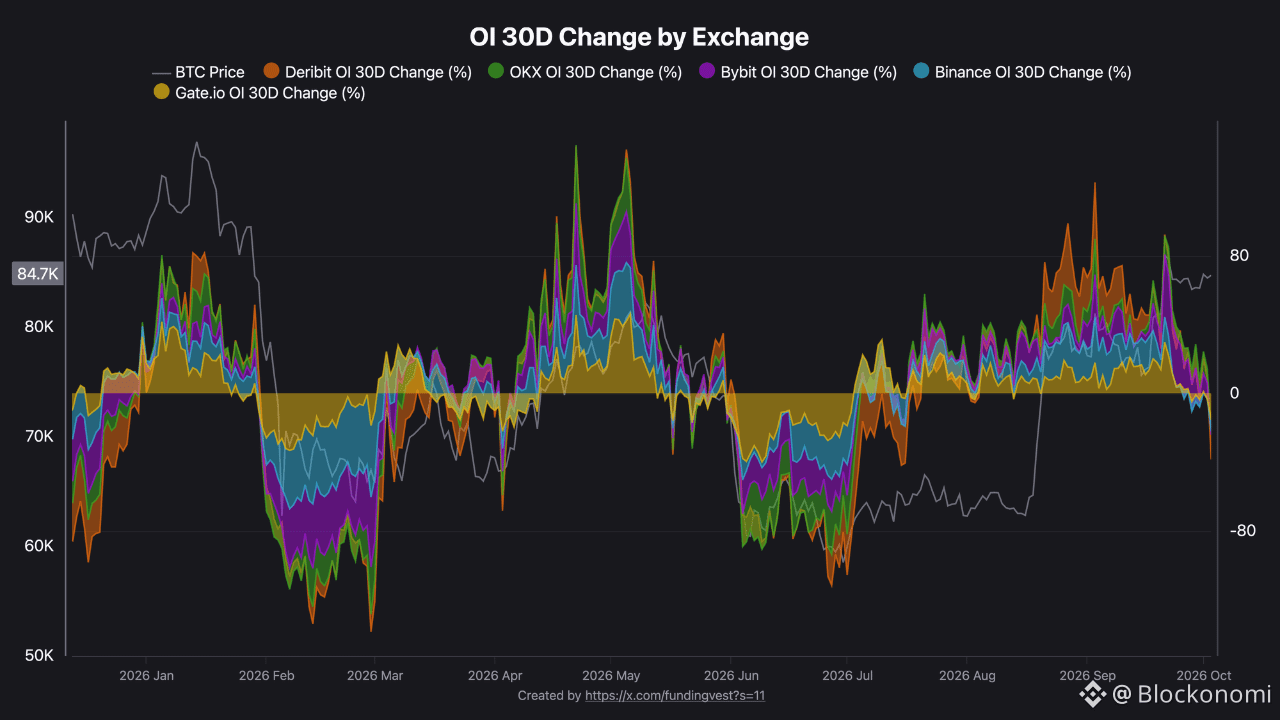
Artikel
Open Interest Bitcoin Turun di Berbagai Bursa Utama saat BTC Mendekati $87.000TLDR:
Open Interest Bitcoin turun 6% di Binance selama 30 hari, menandakan hilangnya keseimbangan volatilitas.
Deribit dan Gate.io masing-masing melihat Open Interest turun 15%, mengindikasikan pergeseran posisi dan volume yang lebih lemah.
Struktur 30 hari ini cocok dengan puncak lokal sebelumnya, di mana kontraksi Open Interest kerap menandai distribusi.
Pengaturan serupa pada Januari dan Mei 2026 disertai penurunan Bitcoin sekitar $10.000.
Open Interest Bitcoin menurun saat aset mendekati level $87.000. Kripto ini terus kehilangan momentum sementara aksi jual makin dalam di seluruh pasar.
Open Interest Bitcoin Turun di Berbagai Bursa Utama saat BTC Mendekati $87.000
TLDR:
Open Interest Bitcoin turun 6% di Binance selama 30 hari, menandakan hilangnya keseimbangan volatilitas.
Deribit dan Gate.io masing-masing melihat Open Interest turun 15%, mengindikasikan pergeseran posisi dan volume yang lebih lemah.
Struktur 30 hari ini cocok dengan puncak lokal sebelumnya, di mana kontraksi Open Interest kerap menandai distribusi.
Pengaturan serupa pada Januari dan Mei 2026 disertai penurunan Bitcoin sekitar $10.000.
Open Interest Bitcoin menurun saat aset mendekati level $87.000. Kripto ini terus kehilangan momentum sementara aksi jual makin dalam di seluruh pasar.
Open Interest Bitcoin turun 6% di Binance selama 30 hari, menandakan hilangnya keseimbangan volatilitas.
Deribit dan Gate.io masing-masing melihat Open Interest turun 15%, mengindikasikan pergeseran posisi dan volume yang lebih lemah.
Struktur 30 hari ini cocok dengan puncak lokal sebelumnya, di mana kontraksi Open Interest kerap menandai distribusi.
Pengaturan serupa pada Januari dan Mei 2026 disertai penurunan Bitcoin sekitar $10.000.
Open Interest Bitcoin menurun saat aset mendekati level $87.000. Kripto ini terus kehilangan momentum sementara aksi jual makin dalam di seluruh pasar.
103
·
--

Artikel
Injective Stockdrop Hadir, CypherOS Tampil Perdana, dan BuyBack Membakar 7,2M INJTLDR:
Komunitas BuyBack ditutup dengan lebih dari 7,2 juta INJ yang dibakar, dan klaim Stockdrop kini dibuka.
CypherOS tampil publik pertamanya sebagai platform privasi untuk transaksi rahasia dan tokenisasi.
Canary Capital mengajukan Amandemen No. 3 untuk ETF Staked INJ yang berencana menempatkan setidaknya 90% dari kepemilikannya untuk staking.
Robinhood kini mendukung perdagangan dan transfer INJ, memberi pengguna akses INJ secara native tanpa jembatan.
Injective Stockdrop mulai beroperasi minggu ini, memungkinkan peserta untuk mengklaim hadiah saham yang telah ditokenisasi. Komunitas BuyBack ditutup dengan lebih dari 7,2 juta INJ yang dibakar hingga saat ini.
Injective Stockdrop Hadir, CypherOS Tampil Perdana, dan BuyBack Membakar 7,2M INJ
TLDR:
Komunitas BuyBack ditutup dengan lebih dari 7,2 juta INJ yang dibakar, dan klaim Stockdrop kini dibuka.
CypherOS tampil publik pertamanya sebagai platform privasi untuk transaksi rahasia dan tokenisasi.
Canary Capital mengajukan Amandemen No. 3 untuk ETF Staked INJ yang berencana menempatkan setidaknya 90% dari kepemilikannya untuk staking.
Robinhood kini mendukung perdagangan dan transfer INJ, memberi pengguna akses INJ secara native tanpa jembatan.
Injective Stockdrop mulai beroperasi minggu ini, memungkinkan peserta untuk mengklaim hadiah saham yang telah ditokenisasi. Komunitas BuyBack ditutup dengan lebih dari 7,2 juta INJ yang dibakar hingga saat ini.
Komunitas BuyBack ditutup dengan lebih dari 7,2 juta INJ yang dibakar, dan klaim Stockdrop kini dibuka.
CypherOS tampil publik pertamanya sebagai platform privasi untuk transaksi rahasia dan tokenisasi.
Canary Capital mengajukan Amandemen No. 3 untuk ETF Staked INJ yang berencana menempatkan setidaknya 90% dari kepemilikannya untuk staking.
Robinhood kini mendukung perdagangan dan transfer INJ, memberi pengguna akses INJ secara native tanpa jembatan.
Injective Stockdrop mulai beroperasi minggu ini, memungkinkan peserta untuk mengklaim hadiah saham yang telah ditokenisasi. Komunitas BuyBack ditutup dengan lebih dari 7,2 juta INJ yang dibakar hingga saat ini.
219
·
--

Artikel
Solana Membalikkan Keunggulan atas Ethereum saat Volume DEX Melampaui Gabungan L2 dan HyperliquidTLDR:
Solana mencatat $3,06B dalam volume spot DEX harian, mengungguli Ethereum, L2, dan Hyperliquid yang digabungkan pada 3 Oktober.
Solana meraih lebih dari 36% dari volume global spot DEX pada H1 2026, hampir dua kali lipat pangsa Ethereum pada periode tersebut.
DefiLlama menunjukkan sekitar $78B dalam volume DEX Solana 30 hari, dibandingkan sekitar $42B yang tercatat secara keseluruhan pada Ethereum.
Volume memecoin turun menjadi 16% dari 40%, sementara swap stablecoin naik menjadi 19% dari 6% pada periode yang sama.
Solana menyalip Ethereum—jaringan Layer 2-nya dan Hyperliquid yang digabungkan—dalam volume spot bursa terdesentralisasi pada 3 Oktober, menurut data Blockworks Research. Perbandingan yang dibagikan oleh SolanaFloor pada 4 Oktober menempatkan Solana di posisi teratas untuk sesi harian terbaru yang telah selesai.
Solana Membalikkan Keunggulan atas Ethereum saat Volume DEX Melampaui Gabungan L2 dan Hyperliquid
TLDR:
Solana mencatat $3,06B dalam volume spot DEX harian, mengungguli Ethereum, L2, dan Hyperliquid yang digabungkan pada 3 Oktober.
Solana meraih lebih dari 36% dari volume global spot DEX pada H1 2026, hampir dua kali lipat pangsa Ethereum pada periode tersebut.
DefiLlama menunjukkan sekitar $78B dalam volume DEX Solana 30 hari, dibandingkan sekitar $42B yang tercatat secara keseluruhan pada Ethereum.
Volume memecoin turun menjadi 16% dari 40%, sementara swap stablecoin naik menjadi 19% dari 6% pada periode yang sama.
Solana menyalip Ethereum—jaringan Layer 2-nya dan Hyperliquid yang digabungkan—dalam volume spot bursa terdesentralisasi pada 3 Oktober, menurut data Blockworks Research. Perbandingan yang dibagikan oleh SolanaFloor pada 4 Oktober menempatkan Solana di posisi teratas untuk sesi harian terbaru yang telah selesai.
Solana mencatat $3,06B dalam volume spot DEX harian, mengungguli Ethereum, L2, dan Hyperliquid yang digabungkan pada 3 Oktober.
Solana meraih lebih dari 36% dari volume global spot DEX pada H1 2026, hampir dua kali lipat pangsa Ethereum pada periode tersebut.
DefiLlama menunjukkan sekitar $78B dalam volume DEX Solana 30 hari, dibandingkan sekitar $42B yang tercatat secara keseluruhan pada Ethereum.
Volume memecoin turun menjadi 16% dari 40%, sementara swap stablecoin naik menjadi 19% dari 6% pada periode yang sama.
Solana menyalip Ethereum—jaringan Layer 2-nya dan Hyperliquid yang digabungkan—dalam volume spot bursa terdesentralisasi pada 3 Oktober, menurut data Blockworks Research. Perbandingan yang dibagikan oleh SolanaFloor pada 4 Oktober menempatkan Solana di posisi teratas untuk sesi harian terbaru yang telah selesai.
87
Masuk untuk menjelajahi konten lainnya
Bergabunglah dengan pengguna kripto global di Binance Square
⚡️ Dapatkan informasi terbaru dan berguna tentang kripto.
💬 Dipercayai oleh bursa kripto terbesar di dunia.
👍 Temukan wawasan nyata dari kreator terverifikasi.
Email/Nomor Ponsel
Topik Sedang Tren
EthStakingExitQueueHits2026High
5 penayangan
26 Berdiskusi
Melihat tren #EthStakingExitQueueHits2026High selalu memicu kepanikan, padahal lonjakan antrean penarikan jarang berarti orang-orang sedang melepas ETH.
Sering kali, ini hanyalah pergerakan struktural yang tidak terlalu menarik:
Mengejar Imbal Hasil: Validator yang melepas ikatan dana untuk memindahkannya ke restaking atau mencari APR DeFi yang lebih baik.
Penyeimbangan Ulang Pool: Penyedia liquid staking besar dan kustodian yang merotasi node validator mereka atau menangani penarikan rutin.
Mekanisme Keamanan Bawaan: Antrean ini memang dirancang untuk memperlambat penarikan agar jaringan tetap sepenuhnya stabil saat terjadi perpindahan modal besar.
Ini rotasi modal, bukan eksodus massal.
Kalian sedang menyesuaikan pengaturan staking sekarang, atau membiarkannya tetap berjalan?
#EthStakingExitQueueHits2026High
aasho
·Disukai 1 Kali
·16 penayangan
FedOctoberHoldOdds82.3%
3 penayangan
19 Berdiskusi
Nikkei225Jumps2.5%ToThreeMonthHigh
24,113 penayangan
445 Berdiskusi