
The next major crypto opportunity might not come from another meme coin. It could come from Wall Street itself.
For years, traditional financial institutions treated blockchain as an experimental technology. Crypto was considered a separate financial world, driven largely by speculation, retail traders and decentralized platforms.
But something important is changing in 2026.
Wall Street is no longer simply observing blockchain. Major financial institutions are starting to build financial infrastructure around it.
And I think this development deserves much more attention than another short-term Bitcoin price prediction.
1. The biggest signal: DTCC is moving securities on chain
One development that caught my attention was the launch of the Depository Trust & Clearing Corporation's (DTCC) tokenization service on October 28, 2026.
DTCC is a critical part of the US financial market infrastructure.
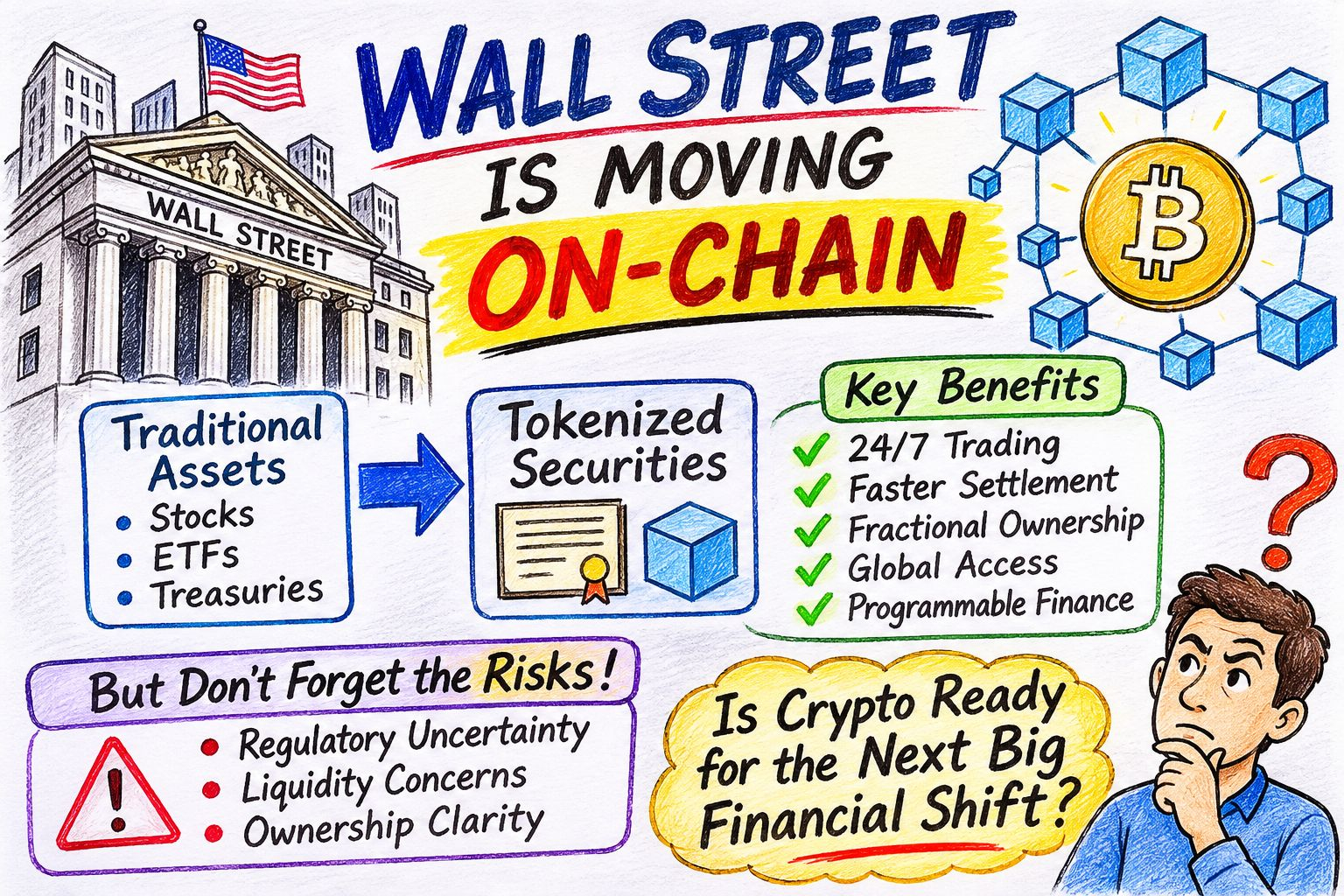
Its new service brings tokenization closer to the traditional securities market, covering stocks, ETFs and US Treasuries.
What makes this particularly interesting?
Around 20 financial institutions signed up to participate, including:
JPMorgan
Citi
Morgan Stanley
Bank of America
UBS
The initial infrastructure uses Canton Network and a private blockchain based on Besu, with further expansion planned.
Think about the significance: institutions that traditionally operated through conventional financial infrastructure are now exploring blockchain based securities settlement.
This isn't just another crypto startup announcing a partnership. It represents a change in how established financial markets could operate.
2. Why does Wall Street want tokenization?
Let me explain the mechanism.
In traditional financial markets, buying and transferring securities involves brokers, custodians, clearing systems and settlement infrastructure.
These processes can introduce delays, operational costs and multiple intermediaries.
Tokenization offers a different approach.
A financial asset can be represented by a digital token on a blockchain, allowing ownership records and transfers to be managed through digital infrastructure.
Potential advantages include:
24/7 market access: Trading and transfers could become available beyond conventional market hours, subject to platform rules and liquidity.
Faster settlement: Blockchain can reduce reconciliation and settlement friction.
Fractional ownership: Certain tokenized products can make smaller investment amounts possible.
Global accessibility: Eligible investors may gain access to financial products through digital platforms.
Programmable finance: Tokenized assets could potentially be integrated into lending, collateral and other financial applications.
But there is one important distinction: tokenization does not automatically eliminate intermediaries, regulatory restrictions or settlement risks.
3. The SEC is opening another door
Another development worth watching is the US Securities and Exchange Commission's September 17, 2026 decision.
The SEC introduced temporary, conditional exemptions for certain tokenized securities trading venues and liquidity providers.
This is significant because regulatory uncertainty has been one of the biggest barriers to bringing traditional securities onto blockchain infrastructure.
However, this is not blanket permission for every crypto exchange to tokenize and trade any stock.
The framework has conditions, eligibility requirements and investor-protection considerations.
That distinction matters.
The future of tokenized finance will depend not only on technology but also on how ownership rights, custody, compliance and investor protections are implemented.
4. The numbers are becoming interesting
Let's look beyond announcements.
According to The Block's November 6, 2026 update:
On chain real world asset value reached approximately $39.3 billion at its September 2026 peak.
The market had grown from approximately $10 billion at the beginning of 2025.
Binance's bStocks reached approximately $772 million in on-chain value within around three months.
Tokenized stocks have become one of the fastest-growing RWA segments.
These figures suggest that tokenization is moving beyond theoretical discussions.
However, we should not confuse growth in tokenized assets with the size of the entire traditional stock market. The two markets are still vastly different in scale.
5. Which crypto sectors could benefit?
This is where I would start looking for opportunities.
I wouldn't automatically buy every token carrying an RWA or institutional-adoption narrative.
Instead, I would investigate the infrastructure behind this transformation.
1. Ondo Finance (ONDO)
Focus: Tokenized financial products and access to traditional market assets.
The important question is whether tokenized securities and institutional financial products can generate sustainable demand for its ecosystem.
2. Chainlink (LINK)
Focus: Oracle infrastructure, data connectivity and cross chain interoperability.
Tokenized financial assets need reliable external data and communication between different blockchain environments.
3. Stellar (XLM)
Focus: Payments and tokenized asset infrastructure.
Its long term opportunity depends on real financial institutions and asset issuers using its network.
4. Ethereum (ETH)
Focus: Smart contracts, tokenized assets and decentralized financial infrastructure.
Ethereum remains an important ecosystem to monitor as tokenization expands.
5. Canton Network
Focus: Institutional blockchain infrastructure and financial-market connectivity.
Its participation in DTCC's tokenization initiative makes it particularly relevant to this narrative.
These are research candidates, not guaranteed beneficiaries. Institutional adoption of a network does not automatically translate into value appreciation for its associated token.
6. But there is a risk Wall Street investors should not ignore
I see three major challenges.
Regulatory risk: Tokenized securities are still securities in many jurisdictions. Compliance requirements do not disappear because an asset is represented by a blockchain token.
Liquidity risk: A tokenized stock may have significantly less liquidity than its traditional counterpart. A 24/7 trading label does not guarantee buyers and sellers at every hour.
Ownership risk: Not every tokenized stock provides direct ownership of the underlying shares. Some products represent contractual claims or other financial entitlements.
Investors must understand exactly what they are buying.
There is also a question of market concentration. If a few large institutions control custody, infrastructure and access, does tokenization really make financial markets more decentralized
That is a discussion worth having.
7. My market outlook: Is this the next major crypto narrative?
I believe the intersection of traditional finance and blockchain deserves serious attention over the next 12–24 months.
The real opportunity may not be in launching thousands of new tokens.
It may be in building the infrastructure that allows existing financial assets to move, settle and interact on blockchain networks.
DTCC, JPMorgan, Citi, Morgan Stanley and other established institutions exploring this technology tell us something important: blockchain is increasingly being evaluated as financial infrastructure rather than simply a speculative asset class.
But I would separate three things before making any investment decision:
Actual institutional adoption.
Real usage and transaction growth.
Direct economic value captured by the associated crypto token.
These are three different things, and confusing them can become an expensive mistake.
My conclusion: Wall Street entering blockchain could be a major structural shift for the financial industry. But the winners will not necessarily be the tokens with the loudest marketing campaigns. They will be the networks and infrastructure providers that can demonstrate real utility, security, liquidity and sustainable adoption.
One question I want to ask the community:
If traditional stocks, ETFs and financial assets become accessible through blockchain infrastructure, will crypto eventually become an extension of the global financial system, or will Wall Street simply use blockchain technology while keeping control of the entire system?
I am interested in hearing both sides of this argument.
#CryptoMarket #RWA #Tokenization #blockchain #Ethereum