

BITCOIN ETFs LOSE $1.91 BILLION: IS INSTITUTIONAL DEMAND DISAPPEARING?
Bitcoin's latest correction has exposed a critical question.
What happens when one of the market's most important regulated investment channels stops attracting capital?
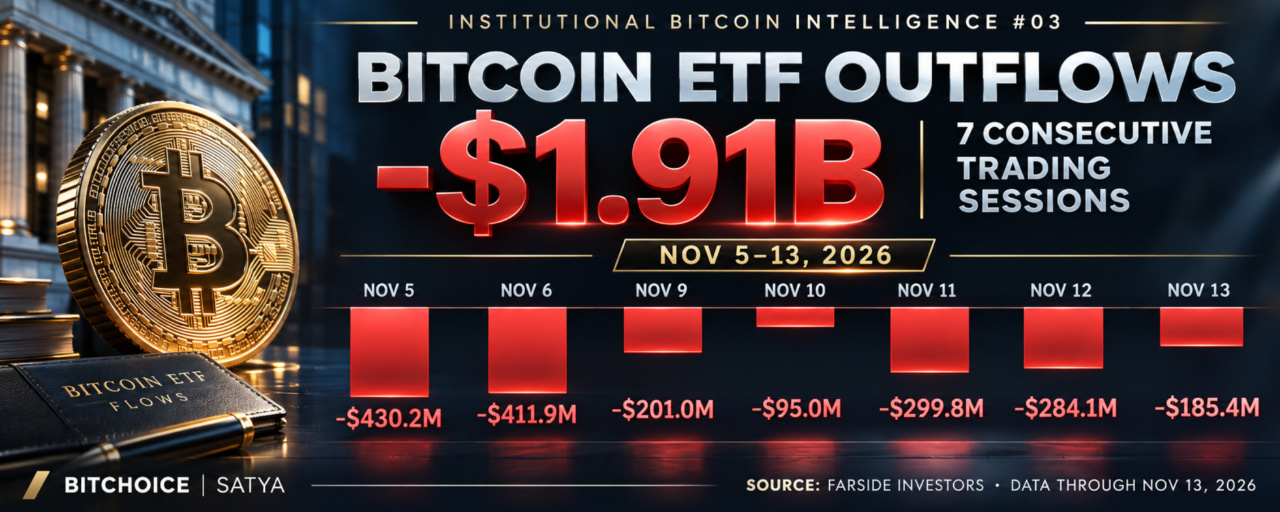
Between November 5 and November 13, 2026, U.S. spot Bitcoin ETFs recorded approximately $1.91 billion in cumulative net outflows across seven consecutive trading sessions.
This was not a single-day event.
It was a sustained period of negative fund flows.
THE SEVEN-SESSION DRAIN
Daily net flows across U.S. spot Bitcoin ETFs:
November 5: −$430.2M
November 6: −$411.9M
November 9: −$201.0M
November 10: −$95.0M
November 11: −$299.8M
November 12: −$284.1M
November 13: −$185.4M
Total: approximately −$1.91B.
The week of November 9–13 alone recorded $1.07B in net outflows.
Across the two full trading weeks ending November 13, the cumulative figure reached approximately $2.35B.
These are separate measurement windows, not figures to be added together.
THE BLACKROCK FACTOR
On November 13, BlackRock's IBIT recorded $143.5M in net outflows, while Fidelity's FBTC lost $41.9M.
IBIT therefore represented approximately 77% of the aggregate $185.4M negative flow that day.
Across the entire seven-session period, IBIT alone accounted for approximately $1.42B in net outflows.
This concentration is important.
Large regulated Bitcoin investment vehicles can influence the balance of incremental demand even when the underlying cryptocurrency continues trading across many other markets.
BUT ETF OUTFLOWS ARE NOT THE SAME AS SPOT SELLING
There is an important distinction often lost in market headlines.
ETF shares can trade between investors on the secondary market without changing the number of shares outstanding.
Fund creations and redemptions are different transactions.
Reported ETF net flows measure the net movement through the fund creation and redemption process.
They do not mean that precisely $1.91B worth of Bitcoin was immediately sold on spot exchanges at the moment the figures were published.
The timing and market impact depend on the funds' operating mechanisms and trading activity.
Still, seven negative sessions indicate that this channel was not delivering positive net demand during the period.
WHAT WOULD SIGNAL A REAL RECOVERY?
1. Consistent positive ETF flows
One green day can interrupt the streak. Several consecutive inflow sessions would provide stronger evidence of improving demand.
2. Reduced derivatives stress
Lower forced liquidation pressure would make price discovery less dependent on sudden leverage unwinds.
3. Stronger market liquidity
ETF flows should be considered alongside stablecoin supply, spot liquidity and broader financial conditions.
4. Broader participation
A healthier recovery would be more convincing if buying pressure was not concentrated in only one fund or one trading session.
THREE INSTITUTIONAL SIGNALS
The latest Bitcoin market data reveal three different pressures.
Options markets continue pricing downside protection.
Strategy has allocated substantial capital to preferred-stock repurchases while continuing to buy BTC.
And U.S. spot Bitcoin ETFs have experienced seven consecutive sessions of withdrawals.
These signals describe different parts of the market.
They should not be mechanically combined or presented as evidence of coordinated institutional selling.
But together they show why the next sustainable Bitcoin advance may depend as much on liquidity and financing conditions as on market sentiment.
OUR ASSESSMENT
Bitcoin does not require uninterrupted ETF inflows to appreciate.
However, a sustained return of positive net flows would strengthen the case that institutional demand is rebuilding.
Until then, a price bounce and a durable recovery should not be treated as the same thing.
What would convince you more: one large ETF inflow day or five consecutive positive sessions?
BITCHOICE | SATYA
Institutional Bitcoin Intelligence #03
Farside Investors, U.S. spot Bitcoin ETF flows through November 13, 2026.
#Bitcoin #BitcoinETF #InstitutionalBitcoin #CryptoLiquidity #CapitalMarkets $BTC
