$KORUB : The Loud Auction Room: Why the Fastest Bidder Usually Overpays
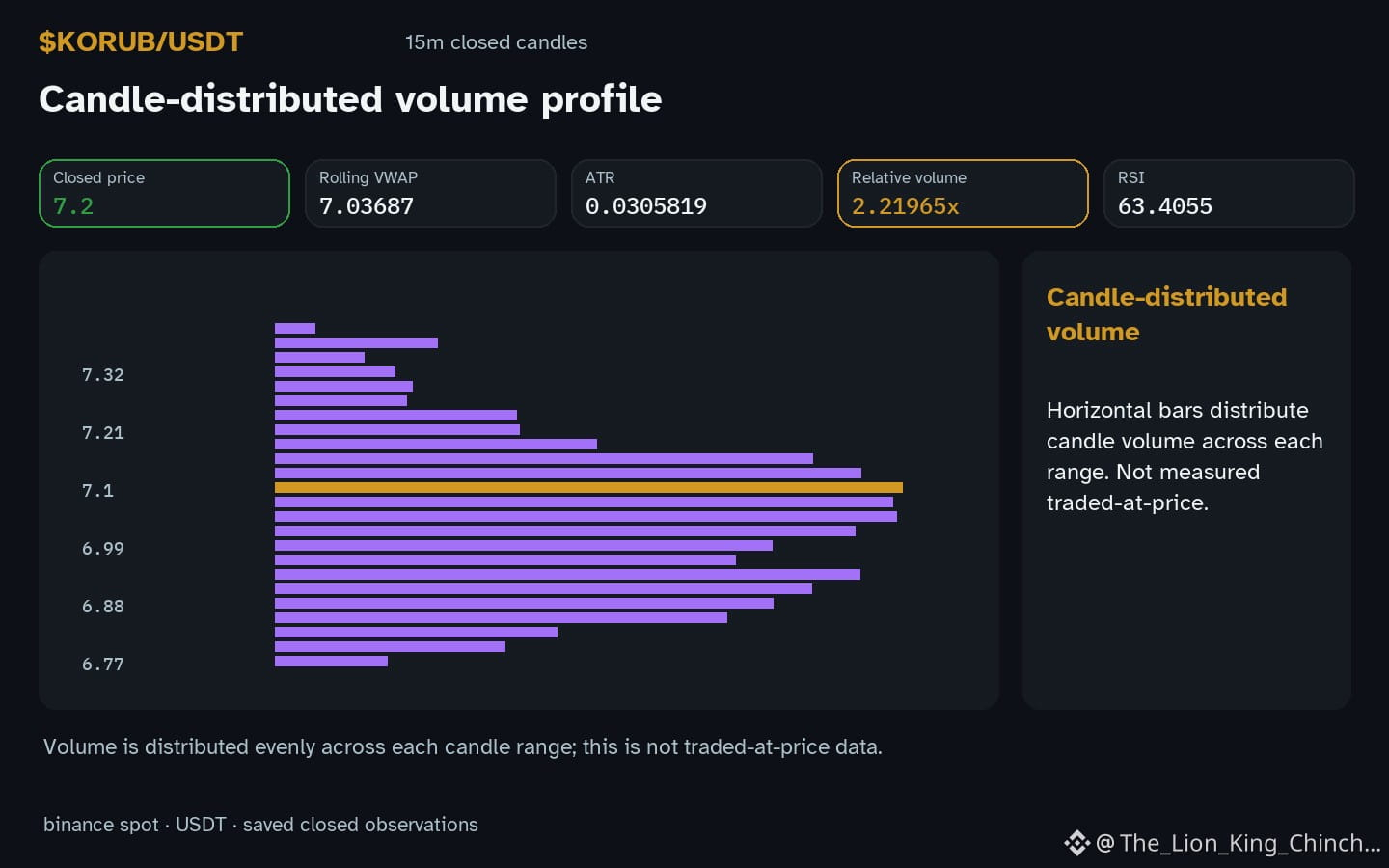
$KORUB : KORUB shows an hourly up move while volume sits above baseline, prompting the question whether a live‑auction style dynamic could explain the candle shape.
A common assumption is that a sudden surge of buying pressure forces the price upward like an auctioneer raising the hammer quickly. In that view, each aggressive market order acts as a bid, and the candle’s upper wick reflects participants trying to outbid one another.
The counterexample to consider is a scenario where the same price rise occurs with modest relative volume 2.22x baseline. Here the candle may simply reflect a thin order book and a few limit orders being hit, rather than a competitive bidding war. The analogy breaks because an auction needs many participants raising the price, while low volume suggests limited interest.
What could change the reading is a future closed‑candle that shows both a higher relative volume and a narrowing spread, indicating many traders actively posting bids. If the next hourly candle closes higher with relative volume above 2.22x baseline and the spread contracts, the auction metaphor gains plausibility. Conversely, if volume remains low and the spread widens, the breakout is more likely a price slip through thin liquidity rather than a true competitive push. This conditional framing keeps the hypothesis testable while acknowledging the limits of candle‑only analysis.
Probabilistic market research, not a recommendation or guaranteed return.
The label or the mechanism behind it?
#KORUB #CryptoEducation #CryptoLearning