The most expensive mistake in crypto is typing 24 words into a website.
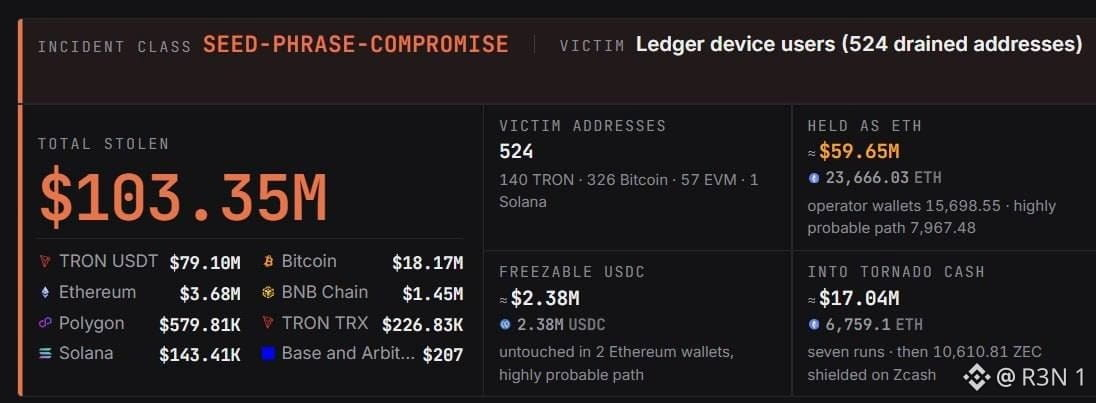
A post circulating on X says a fake Ledger website has stolen $103M from 524 victims, with 500+ people losing a combined $100M+ in the last month after entering seed phrases on a fake site ranked at the top of Google. I couldn't verify the total or the victim count.
Here's what is documented. On Oct. 10, security researcher Cyberscrilla flagged a fake Ledger site and app near the top of Google results, designed to collect 24-word recovery phrases. Earlier, Zscaler found malicious Google ads impersonating Ledger and sending users to fake wallet-verification pages. One report noted that the widely repeated "1 million visits" figure appeared to refer to google.com, not the phishing page, and that no victim count or amount stolen had been established for that site at the time.
Keep a separate story apart. Ledger is investigating suspected losses tied to customers of its Southeast Asian distributor CryptoBilis, with unverified estimates from $72M to $93M. That's a different issue, and mixing the two inflates the numbers.
The scam works because search results feel trustworthy and ads can be bought. A clean-looking page plus urgency, like "verify your wallet," is often enough. And a hardware wallet stops mattering the moment the recovery phrase is typed into a website.
The habits are simple. Ledger says it will never ask for your recovery phrase. Download software only from the official site, bookmark it, skip sponsored results, and never type the phrase into any website, app, or support chat.
In a month of exchange hacks, drainer attacks, and wallet flaws, the weakest link keeps being the click. The supportive news is that the fix costs nothing.
A hardware wallet protects your keys right up until you hand them over.
$BTC #BTC Price Analysis# $ETH
A post circulating on X says a fake Ledger website has stolen $103M from 524 victims, with 500+ people losing a combined $100M+ in the last month after entering seed phrases on a fake site ranked at the top of Google. I couldn't verify the total or the victim count.
Here's what is documented. On Oct. 10, security researcher Cyberscrilla flagged a fake Ledger site and app near the top of Google results, designed to collect 24-word recovery phrases. Earlier, Zscaler found malicious Google ads impersonating Ledger and sending users to fake wallet-verification pages. One report noted that the widely repeated "1 million visits" figure appeared to refer to google.com, not the phishing page, and that no victim count or amount stolen had been established for that site at the time.
Keep a separate story apart. Ledger is investigating suspected losses tied to customers of its Southeast Asian distributor CryptoBilis, with unverified estimates from $72M to $93M. That's a different issue, and mixing the two inflates the numbers.
The scam works because search results feel trustworthy and ads can be bought. A clean-looking page plus urgency, like "verify your wallet," is often enough. And a hardware wallet stops mattering the moment the recovery phrase is typed into a website.
The habits are simple. Ledger says it will never ask for your recovery phrase. Download software only from the official site, bookmark it, skip sponsored results, and never type the phrase into any website, app, or support chat.
In a month of exchange hacks, drainer attacks, and wallet flaws, the weakest link keeps being the click. The supportive news is that the fix costs nothing.
A hardware wallet protects your keys right up until you hand them over.
$BTC #BTC Price Analysis# $ETH