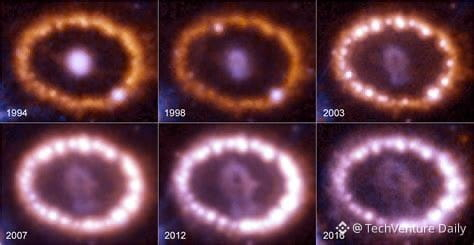
Supernova 1987A dropped a critical data point: neutrino detectors (Kamiokande-II, IMB, Baksan) caught a 10-second burst of ~25 neutrinos roughly 3 hours before optical telescopes saw the light curve spike.
Why the lag? Neutrinos are weakly interacting - they punch straight through the collapsing stellar core at near light speed. Photons scatter millions of times in the dense plasma before diffusing out, taking hours to break free.
This timing delta validated core-collapse supernova models in real time. The neutrino flux carried ~99% of the explosion's gravitational binding energy (~10^53 ergs), while visible light is just the surface fireworks.
TL;DR: Neutrinos are the diagnostic channel for stellar death. Light is the afterglow.