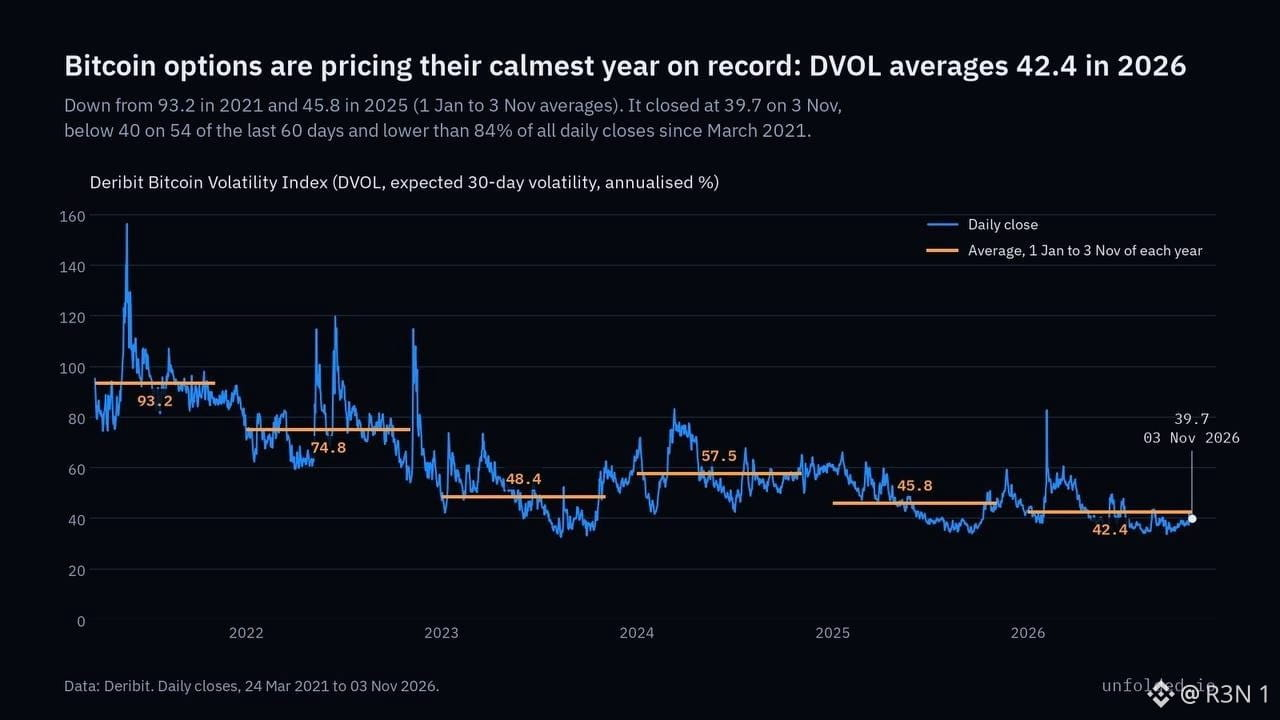
Options traders are pricing the calmest year in Bitcoin's history. Anyone who traded October might disagree.
Deribit's DVOL, which turns Bitcoin options prices into a 30-day implied volatility figure, has averaged 42.4 in 2026 through early November, the lowest yearly reading since launch in March 2021. That compares with 93.2 in 2021 and 45.8 in 2025, and it closed below 40 on 54 of the last 60 days.
Now the tension. October brought $12.5B in liquidations, a record exchange hack, and a grind between $76K and $84K. Yet after the Binance incident, DVOL spiked only to about 44 before sliding back into its low range. Perpetual futures traders got flushed, and options traders barely flinched. Both can be true. Liquidations reflect crowded positioning, while DVOL reflects how big a move the market expects over the next month.
For scale, a DVOL of 42 implies typical daily moves of about 2.2%. Protection is cheaper than in any prior year of the data, and sellers of options collect less for taking the risk.
Calm tends to get read as safety. History says be careful. The year's lowest DVOL printed 18 days before the October 2025 all-time high, and the highest printed on the day of the February 2026 low. Low implied volatility isn't a direction signal. It's a sign that nobody is paying for surprise.
The risk is complacency, because a real shock could reprice quickly from a low base. One bullish reading is a more mature options market. If spikes keep fading as fast as the Binance one did, that would strengthen the case that it has structurally calmed.
When nobody pays for protection, the market doesn't expect a surprise. Surprises don't ask permission.
$BTC #BTC Price Analysis# #Altcoin Season#
Deribit's DVOL, which turns Bitcoin options prices into a 30-day implied volatility figure, has averaged 42.4 in 2026 through early November, the lowest yearly reading since launch in March 2021. That compares with 93.2 in 2021 and 45.8 in 2025, and it closed below 40 on 54 of the last 60 days.
Now the tension. October brought $12.5B in liquidations, a record exchange hack, and a grind between $76K and $84K. Yet after the Binance incident, DVOL spiked only to about 44 before sliding back into its low range. Perpetual futures traders got flushed, and options traders barely flinched. Both can be true. Liquidations reflect crowded positioning, while DVOL reflects how big a move the market expects over the next month.
For scale, a DVOL of 42 implies typical daily moves of about 2.2%. Protection is cheaper than in any prior year of the data, and sellers of options collect less for taking the risk.
Calm tends to get read as safety. History says be careful. The year's lowest DVOL printed 18 days before the October 2025 all-time high, and the highest printed on the day of the February 2026 low. Low implied volatility isn't a direction signal. It's a sign that nobody is paying for surprise.
The risk is complacency, because a real shock could reprice quickly from a low base. One bullish reading is a more mature options market. If spikes keep fading as fast as the Binance one did, that would strengthen the case that it has structurally calmed.
When nobody pays for protection, the market doesn't expect a surprise. Surprises don't ask permission.
$BTC #BTC Price Analysis# #Altcoin Season#