
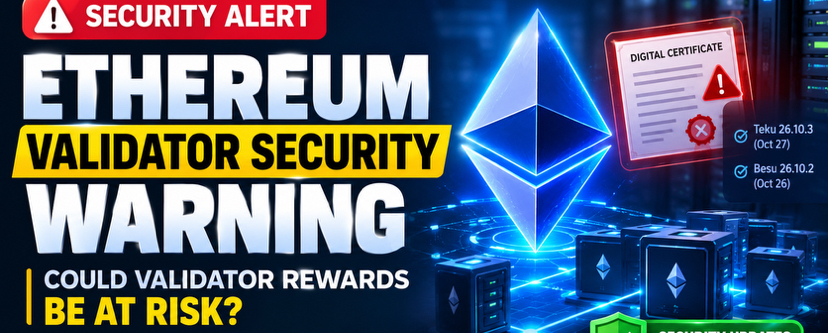

blockchain wasn’t hacked, but a security issue involving external certificate infrastructure exposed potential risks for certain validator configurations.
Here’s what happened. 👇
🔍 WHAT WAS DISCOVERED?
Researchers discovered that eight intermediate certificate-authority keys linked to India’s eMudhra could be recovered because of weak cryptography.
This created a risk that attackers could create fraudulent certificates and impersonate trusted external services.
⚠️ WHY DOES THIS MATTER FOR ETHEREUM?
Some Ethereum validators use external HTTPS services.
In vulnerable configurations, an attacker capable of intercepting network traffic could potentially impersonate those services and redirect certain validator rewards.
🛡️ WHAT HAS BEEN DONE?
Ethereum client developers have released security updates:
🔹 Teku 26.10.3 — October 27
🔹 Besu 26.10.2 — October 26
These Docker updates remove trust in the affected certificate roots.
Important: Operators using standalone installations may need separate Java runtime updates.
📊 IS ETHEREUM ITSELF AT RISK?
Not in the sense of a confirmed blockchain compromise.
✅ Default Teku mainnet configurations without HTTPS endpoints were not affected by this issue.
✅ No exploitation had been reported in the Teku security notice.
⚠️ Certain custom configurations still require attention.
💡 MY TAKE
This incident highlights something important about blockchain security:
A blockchain can have strong security at its core, while external infrastructure connected to it can still introduce vulnerabilities.
For $ETH , protecting validator infrastructure is just as important as maintaining reliable network software.
❓ Do you think crypto security discussions focus too much on blockchain technology and not enough on the infrastructure connected to it?
Follow @sham7x_ for verified crypto news, security developments and market insights.
#Ethereum #ETH #CryptoSecurity #blockchain #BinanceSquare
