



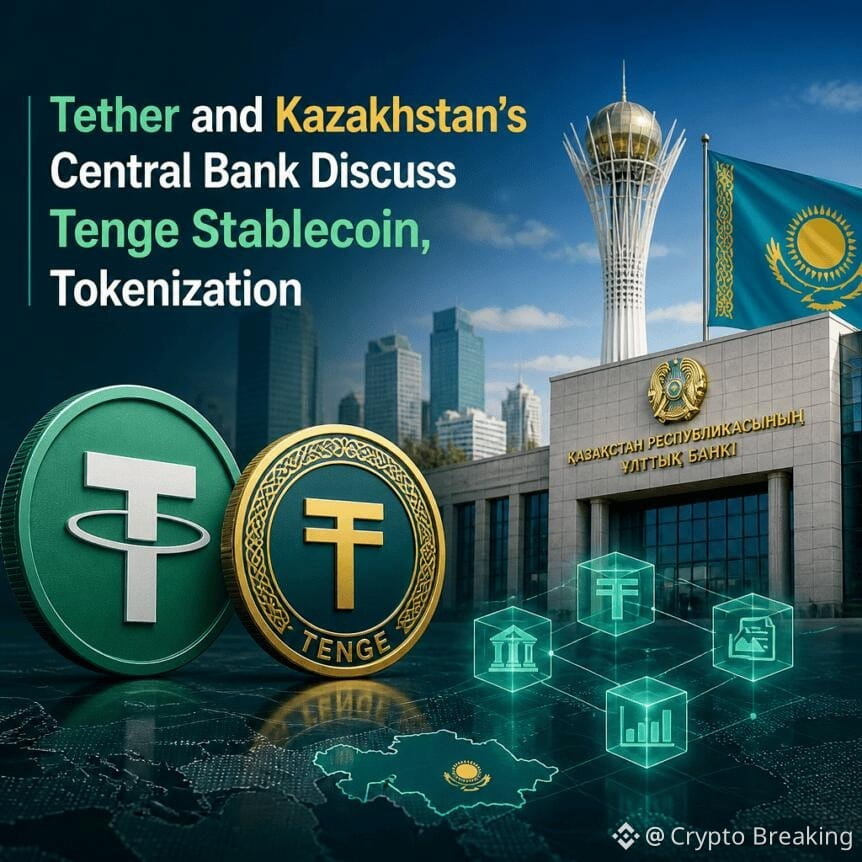
Tether has signed a memorandum of understanding with Kazakhstan’s National Bank and the Alatau City Authority to explore a tenge-pegged stablecoin, as well as broader plans to tokenize real-world assets. The agreement centers on research into how stablecoins could fit into Kazakhstan’s financial system while aligning with public priorities such as transparency and investor protection.
According to Tether, the parties will study international stablecoin issuance models, map out potential use cases, and develop a proposal for a tenge-backed stablecoin pilot. The memorandum also points to work on an asset tokenization framework—first by identifying candidate assets for tokenization, then by planning a pilot project in Alatau that could use Tether’s Hadron platform.
Key takeaways
Tether is partnering with Kazakhstan’s central bank and Alatau officials to examine a tenge-pegged stablecoin and real-world asset tokenization.
The memorandum includes developing a tokenization framework and launching a pilot project in Alatau that may leverage Tether’s Hadron.
Kazakhstan is expanding its digital-asset agenda through government-led plans covering tokenization, payments, settlements, and mining.
Central bank sandbox testing and a stated strategic crypto reserve suggest regulators are already building infrastructure to evaluate digital-asset activity.
What Kazakhstan and Tether agreed to study
Tether’s announcement frames the memorandum as a structured exploration rather than an immediate rollout. Under the terms described by Tether, the National Bank of Kazakhstan and the Alatau City Authority will jointly examine issuance approaches that exist globally, with the goal of designing a pilot for a tenge-backed stablecoin.
In addition to stablecoin issuance research, the agreement calls for the creation of an asset tokenization framework. That work includes selecting potential assets that could be tokenized and planning a pilot project in Alatau. Tether also indicates that the pilot could use its Hadron platform, which is presented in the company’s communication as a toolset for building tokenization-related applications.
The parties will also run workshops and training programs. Tether says the sessions will cover stablecoin issuance, reserve management, and real-world asset tokenization—topics that often determine whether a stablecoin model can meet regulatory expectations around redemption, disclosures, and risk controls.
Regulatory focus: transparency, stability, and investor protection
Kazakhstan’s National Bank Deputy Governor Binur Zhalenov emphasized that the central bank plans to study international approaches to stablecoin issuance and tokenization while placing financial stability first. In the remarks cited by Tether, she also highlighted transaction transparency and investor protection as priorities.
For market participants, that framing matters because it signals how regulators may evaluate the pilot’s design: not just whether a tenge-pegged product can work operationally, but whether it can be structured to preserve stability and provide clearer visibility for users. The workshop-and-training component suggests the initiative is also intended to build internal knowledge around issuance mechanics, reserve handling, and the compliance implications of tokenizing non-crypto assets.
Still, the memorandum does not, in Tether’s description, specify timelines for a launch or spell out the exact reserve and governance model that a pilot would use. The near-term question for observers is therefore what concrete outputs the study phase will produce—such as a formal pilot proposal, technical architecture choices, and regulatory requirements for custody, auditing, and disclosures.
Kazakhstan’s broader digital-asset momentum
This initiative sits within a wider push by Kazakhstan to expand its digital-asset footprint. Tether’s announcement mentions that Kazakhstan accelerated its digital asset efforts this year, including stablecoins, tokenization, crypto payments, and mining. The country’s government has also moved to formalize parts of that strategy through a multi-measure plan approved in September.
According to a government announcement referenced in the article, Kazakhstan approved a 65-measure plan across 10 areas aimed at developing the digital assets industry. The plan includes steps to expand real-world asset tokenization, digital payments, international settlements, and crypto mining. It also instructs relevant ministries to develop a mechanism for supplying mining centers using gas- and coal-fired power generation.
On mining and infrastructure, Kazakhstan has been ranked among the world’s top 10 Bitcoin-producing countries for 2025 by the government, as cited in the referenced reporting.
Meanwhile, Kazakhstan’s central bank activity indicates an ongoing regulatory testing posture. The National Strategic Crypto Reserve is described as reaching $700 million, and the central bank’s regulatory sandbox reportedly completed testing with 34 digital asset projects, based on the government’s announcement referenced in the article.
State holdings and what to watch next
Alongside policy measures and sandbox testing, Kazakhstan’s crypto holdings are also increasingly tracked. BitcoinTreasuries.net is cited as ranking Kazakhstan seventh among governments in its Bitcoin database, with an estimated 3,544 BTC valued at about $294 million.
Taken together, the tenge-stablecoin and tokenization memorandum adds a potentially important building block to Kazakhstan’s strategy: moving from broad experimentation into pilots tied to a domestic currency peg and to real-world asset markets. If the central bank and local authorities move forward, the next steps investors and builders are likely to watch include how the pilot defines reserve and redemption rules, what asset classes are selected for tokenization, and what compliance requirements apply to issuers and intermediaries.
More broadly, the agreement reflects a shift toward regulated experimentation in a jurisdiction that is actively developing its digital-asset framework. Until details of the pilot proposal are made public, the most reliable takeaway is that Kazakhstan is trying to shape stablecoin and tokenization outcomes through structured study—balancing innovation with stability, transparency, and investor protection.
This article was originally published as Tether and Kazakhstan’s Central Bank Discuss Tenge Stablecoin, Tokenization on Crypto Breaking News – your trusted source for crypto news, Bitcoin news, and blockchain updates.