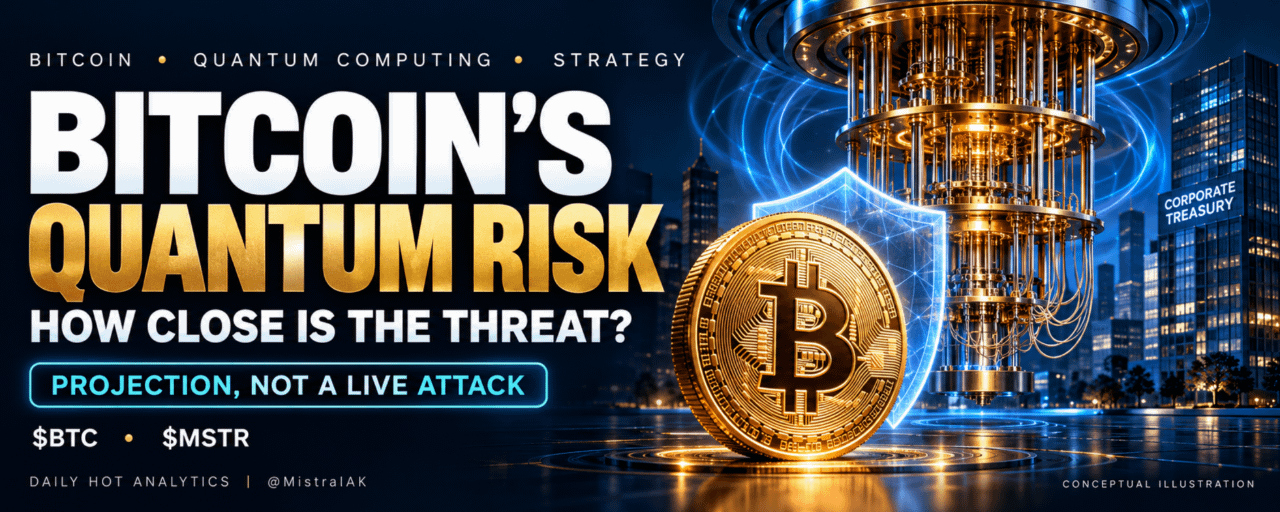

A quantum computing company IonQ's New Research just put a specific date on a threat Bitcoin has argued about for years. Whether or not you buy the timeline, it's forcing a real conversation about a risk that's no longer purely theoretical.
$BTC has spent years fending off "quantum will kill Bitcoin eventually" as a distant, vague worry. That changed on September 8, when IonQ published research putting a number on it: a 20,000-qubit machine, built to IonQ's own 2028 roadmap, could break Bitcoin's signature encryption in under 26 days. That single paper is now feeding into a broader bear case that a contrarian analyst has laid out against both Bitcoin and its biggest corporate holder, Strategy.
KEY FACTS
▪️ IonQ's September 8 research estimates a fault-tolerant 20,000-qubit quantum computer could break secp256k1, the elliptic curve securing Bitcoin's signatures, in roughly 26 days. IonQ frames this against its own 2028 hardware roadmap.
▪️ Current real-world quantum computers have only a few hundred physical qubits, with error rates far too high for this kind of attack today. This is a projection, not a working capability.
▪️ At greatest risk are early, reused, or P2PK-format Bitcoin addresses, where the public key is already exposed on-chain, including a large share of Satoshi-era coins.
▪️ Separately, the SEC and CFTC jointly classified Bitcoin as a "digital commodity" in March 2026, pulling it further into the same regulatory perimeter as traditional financial assets.
▪️ Strategy's enterprise mNAV, the ratio of its total market value to its Bitcoin holdings, fell below 1.0 for the first time in June 2026, meaning the market now values the company at less than its Bitcoin stack alone.
THE QUANTUM RISK, WITHOUT THE HYPE
Bitcoin's cryptography isn't broken today, and IonQ's own timeline depends on hardware that doesn't exist yet. But two things have genuinely moved: the theoretical qubit requirement to break Bitcoin's encryption has dropped by roughly five orders of magnitude over the past several years as algorithms improved, and a company with a commercial interest in the outcome has now published a specific, peer-reviewable resource estimate rather than a vague warning. It's worth taking seriously and worth being skeptical of the source's incentives, at the same time.
Bitcoin developers have proposed post-quantum fixes (BIP-360 and BIP-361), but both are early-stage, contested, and nowhere near activation. The practical near-term advice that survives the debate either way: don't reuse Bitcoin addresses, since that's what exposes a public key permanently.
WHY STRATEGY IS THE MORE FRAGILE PART OF THIS STORY
Strategy's entire model depends on its stock trading above the value of its Bitcoin holdings, so it can issue shares at a premium and buy more BTC with the proceeds. That mechanism broke in June 2026 when its mNAV slipped below 1.0. Without that premium, the company's large preferred-share dividend obligations become a straightforward cash drag rather than something offset by accretive share issuance. That's a real structural vulnerability, independent of whether the quantum threat plays out on IonQ's timeline or not.
WHAT TO WATCH
▪️ Whether IonQ or a competitor hits real fault-tolerant qubit milestones ahead of, on, or behind the 2028 target
▪️ Progress (or lack of it) on Bitcoin's post-quantum proposals
▪️ Whether Strategy's mNAV recovers above 1.0 or stays compressed
▪️ Government and institutional migration deadlines toward post-quantum cryptography standards, which are already underway regardless of Bitcoin's own timeline
BOTTOM LINE
The quantum threat to Bitcoin moved from a hypothetical to a dated engineering roadmap this month, and that's worth taking seriously even while treating IonQ's own incentives with a raised eyebrow. Separately, and on a much shorter timeline, Strategy's business model is already under real strain from its own capital structure.
Is quantum computing a genuine multi-year risk to Bitcoin, or a threat that always seems to stay ten years away? Share your view below.
Sources: IonQ, TheQuantumInsider, CFTC/SEC joint interpretation, The Block. One contrarian view credited to Gene Chan, CFA (Seeking Alpha)
Not financial advice. Always DYOR.
Follow for Daily Trade Analytics & Insider News . @MistralAK
#quantumcomputing #BTC #EarningsSeason #ChainlinkLaunchesBankSWIFTLedgerFramework