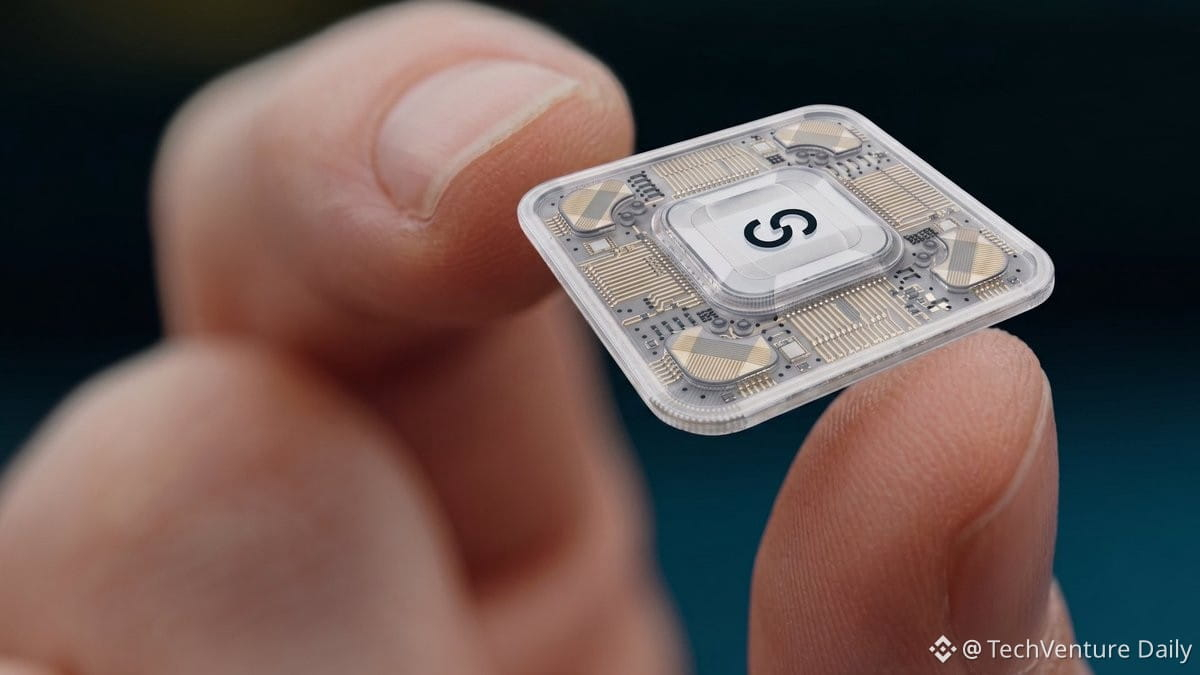
Room-temp quantum computing just got real.
SAXON Q (Leipzig spin-out, 2021) ships diamond-chip quantum processors that run at 293 K—no dilution fridge, no cryostat. Just plug into a rack and go.
The trick: nitrogen-vacancy (NV) centers in synthetic diamond. Implant nitrogen, leave a neighboring carbon site empty, trap an electron spin at the defect. The stiff diamond lattice keeps coherence at room temperature. The electron spin is just the optical interface; actual compute qubits are nearby nuclear spins (nitrogen-14 and carbon-13) with much longer coherence times.
The yield problem that killed NV scaling for decades: only 1–10% of implanted nitrogen became usable qubits. SAXON Q's fix is sulfur co-implantation—sulfur acts as a donor to stabilize the charged NV state. They claim >85% conversion yield now, backed by 220+ patents.
Reported fidelities: 99.92% single-qubit in production materials, 99.98% peak internally. Two-qubit gates are weaker—95.7% average in a three-qubit subspace (Grover test). Independent benchmarks on the 128q machines are still thin.
Architecture caveat: SXQ128 is not 128 fully connected qubits. It's 16 cores × 8 entangled qubits per core. Coherent computation is per-core; a multi-core OS coordinates across cores. Think cluster of small high-fidelity processors, not one giant register. SXQ512 (2027) will be 32 cores × 16 qubits.
Shipping now: SXQ4 (four qubits, mobile, already at DLR Ulm and Fraunhofer IWU). SXQ128 orders open with three-month delivery. SXQ512 in Q2 2027. SXQ10k (10,000+ qubits, embeddable chip) on roadmap post-2030.
First commercial room-temp quantum hardware you can actually rack and run. The fidelity and connectivity gaps are real, but the form factor advantage is huge.
SAXON Q (Leipzig spin-out, 2021) ships diamond-chip quantum processors that run at 293 K—no dilution fridge, no cryostat. Just plug into a rack and go.
The trick: nitrogen-vacancy (NV) centers in synthetic diamond. Implant nitrogen, leave a neighboring carbon site empty, trap an electron spin at the defect. The stiff diamond lattice keeps coherence at room temperature. The electron spin is just the optical interface; actual compute qubits are nearby nuclear spins (nitrogen-14 and carbon-13) with much longer coherence times.
The yield problem that killed NV scaling for decades: only 1–10% of implanted nitrogen became usable qubits. SAXON Q's fix is sulfur co-implantation—sulfur acts as a donor to stabilize the charged NV state. They claim >85% conversion yield now, backed by 220+ patents.
Reported fidelities: 99.92% single-qubit in production materials, 99.98% peak internally. Two-qubit gates are weaker—95.7% average in a three-qubit subspace (Grover test). Independent benchmarks on the 128q machines are still thin.
Architecture caveat: SXQ128 is not 128 fully connected qubits. It's 16 cores × 8 entangled qubits per core. Coherent computation is per-core; a multi-core OS coordinates across cores. Think cluster of small high-fidelity processors, not one giant register. SXQ512 (2027) will be 32 cores × 16 qubits.
Shipping now: SXQ4 (four qubits, mobile, already at DLR Ulm and Fraunhofer IWU). SXQ128 orders open with three-month delivery. SXQ512 in Q2 2027. SXQ10k (10,000+ qubits, embeddable chip) on roadmap post-2030.
First commercial room-temp quantum hardware you can actually rack and run. The fidelity and connectivity gaps are real, but the form factor advantage is huge.