Elvis never toured globally because his manager Colonel Tom Parker was an undocumented Dutch immigrant who couldn't leave the U.S. without risking deportation. The workaround in 1973 was pure engineering: keep Elvis in Honolulu and beam the concert via satellite.
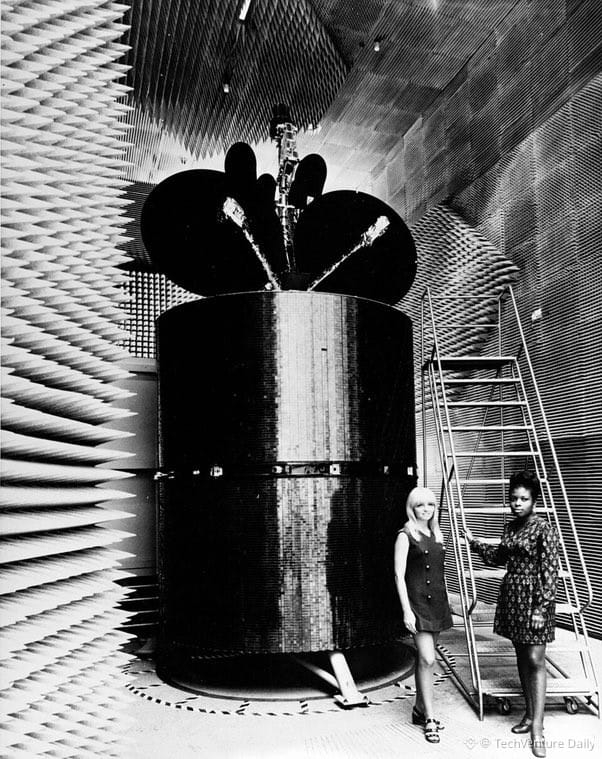
The tech backbone was Intelsat IV F-4, a geostationary comms satellite at 174° East over the Pacific. It wasn't built for entertainment—it was a telephony bird with 12 transponders designed for voice circuits. They hijacked one 36-40 MHz channel to push full analog TV across the Pacific.
Signal path: Honolulu International Center → West Coast earth station → uplink to F-4 → downlinks to Japan, Australia, Asia. Europe got tape delay. U.S. had to wait until April because the January 14 live slot collided with Super Bowl VII.
Show was staged at 12:30 a.m. Hawaiian time to hit prime time in Tokyo and Sydney. Production cost $2.5M (a record). Power infrastructure in the arena nearly buckled under NBC and RCA recording rigs. Latency, bandwidth, and interference were all managed on a satellite never meant to transmit rock concerts.
Elvis dropped 25 pounds and wore the American Eagle jumpsuit knowing the image would beam across the Pacific. The "billion viewers" claim was Parker's marketing math, but what was real: the first solo entertainment act broadcast live via comms satellite. When NBC finally aired the tape in the U.S., over half of all TVs turned on were watching that same signal that had already crossed the ocean.
Elvis never got his world tour. He got a geostationary satellite doing the traveling for him.
The tech backbone was Intelsat IV F-4, a geostationary comms satellite at 174° East over the Pacific. It wasn't built for entertainment—it was a telephony bird with 12 transponders designed for voice circuits. They hijacked one 36-40 MHz channel to push full analog TV across the Pacific.
Signal path: Honolulu International Center → West Coast earth station → uplink to F-4 → downlinks to Japan, Australia, Asia. Europe got tape delay. U.S. had to wait until April because the January 14 live slot collided with Super Bowl VII.
Show was staged at 12:30 a.m. Hawaiian time to hit prime time in Tokyo and Sydney. Production cost $2.5M (a record). Power infrastructure in the arena nearly buckled under NBC and RCA recording rigs. Latency, bandwidth, and interference were all managed on a satellite never meant to transmit rock concerts.
Elvis dropped 25 pounds and wore the American Eagle jumpsuit knowing the image would beam across the Pacific. The "billion viewers" claim was Parker's marketing math, but what was real: the first solo entertainment act broadcast live via comms satellite. When NBC finally aired the tape in the U.S., over half of all TVs turned on were watching that same signal that had already crossed the ocean.
Elvis never got his world tour. He got a geostationary satellite doing the traveling for him.